
Server data from the Official MCP Registry
Build, edit, and deploy Telegram bots on FlowCastle's hosted visual flow platform.
About
Build, edit, and deploy Telegram bots on FlowCastle's hosted visual flow platform.
Remote endpoints: streamable-http: https://api.flowcastle.ai/api/mcp
Security Report
Valid MCP server (1 strong, 1 medium validity signals). No known CVEs in dependencies. Imported from the Official MCP Registry.
Endpoint verified · Requires authentication · 1 issue found
Security scores are indicators to help you make informed decisions, not guarantees. Always review permissions before connecting any MCP server.
Permissions Found in Source Code
Found by scanning the linked source code. This listing connects to a hosted endpoint, so none of this runs on your machine: it describes what the server software does where it is hosted.
What You'll Need
Set these up before or after installing:
How to Connect
Remote Plugin
No local installation needed. Your AI client connects to the remote endpoint directly.
Add this to your MCP configuration to connect:
{
  "mcpServers": {
    "ai-flowcastle-flowcastle": {
      "url": "https://api.flowcastle.ai/api/mcp"
    }
  }
}Documentation
View on GitHubFrom the project's GitHub README.
Telegram bot templates + MCP server for AI bot development
Ready-to-use Telegram bot templates and an MCP server — build, edit, and deploy Telegram bots from Claude Code, Codex, Cursor, or any MCP-capable AI agent. No SDK boilerplate: describe the bot, and your agent assembles the flow.
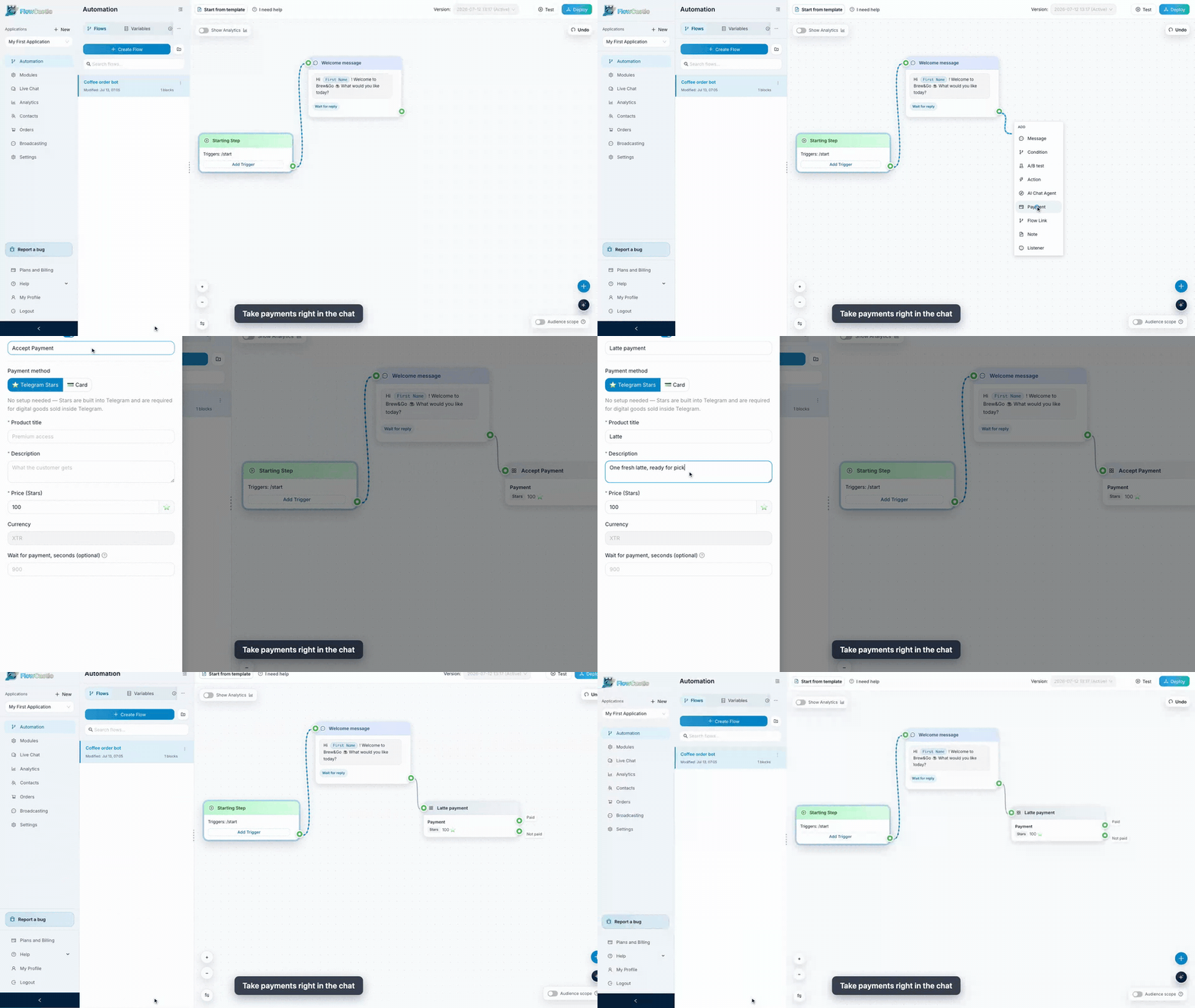
FlowCastle is a visual workflow builder for Telegram bots and web chat: flows, triggers, conditions, AI steps, payments (Stripe / YooKassa / Telegram Stars), broadcasts, drip sequences, and integrations (Gmail, Google Sheets, Notion, OpenAI, …) — with a REST API and an MCP server, so bot development works straight from your AI coding agent. Every block an agent creates through MCP is the same block you can drag, wire, and edit visually.
This repo is for developers. It contains:
| Path | What it is |
|---|---|
templates/ | 23 production bot templates as JSON — the same source that powers the template gallery and the MCP get_flow_example tool |
mcp/ | MCP server reference: endpoint, auth, all 16 tools, and a snapshot of the flow-action schema used by apply_actions |
Build a bot from your AI agent (MCP)
FlowCastle exposes an MCP server over Streamable HTTP:
POST https://api.flowcastle.ai/api/mcp
Authorization: Bearer <your-application-api-key>   # starts with app_
Get a key: sign up → create an application → API page → MCP tab.
Claude Code
export FLOWCASTLE_MCP_TOKEN='<your-application-api-key>'

claude mcp add --transport http flowcastle https://api.flowcastle.ai/api/mcp \
  --header "Authorization: Bearer $FLOWCASTLE_MCP_TOKEN"
Codex
codex mcp add flowcastle \
  --url https://api.flowcastle.ai/api/mcp \
  --bearer-token-env-var FLOWCASTLE_MCP_TOKEN
Cursor / any MCP client (JSON config)
{
  "mcpServers": {
    "flowcastle": {
      "type": "http",
      "url": "https://api.flowcastle.ai/api/mcp",
      "headers": {
        "Authorization": "Bearer <your-application-api-key>"
      }
    }
  }
}
Then just ask your agent things like:
"Look at my FlowCastle workspace and add a lead-qualification flow: greet on /start, ask three button questions, save answers to contact variables, and notify me."
The agent reads your workspace with get_workspace_summary / get_flow_context, drafts a batch of flow-builder actions, checks it with validate_actions, and applies it with apply_actions. See mcp/README.md for the full tool reference.
Templates
Each JSON file in templates/ is a complete bot: metadata (title, summary, use-cases, suggested variables, required modules) plus a schemaExample.actions array — an ordered batch of create_flow / create_block / create_link / create_variable operations in the exact format apply_actions accepts.
Three ways to use them:
- One-click install from the gallery: flowcastle.ai/templates
- Via MCP — ask your agent to
search_flow_examples/get_flow_exampleand apply one (optionally customized) to your workspace - As reference — study how real flows wire triggers, conditions, wait-for-reply steps, payments, and AI blocks
Full index and format description: templates/README.md.
REST Public API
Application-scoped REST API for contacts, contact variables, goal events, flow sends, and broadcasts:
- Base URL:
https://api.flowcastle.ai/api/public/v1 - Interactive docs (Swagger): https://api.flowcastle.ai/api/public/docs
- OpenAPI spec: https://api.flowcastle.ai/api/public/openapi.json
Auth uses the same app_… application key (Authorization: Bearer or X-API-Key).
Guides
Step-by-step builds on the FlowCastle blog:
- Build a Lead Bot in Telegram in 10 Minutes
- Build an AI Support Bot for Telegram
- I Replaced My Morning Apps With One Telegram Bot
Links
- Product: https://flowcastle.ai
- Dashboard: https://dashboard.flowcastle.ai
- Template gallery: https://flowcastle.ai/templates
- API docs: https://api.flowcastle.ai/api/public/docs
Contributing
Found a bug in a template, or built a flow worth sharing? Open an issue or PR — templates are plain JSON, and validate_actions (via MCP) will tell you if a batch is well-formed.
License
The contents of this repository are licensed under the MIT License.
Reviews
No reviews yet
Be the first to review this server!
More Developer Tools MCP Servers
Git
Freeby Modelcontextprotocol · Developer Tools
Read, search, and manipulate Git repositories programmatically
Fetch
Freeby Modelcontextprotocol · Developer Tools
Web content fetching and conversion for efficient LLM usage
Worldmonitor
Freeby Koala73 · Developer Tools
Live markets, conflicts, country risk, chokepoints, energy, and China decision signals. 93 tools.
Paperclip
Freeby Paperclipai · Developer Tools
Trending hip-hop artist momentum scores across four cultural dimensions.
Toleno
Freeby Toleno · Developer Tools
Toleno Network MCP Server — Manage your Toleno mining account with Claude AI using natural language.
mcp-creator-python
Freeby mcp-marketplace · Developer Tools
Create, build, and publish Python MCP servers to PyPI — conversationally.