
Server data from the Official MCP Registry
Build, version and render resumes as PDFs from Claude or any MCP client.
About
Build, version and render resumes as PDFs from Claude or any MCP client.
Remote endpoints: streamable-http: https://resustackapp.com/mcp
Security Report
ResuStack is a Django-based resume builder with MCP server integration for Claude. The code demonstrates solid security practices around authentication (bearer token-based), IDOR prevention, and quota enforcement. However, there are moderate concerns around input validation in PDF/LinkedIn import flows, potential data exposure in error messages, and the reliance on external AI APIs (OpenAI) for processing user resume data without explicit consent logging. Supply chain analysis found 10 known vulnerabilities in dependencies (0 critical, 2 high severity).
3 files analyzed · 20 issues found
Security scores are indicators to help you make informed decisions, not guarantees. Always review permissions before connecting any MCP server.
Permissions Required
This plugin requests these system permissions. Most are normal for its category.
How to Install & Connect
Available as Local & Remote
This plugin can run on your machine or connect to a hosted endpoint. during install.
Documentation
View on GitHubFrom the project's GitHub README.
ResuStack
ResuStack is an AI resume builder. Import a PDF or your LinkedIn profile, pick one of 14 designs, and edit by form or by chat — in the browser, or straight from Claude through its MCP server. Every change is reversible, and the PDF you download is rendered from the same template as the live preview.
🔗 Live: resustackapp.com
✨ Features
Resume builder
- PDF & LinkedIn import — upload an existing resume or a LinkedIn PDF; AI extracts and structures it
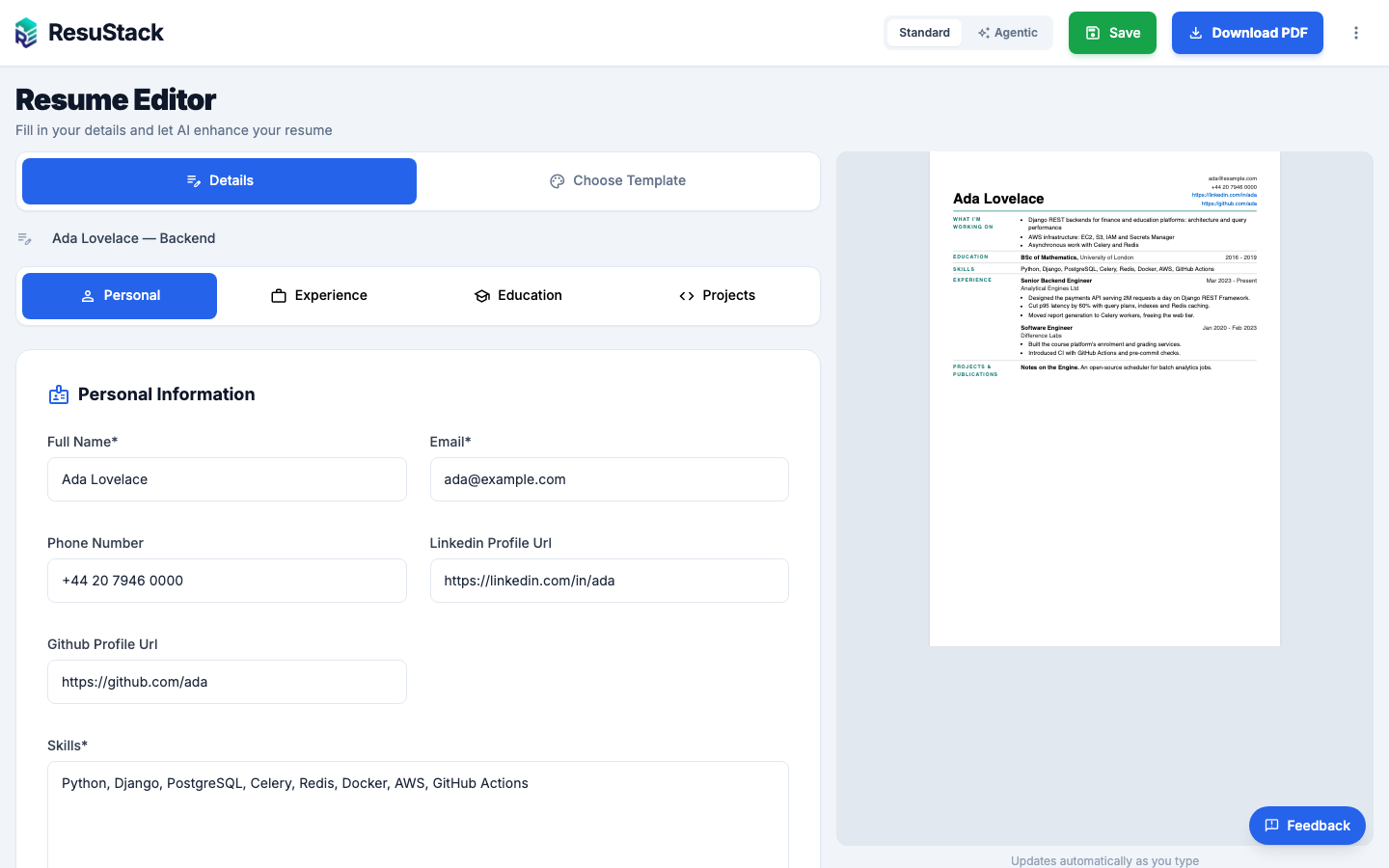
- Split-pane editor — the form on the left, a live preview on the right, with page breaks where the PDF will break
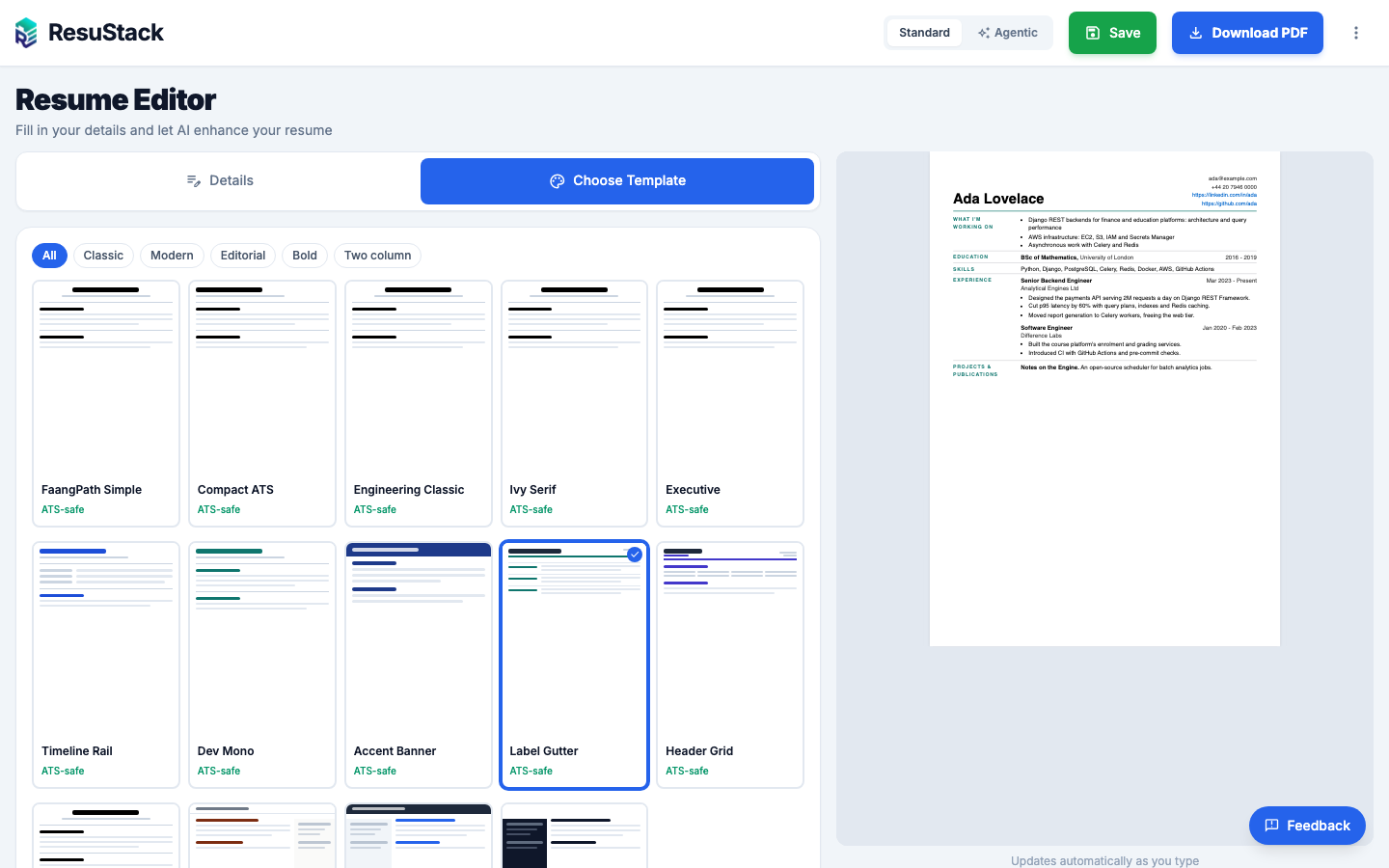
- 14 designs on 6 layouts — single column, banner, label gutter, header grid, left sidebar and right rail; ATS-safe designs are marked, and switching keeps your content
- English and Turkish resumes — headings, "Present", month names and degree phrasing print in the language the resume is written in
- "What I'm working on" — an optional section above Education, shown only when you tick it
- Sign in with Google — or with a username and password; email sign-ups confirm their address before using the AI features
- PDF export — rendered with WeasyPrint from the same template the preview uses
AI
- One-click enhance — rewrites experience and project descriptions into stronger bullet points
- Analyze and compare — score a resume and see where it is weak, or compare two versions
- Guided build — build a resume step by step through questions
Agentic mode
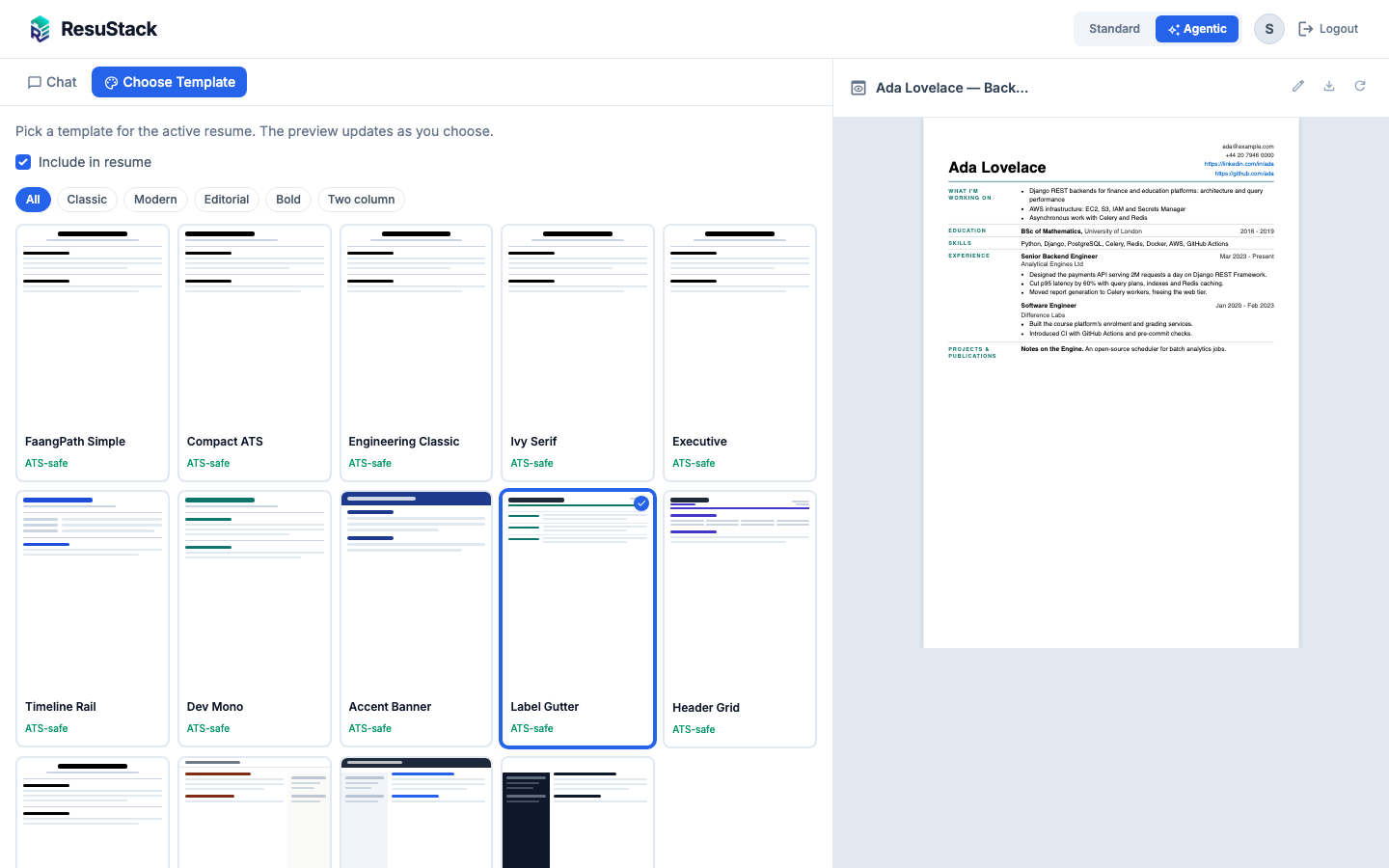
- Edit by chatting — "Make my last role sound more senior"; the agent uses tools, streams its progress and asks for approval before destructive actions
- Template pane — pick a design for the active resume without leaving the chat
- Undo — revert the last change from the conversation
Change history
- A restore point before every save and every AI or MCP edit
- Diff any version against the current one, and restore it — on every plan
Job applications
- Match a resume against a job posting and tailor a version for it
- Track applications, each with a snapshot of the exact resume you sent; clone a snapshot back into an editable resume
Language versions
- Translate a resume in place, or create a translated copy linked to the original
🤖 Use ResuStack from Claude (MCP)
ResuStack is a Model Context Protocol server. Claude — or any MCP client with Streamable HTTP and custom headers — writes the resume; ResuStack stores it, versions it and renders it.
1. Create a token. Sign in, open Profile → API token, and create one. It is shown once; replacing it revokes the old one. The Profile page also shows the endpoint address to use.
2. Add the server. With Claude Code:
claude mcp add --transport http resustack https://resustackapp.com/mcp --header "Authorization: Bearer YOUR_TOKEN"
Authentication is a bearer token only; session cookies are not accepted on this endpoint.
3. Ask. "List my resumes", "Switch my CV to the Label Gutter design and give me the PDF", "Fill What I'm working on from what we did this month."
Tools
| Tool | What it does |
|---|---|
list_resumes | Resumes on the account: id, title, language, template |
get_resume | The full stored content of one resume |
create_resume | Create a resume from structured content |
update_resume | Replace a resume's content (read it first — this is a replace, not a merge) |
set_focus_areas | Set only the "What I'm working on" section; the rest of the resume is untouched |
list_templates | The designs, with a description and whether each is ATS-safe |
set_template | Change a resume's design |
render_pdf | A download link for the PDF — single use, expires in 10 minutes |
check_quota | What the account has left this month |
Prompts
| Prompt | What it does |
|---|---|
focus_areas_from_my_work | Has the client's model summarise the work you have actually done — from the conversations it can see — into a few lines, show them to you, and save them with set_focus_areas only after you approve |
Safety rules
- Every write takes a restore point first; you can undo it on the website
- There is no delete tool — removing a resume stays on the website, where a person clicks
- Every query is scoped to the token's owner
- Rate limited per account
Listing in the MCP Registry
server.json at the repository root describes the server for the official MCP Registry as com.resustackapp/resustack. Publishing under that name requires proving ownership of resustackapp.com with a file served at /.well-known/mcp-registry-auth:
-
Generate a key pair locally. Never commit
key.pem(it is in.gitignore):openssl genpkey -algorithm Ed25519 -out key.pem -
Print the proof record and set it as the
MCP_REGISTRY_AUTHenvironment variable in Dokploy, then redeploy:echo "v=MCPv1; k=ed25519; p=$(openssl pkey -in key.pem -pubout -outform DER | tail -c 32 | base64)" -
Check it is live:
curl https://resustackapp.com/.well-known/mcp-registry-auth -
Log in and publish from the repository root:
mcp-publisher login http --domain resustackapp.com --private-key "$(openssl pkey -in key.pem -noout -text | grep -A3 'priv:' | tail -n +2 | tr -d ' :\n')"mcp-publisher publish
Bump version in server.json (and SERVER_INFO in mcp_server/protocol.py) for each new listing.
📸 Screenshots
Editor — form, live preview and the template pane
Choosing a design
Agentic mode
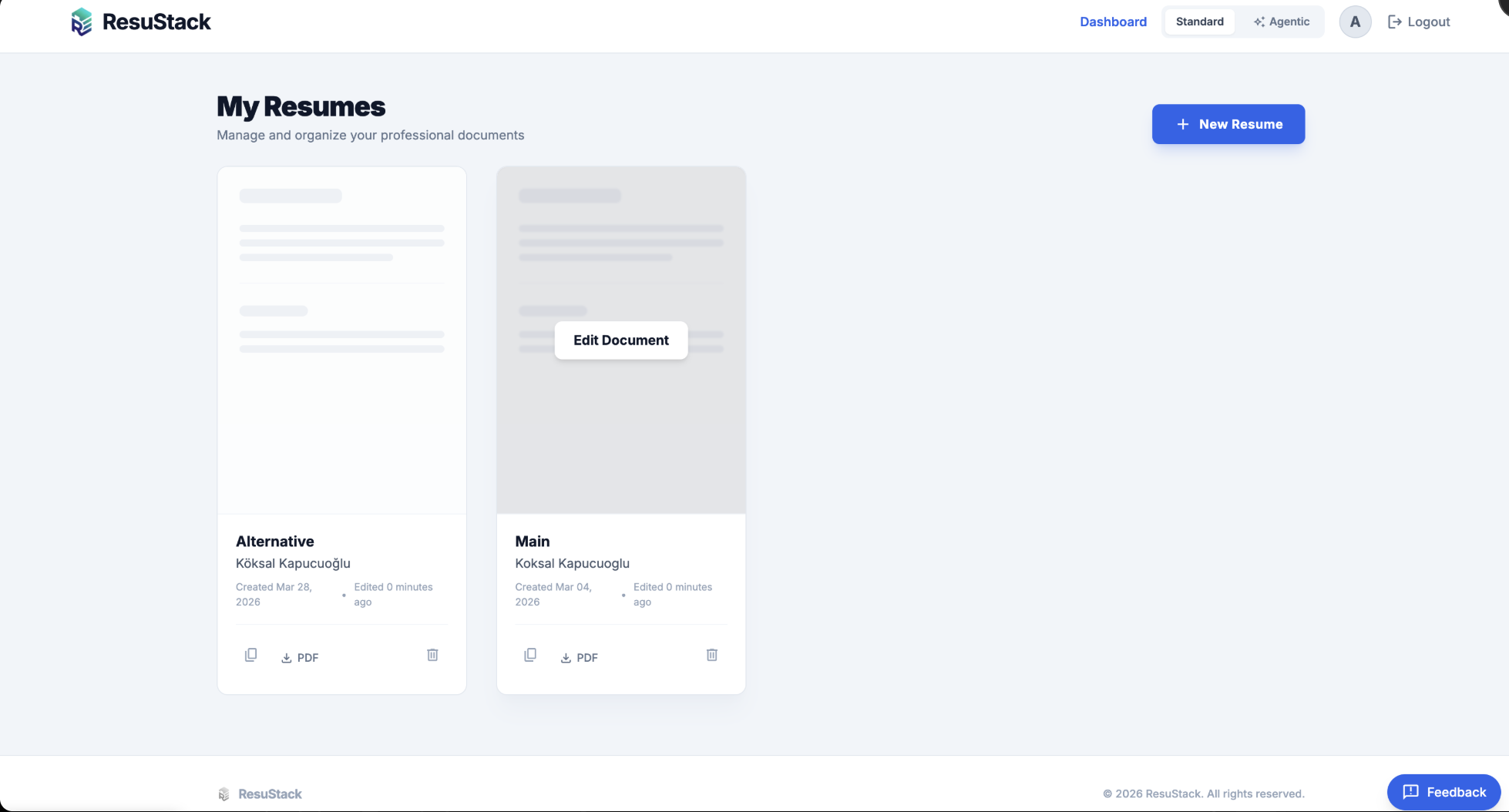
Dashboard
💳 Plans
Free to start. Pro is a one-time purchase for a period — no subscription.
| Free plan | Limit |
|---|---|
| Resumes | 3 |
| PDF or LinkedIn imports | 2 / month |
| AI enhancements | 10 / month |
| PDF downloads | 5 / month |
| Agent chat messages | 10 / month |
| Tracked applications | 3 |
| Restore points per resume | 5 |
Pro removes these limits. Current prices are on the pricing page. Limits live in FREE_TIER_LIMITS in core/settings.py.
🚀 Running locally
Prerequisites
- Docker & Docker Compose
- An OpenAI API key
1. Clone and configure
git clone https://github.com/koksalkapucuoglu/resume-enhance.git
cd resume-enhance && cp .env.example .env
| Variable | Description | Example |
|---|---|---|
OPENAI_API_KEY | OpenAI API key | sk-proj-... |
SECRET_KEY | Django secret key | any long random string |
DEBUG | Debug mode | True |
ALLOWED_HOSTS | Allowed hosts | localhost,127.0.0.1 |
POSTGRES_DB / POSTGRES_USER / POSTGRES_PASSWORD | Database credentials | postgres |
POSTGRES_HOST / POSTGRES_PORT | Database address | db / 5432 |
EMAIL_HOST_USER / EMAIL_HOST_PASSWORD | SMTP credentials for password resets and email verification; for Gmail, an app password | you@gmail.com / app password |
EMAIL_HOST / EMAIL_PORT / EMAIL_USE_TLS / EMAIL_USE_SSL | SMTP server; defaults to Gmail (smtp.gmail.com, 587, TLS). For implicit TLS on 465, set EMAIL_USE_SSL=True | smtp.gmail.com / 587 / True / False |
DOWNLOAD_LINK_MAX_AGE | Seconds a signed PDF link stays valid (optional) | 600 |
GOOGLE_OAUTH_CLIENT_ID / GOOGLE_OAUTH_CLIENT_SECRET | Google sign-in; the button stays hidden until both are set (optional) | from Google Cloud Console |
DEFAULT_FROM_EMAIL | Sender for account emails; defaults to EMAIL_HOST_USER (optional) | ResuStack <you@gmail.com> |
MCP_REGISTRY_AUTH | MCP Registry domain proof served at /.well-known/mcp-registry-auth (optional, public key only) | v=MCPv1; k=ed25519; p=... |
PAYMENT_STATUS | coming_soon shows plans without taking payment; live enables checkout | coming_soon |
PAYMENT_PROVIDER, PAYMENT_WEBHOOK_SECRET, CHECKOUT_URL_*, PRODUCT_ID_* | Payment provider settings (optional) |
2. Start
docker compose up --build
The app runs at http://localhost:8000.
3. Run the tests
docker compose exec web python manage.py test resume mcp_server
WeasyPrint and OpenAI are mocked in the unit tests; no API calls are made.
☁️ Deployment
Production runs on Dokploy. Every push to main triggers a deploy through a GitHub webhook: Dokploy builds the Dockerfile, and entrypoint.sh runs migrate and collectstatic before starting Gunicorn. Traefik handles HTTPS.
Setting it up on a new server:
- Install Dokploy:
curl -sSL https://dokploy.com/install.sh | sh - Open
http://YOUR_SERVER_IP:3000and create an admin account - Create a project → add an Application → connect this GitHub repository
- Add a PostgreSQL service in the same project
- Set the environment variables (see
.env.prod.example) and the domain, then deploy
Notes:
- Leave Dokploy's Run Command empty — the Dockerfile's
ENTRYPOINTdoes everything - Behind Cloudflare's proxy, set Dokploy's domain encryption to None and Cloudflare SSL to Full
- The image installs the fonts the resume designs use; nothing is fetched at render time
docker-compose.prod.yml and the Caddyfile are kept for self-hosting without Dokploy; they are not what production uses.
🔑 Google sign-in
Sign-in with Google uses django-allauth. ResuStack's own login, sign-up and password pages stay in charge; allauth adds only the Google flow.
- In Google Cloud Console, configure the OAuth consent screen (External), with the privacy policy URL
https://resustackapp.com/privacy/and only theopenid,emailandprofilescopes. - Create an OAuth client ID of type Web application with:
- Authorized JavaScript origin:
https://resustackapp.com - Authorized redirect URI:
https://resustackapp.com/accounts/google/login/callback/ - For local development, also
http://localhost:8000/accounts/google/login/callback/
- Authorized JavaScript origin:
- Set
GOOGLE_OAUTH_CLIENT_IDandGOOGLE_OAUTH_CLIENT_SECRETand redeploy.
How it behaves:
- A Google account is never attached to an existing ResuStack account because the email matches — local addresses were never verified. Existing users connect Google from their Profile page while signed in.
- New Google users pass through a short step to pick a username and give consent to transfers abroad.
- Google accounts with an unverified email are refused.
- Accounts created with an email address work at once, but AI features stay locked until the address is confirmed (soft verification). Accounts created before this existed are not affected.
🔒 Privacy
What ResuStack collects, who processes it (including OpenAI for AI features) and how to delete it: resustackapp.com/privacy. The Turkish version, written as the KVKK information notice, is at resustackapp.com/gizlilik. Users can delete their account and all its data from the Profile page.
🏗️ Architecture
Monolithic Django: views, DRF API, an MCP endpoint, WeasyPrint for PDFs, OpenAI for parsing and writing. Resume content is a single JSONField; every design comes from one catalogue in resume/resume_templates.py. The full guide — conventions, patterns and pitfalls — is in .claude/CLAUDE.md.
🗺️ Roadmap
- Multiple resume designs (14)
- Job description matching and application tracking
- Agentic mode with tool calling, approvals and undo
- Change history with diff and restore
- MCP server for Claude and other clients
- English and Turkish resumes
- Listing in MCP registries
- OAuth for MCP clients, alongside tokens
- Payments going live
License
Open Source.
Reviews
No reviews yet
Be the first to review this server!
More Developer Tools MCP Servers
Git
Freeby Modelcontextprotocol · Developer Tools
Read, search, and manipulate Git repositories programmatically
Fetch
Freeby Modelcontextprotocol · Developer Tools
Web content fetching and conversion for efficient LLM usage
Paperclip
Freeby Paperclipai · Developer Tools
Trending hip-hop artist momentum scores across four cultural dimensions.
Toleno
Freeby Toleno · Developer Tools
Toleno Network MCP Server — Manage your Toleno mining account with Claude AI using natural language.
mcp-creator-python
Freeby mcp-marketplace · Developer Tools
Create, build, and publish Python MCP servers to PyPI — conversationally.
MCP Marketplace
Freeby mcp-marketplace · Developer Tools
Search and install MCP servers from inside your AI client.