
Server data from the Official MCP Registry
Render 47 chart types and tiled dashboards as PNG/SVG. Deterministic, no headless browser.
About
Render 47 chart types and tiled dashboards as PNG/SVG. Deterministic, no headless browser.
Remote endpoints: streamable-http: https://mcp.slickfast.com/mcp
Security Report
SlickFast MCP is a well-architected chart rendering engine with strong security fundamentals. The code is pure, deterministic, and free of malicious patterns. Permissions align with purpose (rendering SVGs/PNGs locally). Minor findings include broad exception handling and lack of explicit input validation documentation, but these do not introduce exploitable vulnerabilities. Supply chain analysis found 5 known vulnerabilities in dependencies (0 critical, 4 high severity). Package verification found 1 issue.
4 files analyzed · 9 issues found
Security scores are indicators to help you make informed decisions, not guarantees. Always review permissions before connecting any MCP server.
Permissions Required
This plugin requests these system permissions. Most are normal for its category.
How to Install & Connect
Available as Local & Remote
This plugin can run on your machine or connect to a hosted endpoint. during install.
Documentation
View on GitHubFrom the project's GitHub README.
SlickFast
A deterministic render engine. Spec in, same bytes out. Forever. Charts, boards, and whole Pages. No headless browser.
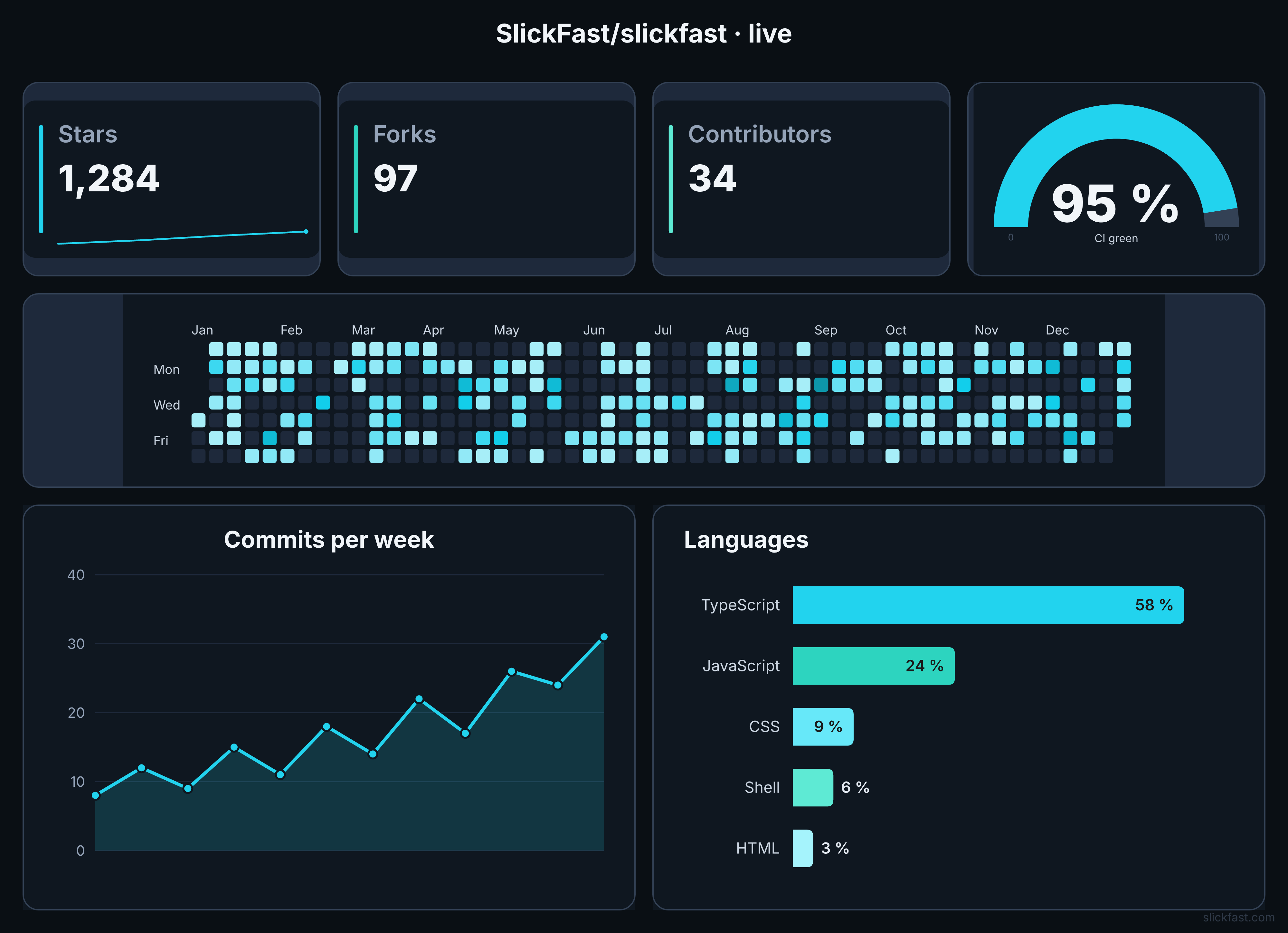 ↑ Engine output — one JSON spec, one image. Get this exact board on your README with the dashboard template (
teal-hero layout).
Local MCP is free forever. A public URL is a plan (free key is enough to learn).
The spec is the chart. A pagespec is a Page. Add .json — that’s the twin.
The hash is on the page. Don’t trust us. Check the math.
- npm (MCP):
@slickfast/mcp@0.7.33 - Website: slickfast.com
- Engine explainer (a Page): open it · twin
- Get started / News: slickfast.com/start · slickfast.com/news
- Bugs: GitHub Issues · feedback@slickfast.com
This project's pulse — a LIVE chart, right here in the README
The dashboard below is not a screenshot. It's a SlickFast live chart: a permanent image URL whose numbers update on their own. A scheduled job pushes fresh stats; every visitor sees current data. Live Charts — embed once, update forever.

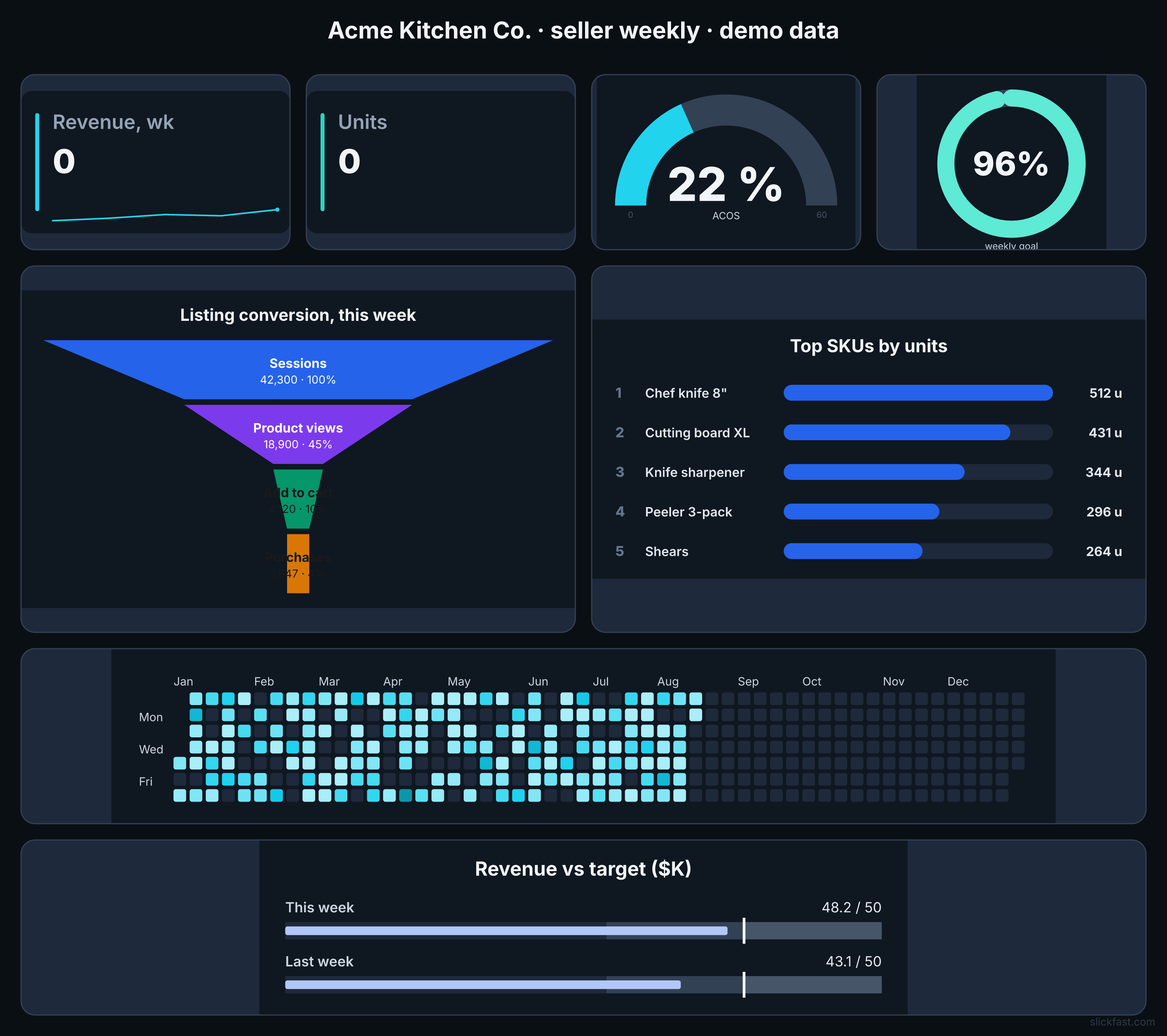
The range — two boards, two renders
A seller ops board (funnel, bullet graph, goal ring, gauge, calendar heatmap, leaderboard — demo data):
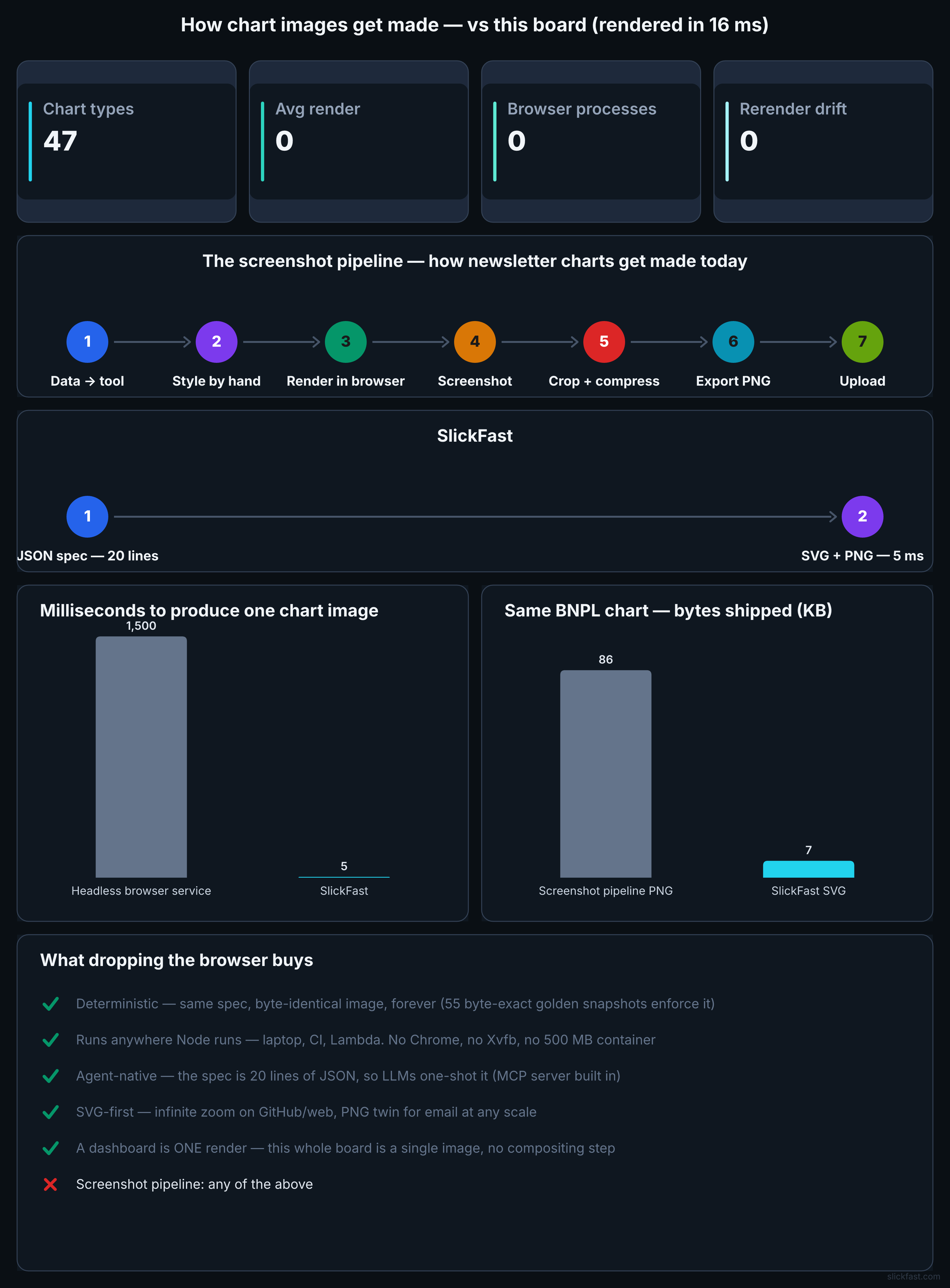
And the board that explains the engine — it times its own render into its title:
Prove it yourself
Don't take the speed or determinism claims on faith — run the benchmark on your own machine:
git clone https://github.com/SlickFast/slickfast && cd slickfast
node scripts/bench.mjs
It renders all 47 chart types, times each, runs a 10,000-chart throughput burst, and double-renders everything to verify byte-identical output. On an M1 Max: median 15µs per chart, ~140,000 renders/sec, 47/47 deterministic. Your numbers are your numbers.
Quick start (MCP)
One-click:


Add to your MCP client config (Claude Code, Claude Desktop, Cursor, …):
{
  "mcpServers": {
    "slickfast": {
      "command": "npx",
      "args": ["-y", "@slickfast/mcp"],
      "env": { "SLICKFAST_API_KEY": "SF-…" }
    }
  }
}
Omit env to stay local-only (draw free forever). Add a free key from slickfast.com when you want a live URL, share, or a published Page.
Then: get_started → news → gallery → one render_chart. Full tool docs: apps/mcp/README.md.
How to keep a Page
“Save it” is two jobs. On disk: render_page + keep the pagespec JSON (no key). In the world: publish_page (SF- key) → pages.slickfast.com/s/… + .json twin. The hash is on the page. Find it later with my_pages.
Why agents pick SlickFast
- Deterministic — same spec, same bytes. Cacheable. Testable.
- Cheap tokens — a few dozen tokens of JSON beat hundreds of matplotlib / SVG retries.
- One-field edits — swap type, palette, size; re-render. No code rewrite.
- Pages = shareable memory — agent output → Page → twin → hash on the page. Not stuck in chat.
- No headless browser — pure in-memory SVG → PNG (and Page HTML).
- 47 types + tiled dashboards in one call.
- Loud errors — bad enum / unknown palette lists the valid options.
- Local by default — nothing phones home from the MCP package.
What's in this repo
| Path | What it is |
|---|---|
packages/render-core/ | The engine: pure (spec) → SVG string. All 47 types, the type registry, SPEC.md (the spec contract), examples, gallery, and the golden snapshot net. |
packages/palette-core/ | The color library: palettes, nested themes, WCAG contrast, tokens. |
packages/raster/ | SVG → PNG rasterization (resvg). |
packages/fonts/ | The swappable font layer. |
apps/mcp/ | The MCP server published as @slickfast/mcp — a thin surface over the engine. |
apps/api/ | The hosted HTTP API — API.md is the how-to-call-it guide (no MCP needed: curl, <img src>, any language), openapi.yaml the machine-readable contract. Live at api.slickfast.com; free tier at slickfast.com. |
scripts/ | The safety net: golden checks, registry-drift check, 323-case torture suite, palette hex check. |
templates/ | Ready-made spec presets. |
Build & verify from source
cd apps/mcp && npm install && npm run build     # builds dist/index.js
cd ../../packages/raster && npm install          # native resvg binding (PNG)

# from the repo root — the full safety net:
node packages/render-core/generate.mjs --check   # golden snapshots (all types)
node scripts/check-surfaces.mjs                  # type-registry drift check
node scripts/torture.mjs                         # 323 empty/edge-case renders
node scripts/check-palettes.mjs                  # palette hex validation
The engine is pure and deterministic by contract: no IO, no Date.now(), no
Math.random() in drawing code, and nothing ships without a snapshot test.
Contributing
- Bug reports and feature requests are the best way to contribute — please use the
issue templates. The MCP's
built-in
report_issuetool writes a ready-to-paste report for you. - Day-to-day development happens in an internal tree and releases are published here, so a PR may be ported in rather than merged directly — you'll be credited either way. For anything non-trivial, open an issue first so we can agree on the shape.
License
AGPL-3.0-only. Local MCP is free. Closed commercial products (embed or self-host without AGPL) need a commercial license from $99/year: slickfast.com/license.html · licensing@slickfast.com. Hosted API / hosted MCP: slickfast.com/#pricing.
Reviews
No reviews yet
Be the first to review this server!
More Developer Tools MCP Servers
Git
Freeby Modelcontextprotocol · Developer Tools
Read, search, and manipulate Git repositories programmatically
Fetch
Freeby Modelcontextprotocol · Developer Tools
Web content fetching and conversion for efficient LLM usage
Worldmonitor
Freeby Koala73 · Developer Tools
Live markets, conflicts, country risk, chokepoints, energy, and China decision signals. 84 tools.
Toleno
Freeby Toleno · Developer Tools
Toleno Network MCP Server — Manage your Toleno mining account with Claude AI using natural language.
mcp-creator-python
Freeby mcp-marketplace · Developer Tools
Create, build, and publish Python MCP servers to PyPI — conversationally.
MCP Marketplace
Freeby mcp-marketplace · Developer Tools
Search and install MCP servers from inside your AI client.