
Server data from the Official MCP Registry
Keyless open data for 84 German cities: 12 lean read-only MCP tools covering 67 data types.
About
Keyless open data for 84 German cities: 12 lean read-only MCP tools covering 67 data types.
Remote endpoints: streamable-http: https://mcp.infranode.dev/mcp
Security Report
InfraNode is a well-architected open-data aggregator with strong security-by-design principles. The codebase demonstrates careful input validation, SSRF mitigation, and graceful degradation patterns. No critical vulnerabilities or malicious patterns detected. Minor findings relate to broad exception handling and defensive coding practices, which are low-severity quality issues that do not materially impact security. Supply chain analysis found 4 known vulnerabilities in dependencies (0 critical, 2 high severity).
4 files analyzed · 7 issues found
Security scores are indicators to help you make informed decisions, not guarantees. Always review permissions before connecting any MCP server.
Permissions Required
This plugin requests these system permissions. Most are normal for its category.
How to Install & Connect
Available as Local & Remote
This plugin can run on your machine or connect to a hosted endpoint. during install.
Documentation
View on GitHubFrom the project's GitHub README.
Deutsch | English
InfraNode





Die Open-Data-REST-API für Deutschland: eine HTTP-API ohne API-Key für Open Data zur öffentlichen Infrastruktur, auch als MCP-Server verfügbar.
Deutsche Städte veröffentlichen viel Open Data, aber jede Quelle hat ihr eigenes
Format, eigene Felder und eigene Eigenheiten, und für mehrere braucht es eine
Registrierung im jeweiligen Portal. InfraNode normalisiert rund 20 Kategorien,
Wetter (DWD), Luftqualität (UBA), ÖPNV (inklusive Echtzeit-Abfahrten), Verkehr,
Strompreis (SMARD), Bodenrichtwerte (BORIS), Parken, Ladeinfrastruktur,
Pegelstände, Demografie, Energie und mehr, für 84+ deutsche Städte hinter
einer Schnittstelle. Kein API-Key, kein Konto. Jede Antwort nutzt
denselben kanonischen { data, meta }-Umschlag mit Lizenz und Attribution je
Datensatz. Dieselben Daten stehen KI-Agenten auch als MCP-Server zur Verfügung
(12 schlanke Read-only-Tools über 78 Datenarten).
Der Einstieg ist get_city_overview, ein einziger Aufruf: Er liefert einen
Katalog aller Datenarten, die es für eine Stadt gibt, dazu einen Live-Auszug der
wichtigsten Werte. So sehen Agenten die volle Breite und nicht nur das Wetter.
InfraNode wächst laufend, neue Datenarten und Städte kommen regelmäßig dazu.
Zu den Quellen gehören der Deutsche Wetterdienst (DWD), das Umweltbundesamt (UBA), Mobilithek/DELFI, der VBB (Verkehrsverbund Berlin-Brandenburg, CC-BY 4.0), GovData, OpenStreetMap, die Bundesnetzagentur, das KBA und weitere.
Im Einsatz
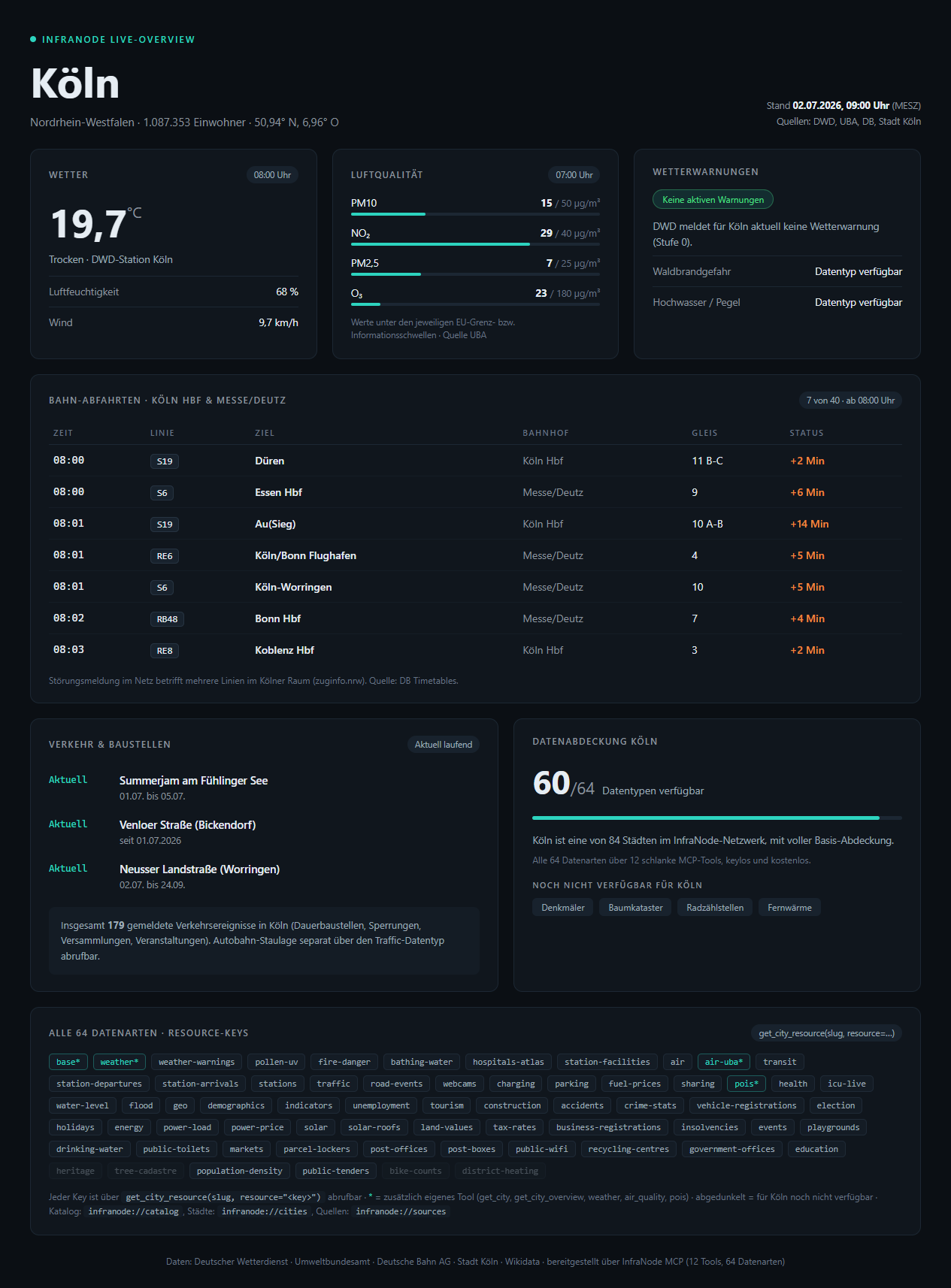
Ein einziger get_city_overview("koeln")-Aufruf: aktuelles Wetter, amtliche
Luftqualität, DWD-Warnungen, Live-Zugabfahrten mit Verspätungen, Baustellen und
der vollständige Datenkatalog der Stadt, aus einem Endpoint ohne API-Key. Jede
Stadt lässt sich live ausprobieren auf
infranode.dev.
So funktioniert es
Ein gemeinsamer HTTP-Client fragt die Upstream-Quellen ab, jede Antwort wird auf
das kanonische Schema abgebildet, mit ihrer Attribution durch das Lizenz-Gate
geführt und in Redis zwischengespeichert (mit Stale-on-Error-Fallback), danach
über eine REST-API und einen MCP-Server ausgeliefert. Fällt eine Quelle aus,
schlägt sich das in source_status nieder. Der Aufruf selbst scheitert nie
daran.
flowchart LR
subgraph SRC["25+ deutsche Open-Data-Quellen"]
direction TB
S1["DWD, UBA<br/>Wetter, Luft"]
S2["Mobilithek, DELFI, DB<br/>ÖPNV, Echtzeit"]
S3["SMARD, BNetzA, MaStR<br/>Energie"]
S4["BORIS, GovData, OSM,<br/>KBA, ..."]
end
subgraph CORE["InfraNode-Kern"]
direction TB
N["Normalisieren<br/>ein kanonisches Schema"] --> L["Lizenz-Gate<br/>Attribution je Datensatz"] --> C["Redis-Cache<br/>Stale-on-Error-Fallback"]
end
SRC --> CORE
CORE --> API["REST-API<br/>infranode.dev/api/v1<br/>84 Städte, ohne API-Key"]
CORE --> MCP["MCP-Server<br/>mcp.infranode.dev<br/>12 Read-only-Tools"]
API --> APPS["Apps & Dashboards"]
MCP --> AGENTS["KI-Agenten<br/>Claude, ChatGPT"]
Wenn InfraNode dir eine Datenintegration erspart: Ein Stern hilft anderen Entwicklern, das Projekt zu finden.
Schnellstart
Basis-URL https://infranode.dev/api/v1. Kein Key, kein Konto, einfach
aufrufen:
curl https://infranode.dev/api/v1/cities/koeln/weather
{
  "data": {
    "city_slug": "koeln",
    "observed_at": "2026-06-18T13:00:00Z",
    "source": "dwd",
    "attribution": { "text": "Datenbasis: Deutscher Wetterdienst", "modified": true },
    "payload": { "kind": "weather", "temperature_c": 30.4, "humidity": 43.0, "station_id": "02667" }
  },
  "meta": { "source_status": "ok", "cache_status": "hit", "correlation_id": "..." }
}
Jede Antwort folgt demselben { data, meta }-Umschlag: Jeder Datensatz trägt
seine attribution (Lizenz und Quelle), und meta.source_status sagt, ob die
Upstream-Quelle Daten geliefert hat. Eine tote Quelle degradiert damit sauber,
statt den Aufruf scheitern zu lassen.
Über alle Datenarten hinweg sind Feldnamen snake_case und englisch, und dasselbe
Konzept heißt immer gleich: post_code, street, house_number, place,
name, start, end, distance_km, power_kw, lat, lon. post_code ist
immer ein fünfstelliger String (führende Nullen bleiben erhalten), Zeitstempel
sind ISO 8601 mit Zeitzone, und ein Wert, den die Quelle nicht liefert, ist
null, nie ein leerer String. Manche Antworten führen daneben noch ältere
Doppelnamen mit identischen Werten (plz, zip, strasse, hausnummer, ort,
city, bezeichnung, beginn, ende, art, dist_km, leistung_kw,
einheit_typ, dazu die camelCase-Rohfelder der Autobahn-Verkehrsmeldungen).
Diese Namen sind veraltet, nimm die kanonischen.
Tipp: Ruf zuerst
/api/v1/citiesauf, um die kanonischen Stadt-Slugs zu finden (etwakoeln,berlin,hamburg), und danach einen stadtbezogenen Endpoint.Der
{slug}wird tolerant aufgelöst, die exakte ASCII-Form brauchst du also selten: der deutsche Name mit oder ohne Umlaute, jede Groß- und Kleinschreibung, gängige englische Exonyme und Kurzformen führen alle auf den kanonischen Slug (München/münchen/munich/munchen→muenchen,cologne→koeln,frankfurt→frankfurt-am-main). Ein unbekannter Name liefert404mit dem HinweisMeintest du ...?, der den nächstliegenden Slug nennt.

Die vollständige interaktive Referenz und die Abdeckung je Stadt stehen auf infranode.dev. Die InfraNode API im Postman API Network spiegelt jeden Endpoint mit echten Beispielantworten, sodass sich die InfraNode API Postman Collection ohne API-Key direkt im Browser ausprobieren lässt.
Daten (84 Städte, 124 Endpunkte)
Jede Kategorie unten ist ein REST-Endpoint unter
/api/v1/cities/{slug}/<key>. Über MCP kommen dieselben Daten durch 12 schlanke
Tools: ein paar benannte (get_city_overview, weather, air_quality, pois,
compare, die Live-Tafeln) und ein generisches
get_city_resource(slug, resource=<key>) für jede weitere Datenart (sein
resource-Enum listet alle 81 Keys).
| Gruppe | Datenarten (Endpoint-Keys) |
|---|---|
| Entdecken | list_cities, sources, compare (eine Datenart über viele Städte), overview (Katalog plus Live-Auszug in einem Aufruf) |
| Wetter & Umwelt | weather, weather-warnings, civil-protection-warnings (BBK NINA), air-uba (amtlich), air (live), pollen-uv, water-level, flood, fire-danger, bathing-water |
| Mobilität | transit, Live-Abfahrten je Haltestelle (Tool transit_departures), stations (Katalog), Bahnhofstafeln nach EVA (Tools station_board_departures/station_board_arrivals, inklusive Nahverkehr und Störungen), station-departures, station-arrivals, traffic, road-events, webcams, charging, parking (Live-Belegung), parking-onstreet, park-and-ride, mobility-points, bike-parking, sharing, fuel-prices, bike-counts |
| Stadt & Menschen | base, geo, demographics, indicators, sustainability (SDG-Indikatoren je Kommune als Zeitreihe 2006-2023, Wegweiser Kommune / Bertelsmann Stiftung, CC0), unemployment, tourism, construction, accidents, crime-stats, health, icu-live, holidays, election, events, council-papers (kommunale Ratsinformationen über OParl: Vorlagen, Anträge und Beschlüsse je Stadt), pois, Spielplätze, Märkte, Toiletten und weitere OSM-Typen |
| Wirtschaft & Immobilien | land-values, tax-rates (Hebesätze für Gewerbe- und Grundsteuer je Kommune), business-registrations (Gründungsdynamik je Kreis), insolvencies (Insolvenzverfahren je Kreis: Unternehmen und übrige Schuldner, jährlich), public-tenders (öffentliche Vergabe: laufende Ausschreibungen und vergebene Aufträge je Stadt) |
| Energie & Fahrzeuge | power-load, power-price, energy, solar, solar-roofs, district-heating, vehicle-registrations |
Verhalten im Betrieb
- Ohne Key, nur lesend. Keine Zugangsdaten, keine Schreibzugriffe, keine Nutzerkonten.
- Kanonischer Umschlag.
{ data, meta }mit Status und Attribution je Quelle. - Sanfte Degradation. Eine ausgefallene Quelle liefert
source_status, keinen Fehler. - Sicher entworfen. SSRF- und Injection-Gates prüfen jede Anfrage, Eingaben laufen gegen feste Allowlists.
Das Sicherheitsmodell steht in SECURITY.md.
Paginierung & Kanal-Voreinstellungen
Listen von Datenarten (charging, energy, events, transit, die
OSM-Feature-Endpoints) haben bei gleicher URL eine kanalabhängige
Voreinstellung:
- Direktes REST liefert die vollständige Liste in einem Aufruf (
limit=null,returned == total,truncated=false). - GPT Actions (OpenAI-Header) und MCP sind an eine voreingestellte Seitengröße gebunden, damit Antworten für Agenten klein bleiben.
limit=all(oder?all=1) erzwingt auf jedem Kanal die volle Liste,limitundoffsetblättern explizit.meta.pagination(total/returned/limit/offset/truncated) steht auf jedem Kanal, der ausgelieferte Ausschnitt ist also immer nachvollziehbar.
Bei traffic ist die rohe Polyline optional: include=geometry (oder ?full=1)
ergänzen, die Standardantwort bleibt schlank.
Stabilität, Changelog & Roadmap
Du baust produktiv auf InfraNode auf? Dann bleib bei Änderungen vorne:
- Changelog listet jede sichtbare Änderung (neue Datenarten, neue Städte, geändertes Verhalten, Fehlerbehebungen, Deprecations), die neueste zuerst. Per RSS abonnierbar.
- Roadmap zeigt das Geplante und die Stabilitätszusage: Die API wächst additiv, der Umschlag bleibt stabil, und Änderungen an bestehenden Antworten werden vorher angekündigt (in der Regel 30+ Tage).
- Statusseite und die GitHub-Releases decken Verfügbarkeit und versionierte Änderungen ab.
Als MCP-Server nutzen
Dieselbe API steht als Remote-MCP-Server bereit, KI-Agenten können also alle 78 Datenarten als Tools aufrufen. Mit Claude Code genügt eine Zeile:
claude mcp add --transport http infranode https://mcp.infranode.dev/mcp
Jeden anderen MCP-Client richtest du auf denselben Remote-Endpoint (Streamable HTTP):
{
  "mcpServers": {
    "infranode": { "url": "https://mcp.infranode.dev/mcp" }
  }
}
- Cursor / Windsurf: den Block oben in
~/.cursor/mcp.jsoneintragen (oder in die MCP-Einstellungen der App). - VS Code:
code --add-mcp '{"name":"infranode","url":"https://mcp.infranode.dev/mcp"}' - Claude Desktop: denselben
mcpServers-Block in dieclaude_desktop_config.jsoneintragen. - ChatGPT: einen Connector mit der URL
https://mcp.infranode.dev/mcpanlegen.
Alle Tools tragen die Annotationen readOnlyHint: true /
destructiveHint: false / idempotentHint: true, MCP-Clients können sie also
gefahrlos automatisch freigeben. Die MCP-Schicht bringt außerdem fertige
Prompts (city_briefing, compare_air_quality, commute_check) und
Ressourcen (infranode://cities, infranode://sources) mit. Die
vollständige Installationsanleitung, das komplette Tool-Manifest mit
Beispielausgaben, das Berechtigungsmodell und ein Beispiel-Transkript stehen in
docs/mcp-install.md. Das Registry-Manifest ist
server.json.
In ChatGPT nutzen (Custom-GPT-Action)
Fertiges GPT: InfraNode: German City Data - Weather & Transit steht im GPT Store (Research & Analysis) und funktioniert sofort.
Für eine eigene Variante liefert InfraNode eine kuratierte OpenAPI-Spec für GPT-Actions: 23 der nützlichsten Operationen (ChatGPT erlaubt höchstens 30 pro Action), ohne Key, alle GET.
- Im GPT-Editor Configure → Actions →
Create new action → Import from URL öffnen und
https://infranode.dev/actions/openapi.jsoneinfügen. - Die Authentifizierung auf None stehen lassen, als Datenschutzerklärung
https://infranode.dev/datenschutz/eintragen. - In den Instructions des GPT festhalten: mit
getCityOverview(slug)starten, Stadtnamen übergetCitiesauflösen unddata.attributionzitieren (die Datenlizenzen verlangen die Namensnennung).
Details und empfohlene Instructions:
infranode.dev/chatgpt/. Die Spec wird von
scripts/build_actions_spec.py aus docs/openapi.yaml erzeugt.
Alternativen und wie InfraNode dazu steht
Andere MCP-Server decken Teile des deutschen oder europäischen Datenraums ab. Für Open Data auf Stadtebene ist InfraNode am breitesten, und die Projekte unten ergänzen einander oft:
- germany-mcp-server Bundes- und Regierungsdaten (Autobahn, DWD, NINA, SMARD, Bundestag). Bundesweit, ohne Tiefe je Stadt.
- db-mcp-server / db-timetable-mcp nur Fahrpläne der Deutschen Bahn.
- mcp-server-public-transport ÖPNV in Europa, in Deutschland deckt es Berlin/Brandenburg (VBB) ab.
- Server für einzelne Städte (etwa München, Berlin) decken je eine Stadt ab.
InfraNode deckt 84 deutsche Städte und 82 Datenarten hinter einem gehosteten Endpoint ohne API-Key ab: Umwelt, Mobilität, Energie, Wirtschaft und Stadtleben. Der vollständige Vergleich Seite an Seite steht auf infranode.dev/mcp-vergleich.
Selbst hosten (optional)
Nötig ist das nicht, der gehostete Endpoint oben ist der schnellste Weg. Der Code liegt aber offen. Den API-Stack lokal mit Docker (Compose v2) starten:
cp .env.example .env          # example config, contains NO real secrets
docker compose -f deploy/docker-compose.yml up
curl http://localhost/api/v1/health   # -> {"status":"ok","version":"1.0.0","redis":true}
Den MCP-Server selbst lokal über stdio betreiben (gegen die öffentliche API):
uv sync --group mcp
INFRANODE_MCP_API_BASE=https://infranode.dev/api/v1 uv run python -m infranode.mcp.server
Für alle Einstellungen gilt das Env-Präfix INFRANODE_ (siehe .env.example),
jede Datenquelle hat ihren eigenen INFRANODE_ENABLE_*-Schalter. Echte Secrets
landen nie im Repo, versioniert ist nur .env.example, und die CI fährt einen
gitleaks-Scan.
Lizenz: Code und Daten sind getrennt
- Code: Apache-2.0 (siehe LICENSE).
- Daten: Die offenen Daten, die InfraNode ausliefert, behalten die Lizenzen
ihrer Upstream-Quellen (etwa ODbL für OpenStreetMap, DL-DE-BY für GovData,
Namensnennung für DWD). Diese Datenlizenzen und die Attribution werden separat
in
DATA-LICENSES.mdgeführt. Die Apache-2.0-Lizenz gilt nur für den Quellcode der API, nicht für die durchgereichten Daten.
Mitmachen
Beiträge sind willkommen. Setup, Gate-Befehle und die Secret-Regel stehen in
CONTRIBUTING.md. Für eine neue Datenquelle ist die
deklarative Quellen-Registry in src/infranode/registry/source_specs.py der
Startpunkt (ein SourceSpec-Eintrag je Upstream), die vollständige Checkliste
steht in CONTRIBUTING.md.
Reviews
No reviews yet
Be the first to review this server!
More Developer Tools MCP Servers
Paperclip
Freeby Paperclipai · Developer Tools
Trending hip-hop artist momentum scores across four cultural dimensions.
Netdata
Freeby Netdata · Developer Tools
Real-time infrastructure monitoring with metrics, logs, alerts, and ML-based anomaly detection.
Git
Freeby Modelcontextprotocol · Developer Tools
Read, search, and manipulate Git repositories programmatically
Toleno
Freeby Toleno · Developer Tools
Toleno Network MCP Server — Manage your Toleno mining account with Claude AI using natural language.
mcp-creator-python
Freeby mcp-marketplace · Developer Tools
Create, build, and publish Python MCP servers to PyPI — conversationally.
MCP Marketplace
Freeby mcp-marketplace · Developer Tools
Search and install MCP servers from inside your AI client.