
About
Verify consequential AI actions before they execute.
Security Report
Valid MCP server (2 strong, 3 medium validity signals). 1 known CVE in dependencies Imported from the Official MCP Registry. 1 finding(s) downgraded by scanner intelligence.
14 files analyzed · 2 issues found
Security scores are indicators to help you make informed decisions, not guarantees. Always review permissions before connecting any MCP server.
How to Install
Add this to your MCP configuration file:
{
  "mcpServers": {
    "io-github-actenon-kernel": {
      "args": [
        "actenon-mcp",
        "actenon-kernel"
      ],
      "command": "uvx"
    }
  }
}Documentation
View on GitHubFrom the project's GitHub README.
Actenon Kernel
The open verifier for proof-bound consequential execution. Defines what a valid proof is. Verifies proofs at the execution edge; issues no grants; runs no policy decisions.















Every claim above is machine-verified
The claims: machine-verified badge links to a CI gate
(verify-claims.yml) that fails on
every PR, push to main, and once a day if any factual claim this README
makes about the kernel stops being true:
- Zero network calls during verification —
tests/test_neutrality.pyruns in the gate, not just behind a badge link. - Runs without Permit, Cloud, or Scan —
tests/test_independence.py, plus a source scan proving the kernel never imports Cloud or Permit, plusscripts/assert_dep_direction.py(runtime deps are exactlyactenon-protocol). - The conformance count — every "N conformance vectors" / "N tests pass" here is compared against
what
actenon-kernel conformance runactually executes; the vector files themselves are hash-locked byscripts/verify_conformance_manifest.py. - Install commands — every
pip installin this README is resolved against the live registry; the Python badge is generated, not hand-edited. - The ecosystem table — rendered from the protocol's
ecosystem.yaml, never hand-edited.
The Invariants workflow additionally proves on every PR that a clean, no-extras install verifies the full conformance surface — 33/33 tests, zero skips — including Ed25519.
If a claim drifts, the badge goes red before a human notices.
The Actenon ecosystem
The Kernel is one of the independent repositories that together close the execution gap — the gap between upstream authorization and the execution edge that actually performs a consequential side effect.
| Repository | Role | Depends on | Packages |
|---|---|---|---|
actenon-protocol | The neutral wire contract — what every artefact looks like on the wire | — | actenon-protocol (PyPI) · @actenon/protocol-types (npm) |
actenon-kernel ← you are here | The open verifier — defines what a valid proof is | actenon-protocol | actenon-kernel (PyPI) |
actenon-permit | The developer on-ramp and authority broker | actenon-kernel, actenon-protocol | actenon-permit (PyPI) · @actenon/sdk (npm) |
actenon-scan | The independent static-analysis scanner | — | actenon-scan (PyPI) |
sdk-go | Go verifier SDK — protected-endpoint proof verification in Go | actenon-protocol | repo |
sdk-rust | Rust verifier SDK — protected-endpoint proof verification in Rust | actenon-protocol | repo |
Optional: actenon-cloud — a managed control plane (private repository, not publicly available). Not required by any component above; every capability in this ecosystem works without it.
Every repo can be adopted independently. The Kernel in particular can be wired in at the agent framework (LangChain tool, MCP tool, Claude Managed Agents custom tool, etc.) or independently at the resource boundary (FastAPI route, Express route, Go HTTP handler). Both placements are first-class.
What this is
The Kernel is the trust anchor of the Actenon ecosystem. It is:
- Independent — runs without Permit, Cloud, or Scan. Zero network calls during verification.
- The verifier at the execution edge — the
PCCBVerifieris pure and stateless; theProtectedExecutorenforces replay, escrow, idempotency, and credential brokering at the edge before any side effect, then emits the Receipt or Refusal. - Conformance-locked — 53 conformance vectors define exactly what "a valid PCCB" means, in any language.
- Multi-language — Python reference, plus TypeScript, Go, and Rust verifier SDKs that all conform to the same vectors.
- Framework-agnostic — proof verification is a function call, not a framework. The same verifier runs inside a LangChain
_run, an MCP tool handler, an Express route, or a Go HTTP handler.
The Kernel does one thing: it verifies that a PCCB (Proof of Constrained Capability Bound) authorizes an exact Action Intent for this caller, this target, this audience, this scope, this time window, and this single execution attempt — and the ProtectedExecutor refuses the attempt (no side effect, structured Refusal emitted) if verification fails. The Kernel does not issue grants or make policy decisions — that's Permit's job.
Guarantee precondition: the edge guarantee holds when the protected edge is the only path to the resource, the backend accepts only brokered credentials issued after verification, and the agent has no standing credential or alternate route. If those conditions are not met, the Kernel still refuses invalid proofs — but it cannot prevent a caller that bypasses it from reaching the resource. Full scope in
docs/SCOPE_AND_GUARANTEES.md.
Why it exists
Modern agent stacks already answer the upstream question — should this requester be allowed to do this kind of thing? — with authentication, policy engines, approval workflows, and audit logs. They still leave open the question the execution edge needs to answer:
Is the exact action about to execute still the exact action that was authorized — for this endpoint, this tenant, this subject, this target, and this time window?
That unanswered question is the execution gap. It is where parameter mutation between approval and execution, replay of valid-looking proof, presentation to the wrong endpoint, tenant/subject rebinding, and stale-proof reuse actually happen. The Kernel closes it.
Read the canonical problem statement in THE_EXECUTION_GAP.md.
The two places you can wire it in
This is the single most important architectural decision in any Actenon adoption, and the Kernel is explicitly designed for both placements.
Placement A — at the agent framework (brokered mode)
The Kernel verifier runs inside the agent's tool implementation. The agent calls a tool; the tool verifies proof; the tool executes. The agent never holds a production credential — the broker resolves it after verification.
agent → framework tool (LangChain / MCP / Claude / CrewAI / ...)
          ↓ verifies PCCB locally
          ↓ brokers credential
          ↓ executes side effect
       Receipt or Refusal
This is the path you take when you control the agent framework and want to bind every tool call to proof. See INTEGRATIONS.md for the six ranked framework paths.
Placement B — independently at the resource boundary (resource-owned mode)
The Kernel verifier runs inside the resource itself — a FastAPI route, an Express endpoint, a Go HTTP handler, an internal service method. The resource is the protected endpoint. The agent (or any caller) must present a valid PCCB to cause a side effect, regardless of how it got there.
any caller (agent / human / service / attacker)
          ↓ presents PCCB
   resource boundary (FastAPI / Express / Go / ...)
          ↓ verifies PCCB locally
          ↓ executes side effect
       Receipt or Refusal
This is the path you take when you cannot fully trust the agent framework, when the resource is shared by multiple callers, or when the resource team and the agent team are different organizations. See the Boundary Kit in actenon-permit and the BoundaryVerifier API in this repo. BoundaryVerifier verifies a signed PCCB against the exact Action Intent; it does not treat a token string as proof.
Both placements use the same Kernel, the same PCCB shape, the same conformance vectors, and the same Receipt/Refusal artefacts. You can mix them in one deployment.
The 15-step verification pipeline
| Phase | Steps | What's checked |
|---|---|---|
| A: Pre-auth | 1–5 | Structure, protocol version, canonicalisation, key resolution, signature |
| B: Post-auth | 6–13 | Time validity, audience, boundary, target, action, parameter digest, authority, revocation |
| C: Stateful | 14–15 | Replay (deferred to executor), execution eligibility |
Pre-auth failures collapse to a single public-safe code PROOF_INVALID. Post-auth failures disclose the specific code (AUDIENCE_MISMATCH, ACTION_MISMATCH, REPLAY_DETECTED, etc.) only to trusted callers. This two-layer refusal model is part of the protocol — see actenon-protocol.
What the Kernel produces
| Artefact | Purpose | Spec |
|---|---|---|
| Action Intent | The public, typed, attributable request for a consequential action | spec/action-intent/SPEC.md |
| PCCB | The proof artifact a protected endpoint verifies before side effects | spec/pccb/SPEC.md |
| Receipt | The canonical structured success outcome | spec/receipt/SPEC.md |
| Refusal | The canonical structured blocked-execution outcome | spec/refusal/SPEC.md |
| Outcome Attestation | Optional Ed25519-signed envelope wrapping a Receipt or Refusal (v2alpha1) | spec/outcome-attestation/SPEC.md |
| Receipt Counter-Signature | Optional third-party counter-sign on a Receipt | spec/countersignature/SPEC.md |
| Transparency Log Entry | Optional digest-based public anchor | spec/transparency-log/SPEC.md |
| Issuer Status | Key lifecycle record (active / retired / suspended / revoked / hard_revoked) | spec/issuer-status/SPEC.md |
| Approval Artefact | Structured approval record that PCCB issuance may require | spec/approval-artifact/SPEC.md |
| Protected Endpoint behaviour | The execution-edge contract | spec/protected-endpoint/SPEC.md |
| Replay behaviour | The single-use proof contract | spec/replay/SPEC.md |
Signed receipts — what the agent had permission to do, what it did or tried, and how
Every execution attempt produces one of two canonical, machine-readable artefacts:
- A Receipt when the side effect executed (or was definitively refused before execution, in the refused-receipt path).
- A Refusal when the protected endpoint refused the attempt before any side effect.
Both are structured, hash-chained, and stable at the contract level. They answer, for any retrospective reviewer (engineer, auditor, regulator, insurer):
- What the agent had permission to do — the Grant's
scopes.allow,scopes.deny,budget,rate,expires_at, and approval rules. The receipt cites the exact grant and proof that authorized this attempt. - What it did or tried to do — the exact
Action Intent(action name, target, tenant, subject, audience, parameters), the action-hash (SHA-256 over RFC 8785 canonical JSON), and the execution state (succeeded,failed,refused,outcome_unknown). - How it did it — the brokered or resource-owned execution mode, the credential reference (not the secret), the adapter / endpoint that performed the side effect, the provider response or refusal code, and the receipt's own signature.
For deployments that need portable cryptographic attestation of origin, the Kernel can wrap any v1 Receipt or Refusal in an Outcome Attestation envelope (v2alpha1, opt-in). The attestation is signed with an Ed25519 key whose lifecycle (active / retired / suspended / soft-revoked / hard-revoked) is itself part of the public contract. A hard-revoked key's historical artefacts remain verifiable only if an independently verified external anchor proves the artefact digest existed before the compromise — see REVOCATION_AND_RECEIPT_DURABILITY.md.
Outcome Attestation is v2alpha1 and is excluded from the 1.0 compatibility promise. It is opt-in, alpha, and may change or be removed in any release until it reaches v2. See VERSIONING.md §1.2.
Install
Python 3.10+ for the Kernel alone. The full stack including Permit requires 3.11+.
pip install actenon-kernel # full verifier: HMAC and Ed25519
Since 1.1.0 the base install verifies everything the ecosystem produces,
including Ed25519 proofs and Outcome Attestations. (The [asymmetric] extra
still resolves for backward compatibility; it installs nothing additional.)
Connect it to an agent (MCP, 60 seconds, zero install)
The Kernel ships a runnable MCP server, so a model can ask it whether an action is allowed before the action runs — and read back exactly why it was refused. Paste this into any MCP client (Claude Desktop, ChatGPT, or anything else that speaks MCP):
{
  "mcpServers": {
    "actenon": {
      "command": "uvx",
      "args": ["--from", "actenon-kernel[mcp]", "actenon-mcp", "--demo"]
    }
  }
}
Using Claude Code? One command registers the same server:
claude mcp add actenon -- uvx --from 'actenon-kernel[mcp]' actenon-mcp --demo
uvx fetches and runs it — nothing to install first. --demo runs offline
with an ephemeral key and in-memory state; it is clearly marked DEMO MODE
in every tool description and must not be used in production.
Three tools: actenon_verify (is this proof good for this exact action?),
actenon_gate (ALLOW or a typed refusal), actenon_receipt (the
hash-chained receipt for a prior decision). Every refusal carries both the
machine code and the human-readable reason.
Full walkthrough, including a real transcript of an agent being refused for
widening a refund and then succeeding within scope:
docs/integrations/MCP_QUICKSTART.md.
Use as a verifier (resource boundary)
from actenon.proof import PCCBVerifier, build_local_proof_signer

# For production, use a file-based or KMS-backed signer (see
# docs/PRODUCTION_INTEGRATION.md §1). The local HMAC signer below is
# development-only — it uses a public test secret.
signer = build_local_proof_signer()    # development only
verifier = PCCBVerifier(signer=signer)

# Raises ProofVerificationError on any failure; returns silently on success.
verifier.verify(intent, pccb, context)
Production key custody: the local HMAC signer above is for development only. For production, use a file-based Ed25519 key or a KMS-backed signer. See
docs/PRODUCTION_INTEGRATION.md§1 for the three custody tiers and theACTENON_ALLOW_PILOT_LOCAL_EDDSA_IN_PRODUCTIONflag documentation.
Use as a boundary verifier (Boundary Kit, resource-owned mode)
BoundaryVerifier() with no trust root refuses every token (ISSUER_UNTRUSTED), including a long or v1.-prefixed string. Pass the same PCCBVerifier the issuer's key can satisfy, and the exact Action Intent the request is performing:
from actenon.boundary import BoundaryVerifier, BoundaryVerificationRequest
from actenon.proof import PCCBVerifier

# The trust root is mandatory: without a PCCBVerifier every proof is
# refused (ISSUER_UNTRUSTED). Pass a durable replay_store= when more than
# one worker serves the same boundary.
verifier = BoundaryVerifier(pccb_verifier=PCCBVerifier(signer=issuer_verifier))
result = verifier.verify_boundary(BoundaryVerificationRequest(
    proof_token=proof_header,         # PCCB JSON, or "v1." + base64url(PCCB JSON)
    intent=action_intent,             # the exact Action Intent this request performs
    action_type="payment.refund",     # must equal the intent's action name
    action_hash="",                   # optional; when set, must equal the proof's action hash
    audience="service:payments",      # this boundary's identity (required)
))
# result.valid         → True only after signature + exact-action verification
# result.refusal_code  → "PROOF_INVALID" | "AUDIENCE_MISMATCH" | "REPLAY_DETECTED" | ...
# result.proof_id      → the PCCB's pccb_id (for receipt correlation)
How Airlock calls the Kernel
Airlock is the cooperative Python broker in front of an agent. Scan names the powers, Permit signs a grant for those powers, and Airlock asks the Kernel to verify the proof before a side effect. That call, from src/actenon_airlock/broker.py, is:
from actenon.gate import ActenonGate
from actenon.replay import ReplayProtector, SqliteReplayStore

self.edge = ActenonGate(
    verifier=Ed25519PublicKeyVerifier([key.public_key_jwk]),  # actenon-permit
    audience="service:actenon-permit-gateway",
    issuer="service:actenon-permit",
    capabilities=tuple(sorted(self.allowed)) or ("airlock.none",),
    replay_protector=ReplayProtector(SqliteReplayStore(state.local / "replay.sqlite3")),
    revocation_checker=StoreRevocationChecker(self.store),    # actenon-permit
)
outcome = self.edge.protect(intent, proof, dispatch.run)
capabilities is the edge allow-list (the grant's Scan powers). A proof for any other capability is refused with SCOPE_CAPABILITY_MISMATCH before dispatch.run. revocation_checker(pccb, context) must return true when the authority is not revoked; a false result or an exception is AUTHORITY_REVOKED. Ed25519PublicKeyVerifier and StoreRevocationChecker are Permit types that satisfy those Kernel interfaces. The Kernel does not import Permit or Scan.
The pipeline is Scan vocabulary, then a signed grant, then this Kernel check, then a signed receipt. Airlock writes its own hash-chained receipt around outcome.to_dict(). The Kernel's job inside that pipeline is the check and the Receipt or Refusal for the protected call.
Use as a minter + executor (brokered mode, full local proof)
python3 -m pip install -e .
python3 -m actenon.cli up
python3 -m actenon.cli doctor
python3 -m actenon.cli simulate --incident replit
Then protect a real endpoint:
python3 -m examples.refund_guard_local.server --runtime-dir artifacts/local_runtime
Multi-language SDKs
| SDK | Use case | Path |
|---|---|---|
| Python (reference) | Full kernel: minter, verifier, executor, CLI, conformance, local proof mode | this repo |
| TypeScript | Verifier-edge proof checking in Node / Express / TS services | sdk/typescript/ |
| Go | Verifier-edge proof checking in Go HTTP services | Actenon/sdk-go (standalone; kernel CI tests the pinned commit) |
| Rust | Verifier-edge proof checking in systems components | Actenon/sdk-rust (standalone; kernel CI tests the pinned commit) |
Every SDK runs the same hash-locked verifier vectors (actenon/conformance/vectors/verifier_sdk_v1, locked in conformance/vector-lock.json; the Go and Rust SDKs vendor them byte-identically). See SDK_SELECTION_GUIDE.md.
Framework & platform adapters
The repo ships ranked, ready-to-run examples showing the Kernel wired into the major agent surfaces. MCP is the hero path; the rest are distribution-supporting.
| # | Surface | Example | Where proof verification happens |
|---|---|---|---|
| 1 | MCP server tool (hero) | examples/mcp_server_protected_tool/ | Inside the MCP tool implementation |
| 2 | LangChain tool | examples/langchain_protected_tool/ | Inside the tool _run |
| 3 | Claude Managed Agents custom tool | examples/claude_managed_agents_protected_tool/ | Inside the agent.custom_tool_use handler |
| 4 | LlamaIndex FunctionTool | examples/llamaindex_protected_tool/ | Inside the wrapped function |
| 5 | CrewAI tool | examples/crewai_protected_tool/ | Inside the tool _run |
| 6 | Semantic Kernel plugin | examples/semantic_kernel_protected_tool/ | Inside the @kernel_function method |
Additional examples (not in the ranked launch set, but production-quality):
| Surface | Example |
|---|---|
| OpenAI Agents SDK | examples/openai_agents_sdk_protected_tool/ |
| FastAPI protected route | examples/fastapi_protected_route/ |
| Express protected route (TypeScript SDK) | examples/express_protected_route/ |
| FastMCP financial transfer | examples/fastmcp_financial_transfer/ |
| Refund guard (local admission → real proof) | examples/refund_guard_local/ |
| Invoice payment guard | examples/invoice_payment_guard_local/ |
| Clinical EHR agent | examples/protected_clinical_ehr_agent/ |
| IAM control plane | examples/protected_iam_control_plane/ |
| Multi-agent swarm | examples/protected_multi_agent_swarm/ |
| Policy preflight refund | examples/protected_policy_preflight_refund/ |
| LangChain finance agent | examples/protected_langchain_finance_agent/ |
| Financial agent protected transfer | examples/financial_agent_protected_transfer/ |
| Adversarial RSA policy stress test | examples/adversarial_rsa_policy_stress_test.py |
Every example keeps the same boundary: the protected endpoint receives an Action Intent + PCCB + local context, verifies proof before any side effect, and returns a canonical Receipt or Refusal. No example requires a hosted control plane.
The incident library — see the gap, then see it closed
The repo ships a local simulator that lets you watch real-world incident patterns unfold, then watch the same pattern get refused at a protected endpoint. Run any of them in seconds:
actenon-kernel simulate --incident replit           # Replit-style destructive DB drift
actenon-kernel simulate --incident prod-delete      # Generic production destructive action
actenon-kernel simulate --scenario mcp-tool-proof-laundering
actenon-kernel simulate --scenario iam-escalation
actenon-kernel simulate --scenario data-export
| Pattern | What it shows | Source-disciplined writeup |
|---|---|---|
| Replit-style database delete | A bounded dev task widens into a destructive DB change because the execution edge trusts broad tool authority instead of verifying the exact action + target. | docs/incidents/REPLIT_STYLE_DATABASE_DELETE.md |
| Production destructive action | The hero "No receipt, no prod delete" path. | docs/incidents/PRODUCTION_DESTRUCTIVE_ACTION.md |
| MCP tool proof laundering | An orchestrator forwards proof minted for one tool to a different tool; the second tool must refuse. | docs/incidents/MCP_TOOL_PROOF_LAUNDERING.md |
| IAM privilege escalation | An agent attempts put_user_policy / attach_role_policy without exact-action proof. | docs/incidents/IAM_PRIVILEGE_ESCALATION_PATTERN.md |
| Data export exfiltration | A sensitive export action attempted without audience/scoped proof. | docs/incidents/DATA_EXPORT_EXFILTRATION_PATTERN.md |
These pages are source-disciplined: they use incident names as pattern language, not as factual incident reports, and they explicitly do not assert uncited facts about any named incident. They show where the execution gap appears and how a protected Actenon boundary would require preflight, proof, credential brokering, and Receipt/Refusal artefacts before side effects. Use INCIDENT_ANALYSIS_TEMPLATE.md to write your own.
Then open the local Trace Viewer to inspect the Intent Record, Action Intent, PCCB, Receipt, Refusal, replay entries, and protected-endpoint state for any simulation:
actenon-kernel up
# → http://127.0.0.1:8421
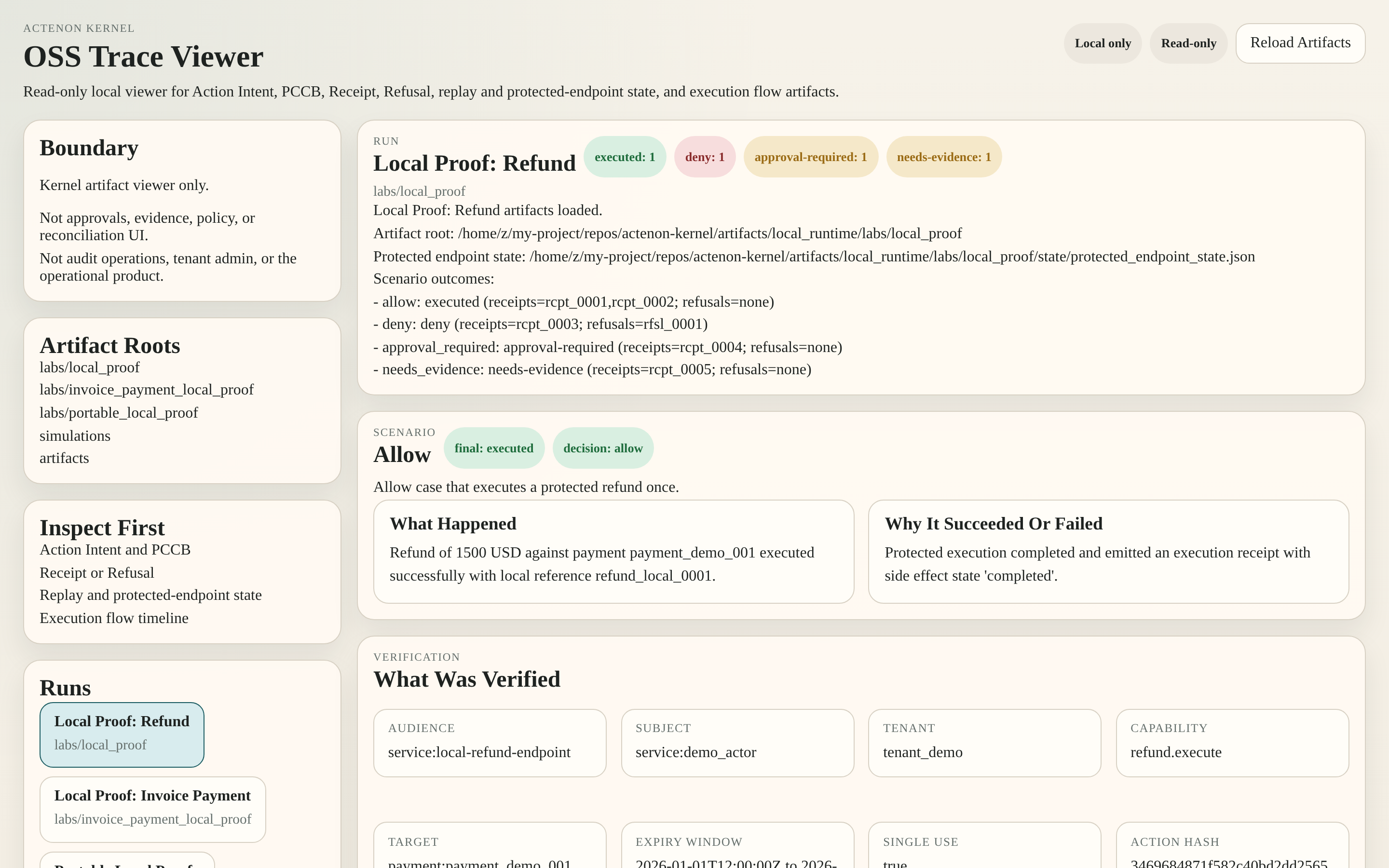
The viewer renders local artefacts produced by the repo's existing proof paths — Intent Record, Action Intent, PCCB, Receipt, Refusal, replay entries, protected-endpoint state, and execution flow reconstructed from those artefacts. It requires no hosted services, operator workflow state, or paid-layer runtime infrastructure. See TRACE_VIEWER.md.
Multi-agent execution model
In a multi-agent system, every additional hop between decision and execution creates more room for proof laundering — treating proof, approval state, or "allowed" context gathered upstream as if it were sufficient authorization for a different downstream execution edge. The Kernel's rule does not weaken because an orchestrator "already checked":
Each protected execution edge verifies its own proof before side effects.
A PCCB is bound to a specific audience, tenant, subject, action, target, scope, expiry, and nonce. Forwarding it across an agent boundary does not make it valid for a different tool. Full doctrine in MULTI_AGENT_EXECUTION_MODEL.md.
Key lifecycle & receipt durability
Issuer signing keys move through five states, each with explicit verification semantics:
| State | Can sign new artefacts? | Historical artefacts still verify? | Future artefacts verify? |
|---|---|---|---|
active | Yes | Yes | Yes |
retired | No | Yes | No |
suspended | No | Yes (unless retroactive policy) | No (during suspension) |
revoked (soft) | No | Yes, if issued before revoked_at | No |
hard_revoked | No | Only with independent external anchor | No |
Hard revoke is used only when key compromise means the issuer's own timestamps can no longer separate legitimate historical artefacts from backdated ones. The Kernel's external-anchor MVP lets a deployment preserve verifiability of historical artefacts even after hard revoke, without changing the issuer-signed bytes. Full lifecycle in REVOCATION_AND_RECEIPT_DURABILITY.md.
Compliance mappings (partial, honest)
The Kernel maps cleanly to the execution-edge portions of common frameworks. It is not a certification, a full crosswalk, or a claim of complete coverage.
| Framework | Where the Kernel helps | What it does not claim |
|---|---|---|
| OWASP Top 10 for LLM Applications | LLM01 Prompt Injection (reduces downstream damage), LLM05 Improper Output Handling, LLM06 Excessive Agency, LLM09 Misinformation, LLM10 Unbounded Consumption | Does not prevent prompt injection into the model/planner/orchestrator itself |
| OWASP Top 10 for Agentic Applications | ASI01 Goal Hijack, ASI02 Tool Misuse, ASI03 Identity & Privilege Abuse, ASI07 Insecure Inter-Agent Comms, ASI08 Cascading Failures, ASI10 Rogue Agents | Does not secure framework runtime outside the protected execution path |
| NIST AI RMF 1.0 | GOVERN 1, MAP 1, MEASURE 1 / 2.4 / 2.7 / 2.8 / 2.9, MANAGE 1 | Not a full measurement program; not enterprise risk register |
Full mapping in COMPLIANCE_MAPPING.md.
Conformance
actenon-kernel conformance run --require-complete
# → 53 tests pass. Mark: Actenon Verified (Conformance 1.1.0)
The active v1 compatibility surface is: Action Intent, PCCB, Receipt, Refusal, Protected Endpoint, Replay. Reserved surfaces (Reconciliation, Policy Bundle) are not active v1 conformance targets. Third-party verifier implementers should target these surfaces and run the same suite. See CONFORMANCE.md.
Audit responses
The repo ships an auditor-readable THREAT_MODEL.md and an AUDIT_RESPONSES.md that ties common diligence questions to specific source files:
- Payload tampering — strict RFC 8785 JCS canonicalisation; floats rejected; duplicate object keys rejected before canonicalisation.
- Clock drift — configurable, validated
clock_skew_toleranceonnot_beforeandexpires_at; strict zero by default. - Concurrency replay (double-spend) — atomic transactional claim against a unique
replay_keyin a durable store, plus mutation lock and monotonicity assertion. Verified under a 32-worker concurrency race: exactly one execution succeeds; the rest are refused withREPLAY_DETECTED.
No external cryptographic review has been performed. The self-review above is good practice but is not a substitute for an independent pair of eyes. See
docs/CRYPTO_REVIEW.mdfor the exact surfaces that need external review, the file pointers for each, and the specific questions a reviewer should answer.
What the Kernel does NOT do
Actenon gates explicit execution-edge actions; it does not inspect or filter prompts, model output, or in-band response content. It can require proof for an explicit export or transmit action, but it does not stop data disclosed inside ordinary output unless that disclosure is itself modeled and routed as a protected action.
- Act as an operating-system jail. It does not intercept syscalls, confine a process, sandbox native code, or stop a program that never calls
protect()orBoundaryVerifier. Hostile native code and same-user programs need OS isolation; Airlock's own docs say the same about the broker around this Kernel. - Issue grants or proofs — that's Permit's job.
- Name which powers a program uses — that's Scan's job. The Kernel checks a proof against an allow-list the caller declares (
capabilities=). - Resolve credentials — that's the broker's job.
- Execute provider calls — that's the adapter's job.
- Manage tenants — that's Cloud's job.
- Inspect prompts, model output, or in-band response content. It is not a prompt filter or general DLP.
- Prove that an upstream policy or approval was correct.
- Prove that a provider executed correctly on its end (it observes the provider response; it does not validate the provider's internal state).
- Stop a malicious or buggy adapter that lies after control passes to it.
- Replace production key custody or HSM-backed signing (the interface is ready; the deployment wires the provider).
The edge guarantee applies only when the protected edge is the only path to the resource, the backend accepts only brokered credentials issued after verification, and the agent has no standing credential or alternate route. Full scope in docs/SCOPE_AND_GUARANTEES.md.
Signing backends
| Backend | Status | Use case |
|---|---|---|
development_local_hmac | Dev-only | Local testing — NOT for production |
pilot_local_eddsa | Pilot-ready | Real Ed25519, key on disk. Requires ACTENON_ALLOW_PILOT_LOCAL_EDDSA_IN_PRODUCTION=1 |
external_managed | Interface ready | AWS KMS / GCP KMS / Azure Key Vault / HSM (PKCS#11). Deployment wires the provider. |
See the signing backends table above for the exact wiring paths. The full production integration guide is in this repo at docs/PRODUCTION_INTEGRATION.md (Apache-2.0, self-contained, does not require actenon-cloud).
What's in this repo
| Path | Purpose |
|---|---|
actenon/proof/ | PCCB minter, verifier, canonicalisation, signing |
actenon/boundary/ | BoundaryVerifier (resource-owned mode) |
actenon/receipts/ | Receipt + Refusal + Outcome Attestation |
actenon/replay/ | Atomic claim/consume/release against durable stores (SQLite, Postgres) |
actenon/escrow/ | Escrow-aware execution checks |
actenon/evidence/ | Local evidence-query support |
actenon/anchors/ | External-anchor verification |
actenon/policy/ | Policy preflight |
actenon/preflight/ | Action preflight checks |
actenon/conformance/ | 53 conformance vectors + suite |
actenon/cli.py | Unified CLI (actenon-kernel verify-proof, actenon-kernel up, actenon-kernel simulate, actenon-kernel conformance run) |
actenon/local_runtime.py | Local trust runtime (no external accounts) |
sdk/typescript/ | TypeScript verifier-only SDK (Go and Rust SDKs are standalone repos pinned in sdk/standalone-sdk-pins.json) |
examples/ | 20+ framework & platform adapters (see above) |
spec/ | Active v1 specs (11 surfaces) |
docs/incidents/ | Pattern-based incident library |
conformance/ | Hash-locked conformance vectors |
Independence
The Kernel depends only on actenon-protocol. It does not depend on Permit, Cloud, or Scan. A third-party proof that conforms to the Kernel's conformance vectors will be accepted by the Kernel verifier, regardless of who issued it. The verifier makes zero network calls during verification.
License
Apache-2.0 — see LICENSE.
Effect ownership at a protected edge
For consequential retry safety, configure EffectProtector from
actenon.execution.effects with a resource-owner namespace and the authority
engine's atomic ledger claim hook. Kernel recomputes the effect identity and
requires the signed extensions.effect reference to match the exact execution
attempt before acquiring credentials. An edge without this hook refuses
effect-bearing proofs. A trusted boundary must return matching effect_evidence
with COMMITTED, NOT_EXECUTED, or AMBIGUOUS certainty; transport success alone
does not establish a committed consequence. Ambiguity holds the reservation
until trusted reconciliation. See integration requirements and attack evidence.
Python resource boundaries and VerifierSDK also enforce mandatory signed effect constraints. Legacy escrow middleware refuses effect-bearing proofs. Verification never establishes that a consequence committed: receipt construction requires matching trusted effect evidence. See entry-point coverage and preserved attacks.
Reviews
No reviews yet
Be the first to review this server!
More Developer Tools MCP Servers
Rea
Freeby Morluto · Developer Tools
Reverse engineer anything from your terminal or agent with one CLI and MCP server.
Paperclip
Freeby Paperclipai · Developer Tools
Trending hip-hop artist momentum scores across four cultural dimensions.
Git
Freeby Modelcontextprotocol · Developer Tools
Read, search, and manipulate Git repositories programmatically
Fetch
Freeby Modelcontextprotocol · Developer Tools
Web content fetching and conversion for efficient LLM usage
Toleno
Freeby Toleno · Developer Tools
Toleno Network MCP Server — Manage your Toleno mining account with Claude AI using natural language.
MCP Marketplace
Freeby mcp-marketplace · Developer Tools
Search and install MCP servers from inside your AI client.