
Server data from the Official MCP Registry
Discover open-source AI agents and get source-owned installation instructions through MCP.
About
Discover open-source AI agents and get source-owned installation instructions through MCP.
Remote endpoints: streamable-http: https://registry.agentskit.io/api/mcp
Security Report
Valid MCP server (1 strong, 0 medium validity signals). No known CVEs in dependencies. Imported from the Official MCP Registry.
4 tools verified · Open access · No issues found
Security scores are indicators to help you make informed decisions, not guarantees. Always review permissions before connecting any MCP server.
Permissions Required
This plugin requests these system permissions. Most are normal for its category.
How to Connect
Remote Plugin
No local installation needed. Your AI client connects to the remote endpoint directly.
Add this to your MCP configuration to connect:
{
  "mcpServers": {
    "io-github-agentskit-io-agentskit-registry": {
      "url": "https://registry.agentskit.io/api/mcp"
    }
  }
}Documentation
View on GitHubFrom the project's GitHub README.
AgentsKit Registry
Profile: top-level-repository



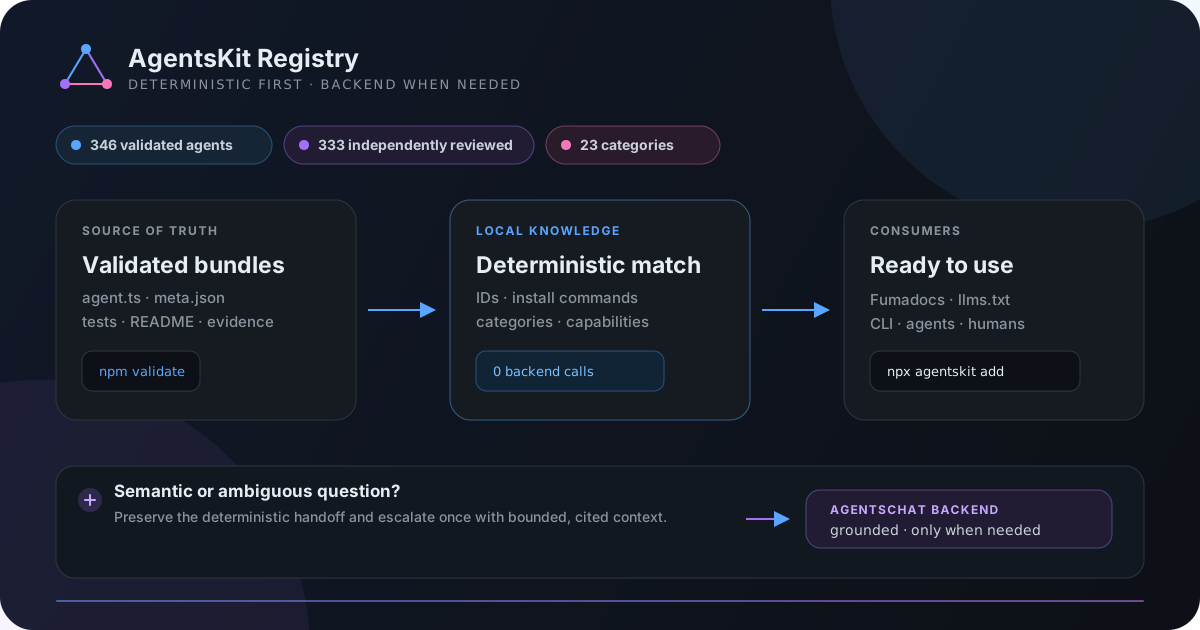
Copy a production-minded AI agent into your project and own the source. AgentsKit Registry is a shadcn-style catalog of 346 validated agents built with AgentsKit. It adds no Registry runtime and no lock-in: the CLI copies readable TypeScript that your team can review and edit.
It is intended for teams that want a ready agent starting point without adopting a proprietary registry runtime.
Tags: agentskit · agent-registry · typescript · ai-agents · shadcn-style
Topics: ai-agents · registry · developer-experience
Browse the Registry · Start in five minutes · Contribute an agent · Security · Governance · Code of Conduct
Verified proof
- Catalog counts come from
public/r/index.jsonandecosystem-claims.json. - Clean-fixture install/run contract:
npm run test:quickstart(scripts/quickstart.test.mjs). - Structural validation and Doc Bridge gates:
npm run validate,npm run docs:bridge:gate. - Deterministic discovery build:
npm run discovery:build. - Credential-free catalog proof:
node examples/verify-readme.mjs.
Validate agents in GitHub Actions
Use the Registry contract as a CI gate for copy-owned agent folders in another repository. The action checks required source, test, metadata, and README files; metadata IDs and referenced files; and the Registry content policy. It does not send source code to an API or require credentials.
name: Validate agents

on:
  pull_request:
  push:
    branches: [main]

jobs:
  agentskit:
    runs-on: ubuntu-latest
    steps:
      - uses: actions/checkout@v4
      - uses: AgentsKit-io/agentskit-registry@v1
        with:
          path: agents
The path input may point to one agent folder or to a directory whose immediate
children are agent folders.
Registry is beta. All 346 entries pass structural and repository tests; 333 also publish sanitized independent-review evidence. Templates remain code you must review against your provider, tools, data policy, and risk profile.
From catalog to code
flowchart LR
  F["Find by ID, category, or capability"] --> A["npx agentskit add <id>"]
  A --> C["Readable source copied locally"]
  C --> R["Review and adapt"]
  R --> S["Ship with your adapter and policy"]
npx agentskit add research
import { openai } from '@agentskit/adapters'
import { createResearchAgent } from './agents/research/agent'

const agent = createResearchAgent({
  adapter: openai({
    apiKey: process.env.OPENAI_API_KEY!,
    model: 'gpt-4o',
  }),
})

const result = await agent.run('What changed in the EU AI Act?')
console.log(result.content)
Swap the adapter, tools, memory, model, and policy through supported AgentsKit contracts. The copied factory stays ordinary application code.
What is actually here
- 346 validated, installable agents across 23 categories, from coding and security to legal, clinical, marketing, operations, support, and research.
- 333 independent-review summaries with scores, confidence, strengths, and required adjustments; private raw reviewer output is never published.
- Typed source + focused tests + usage guide for every installable entry.
- Eval replay fixtures for repeatable behavioral checks without live keys.
- JSON,
llms.txt, MCP, and deterministic discovery artifacts for people, tools, and LLMs to navigate the same canonical catalog.
Claims are derived from public/r/index.json and the
generated ecosystem-claims.json, not hand-maintained
marketing copy.
Discovery without unnecessary backend calls
Exact agent IDs, titles, install commands, categories, capabilities, contribution links, and ecosystem navigation resolve from a signed local artifact. Semantic requests such as “which agent fits my incident workflow?” escalate through AgentsKit Chat to the trusted cited backend only after a validated local miss.
See architecture and ownership for the full boundary.
Repository ownership
This repository owns catalog data and generated machine artifacts. The live
Fumadocs application and its AgentsChat presentation live in
AgentsKit-io/agentskit/apps/registry.
AgentsKit owns runtime primitives and the CLI; AgentsKit Chat owns the shared
answer protocol and renderer behavior. There is no second framework here.
Contributing
New agents and improvements are welcome. Follow CONTRIBUTING.md, use a neighboring validated agent as a reference, and run:
npm run validate
npm run lint
npm test
npm run eval:run -- --ecosystem-doc-bridge
npm run build
npm run docs:bridge:gate
Generated indexes, claims, deterministic artifacts, and Doc Bridge handoffs must remain fresh in the pull request.
Maturity
Registry is beta. All 346 entries pass structural and repository tests; 333 also publish sanitized independent-review evidence. Templates remain code you must review against your provider, tools, data policy, and risk profile.
AgentsKit ecosystem
- AgentsKit — build the agent runtime.
- Registry — start from owned, ready-made source.
- AgentsKit Chat — deliver one agent experience across Web, native, and terminal interfaces.
- Agents Playbook — apply production engineering and review discipline.
- Doc Bridge — turn documentation into executable agent handoffs.
- Code Review — run deep, low-noise review with the model already in use.
- AgentsKit OS — operate and govern agents.
Compatibility and license
Registry source targets the package ranges declared by each meta.json; the
repository CI currently runs on Node.js 22. Review an agent's generated bundle
before upgrading its dependencies. Licensed under MIT.
Reviews
No reviews yet
Be the first to review this server!
More Developer Tools MCP Servers
Paperclip
Freeby Paperclipai · Developer Tools
Trending hip-hop artist momentum scores across four cultural dimensions.
Netdata
Freeby Netdata · Developer Tools
Real-time infrastructure monitoring with metrics, logs, alerts, and ML-based anomaly detection.
Toleno
Freeby Toleno · Developer Tools
Toleno Network MCP Server — Manage your Toleno mining account with Claude AI using natural language.
mcp-creator-python
Freeby mcp-marketplace · Developer Tools
Create, build, and publish Python MCP servers to PyPI — conversationally.
MCP Marketplace
Freeby mcp-marketplace · Developer Tools
Search and install MCP servers from inside your AI client.
MarkItDown
Freeby Microsoft · Content & Media
Convert files (PDF, Word, Excel, images, audio) to Markdown for LLM consumption