
Server data from the Official MCP Registry
Compare on-demand compute + storage pricing across AWS, Azure, and GCP. Bulk workload compare.
About
Compare on-demand compute + storage pricing across AWS, Azure, and GCP. Bulk workload compare.
Security Report
cloudprice-mcp is a well-structured pricing comparison MCP server with clean code, proper error handling, and appropriate permissions for its purpose. The server reads bundled pricing data and makes no external network calls, eliminating data exfiltration risks. No authentication is required, which is acceptable for a read-only pricing lookup tool. Minor code quality observations exist but do not impact security. Supply chain analysis found 3 known vulnerabilities in dependencies (0 critical, 3 high severity). Package verification found 1 issue.
7 files analyzed · 7 issues found
Security scores are indicators to help you make informed decisions, not guarantees. Always review permissions before connecting any MCP server.
Permissions Required
This plugin requests these system permissions. Most are normal for its category.
How to Install
Add this to your MCP configuration file:
{
  "mcpServers": {
    "io-github-alialbaker-cloudprice-mcp": {
      "args": [
        "cloudprice-mcp"
      ],
      "command": "uvx"
    }
  }
}Documentation
View on GitHubFrom the project's GitHub README.
cloudprice-mcp




The FinOps MCP server. Gives Claude, GitHub Copilot, Cursor, Windsurf, Cline, Continue, Zed — or any MCP-compatible AI — structured pricing data and analysis primitives across AWS, Azure, GCP, and OCI. AI clients use cloudprice-mcp to compute Reserved Instance break-even, multi-cloud workload TCO, exit-cost migration analyses, snapshot cost modeling, and egress arbitrage — the kind of FinOps decisions that normally live in three browser tabs and a half-built spreadsheet.
25 tools covering compute, block storage, object storage, managed Postgres, egress (internet + inter-region with OCI's 10 TB free tier surfaced explicitly), Multi-AZ workloads, snapshots with realistic incremental modeling, Reserved Instance / Savings Plan discounts, FinOps decision suite (migration, commitment, TCO, egress arbitrage), multi-cloud spot pricing with eviction tradeoffs, multi-cloud price history (the only public weekly-refreshed dataset of its kind), a stateless cost drift sentinel for scheduled agents, multi-cloud carbon footprint ($ AND kg CO2e on the same query), multi-cloud GPU pricing (T4 / A10 / L4 / L40S / V100 / A100 / H100 across all 4 clouds), cross-provider LLM token pricing (Claude / GPT / Gemini / Llama / Mistral / DeepSeek across Anthropic / OpenAI / Bedrock / Vertex / Azure OpenAI), statistical price-anomaly detection over the weekly snapshot archive (z-score + percent-change, auto-selected by dataset density), and CFO-grade FinOps decision report generation (markdown reports with executive summary, cost table, carbon, audit trail, honest gaps). OCI Always Free tier (4 OCPU compute, 20 GB object storage, 10 TB egress) surfaced as $0 line items where it applies.
One-line install configures every AI client you have: pip install cloudprice-mcp && cloudprice-mcp setup — auto-detects Claude Desktop, GitHub Copilot Agent Mode, Cursor, Windsurf, Cline, Continue.dev, and Zed, then asks Y/N before writing each config.
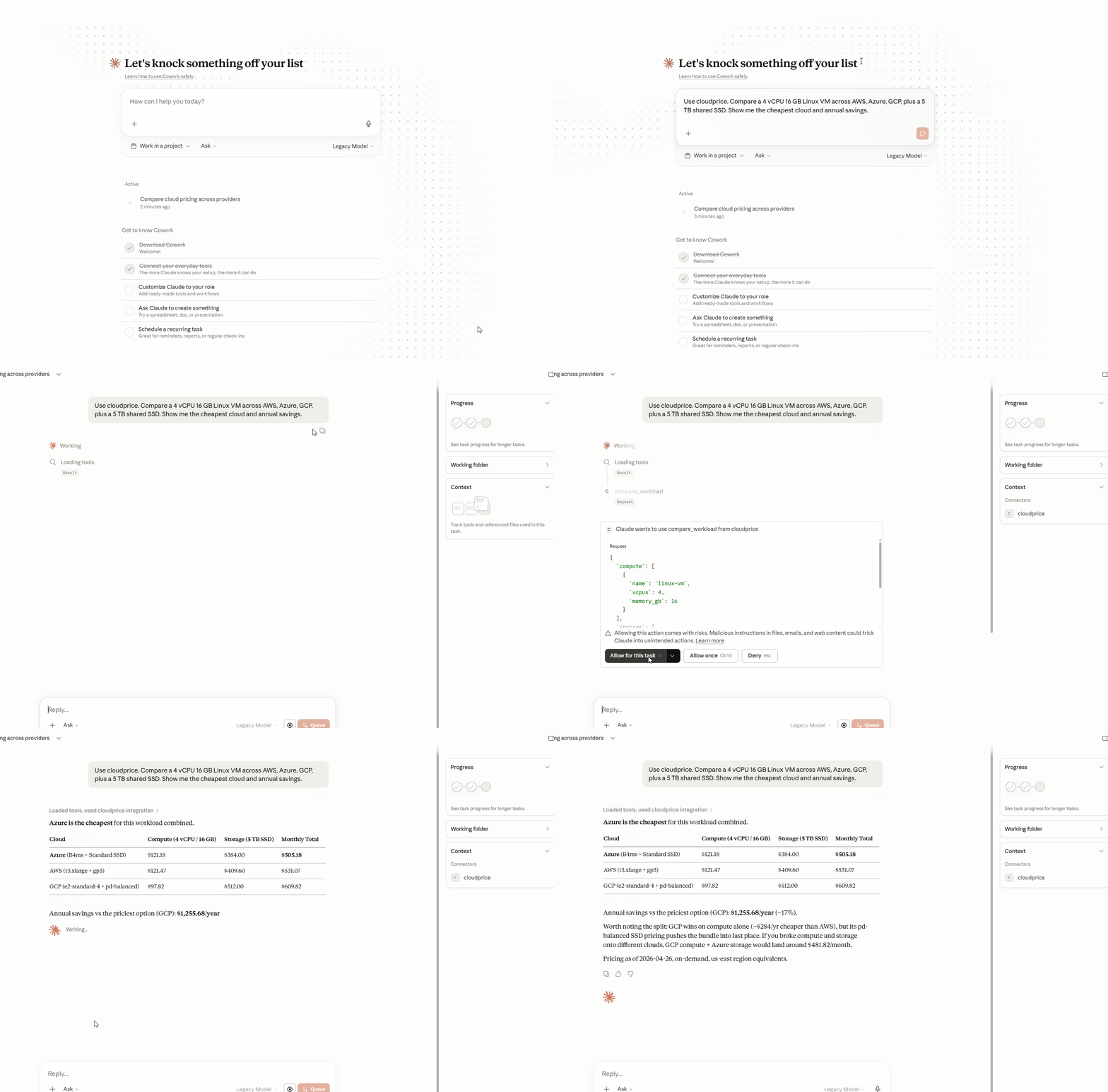
What does FinOps look like with cloudprice-mcp?
Real questions teams actually ask. Paste any of these into Claude / Copilot / Cursor with cloudprice-mcp loaded:
"I have 6× t3.2xlarge running on AWS. Compare the 3-year total cost on-demand vs 1-year Savings Plan vs 3-year RI partial upfront. What's the break-even month?" → AI calls
compare_workload, pulls list-price baseline, layers AWS's published RI rates, returns dollar break-even. ~7-month payback typical.
"I'm thinking about offloading 5 TB of cold-tier object storage from AWS S3 to a cheaper provider. Compare archive-tier cost across all 4 clouds, factor in AWS exit egress, and tell me the payback period." → AI calls
compare_object_storage+compare_egress, computes one-time exit cost vs ongoing savings. Often surfaces "don't move — AWS Glacier Deep Archive is already tied for cheapest".
"At 50 TB/month internet egress, where am I cheapest? Show the 3-year savings of moving." →
compare_egress→ OCI ~$340/mo, AWS/Azure/GCP ~$4,000/mo. The 12× difference is OCI's 10 TB free tier — a real moat for content/CDN workloads.
"Size a 3-tier SaaS workload: 8 web (4/16), 12 app (8/32), 4 DB (16/64), 5 TB shared SSD, 50 TB HDD bulk, 10 TB/month egress. Compare full-stack monthly cost across all 4 clouds with multi-AZ and 1-year commitment." → AI chains
compare_workload+compare_egress, applies multi-AZ multiplier (×2 compute) + commitment discount.
What you get back: dollar numbers traceable to a public catalog, AI-explained tradeoffs, payback periods, and the kind of "don't do that" recommendation that kills bad migrations before they happen. No console-clicking. No tab-switching between three pricing calculators. No FinOps spreadsheet that goes stale the moment a new SKU drops.
Install
Recommended (auto-config):
pip install cloudprice-mcp
cloudprice-mcp setup     # auto-configures every detected MCP client, asks Y/N before writing
Then fully restart whichever clients were configured. 10 tools appear in each. Done.
Trust spectrum:
| Command | When to use |
|---|---|
cloudprice-mcp setup | Default — detects every installed client, shows the plan, asks Y/N once |
cloudprice-mcp setup --yes | Skip prompt (CI / scripts) |
cloudprice-mcp setup --client copilot | Configure a specific client (repeatable: --client copilot --client cursor) |
cloudprice-mcp setup --all | Configure every known client even if not detected |
cloudprice-mcp setup --force | Refresh existing entries — useful after upgrade or moving Python |
cloudprice-mcp setup --dry-run | Show per-client diffs without writing |
cloudprice-mcp setup --print-config | Emit per-client JSON to stdout for manual paste |
cloudprice-mcp setup --list-clients | Detection table — which clients are known + installed on this system |
| Manual edit | Don't trust running new tools — see INSTALL.md per-client sections |
If something doesn't work, run:
cloudprice-mcp doctor
It tells you exactly what's broken (Python version, install path, config location, tool registration, command path validity).
Python 3.10+ required.
For step-by-step manual install (Windows / macOS / Linux), see INSTALL.md.
Tools exposed
Single-spec lookups (v0.1)
| Tool | What it does |
|---|---|
get_aws_price | Look up an EC2 instance type → vCPUs, memory, hourly + monthly USD (us-east-1) |
get_azure_price | Look up an Azure VM size → vCPUs, memory, hourly + monthly USD (eastus) |
get_gcp_price | Look up a GCP Compute Engine machine type → vCPUs, memory, hourly + monthly USD (us-east1) |
compare_clouds | Given a target spec (vCPUs + GB), return the cheapest matching SKU across AWS / Azure / GCP / OCI, sorted by monthly cost, with savings summary |
Bulk + workload compare (v0.2)
| Tool | What it does |
|---|---|
compare_compute_inventory | Bulk-compare a list of compute workloads (each with vCPUs / memory / quantity / hours / optional OS disk) across all 4 clouds. Returns per-row matches, per-cloud totals, cheapest cloud. |
compare_storage_inventory | Bulk-compare a list of block-storage volumes (each with capacity / disk type / quantity) across all 4 clouds. |
compare_workload | Combined compute + block storage in one call. Mirrors a two-sheet sizing workbook (compute BoM + storage BoM). Optional commitment overlay applies 1-year (30%) or 3-year (50%) compute discount. |
Object storage + managed Postgres (v0.3)
| Tool | What it does |
|---|---|
compare_object_storage | Bulk-compare object-storage buckets across AWS S3 / Azure Blob / GCP Cloud Storage / OCI Object Storage. Each row specifies capacity_gb + tier (hot / cool / archive). OCI Always Free 20 GB tier surfaced explicitly — capacity ≤ 20 GB on OCI hot tier returns $0/mo. |
compare_postgres_database | Bulk-compare managed PostgreSQL pricing across AWS RDS / Azure Database for PostgreSQL / GCP Cloud SQL / OCI Database with PostgreSQL. Each row specifies vCPUs / memory / storage_gb. Storage cost is calculated separately from compute. |
FinOps decision suite (v0.6, NEW)
Four named tools that turn cross-cloud pricing into FinOps decisions in one call instead of letting the AI chain three+ tools. All four consume a structured workload inventory (compute / storage / object_storage / databases / egress) plus tool-specific options.
| Tool | What it does |
|---|---|
assess_migration | "Should I move?" — projects per-target cloud cost, savings %, one-time exit egress cost, payback months. Returns a ranked recommendation by 3-year TCO with triggered caveats (e.g., "OCI A1.Flex is ARM — verify your AMIs"). |
optimize_commitment | "When does my RI / SP / CUD pay back?" — six commitment scenarios (none / 1yr_no_upfront / 1yr_all_upfront / 3yr_no_upfront / 3yr_partial_upfront / 3yr_all_upfront) with per-scenario monthly cost, upfront, 3-year total, savings %, payback months. Recommends the lowest 3-year TCO option. |
compare_total_cost_of_ownership | "What's my 3-year cost across clouds?" — multi-year projection with linear YoY growth assumptions for compute / storage / egress. Returns cumulative TCO per cloud, year-by-year breakdown, sensitivity analysis on the dominant variable. The kind of number that goes into board decks. |
find_egress_arbitrage | "Where do I save on data transfer?" — specialized assess_migration scoped to egress only. Surfaces the OCI 12× moat: at 50 TB/month internet egress, OCI is ~$340 vs $4,000+ on the hyperscalers. |
All four tools accept a WorkloadInventory shape that mirrors a 4-section sizing sheet (compute / storage / object_storage / databases / egress) plus optional commitment, multi_az, and one_time.data_to_migrate_gb fields. Output includes honest_gaps — explicit list of what each tool does NOT model — to prevent over-trust.
Egress + Multi-AZ + better snapshots (v0.5, NEW)
| Tool / Feature | What it does |
|---|---|
compare_egress | Compare data-transfer costs across all 4 clouds. Two directions: out_to_internet (tiered pricing with free-tier credits — AWS/Azure 100 GB, OCI 10 TB) and inter_region (cross-region within the same cloud). At 50 TB/month internet egress, OCI is ~12× cheaper than the hyperscalers — a real moat for content/CDN workloads. |
compare_workload multi_az: true | New flag doubles compute totals on every cloud to model Multi-AZ / HA deployments (sync replicas across two zones). Storage stays at 1× because object/block storage is usually cross-AZ at base price. |
snapshot_incremental_factor | New per-row field on storage and OS-disk snapshots. Default 1.0 keeps the v0.2 upper-bound estimate. Set to 0.3 for typical real-world incremental dedup, or 0.0 to exclude snapshots from the total. |
Example: compare_workload input shape
{
  "compute": [
    { "name": "web", "tier": "Web", "vcpus": 4, "memory_gb": 16, "quantity": 8,  "os_disk_gb": 100, "os_disk_type": "ssd" },
    { "name": "app", "tier": "App", "vcpus": 8, "memory_gb": 32, "quantity": 12, "os_disk_gb": 200, "os_disk_type": "ssd" },
    { "name": "db",  "tier": "DB",  "vcpus": 16, "memory_gb": 64, "quantity": 4, "os_disk_gb": 500, "os_disk_type": "ssd" }
  ],
  "storage": [
    { "name": "shared-fast", "tier": "DB",  "capacity_gb": 5000,  "disk_type": "ssd" },
    { "name": "shared-bulk", "tier": "App", "capacity_gb": 50000, "disk_type": "hdd" }
  ]
}
Snapshots (v0.2.1)
snapshot_count on storage rows and os_disk_snapshot_count on compute rows are now priced. Snapshot rates per cloud per disk type are bundled (~$0.05/GB-mo for AWS/Azure, ~$0.026/GB-mo for GCP).
Caveat — upper-bound estimate: snapshots are priced as snapshot_per_gb_month × full_capacity × quantity × snapshot_count. Real-world snapshots are incremental (only changed blocks), so actual cost is typically 20-50% of this model's number. If snapshots dominate your total, ask the cloud's calculator for a tighter estimate.
iops and throughput_mbs on storage rows are still accepted as metadata only — not used for SKU matching in this release.
Reserved Instance / Savings Plan estimator (v0.2.1)
compare_workload accepts an optional commitment parameter:
| Value | Compute discount | Use case |
|---|---|---|
none (default) | 0% | On-demand only |
1yr_no_upfront | 30% | 1-year AWS Savings Plan / Azure RI / GCP CUD (no upfront) |
3yr_partial_upfront | 50% | 3-year, partial upfront — typical "we know our baseline" deals |
Storage and snapshots are not discounted (most clouds don't offer meaningful storage commitments). Discount tiers are conservative averages — your actual rate depends on instance family, payment option, and region.
Pricing data
Prices are bundled as a curated dataset of common SKUs across 4 clouds:
- Compute (~50 VM SKUs across AWS / Azure / GCP / OCI, including OCI A1 Always Free + A2 Arm Ampere + E5 Flex)
- Block storage (SSD + HDD per cloud)
- Object storage (Hot / Cool / Archive tiers per cloud, including OCI Always Free 20 GB)
- Managed PostgreSQL (RDS / Azure DB / Cloud SQL / OCI Database with PostgreSQL)
Auto-refreshed weekly (v0.7+)
The bundled catalog is refreshed every Sunday by a GitHub Action that hits each cloud's public pricing API:
- AWS — Pricing API (via boto3, OIDC-authenticated)
- Azure — Retail Prices API (public, no auth)
- OCI — Public pricing API (public, no auth)
- GCP — Cloud Billing Catalog API (via API key —
GCP_API_KEYenv var). Added in v0.8.0 - Bedrock LLM token prices — AWS Pricing API
AmazonBedrockservice code (via boto3, same OIDC role). Added in v0.15.0 — refreshes input/output token rates for every Bedrock-hosted model we track (Claude 4 Opus/Sonnet, Claude 3/3.5 Haiku, Llama 3.1/3.3, Mistral Large 2, DeepSeek R1) - Extended LLM catalog — LiteLLM's
model_prices_and_context_window.json(MIT-licensed, community-maintained, unauthenticated). Added in v0.16.0 — ingests ~2000 (model, provider) combinations covering Together AI, Fireworks, Groq, Replicate, Perplexity, regional Bedrock/Azure variants, older model versions. Powers thelookup_extended_model_pricingtool. Curated hand-vetted prices (compare_token_pricing) and extended (lookup_extended_model_pricing) are deliberately separate so users always know which catalog they're hitting.
Each refresh writes a dated snapshot to src/cloudprice_mcp/data/prices/YYYY-MM-DD.json and src/cloudprice_mcp/data/token_prices/YYYY-MM-DD.json — every JSON ever published lives in the repo. The history archive is MIT-licensed and grows with every release.
Every tool result includes the catalog's as_of field so you know exactly which prices were used.
Public price history dataset (v0.7.1+)
cloudprice-mcp is the only FinOps tool we know of that preserves every weekly snapshot. You can query "what did m5.xlarge cost in May?" — neither AWS Calculator nor GCP Estimator can answer that because their pages always show today.
Query the history from the CLI:
cloudprice-mcp history --cloud oci --sku VM.Standard.E5.Flex.4OCPU
# oci/VM.Standard.E5.Flex.4OCPU (us-ashburn-1) — 2 data point(s)
#
# AS_OF          HOURLY USD
# --------------------------
# 2026-04-26   $    0.67600
# 2026-05-12   $    0.18400
#
# Change: -72.78% ($-0.49200/h)
The -72.78% drop is the v0.7.0 auto-refresh fixing a hand-curated inaccuracy in the prior OCI catalog — proof that the auto-refresh story works.
Query the history from AI assistants via two new MCP tools:
get_price_history(cloud, sku, since?)— full timeseries + change statslist_tracked_skus(cloud?, since?)— every (cloud, sku) pair we have history for
Real questions this unlocks:
"Has AWS m5.xlarge changed price in the last quarter?" → AI calls
get_price_history, returns timeseries with start/end prices and % change.
"Show me every multi-cloud price mover since January." → AI calls
list_tracked_skus(since="2026-01-01"), returns every SKU + its latest price + change.
Cross-provider LLM token pricing (v0.12.0+)
Token costs are the fastest-growing FinOps line item in 2026 — and nobody compares them cross-provider openly. The same model is often available on multiple providers at different prices (Claude on Anthropic / Bedrock / Vertex; GPT on OpenAI / Azure OpenAI; Llama on Bedrock).
from cloudprice_mcp.finops.tokens import compare_token_pricing

# Cheapest model overall for a 50M-in / 10M-out monthly workload
r = compare_token_pricing(
    monthly_input_tokens=50_000_000,
    monthly_output_tokens=10_000_000,
)
# gemini-1.5-flash on google is cheapest at $6.75/mo for 50M in / 10M out tokens.
#   gemini-1.5-flash       on google        $   6.75/mo
#   gemini-1.5-flash       on vertex        $   6.75/mo
#   gemini-2.0-flash       on google        $   9.00/mo
#   llama-3.1-8b           on bedrock       $  13.20/mo
#   gpt-4o-mini            on openai        $  13.50/mo
#   deepseek-v3            on deepseek      $  24.50/mo
# Same model across all hosts — proves Claude 4 Sonnet provider parity
# (and surfaces that only Anthropic API publishes the 90%-off cache_read rate)
r = compare_token_pricing(model_id="claude-4-sonnet")
#   anthropic   in=$3/1M  out=$15/1M  cache_read=$0.30/1M  cache_write=$3.75/1M
#   bedrock     in=$3/1M  out=$15/1M
#   vertex      in=$3/1M  out=$15/1M
Covers 19 models across 8 providers: Claude (4 Opus / 4 Sonnet / 3.5 Haiku / 3 Haiku), GPT (5, 5 mini, 4o, 4o-mini, o1), Gemini (2.0 Flash, 1.5 Pro/Flash), Llama (3.1 8B/70B/405B, 3.3 70B), Mistral Large 2, DeepSeek V3/R1.
Real questions this unlocks:
"Cheapest model that handles 200K context for output-heavy chat at 10M/mo output volume?" → AI calls
compare_token_pricingwith the volume + an optional model_family filter, returns ranked monthly cost across every viable model+provider combo.
"Should I use Anthropic API or Bedrock for Claude?" →
compare_token_pricing(model_id="claude-4-sonnet")shows price parity on per-token rates, but Anthropic API exposes a 10x cheaper cache_read rate that Bedrock doesn't publish. For caching-heavy workloads, Anthropic wins.
Multi-cloud GPU pricing (v0.11.0+)
The fastest-growing cloud cost category — and nobody compares it cross-cloud openly.
from cloudprice_mcp.finops.gpu import compare_gpu_workload
from cloudprice_mcp.pricing import load_catalog

r = compare_gpu_workload(load_catalog(), gpu_type="H100", gpu_count=8)
# OCI BM.GPU.H100.8 is cheapest at $80.0000/h for 8x H100.
#   oci    BM.GPU.H100.8                  $ 80.0000/h  $10.0000/GPU/h
#   gcp    a3-highgpu-8g                  $ 84.4000/h  $10.5500/GPU/h
#   aws    p5.48xlarge                    $ 98.3200/h  $12.2900/GPU/h
#   azure  ND96isr_H100_v5                $ 98.3200/h  $12.2900/GPU/h
Covers NVIDIA T4, A10, A10G, L4, L40S, V100, A100, H100 across all 4 clouds. Returns:
- Absolute hourly winner — the cheapest matching SKU per cloud
- Per-GPU efficiency winner — sometimes a different cloud (e.g., OCI's BM.GPU4.8 is cheapest per GPU but only sold as 8x, so for
gpu_count=1Azure/GCP win the absolute ranking) - Over-provisioning flags — when the only matching SKU bundles more GPUs than asked for
- GPU memory — differentiates A100 40GB vs 80GB (same
gpu_typefield)
The OCI H100 finding is real: at 8x H100 it's ~19% cheaper than AWS/Azure for identical hardware.
Cost Drift Sentinel (v0.9.0+)
The shift from query tool to agent capability. Most FinOps tools answer "what does this cost?" — this one answers "is this still what it cost when I signed off on it?"
from cloudprice_mcp.finops.sentinel import watch_workload
from cloudprice_mcp.inventory import parse_dict
from cloudprice_mcp.pricing import load_catalog

# First call — captures a baseline. Persist the returned baseline JSON.
result = watch_workload(load_catalog(), parse_dict(workload_spec))
save(result["baseline"])

# Later — pass the baseline back to detect drift.
report = watch_workload(load_catalog(), parse_dict(workload_spec), baseline=load_baseline())
if report["alert_triggered"]:
    notify_humans(report["headline"])
Stateless by design — no server, no database. The baseline JSON lives wherever you want: a file in your IaC repo, S3, Slack DM, anywhere. Each call is a pure function of (catalog, workload, baseline).
Key properties:
- Workload-hash protected — if you change the workload spec, the hash mismatches and you get a fresh baseline rather than a misleading drift report
- SKU-level attribution — the drift report consults the price-history dataset and surfaces which SKUs moved the most between baseline and now
- Configurable threshold — default 5%; pass
alert_threshold_pct=Nto tune
Plug-and-play GitHub Action template at examples/cloudprice-watch.yml — drop it in any IaC repo with a workload.json, get auto-opened GitHub issues when costs drift. Baseline is committed to your repo so the history is auditable.
Carbon-aware FinOps (v0.10.0+) — kg CO2e per workload, alongside USD
The only FinOps MCP tool that returns both cost AND carbon footprint on the same query. AWS / Azure / GCP each publish their own customer dashboards (Customer Carbon Footprint Tool, Emissions Impact Dashboard, Carbon Footprint) — but none compare across providers. cloudprice does.
from cloudprice_mcp.finops.carbon import compare_carbon_footprint
from cloudprice_mcp.pricing import load_catalog

result = compare_carbon_footprint(load_catalog(), vcpus=8, memory_gb=32, quantity=6)
# Returns per-cloud SKU + cost + power class (x86/ARM) + monthly kWh +
# grid-based kg CO2e + market-based residual kg CO2e (after renewable matching),
# ranked cheapest-carbon-first.
What's modeled (and disclosed in every response):
- PUE per cloud from each provider's public sustainability report
- Grid carbon intensity per region from public emissions data (EPA eGRID for US, similar baselines elsewhere)
- Renewable matching per provider (AWS/Azure 100%, GCP ~64% CFE, OCI unmatched outside EU)
- ARM vs x86 power class — ARM SKUs (Graviton, Ampere, Axion) modeled at ~30% lower per-vCPU power
- Two carbon numbers per cloud: location-based (grid) AND market-based (residual after renewable matching) — both surfaced so auditors can see both perspectives
What's NOT modeled (always disclosed via honest_gaps[]):
- Embodied carbon (server manufacturing) — operational only
- GPU / network / storage power — compute + memory only
- Time-of-use grid variation — annual averages only
- Real-time 24/7 CFE matching — GCP publishes annual CFE %; cloudprice uses that
Real questions this unlocks:
"What's the lowest-carbon cloud for 4 vCPU / 16 GB at 6 instances?" → AI calls
compare_carbon_footprint, returns per-cloud kg CO2e/mo ranked.
"How much carbon do I save running on ARM vs x86?" → AI calls it twice with the same shape but different target SKUs.
What's NOT modeled (real-world TCO killers)
- ✅
Egress / data transfer— modeled in v0.5 (compare_egress) - ✅
Multi-AZ / HA replicas— modeled in v0.5 (multi_az: trueoncompare_workload) - ✅
Snapshots upper-bound only— fixed in v0.5 (snapshot_incremental_factor) - Reserved/Savings Plan SKU detail (we apply a flat tier discount, not per-region/per-family detail) — roadmap
- Multi-region pricing (currently us-east only; us-west / eu-west planned for v0.5.1) — roadmap
- IOPS-based storage matching (capacity-only) — roadmap
- Backup storage charges (some clouds free, others billed) — roadmap
- Request costs (PUT/GET pricing for object storage) — roadmap
- Retrieval costs for archive tiers (Glacier-style retrieval can be 10× the storage cost) — roadmap
- VPC peering / interconnect costs — roadmap
These are tracked roadmap items. Use cloudprice-mcp for the on-demand list-price baseline; do final TCO analysis with each cloud's own calculator before relying on numbers for big decisions.
Live runtime pricing (not just weekly refresh) is being considered for v0.8 — would fetch prices directly at MCP tool invocation time instead of from the bundled catalog. Trade-offs: slower (network call per tool use), adds GCP auth requirement, breaks offline mode. The v0.7 weekly auto-refresh covers ~95% of the credibility win at zero runtime cost; live mode is opt-in territory.
Develop locally
git clone https://github.com/Albaker-Group/cloudprice-mcp.git
cd cloudprice-mcp
pip install -e ".[dev]"
pytest
To point Claude Desktop at your dev copy, swap the command in the config:
{
  "mcpServers": {
    "cloudprice": {
      "command": "python",
      "args": ["-m", "cloudprice_mcp.server"]
    }
  }
}
License
MIT — see LICENSE.
Credits
Built by Ali Albaker, multi-cloud architect — runs a live three-cloud portfolio at ~$1.80/month across AWS, Azure, and GCP, with OCI joining as the 4th cloud in 2026.
Reviews
No reviews yet
Be the first to review this server!
More Developer Tools MCP Servers
Paperclip
Freeby Paperclipai · Developer Tools
Trending hip-hop artist momentum scores across four cultural dimensions.
Git
Freeby Modelcontextprotocol · Developer Tools
Read, search, and manipulate Git repositories programmatically
Toleno
Freeby Toleno · Developer Tools
Toleno Network MCP Server — Manage your Toleno mining account with Claude AI using natural language.
mcp-creator-python
Freeby mcp-marketplace · Developer Tools
Create, build, and publish Python MCP servers to PyPI — conversationally.
MCP Marketplace
Freeby mcp-marketplace · Developer Tools
Search and install MCP servers from inside your AI client.
MarkItDown
Freeby Microsoft · Content & Media
Convert files (PDF, Word, Excel, images, audio) to Markdown for LLM consumption