
Server data from the Official MCP Registry
Turn an OpenAPI spec into WireMock stubs, contract tests and chaos scenarios, on local LLMs.
About
Turn an OpenAPI spec into WireMock stubs, contract tests and chaos scenarios, on local LLMs.
Security Report
Valid MCP server (2 strong, 2 medium validity signals). No known CVEs in dependencies. Package registry verified. Imported from the Official MCP Registry.
8 files analyzed · 1 issue found
Security scores are indicators to help you make informed decisions, not guarantees. Always review permissions before connecting any MCP server.
Permissions Required
This plugin requests these system permissions. Most are normal for its category.
What You'll Need
Set these up before or after installing:
Environment variable: SHAKEDOWN_PROVIDER
Environment variable: SHAKEDOWN_MODEL
Environment variable: SHAKEDOWN_OLLAMA_URL
Environment variable: OPENAI_API_KEY
Environment variable: ANTHROPIC_API_KEY
How to Install
Add this to your MCP configuration file:
{
  "mcpServers": {
    "io-github-anzar-ahsan-commits-api-shakedown": {
      "env": {
        "OPENAI_API_KEY": "your-openai-api-key-here",
        "SHAKEDOWN_MODEL": "your-shakedown-model-here",
        "ANTHROPIC_API_KEY": "your-anthropic-api-key-here",
        "SHAKEDOWN_PROVIDER": "your-shakedown-provider-here",
        "SHAKEDOWN_OLLAMA_URL": "your-shakedown-ollama-url-here"
      },
      "args": [
        "-i",
        "--rm",
        "api-shakedown"
      ],
      "command": "uvx"
    }
  }
}Documentation
View on GitHubFrom the project's GitHub README.
API Shakedown
Give it an OpenAPI spec. Get back a ready-to-run test harness: WireMock stubs, contract tests, robustness probes, and chaos scenarios, written by a team of LLM agents that review each other's work.




Runs locally on Ollama by default: no API key, no data leaves your machine. Cloud models (OpenAI, Anthropic) are bring-your-own-key. Available as a CLI, a Docker image, and an MCP server so an AI assistant can drive it.
Status: alpha (0.1.2). Works end to end on the example spec with a local 8B model.
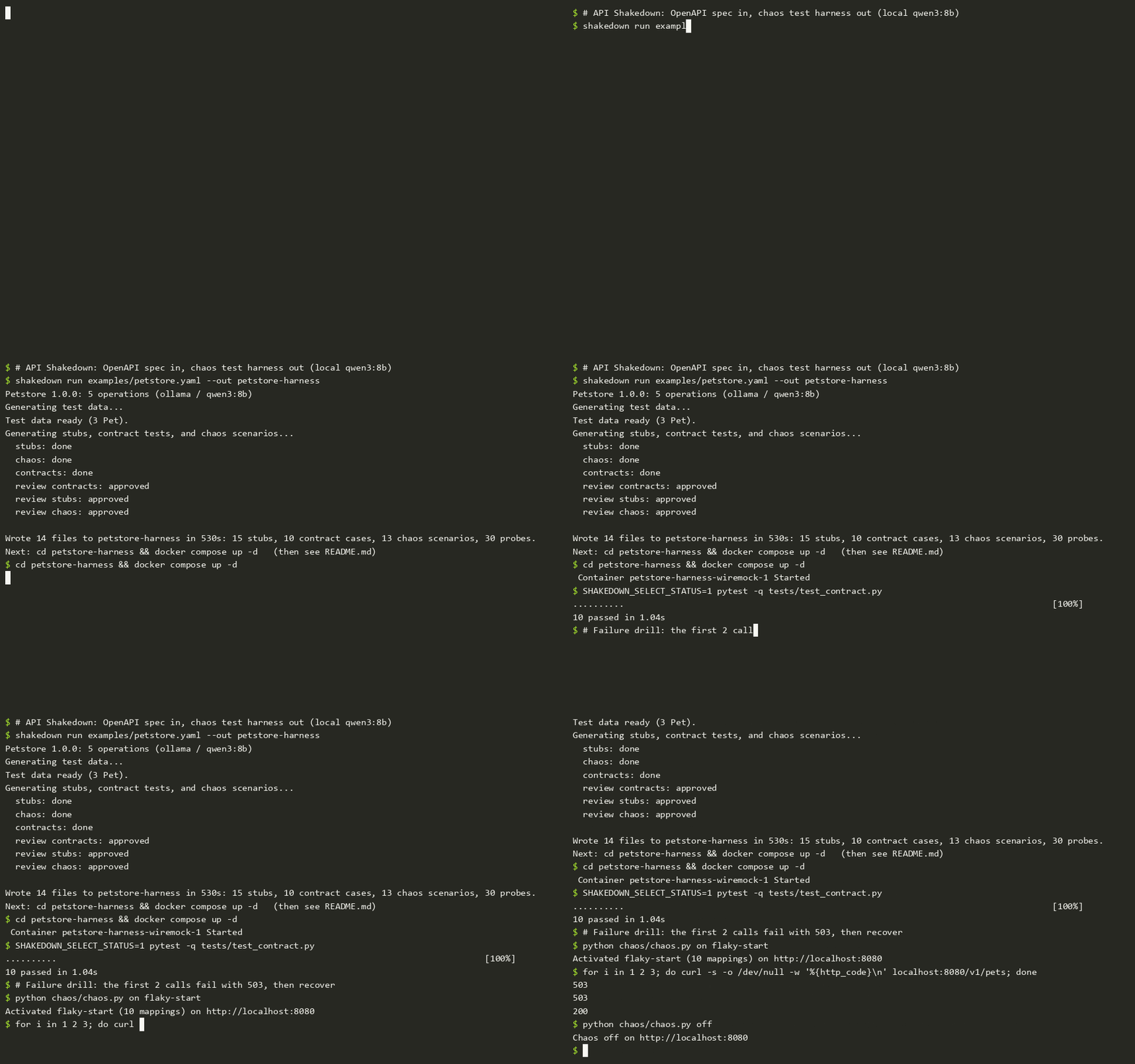
A real run on the bundled example with qwen3:8b on a laptop, sped up: generation
took about 9 minutes. Recording: docs/demo.cast.
Contents
- Why
- Where it helps
- Quick start
- What you get
- How it works
- Install
- Usage
- Configuration
- MCP server
- Docker
- Architecture
- Limitations
- Roadmap
- Development
- Contributing
- License
Why
Teams that consume an API need three things that are tedious to write by hand and go stale quickly:
- A realistic mock of the API to develop and test against.
- Contract tests that tell you when the real API stops matching its spec.
- Failure drills: what does your client do when the API is slow, flaky, rate limited, returns garbage, or goes down?
API Shakedown generates all three from the spec you already have, and keeps them honest:
the LLMs never write code that runs. They propose data (response bodies, test
cases, failure scenarios, test records), and code validates every item against the
spec, feeds problems back to the model, and falls back to deterministic output when a
model cannot get it right. Without any model at all (--offline), every part still works.
Where it helps
| Situation | Typical teams | What API Shakedown gives you |
|---|---|---|
| Building before the backend exists | Frontend, mobile, partner integrators | A virtual service generated from the agreed spec, so work starts on day one instead of after the backend ships or after hand-written mocks. |
| Depending on APIs you don't control (payments, shipping, identity checks, credit bureaus) | Fintech, e-commerce, logistics, insurance | Vendor sandboxes are often rate-limited, flaky or billed per call. Test locally what your app does when the provider times out, rate-limits you, or returns 503 twice before recovering. |
| Proving clients survive failure | Microservice teams, SRE game days | Switch timeouts, rate limits, flaky calls and partial outages on and off while your client runs, and confirm retries, backoff and fallbacks really work. |
| Catching spec drift before release | API owners, platform and public-API teams | Contract tests run against a real deployment in CI and fail when the implementation stops matching its spec. |
| Hardening input validation | Any API team | Robustness probes check that malformed requests get a 4xx, never a 500. A complement to a security review, not a replacement. |
| Regulated or offline environments | Banking, healthcare, government | Everything runs on a local model: the spec never leaves the machine, where many AI tools cannot be used at all. |
| Migrating or rewriting a service | Legacy modernisation | Generate contract tests from the existing spec and run them against the new implementation to confirm it behaves the same. |
| Working through an AI assistant | Developers using Claude and other MCP clients | The assistant generates the harness and runs failure drills on request. |
It is not a load-testing tool or a security scanner, and the virtual service does not keep state between calls; see Limitations.
Quick start
Prerequisites: Python 3.11+, Docker (for WireMock), and Ollama with
a model (ollama pull qwen3:8b) unless you use --offline or a cloud model.
pip install api-shakedown
shakedown doctor                                   # is the model ready?
shakedown run openapi.yaml --out my-harness        # minutes on a local model
cd my-harness
docker compose up -d                               # WireMock with your stubs on :8080
pip install -r requirements.txt
SHAKEDOWN_SELECT_STATUS=1 pytest tests/test_contract.py
python chaos/chaos.py on flaky-start               # now point your client at :8080
python chaos/chaos.py off
Try it on the bundled example: shakedown run examples/petstore.yaml --out petstore.
A real run on the example spec with qwen3:8b:
Petstore 1.0.0: 5 operations (ollama / qwen3:8b)
Generating test data...
Test data ready (3 Pet).
Generating stubs, contract tests, and chaos scenarios...
  stubs: done
  contracts: done
  chaos: done
  review contracts: approved
  review stubs: approved
  review chaos: approved

Wrote 14 files to harness in 436s: 15 stubs, 11 contract cases, 11 chaos scenarios, 30 probes.
Next: cd harness && docker compose up -d   (then see README.md)
What you get
my-harness/
├── README.md                  # generated: how to run it, every scenario, review notes
├── docker-compose.yml         # WireMock 3 serving the stubs (port: SHAKEDOWN_WIREMOCK_PORT)
├── wiremock/mappings/         # stub mappings
├── tests/
│   ├── test_contract.py       # contract tests (cases in contract_cases.json)
│   └── test_robustness.py     # malformed-request probes (cases in robustness_cases.json)
├── chaos/
│   ├── chaos.py               # switch failure scenarios on/off (standard library only)
│   └── chaos_scenarios.json
├── data/dataset.json          # test records and edge-case values per field
├── requirements.txt           # pytest, httpx, openapi-schema-validator
└── shakedown.json             # manifest: counts, review outcome, generation notes
| Part | What it does |
|---|---|
| Stubs | Every documented response of every operation. Known ids return their own record, unknown ids return the documented 404, and any other response can be requested with X-Shakedown-Status: <status>. |
| Contract tests | Happy paths, documented error statuses, and boundary values. Each checks the status code, Content-Type, and the body against the response schema. Run them against the stubs or a real deployment. |
| Robustness probes | Invalid bodies and parameters derived from the schemas (missing required fields, wrong types, out-of-range values, broken JSON). A robust server answers 4xx, never 5xx. |
| Chaos scenarios | Seven baseline failures every client should survive, plus scenarios the LLM targets at your API. |
| Test data | Realistic, consistent records per entity, shared by the stubs and the tests, plus edge-case values for every field. |
Baseline chaos scenarios:
| Scenario | What happens | A resilient client should |
|---|---|---|
total-outage | Every endpoint returns 503 | Fail fast, back off, not hammer the API |
slow-responses | Every response takes 3 s | Stay responsive |
timeouts | Every response takes 30 s | Give up on its own and free resources |
connection-resets | Connections are reset | Retry idempotent calls with backoff |
flaky-start | First 2 calls fail with 503, then recover | Retry and succeed on the third attempt |
rate-limited | First 3 calls return 429 | Honour Retry-After |
truncated-json | Success bodies are cut off mid-JSON | Report a parse error, never crash |
LLM-targeted scenarios from a real run include createPet fails 3 times with 503 then recovers, listPets is rate limited, and getPet loses required fields.
How it works
flowchart LR
    spec[/"OpenAPI spec"/] --> load["Load, validate,<br/>normalize, chunk"]
    load --> data["Test data agent"]
    data --> stubs["Stub agent"]
    data --> contracts["Contract agent"]
    data --> chaos["Chaos agent"]
    stubs --> review{"Reviewer agent"}
    contracts --> review
    chaos --> review
    review -- "blocker: revise with feedback" --> stubs
    review -- "blocker" --> contracts
    review -- "blocker" --> chaos
    review -- "approved, or budget spent" --> coord["Coordinator"]
    coord --> harness[/"Harness directory"/]
- Spec layer: loads YAML/JSON from a path or URL, validates it (problems become
warnings), inlines
$refs safely, and splits operations into prompt-sized chunks so large specs fit small models. - Test data agent runs first: the stubs and tests share its records.
- Stub, contract, and chaos agents run in parallel.
- Reviewer judges each artifact. Blockers send it back to its author with the feedback, for a bounded number of rounds; suggestions are kept as notes.
- Coordinator assembles the harness and its README, including anything the reviewer still rejected when the revision budget ran out.
Every agent follows the same pattern, which is what keeps small local models reliable:
sequenceDiagram
    participant A as Agent
    participant M as LLM
    participant C as Code checks
    A->>M: task + JSON schema (constrained decoding on Ollama)
    M-->>A: proposal (bodies, cases, scenarios, records)
    A->>C: validate against the spec
    alt problems found
        C-->>A: exact errors, e.g. "listPets 200: 'id' is a required property"
        A->>M: fix these problems
        M-->>A: corrected proposal
    end
    A->>A: keep valid items, fall back to deterministic ones for the rest
Things code guarantees, so the model never has to:
- Request matching, URL patterns, priorities, and path-parameter types in the stubs.
- Response bodies valid against their schemas.
- Test inputs that route (valid path parameters, required query parameters), success cases that use ids that exist, 404 cases that use ids that do not.
- Authentication from the spec's security schemes.
- Chaos scenarios that are internally consistent (a "flaky" failure must recover, a rate limit is a 429, a partial outage leaves some endpoints up).
- Reviewer findings that cite real items, and blockers only on what the author controls.
Install
pip install api-shakedown              # local models via Ollama; includes the MCP server
pip install "api-shakedown[cloud]"     # plus OpenAI and Anthropic
Or use the Docker image, which includes everything: see Docker.
Generated harnesses need Docker (for WireMock) and Python for their tests.
Usage
shakedown doctor                     Check the LLM provider is reachable and ready
shakedown inspect SPEC [--json]      Show the operations the agents will see
shakedown run SPEC [options]         Generate a harness
shakedown version
shakedown run options:
| Option | Default | |
|---|---|---|
--out PATH | shakedown-output | Where to write the harness (refuses a non-empty directory) |
--offline | off | No LLM: deterministic output in seconds |
--no-review | review on | Skip the reviewer (about 3x faster on the example) |
--max-revisions N | 1 | Review/revise rounds |
--force | off | Write into a non-empty directory (only overwrites harness files) |
--provider, --model | from settings | Override the LLM for this run |
Using the harness:
docker compose up -d                                     # stubs on http://localhost:8080
SHAKEDOWN_SELECT_STATUS=1 pytest tests/test_contract.py  # against the stubs
python chaos/chaos.py list | on <scenario> | off         # failure drills
SHAKEDOWN_TARGET_URL=https://api.example.com/v1 pytest tests   # against a real server
PowerShell: $env:SHAKEDOWN_SELECT_STATUS = "1"; pytest tests/test_contract.py.
Configuration
Settings come from environment variables or a .env file
(see .env.example). Everything is optional.
| Variable | Default | |
|---|---|---|
SHAKEDOWN_PROVIDER | ollama | ollama, openai, or anthropic |
SHAKEDOWN_MODEL | per provider | qwen3:8b, gpt-5-mini, claude-sonnet-5-5 |
SHAKEDOWN_OLLAMA_URL | http://localhost:11434 | Where Ollama runs |
SHAKEDOWN_BASE_URL | Endpoint override, e.g. an OpenAI-compatible server | |
SHAKEDOWN_TIMEOUT | 600 (Ollama) / 120 | Seconds per request |
SHAKEDOWN_CONTEXT_WINDOW | 16384 | Ollama context size |
SHAKEDOWN_REASONING | model default | Ollama: turn a reasoning model's thinking on/off |
SHAKEDOWN_AGENT_MODELS | Per-agent models, e.g. {"reviewer": "anthropic:claude-sonnet-5-5"} | |
SHAKEDOWN_AGENT_REASONING | thinking off for generators | Per-agent thinking, e.g. {"reviewer": true} |
OPENAI_API_KEY, ANTHROPIC_API_KEY | Bring your own key |
Mixing models works well: generate locally, review with a stronger cloud model:
SHAKEDOWN_AGENT_MODELS='{"reviewer": "anthropic:claude-sonnet-5-5"}' shakedown run openapi.yaml
Generated harnesses read SHAKEDOWN_TARGET_URL, SHAKEDOWN_SELECT_STATUS,
SHAKEDOWN_API_KEY, SHAKEDOWN_BASIC_AUTH, SHAKEDOWN_TIMEOUT, and
SHAKEDOWN_WIREMOCK_PORT / SHAKEDOWN_WIREMOCK_URL.
MCP server
shakedown-mcp (stdio) lets an MCP client such as Claude Code or Claude Desktop
generate harnesses and run failure drills:
| Tool | |
|---|---|
doctor | Is the LLM provider ready? |
inspect_spec | List a spec's operations and warnings |
generate_harness | Generate a harness, with progress notifications |
list_chaos_scenarios | Scenarios in a harness |
activate_chaos / deactivate_chaos | Switch a scenario on/off in a running WireMock |
claude mcp add api-shakedown -- uvx api-shakedown mcp     # Claude Code, nothing to install
claude mcp add api-shakedown -- shakedown-mcp             # Claude Code, after pip install
Name in the official MCP Registry:
io.github.anzar-ahsan-commits/api-shakedown.
Other clients (mcpServers in their config):
{
  "mcpServers": {
    "api-shakedown": {
      "command": "uvx",
      "args": ["api-shakedown", "mcp"],
      "env": { "SHAKEDOWN_PROVIDER": "ollama" }
    }
  }
}
Pass absolute paths. Generating with a local model takes minutes; if your client gives up
on long tool calls, use offline or review: false, or raise its tool timeout.
Docker
docker build -t api-shakedown .
docker run --rm -v "$PWD:/work" api-shakedown run /work/openapi.yaml --out /work/harness
docker run -i --rm -v "$PWD:/work" --entrypoint shakedown-mcp api-shakedown   # MCP server
The image reaches Ollama on the host at host.docker.internal. Details for Linux,
PowerShell, and cloud keys: DOCKER.md.
Architecture
flowchart TB
    subgraph app["api-shakedown"]
        cli["CLI: shakedown"] --> pipeline["pipeline"]
        mcp["MCP server: shakedown-mcp"] --> pipeline
        pipeline --> agents["agents: testdata, stubs, contracts,<br/>chaos, reviewer, coordinator"]
        agents --> domain["spec, wiremock, contracts,<br/>chaos, testdata (code checks)"]
        pipeline --> harness["harness writer + templates"]
    end
    subgraph core["agentpanel (reusable core)"]
        workflow["Workflow: parallel specialists,<br/>cross-review, bounded revision"]
        structured["structured output:<br/>validate, feed back, retry"]
        llm["providers: Ollama, OpenAI, Anthropic"]
    end
    agents --> workflow
    agents --> structured
    structured --> llm
The orchestration core is published separately as agentpanel: a small, domain-agnostic library for "specialists draft, reviewers critique, authors revise, a coordinator decides" workflows on LangGraph. It never imports the application; a test enforces that.
packages/agentpanel/     # the reusable core (its own PyPI package)
src/api_shakedown/       # the application
  spec/                  # loading, validation, $ref resolution, edge cases, samples
  agents/                # the six agents
  templates/             # runners copied into every harness
examples/petstore.yaml   # example spec
tests/                   # offline tests; `-m live` for Ollama + Docker tests
Limitations
- Speed on local models: a full run on the 5-operation example takes about 7 minutes
with
qwen3:8b, most of it review;--no-reviewtakes about 2.5 minutes. - Small reviewers are imperfect: an 8B reviewer sometimes raises a false blocker, which costs a revision round. Use a stronger model for the reviewer if you can.
- Specs: OpenAPI 3.0-3.2. Swagger 2.0 must be converted first; references to other files are not followed; self-referencing schemas are not validated.
- Stubs are static: a create call returns a new record, but stubs do not keep state between calls.
- Probes against stubs only cover operations that document a 4xx; they are meant for real servers.
- Contract tests assume data exists: against an empty real server, cases that read a record fail until you create it (setup steps are on the roadmap).
- Scope: not a load-testing tool or a security scanner.
- Large specs are slow on a laptop: the Typesense API (79 operations) takes several
hours end to end with
qwen3:8bon a laptop GPU, versus minutes for small specs. A bigger GPU or a cloud model is much faster;--offlinetakes seconds. Reports from more real-world specs are very welcome.
Roadmap
- Faster runs on large specs (smaller prompts per batch, progress per batch)
- Setup steps for contract tests, so they create the data they read on a real server
- Stateful stubs (WireMock response templating, created records visible to later calls)
- Auth-failure scenarios (401/403) and "valid but nasty input must not 5xx" probes
- Review of the test dataset
- More harness targets (k6 load profiles, Postman collections)
Development
git clone https://github.com/anzar-ahsan-commits/api-shakedown.git
cd api-shakedown
python -m venv .venv && source .venv/bin/activate     # Windows: .venv\Scripts\activate
pip install -e packages/agentpanel -e ".[dev]"
ruff check . && ruff format --check . && mypy
pytest                 # offline: LLMs are faked, about 20 s
pytest -m live         # also uses your local Ollama and Docker
Contributing
Contributions are welcome: see CONTRIBUTING.md. Security issues: see SECURITY.md.
License
MIT © 2026 Anzar Ahsan
Reviews
No reviews yet
Be the first to review this server!
More Developer Tools MCP Servers
Fetch
Freeby Modelcontextprotocol · Developer Tools
Web content fetching and conversion for efficient LLM usage
Git
Freeby Modelcontextprotocol · Developer Tools
Read, search, and manipulate Git repositories programmatically
Toleno
Freeby Toleno · Developer Tools
Toleno Network MCP Server — Manage your Toleno mining account with Claude AI using natural language.
MCP Marketplace
Freeby mcp-marketplace · Developer Tools
Search and install MCP servers from inside your AI client.
mcp-creator-python
Freeby mcp-marketplace · Developer Tools
Create, build, and publish Python MCP servers to PyPI — conversationally.
FinAgent
Freeby mcp-marketplace · Finance
Free stock data and market news for any MCP-compatible AI assistant.