
Server data from the Official MCP Registry
Deterministic IR/IR-LINT validation, policy packs, drift vs exports (archrad). Apache-2.0.
About
Deterministic IR/IR-LINT validation, policy packs, drift vs exports (archrad). Apache-2.0.
Security Report
Valid MCP server (3 strong, 3 medium validity signals). 1 known CVE in dependencies Package registry verified. Imported from the Official MCP Registry.
10 files analyzed · 2 issues found
Security scores are indicators to help you make informed decisions, not guarantees. Always review permissions before connecting any MCP server.
Permissions Required
This plugin requests these system permissions. Most are normal for its category.
How to Install
Add this to your MCP configuration file:
{
  "mcpServers": {
    "io-github-archradhq-deterministic": {
      "args": [
        "-y",
        "@archrad/deterministic"
      ],
      "command": "npx"
    }
  }
}Documentation
View on GitHubFrom the project's GitHub README.
@archrad/deterministic
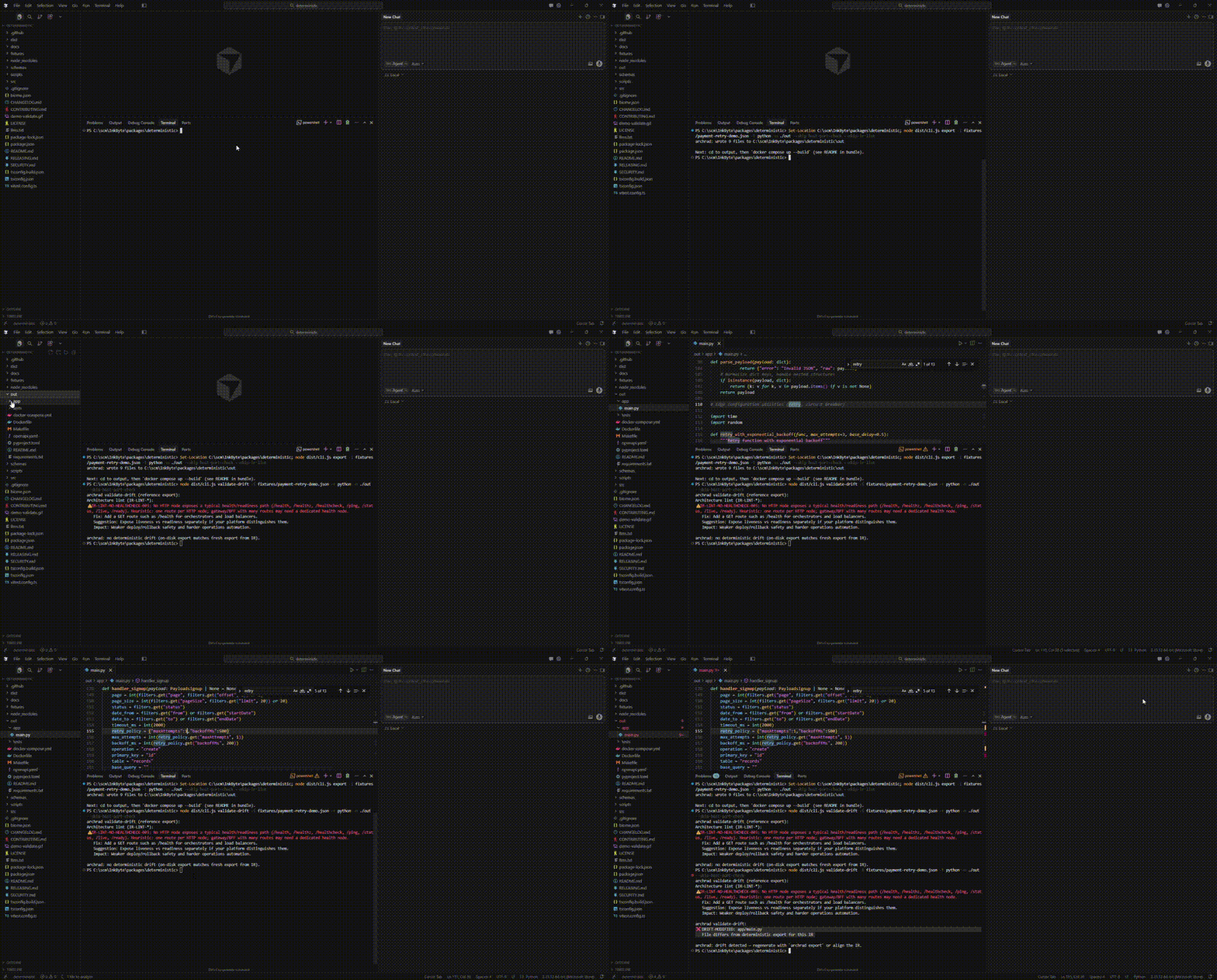



Your architecture drifts before you write a single line of code. archrad validate catches it — deterministically, in CI, before the PR merges.
Define your system as a graph. ArchRAD compiles it, lints it against architecture rules, and tells you exactly what's wrong — with rule codes, not opinions.
New in 0.7.x —
archrad demoruns a full example with zero setup, andarchrad scandrafts an IR from any repo with every node cited tofile:line. Lint findings only decrease in this release; nothing that passed on 0.6.x can start failing. See the changelog.
Quick start (60 seconds)
npm install -g @archrad/deterministic
archrad demo
No IR file, no flags, no config — runs from any directory. Lints a bundled example and shows you the findings:
    orders-api (http)  ──▶  orders-db (postgres)

⚠️ IR-LINT-DIRECT-DB-ACCESS-002: API node "orders-api" connects directly to datastore node "orders-db"
   Fix: Introduce a service or domain layer between HTTP handlers and persistence.
⚠️ IR-LINT-MISSING-AUTH-010: HTTP entry node "orders-api" has no auth node or auth config …
⚠️ IR-LINT-NO-HEALTHCHECK-003: No HTTP node exposes a typical health/readiness path …
Then run it on your own repo
archrad scan . --out draft.ir.json    # draft an IR — every node cited to file:line
archrad validate --ir draft.ir.json   # lint it
scan reads your Docker Compose, Kubernetes manifests, Terraform, OpenAPI, package manifests, and source
code, then grades every node by confidence so you can see what was parsed versus guessed. The output is a
normal IR file — review it, edit it, commit it.
Already have an OpenAPI spec or a Backstage catalog? Skip the scan:
archrad ingest openapi --spec ./openapi.yaml --out ./graph.json
archrad ingest backstage --catalog . --out ./graph.json
Once a graph is committed, archrad validate is your CI gate — exit 1 blocks the merge.
What it does
ArchRAD is a blueprint compiler and governance layer. You define your architecture as an IR — nodes, edges, allowed connections — and ArchRAD validates it against a deterministic rule engine. The same IR, the same rules, the same inputs always produce the same findings.
| Command | What it checks | Codes |
|---|---|---|
archrad validate | Graph structure + architecture lint | IR-STRUCT-* IR-LINT-* |
archrad lint | Architecture lint only (fast inner-loop; skips structural) | IR-LINT-* |
archrad explain <code> | Canonical rule guidance without running a pass | — |
archrad policies-sha256 --dir <policies> | Generate a archrad-policy-pack.sha256 manifest for signed PolicyPacks | — |
archrad validate-drift | IR vs generated code on disk | DRIFT-* |
archrad scan | Draft IR from a repo — topology, OpenAPI, manifests, code; every node cited + graded by confidence | — |
archrad reconstruct | Draft IR from source code alone (one of scan's four signal sources, usable standalone) | — |
archrad ingest openapi | Derive IR from OpenAPI (local path or https URL for --spec; -H for URL auth headers) | — |
archrad ingest backstage | Backstage catalog-info.yaml → IR (Component, Resource, API, System; Location file targets) | — |
archrad fragment merge | Merge 2+ IR files — union by node.id (conflicts → stderr); --prefix-fragments for disjoint union | — |
archrad export | Compile IR → FastAPI or Express + Docker | — |
Ingest + merge workflows: docs/INGEST.md. All commands / flags: docs/CLI_REFERENCE.md. Codegen (export): docs/EXPORT.md.
Draft an IR from a real repo (archrad scan)
archrad scan points at a repository and emits a draft IR — never a final
answer, always something to review and edit. It runs six extractors, graded by
how much they have to guess:
| Source | Signal | Confidence |
|---|---|---|
| Topology | docker-compose.yml, Kubernetes manifests | high — a declaration, parsed for real |
| Interface | OpenAPI / Swagger | medium — documents a real surface, but only what's documented |
| Infrastructure-as-code | Terraform (*.tf) | medium — a real declaration, but read via regex, not a true HCL parse |
| Manifest | package.json, requirements.txt, go.mod, pom.xml | low — a driver dependency implies an edge, not proof it's used |
| Code | pattern scan of source (Node.js/TS, Python, C#) | low — regex over text, no semantic understanding |
Every node and edge carries config.provenance[] — inferred_from: "file:line",
a confidence, and which extractor found it — so nothing has to be taken on
faith. When two extractors describe the same thing, scan merges them (keeping
the highest-confidence body, unioning all provenance) instead of duplicating or
erroring.
archrad scan . --dry-run                       # print the draft, write nothing
archrad scan ./server --out draft.ir.json       # write it
archrad scan . --extractors compose,manifest    # only run specific extractors
archrad scan . --scope all                      # include tests, examples, docs, and demos
CLI scans default to --scope production so fixtures, documentation examples,
Storybook stories, and test-only manifests do not become production findings.
Use --scope all when those artifacts are the subject of the review. Library
callers retain the backwards-compatible scope: 'all' default.
The output is a normal IR file — pipe it straight into archrad validate once
you've reviewed it. Full flags: docs/CLI_REFERENCE.md.
Implementation governance (archrad reconstruct + --codebase)
"The IR looks clean — but is that what was actually shipped?"
The validation pipeline above checks your authored IR (the design contract). The --codebase flag bridges the gap to the real codebase by reconstructing an IR from source code and comparing them.
The "dummy IR" attack — and how to catch it
A developer can author a compliant IR (passes all IR-STRUCT-* and IR-LINT-* rules) while the actual code bypasses the documented architecture. The most dangerous pattern: an IR that shows a clean service layer but code that directly queries the database.
# Catch discrepancies between the authored design and the shipped code
archrad validate --ir authored-ir.json --codebase ./src --report findings.html
When --codebase is provided, the pipeline runs three stages:
- IR-STRUCT-* structural validation on the authored IR
- IR-LINT-* architecture lint on the authored IR
- IR-DRIFT-IMPL-* comparison of authored IR vs reconstructed codebase IR
IR-DRIFT-IMPL-* rules
Implementation drift uses a separate exit threshold: --fail-on, --fail-on-warning, and --max-warnings apply only to IR-STRUCT-, IR-LINT-, and merged PolicyPack findings. IR-DRIFT-IMPL-* are gated solely by --impl-drift-fail-on (default: drift severities error fail the command).
| Code | Severity | What it catches |
|---|---|---|
IR-DRIFT-IMPL-000 | warning | Authored IR could not be parsed for drift comparison (fix structural issues first) |
IR-DRIFT-IMPL-001 | warning | IR declares HTTP-like entry nodes but reconstruction detected zero artifacts in --codebase |
IR-DRIFT-IMPL-002 | warning | HTTP / health routes in code but authored IR has no HTTP-like nodes |
IR-DRIFT-IMPL-003 | error | Direct DB connection in code, no DB edge in authored IR |
IR-DRIFT-IMPL-004 | error | HTTP route in code not present in authored IR |
IR-DRIFT-IMPL-005 | warning | Service-to-service call in code, no edge in authored IR |
IR-DRIFT-IMPL-006 | info | Auth middleware in code, no auth node in authored IR |
IR-DRIFT-IMPL-003 is the critical one. An error there means the authored IR hides a direct DB dependency.
Reconstruct standalone
# Just reconstruct — write the IR without comparing
archrad reconstruct --from ./src --output reconstructed-ir.json

# Force language detection
archrad reconstruct --from ./src --language python --output py-ir.json

# Print to stdout (dry-run)
archrad reconstruct --from ./src --dry-run

# Show every detected artifact
archrad reconstruct --from ./src --verbose
Supported languages
| Language | Detected patterns |
|---|---|
| Node.js / TypeScript | Express, Fastify, NestJS routes + controllers; BullMQ workers, Agenda jobs, cron schedules; pg, Prisma, TypeORM, Sequelize, Mongoose, Redis, BullMQ, Firebase; Passport, express-jwt, NestJS guards, Auth0, Okta, Keycloak, Cognito; axios, got, node-fetch, gRPC; outbound HTTP URLs extracted per destination |
| Python | Flask, FastAPI, Django URLs, DRF @action; SQLAlchemy, psycopg2, asyncpg, PyMongo, motor, redis-py; login_required, jwt_required, FastAPI OAuth2; requests, httpx, aiohttp, gRPC |
| C# | Minimal API MapGet/MapPost; ASP.NET Core [HttpGet]/[ApiController]; EF Core DbContext, Npgsql, Dapper; [Authorize], AddAuthentication, JWT bearer; HttpClient, gRPC, RestSharp |
Service decomposition (Node.js)
The reconstructor detects service boundaries and creates one node per service rather than collapsing everything into a single gateway:
| Layout | Detection signal | Result |
|---|---|---|
Files in routes/ or controllers/ directory | router.get/post/… in dedicated file | One service node per file |
| NestJS controllers | @Controller decorator / *.controller.ts naming | One service node per controller file |
Entry file with app.listen() | Mounts other routers | gateway node |
| BullMQ / Agenda / cron files | new Worker(…), agenda.define(…) | worker node |
| Monolithic file (all routes in one file) | Single file, no routes/ dir | Single gateway node — no forced split |
Edges between nodes reflect what the reconstruction found:
- gateway → service edges are added for all decomposed services.
- service → database edges appear only when the route file itself contains a DB import or env var reference (not when DB access is hidden behind a shared utility module).
Node naming
DB and cache nodes use the most user-recognizable name available:
- Env var name —
process.env.REDIS_URL→ node named"redis",process.env.SESSION_REDIS_URL→"session-redis" - Connection variable name —
const userDb = new Pool(…)→ node named"userDb"(for unique variable names) - Library / driver name — fallback when no env var or named variable is detectable
Node IDs and names never include env_var or other detection-method metadata.
External service identification
Outbound HTTP/gRPC calls create distinct external nodes per destination:
axios.post('https://api.stripe.com/…')→ node"stripe"fetch('https://auth0.com/oauth/token')→ node"auth0"new PaymentServiceClient('payments-svc:50051')→ node"payment"(gRPC)- Generic fallback for clients without a detectable URL: one shared
"external-service"node
Honest scope limits
Reconstruction is best-effort signal, not certainty:
- Dynamic patterns —
eval, reflection, metaprogramming, and generated code are not detected. - Runtime config — topology decisions made at runtime (feature flags, config-driven routing) cannot be statically analyzed.
- Cross-language services — a single codebase containing multiple language runtimes reduces accuracy.
- Heavy abstractions — macro-based or annotation-processor-heavy frameworks may obscure routes or connections.
- Shared data access layers — when DB connections live in a shared utility file (e.g.,
db.ts,firebaseAdmin.ts) rather than the route files themselves, those connections are not linked to individual service nodes. The reconstructed IR honestly omits edges it cannot trace statically.
Interpreting lint findings on reconstructed IR
Run archrad validate on a reconstructed IR and you may see:
| Finding | On reconstructed IR | Interpretation |
|---|---|---|
IR-LINT-DEAD-NODE-011 (service node, no outgoing edges) | Expected when services use a shared data-access layer | Not a real problem; the route files have no directly-detected downstream edges |
IR-LINT-HIGH-FANOUT-004 on gateway | Expected for large monorepos | The gateway→service edge count reflects the route file count |
IR-LINT-DIRECT-DB-ACCESS-002 on gateway | Real finding | A route in the entry file directly accesses a DB without a service layer |
IR-LINT-NO-HEALTHCHECK-003 | May fire if health endpoint is in a separate routes/health.ts service node | Check whether the health route is reachable from the entry point |
IR-LINT-DIRECT-DB-ACCESS-002 on reconstructed IR is the high-signal rule: if it fires on a gateway node, it means the entry file itself has direct DB access (not delegated to a service layer). If the decomposition correctly identified service nodes between the gateway and the database, this rule should be silent.
Treat reconstructed IR as a draft for human review, not as ground truth. Use it to catch obvious drift between authored architecture and actual code, not as an authoritative picture of the system.
Treat IR-DRIFT-IMPL-* findings as "review required", not absolute truth. The reconstructed IR is signal, not certainty.
Worked example — catching a "dummy IR"
Authored IR (authored.json) shows clean layered architecture:
{ "graph": { "nodes": [
  { "id": "api", "type": "gateway", "name": "API" },
  { "id": "svc", "type": "service", "name": "Order Service" },
  { "id": "db", "type": "postgres", "name": "Orders DB" }
], "edges": [
  { "from": "api", "to": "svc" },
  { "from": "svc", "to": "db" }
]}}
But src/api/routes.ts contains:
import { Pool } from 'pg';
const db = new Pool({ connectionString: process.env.DATABASE_URL });
// direct DB query in the route handler — bypasses the service layer
app.get('/orders', async (req, res) => res.json(await db.query('SELECT * FROM orders')));
Running archrad validate --ir authored.json --codebase ./src:
❌ IR-DRIFT-IMPL-003: Direct database connection(s) detected in code (pg (PostgreSQL) → postgres) but no DB edges exist in the authored IR
   Fix: Either add the missing DB edges to the authored IR, or confirm the codebase points to the correct service.
   Suggestion: This discrepancy is a governance red flag: the authored IR could be masking a direct DB dependency.
   Impact: CRITICAL — this pattern is exploited in "dummy IR" attacks where clean design docs conceal direct database access in shipped code.
The IR said no direct DB access. The code said otherwise. IR-DRIFT-IMPL-003 caught the gap.
Project config (archrad.yml)
Drop an archrad.yml at the root of your repo and skip re-typing flags:
# archrad.yml
ir: ./archrad-graph.json
target: python
output: ./generated
failOn: warning
policies: ./policies
archrad validate          # uses ir, failOn, policies
archrad export            # uses ir, target, output
archrad validate-drift    # uses ir, target, output
archrad walks upward from the CWD looking for archrad.yml (or
archrad.yaml). Explicit CLI flags always override the config. Use
--no-config to ignore any discovered file, or --config <path> to
point at a non-standard location. Full schema: docs/CONFIG.md.
Fast inner loop: archrad lint + archrad explain
# Iterate on lint without re-checking IR structure every run:
archrad lint --ir ./graph.json

# Focus on a single rule while fixing it:
archrad lint --ir ./graph.json --rule IR-LINT-MISSING-AUTH-010

# Understand a rule code without running a pass:
archrad explain IR-LINT-DIRECT-DB-ACCESS-002
archrad explain --list                  # every known rule code
archrad lint is the fast inner loop; use archrad validate once before the CI gate to also enforce IR structural shape. With archrad.yml at repo root, both run with no flags.
CI integration
# Fail on any structural error (default):
archrad validate --ir ./graph.json

# Also fail on lint warnings:
archrad validate --ir ./graph.json --fail-on-warning

# Machine-readable output for GitHub Actions:
archrad validate --ir ./graph.json --json
MCP server (Cursor / Claude Desktop)
After install, archrad-mcp is on your PATH. Add it to your IDE:
{
  "mcpServers": {
    "archrad": { "command": "archrad-mcp" }
  }
}
Your agent can call the same engine as the CLI via six MCP tools (e.g. archrad_validate_ir, archrad_lint_summary, archrad_validate_drift, archrad_policy_packs_load, archrad_list_rule_codes, archrad_suggest_fix). See docs/MCP.md for parameters and local testing.
How it works (architecture)
IR (nodes/edges)  →  validateIrStructural (IR-STRUCT-*)  →  errors block export
                           ↓
                    validateIrLint (IR-LINT-*)  →  warnings (CI: --fail-on-warning / --max-warnings)
                           ↓
              pythonFastAPI | nodeExpress generators
                           ↓
              openapi.yaml + app code + package metadata
                           ↓
              golden layer (Dockerfile, docker-compose.yml, Makefile, README; host→container e.g. 8080:8080)
                           ↓
              validateOpenApiInBundleStructural(openapi.yaml)  →  document-shape warnings (not full API lint)
                           ↓
              { files, openApiStructuralWarnings, irStructuralFindings, irLintFindings }

  Optional CI: archrad validate-drift  →  re-export IR in-memory, diff vs existing ./out  →  DRIFT-MISSING / DRIFT-MODIFIED (thin deterministic gate)
Validation levels (quick contract)
- JSON Schema validation — IR document shape vs
schemas/archrad-ir-graph-v1.schema.json(editor/CI; optional at runtime). - IR structural validation —
validateIrStructural: arrays, ids, HTTPconfig, edge refs, cycles (IR-STRUCT-*). Uses an internal normalized graph (seedocs/IR_CONTRACT.md). - Export-time generated OpenAPI structural validation — Parse + required fields on the generated
openapi.yaml(document shape, not Spectral).
Architecture lint (IR-LINT-*) sits after structural checks: rule visitors on the parsed graph (heuristics, not schema).
Validation layers (naming)
| Layer (OSS) | What it is | Codes |
|---|---|---|
| IR structural validation | Graph well-formedness: ids, edges, cycles, HTTP path/method | IR-STRUCT-* |
| Architecture lint (basic) | Deterministic heuristics only (no AI, no org policy) | IR-LINT-* |
| OpenAPI structural validation (document shape) | Parse + required top-level OpenAPI fields on generated spec | (string warnings, not IR codes) |
| Layer (Cloud — not this package) | Examples |
|---|---|
| Policy engine | SOC2, org rules, entitlement |
| Architecture intelligence | Deeper NFR / cost / security reasoning |
| AI remediation | Repair loops, suggested edits |
- IR structural validation: duplicate/missing node ids, bad HTTP
config.url/config.method, unknown edge endpoints, directed cycles. - Architecture lint: Implemented as a registry of visitor functions on a parsed graph (
buildParsedLintGraph→LINT_RULE_REGISTRYinsrc/lint-rules.ts). If the IR cannot be parsed,buildParsedLintGraphreturns{ findings }(IR-STRUCT-) instead ofnull; useisParsedLintGraph()or callvalidateIrLint, which forwards those findings. Each rule returnsIrStructuralFinding[];runArchitectureLinting/validateIrLintflatten them. Custom org rules: composerunArchitectureLintingwith your own(g) => findingsin CI (worked example:docs/CUSTOM_RULES.md), or fork and append toLINT_RULE_REGISTRYif the stockarchrad validateCLI must emit your codes. CLIarchrad validate/archrad exportprint lint under **Architecture lint (IR-LINT-)** (grouped separately from structural). Codes include IR-LINT-DIRECT-DB-ACCESS-002, IR-LINT-SYNC-CHAIN-001, IR-LINT-NO-HEALTHCHECK-003, IR-LINT-HIGH-FANOUT-004, IR-LINT-ISOLATED-NODE-005, IR-LINT-DUPLICATE-EDGE-006, IR-LINT-HTTP-MISSING-NAME-007, IR-LINT-DATASTORE-NO-INCOMING-008, IR-LINT-MULTIPLE-HTTP-ENTRIES-009, IR-LINT-MISSING-AUTH-010, IR-LINT-DEAD-NODE-011. Sync-chain depth counts synchronous edges only; mark message/queue/async hops viaedge.metadata.protocol/config.async(seeedgeRepresentsAsyncBoundaryinlint-graph.tsanddocs/ENGINEERING_NOTES.md). - Generators →
openapi.yaml, handlers, deps. - Golden path →
make run/docker compose up --build. - OpenAPI document shape on the bundle — not Spectral-level lint. Issues →
openApiStructuralWarnings.
IR contract: schemas/archrad-ir-graph-v1.schema.json. Parser boundary + normalized shapes: docs/IR_CONTRACT.md (normalizeIrGraph → materializeNormalizedGraph).
Trust builder: IR-STRUCT-* errors block export; IR-LINT-* warnings are visible and can gate CI via --fail-on-warning / --max-warnings; OpenAPI shape issues surface as export warnings.
Reference (OSS): docs/DRIFT.md (deterministic validate-drift), docs/RULE_CODES.md (finding codes; MCP docsUrl targets GitHub anchors), docs/MCP.md (MCP tools + local testing).
Codegen vs validation (retry, timeouts, policy)
Generators may emit retry/timeout/circuit-breaker code when the IR carries matching edge or node config (e.g. retryPolicy). That is code generation, not a guarantee. OSS does not currently require or lint “every external call must have timeout/retry” — that class of rule is semantic / policy and fits ArchRad Cloud or custom linters on top of the IR.
Ways to use it
| Mode | Best for | Example |
|---|---|---|
| CLI | Quick local scaffolding, CI, “no Node project” usage | archrad export --ir graph.json --target python --out ./out |
| YAML → IR | Author graphs in YAML, emit JSON for validate/export | archrad yaml-to-ir -y graph.yaml -o graph.json |
| OpenAPI → IR | Derive HTTP nodes from OpenAPI 3.x (same IR shape as YAML path); ArchRad Cloud merge uses the same library | archrad ingest openapi --spec openapi.yaml -o graph.json |
| CLI validate | CI / pre-commit: IR structural + architecture lint, no codegen | archrad validate --ir graph.json |
| CLI validate-drift | After export or merges: on-disk tree vs fresh deterministic export from same IR | archrad validate-drift -i graph.json -t python -o ./out |
Library (@archrad/deterministic) | IDPs / pipelines | runDeterministicExport → files + findings; runValidateDrift / runDriftCheckAgainstFiles for drift |
MCP (archrad-mcp) | Cursor / Claude Desktop / other MCP hosts | stdio server: validate IR, lint summary, drift, policy packs, static archrad_suggest_fix — see docs/MCP.md |
MCP (Cursor example): after npm i -g @archrad/deterministic (or npx), add a server with command archrad-mcp and no args (stdio). Pass ir inline or irPath to a JSON file for large graphs. archrad_suggest_fix returns curated text for a finding code (e.g. IR-LINT-MISSING-AUTH-010) — not machine-generated IR patches. Step-by-step testing (smoke script, MCP Inspector, Cursor chat prompts): docs/MCP.md, section Local testing.
CLI
Input is structured IR (JSON), not natural language. There is no archrad export --prompt "...". Pass a graph file (nodes/edges).
Fixtures (in this repo): fixtures/minimal-graph.json (small); fixtures/demo-direct-db-violation.json / fixtures/demo-direct-db-layered.json (before/after IR-LINT-DIRECT-DB-ACCESS-002); fixtures/ecommerce-with-warnings.json (many lint rules); fixtures/payment-retry-demo.json (retry-related codegen in export). --target python is the FastAPI bundle; there is no separate fastapi target. To go from plain English → IR, use ArchRad Cloud or your own LLM step; this package only does IR → files.
Recording demos and GIFs (VHS, storyboards, drift replay): scripts/README_DEMO_RECORDING.md only — not required to use the CLI.
OpenAPI → JSON (spec as source of truth): each operation under paths becomes an http node (config.url + config.method). Then validate and export like any other IR:
archrad ingest openapi --spec ./openapi.yaml --out ./graph.json
archrad validate --ir ./graph.json
archrad export --ir ./graph.json --target python --out ./out
OpenAPI security → IR → lint: ingestion copies global and per-operation security requirement names onto each HTTP node as config.security (sorted, deterministic). An operation with explicit security: [] becomes config.authRequired: false (intentionally public). If the spec declares no security at any level, nodes are left without those fields — then archrad validate can surface IR-LINT-MISSING-AUTH-010 on HTTP-like entry nodes (compliance gap from the spec artifact alone).
YAML → JSON (lighter authoring): edit fixtures/minimal-graph.yaml (or your own file) and compile to IR JSON, then validate or export:
archrad yaml-to-ir --yaml fixtures/minimal-graph.yaml --out ./graph.json
archrad validate --ir ./graph.json
# or pipe: archrad yaml-to-ir -y fixtures/minimal-graph.yaml | archrad validate --ir /dev/stdin   # on Unix; on Windows use --out then validate
YAML must have either top-level graph: (object) or top-level nodes: (array); bare graphs are wrapped as { "graph": { ... } } automatically.
After npm install -g or npx (typical):
archrad export --ir ./graph.json --target node --out ./my-express-api

# Validate IR (structural + architecture lint). Pretty output; exit 1 on structural errors by default:
archrad validate --ir ./graph.json
# Machine-readable + CI gates:
archrad validate --ir ./graph.json --json
archrad validate --ir ./graph.json --fail-on-warning
archrad validate --ir ./graph.json --max-warnings 0
# Structural only (skip IR-LINT-*):
archrad validate --ir ./graph.json --skip-lint
# Declarative PolicyPack YAML/JSON in a directory (after IR-LINT-*; skipped with --skip-lint):
archrad validate --ir ./graph.json --policies ./policy-packs
From a git clone (contributors): run npm ci && npm run build in the package root (there is no prepare hook — see docs/ENGINEERING_NOTES.md), then use node dist/cli.js the same way you would use archrad (e.g. node dist/cli.js validate --ir fixtures/minimal-graph.json).
Deterministic drift (thin, OSS): compare an existing export tree on disk to a fresh export from the same IR. Detects missing / changed generated files (line endings normalized). Optional --strict-extra flags files present on disk but not in the reference export. Not semantic “does code match intent” — ArchRad Cloud adds builder/UI drift checks and broader governance.
archrad export -i ./graph.json -t python -o ./out
# …edit files under ./out…
archrad validate-drift -i ./graph.json -t python -o ./out --skip-host-port-check
# CI-friendly:
archrad validate-drift -i ./graph.json -t python -o ./out --skip-host-port-check --json
# Fail if the tree has extra files not in the reference export:
archrad validate-drift -i ./graph.json -t python -o ./out --strict-extra
Example: validate architecture
archrad validate --ir fixtures/minimal-graph.json
Example output (stderr):
archrad validate:
⚠️ IR-LINT-NO-HEALTHCHECK-003: No HTTP node exposes a typical health/readiness path (...)
   Fix: Add a GET route such as /health for orchestrators and load balancers.
   Suggestion: Expose liveness vs readiness separately if your platform distinguishes them.
   Impact: Weaker deploy/rollback safety and harder operations automation.
Structural errors look like ❌ IR-STRUCT-... with Fix: lines. Use --json to consume findings in GitHub Actions or other CI.
--ir— JSON:{ "graph": { "nodes", "edges", "metadata" } }or a raw graph (CLI wraps it).--target—python|node|nodejs--out— output directory (created if needed)--host-port <n>— host port Docker publishes (default 8080; container still listens on 8080 inside). Same as envARCHRAD_HOST_PORT.--skip-host-port-check— don’t probe127.0.0.1before export.--strict-host-port— exit with error if the host port appears in use (CI-friendly).--danger-skip-ir-structural-validation— UNSAFE: skipvalidateIrStructuralbefore export (never in CI). Parse/normalize failures (invalid root, empty graph) are still detected viavalidateIrLintand block export withIR-STRUCT-*inirStructuralFindings. A hidden--skip-ir-structural-validationremains as a deprecated alias.--skip-ir-lint— skipvalidateIrLintduring export.--fail-on-warning/--max-warnings <n>— if set, no files are written when IR structural + lint findings violate the policy (same semantics asvalidate).
By default, if 8080 (or your --host-port) looks busy on localhost, the CLI warns so you can change the port before docker compose fails with a bind error.
Export runs IR structural validation, then architecture lint, then codegen. Structural errors abort with no files written. irLintFindings contains only IR-LINT-*; IR-STRUCT-* from a failed parse always appear under irStructuralFindings (including when structural validation was skipped). Lint warnings print by default; use --fail-on-warning / --max-warnings to block writes for CI.
Library
import {
  runDeterministicExport,
  runValidateDrift,
  validateIrStructural,
  validateIrLint,
  sortFindings,
  shouldFailFromFindings,
} from '@archrad/deterministic';

const { files, openApiStructuralWarnings, irStructuralFindings, irLintFindings } =
  await runDeterministicExport(ir, 'python', {
    hostPort: 8080,
    skipIrLint: false, // default
  });
// Structural errors → empty files (unless skipIrStructuralValidation). Lint is non-blocking for export unless you check policy in your pipeline.

const drift = await runValidateDrift(ir, 'python', '/path/to/existing-export', {
  skipIrLint: false, // set true to match CLI --skip-ir-lint on reference export
});
// drift.ok, drift.driftFindings, drift.exportResult — same core semantics as CLI validate-drift (CLI also probes host port before calling the library)

const all = sortFindings([...validateIrStructural(ir), ...validateIrLint(ir)]);
if (shouldFailFromFindings(all, { failOnWarning: true })) {
  /* gate your CI */
}
Optional: isLocalHostPortFree / normalizeGoldenHostPort from the same package if you want your own preflight.
Golden path (contributors — local clone)
This path assumes you cloned the repo and ran npm ci && npm run build in the package root. If you only installed with npm install -g @archrad/deterministic, use archrad instead of node dist/cli.js (same flags).
node dist/cli.js export --ir fixtures/minimal-graph.json --target python --out ./out
cd ./out
make run
# In another terminal, once the API is up:
curl -sS -X POST http://localhost:8080/signup -H "Content-Type: application/json" -d '{}'
You should see 422 Unprocessable Entity (FastAPI/Pydantic) or 400 with a clear body — proof the stack is live and validation matches the spec, not a silent 500.
Quick check from a clone: cd packages/deterministic && npm ci && npm run build && npm test, then export to ./tmp-out, cd tmp-out && make run, curl as above. Use --host-port 18080 (or node dist/cli.js export ... --host-port 18080) if 8080 is busy.
Optional: bash scripts/golden-path-demo.sh runs the same flow. Demo recording (GIFs, tapes, drift replays): scripts/README_DEMO_RECORDING.md.
Open source vs ArchRad Cloud
This repository is only the deterministic engine — local, offline, no phone-home.
| Here (OSS) | ArchRad Cloud (commercial product) |
|---|---|
IR structural + architecture lint (validate, IR-STRUCT-*, IR-LINT-*), compiler (export), validate-drift (on-disk vs fresh export), OpenAPI document-shape warnings, golden Docker/Makefile | Policy engine, deeper architecture intelligence, AI remediation, richer drift / sync UX in the builder |
archrad CLI forever, no account required for this package | Auth, orgs, quotas, billing |
| No proprietary LLM orchestration or “repair” loops | LLM generation, repair, multi-model routing |
| No Git sync, no enterprise policy injection in this repo | Git push, governance, compliance dashboards |
You can depend on this CLI and library without ArchRad Cloud. The cloud product stacks collaboration and AI on top of the same deterministic contract.
Contributing
See CONTRIBUTING.md.
License
Apache-2.0 — see LICENSE.
Reviews
No reviews yet
Be the first to review this server!
More Developer Tools MCP Servers
Rea
Freeby Morluto · Developer Tools
Reverse engineer anything from your terminal or agent with one CLI and MCP server.
Paperclip
Freeby Paperclipai · Developer Tools
Trending hip-hop artist momentum scores across four cultural dimensions.
Git
Freeby Modelcontextprotocol · Developer Tools
Read, search, and manipulate Git repositories programmatically
Toleno
Freeby Toleno · Developer Tools
Toleno Network MCP Server — Manage your Toleno mining account with Claude AI using natural language.
MCP Marketplace
Freeby mcp-marketplace · Developer Tools
Search and install MCP servers from inside your AI client.
mcp-creator-python
Freeby mcp-marketplace · Developer Tools
Create, build, and publish Python MCP servers to PyPI — conversationally.