
Server data from the Official MCP Registry
Local-first miniature-paint inventory and cross-brand color matching for AI agents.
About
Local-first miniature-paint inventory and cross-brand color matching for AI agents.
Security Report
Valid MCP server (4 strong, 4 medium validity signals). No known CVEs in dependencies. Package registry verified. Imported from the Official MCP Registry.
10 files analyzed · 1 issue found
Security scores are indicators to help you make informed decisions, not guarantees. Always review permissions before connecting any MCP server.
Permissions Required
This plugin requests these system permissions. Most are normal for its category.
What You'll Need
Set these up before or after installing:
Environment variable: INVENTORY_PATH
How to Install
Add this to your MCP configuration file:
{
  "mcpServers": {
    "io-github-arturskowronski-minipainter": {
      "env": {
        "INVENTORY_PATH": "your-inventory-path-here"
      },
      "args": [
        "-y",
        "minipainter",
        "-y",
        "-p",
        "minipainter"
      ],
      "command": "npx"
    }
  }
}Documentation
View on GitHubFrom the project's GitHub README.
MINIPAINTER
The paint bench, indexed.


Site: arturskowronski.github.io/minipainter
minipainter is a local-first paint registry for miniature-painting workflows. It exists for one practical reason: AI paint suggestions are much more useful when they understand the paints you actually own.
The project gives you:
- a deterministic local catalog (1,607 paints across Citadel, Army Painter, Vallejo, AK) and inventory
- owned-first paint lookup and cross-brand color matching
- a colored terminal UI (TUI) that shows each paint's real RGB as a swatch
- MCP servers for both Claude Desktop and ChatGPT
- a CLI surface designed for both humans and agent workflows
The colored TUI
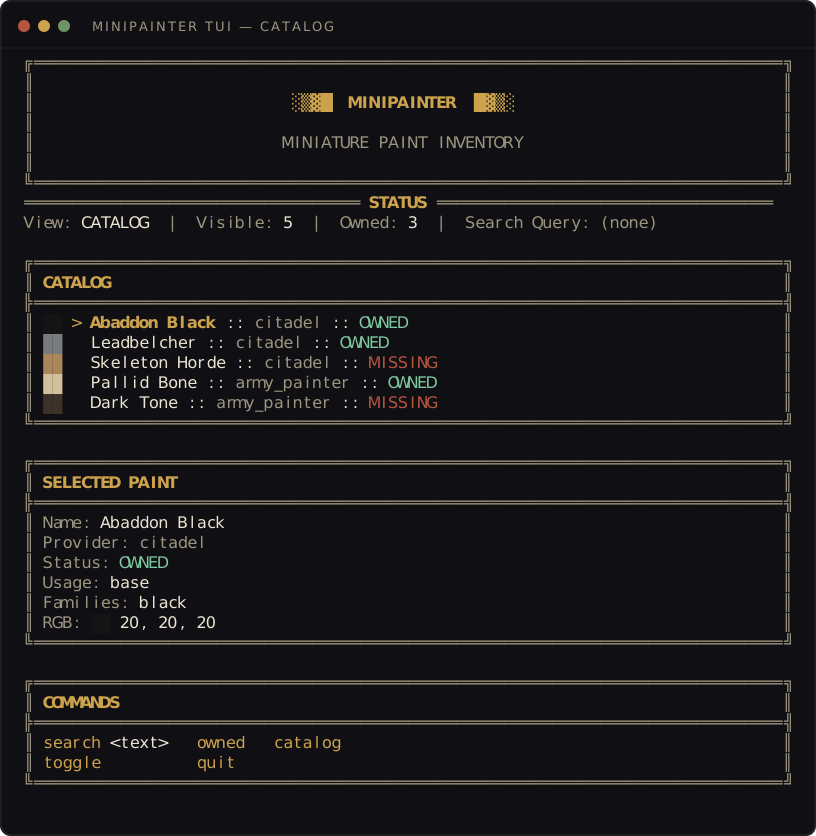
The ledger TUI is a real colored terminal app: a MINIPAINTER banner, gold section
frames, green OWNED / red MISSING status, and a truecolor swatch of every paint's own
RGB. Color turns on for a TTY and honors NO_COLOR.
Why This Exists
Most paint advice workflows break at the same point: they recommend paints you do not have on hand.
minipainter is built to solve that exact problem:
- keep a local record of what is in your paint rack
- search it quickly by name, role, family, and approximate color
- prepare a stable inventory foundation for a future AI skill that can inspect links, photos, and model images
The long-term goal is not “AI picks random colors for miniatures.” The goal is “AI reasons from your actual inventory first, then suggests stronger alternatives only when useful.”
Feature Highlights
Owned-first matching: lookups and recommendations can prioritize paints you already have.Catalog in repo, inventory in your home: paint records live indata/catalog/; what you own lives in~/.minipainting/inventory.jsonand follows you across projects.RGB-aware search: approximate RGB values help with nearest-color matching.Colored TUI: terminal ledger with per-paint RGB swatches and OWNED/MISSING status.Agent-friendly CLI: deterministic command output for AI integration (Claude + ChatGPT MCP).
Screenshots
Hero Screen
Full-screen TUI with banner, catalog, detail panel, and command strip.
See: docs/assets/hero.txt
Search View
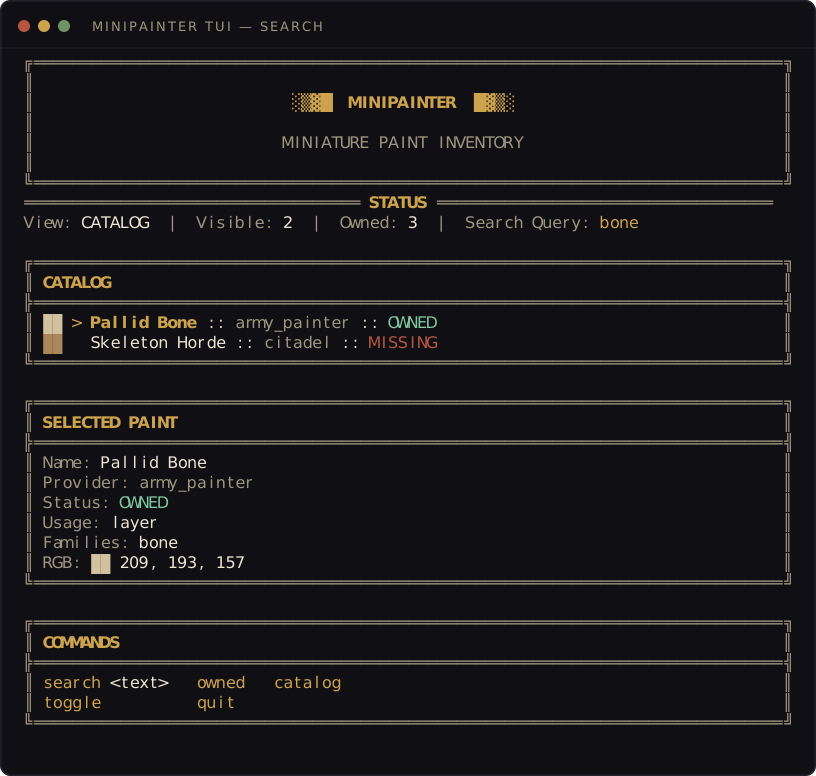
Filtered lookup for a semantic search like bone.
See: docs/assets/search.txt
Owned View
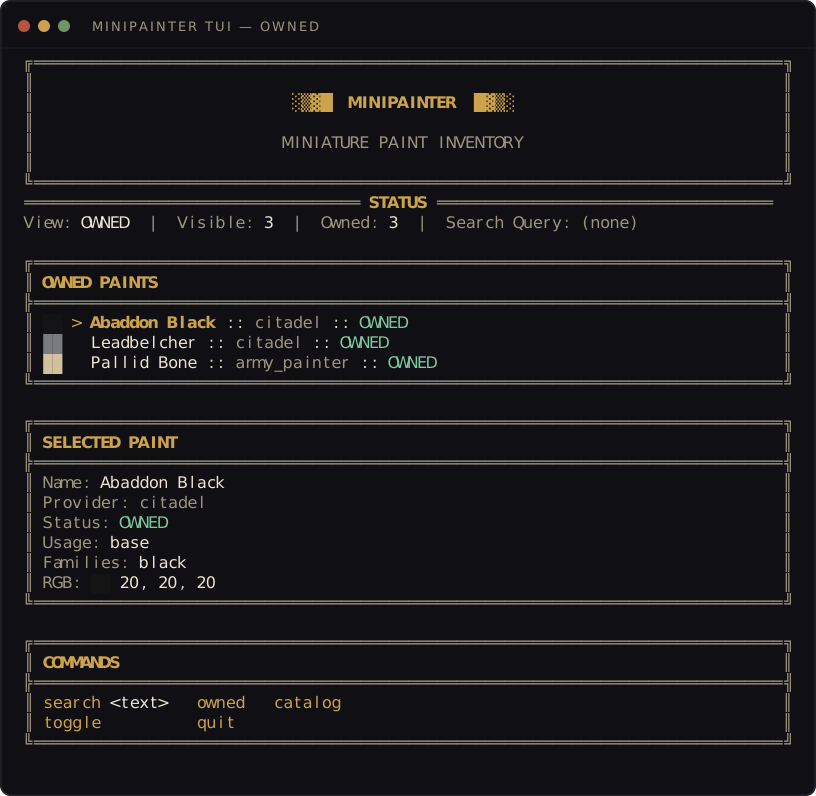
Inventory-only presentation focused on what is already bound to your collection.
See: docs/assets/owned.txt
CLI Flow
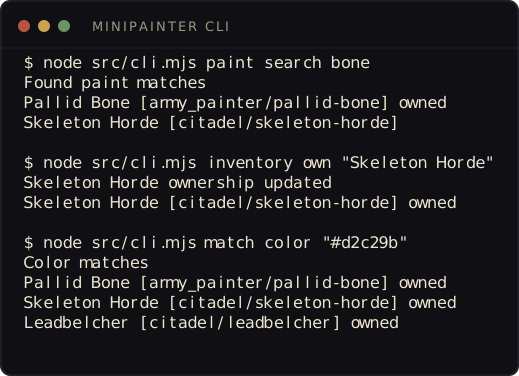
Representative command-line usage for search, ownership updates, and color matching.
See: docs/assets/cli.txt
Run with Docker (Postgres)
The whole stack — MCP/HTTP server plus a Postgres that stores your inventory — starts with
one command. Inventory persists in a named volume, so it survives container restarts and
docker compose down / recreation (only down -v wipes it).
docker compose up --build # http://localhost:3000
GET /health— livenessGET /api/inventory— owned paints (from Postgres)POST /mcp— MCP for Claude Desktop ·POST /mcp/v3— MCP for ChatGPT (search/fetch)
Storage is selected by DATABASE_URL: set it (as docker-compose.yml does) for Postgres,
leave it unset to use a local JSON inventory file (unchanged local behavior). See .env.example.
Deploy
Any Docker + Postgres host works (Fly.io, Railway, a VPS…). For a one-click remote MCP
server with a managed database, the repo ships a Render Blueprint (render.yaml) that
provisions the web service and Postgres together and wires DATABASE_URL automatically:

The reference deployment warpaint-mcp.fly.dev runs on Fly.io with Fly Managed Postgres — see
docs/deploy-fly.md for the fly mpg attach + migration steps.
Install
The fastest way — run it straight from npm with npx, no clone, no install:
npx minipainter paint search bone
npx minipainter match color "#d2c29b"
npx minipainter tui
Or install it globally to get the short mpaint command everywhere:
npm install -g minipainter
mpaint paint search bone
mpaint match color "#d2c29b"
The catalog is bundled, so search and matching work on first run with nothing to configure. Your inventory lives at ~/.minipainting/inventory.json, created automatically the first time you mark a paint owned (legacy ~/.warpaint/ is auto-migrated).
Requirements:
- Node.js 18 or newer
- POSIX-ish shell (Linux, macOS, WSL)
From source
To hack on it, clone and run against the working tree:
git clone https://github.com/ArturSkowronski/minipainter.git
cd minipainter
npm install
node src/cli.mjs paint search bone
After that you have four usage modes:
- CLI / TUI — see Quickstart below
- Self-hosted HTTP server — a single Docker-friendly runtime with JSON storage and API endpoints
- Local MCP for Claude Desktop — see Claude Desktop MCP Setup
- Remote MCP for Claude mobile/web — see Remote MCP
Quickstart
Initialize the local inventory at ~/.minipainting/inventory.json:
node src/cli.mjs catalog sync
Search paints:
node src/cli.mjs paint search black
node src/cli.mjs paint search bone --json
Inspect one paint:
node src/cli.mjs paint show "Abaddon Black" --json
Mark paints as owned or missing:
node src/cli.mjs inventory own "Abaddon Black"
node src/cli.mjs inventory unown "Abaddon Black"
node src/cli.mjs inventory list
Run semantic or color matching:
node src/cli.mjs match describe bone
node src/cli.mjs match color "#d2c29b"
Launch the TUI:
node src/cli.mjs tui
Run the MCP server locally:
node src/mcp-server.mjs
Run the self-hosted HTTP server locally:
DATA_DIR=.minipainting-data node src/mcp-http-server.mjs
TUI Workflow
The TUI is centered around three presentation areas:
FORGE CATALOG: visible paints in the current scopeSELECTED PIGMENT: the currently highlighted paint with provider, families, usage, and RGBRITUAL COMMANDS: the command legend for the active session
Current TUI commands:
search <text>ownedcatalogtogglequit
Recommended use:
- start with
catalog - narrow with
search bone,search black, or similar queries - inspect the selected pigment panel
- toggle ownership as your collection changes
Project Direction
Implemented now:
- local JSON registry
- starter provider catalogs for Citadel and Army Painter
- owned / missing inventory tracking
- deterministic search and color matching
- colored terminal presentation with per-paint swatches
- local MCP server for Claude Desktop
Planned later:
- a separate skill for parsing paint-set links
- image-driven inventory fill from paint bottle photos
- model-photo analysis that recommends owned paints first
- stronger cross-provider equivalents and matching hints
Technical Notes
- Built-in catalog data lives in
data/catalog/(Citadel and Army Painter, kept in version control) - Inventory file:
~/.minipainting/inventory.json— stores only owned paint ids in the form{ "version": 1, "owned": ["citadel/abaddon-black", ...] } - Self-hosted server data directory:
DATA_DIR(defaults to/datain Docker); inventory lives at<DATA_DIR>/inventory.json - The catalog and inventory are composed at runtime; saving never rewrites the catalog
- IDs are stable by convention (provider + name slug); on load, owned ids missing from the catalog are reported as warnings instead of being silently dropped
- A pre-existing project-local
.minipainting/registry.jsonnext to the inventory path is auto-migrated on first run - Legacy
.warpaint/data directories are auto-renamed to.minipainting/on first run (both home and project-local variants) - Override the inventory location at the API surface with
{ inventoryPath }or{ cwd }(the latter resolves to<cwd>/.minipainting/inventory.json, which is what the test suite uses for isolation) - RGB values are approximate reference colors for matching, not a guarantee of final painted appearance
- MCP entrypoint:
node src/mcp-server.mjs - MCP helper script:
npm run mcp - HTTP server helper script:
npm run server - README demo captures are reproducible via:
npm run generate:demo
Claude Desktop MCP Setup
minipainter now includes a local MCP server so Claude Desktop can use your paint registry directly.
Example local MCP config:
{
  "mcpServers": {
    "minipainter": {
      "command": "node",
      "args": ["/absolute/path/to/minipainter/src/mcp-server.mjs"]
    }
  }
}
After adding the server, Claude Desktop can call tools such as:
paint_searchpaint_showinventory_listinventory_mark_ownedinventory_mark_unownedmatch_colormatch_describe
Suggested local flow:
- initialize your registry once with
node src/cli.mjs catalog sync - add the MCP server to Claude Desktop
- ask Claude to search paints or update ownership through the exposed tools
Agent Skill
For Claude Code, fetch the skill straight from the site, no clone required. It ships with the
right guardrails baked in: JSON-only reads, product_format rules, failure handling.
# project-scoped
mkdir -p .claude/skills/minipainter
curl -fsSL https://arturskowronski.github.io/minipainter/SKILL.md \
  -o .claude/skills/minipainter/SKILL.md
Or save it to ~/.claude/skills/minipainter/SKILL.md to use it everywhere.
Self-Hosted Docker
The Docker image runs a single HTTP server runtime designed for self-hosted use. Build it from the repo (no image is published to a registry yet):
docker build -t minipainter .
docker run -p 3000:3000 -v minipainting-data:/data minipainter
Or bring up the server together with Postgres in one step with docker compose up -d.
The server exposes:
GET /healthGET /api/paintsGET /api/paints/:paintGET /api/inventoryPUT /api/inventory/:paintDELETE /api/inventory/:paintPOST /api/match/colorPOST /api/match/describePOST /mcp
Optional runtime configuration:
PORT— listen port, defaults to3000DATA_DIR— persistent state directory, defaults to/datain DockerAUTH_TOKEN— protects/api/*and/mcpwithAuthorization: Bearer ...INVENTORY_SYNC_TOKEN— protects the legacy/inventorysync endpoint
Remote MCP (Claude Mobile)
For Claude mobile or web, the stdio MCP server above is not reachable. Run
minipainter-mcp-http instead — a Streamable HTTP MCP transport exposing the
same tools, plus GET/POST /inventory for syncing the local inventory.
Local smoke test
export INVENTORY_SYNC_TOKEN=$(openssl rand -hex 32)
export PORT=3000
export INVENTORY_PATH=$HOME/.minipainting/inventory.json
npm run mcp:http
Then in another shell:
curl -s http://localhost:3000/health
curl -s -X POST http://localhost:3000/mcp \
  -H "Content-Type: application/json" \
  -H "Accept: application/json, text/event-stream" \
  -d '{"jsonrpc":"2.0","id":1,"method":"tools/list"}'

# Sync endpoint (bearer-token protected)
curl -s -H "Authorization: Bearer $INVENTORY_SYNC_TOKEN" \
     http://localhost:3000/inventory
Deploy to Fly.io
The repo ships a Dockerfile and fly.toml. Full recipe in
docs/deploy-fly.md. Short version:
fly launch --no-deploy --copy-config --name <your-app-name>
fly volumes create inventory_data --region <your-region> --size 1
fly secrets set INVENTORY_SYNC_TOKEN="$(openssl rand -hex 32)"
fly deploy
Connect Claude
In Claude (mobile or web), add a custom connector:
- URL:
https://<your-app-name>.fly.dev/mcp
The /mcp endpoint currently has no authentication — anyone with the URL can
call tools. Use the obscurity of the URL plus Fly's network controls for now;
add per-user auth before sharing the URL.
Environment variables
| Variable | Required | Purpose |
|---|---|---|
INVENTORY_SYNC_TOKEN | for /inventory | Bearer token protecting GET/POST /inventory; when unset, sync returns 503 |
INVENTORY_PATH | no | Path to inventory.json; default ~/.minipainting/inventory.json locally, /data/inventory.json in the Docker image |
INVENTORY_JSON | no | One-time seed JSON; only used when INVENTORY_PATH is absent on first boot |
WARPAINT_INVENTORY_JSON | no | Legacy alias of INVENTORY_JSON |
MCP_SERVER_NAME | no | Server name in MCP handshake + startup log; default paint-inventory |
PORT | no (default 3000) | TCP port to listen on |
Known limitations
/mcphas no authentication yet. The bearer token only protects/inventory.- Stateless transport: no long-running SSE tool streams (the tools are fast so this is fine).
Self-hosting your own MCP
The MCP server is generic — only the CLI (mpaint) is branded. To run your
own instance:
-
Fork or clone the repo.
-
(Optional) rename your Fly app in
fly.toml. -
Create a Fly volume and set secrets:
fly volumes create inventory_data --size 1 --region <your-region> fly secrets set INVENTORY_SYNC_TOKEN=$(openssl rand -hex 24) # Optional one-time seed: fly secrets set INVENTORY_JSON="$(cat ~/.minipainting/inventory.json)" -
(Optional) name your MCP server (shown in the MCP handshake and startup logs):
fly secrets set MCP_SERVER_NAME=my-paints -
Deploy:
fly deploy -
Register the remote in your local CLI and sync:
mpaint sync add default \
  --url https://my-app.fly.dev \
  --token <token-from-step-3>
mpaint sync push
After this, your local inventory and the deployed MCP stay in sync via
mpaint sync push (upload local → remote) and mpaint sync pull --force
(overwrite local from remote).
License
MIT © Artur Skowronski
Reviews
No reviews yet
Be the first to review this server!
More Developer Tools MCP Servers
Git
Freeby Modelcontextprotocol · Developer Tools
Read, search, and manipulate Git repositories programmatically
Fetch
Freeby Modelcontextprotocol · Developer Tools
Web content fetching and conversion for efficient LLM usage
Worldmonitor
Freeby Koala73 · Developer Tools
Live markets, conflicts, country risk, chokepoints, energy, and China decision signals. 89 tools.
Paperclip
Freeby Paperclipai · Developer Tools
Trending hip-hop artist momentum scores across four cultural dimensions.
Toleno
Freeby Toleno · Developer Tools
Toleno Network MCP Server — Manage your Toleno mining account with Claude AI using natural language.
mcp-creator-python
Freeby mcp-marketplace · Developer Tools
Create, build, and publish Python MCP servers to PyPI — conversationally.