
Server data from the Official MCP Registry
Windows desktop automation that re-reads only what changed: 7x fewer tokens per task.
About
Windows desktop automation that re-reads only what changed: 7x fewer tokens per task.
Security Report
OSWright is a well-engineered desktop automation MCP server with appropriate security awareness—it explicitly documents that it has no authentication and must be bound to localhost by default, requiring an explicit flag to expose remotely. The codebase is clean with proper input validation and no obvious malicious patterns. However, the server's core purpose involves granting full keyboard, mouse, screen, and clipboard control, which is inherently high-privilege. The truncated code prevents complete analysis of all tools, but examined portions show good security practices for an automation tool in this category. Supply chain analysis found 6 known vulnerabilities in dependencies (0 critical, 4 high severity). Package verification found 1 issue.
3 files analyzed · 11 issues found
Security scores are indicators to help you make informed decisions, not guarantees. Always review permissions before connecting any MCP server.
Permissions Required
This plugin requests these system permissions. Most are normal for its category.
How to Install
Add this to your MCP configuration file:
{
  "mcpServers": {
    "io-github-ask-812-oswright": {
      "args": [
        "oswright"
      ],
      "command": "uvx"
    }
  }
}Documentation
View on GitHubFrom the project's GitHub README.
OSWright




Desktop automation for AI agents, without paying for a screenshot every step.
mcp-name: io.github.Ask-812/oswright
An MCP server that lets an LLM drive real desktop applications — the desktop equivalent of Playwright MCP. It keeps a model of the screen between actions and re-reads only the parts that changed, so the same work costs an order of magnitude fewer tokens.
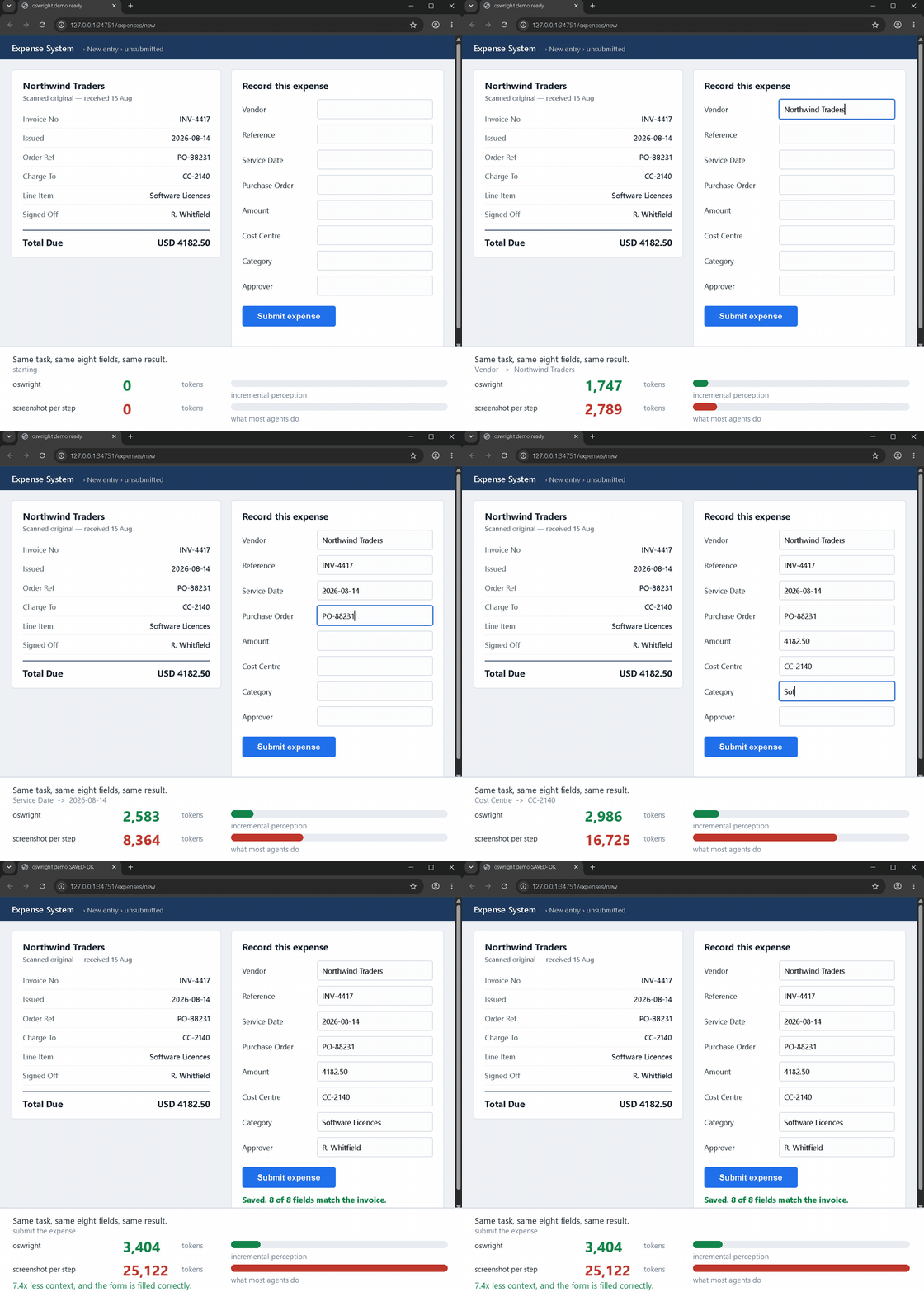
Eight fields read off an invoice and typed into an expense form, verified by the
application itself. Same task, same result, 7.4× less context than returning
a screenshot after every action. Every number on screen is measured during the
run — regenerate the whole thing with python benchmarks/record_demo.py.
Why this exists
Most GUI agents re-perceive the entire screen on every step: screenshot, OCR, hand the model an image, repeat. Measured on a live desktop, the median observation changes 0.012% of the screen's pixels. Re-reading everything does far more work than the change warrants, and charges ~2,800 image tokens whether anything happened or not.
OSWright asks the compositor what changed, rescans only that, and answers
element lookups from the cheapest source that can. The claims below are measured
on this machine and reproducible from benchmarks/ — including
the ones that did not come out in its favour.
Key Features
- Cross-platform. Windows (Win32 API), Linux (pynput/X11), macOS (pynput/Quartz).
- Accessibility tree. Find elements deterministically by role and name via Windows UI Automation — 100% accurate, instant, no model needed.
- Fast OCR. Windows OCR (built-in, instant) with EasyOCR fallback for Linux/macOS. Results are cached automatically.
- Lightweight on Windows. No PyTorch download — Windows uses the built-in OCR engine, so a full install is a few MB rather than a few GB.
- Image matching. Locates elements by template image via OpenCV.
- Window management. List, focus, minimize, close, and screenshot specific windows.
- Screenshot diffing. Detect when the screen changes with
wait_for_change. - Clipboard access. Read and write system clipboard for data transfer.
- App launcher. Launch applications and wait for them to load.
- Auto-snapshot. Every action returns a screenshot so the agent always sees current state.
- 43 MCP tools. Screen, OCR, UIA, mouse, keyboard, windows, clipboard, and compound actions.
- Incremental perception. Rescans only the parts of the screen that changed, and can return what changed instead of a full screenshot — ~21× fewer tokens per step.
- Screen memory. Recognises screens it has read before and reuses them, verified by pixels — 89× cheaper than reading again.
- Speculative perception. Learns what actions do and confirms the expected result instead of re-reading — 19–23× cheaper, with a
surprisereport when the interface does something unexpected. - Adaptive waiting. Waits for the screen to actually settle rather than sleeping a fixed 300 ms — 11.9 s saved over a 50-step task.
- Resolution cascade. Element lookups stop at the cheapest method that works; repeat lookups cost ~0.05 ms.
- DPI-correct. Coordinates are physical pixels everywhere, so clicks land correctly on scaled displays.
- Test suite. 254 automated tests; the desktop-driving ones skip themselves when no display is available.
Requirements
- Python 3.10 or newer
- VS Code, Cursor, Windsurf, Claude Desktop, or any other MCP client
Getting started
First, install the OSWright MCP server with your client.
Standard config works in most tools:
{
  "mcpServers": {
    "oswright": {
      "command": "uvx",
      "args": ["oswright"]
    }
  }
}
Note: If you don't have
uvx, you can usepip install oswrightand then set"command": "oswright"directly.
Follow the MCP install guide, use the standard config above.
claude mcp add oswright uvx oswright
Add to your user or workspace settings.json under mcp.servers:
{
  "mcp": {
    "servers": {
      "oswright": {
        "command": "uvx",
        "args": ["oswright"]
      }
    }
  }
}
Or use the VS Code CLI:
code --add-mcp '{"name":"oswright","command":"uvx","args":["oswright"]}'
Go to Cursor Settings -> MCP -> Add new MCP Server. Name it oswright, use command type with the command uvx oswright.
Follow Windsurf MCP documentation. Use the standard config above.
Add to your cline_mcp_settings.json:
{
  "mcpServers": {
    "oswright": {
      "type": "stdio",
      "command": "uvx",
      "args": ["oswright"],
      "disabled": false
    }
  }
}
Go to Advanced settings -> Extensions -> Add custom extension. Name it oswright, use type STDIO, and set the command to uvx oswright.
If you prefer a standard pip install:
pip install oswright
Then use this config:
{
  "mcpServers": {
    "oswright": {
      "command": "oswright"
    }
  }
}
Or run directly:
python -m oswright
Incremental perception
Most GUI agents re-perceive the entire screen on every step: full screenshot, full OCR, then hand the model a fresh image. Measured on a live desktop, the median observation changes 0.012% of pixels — so a full rescan does roughly 240× more work than the change warrants, and the screenshot it returns costs ~2,800 image tokens whether anything happened or not.
OSWright keeps a model of the screen between observations and rescans only the regions that actually moved.
observe()  ->  {"changed": true,
                "added":   [{"text": "Saved", "x": 812, "y": 447}],
                "removed": ["Unsaved changes"],
                "screen_fraction_scanned": 0.015}
Measured on this machine over a 14-step agent loop:
| v0.4.0 (full OCR + screenshot) | incremental | |
|---|---|---|
| Median latency per step | 212 ms | 33 ms |
| Tokens per observation | ~2,764 | ~49 |
| Tokens over 14 steps | 38,696 | 1,025 |
| Screen re-read | 100% | 16% |
The busier the screen, the larger the gap: full OCR scales with how much text is
on screen, whereas the incremental path scales with how much changed. The same
comparison measures 6.5× on a quiet desktop and 14.3× with a dense web page
open. Re-measure with benchmarks/ rather than trusting these.
Cost is a proxy, though, and a cheaper perception path that quietly degraded accuracy would be worse than none. So it is checked against task completion: scripted tasks driving the real tool surface across four applications, graded against each application's own state — UI Automation for Calculator and Explorer, the window title for Chrome and VS Code — never against OCR.
| configuration | Calculator | File Explorer | Chrome | tokens |
|---|---|---|---|---|
| v0.4-style (full screenshot) | 9/9 | 3/3 | 3/3 | 118,858 |
| delta only | 9/9 | 3/3 | 3/3 | 5,252 |
| delta + memory | 9/9 | 3/3 | 3/3 | 5,099 |
| delta + memory + prediction | 9/9 | 3/3 | 3/3 | 7,981 |
Accuracy is identical across every configuration while token cost falls 23×.
Run it with python benchmarks/bench_tasks.py.
Why both pixels and accessibility
The design bets that neither perception path wins everywhere. Turning each half off measures that rather than asserting it:
| configuration | Calculator | File Explorer | Chrome |
|---|---|---|---|
| full cascade | 9/9 | 3/3 | 3/3 |
| accessibility only | 9/9 | 0/3 | 0/3 |
| pixels only | 6/9 | 3/3 | 3/3 |
Accessibility-only — the posture most Windows GUI agents take — is perfect on
XAML and blind on a Win32 list view and on web content. Probed against VS Code
it sees 18 elements, the entire IDE being a single node named Chrome Legacy Window, while OCR reads 94 including every filename.
Pixels-only fails Calculator's buttons, because the button a human reads as 7
is named Seven, and Windows OCR returns no digits from Calculator at all.
The cascade is the only configuration that passes everywhere.
The resolution cascade
find_element and click_element stop at the first method that can answer,
so cost tracks how novel the request is rather than how large the screen is:
| Rung | Method | Typical cost |
|---|---|---|
| 0 | Already in the screen model | ~0.05 ms |
| 1 | Rescan only what changed | ~70 ms |
| 2 | Accessibility tree (knows a Button is a button) | ~40 ms |
| 3 | App's own text buffer via UIA TextPattern — exact characters | ~400 ms |
| 4 | Full-screen OCR | ~250 ms |
Looking up text the model already knows is ~5,000× cheaper than the v0.4.0 path (0.05 ms versus 244 ms). The response reports which rung answered, so you can see what a task is actually costing.
Rung 3 is worth understanding: UIA's TextRange.FindText searches the
application's own text buffer and returns exact bounding rectangles. It is
immune to font, DPI, antialiasing and OCR error. It sits below the pixel rungs
only because scanning a window's controls for it costs a few hundred
milliseconds of cross-process COM — it is the accurate rung, not the fast one.
Note on ordering. These rungs are ordered by measurement, not by theory. The common advice is to make the accessibility tree primary, but on real applications it is not always cheaper: walking Chrome's tree took 537 ms here, slower than a full-screen OCR pass, and VS Code exposed only 18 elements to it. Neither pixels nor accessibility wins everywhere, which is why this is a cascade rather than a choice.
Asking the compositor instead of looking
On Windows, the desktop compositor already knows which pixels changed and exposes them through DXGI Desktop Duplication. Asking it costs 0.14 ms and transfers no pixels, against tens of milliseconds to capture a frame and discover it was identical — so an idle observation skips the capture entirely.
When something has changed, the compositor is left holding that frame, so its
pixels are read directly from the GPU rather than grabbed a second time through
a different API — 1.5–2.3× faster than mss in measurements here.
The compositor is used only as a fast negative for change detection. When it reports a change, the dirty regions still come from hashing the captured frame: the two are measured over slightly different intervals, so compositor rectangles can under-report relative to the pixels actually captured, and an under-reported region is text that never gets re-read. It degrades silently to tile hashing and normal capture wherever Desktop Duplication is unavailable.
Enable delta observations for action tools with --observation-mode delta.
The default remains screenshot for compatibility with existing clients.
Reproduce all of this yourself: see benchmarks/.
The reasoning behind each decision, including the dead ends, is in
docs/ENGINEERING_LOG.md.
Configuration
OSWright MCP server supports the following arguments. They can be provided in the JSON configuration as part of the "args" list:
| Option | Description | Env Variable |
|---|---|---|
--port <port> | Port for SSE transport. If omitted, uses stdio (default). | FASTMCP_PORT |
--host <host> | Host to bind the HTTP/SSE server to. Default: 127.0.0.1. | FASTMCP_HOST |
--transport <mode> | Transport protocol: stdio, sse, streamable-http. Auto-detected from --port. | |
--ocr-languages <langs> | OCR languages (default: en). Example: --ocr-languages en es fr | OSWRIGHT_OCR_LANGUAGES |
--timeout <seconds> | Default timeout for auto-wait operations (default: 10). | OSWRIGHT_TIMEOUT |
--snapshot-max-width <px> | Downscale the auto-snapshot returned after each action. 0 (default) keeps full resolution. Lower values cut token cost significantly. | OSWRIGHT_SNAPSHOT_MAX_WIDTH |
--observation-mode <mode> | What action tools return: screenshot (default), delta (only what changed, ~30× fewer tokens), or both. | OSWRIGHT_OBSERVATION_MODE |
--no-atlas | Do not remember screens across visits. | OSWRIGHT_NO_ATLAS |
--no-speculate | Do not predict the outcome of actions. | OSWRIGHT_NO_SPECULATE |
--allow-remote | Required to bind a non-loopback address. See Security. | |
--log-level <level> | Logging level: DEBUG, INFO, WARNING, ERROR. Default: INFO. | OSWRIGHT_LOG_LEVEL |
An explicit command-line flag always wins over the corresponding environment variable.
Example: Multi-language OCR
{
  "mcpServers": {
    "oswright": {
      "command": "uvx",
      "args": ["oswright", "--ocr-languages", "en", "es", "fr"]
    }
  }
}
Standalone MCP server (SSE)
When running from a worker process or another machine, use SSE transport:
uvx oswright --port 8931
Then in your MCP client config:
{
  "mcpServers": {
    "oswright": {
      "url": "http://127.0.0.1:8931/sse"
    }
  }
}
Security
OSWright has no authentication. Anyone who can reach the port gets full keyboard, mouse, screen and clipboard control of the machine — it is remote desktop takeover, not a sandboxed API.
The server therefore binds to 127.0.0.1 by default and refuses to start on
a non-loopback address unless you pass --allow-remote. To reach it from
another machine, prefer an SSH tunnel over exposing the port:
ssh -L 8931:127.0.0.1:8931 user@desktop-host
Stdio transport (the default, used by every MCP client config above) is not network-exposed at all and is the recommended way to run OSWright.
Tools that can destroy work are annotated accordingly: close_window is marked
destructive, and launch_app starts arbitrary programs. Screenshot tools refuse
to overwrite an existing save_path.
Platform Notes
| Platform | Input Backend | OCR Backend | Extra downloads |
|---|---|---|---|
| Windows | Win32 API (SendInput) | Windows OCR (instant, built-in) | None. No PyTorch. UI Automation included. |
| Linux | pynput (X11) | EasyOCR | PyTorch (~2.5 GB). Requires X11; Wayland has limited support. |
| macOS | pynput (Quartz) | EasyOCR | PyTorch (~2.5 GB). Grant Accessibility permissions in System Settings > Privacy > Accessibility. |
On Windows, EasyOCR is not installed, because the built-in Windows OCR engine is faster and needs no model download. Install it only if you need a language Windows OCR does not support:
pip install "oswright[easyocr]"
Coordinates
All coordinates returned by OCR, image matching and UI Automation are absolute
physical screen pixels, ready to pass straight to mouse_click. This holds for
sub-regions and for multi-monitor setups where the virtual desktop starts at a
negative origin. screenshot also reports origin_x/origin_y, the absolute
position of the image's top-left pixel, for when you read a coordinate off the
image yourself.
Tools
-
screenshot -- Take a screenshot of the screen or a region. Returns the image as native MCP image content. Optionally saves to a file path.
- Read-only: true
-
get_screen_info -- Get screen dimensions and monitor count.
- Read-only: true
-
find_text_on_screen -- Find all occurrences of text on screen using OCR. Returns matches with coordinates and confidence.
- Parameters:
text,exact, region bounds,monitor - Read-only: true
- Parameters:
-
read_screen_text -- Read ALL visible text on the screen using OCR. Returns every detected text element with position.
- Parameters: region bounds,
monitor - Read-only: true
- Parameters: region bounds,
- find_image_on_screen -- Find all occurrences of a template image on screen using OpenCV template matching.
- Parameters:
template_path,threshold,monitor - Read-only: true
- Parameters:
-
mouse_click -- Click the mouse at coordinates or current position. Returns screenshot.
- Parameters:
x,y,button,clicks
- Parameters:
-
mouse_double_click -- Double-click at coordinates or current position. Returns screenshot.
-
mouse_move -- Move the mouse cursor to screen coordinates.
-
mouse_scroll -- Scroll the mouse wheel. Returns screenshot.
- Parameters:
amount,x,y
- Parameters:
-
mouse_drag -- Drag from one point to another. Returns screenshot.
- Parameters:
start_x,start_y,end_x,end_y,button,duration
- Parameters:
-
get_mouse_position -- Get the current mouse cursor position.
- Read-only: true
-
type_text -- Type text character by character. Returns screenshot.
- Parameters:
text,delay
- Parameters:
-
press_key -- Press a key or combo like
Enter,Ctrl+C,Alt+Tab. Returns screenshot.- Parameters:
key
- Parameters:
-
click_text -- Find text via OCR and click on it. Auto-retries until found or timeout. Returns screenshot.
- Parameters:
text,exact,button,timeout,poll_interval,monitor
- Parameters:
-
double_click_text -- Find text via OCR and double-click on it. Returns screenshot.
-
right_click_text -- Find text via OCR and right-click on it. Returns screenshot.
-
hover_text -- Find text via OCR and hover over it. Returns screenshot.
-
fill_field -- Find a label, click it, clear, and type a value. Returns screenshot.
- Parameters:
target_text,value,exact,timeout,monitor
- Parameters:
-
fill_form -- Fill multiple fields in one call. Reduces round-trips.
- Parameters:
fields(list of{label, value}),timeout,monitor
- Parameters:
-
wait_for_text -- Wait for text to appear on screen. Polls via OCR.
- Parameters:
text,exact,timeout,poll_interval,monitor - Read-only: true
- Parameters:
-
wait_for_text_gone -- Wait for text to disappear from screen.
- Parameters:
text,exact,timeout,poll_interval,monitor - Read-only: true
- Parameters:
-
wait_for_time -- Wait for a specified duration (capped at 30s), then screenshot.
-
list_windows -- List all visible windows. Optionally filter by title substring.
- Parameters:
title_filter - Read-only: true
- Parameters:
-
focus_window -- Bring a window to the foreground by title. Returns screenshot.
- Parameters:
title
- Parameters:
-
close_window -- Close a window by title (sends WM_CLOSE). Returns screenshot.
- Parameters:
title
- Parameters:
-
minimize_window -- Minimize a window by title. Returns screenshot.
- Parameters:
title
- Parameters:
-
screenshot_window -- Capture a screenshot of just one window.
- Parameters:
title,save_path - Read-only: true
- Parameters:
-
get_clipboard -- Get the current text content of the system clipboard.
- Read-only: true
-
set_clipboard -- Copy text to the system clipboard.
- Parameters:
text
- Parameters:
-
launch_app -- Launch an application and optionally wait for it to load. Runs the program directly, never through a shell.
- Parameters:
command,args,wait_text,timeout - Reports
wait_text_foundso you can tell whether the app actually loaded.
- Parameters:
-
get_ocr_info -- Get info about the active OCR backend and available backends.
- Read-only: true
-
observe -- Report what changed on screen since the last observation. Rescans only the regions that moved. Prefer this over
screenshotfor tracking state.- Parameters:
force_full - Read-only: true
- Parameters:
-
find_element -- Find on-screen text using the cheapest method that can answer. Reports which cascade rung responded.
- Parameters:
text,exact,window_title - Read-only: true
- Parameters:
-
click_element -- Find text via the cascade and click it. The cheap alternative to
click_text.- Parameters:
text,exact,button,window_title
- Parameters:
-
read_model_text -- Read on-screen text from the incremental model without re-OCRing the display.
- Parameters:
query,limit - Read-only: true
- Parameters:
-
perception_stats -- Report how much perception work the model has avoided.
- Read-only: true
-
remember_screen -- Remember the current screen so future visits skip reading it. Persists across sessions.
- Read-only: true
-
atlas_stats -- Report what the screen atlas has remembered and how often it helped.
- Read-only: true
-
get_ui_tree -- Get the accessibility tree of the focused window. Returns all interactive elements with names, types, positions. Deterministic and instant.
- Parameters:
window_title,max_depth - Read-only: true
- Parameters:
-
click_ui_element -- Click a UI element using the accessibility tree. More reliable than OCR.
- Parameters:
name,control_type,automation_id,window_title
- Parameters:
-
fill_ui_element -- Set the value of a UI element (e.g., text box). More reliable than OCR-based fill.
- Parameters:
value,name,automation_id,window_title
- Parameters:
-
get_active_window -- Get info about the currently focused window.
- Read-only: true
-
wait_for_change -- Wait for the screen to visually change. Takes a baseline screenshot, polls until different.
- Parameters:
timeout,poll_interval
- Parameters:
Python Library
OSWright also works as a standalone Python library with a Playwright-style API:
from oswright import OSWright

with OSWright() as ow:
    screen = ow.screen()
    screen.click(text="Start")
    screen.type_text("Hello World")
    screen.press("Ctrl+S")
    screen.screenshot("desktop.png")
See the examples/ directory for more.
Architecture
oswright/
  __init__.py          # Package entry point (single source of __version__)
  core.py              # OSWright class (= Browser)
  screen.py            # Screen class (= Page)
  locator.py           # Locator + Assertions (= Locator + expect)
  capture.py           # Screen capture (mss - cross-platform, thread-safe)
  dirty.py             # Change detection - which parts of the screen moved
  screenmodel.py       # Persistent screen model, updated incrementally
  cascade.py           # Resolution cascade - cheapest method that can answer
  atlas.py             # Remembers screens across visits and sessions
  settle.py            # Knowing when the screen has finished responding
  speculate.py         # Predicting what an action does, instead of looking
  textprovider.py      # Exact text from the app itself via UIA TextPattern
  detect.py            # OCR dispatcher with caching (auto-selects best backend)
  _ocr_windows.py      # Windows OCR backend (instant, built-in)
  accessibility.py     # Windows UI Automation (deterministic element finding)
  cache.py             # Screenshot diffing, image hashing, OCR result cache
  _dpi.py              # Process DPI awareness (keeps every API in physical pixels)
  _dxgi_windows.py     # Compositor dirty rectangles via DXGI Desktop Duplication
  input.py             # Platform dispatcher for input backends
  _input_windows.py    # Windows input backend (Win32 API)
  _input_pynput.py     # Linux/macOS input backend (pynput)
  window.py            # Window management (list, focus, close)
  clipboard.py         # Clipboard read/write (cross-platform)
  mcp_server.py        # MCP server (43 tools for AI agents)
tests/
  conftest.py          # Fixtures that skip when no display/OCR is available
  test_core.py         # Unit tests (no desktop required)
  test_perception.py   # Incremental perception (stubbed, runs headless)
  test_atlas.py        # Screen memory and its failure modes (headless)
  test_speculate.py    # Prediction, settling, and their limits (headless)
  test_e2e.py          # End-to-end tests against the real desktop (marked `e2e`)
Remembering screens
Applications are deterministic — the same dialog has the same layout every time. OSWright remembers screens it has read and reuses them on the next visit, across sessions: 125 ms cold read → 1.4 ms warm recall (89×).
A remembered screen is never trusted on recognition alone. A few regions are spot-checked by pixels before the layout is reused, so a screen that has changed is rejected rather than acted on. Verification fails closed: a screen with nothing checkable is not remembered at all.
Disable with --no-atlas. Remembered screens live in ~/.oswright/atlas.json.
Predicting actions instead of observing them
Applications are deterministic — clicking Save produces the same dialog every time — so after the first observation the outcome of an action is already known. OSWright learns what actions do and confirms the expected screen rather than reading it again: 19–23× cheaper than observing (2.3 ms versus 43–50 ms).
A prediction has to be seen twice before it is trusted, is retired if it proves
wrong, and is checked the same two ways a remembered screen is. A failed
prediction is reported to the agent as a surprise — the interface did
something it does not normally do, which is worth knowing rather than silently
absorbing.
What a confirmed prediction guarantees: the layout — the same controls in
the same places. Not that every character is identical. A single changed digit
alters fewer pixels than a blinking caret, so no whole-screen check can separate
them at any resolution. Use observe(force_full=True) when exact text matters.
Disable with --no-speculate.
Waiting only as long as needed
Action tools used to sleep a fixed 300 ms, chosen for the slowest case, so every action paid the worst case. The compositor knows when the screen stops changing, so the wait now ends when the interface actually settles:
| Previous fixed sleep | 300 ms |
| Median actual wait | 61.5 ms |
| Saved over a 50-step task | 11.9 s |
"Settled" means no large change recently, not no change: a real desktop is never still — a caret and a clock produce a change event every ~18 ms covering about 32 pixels, while genuine UI changes cover tens of thousands.
Not done yet
- Wayland input injection, and macOS
AXTextMarkeras a TextPattern equivalent. - A vision-model rung for surfaces that are neither accessible nor text-legible: games, canvases, image editors.
- Transitions keyed on more than the previous screen, for actions whose outcome depends on state that is not visible.
What is measured, and what is not
Perception cost and task success are both measured on this machine and
reproducible via benchmarks/ — across four applications, cheaper perception
does not cost accuracy, and the pixel/accessibility split is measured rather
than argued.
Against Windows-MCP
Same tasks, four scenarios, each graded by the application itself. Neither tool grades itself, and Windows-MCP runs at its own defaults:
| Calculator | Explorer | Chrome | Chrome, 2 steps | passed | tokens | |
|---|---|---|---|---|---|---|
| oswright | 5/5 | 4/5 | 5/5 | 5/5 | 19/20 | 832 |
| Windows-MCP, snapshot per action | 5/5 | 5/5 | 5/5 | 5/5 | 20/20 | 14,053 |
| Windows-MCP, snapshot once | 5/5 | 5/5 | 5/5 | 5/5 | 20/20 | 8,214 |
Read that honestly: Windows-MCP was more reliable, and oswright was 16.9x cheaper. oswright dropped one click in twenty, on a window that had just opened.
The cost difference is structural rather than a tuning win. Windows-MCP returns
the screen to the agent -- Snapshot renders the accessibility tree as
(x,y) button "Seven" [action: click] -- and takes coordinates back, so a
description of the screen is charged to the model's context on every action.
oswright takes the text and returns the outcome.
The reliability gap may be caused by the speed: oswright resolves and clicks in ~100 ms, sometimes before a freshly-focused window is ready for input, where a slower loop gives the application time it never had to ask for. That is a hypothesis, not a finding -- adding a pre-action settle made no measurable difference over ten trials, so it is recorded rather than fixed.
The Chrome, 2 steps scenario exists because every other task here is short
enough that a tool can read the screen once and reuse those coordinates. There
the first click moves the controls 325 px down the page, and the snapshot-once
configuration had to re-read the screen -- so on tasks whose interface
moves, its cheap number does not exist and its real cost is the per-action one.
Reproduce with python benchmarks/bench_head_to_head.py (setup in the file's
docstring).
What this does not establish: four short tasks on one laptop. Nothing about long multi-step work, recovery, or product maturity -- Windows-MCP has OAuth, analytics, a watchdog and an installer; oswright has none of those. Its accessibility traversal also reads Chrome's page content, which oswright's own accessibility rung does not. "Substantially cheaper per action, at a small reliability cost" is the claim. "Better product" is not.
Development
pip install -e ".[dev]"

pytest tests/                # everything available on this machine
pytest tests/ -m "not e2e"   # unit tests only, no desktop needed
ruff check oswright tests    # lint
python benchmarks/bench_pipeline.py   # reproduce the performance numbers
python benchmarks/bench_tasks.py      # task success (opens Calculator repeatedly)
Design decisions, measurements and dead ends are recorded in
docs/ENGINEERING_LOG.md.
License
MIT
Reviews
No reviews yet
Be the first to review this server!
More Developer Tools MCP Servers
Git
Freeby Modelcontextprotocol · Developer Tools
Read, search, and manipulate Git repositories programmatically
Fetch
Freeby Modelcontextprotocol · Developer Tools
Web content fetching and conversion for efficient LLM usage
Worldmonitor
Freeby Koala73 · Developer Tools
Live markets, conflicts, country risk, chokepoints, energy, and China decision signals. 93 tools.
Paperclip
Freeby Paperclipai · Developer Tools
Trending hip-hop artist momentum scores across four cultural dimensions.
Toleno
Freeby Toleno · Developer Tools
Toleno Network MCP Server — Manage your Toleno mining account with Claude AI using natural language.
mcp-creator-python
Freeby mcp-marketplace · Developer Tools
Create, build, and publish Python MCP servers to PyPI — conversationally.