
Server data from the Official MCP Registry
Local-first shared memory for multiple AI agents that compounds with use; Markdown + git, MCP + CLI.
About
Local-first shared memory for multiple AI agents that compounds with use; Markdown + git, MCP + CLI.
Security Report
Valid MCP server (1 strong, 1 medium validity signals). No known CVEs in dependencies. Package registry verified. Imported from the Official MCP Registry.
5 files analyzed · 1 issue found
Security scores are indicators to help you make informed decisions, not guarantees. Always review permissions before connecting any MCP server.
Permissions Required
This plugin requests these system permissions. Most are normal for its category.
What You'll Need
Set these up before or after installing:
Environment variable: COMPOUND_MEMORY_ROOT
Environment variable: COMPOUND_MEMORY_AGENT_ID
How to Install
Add this to your MCP configuration file:
{
  "mcpServers": {
    "io-github-chinwe-compound-memory": {
      "env": {
        "COMPOUND_MEMORY_ROOT": "your-compound-memory-root-here",
        "COMPOUND_MEMORY_AGENT_ID": "your-compound-memory-agent-id-here"
      },
      "args": [
        "compound-memory"
      ],
      "command": "uvx"
    }
  }
}Documentation
View on GitHubFrom the project's GitHub README.
compound-memory




English | 简体中文
Local-first shared memory for multiple AI agents — plain Markdown files that compound in value as they are used. Memory lives on your disk as frontmatter-annotated Markdown, gets stronger with every confirmed use, decays into a revivable archive when neglected, and auto-commits to a local git history on every write.
Why
Every agent session starts from zero: preferences get re-asked, project conventions get re-discovered, the same pitfall gets hit twice. compound-memory gives all your agents one shared store:
- Local-first — nothing leaves your machine; memories are human-readable Markdown files, not rows in an opaque database.
- MCP-native — exactly 5 tools (
memory_write/memory_search/memory_get/memory_link/memory_feedback) as the single read-write boundary; works with any MCP host (Claude Code, ZCode, WorkBuddy, …), plus a full CLI for operations. - Compounding — confirmed usage raises confidence, related memories are recalled as neighbors, validation from a different host counts as independent evidence, and distillation merges many raw memories into fewer, denser ones.
- Multi-agent by design — a
_sharednamespace everyone reads, plusagent-*private namespaces each host owns; cross-host validation is tracked per host. - Optional semantic recall — vector search via sqlite-vec + BGE embeddings, with automatic graceful fallback to pure lexical search when unavailable.
Quick Start
For AI agents
Paste this one-liner into your coding agent (Claude Code, Cursor, ZCode, …) and let it do the rest:
Set up compound-memory (https://github.com/chinwe/compound-memory) — a local-first multi-agent shared memory (MCP server + CLI) — on this machine: install it (`uv tool install compound-memory`, or clone the repo and `uv sync --extra dev`), initialize the store (`compound-memory init`, defaults to ~/.agents/memory), register its stdio MCP server in this host's MCP config — command `compound-memory-server` (PyPI install) or `uvx --from compound-memory compound-memory-server`, env `COMPOUND_MEMORY_ROOT=~/.agents/memory` and `COMPOUND_MEMORY_AGENT_ID=agent-<your-host-id>` — then verify by calling `memory_search` and expecting a `{"hits": [...]}` response; if the host needs a restart to load MCP servers, tell me. Host-specific configs and the usage protocol: docs/agent-integration.md in the repo.
For humans
1. Install
Python ≥ 3.11. Either route works:
# Route A: clone the repo (uv-managed; same path the MCP config uses)
git clone https://github.com/chinwe/compound-memory.git
cd compound-memory && uv sync --extra dev

# Route B: install from PyPI (no clone needed)
uv tool install compound-memory   # or: pip install compound-memory
2. Initialize your store
Defaults to ~/.agents/memory; override with the COMPOUND_MEMORY_ROOT env var.
uv run compound-memory init
3. Wire it into your MCP host (recommended)
This lets your everyday agents read/write the shared store automatically:
{
  "mcpServers": {
    "compound-memory": {
      "type": "stdio",
      "command": "uv",
      "args": ["run", "--directory", "<repo>", "compound-memory-server"],
      "env": {
        "COMPOUND_MEMORY_ROOT": "~/.agents/memory",
        "COMPOUND_MEMORY_AGENT_ID": "agent-<your-host-id>"
      }
    }
  }
}
Installed from PyPI? Swap command/args for uvx + ["--from", "compound-memory", "compound-memory-server"] — no repo clone needed. Setting COMPOUND_MEMORY_AGENT_ID is strongly recommended: the store then resolves caller identity from the process env, so a model misreporting its identity (or forging someone else's source) is rejected loudly.
Verify: ask your agent to call memory_search (any keyword) — a {"hits": [...]} response means you're connected. Or run uv run compound-memory stats from the CLI.
4. Next step
Inject the usage protocol from skills/compound-memory/SKILL.md into your host (the search → feedback → distill loop), per docs/agent-integration.md §6.
Demo
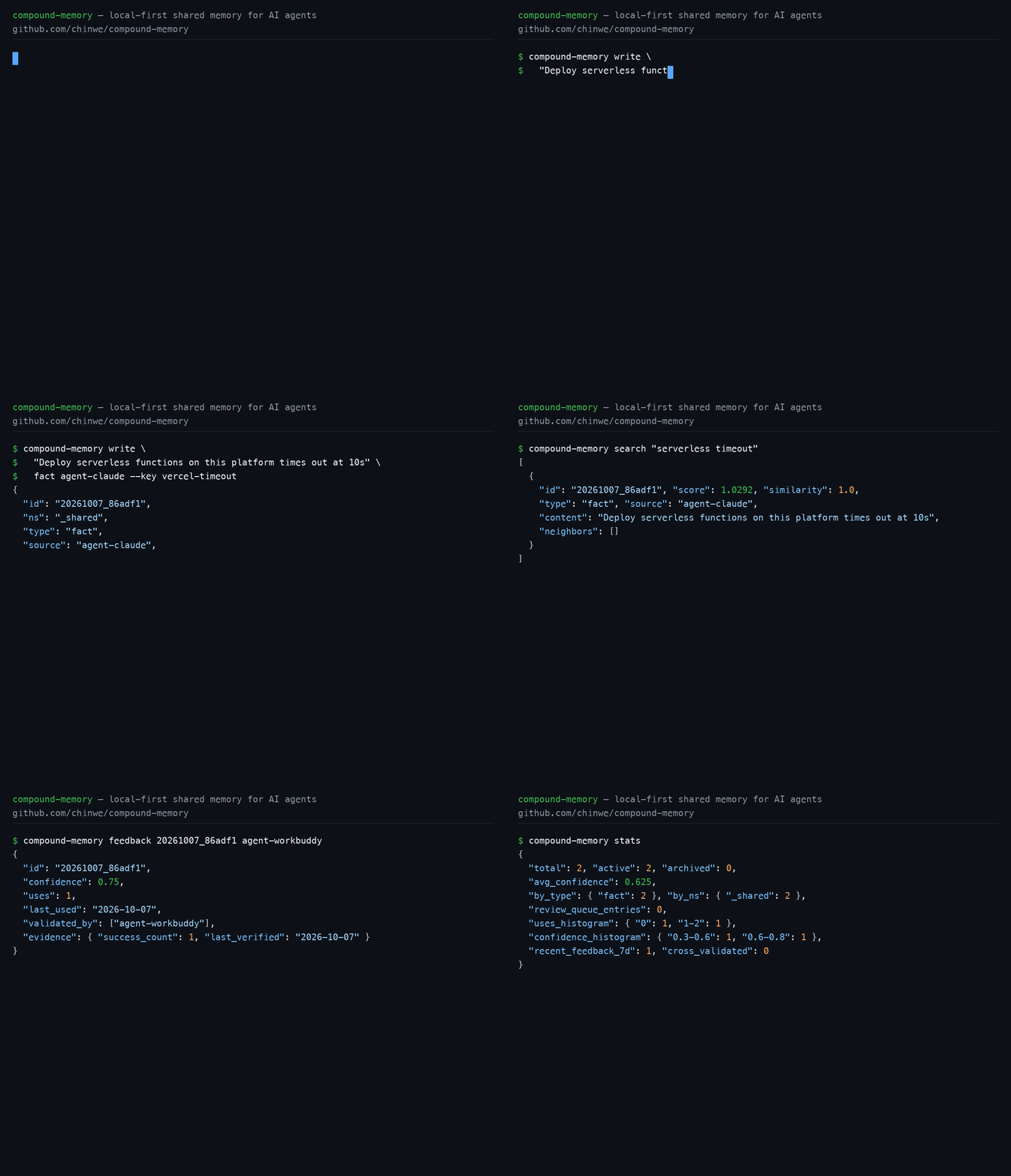
One full loop: write → search → feedback (with cross-host first-validation bonus) → store health. Real output from v0.4.0, long payloads trimmed:
uv run compound-memory init
{ "ok": true, "root": "~/.agents/memory" }
Two different hosts each write one stable fact (new memories start at confidence 0.5, uses 0):
uv run compound-memory write \
  "Deploy serverless functions on this platform times out at 10s — keep handlers under that budget" \
  fact agent-claude --key vercel-timeout
{
  "id": "20261007_86adf1",
  "ns": "_shared",
  "type": "fact",
  "source": "agent-claude",
  "content": "Deploy serverless functions on this platform times out at 10s — keep handlers under that budget",
  "confidence": 0.5,
  "uses": 0,
  "key": "vercel-timeout",
  "validated_by": []
  ...
}
uv run compound-memory write \
  "User prefers concise replies with tables and code examples" \
  fact agent-zcode --key user-style
Search ranks by score (--explain attaches per-hit ranking components for debugging):
uv run compound-memory search "serverless timeout"
[
  {
    "id": "20261007_86adf1", "score": 1.0292, "similarity": 1.0,
    "type": "fact", "source": "agent-claude",
    "content": "Deploy serverless functions on this platform times out at 10s — keep handlers under that budget",
    "neighbors": []
  },
  {
    "id": "20261007_6a0c0c", "score": 0.5211, "similarity": 0.4919,
    "type": "fact", "source": "agent-zcode",
    "content": "User prefers concise replies with tables and code examples",
    "neighbors": []
  }
]
A different host used this memory and reported it back — uses +1, conf +0.1; and since the reporter agent-workbuddy ≠ source agent-claude, the first cross-host validation adds another +0.15:
uv run compound-memory feedback 20261007_86adf1 agent-workbuddy
{
  "id": "20261007_86adf1",
  "confidence": 0.75,
  "uses": 1,
  "last_used": "2026-10-07",
  "validated_by": ["agent-workbuddy"],
  "evidence": {
    "success_count": 1, "failure_count": 0, "contradiction_count": 0,
    "last_verified": "2026-10-07",
    "recent": [{ "date": "2026-10-07", "agent": "agent-workbuddy", "outcome": "success" }]
  }
  ...
}
Store health at a glance (fixed-bucket histograms, liveness, distillation yield):
uv run compound-memory stats
{
  "total": 2, "archived": 0, "active": 2,
  "avg_confidence": 0.625,
  "by_type": { "fact": 2 },
  "by_ns": { "_shared": 2 },
  "review_queue_entries": 0,
  "uses_histogram": { "0": 1, "1-2": 1, "3-5": 0, "6-9": 0, "10+": 0 },
  "confidence_histogram": { "<0.3": 0, "0.3-0.6": 1, "0.6-0.8": 1, "0.8-1.0": 0 },
  "recent_feedback_7d": 1, "cross_validated": 0,
  "distilled_total": 0, "distilled_recent_7d": 0
}
Three things to notice:
- New memories start at
confidence0.5 and move on evidence — feedback carries an outcome:successraises it,failurelowers it (floor 0.05),contradictionfreezes it into the review queue,obsoletearchives immediately. - First validation from a different host earns an independent bonus (once per host per memory), with
validated_by/evidencetrails — confidence is evidence of correctness, not popularity. - Hits embed one-hop neighbors automatically (empty here — no links yet;
memory_linkcreates bidirectional links that get recalled for free).
How compounding works
| Interest source | Mechanism |
|---|---|
| ① Usage reinforcement | memory_feedback: uses+1, conf+0.1 |
| ② Link value | memory_link creates bidirectional links; memory_get pulls one-hop neighbors; search hits embed up to 3 compact neighbors (active memories only, --no-neighbors to disable) |
| ③ Distillation | distill-plan (CLI, deterministic candidates + dual-signal dedup annotations) → agent judgment → distill-apply atomic commit (product links back to sources; sources archived but revivable) |
| ④ Cross-agent validation | Feedback from an agent other than the source adds conf +0.15 |
Scoring (weights are the W_* constants in src/compound_memory/scoring.py): 0.70·similarity + 0.15·confidence + 0.10·recency(0.5+0.5·e^(−Δt/τ)) + 0.05·type weight. With the vector channel enabled, ranking switches to RRF fusion with an ε=0.04 prior tie-break (see the spec, "index as cache").
The 5 MCP tools
| Tool | Purpose | Key points |
|---|---|---|
memory_write | Write a memory | type: episode/fact/insight/skill/decision; source: your agent id; give fact/insight/decision a stable key; optional valid_from/valid_until (ISO dates) and project scope |
memory_search | Retrieve | Returns {"hits": [...]} ranked by score; embeds up to 3 one-hop neighbors; dual-channel by default (_shared + caller's own private ns); optional project (fail-closed) and explain |
memory_get | Fetch by id | Always contains a found key; pulls one-hop neighbors; private-ns targets require reader |
memory_link | Link two memories | Bidirectional; both sides must be in the same ns; private-ns links require owner identity |
memory_feedback | Report "this memory was actually used" | Default outcome=success: uses+1, conf+0.1; first cross-host validation +0.15; also failure / contradiction / obsolete / unknown. Mandatory after adopting a hit — that's the loop that makes the store compound |
Tool descriptions embed the protocol rules themselves, so agents keep the loop intact even without host-side rules injected. Full parameter reference: docs/agent-integration.md.
CLI
uv sync --extra dev              # first clone: build .venv (later `uv run` reuses it)

uv run compound-memory init               # initialize an empty store
uv run compound-memory write "Vercel Serverless has a 10s timeout" episode agent-workbuddy
uv run compound-memory search "Vercel timeout"   # hits embed one-hop neighbors (limit 3, --no-neighbors to disable)
uv run compound-memory feedback <id> agent-claude
uv run compound-memory decay          # run from cron
uv run compound-memory revive <id>    # revive an archived memory
uv run compound-memory distill-plan   # distillation candidates: merge_with (same-key strong) + possible_dup_of (BM25 weak) + promotion_candidate (high-activity episodes)
uv run compound-memory distill-apply "the merged insight" insight agent-workbuddy --sources <id1>,<id2>  # atomic: product (links, origin=distillation) + source archival, one commit
uv run compound-memory stats            # health: uses/confidence buckets + liveness + distillation yield
uv run compound-memory rebuild-index  # rebuild the search cache anytime
uv run compound-memory review-queue   # conflict queue (CLI-only entry)
uv run compound-memory git-log        # audit trail
More operations: explain <id> (confidence composition + evidence detail for one memory), forget <id> --agent <id> (terminal removal, ADR-0009), review-resolve (adjudicate conflicts), extract <transcript|dir> (deterministic session-transcript mining).
Architecture
Agent (MCP client / CLI)
  └─ memory_write | memory_search | memory_get | memory_link | memory_feedback
       └─ MemoryStore (~/.agents/memory)
            ├─ namespaces/_shared/{episode,fact,insight,skill}/*.md   shared area
            ├─ namespaces/agent-*/...                                  private areas
            ├─ archive/...                                             decayed archive (revivable)
            ├─ index/tokens.json                                       rebuildable search cache
            ├─ review-queue.md                                         fact/insight conflict queue
            └─ .git/                                                   auto-commit on every write
Scheduled distillation prep (launchd / cron / systemd)
Per ADR 0001, the deterministic prep runs on a schedule while judgment (summarizing / merging) stays with the calling agent. Every day at 09:00 the candidate list lands in <root>/distill/last-plan.json. Pick one scheduler — launchd (macOS standard, catches up after sleep), systemd user timer (Persistent=true, same catch-up), or cron (most portable, no catch-up) — all three drive the same platform-neutral scripts/distill-prepare.sh. Ready-made templates with copy-paste instructions: scripts/com.compound-memory.distill-prepare.plist.tmpl (launchd), scripts/compound-memory-distill-prepare.{service,timer}.example (systemd), and the Chinese README for cron. The script runs set -eu: any failure exits non-zero (visible via launchctl list / systemctl --user list-timers / cron mail, log at distill/prepare.log). distill/ is a runtime artifact directory (auto-gitignored) — no commit noise; only distill-apply after agent judgment lands one atomic commit.
Documentation
docs/specs/0001-compound-memory-spec.md— design specdocs/agent-integration.md— per-host MCP configs + the unified usage protocol (Chinese)docs/adr/— architecture decision recordsCONTEXT.md— glossary (Chinese)skills/compound-memory/SKILL.md— usage rules for hosts (Chinese)
Development
uv run pytest tests/ -q     # full suite (MCP tool boundary + distillation + lifecycle/index/CLI + input defense)
uv run mypy src/compound_memory/
Test seams: the MCP tool boundary via in-process mcp.Client(server) (no subprocess) plus unit tests for core modules (scoring / index / store ops). CI runs tests, type checks, and a pure-wheel install smoke across Python 3.11/3.12/3.13.
Release
PyPI versions are immutable and the tag must match pyproject.toml's version (the release workflow verifies this and fails loudly). Releases go through GitHub Actions + PyPI Trusted Publisher (OIDC, no token): push a tag like v0.1.0 and release.yml builds and publishes automatically.
MCP Registry name: mcp-name: io.github.chinwe/compound-memory
Reviews
No reviews yet
Be the first to review this server!
More Developer Tools MCP Servers
Git
Freeby Modelcontextprotocol · Developer Tools
Read, search, and manipulate Git repositories programmatically
Fetch
Freeby Modelcontextprotocol · Developer Tools
Web content fetching and conversion for efficient LLM usage
Worldmonitor
Freeby Koala73 · Developer Tools
Live markets, conflicts, country risk, chokepoints, energy, and China decision signals. 89 tools.
Paperclip
Freeby Paperclipai · Developer Tools
Trending hip-hop artist momentum scores across four cultural dimensions.
Toleno
Freeby Toleno · Developer Tools
Toleno Network MCP Server — Manage your Toleno mining account with Claude AI using natural language.
mcp-creator-python
Freeby mcp-marketplace · Developer Tools
Create, build, and publish Python MCP servers to PyPI — conversationally.