
Server data from the Official MCP Registry
MCP server for generating advanced mock 2D PNG assets for game prototypes.
About
MCP server for generating advanced mock 2D PNG assets for game prototypes.
Security Report
Valid MCP server (1 strong, 1 medium validity signals). No known CVEs in dependencies. Package registry verified. Imported from the Official MCP Registry. Trust signals: 3 highly-trusted packages.
7 files analyzed · 1 issue found
Security scores are indicators to help you make informed decisions, not guarantees. Always review permissions before connecting any MCP server.
Permissions Required
This plugin requests these system permissions. Most are normal for its category.
How to Install
Add this to your MCP configuration file:
{
  "mcpServers": {
    "io-github-crony-io-2d-assets-mcp": {
      "args": [
        "-y",
        "2d-assets-mcp"
      ],
      "command": "npx"
    }
  }
}Documentation
View on GitHubFrom the project's GitHub README.
2d-assets-mcp
Design your game's feel before you design its art.




Just like wireframing helps designers visualize user flows before start sketching, 2d-assets-mcp helps game developers visualize timing, frames-per-second (FPS), collision boundaries, and UI layouts before spending hours on final artwork.
This MCP (Model Context Protocol) server lets any AI assistant (Antigravity, Claude Code, Codex, Devin, or any of them as long as it's MCP-compatible) generate advanced 2D mock/placeholder assets in PNG format right into your project folder. Save time and prototype faster, nail your game's feel with 2d-assets-mcp, and then replace the mockups with original artwork when you are ready.
This MCP is engine-agnostic and it works flawlessly with any game engine that supports PNG import, like:
- Godot
- Unity
- Unreal Engine
- GameMaker
- Construct
- RPG Maker
- And many more!
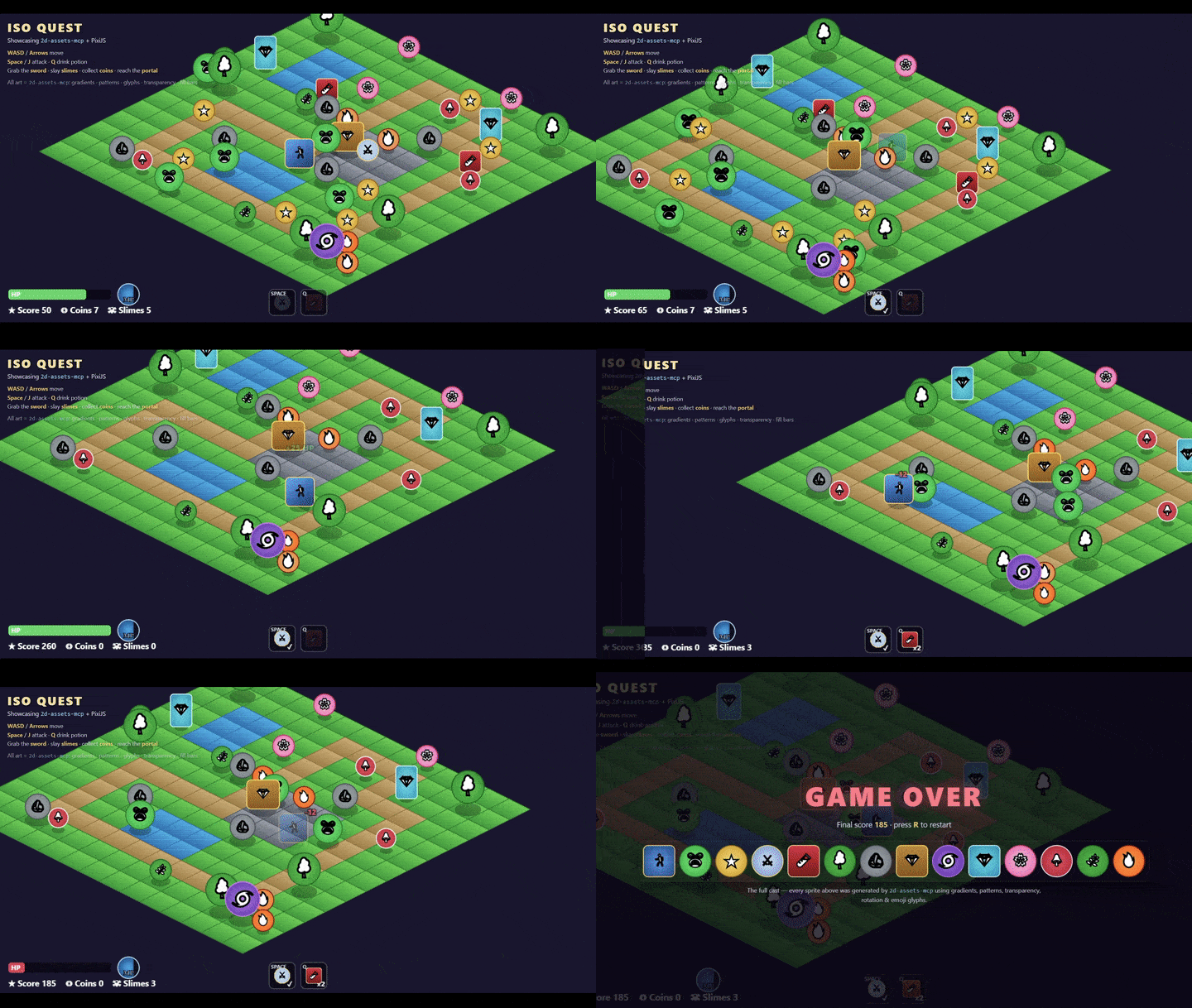
Save time and create placeholder health bars, spritesheets, and whatever UI elements you can think of with full support for gradients, patterns, transparency, text rotation, and auto-scaling, all via chat and without ever opening an image editor. The idea behind it is to help you test and iterate how your game feels first by prototiping scale, jump arcs, and animation timing without waiting on final art assets, and also with zero friction: Need that placeholder button to be 20% larger? Just ask your AI client to regenerate it.
[!TIP] 2d-assets-mcp has AI-Friendly Metadata → meaning each generated PNG embeds rich JSON metadata (dimensions, color, shape, gradient properties, pattern details, text properties, stroke properties, description) directly in its EXIF data, so AI models without vision can still understand what an asset contains.
Generated Assets Examples
Here are some example assets generated by this MCP server:

Character Sprites & Animations
Hero Idle Animation (8 frames, 512x64)

8-frame idle animation spritesheet with effect
UI Elements
Attack Button (128×48)

Button with red gradient, rounded corners, and "ATTACK" label
Health Bar (200×24)

Health bar at 75% fill with green color and dark gray track
Game Items
Gold Coin (32×32)

Circular coin with radial gradient, dot pattern overlay, and "COIN" label
Grass and water


Trees

Animation Spritesheets
Fire animation (4 frames, 192x48)

4-frame spritesheet
Security Considerations
Asset Content
- Generated assets are pure placeholder graphics and they do not contain malicious code.
- Embedded metadata is plain JSON and is not executable.
Because this MCP server writes files directly to your machine to save you time, please review these security best practices:
File System Access
- The server can write files to any path specified by the AI assistant.
- Recommendation: Configure your AI client to restrict access strictly to your game's project directories.
- Warning: Be cautious when asking the AI to generate assets outside your project directory.
Path Traversal
- This server validates paths, but you should always be aware of potential path traversal attempts when dealing with MCP servers, and review generated file paths before confirming operations.
Overall Best Practices
- Use absolute paths in configurations to prevent ambiguity.
- Restrict AI access to your game project directory only.
- Review generated assets before committing to version control.
- Keep your Node.js dependencies updated.
Core Features
- Instant asset generation: one tool call, one PNG, full visual configuration.
- Spritesheet & Batch mode: generate multiple frames or composite them into a single animation-strip spritesheet in one request.
- Rich visuals: support for solid fills, linear/radial gradients, stripe/dot/grid pattern overlays, rounded corners, circles, opacity, and stroke control.
- Dynamic UI Elements: create partially filled progress/health bars using
fillPercentandtrackColorfor partially-filled assets. - Auto-scaling labels: text automatically scales to fit the asset, or you can override it with explicit
fontSizeif needed. - Non-vision AI friendly: embedded JSON metadata readable back via
read_image_metadata, without loading image pixels, ideal for non-vision AI workflows. - Smart naming: output files are automatically named with their dimensions (e.g.
player_idle_128x128.png) to help models with no vision know the dimensions when using the asset.
Tools Reference
This MCP server equips your AI with 3 tools to generate and read 2D asset metadata.
1. generate_mock_asset
Generates a single PNG asset and writes it to the disk. It supports gradients, patterns, transparency, text rotation, and embedded metadata.
Required parameters
| Parameter | Type | Description |
|---|---|---|
filename | string | Output filename, e.g. player_idle.png |
directory | string | Absolute path to the output folder (created if missing) |
text | string | Label rendered on the asset |
color | string | Background hex color, e.g. #FF5733 |
Optional parameters: shape & size
| Parameter | Type | Default | Description |
|---|---|---|---|
width | number | 128 | Width in pixels |
height | number | 128 | Height in pixels |
shape | rectangle | rounded-rectangle | circle | rectangle | Geometric shape |
opacity | number 0–1 | 1.0 | Background opacity |
strokeColor | string | #000000 | Border hex color |
strokeWidth | number | 4 | Border width in px; 0 removes the border |
Optional parameters: fill & gradient
| Parameter | Type | Default | Description |
|---|---|---|---|
fillMode | solid | linear-gradient | radial-gradient | solid | Background fill type |
secondaryColor | string | auto-derived | Second gradient stop; auto-shaded from color if omitted |
gradientAngle | number | 45 | Angle in degrees for linear gradients (ignored for radial) |
Optional parameters: progress/health bar
| Parameter | Type | Default | Description |
|---|---|---|---|
fillPercent | number 0–100 | 100 | How much of the asset is filled (left to right) |
trackColor | string | — | Color of the unfilled portion; transparent if omitted |
Optional parameters: pattern overlay
| Parameter | Type | Default | Description |
|---|---|---|---|
pattern | none | stripes | dots | grid | none | Pattern overlay type |
patternColor | string | auto-derived | Pattern color; contrast-auto if omitted |
patternOpacity | number 0–1 | 0.18 | Pattern overlay opacity |
patternScale | number ≥2 | 16 | Pattern tile size in pixels |
Optional parameters: text
| Parameter | Type | Default | Description |
|---|---|---|---|
textPosition | center | top | bottom | center | Vertical text alignment |
fontSize | number | auto-scaled | Explicit font size in px; auto-fits if omitted |
textRotation | number | 0 | Text rotation angle in degrees |
textColor | string | auto-contrasting | Hex color for text; auto-calculated if omitted |
Optional parameters: metadata
| Parameter | Type | Default | Description |
|---|---|---|---|
assetDescription | string | — | Human-readable description embedded in the PNG EXIF for non-vision AI context |
[!NOTE] Output filename format
The server automatically appends the dimensions to the filename before writing:
player_idle.png → player_idle_128x128.png
2. generate_mock_asset_batch
Generates multiple assets in one request. Supports individual PNGs or a single composed spritesheet.
Required parameters
| Parameter | Type | Description |
|---|---|---|
assets | AssetConfig[] | Array of asset configs (same fields as generate_mock_asset) |
Optional parameters
| Parameter | Type | Default | Description |
|---|---|---|---|
spritesheetMode | individual \ spritesheet | spritesheet | individual writes separate PNGs; spritesheet composes a single PNG |
sheetFilename | string | spritesheet.png | Output filename for the composed spritesheet |
sheetDirectory | string | first asset's directory | Output directory for the spritesheet |
sheetMargin | number | 8 | Outer padding around the spritesheet in pixels |
sheetSpacing | number | 8 | Gap between animation frames in pixels |
[!NOTE] Spritesheet layout
All assets are arranged in a single row (traditional animation strip). Each frame cell is sized to the largest asset in the batch; smaller assets are centered within their cell. The output filename includes the total sheet dimensions:
player_run.png → player_run_648x136.png
3. read_image_metadata
Reads the JSON metadata embedded in the EXIF ImageDescription field of any PNG generated by this server. Useful for AI models that lack vision, because they can understand what an asset contains without decoding the image.
Required parameters
| Parameter | Type | Description |
|---|---|---|
filepath | string | Absolute path to the PNG file |
How metadata embedding works
Metadata is stored as a JSON string in the PNG's EXIF IFD0.ImageDescription field using the sharp library's withMetadata API.
Reading it back uses a deliberate bypass of standard TIFF byte-walking: instead of parsing the binary TIFF structure, the raw EXIF buffer is scanned as a UTF-8 string for the known "generator":"2d-assets-mcp" key, then the surrounding JSON object is extracted. This makes the reader immune to TIFF padding, byte-order variations, and unusual IFD layouts across different PNG writers.
{
  "generator": "2d-assets-mcp",
  "type": "asset",
  "name": "player_idle",
  "width": 128,
  "height": 128,
  "color": "#4A90E2",
  "shape": "rounded-rectangle",
  "fillMode": "linear-gradient",
  "fillPercent": 100,
  "trackColor": null,
  "pattern": "none",
  "secondaryColor": "#2E5A8A",
  "gradientAngle": 45,
  "textRotation": 0,
  "textPosition": "center",
  "strokeColor": "#000000",
  "strokeWidth": 4,
  "description": "Player idle placeholder, blue rounded rectangle 128x128",
  "createdAt": "2025-01-15T10:30:00.000Z"
}
Spritesheet metadata fields (additional fields returned for spritesheet files)
{
  "generator": "2d-assets-mcp",
  "type": "spritesheet",
  "totalWidth": 648,
  "totalHeight": 136,
  "columns": 4,
  "rows": 1,
  "frameCount": 4,
  "frameWidth": 128,
  "frameHeight": 128,
  "margin": 8,
  "spacing": 8,
  "frames": [
    {
      "index": 0,
      "x": 8,
      "y": 8,
      "width": 128,
      "height": 128,
      "name": "frame_0",
      "color": "#4A90E2",
      "shape": "rounded-rectangle"
    }
  ],
  "createdAt": "2025-01-15T10:30:00.000Z"
}
Example Prompts for Your AI
Once connected to an AI coding assistant, try these prompts to speed up your workflow:
Single asset
"Create a 128×128 blue rounded-rectangle placeholder for my player character at
C:\Users\me\project\assets\sprites\(Windows) or/home/me/project/assets/sprites/(Linux) or/Users/me/project/assets/sprites/(macOS). Label it 'Player' and give it a radial gradient."
Health bar
"Generate a health bar PNG at 200×24 pixels, filled 65%, thin stroke, red fill color, dark gray track, at your project's UI folder. Call the file
health_bar.png."
Spritesheet
"Create a 4-frame run cycle spritesheet for my player. Each frame should be 64×64, different shades of blue, labeled Frame 1 through Frame 4. Save it to my project's sprites folder."
Read metadata
"Read the metadata from my project's sprites folder, file
player_idle_128x128.png."
Installation
Option 1: Use directly with npx (no install required)
The fastest way to connect it to any AI coding assistant:
{
  "mcpServers": {
    "2d-assets": {
      "command": "npx",
      "args": ["-y", "2d-assets-mcp"]
    }
  }
}
Option 2: Manual installation with package manager (pnpm, npm, yarn)
1. Clone the repository
git clone https://github.com/crony-io/2d-assets-mcp.git
cd 2d-assets-mcp
2. Install dependencies
pnpm install   # recommended
# or: npm install
# or: yarn install
3. Build the project
pnpm run build
# or: npm run build
# or: yarn run build
4. Configure your MCP client
{
  "mcpServers": {
    "2d-assets-mcp": {
      "command": "node",
      "args": ["/absolute/path/to/2d-assets-mcp/dist/index.js"]
    }
  }
}
Option 3: Install globally with pnpm or npm
This project works with any Node.js package manager. Choose your preferred one:
npm
npm install -g 2d-assets-mcp
pnpm
pnpm add -g 2d-assets-mcp
Then reference the installed binary:
{
  "mcpServers": {
    "2d-assets": {
      "command": "2d-assets-mcp"
    }
  }
}
Claude Code / Claude Desktop
Add to your Claude Code/Claude Desktop MCP settings:
{
  "mcpServers": {
    "2d-assets-mcp": {
      "command": "node",
      "args": ["/absolute/path/to/2d-assets-mcp/dist/index.js"]
    }
  }
}
Devin
Add to your Devin MCP settings (mcp_config.json):
{
  "mcpServers": {
    "2d-assets-mcp": {
      "command": "node",
      "args": ["/absolute/path/to/2d-assets-mcp/dist/index.js"],
      "disabled": false
    }
  }
}
Cursor
Create .cursor/mcp.json in your project:
{
  "mcpServers": {
    "2d-assets-mcp": {
      "command": "node",
      "args": ["/absolute/path/to/2d-assets-mcp/dist/index.js"]
    }
  }
}
Development
Prerequisites
- Node.js 18 or later
- pnpm 8 or later or npm 9 or later (any package manager works)
Setup
git clone https://github.com/crony-io/2d-assets-mcp.git
cd 2d-assets-mcp
# Choose your package manager:
pnpm install   # recommended
# or
npm install
# or
yarn install
Scripts
| Command | Description |
|---|---|
npm run build / pnpm run build | Compile TypeScript to dist/ |
npm run dev / pnpm run dev | Run directly from source with tsx (no build needed) |
npm run start / pnpm run start | Run the compiled server from dist/ |
npm run typecheck / pnpm run typecheck | Type-check without emitting files |
npm run check / pnpm run check | Run all checks: format, lint, and typecheck |
Adding a new tool
- Create
src/tools/yourTool.tsand export aregisterYourTool(server: McpServer)function - Import and call it in
src/server.ts - Add any new Zod schemas to
src/schemas.tsand types tosrc/types.ts
License
MIT — see LICENSE for full text.
Contributing
Issues and pull requests are always welcome. Just please, before you open a PR make sure to:
- Run
pnpm run checkornpm run check(zero errors required). - Keep new tools in their own file under
src/tools/. - Export new types from
src/types.tsand schemas fromsrc/schemas.ts. - Update this README's Tools Reference section for any new or changed parameters.
Reviews
No reviews yet
Be the first to review this server!
More Developer Tools MCP Servers
Paperclip
Freeby Paperclipai · Developer Tools
Trending hip-hop artist momentum scores across four cultural dimensions.
Git
Freeby Modelcontextprotocol · Developer Tools
Read, search, and manipulate Git repositories programmatically
Toleno
Freeby Toleno · Developer Tools
Toleno Network MCP Server — Manage your Toleno mining account with Claude AI using natural language.
mcp-creator-python
Freeby mcp-marketplace · Developer Tools
Create, build, and publish Python MCP servers to PyPI — conversationally.
MCP Marketplace
Freeby mcp-marketplace · Developer Tools
Search and install MCP servers from inside your AI client.
MarkItDown
Freeby Microsoft · Content & Media
Convert files (PDF, Word, Excel, images, audio) to Markdown for LLM consumption