
Server data from the Official MCP Registry
Persistent code knowledge graph + 9 composite MCP tools for AI coding agents.
About
Persistent code knowledge graph + 9 composite MCP tools for AI coding agents.
Security Report
forensic-deepdive is a well-architected codebase analysis tool with proper dependency management and thoughtful security practices. No authentication is required for local operation (appropriate for the use case), and code quality is high with clear decision documentation. Minor concerns around the minified JavaScript library and broad exception handling in a few areas prevent a higher score, but these are not material security issues. Supply chain analysis found 6 known vulnerabilities in dependencies (0 critical, 3 high severity). Package verification found 1 issue.
3 files analyzed · 11 issues found
Security scores are indicators to help you make informed decisions, not guarantees. Always review permissions before connecting any MCP server.
Permissions Required
This plugin requests these system permissions. Most are normal for its category.
How to Install
Add this to your MCP configuration file:
{
  "mcpServers": {
    "io-github-dhevenddra-forensic-deepdive": {
      "args": [
        "forensic-deepdive"
      ],
      "command": "uvx"
    }
  }
}Documentation
View on GitHubFrom the project's GitHub README.
forensic-deepdive
forensic-deepdive gives an AI coding agent forensic understanding of an unfamiliar codebase — a persistent knowledge graph, an MCP server, and five durable markdown artifacts, so your agent stops re-discovering the same architecture from scratch every session.
uv tool install forensic-deepdive && forensic extract /path/to/repo
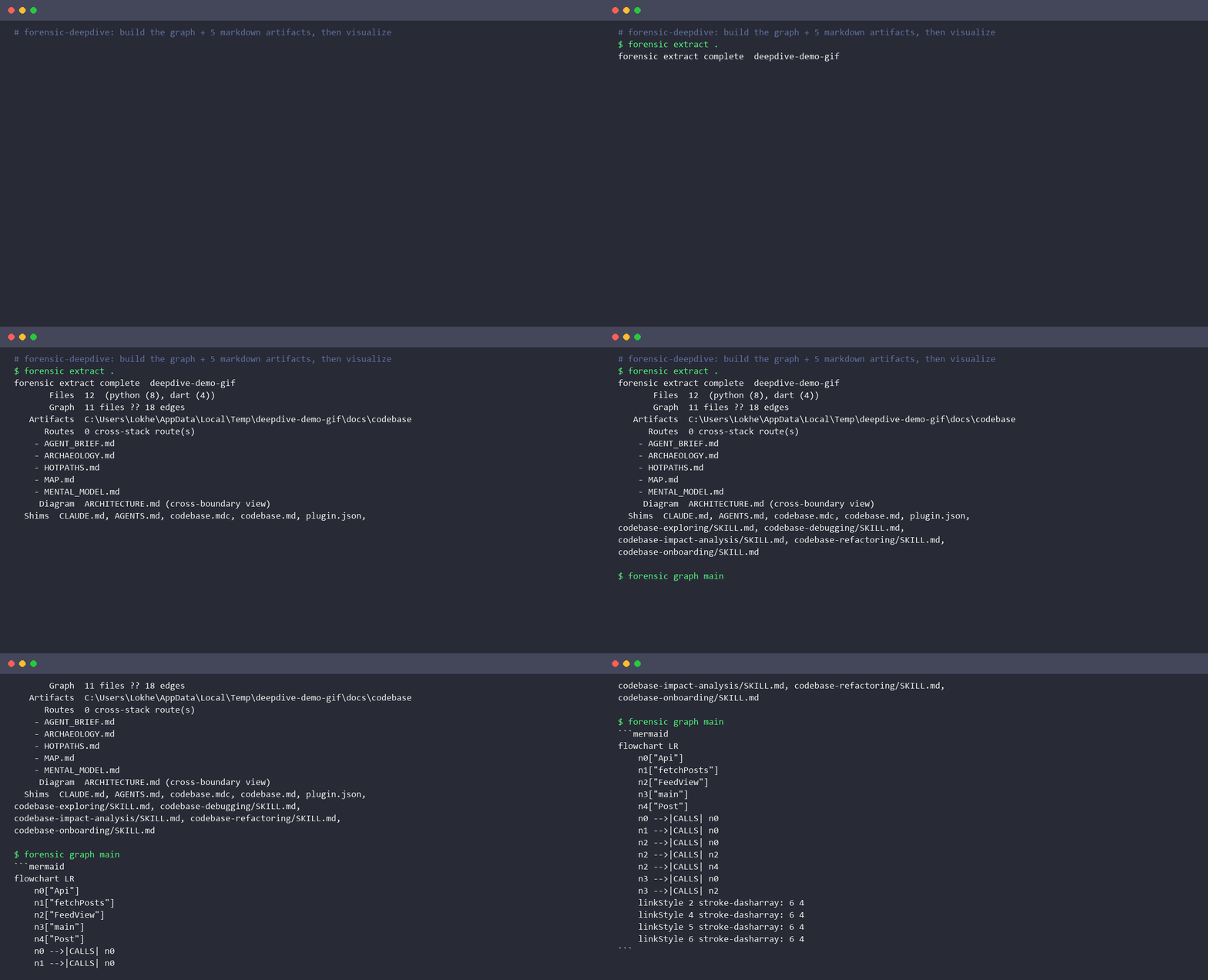
Why this is different: every edge and every emitted claim carries a confidence tag —
EXTRACTED (deterministic fact) / INFERRED (a heuristic resolved cleanly) / AMBIGUOUS
(multiple candidates, shown, not guessed) — so your agent knows what to trust before it
acts on it. Nothing else in this category tags confidence at all.
Why not GitNexus / CodeGraphContext / DeepWiki / Sourcegraph
| forensic-deepdive | GitNexus | CodeGraphContext | DeepWiki | Sourcegraph | |
|---|---|---|---|---|---|
| License | Apache-2.0 | PolyForm Noncommercial | MIT | proprietary (open variant: MIT) | partial |
| Persistent code knowledge graph | ✅ LadybugDB | ✅ LadybugDB | partial | ❌ | partial |
| MCP server | ✅ 9 composite tools | ✅ 16 tools | partial | ❌ | ❌ |
| Per-edge confidence taxonomy | ✅ EXTRACTED / INFERRED / AMBIGUOUS | ❌ | ❌ | ❌ | ❌ |
| Git archaeology as a first-class layer | ✅ | ❌ | ❌ | ❌ | partial |
| Durable committed markdown artifacts | ✅ 5 files | partial | partial | ✅ (wiki) | ❌ |
Agent-insight layer (record_insight / recall_insights) | ✅ | ❌ | ❌ | ❌ | ❌ |
| Multi-platform skill emission | ✅ 10 shims | partial | partial | ❌ | ❌ |
| Local-only (no cloud required) | ✅ co-equal | ✅ | ✅ | ❌ | ❌ |
GitNexus is the runaway leader in this category — but its PolyForm Noncommercial
license locks every commercial user out. forensic-deepdive is the Apache-2.0
alternative: same persistent-graph-plus-MCP shape, plus honest confidence tags, git
archaeology, persistent agent memory, and the 5 markdown artifacts as a fallback for any
agent that doesn't speak MCP — with a license your employer's legal team will actually
sign off on.
What it produces
forensic-deepdive analyzes any codebase (9 languages, polyglot) and produces:
- A persistent embedded graph at
<repo>/.deepdive/graph.lbug— File, Symbol, Module, Commit, Author, Endpoint, and DbTable nodes plus DEFINES, MEMBER_OF, IMPORTS, CALLS, EXTENDS, IMPLEMENTS, TOUCHED_BY_COMMIT, AUTHORED_BY, CO_CHANGES_WITH, and the cross-boundary HANDLES / CALLS_ENDPOINT / ROUTES_TO / INJECTS / PERSISTS_TO edges. Every edge carries a confidence tag (EXTRACTED/INFERRED/AMBIGUOUS) — no hidden heuristics. The singleEndpointjoin node unifies five cross-boundary protocols (HTTP, MCP tools, registry-dispatch, gRPC, messaging/AMQP), so a frontend call resolves to its backend handler across the stack as oneROUTES_TOedge. - An MCP server (
forensic serve) exposing 9 composite tools (impact,context,archaeology,flow,query,record_insight,recall_insights,visualize,trace) consumable by Claude Code, Cursor, Codex, Continue, Cline, Windsurf — and any other MCP-aware agent. - Five durable markdown artifacts under
<repo>/docs/codebase/, regenerated from the graph on every extract:MAP.md— what's where, ranked by centrality.HOTPATHS.md— the dependency hot spots, with a per-row confidence-mix column so you see exactly how cleanly each symbol resolves.ARCHAEOLOGY.md— why the code looks the way it does (git history, top authors with %, bus factor, co-change clusters, defect proximity).MENTAL_MODEL.md— the doc the original author would write to onboard a new hire.AGENT_BRIEF.md— ≤5 KB of assertive Never/Always rules with per-rule confidence tags. Drop-inCLAUDE.mdfor any project.
- Ten shims into the target repo — 4 editor rule files (
CLAUDE.md,AGENTS.md,.cursor/rules/codebase.mdc,.continue/rules/codebase.md), 5 single-intent Claude skills under.claude/skills/codebase-{exploring,debugging,impact-analysis,refactoring,onboarding}/, and a.claude-plugin/plugin.jsonmanifest. All write-if-absent — hand-edited files are never overwritten. - An agent-insight layer —
record_insight/recall_insightsMCP tools backed by<repo>/.deepdive/insights.jsonlby default (zero dependencies, human-readable, git-friendly). The optional[graphiti]extra upgrades to a temporal knowledge graph backend above a 2-of-5 repo-size threshold.
Extract also regenerates ARCHITECTURE.md — a system-level Mermaid view of the cross-boundary graph (ROUTES_TO / INJECTS / PERSISTS_TO, confidence-styled), a separate human-validation surface (not one of the five contract artifacts, exactly like forensic visualize and serve --ui). Regenerate it on its own with forensic diagram --repo <repo>. Use it to sanity-check the graph — a wrong edge there is a wrong edge everywhere.
Add --emit-vault to also write an Obsidian-friendly vault under <output>/vault/ — every artifact gets summary:/tags: frontmatter, cross-references become [[wikilinks]], and an INDEX.md MOC ties them together (with a .obsidian/ config). A local-first second brain for humans (graph view, backlinks) and agents (triage by summary: without opening files, a traversable index). Opt-in; off by default.
Status
v0.10.0 "The Upgrade Path" — an integrity release. v0.9 shipped correct, and then its findings run caught --refresh-shims being structurally unable to refresh half its targets, with 909 tests green over it. The cause wasn't the fix — it was that every test in the suite wrote into an empty directory, so only the first run had ever been tested. Everyone who isn't a new user lives on the untested path.
So 0.10 adds almost no surface. It makes the guarantees already made real: running Deepdive over a repo that already carries a previous release's output now provably converges (and provably leaves your hand-edited files alone), extract tells you when generated shims are stale instead of waiting for you to know the flag exists, and a stale examples/ fails CI rather than being caught by eye mid-release. New: forensic extract --timings, per-phase wall clock.
It also contains a cancelled feature, which is the more useful story. The planned performance work targeted PageRank. The profile required before touching it measured PageRank at 0.04 % of a large extract, and the already-batched store writes at 79–87 %. The optimization was disproven before it was written — see docs/findings/v0.10/PROFILE.md. Confirming a known technique had been applied had been mistaken for confirming it was fast.
The engine, the graph, the contract layer and the 5-artifact + 9-MCP-tool contract are unchanged from 0.9, and emitted content is byte-identical but for the version footer.
⚠ If you installed 0.8.0 or 0.9.0 and
forensic servestopped working — this is why. Those releases declaremcp>=1.27.1with no upper bound.mcp2.0.0 removedmcp.server.fastmcp, which the MCP server imports, so a fresh install of 0.8.0 or 0.9.0 today resolves tomcp2.0.0 and fails on import. Our development lockfile pinned 1.27.1, so every local check stayed green and only the clean-environment wheel smoke in CI could see it. Fix: upgrade to 0.10.0 (which capsmcp<2), or pinmcp<2yourself. Nothing else about those releases is affected.
What's proven, and what isn't — the honest-framing section moved to
docs/findings/HONEST.md (unchanged content, DEC-119). Short
version: proven usable with real agent auto-discovery; not proven to make
autonomous issue resolution measurably faster end-to-end (hardware-gated). This is an
assisted-analysis tool, and it is not overclaimed as more.
Quick start
# install from PyPI (puts `forensic` on PATH); or run ephemerally with uvx
uv tool install forensic-deepdive
forensic info            # banner + capability panel
forensic extract /path/to/repo

# …or from source for development:
git clone https://github.com/Dhevenddra/forensic-deepdive && cd forensic-deepdive
uv sync --all-extras

# what can it do? (banner + capability panel: artifacts, protocols, MCP tools, confidence legend)
uv run forensic info

# guided setup: analyze a repo, then wire it up as an MCP server
# (--yes takes every default: scriptable, and the one mode that needs no extra)
uv run forensic onboard --repo /path/to/repo

# run on any repo
uv run forensic extract /path/to/repo

# graph lands at <repo>/.deepdive/graph.lbug
# 5 markdown artifacts at <repo>/docs/codebase/
# 10 shims at <repo>/.claude/, .cursor/, .continue/, root

# trace a cross-stack feature slice (frontend call -> endpoint -> handler -> tail)
uv run forensic trace <symbol> --repo /path/to/repo

# interactive query REPL over one held-open store (needs the [interactive] extra)
# bare text = natural-language query (no LLM) · :cypher <q> = raw Cypher · :help · Ctrl-D exits
uv run forensic repl --repo /path/to/repo

# full-screen terminal graph browser — the loopback-free sibling of serve --ui
# 1/2/3 = Symbols/Files/Endpoints · type to filter · c/e/l = confidence/edge/language · Enter = context · i/f = impact/flow
uv run forensic browse --repo /path/to/repo

# the session shell: all of the above over ONE held-open graph, with history
# in-session: extract · query · trace · impact · flow · diagram · browse · onboard · serve
uv run deepdive --repo /path/to/repo

# query the graph as an MCP server (point it at the analyzed repo)
uv run forensic serve --repo /path/to/repo

# inspect every repo you've analyzed
uv run forensic list
Install from PyPI
Published as forensic-deepdive —
no clone needed:
uv tool install forensic-deepdive        # puts `forensic` on PATH
forensic extract /path/to/repo

# …or run ephemerally, no install:
uvx forensic-deepdive extract /path/to/repo
Optional extras: uv tool install "forensic-deepdive[semantic]" (offline ONNX NL
query), [interactive] (the forensic repl query console, the forensic browse
TUI graph browser, and the deepdive session shell), [openapi] (YAML spec
parsing), [graphiti] (temporal insight backend).
Upgrading from 0.8
Re-run extract with --refresh-shims once. The generated shims and skills under
.claude/, .cursor/ and .continue/ are written only if absent, so a plain
re-extract leaves your 0.8-era copies in place, and two of the skill files still cite
internal decision IDs that 0.9 removed:
forensic extract /path/to/repo --force --refresh-shims
Only files Deepdive generated are rewritten. A shim you have hand-edited is never
touched.
pip install forensic-deepdive works too if you're not on uv.
Use it as an MCP server
forensic serve is a stdio MCP server exposing the 9 composite tools to any
MCP-aware agent (Claude Code, Cursor, VS Code/Copilot, Codex, Continue, Cline,
Windsurf). First build the graph once (forensic extract <repo>), then wire the
server. Three ways, easiest first:
1. Claude Code plugin (self-hosted marketplace — no PyPI step):
/plugin marketplace add Dhevenddra/forensic-deepdive
/plugin install forensic-deepdive@dhevenddra
2. From the MCP Registry — indexed as
io.github.Dhevenddra/forensic-deepdive, so registry-aware clients and discovery hubs
(PulseMCP, MCPJungle, the VS Code @mcp index) can find and install it directly.
3. Manual config — generate a client snippet with forensic mcp-config, or paste:
{
  "mcpServers": {
    "forensic-deepdive": {
      "command": "uvx",
      "args": ["forensic-deepdive", "serve", "--repo", "."]
    }
  }
}
Per-client copy-paste blocks (Cursor, VS Code, Codex, the uvx-not-found GUI gotcha)
are in docs/install.md.
The 9 supported languages
Python, C, Dart, Swift, TypeScript, JavaScript, Java, Go, Rust.
The 9 MCP tools
| Tool | What it does |
|---|---|
impact(symbol, depth, direction, min_confidence) | Blast-radius BFS over CALLS edges, depth-bucketed, confidence-filterable. |
context(symbol) | Single-call kitchen sink: definition + callers + callees + parent/siblings/members + extends/implements + recent commits + dominant author + recent insights. |
archaeology(file_or_symbol) | Churn, top authors with %, bus factor, co-change cluster, defect proximity, recent commits. |
flow(entry_point, max_depth) | DFS over CALLS with cycle detection. |
query(cypher | natural_language) | Raw Cypher, or hybrid NL retrieval (FTS5/BM25 + structural graph signal + opt-in offline semantic, RRF-fused and shaped) with per-hit provenance + confidence. |
record_insight(symbol, claim, evidence, verified_by) | Persist a verified learning. |
recall_insights(symbol, since, limit) | Newest-first substring match against stored insights. |
visualize(target, format, depth, max_nodes, ...) | Bounded Mermaid diagram of a symbol/file neighborhood (or central); edge dash style encodes confidence. |
trace(symbol, direction, max_depth) | Cross-stack feature slice across the Endpoint join node: downstream walks frontend call → CALLS_ENDPOINT → endpoint → HANDLES → handler → CALLS tail; upstream answers "who calls this endpoint". |
Tool descriptions are individually ≤200 tokens so the 9-tool envelope stays comfortably inside Anthropic's per-turn skill metadata budget.
The confidence taxonomy
Every edge and every emitted claim carries EXTRACTED / INFERRED / AMBIGUOUS:
EXTRACTED— deterministic from AST orgit log. Facts.INFERRED— a heuristic resolved cleanly (import-graph walk, receiver-type inference, single same-name candidate cross-file). High-trust but derived.AMBIGUOUS— multiple candidates surfaced; the resolver couldn't disambiguate. You see every candidate, not a silent guess.
HOTPATHS shows a per-row confidence-mix column so at a glance you can tell Logger (4 EXTRACTED + 1458 INFERRED — mostly clean) from ChatToolResponse (449 AMBIGUOUS — same-name cross-file collision).
Honest-mode (pure-static, zero LLM, zero network)
forensic extract works end-to-end with no ANTHROPIC_API_KEY, no OPENAI_API_KEY, no Ollama, no network. Graphiti is opt-in via the [graphiti] PyPI extra plus a 2-of-5 repo-size threshold (≥50 k LOC, ≥25 contributors, ≥18 mo old, ≥200 PRs/12 mo, ≥100 issues with discussion). The JsonlInsightStore is the always-available floor.
(The GitNexus/CodeGraphContext/DeepWiki/Sourcegraph comparison table is up top — it's the headline, not a footnote.)
Local development
git clone https://github.com/Dhevenddra/forensic-deepdive
cd forensic-deepdive
uv sync --all-extras
uv run forensic --version
uv run pytest -x          # 1000+ tests at v0.10.0
uv run ruff check src/ tests/
uv run forensic extract tests/fixtures/tiny_fixture
Read CLAUDE.md, DECISIONS.md (81 active DECs), and PROGRESS.md before making changes. This repo dogfoods its own pattern: every session starts with the protocol in CLAUDE.md, every architectural choice is captured as a DEC-N entry, and the artifact-name contract (MAP, HOTPATHS, ARCHAEOLOGY, MENTAL_MODEL, AGENT_BRIEF) is part of the public API.
Acknowledgments
- Aider (Paul Gauthier) for the PageRank-on-Tree-sitter repo-map pattern. Algorithm ported with attribution; we do not depend on
aideras a package. - Graphify (safishamsi) for the EXTRACTED / INFERRED / AMBIGUOUS confidence taxonomy. Productized in DEC-015 across every emitter.
- GitNexus (abhigyanpatwari) for the multi-repo registry pattern (
~/.deepdive/registry.json, DEC-018), the composite-MCP-tool shape, and being the licensing wedge that makes this project's Apache-2.0 differentiation matter. - Kuzu (now Apple-archived) for the embedded graph engine; LadybugDB for the live community fork that v0.2 ships against (DEC-013).
- Zep / getzep for Graphiti — the temporal knowledge graph that powers the above-threshold insight backend (DEC-019).
- Anthropic for the Skills format, Claude Code, and the MCP protocol that makes this whole product shape possible.
- Astral for
uvandruff. - Repomix (yamadashy) for the original v0.1 flatten-the-repo pattern, now demoted to
--legacy-repomix(DEC-017) but still available for legacy use cases.
Contributing
Contributions are welcome — see CONTRIBUTING.md for the dev
setup, the verification gate, and the architectural invariants (the 5-artifact contract,
the Endpoint keystone, the confidence taxonomy). By contributing you agree your work
is licensed under Apache-2.0.
License
Apache-2.0. See LICENSE.
If you redistribute, modify, or build on this project, the Apache-2.0 terms apply: you
must retain the copyright notice, the LICENSE text, and the NOTICE file, and
state any changes you made (License §4). Attribution is required; the project is
Copyright 2026 Dhevenddra (see NOTICE). The boilerplate header in the
LICENSE appendix (Copyright [yyyy] [name of copyright owner]) is a template for
applying the license to source files — it is not itself a requirement, and the LICENSE
file is kept verbatim as the official Apache-2.0 text.
Reviews
No reviews yet
Be the first to review this server!
More Developer Tools MCP Servers
Git
Freeby Modelcontextprotocol · Developer Tools
Read, search, and manipulate Git repositories programmatically
Fetch
Freeby Modelcontextprotocol · Developer Tools
Web content fetching and conversion for efficient LLM usage
Paperclip
Freeby Paperclipai · Developer Tools
Trending hip-hop artist momentum scores across four cultural dimensions.
Toleno
Freeby Toleno · Developer Tools
Toleno Network MCP Server — Manage your Toleno mining account with Claude AI using natural language.
mcp-creator-python
Freeby mcp-marketplace · Developer Tools
Create, build, and publish Python MCP servers to PyPI — conversationally.
MCP Marketplace
Freeby mcp-marketplace · Developer Tools
Search and install MCP servers from inside your AI client.