
Server data from the Official MCP Registry
Deterministic React render profiling: renders, wasted renders and their causes per component.
About
Deterministic React render profiling: renders, wasted renders and their causes per component.
Security Report
40 tools verified · Open access · No issues found
Security scores are indicators to help you make informed decisions, not guarantees. Always review permissions before connecting any MCP server.
Remote servers are capped at 8.0 because source code is not available for review. The score reflects endpoint verification only.
How to Install
Add this to your MCP configuration file:
{
  "mcpServers": {
    "io-github-edgeorgie-crispy-profiling": {
      "args": [
        "-y",
        "crispy-profiling"
      ],
      "command": "npx"
    }
  }
}Documentation
View on GitHubFrom the project's GitHub README.
🥓 crispy-profiling
Snapshot testing for React re-renders — deterministic, runtime-proven, with the fix.


Status: early (0.x), improving every week. Validated on five open-source apps (Redux Essentials, Next.js App Router Playground, Excalidraw, shadcn-admin, react-admin): it found a fixable re-render problem in each. See Known limitations and the changelog. Bug reports, wrong hints and case studies are the most valuable contribution right now.
crispy-profiling opens your React app in headless Chromium, runs the interactions you describe, and tells you which components rendered, how many times, why (props / state / context / parent) and which renders were avoidable. Render counts are deterministic, so two reports of the same scenario only differ when the code changed. That makes it a reliable feedback loop for:
- AI coding agents: an MCP server and an Agent Skill so Claude Code, Cursor, Codex, Copilot & co. can measure a re-render fix instead of guessing.
- CI: render budgets and baseline comparison that fail a PR when a component starts re-rendering.
- You: a CLI that answers "why does this re-render?" without opening DevTools.
No code changes in your app: it uses the same hook React DevTools uses. Tested on React 19 and validated on 18.3 and 19.0 apps; React 16.8–17 expose the same hook but are not tested.
Quick start
npm i -D crispy-profiling
npx crispy install                                   # downloads the matching Chromium (once)
npx crispy init      # detects Next.js/Vite, the dev URL and your dev command → crispy.config.json
npx crispy test      # starts your dev server, records crispy.snap.json → commit it
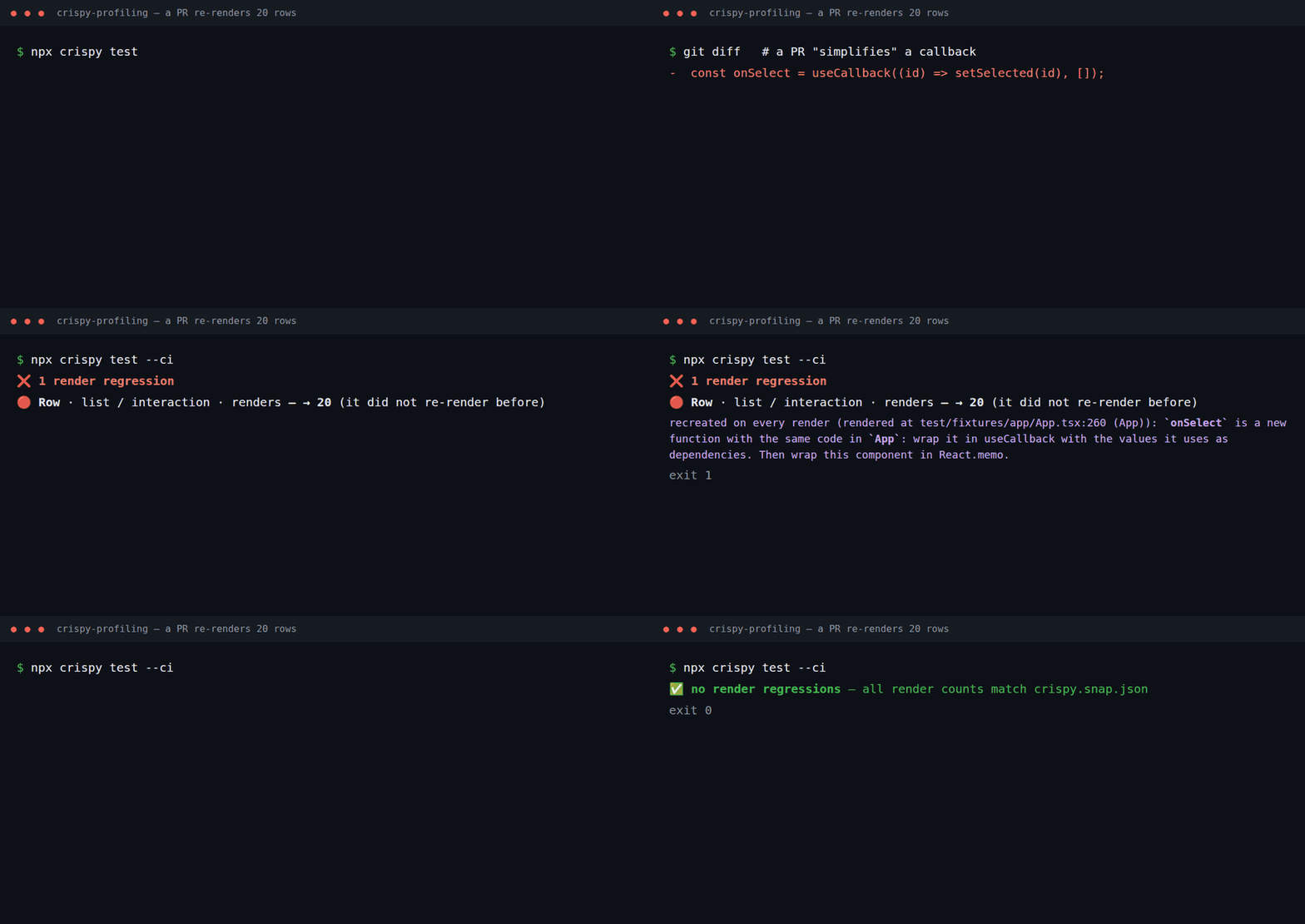
From then on, npx crispy test (locally, in CI or from an AI agent) fails when a component starts
re-rendering, and tells you why and how to fix it:
| 🔴 regressed | list / interaction | Row | renders | — → 20 | recreated on every render (rendered at
  src/App.tsx:222 (App)): `onSelect` is a new function with the same code in `App`: wrap it in
  useCallback with the values it uses as dependencies. Then wrap this component in React.memo. |
For a one-off look at a flow, npx crispy run prints every component with its causes and a fix:
| Component | Renders | Avoidable | Callback | Causes (props/state/context/unstable/callback/parent) | Rendered at          | Why / how to fix |
| Row       |      20 |         0 |       20 | 0/0/0/0/20/0 | `src/App.tsx:222 (App)` | `onSelect` is a new function with the same code in `App`: wrap it in useCallback… |
| Status    |       1 |         1 |        0 | 0/0/0/1/0/0  | `src/App.tsx:178 (App)` | `style` is recreated with equal data in `App`: hoist it out of the component or wrap it in useMemo… |
| App       |       1 |         0 |        0 | 0/1/0/0/0/0  | `src/main.tsx:12`       | state updates here cause 23 avoidable render(s) below (`Row`, `Header`, `Status`)… |
Every phase starts with Root causes — fix these first: the few components that recreate a
value, recreate a context value or update state that re-renders unchanged children, ranked by the
avoidable renders they cause, with the child where one React.memo would stop most of a cascade.
"Rendered at" and definedIn are mapped back to your original source files and lines through the
source maps your dev server or bundler serves (Vite, webpack, Turbopack); without source maps they
refer to the code the browser runs.
Works with Vite and Next.js (Turbopack and webpack dev servers); framework internals such as the Next.js dev overlay are filtered out. Profile the development build.
Render snapshots (crispy test)
Like Jest snapshots, but for re-renders. Commit the expected render counts of your key flows; every PR — written by a person or an AI agent — is checked against them at runtime.
npx crispy test        # 1st run: writes crispy.snap.json → commit it
npx crispy test        # later: fails if any component renders more (or more avoidably)
npx crispy test -u     # accept intended changes / lock in improvements
npx crispy test --ci   # in CI: a missing snapshot fails instead of being written (auto-detected; --no-ci to opt out)
When something regresses you get the component, the cause, where it is rendered and the fix (see Quick start).
crispy.snap.json has one line per component, so the PR diff shows exactly which counts changed:
"interaction": {
  "commits": 1,
  "components": {
    "App": { "renders": 1, "avoidable": 0 },
    "Header": { "renders": 1, "avoidable": 1 }
  }
}
Rules: any increase in commits, renders or avoidable renders fails (snapshot.tolerance allows
slack), and every metric is checked independently, so an improvement never hides a regression.
Counts that varied between runs are stored as [min, max] ranges and only fail outside them
(-u keeps the known range instead of narrowing it). Decreases pass and suggest -u. New UI
passes and is reported (record it with -u); if it already renders avoidably it is flagged ⚠️
(set snapshot.failOnNewAvoidable to fail instead). A known component that starts re-rendering
in a phase still fails. A rename, even combined with a move to another file, with the same counts
is reported as 🔁 renamed, not as a regression.
crispy test never edits the committed file on its own; the
snapshot always covers every component (even with topComponents); budgets still apply.
Configuration
crispy.config.json (JSON Schema):
{
  "$schema": "./node_modules/crispy-profiling/schema/crispy.config.schema.json",
  "baseUrl": "http://localhost:5173",
  "runs": 3,
  "scenarios": [
    {
      "name": "search",
      "path": "/products",
      "steps": [
        { "action": "type", "selector": "#search", "value": "shoes" },
        { "action": "phase", "name": "sort" },
        { "action": "click", "selector": "text=Price: low to high" }
      ],
      "budgets": {
        "interaction": { "maxAvoidableRenders": 0, "components": { "ProductCard": { "maxRenders": 20 } } }
      }
    }
  ]
}
| Field | Default | Description |
|---|---|---|
baseUrl | — | Origin of the running app. |
runs | 3 | Runs per scenario; the report keeps median/min/max and flags unstable counts. |
settleMs | 300 | A step is "settled" after this long without React commits and without in-flight network requests. |
maxSettleMs | 10000 | Max wait per step. Pages that never settle (polling, animations) produce a warning in the report instead of hanging. |
cpuThrottle | 1 | Slow the CPU down (e.g. 4) to check counts on a slow CI runner or low-end device. Counts should not change. |
clock | false | Control timers with a fake clock (setTimeout, setInterval, requestAnimationFrame, Date, performance) so polling/animated apps give deterministic counts. |
timeoutMs | 30000 | Max time for navigation, a step or settling. |
timings | false | Add component self time + LCP/CLS/long tasks. Off by default: timings are not reproducible. |
topComponents | 0 | Keep only the N most-rendered components per phase (0 = all). |
viewport | 1280×800 | Browser viewport. |
browser | headless | executablePath, channel (e.g. "chrome"), headless. CRISPY_CHROMIUM_PATH also works. |
includeInternals | false | Show framework/library internals (components defined in node_modules that only library code renders, e.g. Next.js router internals). Library components your code renders directly are always shown. |
webServer | — | { "command": "npm run dev" }: crispy starts your dev server, waits for baseUrl (or url) and stops it afterwards; a server already running there is reused. crispy init fills it in. |
login | — | { "path": "/login", "steps": [...] }: sign in once before profiling (never counted). Use "${E2E_PASSWORD}" to read secrets from the environment. |
storageState | — | A saved session file (cookies + localStorage), e.g. from crispy login for SSO/OAuth logins. Keep it out of git. |
random | seeded | Math.random returns the same sequence in every run, so fake data, IDs and animations render the same way. native keeps the browser's. |
snapshot | crispy.snap.json, 0, false | file (relative to the config file), tolerance and failOnNewAvoidable used by crispy test. |
compare | 10%, 1 | rendersIncreasePct and minRendersDelta used by compare. |
Steps: click, hover, fill, type, press, select (a <select> option), drag
(selector to to, or by dx/dy, with pointer steps), scroll, waitFor (state:
visible, hidden, attached, detached), wait, goto, phase.
type presses one key at a time and waits for React to finish (including deferred values and
transitions) before the next key, so concurrent features give the same counts on fast and slow CPUs.
Renders before the first step are recorded in phase load; renders during steps go to
interaction unless you name phases yourself with { "action": "phase", "name": "..." }.
Budgets (per phase): maxCommits, maxTotalRenders, maxAvoidableRenders, maxWastedRenders,
and per component maxRenders / maxAvoidableRenders / maxWastedRenders.
A budget for a phase the scenario never produces is a config error; a component budget that never
matches a rendered component produces a warning (likely a typo). Budgets always see every component,
even when topComponents trims the report.
What the numbers mean
| Field | Meaning |
|---|---|
renders | Times the component function/class rendered (mounts + updates). |
avoidableRenders | Updates where nothing really changed: wasted renders plus renders caused only by recreated-but-equal data (objects, arrays, elements, dates, maps…). Certainly avoidable. |
callbackRenders | Updates caused only by functions recreated with the same code (inline callbacks). Avoidable if the values they capture did not change — crispy cannot see captures, so they are reported apart. |
wastedRenders | Updates where props (shallow), state and consumed context were all unchanged. |
causes.props / state / context | Updates where that input changed (one update can have several causes). |
causes.unstable | Only data identities changed: object/array literals, dates, maps, context values or hook results recreated with equal contents. |
causes.callback | Only functions were recreated with the same code (bound/native functions count as real changes). |
causes.parent | Updates with no changed input: the parent re-rendered (same as wasted). |
unstableProps | Prop keys recreated with equal data — fix with useMemo or by hoisting constants. |
callbackProps | Prop keys that were recreated callbacks — fix with useCallback and the right dependencies, or React Compiler. |
changedProps | Prop keys whose identity changed, with counts — the "why" behind causes.props. |
triggeredBy | Components whose own state update started the cascade that re-rendered this one, with counts. Fix the trigger, not every child. |
recreatedContextFrom | Components that own a context provider whose value was recreated with equal content (e.g. value={{ user, logout }}) — memoize the value there. |
memo | true when the component is wrapped in React.memo, so hints never suggest wrapping it again. |
creators | `prop |
staleMemo | `prop |
providerAt | Where the provider of a recreated context value is rendered. |
compiled | true when React Compiler compiled the component. |
locations | Up to 3 places where the component is rendered, as file:line (Owner) (owner JSX call site, most frequent first), resolved through source maps when available. |
Item (src/List.tsx) keys | Components are identified by name and the file that defines them (resolved through the DevTools protocol). Distinct components that share a name are keyed as Name (file), so adding an unrelated Item never renames existing ones; snapshots store the file and keep matching. When files cannot tell them apart (styled-components, HOC factories, several components in one file), they are keyed by where they render (Item @ src/Card.tsx:12); numbered keys (Item#2) are the last resort. Keys stay the same across goto navigations. |
definedIn | File where the component function is defined. |
stable | false when counts differ between runs (timers, network, randomness). |
Every Markdown report (crispy run, crispy test, MCP tools) adds a Why / how to fix column
built from these fields. Hints point at the root cause: the component whose state starts a cascade,
the owner that recreates a prop (with its file:line), or the provider that recreates a context value.
Profile the development build: production builds minify component names.
CLI
crispy init [--base-url <url>]          Create crispy.config.json (detects framework, URL, dev command)
crispy install [--with-deps]            Download the Chromium build crispy uses
crispy login [-c file] [--path /login]  Sign in by hand in a browser window and save the session
crispy run [-c file] [-o file] [-s scenario...] [--markdown file] [--no-fail]
crispy test [-c file] [-u|--update] [--ci] [-s scenario...] [--markdown file]
crispy compare <base.json> <head.json> [--threshold 10] [--min-delta 1] [--markdown file] [--json file] [--no-fail]
crispy mcp                              Start the MCP server on stdio
Exit codes: 0 ok · 1 budget violation or regression · 2 usage/runtime error.
For AI agents
MCP server
Tools: profile_url, run_scenarios, test_render_snapshots, compare_reports, inspect_component.
{
  "mcpServers": {
    "crispy-profiling": { "command": "npx", "args": ["-y", "crispy-profiling@latest", "mcp"] }
  }
}
Claude Code: claude mcp add crispy-profiling -- npx -y crispy-profiling@latest mcp
Claude Code plugin (MCP server + skill)
/plugin marketplace add edgeorgie/crispy-profiling
/plugin install crispy-profiling@crispy-profiling
Agent Skill (Claude Code, Cursor, Codex, Copilot, Gemini CLI, …)
npx skills add edgeorgie/crispy-profiling
The skill teaches the agent the measure → fix → re-measure → compare loop and how to map each signal
to a fix (React.memo, useCallback, useMemo, context splitting, state colocation).
CI (GitHub Action)
permissions:
  contents: read
  pull-requests: write   # lets crispy comment on the PR
steps:
  - uses: actions/checkout@v7
  - uses: actions/setup-node@v7
    with: { node-version: 22 }
  - run: npm ci
  - uses: edgeorgie/crispy-profiling@v0   # starts your dev server (webServer) and runs `crispy test --ci`
The step fails when any component renders more than the committed snapshot allows (or a budget is
exceeded). The job summary — and one PR comment, updated on every push — lists each regression with
its cause, where it is rendered and the suggested fix (comment: false to disable). command: run (with an optional baseline report) is available for budget-only or
baseline-comparison setups. Full workflow: examples/github-workflow.yml.
Programmatic API
import { compareReports, parseConfig, profile } from 'crispy-profiling';

const config = parseConfig({ baseUrl: 'http://localhost:5173', scenarios: [{ name: 'home' }] });
const report = await profile(config);
How it compares
Use the tools together: they answer different questions.
| Tool | What it is for | Where crispy fits |
|---|---|---|
| React DevTools Profiler | Interactive, manual profiling in your browser | crispy runs the same kind of analysis headless, on scripted interactions, every time |
| React Scan | Visual highlighting of re-renders while you use the app; also has a programmatic onRender API | crispy turns render counts into committed snapshots that fail CI, with a fix hint per component |
| why-did-you-render | Console notifications in development about avoidable re-renders (Babel setup) | crispy needs no app changes and reports per interaction, deterministically |
| React Doctor | Static analysis (lint rules) of the codebase with a score | crispy observes what actually rendered at runtime; static findings and runtime proof complement each other |
| React Compiler | Automatic memoization at build time | crispy shows what the compiler did not cover (e.g. dependencies that change every render) and verifies the result |
What crispy adds: deterministic counts (same code → same report), snapshots in CI, root-cause hints (who creates the unstable value, which dependency changes) and verification (the fix shows up as 🟢 improved).
Known limitations
- Development builds only. Production builds strip component names and the debug information crispy uses for causes and locations.
- Render counts are not milliseconds. crispy finds avoidable renders deterministically; whether
they matter depends on how expensive the components are. Use
timings: true(not reproducible) to see self time, LCP and long tasks. - Web only, Chromium only. No React Native; other browsers are not needed for render counts.
- Scenarios are written by hand (selectors and steps).
crispy initcreates a starting point. - Hints are heuristics. In our validation on real apps most hints pointed at the right component, but not all were directly actionable; report a wrong hint with the report attached and we will fix it.
- Apps with real network timing can vary between runs: counts are stored as ranges, randomness
is seeded and one extra commit is tolerated, but very timing-dependent flows may need
waitForsteps orclock: true.
How this is built
crispy-profiling is developed with AI coding agents (Claude Code) under human direction, with the same rules as any contribution: atomic commits, tests, CI on Node 20/22/24 and review. Every milestone is checked by an independent agent acting as a hostile reviewer and validated on real open-source apps; every number in this README and in the changelog can be reproduced with the commands shown. Found something wrong? Please open an issue.
How it works
An init script installs (or wraps) __REACT_DEVTOOLS_GLOBAL_HOOK__ before React loads. On every
commit it walks the new fiber tree against its alternate, like React DevTools, and records each
component that performed work, comparing props, hook state and context values to classify the cause.
See docs/ARCHITECTURE.md.
Contributing
Issues and PRs are welcome — see CONTRIBUTING.md (GitFlow: branch from
develop). AI coding agents: start with AGENTS.md; docs index for LLMs:
llms.txt.
License
MIT © Edwin Jorge
Reviews
No reviews yet
Be the first to review this server!
More Developer Tools MCP Servers
Git
Freeby Modelcontextprotocol · Developer Tools
Read, search, and manipulate Git repositories programmatically
Fetch
Freeby Modelcontextprotocol · Developer Tools
Web content fetching and conversion for efficient LLM usage
Worldmonitor
Freeby Koala73 · Developer Tools
Live markets, conflicts, country risk, chokepoints, energy, and China decision signals. 86 tools.
Paperclip
Freeby Paperclipai · Developer Tools
Trending hip-hop artist momentum scores across four cultural dimensions.
Toleno
Freeby Toleno · Developer Tools
Toleno Network MCP Server — Manage your Toleno mining account with Claude AI using natural language.
mcp-creator-python
Freeby mcp-marketplace · Developer Tools
Create, build, and publish Python MCP servers to PyPI — conversationally.