
Server data from the Official MCP Registry
A repository wiki of Markdown pages anchored to real code: read, search, and verified writes.
About
A repository wiki of Markdown pages anchored to real code: read, search, and verified writes.
Security Report
The livewiki MCP server is a well-structured documentation tool with appropriate permissions matching its purpose (file I/O, network for LLM APIs, environment variables for credentials). Code quality is generally solid with proper error handling and validation. However, there are moderate security concerns around subprocess execution without full input validation, potential for unvalidated external data in verification workflows, and broad exception handling that could mask security issues. These findings are not critical but warrant attention from users deploying this server. Supply chain analysis found 2 known vulnerabilities in dependencies (2 critical, 0 high severity). Package verification found 1 issue (1 critical, 0 high severity).
4 files analyzed · 11 issues found
Security scores are indicators to help you make informed decisions, not guarantees. Always review permissions before connecting any MCP server.
Permissions Required
This plugin requests these system permissions. Most are normal for its category.
Unverified package source
We couldn't verify that the installable package matches the reviewed source code. Proceed with caution.
How to Install
Add this to your MCP configuration file:
{
  "mcpServers": {
    "io-github-eduardoabreu81-livewiki": {
      "args": [
        "-y",
        "livewiki"
      ],
      "command": "npx"
    }
  }
}Documentation
View on GitHubFrom the project's GitHub README.
livewiki
Code-anchored documentation that knows when it is stale.
livewiki turns a repository into a Markdown wiki whose every code reference is anchored to a real indexed symbol. An LLM writes the prose; livewiki does the deterministic work — planning the pages, running structural anti-hallucination checks on what the model wrote, tracking which anchored symbols changed, and preserving your edits.
The wiki is exposed to any coding agent by
@livewiki/mcp — an MCP (Model Context Protocol)
server with eight tools for reading, searching, and safely writing the wiki.


livewiki view builds a self-contained offline site from the wiki — grouped
sidebar, offline search, diagrams, and dark mode:
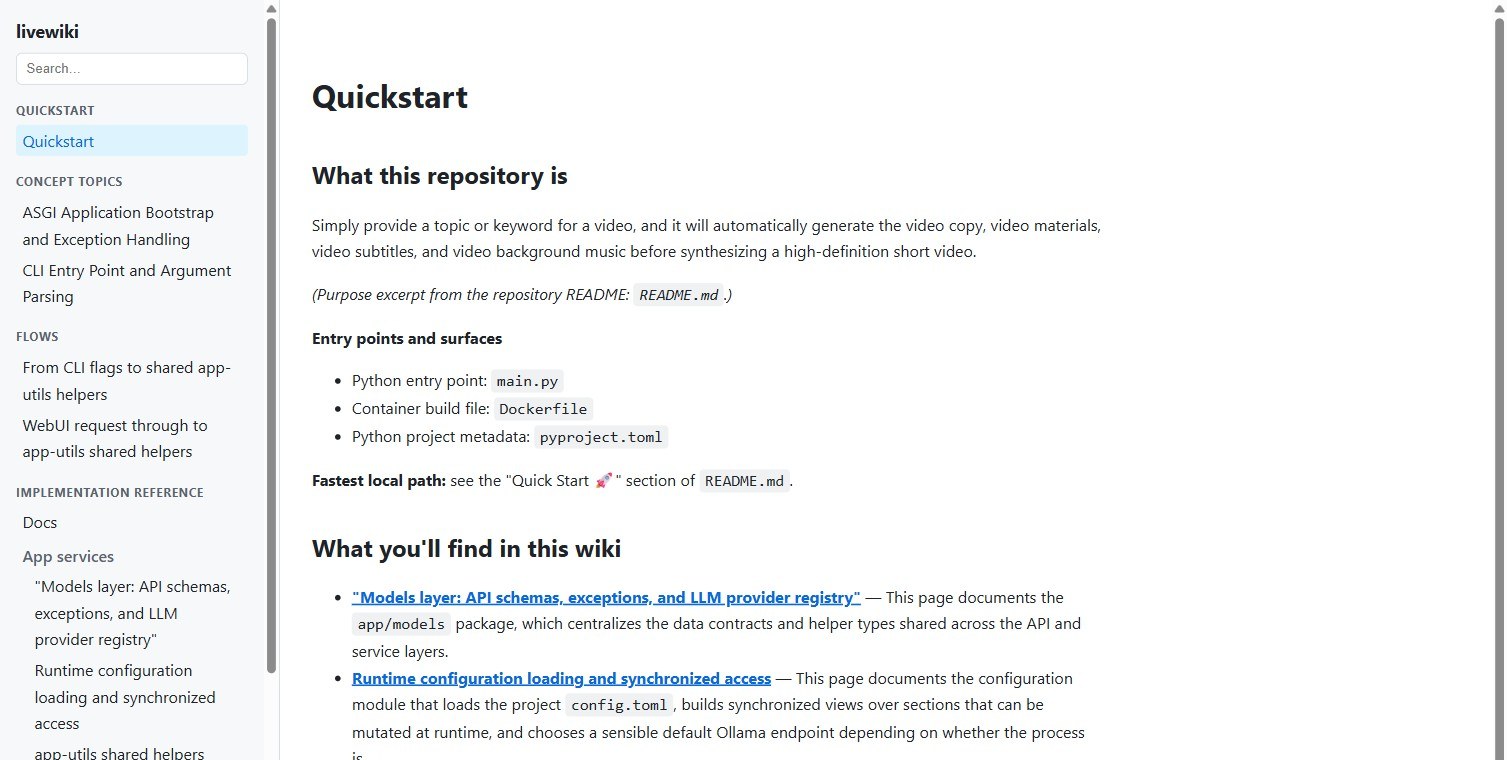
Example wiki generated by livewiki for MoneyPrinterTurbo-Plus, an external Python repository.
Why
Technical docs go stale the moment the code changes. livewiki makes that visible and cheap to fix instead of silent:
- Deterministic anti-hallucination checks. Every code reference must point
at a real indexed symbol.
livewiki verifyreads the wiki fresh from disk and fails on invented symbols, broken anchors, and signatures that no longer match — including references the LLM wrote seconds ago, without runningindexfirst, and without spending a token. Structural, not semantic; the section below draws the line. - Your edits win. Pages you mark
owner: humanare never rewritten, andlw:manualblocks are preserved byte-for-byte. - Debt is tracked, not discovered.
livewiki statusranks what drifted; a GitHub Action can gate every merge on zero documentation debt, without spending tokens. - Works where you already work. Bootstrap and maintain through the coding agent you use, or run a fully automated batch.
What verify checks — and what it doesn't
The anti-hallucination layer is deterministic and structural. livewiki verify
reads the wiki fresh from disk — so a page an LLM wrote seconds ago is checked
without running index first — and fails on:
- a cited symbol that does not exist in the code;
- an anchor that broke because the symbol moved, was renamed, or was deleted;
- a cited signature that no longer matches the indexed one;
- an internal link that does not resolve;
- a referenced artifact that is missing from disk;
- frontmatter or page structure that violates the format contract.
That removes whole classes of fabricated content — the invented function, the API that never existed, the reference that quietly rotted — before a reader ever sees it, at zero token cost. Anything that fails is rejected and rolled back rather than merged.
It does not prove that a sentence is true. A plausible but wrong explanation of code that really does exist passes every check above, because every check above is about structure and identity, not meaning. Read "anti-hallucination" here as a layer that mechanically eliminates a large class of fabrication and tells you the moment code moves under the prose — not as a guarantee of factual accuracy. Reviewing the explanation itself is still your job.
Quick start
Requires Node.js 24 or newer.
1. Install
npm install -g @livewiki/cli
(npx @livewiki/cli works too, without installing globally.)
2. Initialize
From the root of the repository you want documented:
livewiki init
Indexes the code and creates the wiki skeleton under livewiki/, plus a
derived cache under .livewiki/ (added to .gitignore). Deterministic — no
LLM call, no tokens.
3. Bootstrap the wiki once
You have two routes — pick one.
Route A — through your coding agent (no API key needed):
livewiki install
The installer detects your agent, wires the MCP server, the
document-as-you-go skill, and git hooks. Then ask the agent to bootstrap the
wiki; it pulls tasks from livewiki_next_task and submits pages with
livewiki_write_doc using the model it already has.
Route B — a configured LLM API (unattended):
livewiki config
The wizard lists the providers, asks for your API key (typed without echo),
and saves it. Bare livewiki on an unconfigured repo starts the same wizard.
Then:
livewiki init --batch
The resumable pipeline plans real page units and writes one page per source
file and folder, plus flows, concept topics, diagrams, and an
understanding.md synthesis. Interrupt it and resume with
livewiki batch resume <runId>.
4. Verify and browse
livewiki verify   # validate code references, internal links, and artifacts
livewiki view     # build an offline site with search, Mermaid, and dark mode
Works with your coding agent
livewiki install auto-detects and wires 13 agents over MCP (with skills
and hooks where the agent supports them):
Claude Code · Codex · Cursor · Kimi · Gemini CLI · OpenCode · OpenClaw · Cline · Kiro · Qwen · Warp · Zed · Hermes
Prefer manual wiring? Any stdio MCP client works:
{
  "mcpServers": {
    "livewiki": {
      "command": "npx",
      "args": ["-y", "@livewiki/mcp", "--repo", "/path/to/repo"]
    }
  }
}
The server is also published to the official MCP
Registry as
io.github.eduardoabreu81/livewiki, so a client that resolves servers from the
registry can find it by name instead of using the snippet above.
Languages
| Language | Anchored docs (symbols extracted) |
|---|---|
| TypeScript | ✅ .ts |
| JavaScript | ✅ .js .mjs .cjs |
| TSX / JSX | ✅ .tsx .jsx |
| Python | ✅ .py |
| Go | ✅ .go |
| Rust | ✅ .rs |
| Java | ✅ .java |
| Everything else | Prose floor — every text file is walked and documented as prose, no symbols |
Anchored pages cite real symbols; the prose floor still gives every file a place in the wiki. Tier-1 language support grows as the pattern is proven (Go, Rust, and Java each landed this way).
Providers
livewiki config lists these 17 presets. Each reads its own API-key
environment variable; livewiki config show prints the one your preset
expects without ever showing the value.
| Provider | Preset | Env var |
|---|---|---|
| Anthropic | anthropic | ANTHROPIC_API_KEY |
| OpenAI | openai | OPENAI_API_KEY |
| OpenRouter | openrouter | OPENROUTER_API_KEY |
| DeepSeek | deepseek | DEEPSEEK_API_KEY |
| Kimi (Moonshot) | kimi | MOONSHOT_API_KEY |
| MiniMax | minimax | MiniMax_API_KEY |
| Google Gemini | gemini | GEMINI_API_KEY |
| NVIDIA | nvidia | NVIDIA_API_KEY |
| Ollama (local) | ollama | OLLAMA_API_KEY (optional) |
| LM Studio (local) | lmstudio | LMSTUDIO_API_KEY (optional) |
| Fireworks | fireworks | FIREWORKS_API_KEY |
| Novita | novita | NOVITA_API_KEY |
| GMI | gmi | GMI_API_KEY |
| StepFun | stepfun | STEPFUN_API_KEY |
| Hugging Face | huggingface | HF_TOKEN |
| xAI | xai | XAI_API_KEY |
| Alibaba (DashScope) | alibaba | DASHSCOPE_API_KEY |
ollama and lmstudio need no key for a local server. For CI and headless
automation, set the env var directly — it takes precedence over the saved key.
What a generated page looks like
Excerpt from this repository's own
livewiki/core-src/verify.md:
## Discovery: walking the wiki from disk

The verifier never trusts the index for which pages exist — a doc freshly written by an LLM must be caught without first running `index`. Two walkers enumerate the `livewiki/` directory from disk; both skip hidden directories but keep dot-prefixed files.


```ts
async function collectWikiPages(absRoot: string): Promise<{ relPath: string }[]>
```
The prose explains the implementation; the lw:anchors marker ties the section
to real indexed symbols, so staleness and invalid references are detected
mechanically.
How it works
- Deterministic layer — the CLI indexes source, extracts symbols, computes staleness, plans work, tracks debt, and verifies — without a model.
- Writing layer — a connected agent (or an API-backed batch) writes the prose, from a closed list of allowed symbol keys.
- Anti-hallucination layer — deterministic and structural: code anchors, cited signatures, internal links, artifacts, and page structure are all checked against disk; invalid writes are rolled back. It eliminates fabricated and rotted references, not semantic mistakes.
- Human ownership —
owner: humanpages are never rewritten;lw:manualblocks are preserved byte-for-byte. - Portable baseline — the accepted state of every documentation obligation
lives in a versioned
livewiki/.baseline.json, so debt is enforced against a real baseline and the wiki survives a deleted local cache.
Documentation debt can gate every merge in CI, without LLM calls or tokens — see the GitHub Actions template.
Historical comparison methodology and dated results are archived in Benchmarks.
Packages
| Package | Purpose |
|---|---|
@livewiki/cli | The livewiki command |
@livewiki/mcp | MCP server for stdio-capable MCP clients |
@livewiki/core | Library: indexer, anchors, ledger, pipeline |
Documentation
- SPEC.md — behavior and format contracts
- VISION.md — product rationale and non-goals
- docs/ROADMAP.md — approved backlog and execution order
License
MIT — see LICENSE.
Reviews
No reviews yet
Be the first to review this server!
More Developer Tools MCP Servers
Fetch
Freeby Modelcontextprotocol · Developer Tools
Web content fetching and conversion for efficient LLM usage
Git
Freeby Modelcontextprotocol · Developer Tools
Read, search, and manipulate Git repositories programmatically
Toleno
Freeby Toleno · Developer Tools
Toleno Network MCP Server — Manage your Toleno mining account with Claude AI using natural language.
mcp-creator-python
Freeby mcp-marketplace · Developer Tools
Create, build, and publish Python MCP servers to PyPI — conversationally.
MCP Marketplace
Freeby mcp-marketplace · Developer Tools
Search and install MCP servers from inside your AI client.
MarkItDown
Freeby Microsoft · Content & Media
Convert files (PDF, Word, Excel, images, audio) to Markdown for LLM consumption