
Server data from the Official MCP Registry
MCP server for Avito: chats, listings, orders and analytics, with previews and confirmations.
About
MCP server for Avito: chats, listings, orders and analytics, with previews and confirmations.
Security Report
Valid MCP server (5 strong, 1 medium validity signals). No known CVEs in dependencies. Package registry verified. Imported from the Official MCP Registry. Trust signals: 3 highly-trusted packages.
5 files analyzed · 1 issue found
Security scores are indicators to help you make informed decisions, not guarantees. Always review permissions before connecting any MCP server.
What You'll Need
Set these up before or after installing:
Environment variable: Client_id
Environment variable: Client_secret
Environment variable: Profile_id
Environment variable: AVITO_MCP_PROTOCOL_ERA
How to Install
Add this to your MCP configuration file:
{
  "mcpServers": {
    "io-github-elchin92-avito-mcp": {
      "env": {
        "Client_id": "your-client-id-here",
        "Profile_id": "your-profile-id-here",
        "Client_secret": "your-client-secret-here",
        "AVITO_MCP_PROTOCOL_ERA": "your-avito-mcp-protocol-era-here"
      },
      "args": [
        "-y",
        "avito-mcp"
      ],
      "command": "npx"
    }
  }
}Documentation
View on GitHubFrom the project's GitHub README.
avito-mcp




Connect your AI client to your Avito account: read chats and statistics, prepare replies, and manage listings and orders.
Ask your AI client in plain language; it uses this MCP server to call the official Avito APIs. 148 tools across 18 APIs cover buyer chats, listings, statistics, promotion and orders. Run it on your computer or your own server.
You bring an AI client and an Avito account with API access. The client provides the model; this project provides the connection and tools. Automatic replies and scheduled reports need an agent or scheduler configured separately.
Русская версия → · Documentation · Client setup · Workflows · Troubleshooting
New in v2.1.1: step-by-step setup, complete English and Russian workflow and troubleshooting guides, and explicit demo versus live-account instructions. Release notes.
| Your next step | Guide |
|---|---|
| See it work without an Avito account | Run the demo |
| Connect your own account | Quick start |
| Set up a client you already use | Client configurations |
| Deploy or contribute | Operations · Contributing |
Try without Avito credentials
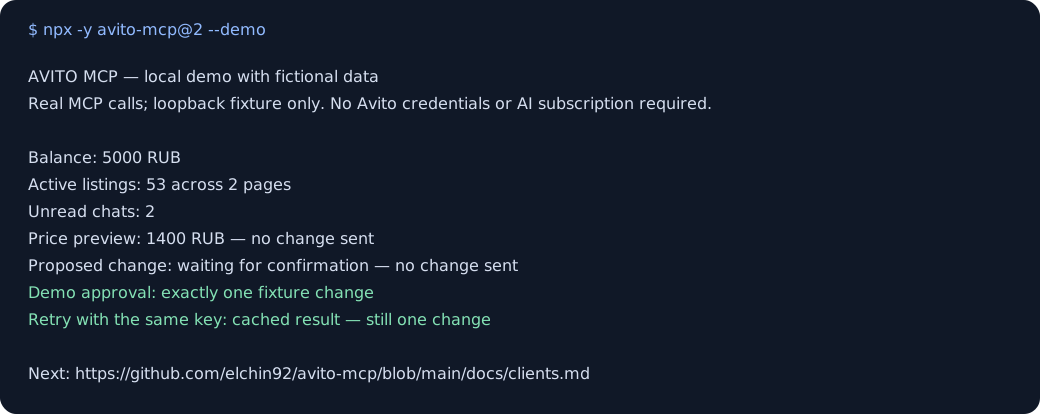
npx -y avito-mcp@2 --demo
The demo uses fictional data: 53 listings and 2 unread chats. It runs locally, needs no Avito keys and sends no requests to Avito. It walks through a report, a price preview, confirmation and a repeated request that changes the price only once. The first npx run downloads the npm package; from source, use npm run demo.
To use your own Avito account, follow the quick start and omit --demo. Normal server calls use your configured account; demo data never replaces it.
What you can do
| Task | Start here | Result |
|---|---|---|
| Check how your listings are doing | Morning report, analytics profile | Balance, listing activity and spending, with dates and source IDs |
| Work through buyer messages | Unread-chat triage, messenger profile | Prioritised chats and draft replies; sending is a separate confirmed action |
| Change a listing price | Preview and confirm, seller profile | Request preview, pending action, then a result to check |
Profiles use existing environment variables to expose a focused tool set. The recipes explain what to ask, which tools are involved, and how to check the result.
Quick start
1. Prepare your account
You need Node.js 22.12+, an MCP-capable AI client, and Avito API credentials for your account. Obtain Client_id, Client_secret, and numeric Profile_id through Avito's API account page. Available methods depend on your account's API access; installing this server does not grant additional Avito permissions.
2. Add the server to your client
For Claude Desktop, merge this into its MCP config using Settings → Developer → Edit Config. For Cursor, use your personal ~/.cursor/mcp.json. Replace the three placeholders locally and keep the filled config out of Git.
{
  "mcpServers": {
    "avito": {
      "command": "npx",
      "args": ["-y", "avito-mcp@2"],
      "env": {
        "Client_id": "YOUR_CLIENT_ID",
        "Client_secret": "YOUR_CLIENT_SECRET",
        "Profile_id": "YOUR_PROFILE_ID",
        "AVITO_MCP_MODE": "read_only"
      }
    }
  }
}
3. Check a real read
Restart the client and ask: “Use Avito to show my account balance and the first page of active listings. Do not change anything.” A successful answer should show your real balance and listing IDs, or an empty list if the account has no listings. The example starts in read_only; without this setting the server's default remains full_access.
VS Code, Zed, Codex and ChatGPT use their own setup formats. Copy the client-specific config, then try a workflow. The examples pin major version 2; pin an exact published version for controlled deployments.
Connect your AI client
| Client | Ready-to-copy config |
|---|---|
| Claude Desktop | JSON + setup |
| Cursor | JSON + setup |
| VS Code / Copilot | servers JSON |
| Zed | context_servers JSON |
| Codex CLI / IDE extension | TOML |
| ChatGPT desktop | Settings → MCP servers or shared TOML |
| ChatGPT web | Remote plugin setup and limits |
These are documented configurations, not a claim that every client/version has been tested against a live Avito account. Report compatibility results with the client version and operating system.
API coverage
| Domain | Examples |
|---|---|
| Messenger | Chats, messages, images, subscriptions and webhook events |
| Listings and statistics | Listing details, prices, views, contacts and spending |
| Orders and stock | Delivery statuses, tracking, labels, marking codes and stock |
| Promotion | VAS, CPA bids, forecasts and promotion orders |
| Autoload | Feed uploads, reports and ID mapping |
| Account and other APIs | Balance, reviews, staff, tariffs and calls |
| Logistics partners | 3PL delivery endpoints; most sellers do not need these |
The bundled API snapshot covers 138 Swagger operations plus local and meta tools. The full manifest has 148 tools; default registration exposes 144, because token-returning tools and local image uploads require separate opt-ins. read_only exposes 80 before allowlist filtering. Inspect avito://manifest or build dist/manifest.json for exact names, schemas and risks.
Resources include the tool manifest, active configuration, rate limits, pending confirmations and webhook events. Five built-in prompts cover a daily overview, unread chats, promotion preparation, tool explanations and a safety report. Resource and prompt reference.
Safety and retries
read_only,guarded, andfull_access, plusAVITO_MCP_ALLOW_TOOLS/AVITO_MCP_DENY_TOOLS, control which tools are available.dryRun: truepreviews a destructive request without sending it. It does not reserve an action or validate the live account's permission to execute it.- Money and customer-visible actions use a two-call confirmation flow by default. The agent can make both calls: this is not proof of human approval. Use client-side approvals or the separate approval controls described in safety configuration.
- An
idempotencyKeydeduplicates the same tool and arguments within the configured retention period. Reuse the same key for the same intended operation. If the outcome is uncertain, reconcile with Avito before retrying or choosing a new key. - Credentials go directly to Avito; there is no project-operated proxy or telemetry. Tool results are visible to your AI client and may be sent to its model provider under that client's settings.
Business calls use the real Avito account. Start with reads and previews. Ready-to-use safety configurations describe stronger approval controls, upload boundaries and recovery.
Remote MCP over HTTP (OAuth 2.1)
For a hosted agent or several clients, use Streamable HTTP on your own HTTPS domain. Set AVITO_MCP_TRANSPORT=http, AVITO_MCP_HTTP_PUBLIC_URL=https://mcp.example.com, and a strong AVITO_MCP_OAUTH_OWNER_PASSWORD, together with the Avito credentials.
Deployment, OAuth, Caddy and nginx configuration. bearer and none modes do not claim conformance with the MCP authorization specification; use OAuth for clients that discover authorization automatically.
Avito webhook receiver
The optional receiver buffers incoming Avito events and exposes them through a tool and a subscribable resource. An external agent must consume those events and decide whether to respond. Receiver setup.
Protocol and compatibility
Protocol revisions
AVITO_MCP_PROTOCOL_ERA selects legacy (default, MCP 2025-11-25), dual (both revisions), or modern (MCP 2026-07-28). A default stdio installation keeps serving the legacy revision; enabling the newer revision is explicit.
AVITO_MCP_HTTP_MAX_SESSIONS and AVITO_MCP_HTTP_SESSION_IDLE_SEC apply to legacy 2025-11-25 only. Modern HTTP uses AVITO_MCP_HTTP_MAX_INFLIGHT and AVITO_MCP_HTTP_MAX_STREAMS instead. Protocol details and limits.
Public tool names, documented valid arguments, environment variables, resource URIs and prompt names follow SemVer. See versioning details, migration from 1.3.x, and CHANGELOG.
Security
Token-returning tools and image uploads stay hidden until explicitly enabled. Tokens and runtime state are stored locally with restricted file permissions. Safety configuration, security policy and private reporting, and operational diagnostics describe the boundaries.
Install from source
git clone https://github.com/elchin92/avito-mcp.git
cd avito-mcp
npm ci
cp .env.example .env
# Fill in your credentials locally.
npm run build:release
Configure your client to run node /absolute/path/to/dist/server.js. Pass credentials through its env, or set AVITO_ENV_FILE to the absolute path of your filled .env file. Dockerfile and systemd installer are included; read operations and .env.example before deploying.
Contributors: CONTRIBUTING explains the shared tool factory and validation. Run npm run verify:release before a code PR. CI checks types, tests, coverage, package installation and deployment behavior; live Avito smoke tests are a separate, explicit check.
Not covered here
The Auction, Autostrategy, Autoteka, Jobs, Realty reports and Short-term rent API specifications are not bundled. This project also does not provide a model, a hosted agent service, or a scheduler. See the roadmap for concrete contribution opportunities.
Questions and bug reports: GitHub Issues · Support. Useful contributions include a reproducible bug, a tested client configuration, or a clearer workflow. If the project helps you, a GitHub star helps other Avito users find it.
MIT. Independent project; not affiliated with Avito. See NOTICE for the trademark and API-terms notice.
Reviews
No reviews yet
Be the first to review this server!
More Developer Tools MCP Servers
Git
Freeby Modelcontextprotocol · Developer Tools
Read, search, and manipulate Git repositories programmatically
Fetch
Freeby Modelcontextprotocol · Developer Tools
Web content fetching and conversion for efficient LLM usage
Worldmonitor
Freeby Koala73 · Developer Tools
Live markets, conflicts, country risk, chokepoints, energy, and China decision signals. 93 tools.
Paperclip
Freeby Paperclipai · Developer Tools
Trending hip-hop artist momentum scores across four cultural dimensions.
Toleno
Freeby Toleno · Developer Tools
Toleno Network MCP Server — Manage your Toleno mining account with Claude AI using natural language.
mcp-creator-python
Freeby mcp-marketplace · Developer Tools
Create, build, and publish Python MCP servers to PyPI — conversationally.