
Server data from the Official MCP Registry
Search Gmail and Outlook, save drafts, manage email rules, and view email stats.
About
Search Gmail and Outlook, save drafts, manage email rules, and view email stats.
Remote endpoints: streamable-http: https://www.getinboxzero.com/mcp
Security Report
Valid MCP server (2 strong, 0 medium validity signals). No known CVEs in dependencies. Imported from the Official MCP Registry. Trust signals: 5 highly-trusted packages.
Endpoint verified · Requires authentication · 1 issue found
Security scores are indicators to help you make informed decisions, not guarantees. Always review permissions before connecting any MCP server.
Permissions Found in Source Code
Found by scanning the linked source code. This listing connects to a hosted endpoint, so none of this runs on your machine: it describes what the server software does where it is hosted.
How to Connect
Remote Plugin
No local installation needed. Your AI client connects to the remote endpoint directly.
Add this to your MCP configuration to connect:
{
  "mcpServers": {
    "io-github-elie222-inbox-zero": {
      "url": "https://www.getinboxzero.com/mcp"
    }
  }
}Documentation
View on GitHubFrom the project's GitHub README.
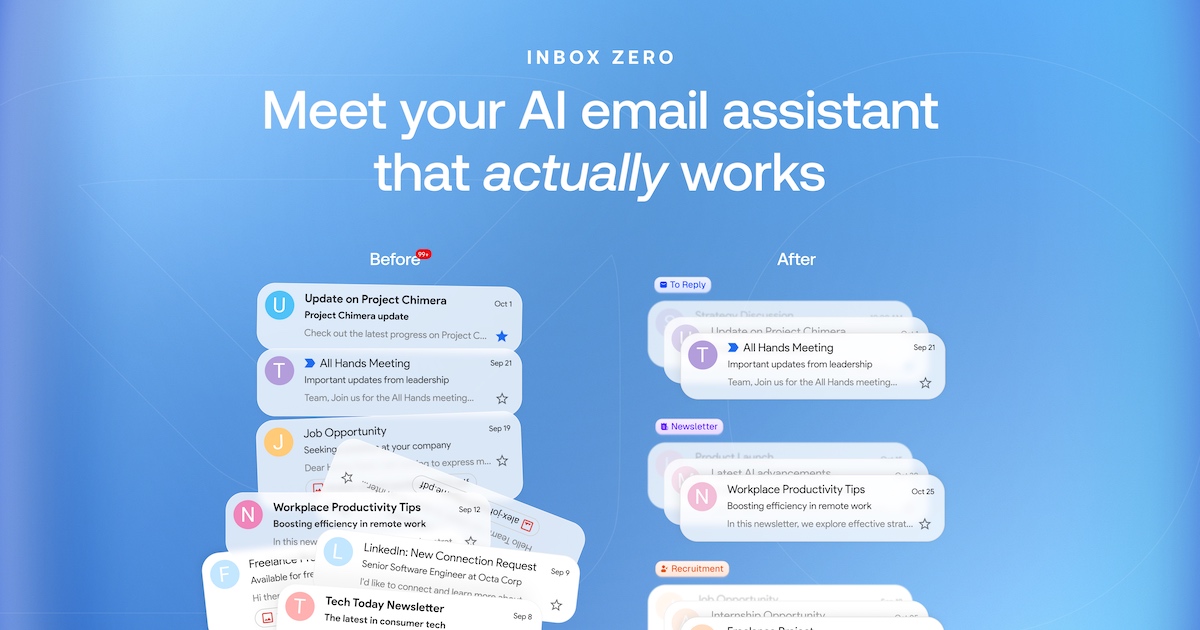




Mission
To help you spend less time in your inbox, so you can focus on what matters most.
Features
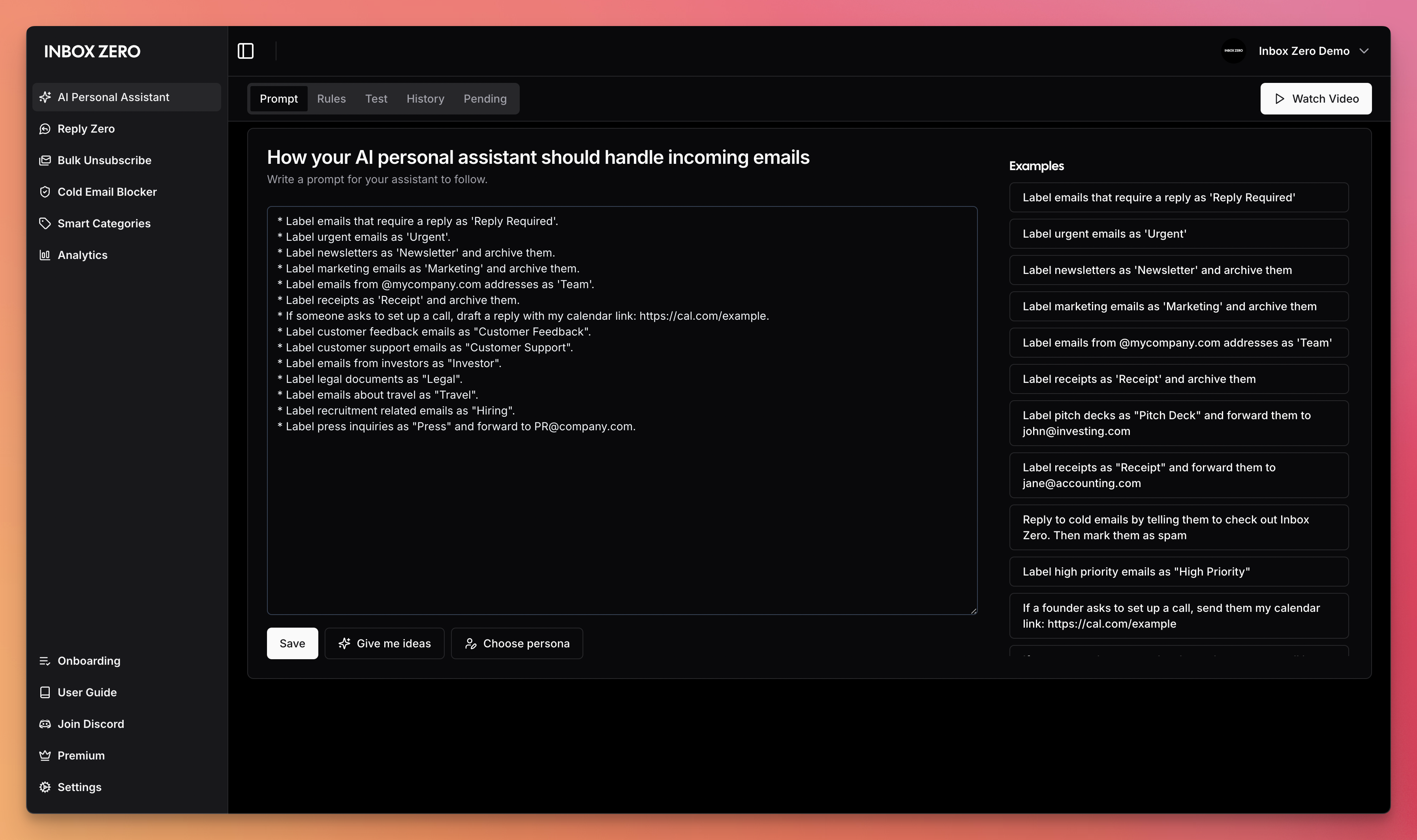
- AI Personal Assistant: Organizes your inbox and pre-drafts replies in your tone and style.
- AI Rules for email: Explain in plain English how your AI should handle your inbox.
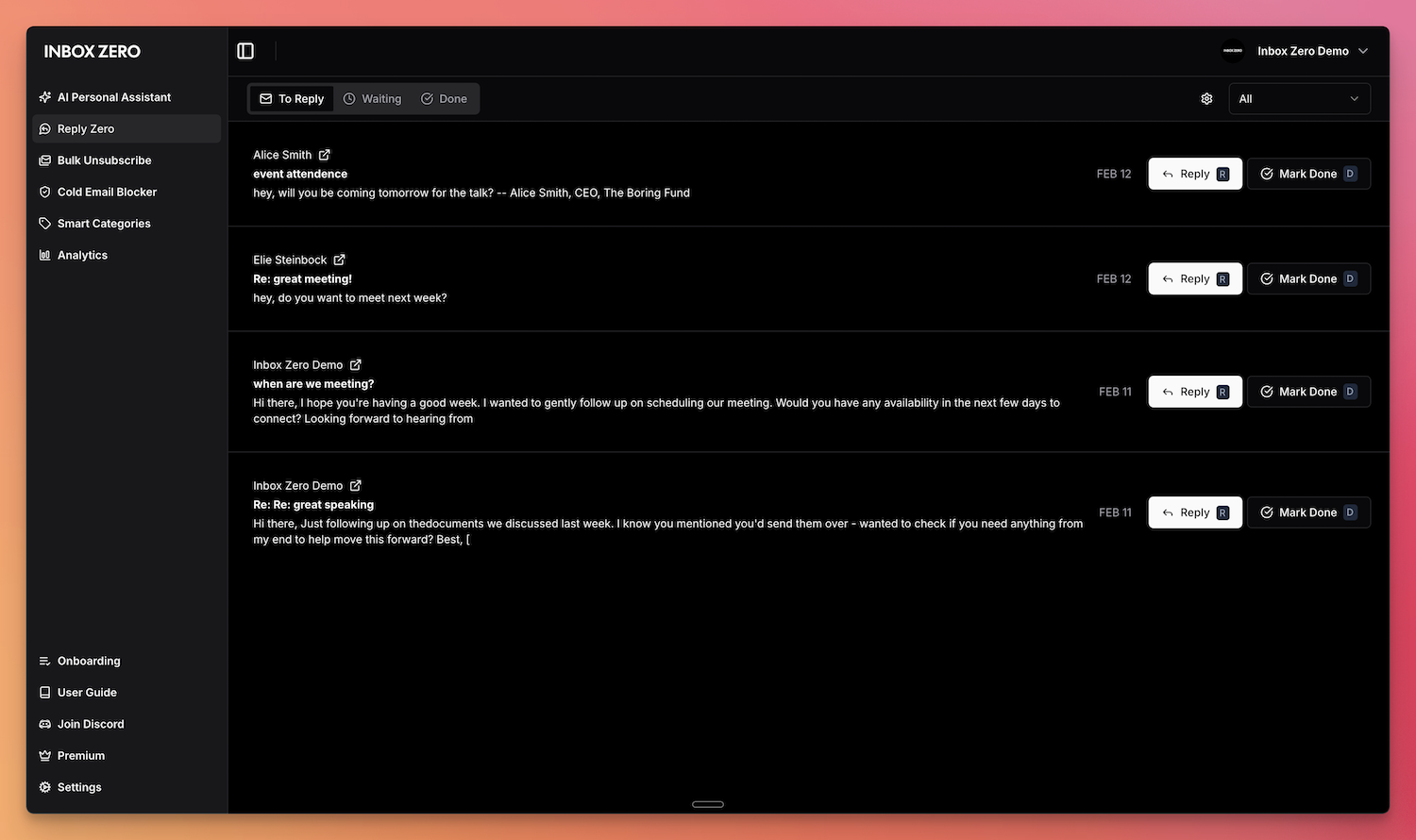
- Reply Zero: Track emails to reply to and those awaiting responses.
- Bulk Unsubscriber: One-click unsubscribe and archive emails you never read.
- Bulk Archiver: Clean up your inbox by bulk archiving old emails.
- Cold Email Blocker: Auto‑block cold emails.
- Email Analytics: Track your activity and trends over time.
- Meeting Briefs: Get personalized briefings before every meeting, pulling context from your email and calendar.
- Smart Filing: Automatically save email attachments to Google Drive or OneDrive.
- Slack & Telegram Integration: Chat with your AI assistant from Slack or Telegram to manage your inbox without leaving the apps you already use.
Learn more in our docs.
Feature Screenshots
 |  |
|---|---|
| AI Assistant | Reply Zero |
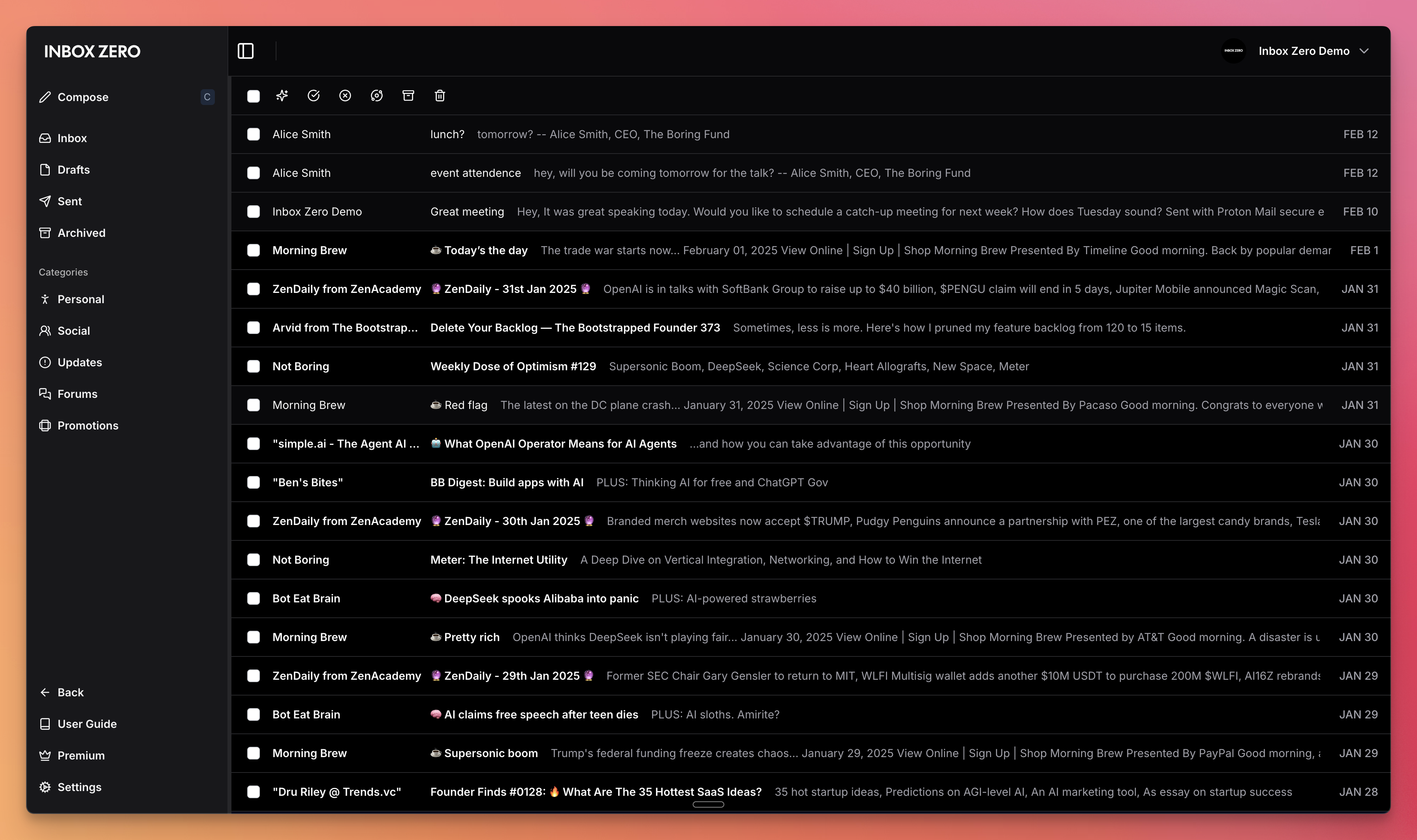 | 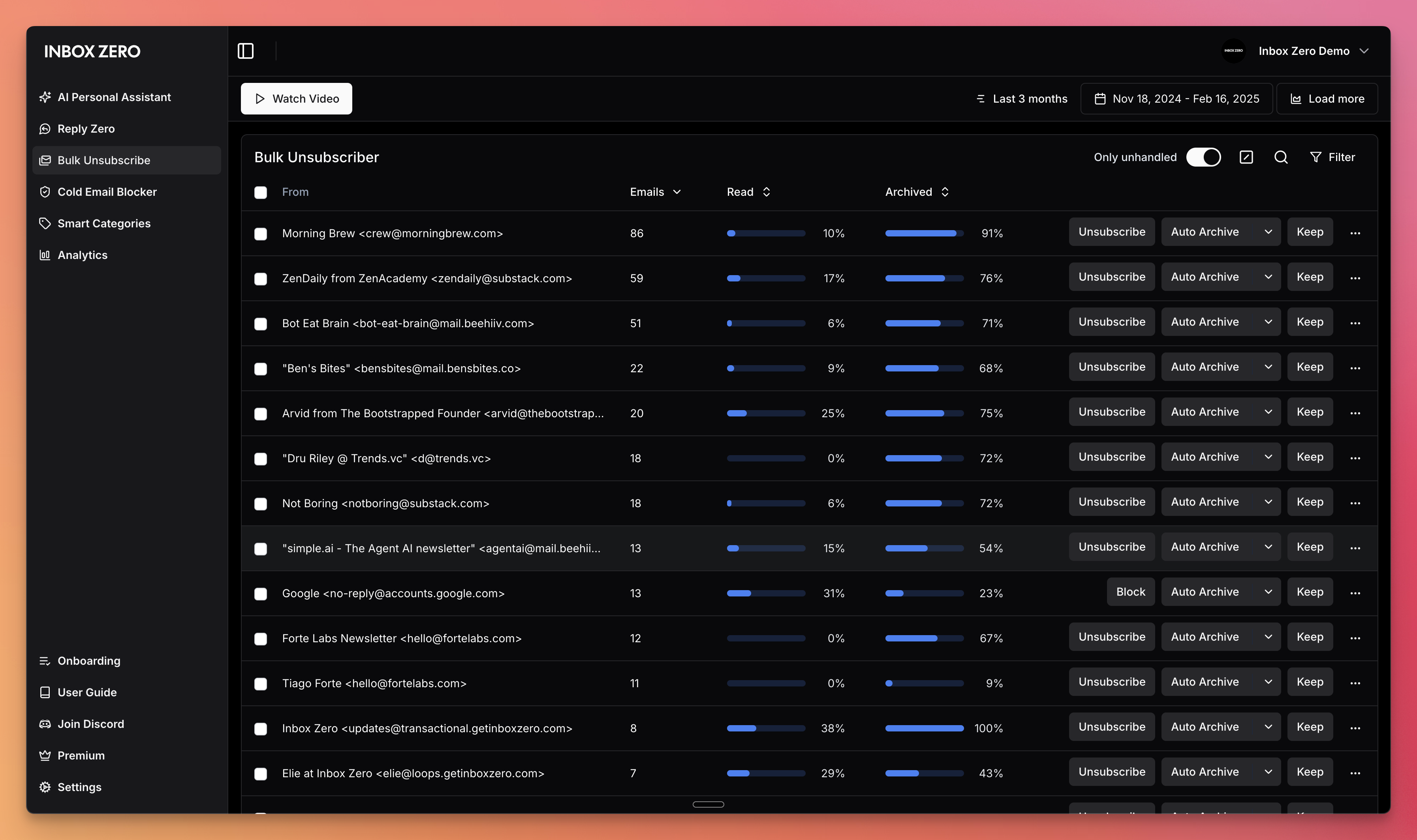 |
| Gmail client | Bulk Unsubscriber |
Demo Video
Built with
Star History
Feature Requests
To request a feature open a GitHub issue, or join our Discord.
Getting Started
We offer a hosted version of Inbox Zero at getinboxzero.com.
Self-Hosting
The fastest way to self-host Inbox Zero is with the CLI:
npx @inbox-zero/cli setup      # One-time setup wizard
npx @inbox-zero/cli start      # Start containers
For complete self-hosting instructions, production deployment, OAuth setup, and configuration options, see our Self-Hosting Docs.
Local Development
Prerequisites: macOS or Linux (WSL on Windows), Node.js v24, and the pnpm version pinned in
package.json. Install either Docker Desktop with Compose or native PostgreSQL and Redis. On macOS, native services can be installed withbrew install postgresql@16 redis.
git clone https://github.com/elie222/inbox-zero.git
cd inbox-zero
pnpm install
pnpm local:start
Open http://localhost:3000/mail and sign in with Google as developer@example.com, or Microsoft as developer@outlook.test. The Google mailbox contains demo messages. Demo users have onboarding completed, and premium checks are bypassed for local development.
The command starts an isolated database, Redis and its HTTP endpoint, both mail-provider emulators, billing and email-delivery emulators, an LLM emulator, and Next.js. It applies migrations and waits for services to become ready. No OAuth credentials or AI API keys are required. AI responses are canned; this mode exercises application flows, not model quality.
Existing .env files are left unchanged and ignored by this launcher. Generated credentials, seed data, and the current service addresses are stored under .context/local-dev/. Native database data stays there; Docker database data stays in a volume unique to the checkout. Restarts preserve database data and credentials. Redis caches and provider/emulator state start fresh on each run.
Press Ctrl-C to stop the app and the services this command started. Start it again with the same command. If port 3000 is occupied, use pnpm local:start --port 3001. Native PostgreSQL and Redis are selected when available; use --backend docker or --backend native to select explicitly. A checkout-specific loopback port prevents concurrent launchers; the operating system releases that lock after a crash, and stale PID files are replaced automatically. Services use automatically assigned ports, so existing databases and Redis instances are not reused or stopped.
Run pnpm local:start --help for options. If an unrelated process occupies the reported lock port, stop that process or use a different checkout location. PostgreSQL data must be opened with the same major version that created it. If you upgrade your native PostgreSQL major version, back up or move .context/local-dev/postgres before starting a new cluster.
For development against real providers, continue to use pnpm setup, your own environment files, and pnpm dev. See the Contributing Guide for configuration and devcontainer setup.
Contributing
View open tasks in GitHub Issues and join our Discord to discuss what's being worked on.
Docker images are automatically built on every push to main and tagged with the commit SHA (e.g., elie222/inbox-zero:abc1234). The latest tag always points to the most recent main build. Formal releases use version tags (e.g., v2.26.0).
Reviews
No reviews yet
Be the first to review this server!
More Developer Tools MCP Servers
Git
Freeby Modelcontextprotocol · Developer Tools
Read, search, and manipulate Git repositories programmatically
Fetch
Freeby Modelcontextprotocol · Developer Tools
Web content fetching and conversion for efficient LLM usage
Worldmonitor
Freeby Koala73 · Developer Tools
Live markets, conflicts, country risk, chokepoints, energy, and China decision signals. 86 tools.
Toleno
Freeby Toleno · Developer Tools
Toleno Network MCP Server — Manage your Toleno mining account with Claude AI using natural language.
mcp-creator-python
Freeby mcp-marketplace · Developer Tools
Create, build, and publish Python MCP servers to PyPI — conversationally.
MCP Marketplace
Freeby mcp-marketplace · Developer Tools
Search and install MCP servers from inside your AI client.