
Server data from the Official MCP Registry
File-first, local-first MCP memory for AI coding assistants: Markdown + YAML, no vector DB.
About
File-first, local-first MCP memory for AI coding assistants: Markdown + YAML, no vector DB.
Security Report
Valid MCP server (1 strong, 2 medium validity signals). No known CVEs in dependencies. Imported from the Official MCP Registry. 1 finding(s) downgraded by scanner intelligence.
5 files analyzed · 1 issue found
Security scores are indicators to help you make informed decisions, not guarantees. Always review permissions before connecting any MCP server.
Permissions Required
This plugin requests these system permissions. Most are normal for its category.
How to Install
Add this to your MCP configuration file:
{
  "mcpServers": {
    "io-github-elvirafa-memory-fabric": {
      "args": [
        "memory-fabric-mcp",
        "memory-fabric"
      ],
      "command": "uvx"
    }
  }
}Documentation
View on GitHubFrom the project's GitHub README.
Memory Fabric

File-first, local-first memory layer for MCP-compatible AI coding assistants.
Memory Fabric gives AI tools like Claude Code, Cursor, and GitHub Copilot a consistent, project-aware context layer without locking you into one model, editor, cloud provider, or operating system.
Memory is stored as human-readable Markdown with YAML frontmatter. No vector database. No cloud account. No embeddings required.
Features
- MCP-native: exposes memory tools through the standard Model Context Protocol
- File-first: Markdown files are the source of truth, inspectable and commit-ready
- Local-first: core reads and writes work offline
- Store-first: facts live in
memory-store/, one per file; root maps (architecture.md,decisions.md, ...) are generated views rebuilt by Dreaming, never hand-written - Captures itself: every git commit is recorded as episodic memory automatically — no agent cooperation required — via an opt-in post-commit hook
- Git-native merge: an optional custom merge driver lets two branches' memory merge as cleanly as their code, instead of conflicting on a shared timestamp line
- Self-verifying: memories can cite the file/line/commit they depend on;
ai-memory verifyflags citations that rotted - Learns from failure:
write_failure_memory_tooldeduplicates repeat occurrences of the same error into one growing record instead of scattering near-duplicates - Secret-safe: API keys and credentials are redacted before writing
- Token-budget aware: assembles context within limits; never slices files mid-document
- Quality eval: scores memory usefulness and Dreaming before/after results locally
- Unicode-safe: works with any human language
- Graceful degradation: works without
rg, git hooks, or Dreaming configured
Status
v1.4.2 — field pack precision (contradiction IDF/same-topic, stale ranking,
dream cooldown, doctor smells) on top of 1.4.1 hygiene.
Live on PyPI.
Core CLI and MCP tools work end-to-end. See ROADMAP.md for what
shipped, what's in progress, and what's next.
Demo
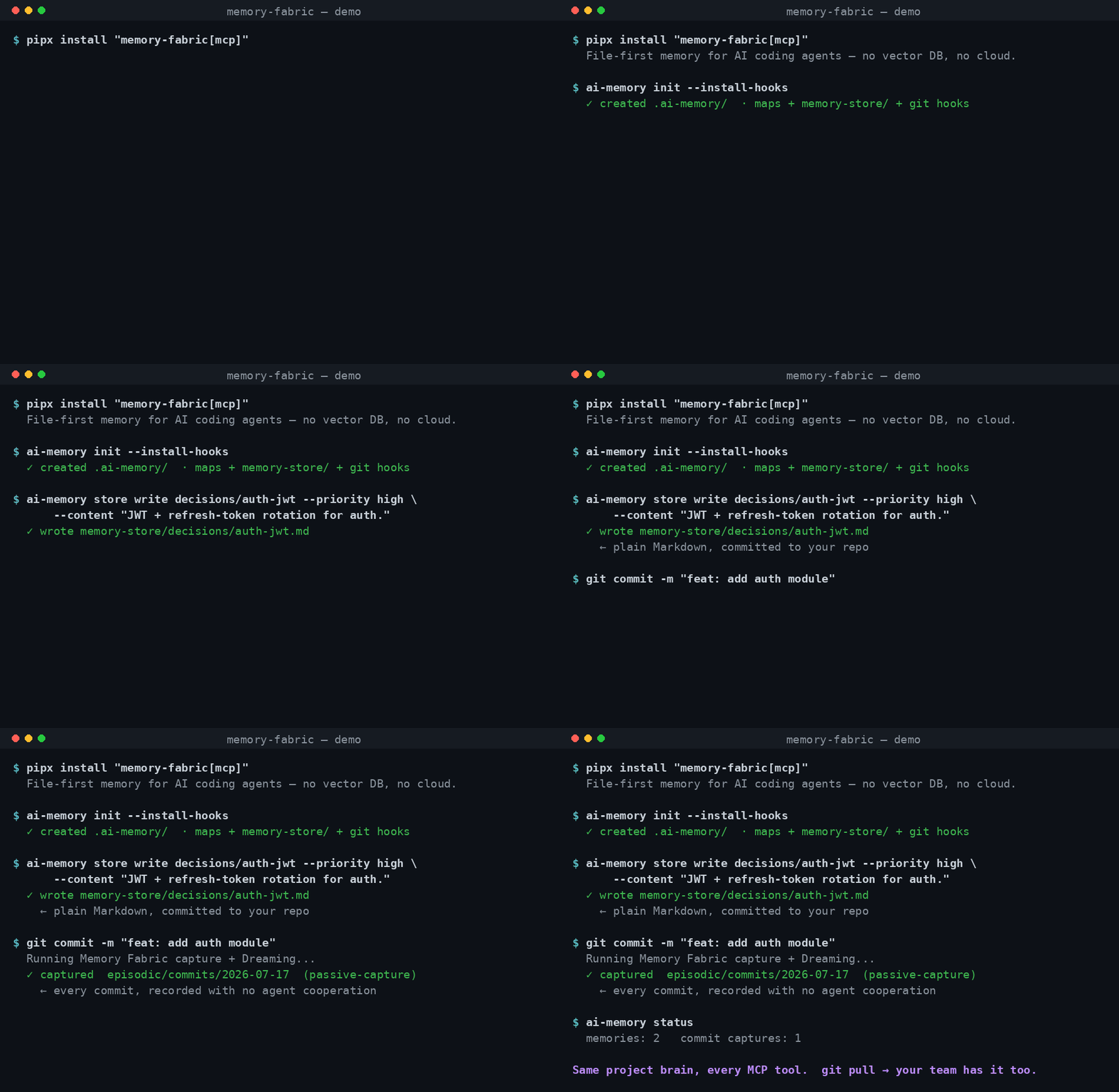
The CLI and self-capture flow: initialize a project, write a memory as a plain
Markdown file in your repo, and watch a git commit record itself as episodic
memory with no agent cooperation. The cross-tool moment — an agent writes memory
in one tool and a different tool reads it back — is storyboarded in
DEMO.md for the full video.
Privacy — no telemetry
Memory Fabric never sends data anywhere. There is no account, no cloud, no
analytics, no phone-home. The core read and write paths make no network calls at
all; the only optional network requests are a PyPI version-drift check and an
LLM-provider preflight, both of which you can turn off with --offline. Your
memory is plain Markdown in your own git history — it never leaves your machine
unless you push it.
An optional, off-by-default field diary can record operational counts on
your machine after you run ai-memory diary approve. That is not the session
journal, and it is not telemetry: nothing is transmitted. MEMORY_FABRIC_DIARY=0
is a kill switch. This is a deliberate guarantee, not a default we might change.
Installation
From PyPI (recommended)
Requires Python ≥ 3.11.
pipx install memory-fabric          # CLI only
pipx install "memory-fabric[mcp]"   # CLI + MCP server
Or with plain pip (inside a virtual environment):
pip install memory-fabric          # CLI only
pip install "memory-fabric[mcp]"   # CLI + MCP server
Zero-install one-off run (requires uv):
uvx --from "memory-fabric[mcp]" memory-fabric-mcp # starts the MCP server on stdio
From GitHub (latest, pre-release)
# CLI only
pipx install "git+https://github.com/elViRafa/agentic-memory.git"

# CLI + MCP server
pipx install "memory-fabric[mcp] @ git+https://github.com/elViRafa/agentic-memory.git"
Or with plain pip (inside a virtual environment):
pip install "git+https://github.com/elViRafa/agentic-memory.git"          # CLI only
pip install "memory-fabric[mcp] @ git+https://github.com/elViRafa/agentic-memory.git"  # + MCP
Upgrading
Because Memory Fabric is in active development, we recommend upgrading regularly:
-
Upgrade the Package:
# If installed via pipx: pipx upgrade memory-fabric # If installed in a virtual environment via pip: pip install --upgrade "memory-fabric[mcp]" # If installed from GitHub (pre-release): pipx install --force "memory-fabric[mcp] @ git+https://github.com/elViRafa/agentic-memory.git" -
Refresh the MCP client config (uvx installs): If your client config launches the server via
uvx(the default written by olderai-memory installruns), uv serves the build it cached the first time and never re-resolves an unpinned spec — restarting the client is not enough and can leave the server several releases behind without any signal. After upgrading, either:# Re-write the client config (now pins the exact installed version, or points # at the local memory-fabric-mcp binary when one sits next to the CLI): ai-memory install --client <your-client> --project # ...or drop the stale cached build so uvx re-resolves: uv cache clean memory-fabricai-memory doctorwarns when the local version drifts from the latest on PyPI or when a differentai-memoryinstallation shadows this one on PATH. -
Restart MCP Clients: After upgrading, restart your IDE (Cursor, VS Code) or assistant process (Claude Code) to ensure the client reloads the updated
memory-fabric-mcpserver. -
Refresh Local Projects (Optional): If you have projects initialized with older versions of Memory Fabric, navigate to the project directory and run:
ai-memory init --install-hooksThis will safely refresh starter templates and local git hook integration to the latest format without overwriting your existing memory markdown files.
Windows terminals: the CLI emits UTF-8 (memory content legitimately contains em-dashes and bullets). Windows Terminal and PowerShell 7 render it out of the box; on legacy consoles (PowerShell 5.1 with an OEM code page) set
chcp 65001orPYTHONUTF8=1if you see replacement characters.
Or clone and install in editable mode for local development:
git clone https://github.com/elViRafa/agentic-memory.git
cd agentic-memory
pip install -e .          # CLI only
pip install -e ".[mcp]"   # CLI + MCP server
Quick Start
1. Initialize a project
ai-memory init
Creates .ai-memory/ in the current directory with starter sections and a .gitignore.
2. Check health
ai-memory doctor
3. Evaluate memory quality
ai-memory eval
ai-memory eval --json
eval scores whether memories are useful for coding assistants. It checks section coverage, starter-template content, summary quality, metadata, retrieval readiness, and likely secrets.
If .ai-memory/ exists, reports are saved under ignored local files:
.ai-memory/evals/latest.json
.ai-memory/evals/latest.md
.ai-memory/evals/<timestamp>-memory.json
.ai-memory/evals/<timestamp>-memory.md
If .ai-memory/ does not exist yet, eval prints a pre-init report only and creates no files.
4. Query memory
ai-memory query "authentication"
5. Run maintenance (Dreaming)
ai-memory dream --mode light
ai-memory dream --mode deep
Dreaming creates a snapshot before maintenance. You can evaluate whether a Dreaming run improved memory quality:
ai-memory eval --dream latest
ai-memory dream --mode light --eval
Dream eval compares the pre-dream snapshot to current memory and reports score delta, changed files, improvements, and regressions.
MCP Server — Install
One command per client. Safe to re-run: merges with your existing config, never overwrites it, and backs up the original file if it can't be parsed.
One-click install



These call uvx --from "memory-fabric[mcp]" memory-fabric-mcp under the hood — same
canonical invocation as ai-memory install, just without the CLI step. Requires
uv.
| Client | Command |
|---|---|
| Claude Code | ai-memory install --client claude-code |
| Claude Desktop | ai-memory install --client claude-desktop |
| VS Code | ai-memory install --client vscode |
| Cursor | ai-memory install --client cursor |
| Windsurf | ai-memory install --client windsurf |
| Codex | ai-memory install --client codex |
| Antigravity | ai-memory install --client antigravity |
| Gemini CLI | ai-memory install --client gemini-cli |
| Cline | ai-memory install --client cline |
| All detected clients | ai-memory install --client all |
Add --project to write project-scoped config instead of the global/user config
(where the client supports it). Add --dry-run to preview the change as a unified
diff without writing anything. Add --uninstall to remove only the memory-fabric
entry, leaving everything else in the file untouched.
Available MCP Tools
| Tool | Description |
|---|---|
initialize_memory_fabric_tool | Create .ai-memory/ scaffolding in a project |
read_combined_context_tool | Load Tier 0 directives + prioritized memory within token budget |
read_section_tool | Read a single memory section by name |
keyword_search_tool | Search memory with ripgrep or Python fallback |
write_local_memory_tool | Update steering sections (framework-rules, ubiquitous-language) only. Writing facts or root maps is rejected (store-first) — root maps are generated from memory-store/; use write_memory_store_tool |
propose_memory_patch_tool | Preview proposed memory changes without applying |
dream_tool | Run memory maintenance / consolidation (--mode light |
prepare_dream_payload_tool | Prepare candidate snapshot and return consolidation prompt for client-driven dreaming |
apply_dream_results_tool | Apply LLM consolidated JSON output to candidate snapshot and save changes |
evaluate_memory_fabric_tool | Evaluate local memory quality |
evaluate_dream_quality_tool | Evaluate a Dreaming run against a snapshot |
write_memory_store_tool | Write a memory file to a semantic store path (e.g. architecture/decisions/auth); accepts an optional evidence citation list |
read_memory_store_tool | Read a single memory-store file by its semantic path |
list_memory_store_tool | List files in the memory store, optionally filtered by prefix/tags |
delete_memory_store_tool | Remove a memory-store file by its semantic path |
write_session_journal_tool | Append a timestamped session journal entry (episodic memory) |
write_failure_memory_tool | Record an error → fix pair; repeat occurrences of the same error accumulate onto one entry |
Agentic Architecture (making agents use Memory Fabric automatically)
Registering the MCP server is necessary but not sufficient — AI agents will not use its tools unless explicitly instructed to do so.
Memory Fabric provides an automated Agentic Architecture to handle this for you.
When you run ai-memory init in your project, the CLI automatically deploys a complete suite of agent instruction files tailored for every major AI tool:
| Target | File(s) Created |
|---|---|
| Gemini CLI / Codex / Antigravity | AGENTS.md |
| Grok (TUI / Build / Agent harness) | AGENTS.md (primary project rules); full docs + MCP registration in ~/.grok/config.toml or .mcp.json; see also .grok/docs/user-guide/13-memory-fabric.md when installed for the client |
| Cursor IDE | .cursor/rules/memory-fabric.mdc |
| Windsurf IDE | .windsurf/rules/memory-fabric.md |
| Cline / Generic IDE Agents | .agents/rules/memory-store.md, .agents/rules/dreaming.md |
| Claude Code | CLAUDE.md (created or appended) |
| GitHub Copilot | .github/copilot-instructions.md (created or appended) |
Single Source of Truth (Syncing)
All these files are generated from two canonical content blocks inside the Memory Fabric Python package. Running ai-memory sync-agents regenerates every platform file from these templates, guaranteeing perfect consistency. If you used ai-memory init --install-hooks, a pre-commit git hook runs this sync automatically on every commit.
In the shared user files (AGENTS.md, CLAUDE.md, .github/copilot-instructions.md) the fabric content lives inside managed marker blocks (…); sync only ever rewrites content between the markers, so anything you add outside them is preserved byte-for-byte.
Project Directives (v1.1)
Beyond the package's own protocol instructions, you can define project directives — hand-curated development guidelines shared by every AI agent working on the repo. A directive is simply a root section file .ai-memory/<name>.md with role: steering frontmatter (like the built-ins framework-rules and ubiquitous-language), plus two optional boolean routing keys:
| Key | Meaning | Default |
|---|---|---|
sync | include the directive in the per-tool files generated by sync-agents | true |
context | inject the directive as Tier 0 into read_combined_context | true for the built-ins; false for user directives (file-reading agents already get the synced copy) |
ai-memory sync-agents composes every sync: true steering section into one project-directives document and distributes it as .agents/rules/project-directives.md, .cursor/rules/project-directives.mdc, .windsurf/rules/project-directives.md, and a managed marker block in AGENTS.md/CLAUDE.md/.github/copilot-instructions.md — so AGENTS.md-only readers (Codex, OpenCode, Gemini) receive them too. Deleting the last synced directive tears all of that down again.
For CI, ai-memory sync-agents --check is a drift gate: it writes nothing and exits 1 when any generated file is out of date. ai-memory doctor additionally warns when the always-loaded context surface exceeds its token budget (default 3000, MEMORY_FABRIC_DIRECTIVE_BUDGET), when a hand-edited steering file contains something that looks like a secret, and when a stale pre-1.1 fabric block sits outside the managed markers.
For full details on the architecture, see AGENTIC_ARCHITECTURE.md.
Why this matters
Without these instruction files, agents will often explain they "don't use MCP tools automatically," or worse, they will write memory markdown files directly using native file-system tools—bypassing secret scanning, token budgeting, and background Dreaming management.
By simply running ai-memory init, you get zero-configuration, plug-and-play capability across the entire agent ecosystem.
Using Memory Fabric in Other Projects
You can use a single installed instance of Memory Fabric across all your coding projects:
-
Scaffold the target project: Navigate to your target project's root folder and initialize it:
cd /path/to/other-project
ai-memory init --install-hooks
This automatically creates
.ai-memory/, deploys the Agentic Architecture rule files, sets up.gitignore, and installs the git post-commit hooks. -
Global MCP Configuration: Verify your AI assistant's configuration points to your globally installed
memory-fabric-mcpexecutable. The MCP tools automatically parse and use the active project's path passed by the assistant as thecwdargument, enabling a single global MCP server registration to support all your local workspaces.
Project Memory Layout
Memory Fabric is store-first: memory-store/ is the only place agents write facts by
hand, one fact per file. The root map files (architecture.md, decisions.md, debt.md,
schemas.md, index.md) are generated views rebuilt by Dreaming from their matching
memory-store/<category>/ subtree — never edit them directly, they carry generated: true
frontmatter and a hand edit gets folded back into the store for review on the next Dream.
The exception is the steering tier: any root section with role: steering frontmatter
(the built-ins framework-rules.md and ubiquitous-language.md, plus any project
directives you create) is hand-curated — humans and agents may edit these files directly
(review via MR). The built-ins are always loaded into context in full, never generated
and never evicted by the token budget; user directives default to context: false and
reach agents through the sync-agents per-tool files instead.
.ai-memory/
|-- index.md                  # generated discovery index
|-- architecture.md           # generated map of memory-store/architecture/
|-- schemas.md                # generated map of memory-store/schemas/
|-- decisions.md              # generated map of memory-store/decisions/
|-- debt.md                   # generated map of memory-store/debt/
|-- ubiquitous-language.md    # hand-curated steering directive (always loaded)
|-- framework-rules.md        # hand-curated steering directive (always loaded)
|-- memory-store/             # the source of truth — one fact per file
|   |-- index.md              # generated store-wide index
|   |-- architecture/...
|   |-- decisions/...
|   |-- debt/...
|   |-- schemas/...
|   |-- failures/<slug>.md    # error -> fix pairs, deduplicated by normalized signature
|   |-- episodic/<date>.md    # agent-written session journals
|   `-- episodic/commits/<date>/<short-hash>.md  # one passively captured commit each
|-- evals/       # ignored local quality reports
|-- snapshots/   # ignored rollback baselines
|-- private/     # ignored personal notes + session markers
`-- .gitignore
All memory files use YAML frontmatter:
---
store_path: architecture/decisions/auth-service
summary: "One-line fallback used when the file exceeds the token budget."
priority: high
tags: [api, auth]
schema_version: "1.3"
last_updated: 2026-06-01T12:00:00-04:00
evidence: [src/auth.py:42, "commit:abc1234"]
---

Your memory content here.
The optional evidence field lets a memory cite what it depends on — a file, a
file:line, or a commit:<hash>. Run ai-memory verify to check those citations still
resolve; a memory citing a file that was renamed or deleted gets flagged instead of
quietly rotting.
Capture Reliability
Agent instruction files get an agent to read memory reliably at session start, but writes are less consistent — a long session can compress away the instructions, and some clients never load a rules file at all. Two mechanisms close that gap without depending on any agent's cooperation — commit, and the project brain updates itself; end a session without a journal, and the Stop hook blocks it.
Passive capture. With ai-memory init --install-hooks, every commit is recorded as
episodic memory automatically:
ai-memory capture              # capture HEAD (this is what the post-commit hook runs)
ai-memory capture --commit abc1234
Each capture writes one file per commit at
memory-store/episodic/commits/<date>/<short-hash>.md, with source: passive-capture
and review_status: pending frontmatter — reviewable, and distinct from agent-written
journal entries. It's idempotent per commit hash, needs no LLM, and is the raw material
the next ai-memory dream consolidates or extracts facts from.
One file per commit rather than one shared file per day is what keeps the tree
mergeable. Capture runs after the commit, so the record for commit N can only be
committed by commit N+1 — it is always sitting uncommitted in between. A shared day file
would therefore be a tracked, modified file at all times, and git refuses to merge into
one (error: Your local changes to the following files would be overwritten by merge)
before any merge machinery runs — including the semantic merge driver that would have
resolved it. A distinct new file per commit is untracked instead, which git merges
straight over, and two developers can never write the same path.
Noise commits (merges, [bot] authors, chore:/style:/ci:/build(deps)
prefixes, lockfile-only changes) are skipped by default — audibly, with a
skipped_reason and a --no-filter opt-out, never silently — and ai-memory dream --mode deep folds commit records older than 14 days into weekly summaries so
episodic/commits/ never grows unbounded. See ROADMAP_CAPTURE_HOOKS.md
for the full design.
Session-end enforcement. ai-memory session-start marks when a session began;
ai-memory guard-journal exits non-zero (reason on stderr) if write_session_journal_tool
hasn't been called since. ai-memory install --client <claude-code|gemini-cli|codex> --with-hooks wires this in automatically — SessionStart marks the session and injects a
short context reminder, Stop blocks ending the session until the journal exists, and a
pre-compaction event runs a non-blocking local consolidation checkpoint. ai-memory status reports local capture stats (last journal, commit captures, memories written in
the last 7 days) so you can see whether capture is actually happening.
Proof, not just a claim. scripts/capture_rate_benchmark.py scripts a fully
non-cooperative simulated agent — one that never calls write_session_journal_tool on its
own — through 20 sessions in each mode:
| Mode | Sessions journaled | Commit capture rate |
|---|---|---|
| Instructions-only (no hooks) | 0 / 20 (0%) | 20 / 20 (100%) |
Hooks enabled (guard-journal enforced) | 20 / 20 (100%) | 20 / 20 (100%) |
Passive commit capture holds at 100% either way, since it runs off the git post-commit
hook, not the client-side session hooks. Session journaling goes from 0% to 100% only once
the Stop hook is wired in — a mechanism proof (the enforcement primitive cannot be silently
skipped), not a statistical study of real-world agent compliance, which is separate,
larger benchmark work (see ROADMAP.md Phase 5). Reproduce it yourself:
python scripts/capture_rate_benchmark.py --sessions 20.
Failure memory. The highest-signal category for a coding agent — "I hit this exact error before, here's what fixed it":
ai-memory failure --error "KeyError: 'user_id' in handlers.py:12" --fix "Added a default value."
The error text is normalized (paths and line numbers stripped) into a stable signature,
so a repeat of the same kind of error accumulates onto one growing
memory-store/failures/<slug>.md entry — with an occurrences counter — instead of
scattering into near-duplicate files.
Git-Native Trust
Two capabilities that only exist because memory lives in the same git repo as the code it describes — no vector-database or cloud memory product can offer either.
Semantic merge driver. Two branches that each append new facts to the same store file
used to conflict on the shared last_updated line even when the actual content additions
never overlapped. ai-memory init --merge-driver registers a custom driver that resolves
the shapes team memory actually produces, and falls back to git's own textual merge for
anything it can't safely resolve — never worse than not having it installed.
ai-memory init --merge-driver
What it merges, in order of preference:
| Change shape | Resolution |
|---|---|
| Frontmatter only | Tags union, more urgent priority wins, later last_updated wins |
Generated views (index.md, failures.md, and the other root maps) | Union — never a conflict; they're rebuilt from memory-store/ by the next Dreaming run anyway |
| Both branches appended new facts | Both kept, near-duplicate lines dropped |
Both branches wrote different ## entries (two agents journaling the same day) | Merged block by block |
The same ## entry rewritten on both sides | Deferred to git's textual merge — a real disagreement, so a human picks |
This writes .ai-memory/**/*.md merge=memory-fabric to .gitattributes (committed and
shared) and registers the driver command in local git config (per-clone by git's own
design).
Teams: the per-clone half is the part that bites. .gitattributes travels with the
repo, but the driver command does not — a teammate who clones and merges without
registering it gets ordinary textual conflicts in .ai-memory/, with nothing to explain
why. Two things close that gap: ai-memory doctor warns when a clone declares the driver
but hasn't registered it, and any ai-memory init in such a clone registers it
automatically.
Already mid-merge? You don't have to redo the merge — resolve-conflicts applies the
same resolution to the conflict git already recorded, and stages what it resolves:
ai-memory resolve-conflicts
# resolved: .ai-memory/failures.md, .ai-memory/memory-store/episodic/2026-07-28.md
git commit
It exits non-zero and leaves the file untouched — conflict markers and all — for anything that needs a human, so it's safe to run on a whole conflicted merge.
Self-verifying citations. See the evidence field above — ai-memory verify is the
command that checks citations still resolve and flags the ones that don't.
Global Memory
Developer-level preferences that apply across all projects are stored at:
| Platform | Path |
|---|---|
| Windows | %APPDATA%\memory-fabric\global\ |
| macOS | ~/Library/Application Support/memory-fabric/global/ |
| Linux | $XDG_CONFIG_HOME/memory-fabric/global/ |
global/directives.md is Tier 0: it is always loaded fully, bypassing token budgeting.
CLI Reference
ai-memory [--cwd <path>] [--json] [--debug-llm] <command>

Commands:
  init            Create .ai-memory/ scaffolding (--install-hooks, --merge-driver)
  status          Show memory status and capture stats
  doctor          Validate memory files and environment
  verify          Check evidence citations still resolve (--no-mark for a read-only report)
  failure         Record an error -> fix pair (--error, --fix, --tags)
  merge-driver    Git merge driver backend (invoked by git itself, not for direct use)
  resolve-conflicts  Resolve conflicted .ai-memory files of an in-progress merge (--all)
  capture         Record a commit as episodic memory (--commit, default HEAD)
  session-start   Mark session start (for client SessionStart hooks)
  guard-journal   Exit non-zero if no session journal was written (for client Stop hooks)
  install         Configure an MCP client to use memory-fabric (--client <name|all>)
  eval            Score memory quality or Dreaming quality
  bench           Coding-memory benchmark: memory-on vs memory-off retrieval
  dream           Run memory maintenance (--mode light|deep)
  migrate         Split legacy hand-written sections into store entries (--dry-run, --section, --no-llm)
  query           Search memory
  store           CRUD operations on semantic memory store
  sync-agents     Regenerate agent instruction files from canonical templates
  sync-global     Preview local-to-global promotions
  rollback        Restore from a snapshot (--to <name>, or --list to discover valid names)
  clean           Prune old snapshots/candidates (--keep-snapshots, --keep-candidates, --dry-run)
  diary           Local field diary (approve|revoke|mute|unmute|status|checkpoint|wipe) — off by default, never sent
Eval examples:
ai-memory eval
ai-memory eval --json
ai-memory eval --llm-review
ai-memory eval --dream latest
ai-memory eval --dream memory-20260601T140000_0400
Optional LLM review is never enabled by default. When requested, deterministic local scores remain the source of truth; LLM notes are secondary and inputs are sanitized before review.
ai-memory bench
ai-memory bench --json
ai-memory bench --fixture . --suite .ai-memory/evals/bench.yaml
bench scores whether later-session questions recover earlier decisions (memory-on vs an empty store). The built-in fixture and methodology live in benchmarks/coding-memory/. No LLM is required.
Built-in fixture (2026-08-15, ai-memory bench):
| Task | Memory-on recall | Memory-off recall |
|---|---|---|
| TOT_LOCAL CAD vs system columns | 1.00 | 0.00 |
test_*.py naming | 1.00 | 0.00 |
| No Django REST Framework | 1.00 | 0.00 |
urnas_add_pos_calc PRD 0008/0009 reversal | 1.00 | 0.00 |
| Mean / lift | 1.00 | 0.00 (lift 1.00) |
LLM Configuration & MCP Sampling
Memory Fabric uses Large Language Models (LLMs) to perform semantic memory consolidation (Dreaming) and qualitative evaluation. You can configure this in two ways: via direct environment variables or via zero-config MCP Sampling.
Resolution Precedence
When an operation requires an LLM, Memory Fabric resolves the provider in the following order:
- Direct LLM Provider: Uses direct API calls if
MEMORY_FABRIC_LLM_PROVIDERis set in the environment along with the corresponding API keys. - Native MCP Sampling: If no direct provider is set (or configured keys are missing) AND the command is executed within an active MCP session where the parent agent supports sampling, Memory Fabric delegates the LLM call to the agent itself.
- Graceful Local Fallback: If neither is available, it degrades gracefully to local, deterministic regex-based deduplication without semantic synthesis.
Using MCP Sampling in Dreaming
MCP Sampling allows Memory Fabric to run semantic Dreaming and evaluations without configuring any local API keys or provider environment variables. Instead, it uses the host client's (e.g. Claude Code) native LLM connection.
How It Works
- When your AI assistant calls the
dream_toolorevaluate_memory_fabric_toolvia MCP, the Memory Fabric server checks if the client session supports sampling capabilities. - If supported and no direct provider is configured, the server sends a
create_messagerequest back to the client. - The client assistant executes the LLM reasoning under the hood and returns the consolidated memory JSON or evaluation notes.
Key Benefits
- Zero-Config: No need to configure or expose
GEMINI_API_KEY,OPENAI_API_KEY, orANTHROPIC_API_KEYto the background MCP server process. - Unified Context: The consolidation uses the same model and settings configured in your main coding assistant.
[!IMPORTANT] CLI Limitation: MCP Sampling relies on an active client-server session. Since the standalone terminal CLI (
ai-memory) runs outside of an MCP client, runningai-memory dreamfrom the command line cannot use MCP Sampling. To use LLM-based consolidation via the CLI, you must configure a direct LLM provider.
Client-Driven / Split-Tool Dreaming (Avoiding Deadlocks & Timeouts)
In some sequential/blocking MCP client environments (like IDE extensions or agentic loops), executing a nested MCP Sampling request (create_message) while the client is waiting for a tool response can lead to a JSON-RPC deadlock or execution timeouts.
To completely avoid this re-entrancy issue, Memory Fabric provides a client-driven split-tool dreaming protocol:
- Prepare Payload: The agent/client first calls
prepare_dream_payload_tool. This returns aconsolidation_promptand acandidate_storeID, but performs no blocking LLM reasoning. - Execute Locally: The client uses its own local LLM connection/context to execute the returned
consolidation_promptand captures the raw JSON output. - Apply Results: The client sends the raw LLM JSON response back by calling
apply_dream_results_tool(candidate_store=..., llm_response=...). Memory Fabric parses the response, applies the consolidated changes to the candidate folder, and saves the new memory states.
Direct LLM Providers Configuration
To use the CLI with LLMs, or to bypass MCP Sampling with a specific provider, set the following environment variables:
| Provider | Environment Variables | Notes |
|---|---|---|
| Gemini | MEMORY_FABRIC_LLM_PROVIDER=geminiGEMINI_API_KEY=your_key | Defaults to gemini-2.5-flash |
| OpenAI | MEMORY_FABRIC_LLM_PROVIDER=openaiOPENAI_API_KEY=your_keyOPENAI_MODEL=gpt-4o-mini (opt)OPENAI_API_BASE=... (opt) | Can connect to custom local/remote OpenAI-compatible endpoints |
| Anthropic | MEMORY_FABRIC_LLM_PROVIDER=anthropicANTHROPIC_API_KEY=your_key | Defaults to claude-3-5-haiku-20241022 |
| Ollama | MEMORY_FABRIC_LLM_PROVIDER=ollamaOLLAMA_HOST=... (opt)OLLAMA_MODEL=gemma2 (opt) | Offline, local reasoning |
Model quality matters for deep Dreaming. Consolidation quality — especially contradiction detection — degrades with small local models, and the failure is silent (the model simply returns an empty
contradictionslist). In our testing an 8B-class model (qwen3-vl:8b) missed a deliberately planted TTL conflict; prefer a ~14B+ model (or a hosted provider) when you rely ondream --mode deepfor semantic conflict detection. As a safety net, Memory Fabric always runs a deterministic heuristic that flags store files with overlapping wording but divergent numbers, independent of the LLM's answer.
LLM Debugging
If you want to view the exact prompts sent and responses received by the LLM providers (Gemini, OpenAI, Anthropic, Ollama), you can enable LLM debug logging.
-
Via the CLI: Pass the
--debug-llmglobal flag before the subcommand:ai-memory --debug-llm dream --mode deepThis automatically prints logs to
sys.stderrand appends them to a file namedllm_debug.log(in.ai-memory/llm_debug.logif the directory exists, otherwise in the current working directory). -
Via Environment Variables: Set the
MEMORY_FABRIC_LLM_DEBUGvariable in your environment:stderr: Output prompts and raw JSON responses only tosys.stderr.1ortrue: Output tosys.stderrand write to the defaultllm_debug.logfile./path/to/log.txt(or any other custom value): Append logs to a custom file path.
To protect your credentials and API keys, headers like Authorization and x-api-key are automatically redacted as [REDACTED] in the debug logs.
Write Safety
Every write path runs secret detection before saving. Detected secrets are replaced with [REDACTED_SECRET] and returned in the redactions field of the response. File locking prevents concurrent write corruption.
Eval scans existing memories for likely secrets but does not rewrite existing files. It reports what needs manual review.
Requirements
- Python >= 3.11
mcp >= 1.0.0(optional, required for MCP server only)rg(optional; ripgrep speeds up keyword search, Python fallback used when absent)
Contributing
Contributions are welcome. See CONTRIBUTING.md for setup, the
checks CI enforces, and the store-first conventions. For anything security-sensitive,
see SECURITY.md rather than opening a public issue.
License
MIT — © 2026 Memory Fabric Contributors. No telemetry, no account, no cloud.
Reviews
No reviews yet
Be the first to review this server!
More Developer Tools MCP Servers
Git
Freeby Modelcontextprotocol · Developer Tools
Read, search, and manipulate Git repositories programmatically
Fetch
Freeby Modelcontextprotocol · Developer Tools
Web content fetching and conversion for efficient LLM usage
Worldmonitor
Freeby Koala73 · Developer Tools
Live markets, conflicts, country risk, chokepoints, energy, and China decision signals. 86 tools.
Paperclip
Freeby Paperclipai · Developer Tools
Trending hip-hop artist momentum scores across four cultural dimensions.
Toleno
Freeby Toleno · Developer Tools
Toleno Network MCP Server — Manage your Toleno mining account with Claude AI using natural language.
mcp-creator-python
Freeby mcp-marketplace · Developer Tools
Create, build, and publish Python MCP servers to PyPI — conversationally.