
Server data from the Official MCP Registry
Health record rights: 198 countries scored 0 to 100 with sources; the 50 states and DC; real cases.
About
Health record rights: 198 countries scored 0 to 100 with sources; the 50 states and DC; real cases.
Remote endpoints: streamable-http: https://healthrecordrights.com/mcp
Security Report
Valid MCP server (1 strong, 1 medium validity signals). No known CVEs in dependencies. Imported from the Official MCP Registry.
9 tools verified · Open access · No issues found
Security scores are indicators to help you make informed decisions, not guarantees. Always review permissions before connecting any MCP server.
Permissions Required
This plugin requests these system permissions. Most are normal for its category.
How to Connect
Remote Plugin
No local installation needed. Your AI client connects to the remote endpoint directly.
Add this to your MCP configuration to connect:
{
  "mcpServers": {
    "io-github-evil-robot-health-record-rights-index": {
      "url": "https://healthrecordrights.com/mcp"
    }
  }
}Documentation
View on GitHubFrom the project's GitHub README.
Health Record Rights Index
Who holds the record? An open index that scores 198 countries and territories, from 0 to 100, on one question: can a person see, control and share their own health record?
By SuperTruth Inc. Index version 1.0, data as of 2 October 2026. Data release 1.1 adds the US state layer: what the law of each of the 50 states and DC adds to federal law, read on 3 and 4 October 2026. Data and paper CC BY 4.0, code MIT.
- Live index: https://healthrecordrights.com
- Paper:
paper/paper.pdf(working paper, version 1.2; source inpaper/paper.md) - Data:
data/(one file per country),data/us-states/(one file for each of the 50 states and DC) andexports/(CSV and JSON) - API: https://healthrecordrights.com/api/v1/ serves the same data as JSON, with no key
Use the data
The Health Record Rights Index is also open as read-only JSON at https://healthrecordrights.com/api/v1/, with no key and no sign-up. The same data is open to AI assistants through an MCP server at https://healthrecordrights.com/mcp. MCP is a shared standard that lets an assistant read outside data. Each address may make 60 requests a minute, with bursts up to 120, shared between the API and the MCP server. For the whole index at once, use the downloads instead. The data is licensed under CC BY 4.0; credit "SuperTruth, Inc., Health Record Rights Index". Quoted law and source titles stay with their owners, and the code in this repository is MIT. Every route, field and example is on https://healthrecordrights.com/developers/.
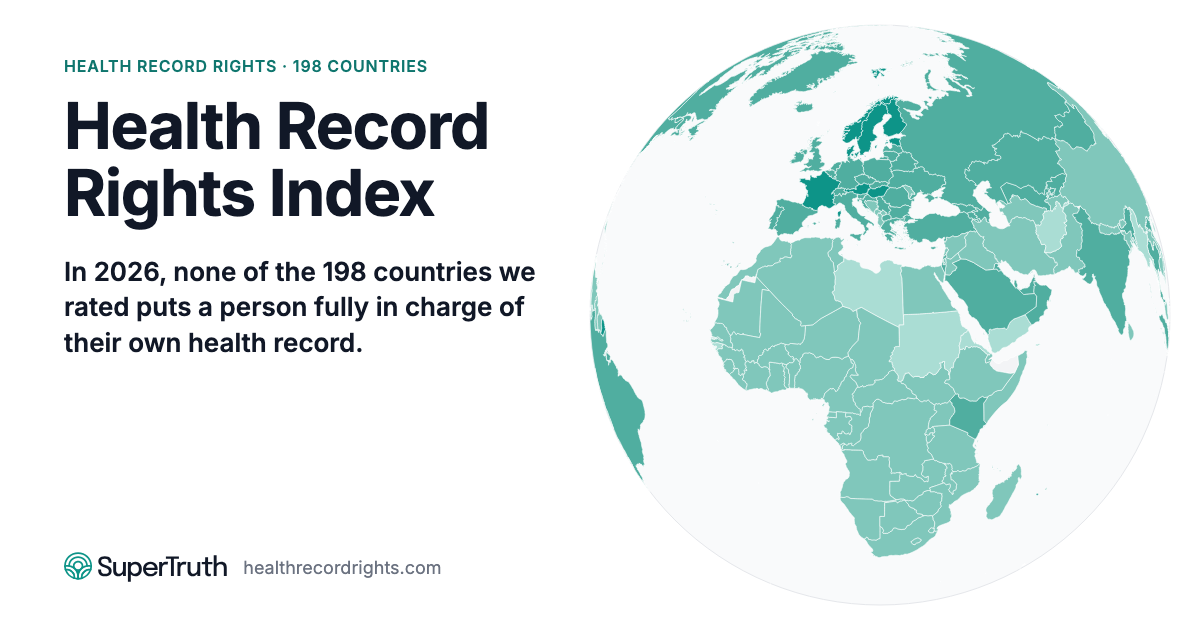
The finding
In 2026, none of the 198 countries and territories we rated puts a person fully in charge of their own health record.
- No country holds the top band. No country reaches Leading (85 and up). By band, 9 rate Strong, 66 Mixed, 111 Weak and 12 Poor. The median is 39.
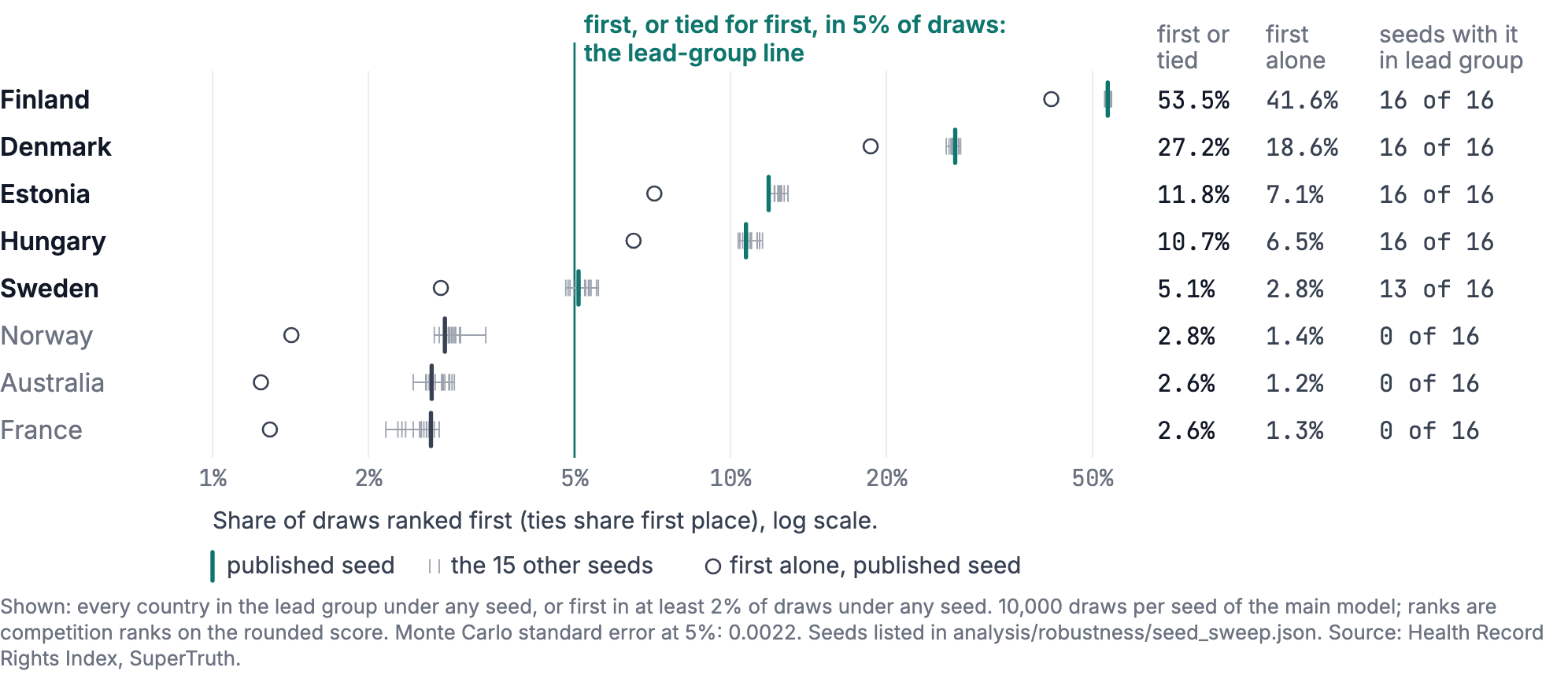
- The leaders are a group, not a winner. Finland, Denmark, Estonia, Hungary and Sweden have the highest scores. Allowing for scoring error, any of them could rank first, so we name them together.
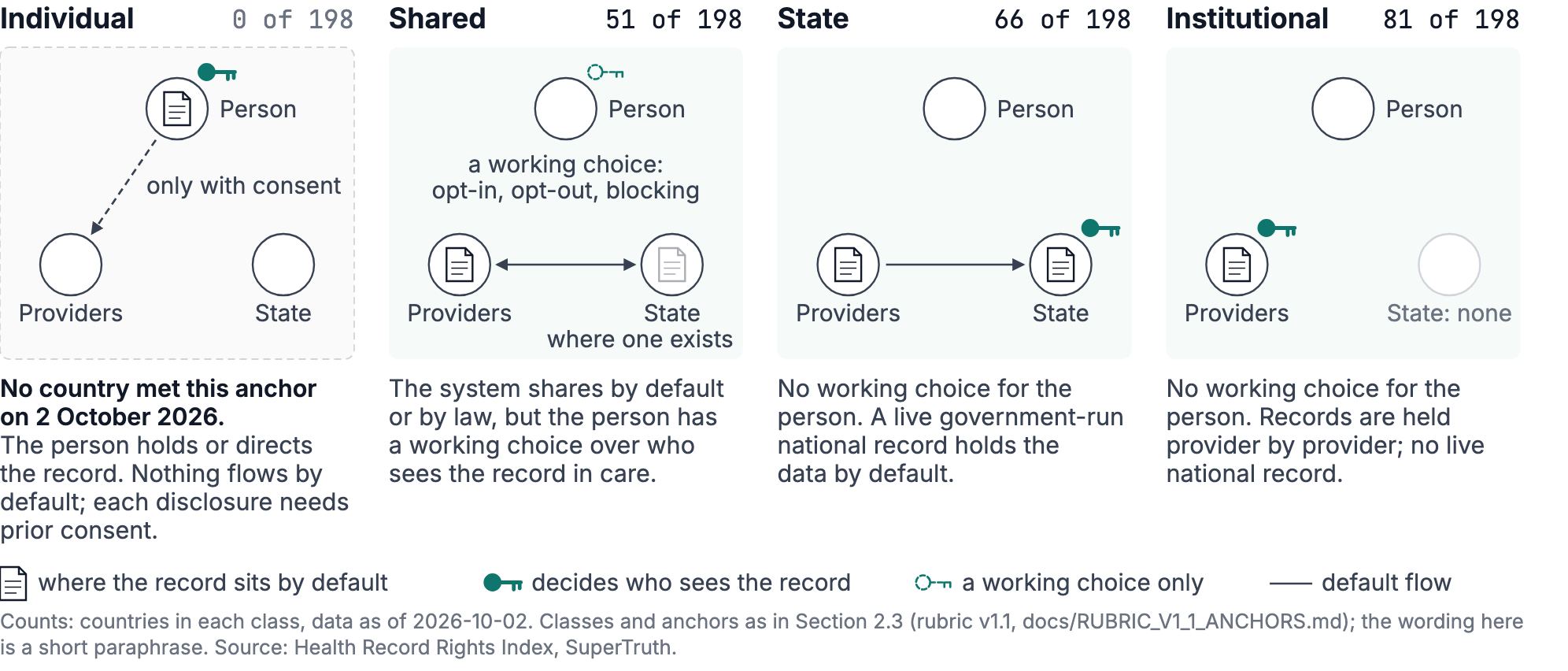
- Someone else holds the keys everywhere. By default the record sits with the state or with providers: 51 systems are Shared (the person has a working choice inside a shared system), 81 Institutional and 66 State. None is Individual.
- Ranks are ranges. Every country carries the range of ranks it holds in 90% of simulations. Read those, not single positions.
Coverage: all 193 UN member states, plus Greenland, Kosovo, Palestine, Taiwan and Vatican City. Including a place takes no position on its status; we cover every place that runs its own health system.
Top 10
| Rank | Likely range | Country | Score | Band |
|---|---|---|---|---|
| 1 | 1 to 6 | Finland | 71 | Strong |
| 2 | 1 to 8 | Denmark | 70 | Strong |
| 3= | 1 to 13 | Estonia | 68 | Strong |
| 3= | 1 to 13 | Hungary | 68 | Strong |
| 5 | 1 to 17 | Sweden | 67 | Strong |
| 6= | 2 to 20 | Australia | 66 | Strong |
| 6= | 2 to 20 | France | 66 | Strong |
| 6= | 2 to 20 | Norway | 66 | Strong |
| 9 | 3 to 23 | Austria | 65 | Strong |
| 10 | 3 to 26 | Portugal | 64 | Mixed |
Other large systems: Germany 63 (11=), the Netherlands 60 (23=), the United Kingdom 59 (27=), Japan 56 (38=), Canada and Brazil 52 (47=), the United States 48 (55=, likely 45 to 80), India 45 (71=), China 43 (80=). The full ranking is in exports/who-holds-the-record-scores.csv and Table 2 of the paper.
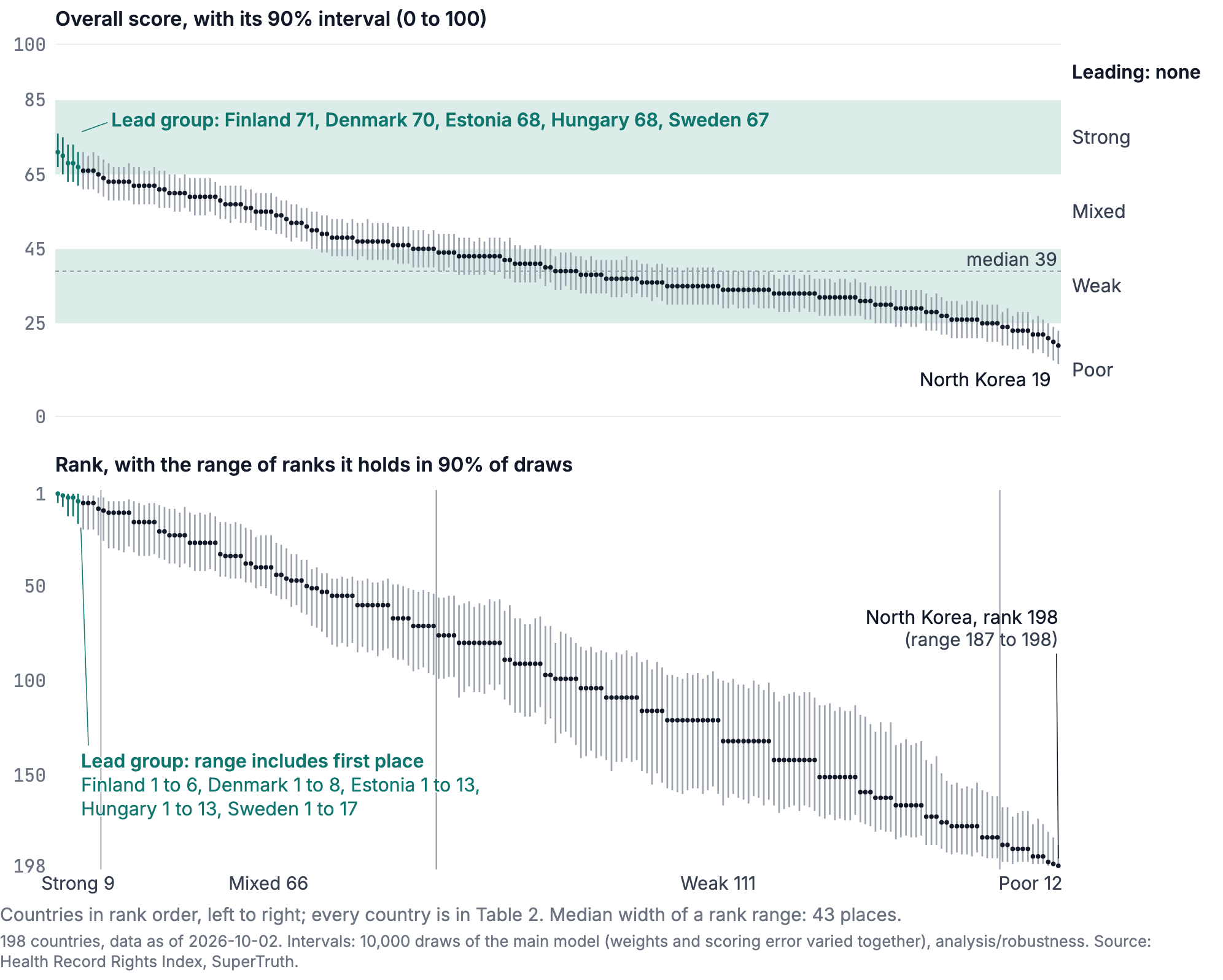
Every country in rank order. The lower panel draws each country's rank range; the upper panel adds the score intervals behind them. No country reaches Leading.
What we measure
Eight weighted categories, each scored 0 to 100 against a written rubric (RUBRIC.md):
| Category | Weight |
|---|---|
| Patient access to the full record | 20% |
| Patient control and consent | 20% |
| Privacy and security | 15% |
| Connected care journey | 15% |
| Protection from commercial use | 10% |
| Clinician access at the point of care | 10% |
| Research and trial consent | 5% |
| Clinical AI governance | 5% |
The overall score is the weighted sum. The weights are the authors' judgment; the paper tests how much the ranking depends on them. Each country is also placed in one of four classes for who holds the keys by default:
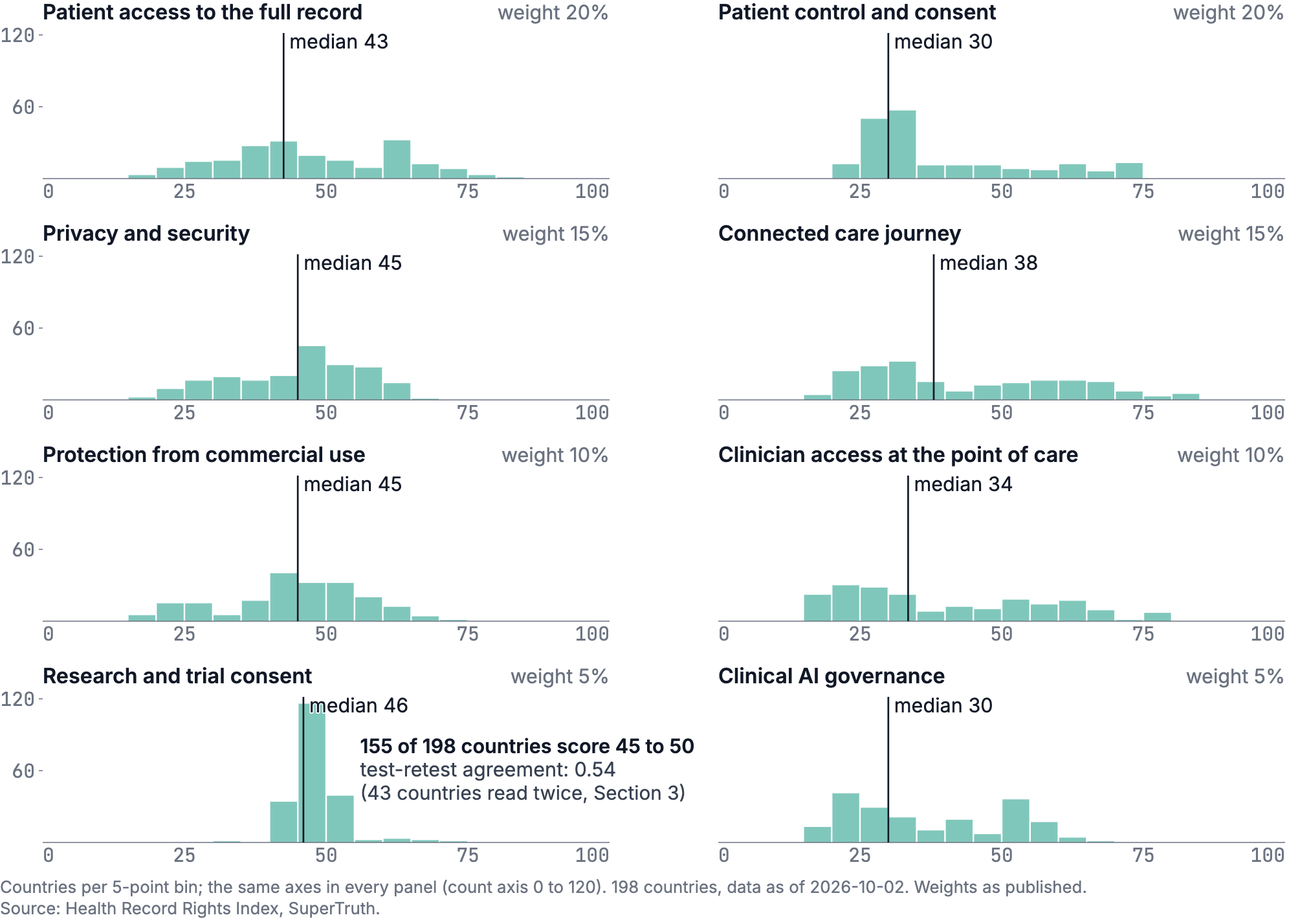
Which rights lag. Patient control and clinical AI governance sit lowest; research consent heaps just below the middle of the scale, which is why it barely separates countries.
How it was built
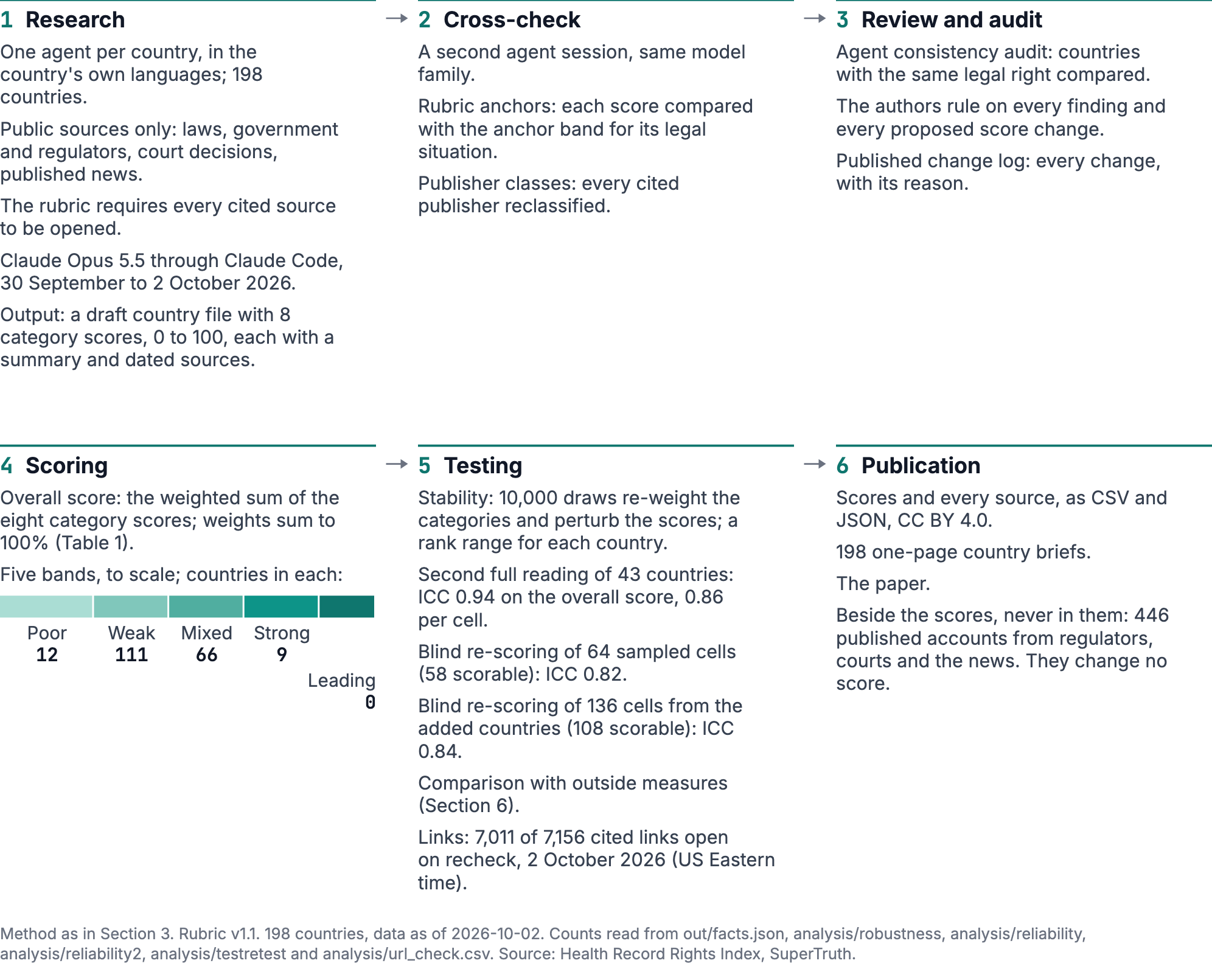
- Research. One research agent per country, in the country's own languages, using public sources only: laws, government and regulator pages, court decisions and published news. The rubric requires every cited source to be opened. The agents are built on Anthropic's Claude (Claude Opus 5.5 through Claude Code, 30 September to 2 October 2026). The paper discloses this in full.
- Cross-check. A second agent session of the same model family checks each country file against the rubric anchors and against peer countries with the same legal situation.
- Review and audit. Agents audit consistency across countries; the authors rule on every finding and every score change, and every change is logged in
docs/SCORE_CHANGES.md. - Scoring. Weighted sum, then five bands.
- Testing. Ranking stability (10,000 simulations), two blind re-scorings, a full second reading of 43 countries, comparison with outside measures, and a link check of every cited source.
- Publication. Scores, every source, a one-page brief per country, and the paper.
Everything comes from public information: 5,147 cited sources. Of 7,156 cited links, 7,011 opened on recheck on 2 October 2026; 88 were blocked by bot protection and 57 did not answer. No link was dead.
The US state layer
The index scores the United States as one country, on federal law. The state layer records what each state's own law adds to that federal floor, for the 50 states and DC: copy rights, consent for health information exchange, health data held outside HIPAA, breach notice, a private right to sue, rules for AI in care, and four kinds of sensitive record (genetic, HIV, mental health and reproductive). It gives no state score and no state rank, and it changes no country score.
Each state file in data/us-states/ cites the provisions its answers rest on: 929 in all, each with its citation, its official link and the words of the law quoted from it. 912 of the quotes were found word for word in a stored copy of the page (quoteVerified: "raw", with the copy's SHA-256 in rawSha256). The other 17 come from pages built by script that could not be stored as text (quoteVerified: "session"); a second agent session re-read each of them. The stored copies are not in this repository, because statute pages hosted by vendors carry their own terms.
A blind re-reading of 150 sampled cells, by agent sessions that could read only stored copies of the cited pages, agreed with the published cells at an intraclass correlation of 0.965 on the 114 cells with ordered levels where the rater settled a level (bootstrap interval clustered by state, 0.92 to 1.00). Section 11 of the paper sets out the method and its limits. The plan, the rubric, the log of changes, the decision rules, the rulings and the agreement results are in analysis/us/states/.
This is not legal advice. Each cell records what a primary legal text said on the date it was read.
How far to trust it
We published the checks against ourselves, including the ones that do not flatter us.
- Two blind re-scorings. Separate agent sessions re-scored random samples of cells from the cited sources alone, without seeing our scores or our site. On the first 65 countries, agreement was 0.82 (intraclass correlation). On a pre-registered sample of 136 cells from the 133 countries added on 2 October, agreement was 0.84. Access to the record agreed least (0.68), mostly where the rater could not open a cited law text, so a single access score for an added country is not reproducible to the point.
- No human rater has scored the index yet. That is the next step.
- The lead group is on a rule set before the results. A country is in it if it ranks first, alone or tied, in at least 5% of simulations. Sweden is on the edge: 5.09% under the published run, 13 of 16 random seeds, and 2.8% if ties are not counted.
- Confidence labels follow a printed rule. High means at least 7 of 8 categories rest on an official source with no fact marked unchecked; low means 4 or more do not. 27 countries are high, 105 medium and 66 low. The label is about the evidence, not the country's rights, and it never changes a score.
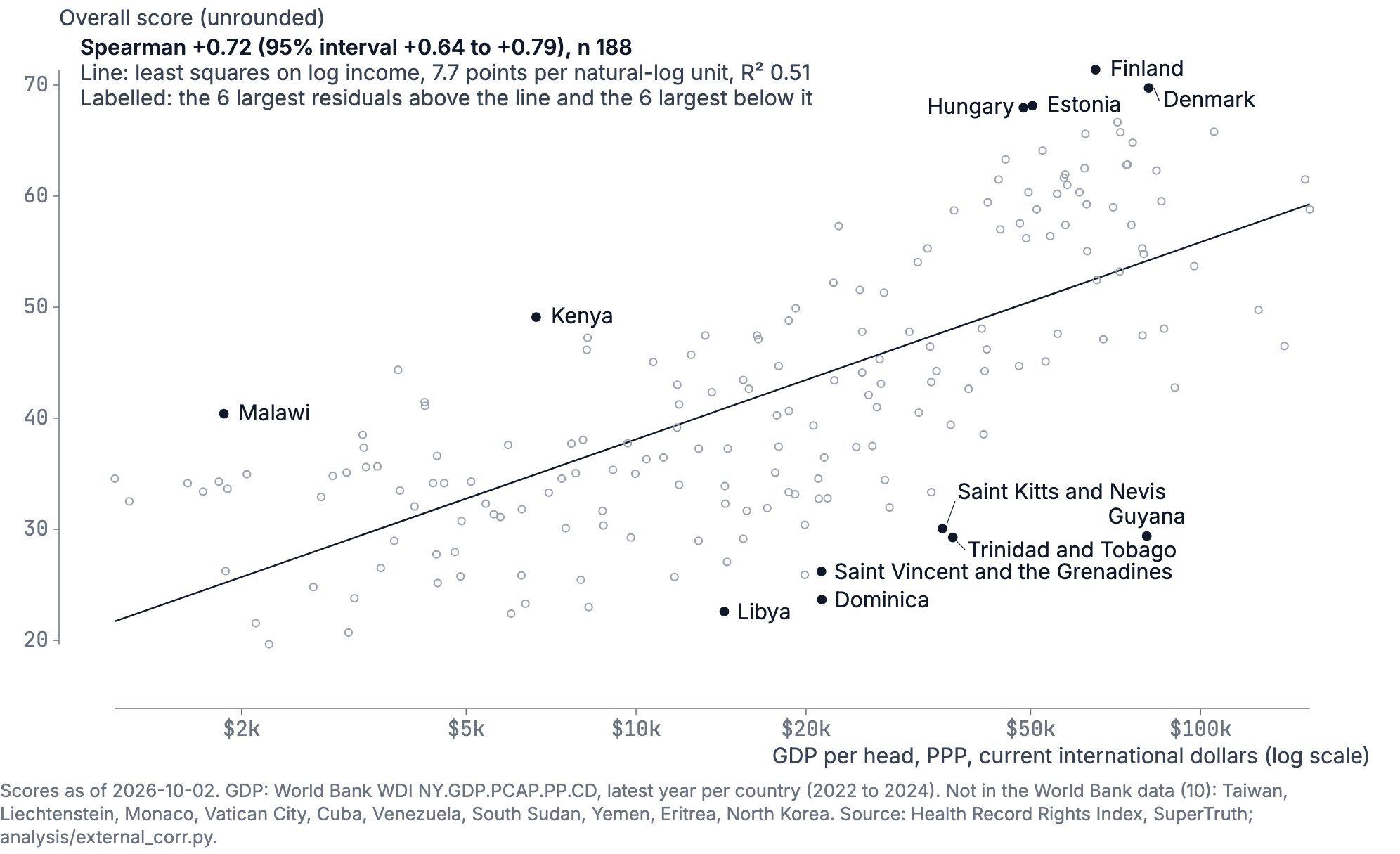
- Income matters but does not decide. Richer countries score higher, and income explains about half of the spread, but not all of it.
The traveling patient
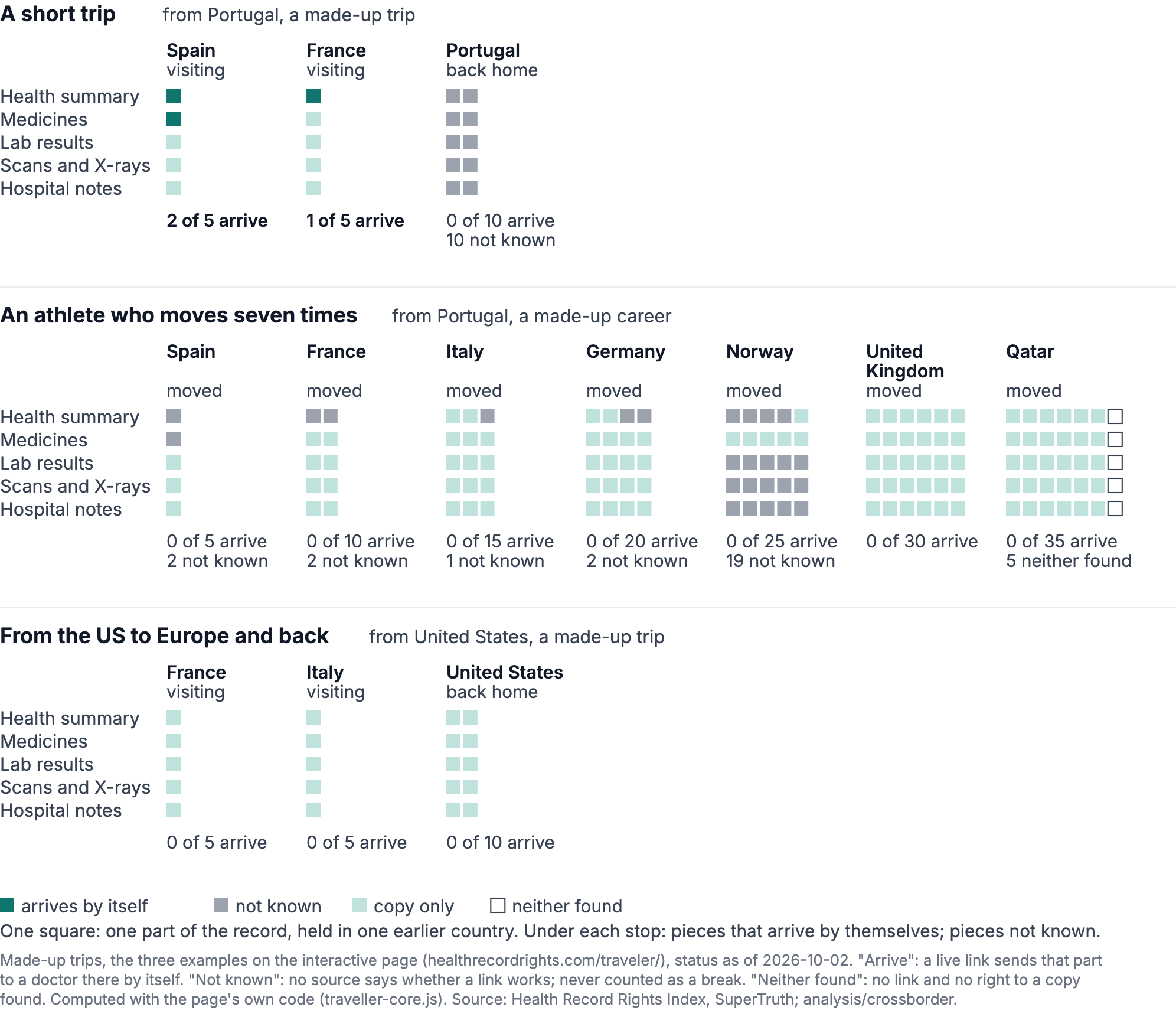
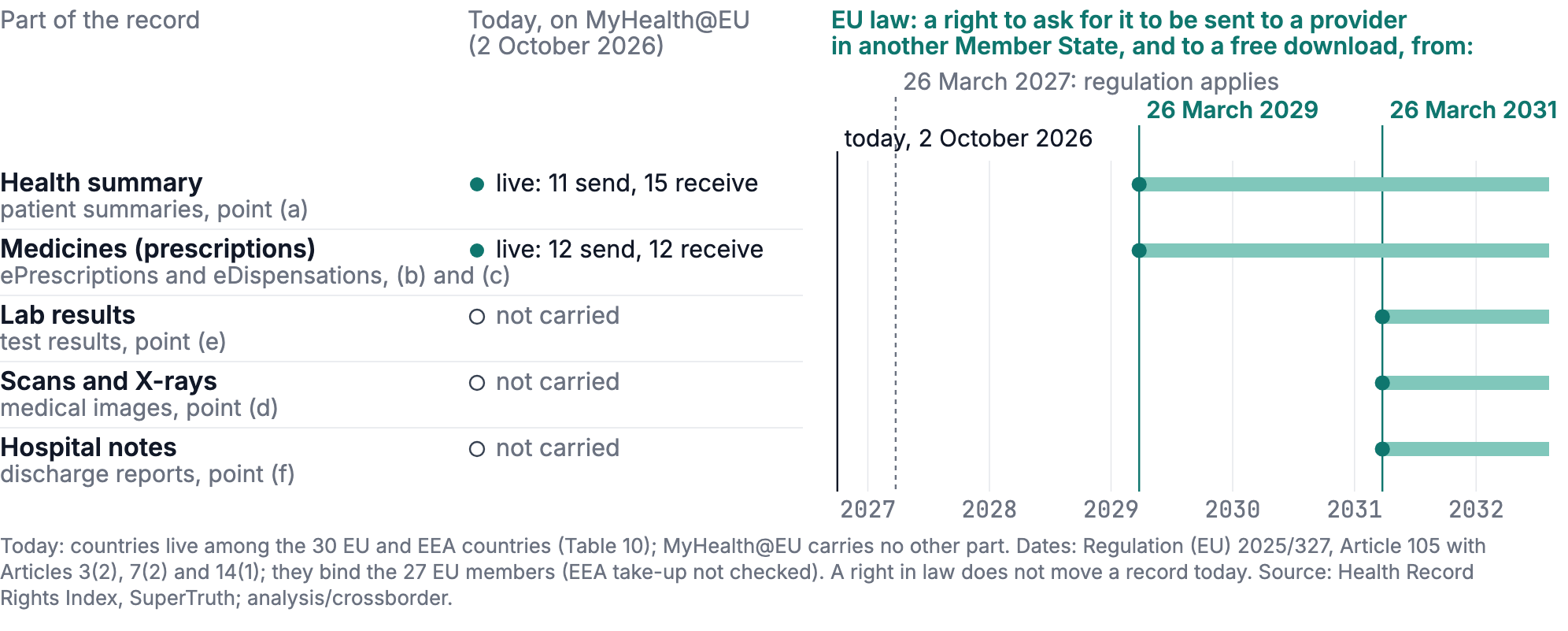
Does your record follow you across a border? The live page at https://healthrecordrights.com/traveler/ lets you pick where you live and a trip, and shows which of the five parts of your record (health summary, medicines, lab results, scans and X-rays, hospital notes) reach a doctor in each country by themselves, and which you would have to carry as a copy.
- Of 702 one-way routes between EU countries, a health summary travels by itself on 143.
- No source says the EU's cross-border service also works for people who move, not just visit.
- 138 of 198 countries give a person a right to a copy of their record.
- EU law adds a right to ask for each part to be sent to another member state: the health summary and medicines from 26 March 2029, the rest from 26 March 2031. A right in law does not move a record today.
What is in this repository
| Path | What it holds |
|---|---|
data/ | One JSON file per country: the eight category scores with summaries and detail, the laws, who holds the keys, and every cited source with its date |
data/us-states/ | One JSON file for each of the 50 states and DC: what the state's law adds to federal law, question by question, with every provision cited and quoted |
exports/ | The country data as CSV and JSON for analysis |
RUBRIC.md | The scoring rubric, its anchors and the confidence rule |
DECISION_RULES.md | The rules the build enforces, each with its check (for example, no single country is called first; the leaders are named as a group) |
docs/ | Score change log, stories rules, evidence grade method |
paper/ | The working paper (PDF and Markdown), its stylesheet, build script and figures |
analysis/robustness/ | Ranking stability, lead-group rule and the seed sweep |
analysis/reliability/, analysis/reliability2/ | The two blind re-scoring studies: plans with their hashes, rater kits, samples, ratings, results and reports |
analysis/external/ | Comparisons with the WHO Global Digital Health Monitor, Eurostat and income |
analysis/crossborder/ | Cross-border record exchange and copy rights behind the traveling patient |
analysis/confidence/, analysis/dti/, analysis/variance/, analysis/strain/ | Confidence labels, evidence grades, variance structure, health system strain |
analysis/literature/ | Literature review |
analysis/us/states/ | The US state layer: plan and its hashes (PLAN.md, plan_stamp.txt), rubric (RUBRIC_STATES.md), log of changes to the plan (DEVIATIONS.md), decision rules, counts by question (aggregate.json), how rulings were made and every ruling applied (main/RULINGS_METHOD.md, main/rulings_applied.json), and the agreement results before and after the rulings (main/reliability.json, main/reliability_post_rulings.json) |
LICENSE-DATA.md | What the CC BY 4.0 data license covers, and what it does not (quoted law, third-party titles, linked pages) |
scripts/ | Paper generation (every number in the paper is computed, never typed), figure generators, checks and tests |
build.js, template.html, brief.js, presskit.js, nav.js, traveller*.js | The code that builds the site from the data |
Reproduce it
npm install
node build.js                  # builds the site into out/
node scripts/paper_gen.js      # recomputes every number in the paper; refuses stale inputs
zsh paper/build.sh             # builds paper/paper.pdf (needs pandoc and Chrome)
The paper generator checks a hash of the data against every analysis output and stops if any figure was computed on older data.
One limit: the published accounts (the stories layer) are not in this repository, so that removal requests can be honoured. build.js runs without them and leaves the stories out; paper_gen.js needs them for Section 5's counts and will not run from this repository alone. Every score, rank and analysis rebuilds from what is here. Two more limits for data release 1.1: the code here is the version 1.0 code, so it rebuilds the country data but not the state pages or the version 1.2 paper; and the state layer's harness scripts are not in this repository, so the hashes in analysis/us/states/plan_stamp.txt cannot be checked from here.
How to cite
Snyder, J. A., Hill, R. P., IV, Raney, D., & Sims, L. (2026). The Health Record Rights Index: Who Holds the Record in 198 Countries? (version 1.2). SuperTruth Inc. https://doi.org/10.5281/zenodo.23137550
Paper, version 1.2: https://doi.org/10.5281/zenodo.23137550 (all versions: https://doi.org/10.5281/zenodo.23120174) Data, version 1.1: https://doi.org/10.5281/zenodo.23137895 (all versions: https://doi.org/10.5281/zenodo.23120172)
Citation metadata is in CITATION.cff. The four authors share equal credit.
Licences
- Data, scores and paper: CC BY 4.0. Credit SuperTruth and link the index.
LICENSE-DATA.mdsays what that covers: quoted law, titles of others' pages and the linked pages keep their owners' terms. - Code: MIT (see
LICENSE). - The SuperTruth name and logos in
brand/are trademarks of SuperTruth Inc. and are not covered by either licence.
Disclosure and corrections
SuperTruth sells health data verification products, and three of the authors are its officers. The fourth, Leann Sims, is Chief Executive Officer of MedSync, a US health information exchange that works with SuperTruth; the state layer asks about consent for health information exchange and does not name or score MedSync or any other exchange. imaware, an affiliate of SuperTruth, provides testing services under agreements with some US state governments; the index scores the United States as one country, and the state layer gives no state a score or a rank. We built this index and chose its stories ourselves. No government, health system, company or person paid to be included or had any say in the scores.
Press and interviews: Rheanna Crescenzo, press@supertruth.ai
This is a research tool, not legal advice. If we got a country wrong, open an issue with the page that shows it and we will fix it in the open.
The published accounts of record problems shown on the site are not deposited here, so that a removal request can be honoured; each links to its public source on the site.
Reviews
No reviews yet
Be the first to review this server!
More Developer Tools MCP Servers
Git
Freeby Modelcontextprotocol · Developer Tools
Read, search, and manipulate Git repositories programmatically
Fetch
Freeby Modelcontextprotocol · Developer Tools
Web content fetching and conversion for efficient LLM usage
Worldmonitor
Freeby Koala73 · Developer Tools
Live markets, conflicts, country risk, chokepoints, energy, and China decision signals. 86 tools.
Toleno
Freeby Toleno · Developer Tools
Toleno Network MCP Server — Manage your Toleno mining account with Claude AI using natural language.
mcp-creator-python
Freeby mcp-marketplace · Developer Tools
Create, build, and publish Python MCP servers to PyPI — conversationally.
MCP Marketplace
Freeby mcp-marketplace · Developer Tools
Search and install MCP servers from inside your AI client.