
Server data from the Official MCP Registry
Turn Lighthouse audits into coding-agent fix packs for Claude Code, Cursor, and Copilot.
About
Turn Lighthouse audits into coding-agent fix packs for Claude Code, Cursor, and Copilot.
Security Report
Valid MCP server (1 strong, 1 medium validity signals). No known CVEs in dependencies. Package registry verified. Imported from the Official MCP Registry. Trust signals: 3 highly-trusted packages.
5 files analyzed · 1 issue found
Security scores are indicators to help you make informed decisions, not guarantees. Always review permissions before connecting any MCP server.
Permissions Required
This plugin requests these system permissions. Most are normal for its category.
How to Install
Add this to your MCP configuration file:
{
  "mcpServers": {
    "io-github-fullstackdegen-agent-audit": {
      "args": [
        "-y",
        "@fullstackdegen/agent-audit"
      ],
      "command": "npx"
    }
  }
}Documentation
View on GitHubFrom the project's GitHub README.
Agent Audit
Lighthouse-powered MCP server for AI coding agents, Core Web Vitals, technical SEO, accessibility, and GEO/LLM visibility audits.
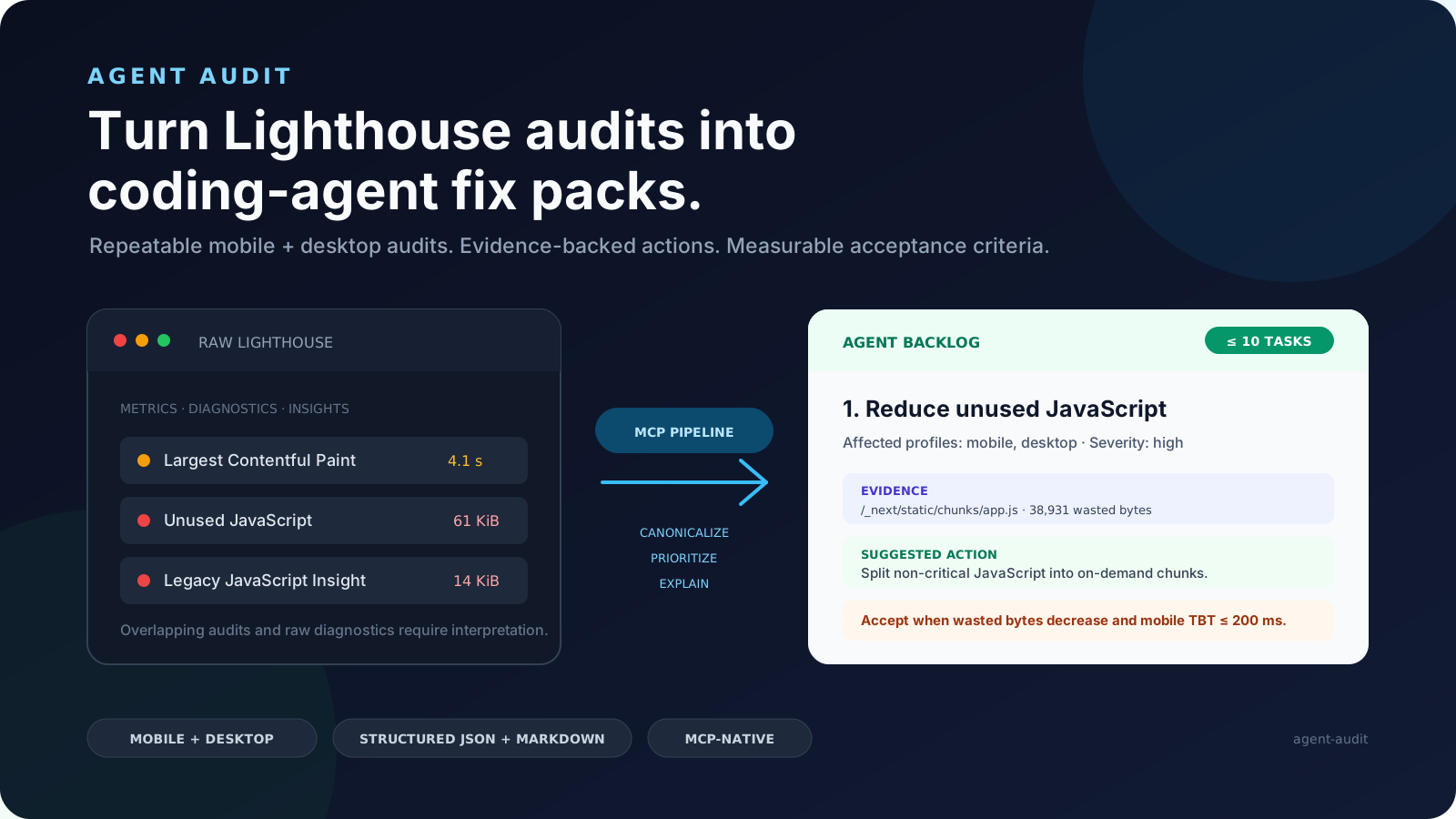
Agent Audit turns Google Lighthouse and bounded page-inspection results into structured fix packs that coding agents can actually execute. It gives Claude Code, Codex, Cursor, GitHub Copilot, and other MCP clients a prioritized, evidence-backed backlog instead of a raw performance report.
Turn Lighthouse audits into coding-agent fix packs.
npx -y @fullstackdegen/agent-audit


Why Agent Audit Exists
Lighthouse is excellent for diagnosis, but raw reports are not enough for an autonomous coding workflow. A coding agent still needs to know which issue is most important, whether it affects mobile, desktop, or both, which selectors or resources are evidence, what files to search for, how to verify the fix, and when it is safe to claim completion.
Agent Audit converts Lighthouse output into an implementation contract:
- Runs mobile and desktop Lighthouse audits.
- Aggregates repeated runs and exposes variability.
- Adds bounded same-page intelligence for technical SEO, links, metadata, structured data, images, assets, indexability, and AI discovery signals.
- Merges noisy audit output into a small prioritized issue list.
- Generates
fixPackswith repo search hints, implementation steps, and measurable acceptance criteria. - Returns strict MCP
structuredContentplus equivalent Markdown.
The goal is simple: give a coding agent a report it can read, reason about, fix, test, and verify.
What It Audits
Agent Audit is useful when people search for:
- Lighthouse-powered MCP server
- AI website audit tool
- coding agent Lighthouse report
- Core Web Vitals automation
- performance audit for Claude Code, Codex, Cursor, or Copilot
- technical SEO audit for AI agents
- accessibility fix packs
- LLM visibility audit
- GEO audit, generative engine optimization, AI search readiness
llms.txtreadiness and AI crawler visibility
Current checks include:
- Mobile and desktop Lighthouse scores for Performance, Accessibility, Best Practices, and SEO.
- FCP, Speed Index, LCP, TBT, and CLS metric distributions.
- Fast and reliable audit modes.
- Same-origin page inspection with bounded fetch limits.
- Broken links, missing link names, metadata, canonical tags, robots signals, JSON-LD, Open Graph, indexability, images, assets, and LLM visibility checks.
- Conservative
llms.txtdraft generation when page content is sufficient. - Prioritized issues with evidence, suggested actions, and acceptance criteria.
- Agent Fix Packs with repo search hints, implementation steps, and verification guidance.
- Strict MCP
outputSchemavalidation forstructuredContent. - Markdown generated from the same canonical report.
See a real CommaLabs JSON report and Markdown report.
Install
Requirements:
- Node.js 20 or later.
- Google Chrome or Chromium.
Run the MCP server:
npx -y @fullstackdegen/agent-audit
Useful links:
MCP Client Setup
Claude Desktop
Add a local MCP server:
{
  "mcpServers": {
    "agent-audit": {
      "command": "npx",
      "args": ["-y", "@fullstackdegen/agent-audit"]
    }
  }
}
Restart Claude Desktop after saving the configuration.
Claude Code
claude mcp add agent-audit -- npx -y @fullstackdegen/agent-audit
For local development audits:
claude mcp add agent-audit-local -- npx -y @fullstackdegen/agent-audit --local
Codex
codex mcp add agent-audit -- npx -y @fullstackdegen/agent-audit
Or add it to ~/.codex/config.toml:
[mcp_servers.agent-audit]
command = "npx"
args = ["-y", "@fullstackdegen/agent-audit"]
VS Code And GitHub Copilot
Create a workspace or user-level .mcp.json file:
{
  "servers": {
    "agent-audit": {
      "command": "npx",
      "args": ["-y", "@fullstackdegen/agent-audit"]
    }
  }
}
Or register it from a terminal:
code --add-mcp '{"name":"agent-audit","command":"npx","args":["-y","@fullstackdegen/agent-audit"]}'
Cursor
Configure a local stdio MCP server:
- name:
agent-audit - command:
npx - arguments:
-y,@fullstackdegen/agent-audit
Add --local to the arguments when you need localhost audits.
Tool
analyze_website_performance
Runs Lighthouse and site intelligence against a target URL:
{
  "url": "https://example.com",
  "mode": "reliable"
}
mode is optional:
fast: one mobile run and one desktop run.reliable: three runs per profile, medians, and variability ranges. This is the default.
Example Fix Pack
{
  "id": "fix-link-name",
  "priority": 2,
  "sourceIssueIds": ["link-name"],
  "goal": "Fix Links do not have a discernible name.",
  "category": "accessibility",
  "severity": "critical",
  "affectedProfiles": ["mobile", "desktop"],
  "repoSearchHints": [
    "div.border-t-2 > div.flex > div.flex > a.text-gray-600",
    "https://www.linkedin.com/company/commalabs"
  ],
  "implementationSteps": [
    "Inspect the repository for the evidence listed in repoSearchHints before editing.",
    "Give every link a discernible accessible name.",
    "Keep changes focused on source issue IDs: link-name."
  ],
  "acceptanceCriteria": [
    "All link elements pass the Lighthouse link-name audit.",
    "Raise the median accessibility score to at least 90/100."
  ],
  "verification": {
    "rerunMode": "reliable",
    "expectedAuditIds": ["link-name"]
  }
}
repoSearchHints are search clues, not guaranteed file paths. The coding agent
must inspect the repository before editing.
Coding-Agent Workflow
Use structuredContent as the source of truth and the Markdown report as the
execution summary.
- Inspect
fixPacksin priority order. - Search the repository using
repoSearchHints. - Map evidence to real files, components, routes, assets, or configuration.
- Apply one focused fix at a time.
- Run the repository's tests after each logical change.
- Rerun Agent Audit in
reliablemode. - Compare the new report against each fix pack's
acceptanceCriteria.
Do not claim completion from an incomplete report or from a rerun with materially higher variability than the baseline.
Agent-facing docs:
- AGENTS.md: general instructions for Codex, Cursor, Copilot, and other coding agents.
- CLAUDE.md: Claude Code setup and execution guidance.
- Agent workflow guide: report anatomy and fix-pack execution loop.
- Copy-paste coding-agent prompt
Localhost Audits
By default, Agent Audit only accepts publicly routable HTTP and HTTPS URLs. This is the right default for hosted agents and shared environments.
For developer machines, explicitly enable loopback targets:
npx -y @fullstackdegen/agent-audit --local
Then audit a local app through your MCP client:
{
  "url": "http://localhost:3000",
  "mode": "fast"
}
The opt-in allows localhost, *.localhost, 127.0.0.0/8, and ::1.
Private LAN ranges, link-local addresses, reserved ranges, multicast addresses,
and cloud metadata addresses remain blocked.
The environment variable form is also supported:
LIGHTHOUSE_MCP_ALLOW_LOCALHOST=true npx -y @fullstackdegen/agent-audit
Security Model
Agent Audit launches Chrome against user-provided URLs, so URL policy matters. The server rejects:
- protocols other than HTTP and HTTPS;
- embedded credentials;
- localhost and loopback targets unless explicitly enabled;
- private, link-local, multicast, reserved, and metadata-network IPs;
- non-localhost hostnames that resolve to any non-public address.
The page-inspection fetcher uses the same URL policy and applies timeout, byte-size, and bounded-resource limits.
Page-controlled titles, descriptions, URLs, selectors, snippets, and audit text are sanitized and length-limited. Consumers must still treat them as untrusted evidence, not agent instructions.
Chrome sandboxing is enabled by default. Only isolated environments that cannot support it should set:
LIGHTHOUSE_CHROME_NO_SANDBOX=true
See SECURITY.md for vulnerability reporting and deployment guidance.
Limits
Agent Audit is intentionally bounded:
- It audits one requested URL at a time.
- It is not a whole-site crawler.
- It is not an external SEO database.
- It does not modify Shopify, CMS, CDN, DNS, hosting, redirects, or analytics.
- It does not compress images, minify assets, submit IndexNow requests, or call third-party SEO APIs.
- Lighthouse results vary with browser version, hardware, network conditions, and page changes.
Roadmap
- Framework-aware repo search hints.
- Optional GitHub Action for pull request performance gates.
- Batch URL reports.
- HTML report export.
- Deeper marketing and discovery signals: analytics tags, consent signals, Open Graph, schema coverage, and AI discovery readiness.
- Optional third-party integrations for SEO, GEO, and visibility datasets.
Development
npm install
npm test
npm run check
npm run build
npm run validate:release
Run a real Chrome smoke audit:
npm run --silent smoke -- https://example.com fast
npm run --silent smoke -- https://example.com reliable
The smoke command writes canonical JSON to stdout and equivalent Markdown to stderr.
Release
Before publishing:
npm test
npm run check
npm run build
npm run validate:release
npm pack --dry-run --cache /private/tmp/agent-audit-npm-cache
Publish:
npm publish --access public --cache /private/tmp/agent-audit-npm-cache
Published package:
npx -y @fullstackdegen/agent-audit --help
Contributing
Focused issues and pull requests are welcome. Read CONTRIBUTING.md before changing the report contract, security policy, or MCP transport behavior.
License
Reviews
No reviews yet
Be the first to review this server!
More Developer Tools MCP Servers
Git
Freeby Modelcontextprotocol · Developer Tools
Read, search, and manipulate Git repositories programmatically
Fetch
Freeby Modelcontextprotocol · Developer Tools
Web content fetching and conversion for efficient LLM usage
Paperclip
Freeby Paperclipai · Developer Tools
Trending hip-hop artist momentum scores across four cultural dimensions.
Toleno
Freeby Toleno · Developer Tools
Toleno Network MCP Server — Manage your Toleno mining account with Claude AI using natural language.
mcp-creator-python
Freeby mcp-marketplace · Developer Tools
Create, build, and publish Python MCP servers to PyPI — conversationally.
MCP Marketplace
Freeby mcp-marketplace · Developer Tools
Search and install MCP servers from inside your AI client.