
Server data from the Official MCP Registry
Adaptive plan/build/review cycles for AI coding assistants, persisted across sessions.
About
Adaptive plan/build/review cycles for AI coding assistants, persisted across sessions.
Remote endpoints: streamable-http: https://mcp.getpapi.ai/mcp
Security Report
Valid MCP server (1 strong, 0 medium validity signals). No known CVEs in dependencies. ⚠️ Package registry links to a different repository than scanned source. Imported from the Official MCP Registry. 1 finding(s) downgraded by scanner intelligence.
Endpoint verified · Requires authentication · 2 issues found
Security scores are indicators to help you make informed decisions, not guarantees. Always review permissions before connecting any MCP server.
Permissions Required
This plugin requests these system permissions. Most are normal for its category.
How to Install & Connect
Available as Local & Remote
This plugin can run on your machine or connect to a hosted endpoint. during install.
Documentation
View on GitHubFrom the project's GitHub README.
PAPI






Your AI starts every session from zero. Your project stays on course.
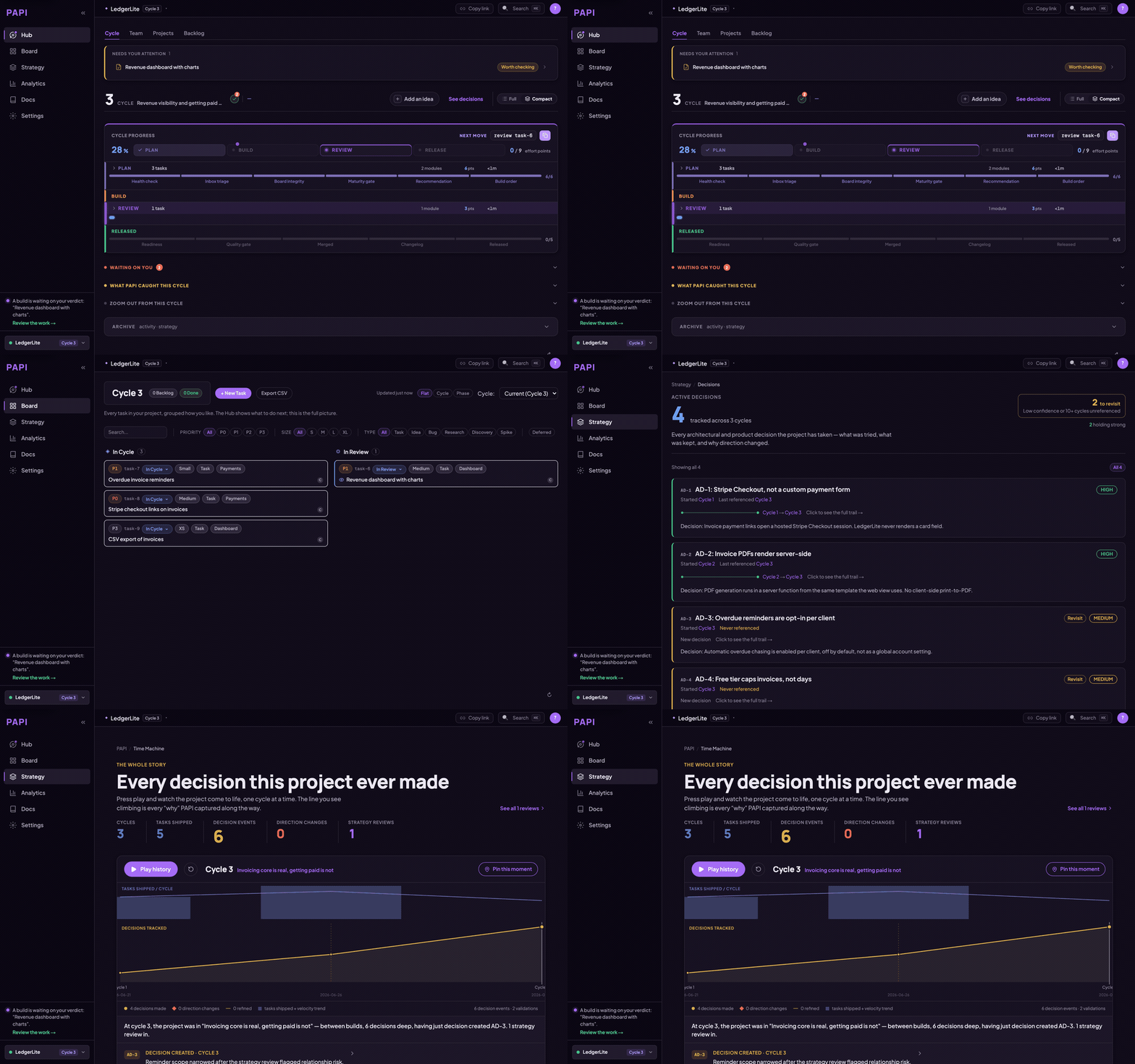
AI coding tools are great at writing code and terrible at holding a direction. Scope grows, plans change, and the decisions behind them get made in a chat window and lost there. PAPI keeps the project on course. It gives your assistant structured plan, build, review and release cycles, plus a decision trail recording what was chosen, what was dropped, and why. Your assistant writes and reads it while it works, so it stays current without anyone maintaining it.
You connect it once. From then on, your assistant starts every session knowing which cycle you're on, what's in flight, and what to do next.
Free to start. The whole plan → build → review → release loop, on up to three projects, no card. Free runs a real project start to finish; it isn't a trial. Pricing.
What this repo is. Documentation, install guides, and the issue tracker. PAPI's engine is closed source and hosted — you connect to it, you don't build it from here. The
@papi-ai/serverpackage on npm is the supported local runtime. The contents of this repo are MIT.
Quick start
Let your AI install it. Paste this to your assistant — Cursor, Claude Code, Windsurf, Codex, VS Code, or any other MCP client:
Read https://getpapi.ai/llms.txt and set up PAPI
That's the whole install. Your assistant reads the runbook for whichever tool it's running in and wires up the connection itself. (Same instructions live in this repo as llms.txt and llms-install.md if your assistant can't fetch URLs.)
Then authenticate — this part is yours. PAPI signs in over OAuth, and no AI can click through a browser consent screen for you. Your assistant will tell you exactly where to click; until you do, the server sits at Needs authentication and no tool call will work. This is the step people miss.
Once you're connected, tell your assistant:
Run the
setuptool to scaffold this project, then runorientand tell me which cycle this project is on.
Prefer to wire it up yourself?
In Claude Code, the shortest path is the plugin — two lines, nothing to copy or edit:
/plugin marketplace add getpapi/papi
/plugin install papi@papi
The plugin carries the server config, plus two skills: check-mcp diagnoses a connection that isn't working, and papi-verify health-checks the current cycle.
Every tool also takes the same streamable-HTTP endpoint directly, https://mcp.getpapi.ai/mcp. In Claude Code that's:
claude mcp add --transport http papi https://mcp.getpapi.ai/mcp
Either way, finish with /mcp → papi → Authenticate.
DeepSeek Harness users can install the repository-owned bundle after creating a PAPI connection token:
dsh plugin --profile web add @papi-ai/deepseek-harness
See PAPI for DeepSeek Harness for token handling, verification, compatibility, and removal.
Per-tool config for Cursor, VS Code, Windsurf, Codex, and any generic MCP client is in docs/install.md.
What you get
- plan breaks your goals into a cycle of right-sized tasks, each with a build handoff your assistant can execute directly.
- build tracks what was built, what surprised you, and what was discovered along the way.
- review and release close the loop, so every cycle feeds the next plan.
- strategy reviews every few cycles step back and check direction, not just velocity.
- A dashboard at getpapi.ai shows your cycles, board, and decisions, so you can see the state of the project without asking.
The methodology is the product: a plan, build, review, release loop your assistant runs with you, with memory that compounds. PAPI has been built with PAPI for every cycle in the badge above.
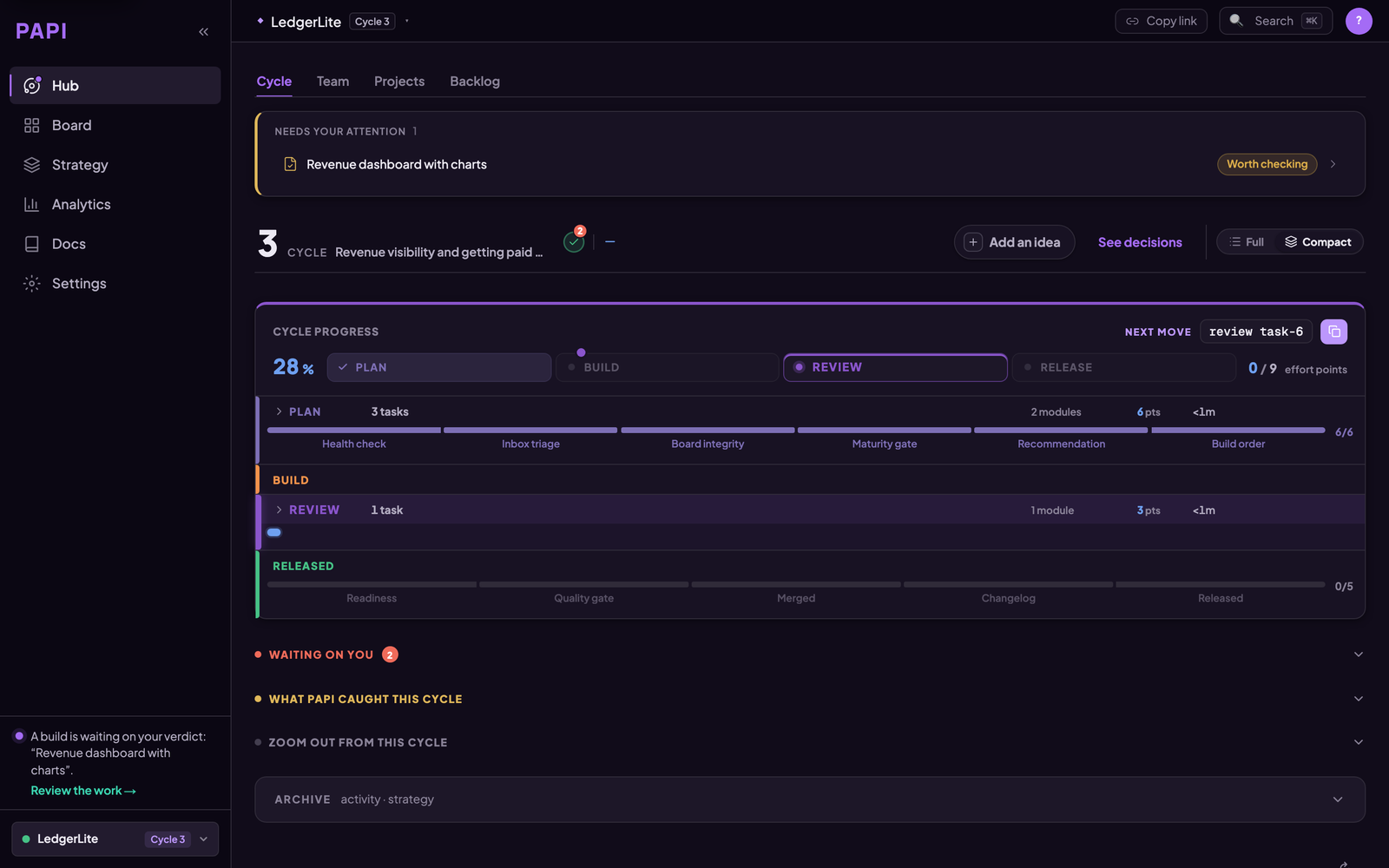
The hub opens on one question — what happens next. The cycle's progress through plan, build, review and release sits under it.
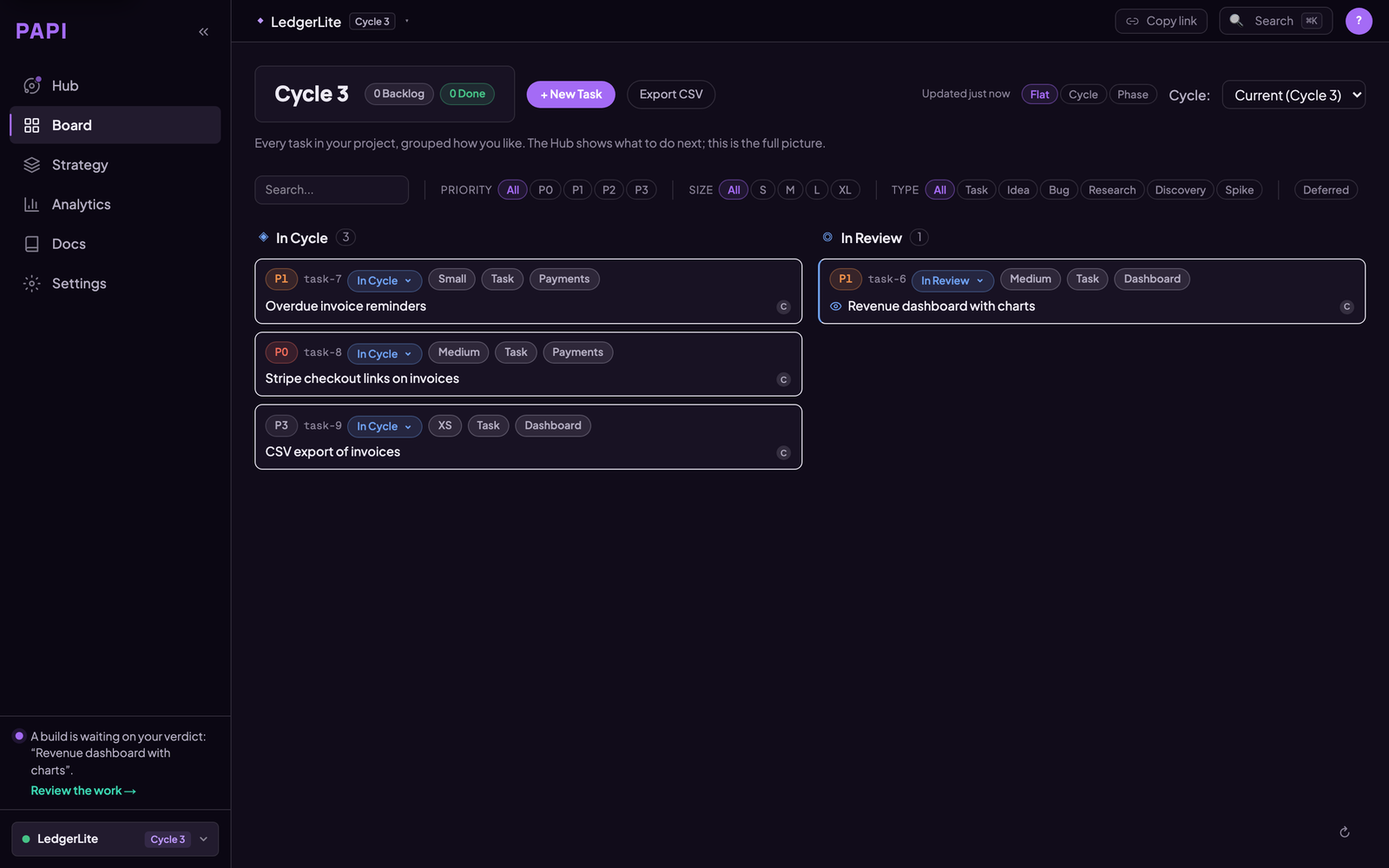
The board is the full picture. Your assistant writes to it as a side effect of working, so it is current without anyone maintaining it.
How this differs from a tracker
Unlike Linear, Jira, Asana or Notion, this was not built for humans and then opened to agents. Those boards assume a human writes the ticket and a human reads it, in a tab your AI can't see. PAPI's board is written and read by your assistant as a side effect of working: starting a build opens the task, finishing it files the report, releasing closes the cycle. You approve the plan and you sign off the review. The ticket admin in between is the part that disappears. You manage the outcome, not the keystrokes.
Unlike Taskmaster and other in-repo task files, PAPI's state isn't a file one tool generates once and then drifts from. It's hosted and structured — cycles, build reports, review verdicts, and Active Decisions carrying confidence levels that change as evidence arrives. The same project memory is there from Claude Code, Cursor, VS Code, or Codex, so switching tools doesn't reset your context, and last cycle's learnings are an input to the next plan rather than something you have to remember to mention.
Neither of those is a knock on the tools. They're solving a different problem to the one that breaks every time your assistant opens a fresh window.
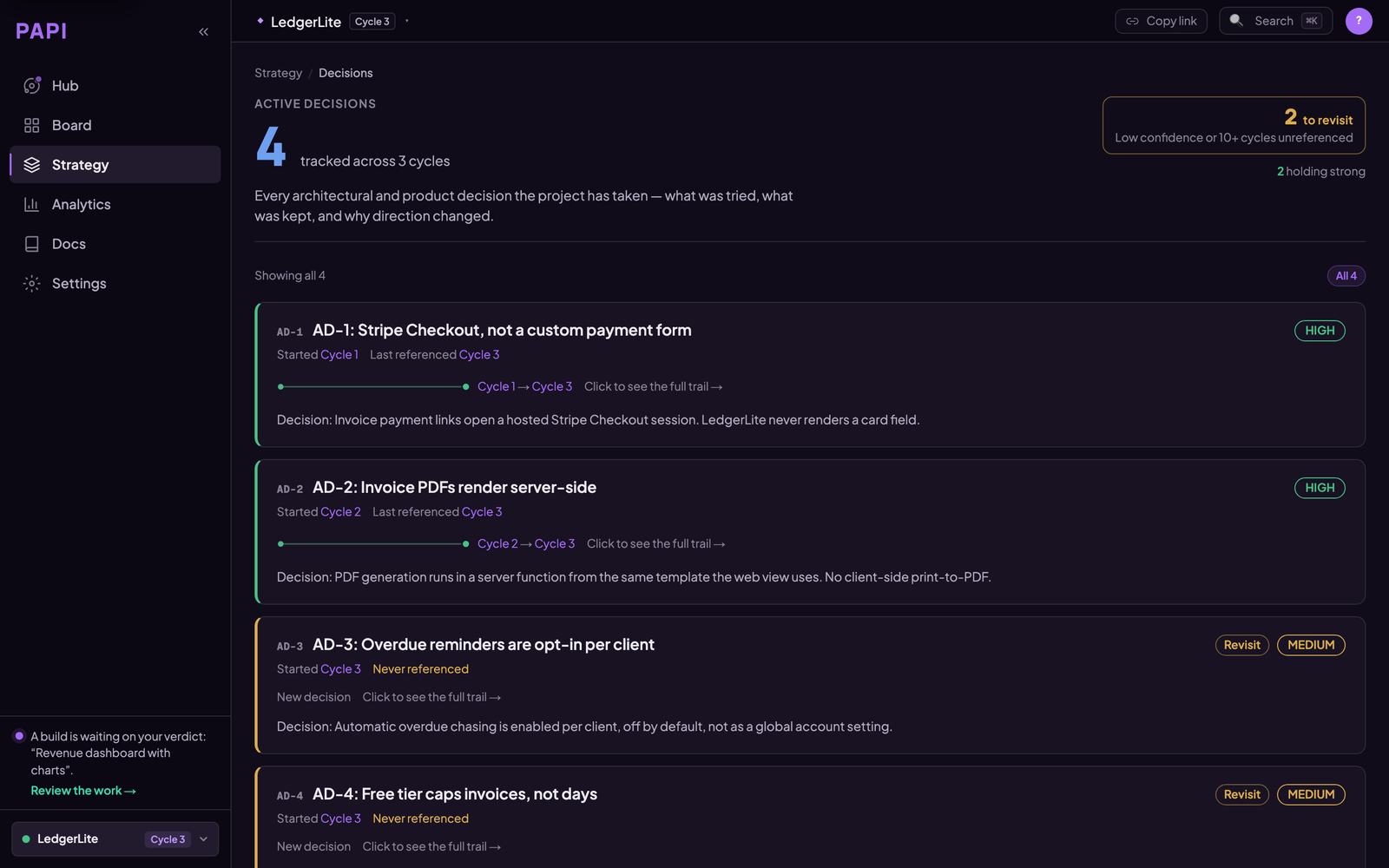
Active Decisions are the part a task tracker has no field for: what was decided, why, what was rejected, and when to revisit it. Confidence moves as evidence arrives.
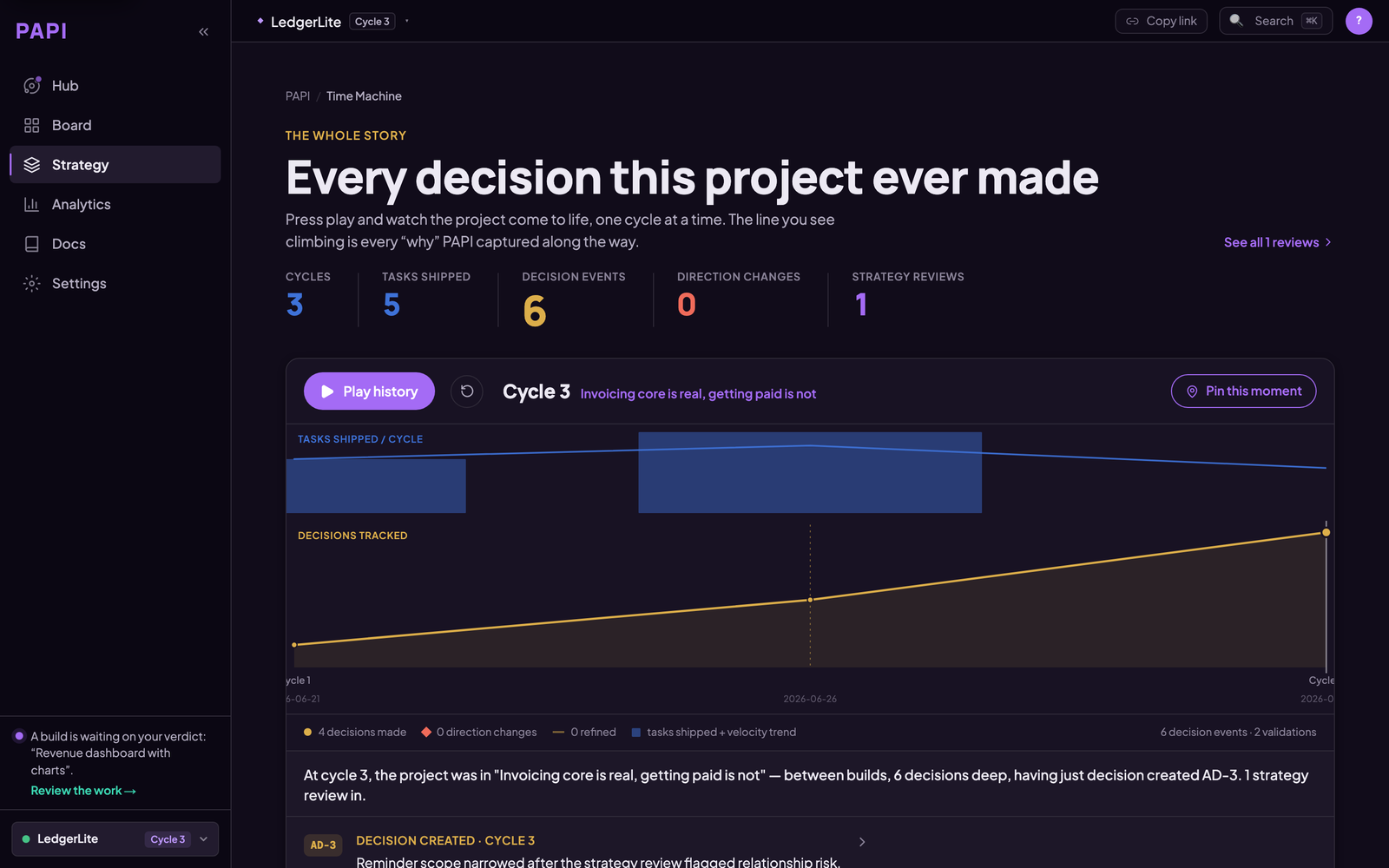
Every cycle leaves a trail, so the reasoning behind the project is still there months later — including for the assistant reading it back.
Tools
PAPI exposes these MCP tools to your assistant. The whole loop is a handful of calls.
Core loop
- orient — one call returns the current cycle, what's in flight, and the recommended next action. Run it at the start of every session.
- setup — scaffold PAPI onto a new project.
- plan — break goals into a cycle of right-sized tasks, each with a build handoff your assistant can execute directly.
- build_list — list the current cycle's tasks and their handoffs.
- build_execute — start a task (creates a branch and handoff) and complete it (records the build report).
- review_list / review_submit — surface finished builds and record accept / request-changes / reject verdicts.
- release — merge completed work and roll the cycle forward.
Board and backlog
- board_view — read the project board and any task.
- board_edit — change a task's status, cycle, priority, or notes.
- ad_hoc — record quick work done outside the cycle so it shows in project history.
- idea — capture a feature, bug, or research note into the backlog.
- bug — file a bug against the board.
Strategy and intelligence
- strategy_review — step back every few cycles to check direction, not just velocity.
- strategy_change — record an Active Decision, with supersede history.
- zoom_out — a periodic retrospective across many cycles.
Docs and projects
- doc_register / doc_search — register and find project reference docs.
- project_list / project_switch / project_create — manage multiple PAPI projects.
Documentation
In this repo:
| Doc | What it covers |
|---|---|
| llms.txt | The agent runbook — point your AI at this (live version: getpapi.ai/llms.txt) |
| llms-install.md | Per-tool install instructions for AI assistants |
| docs/install.md | Install paths for every supported tool |
| docs/how-it-works.md | Cycles, handoffs, decisions, and how the pieces fit |
| docs/troubleshooting.md | Connection problems, project routing, common fixes |
Full documentation on the website — no account needed:
| Page | What it covers |
|---|---|
| Quick Start | Zero to your first cycle plan in under 5 minutes |
| Workflow | The full plan → build → review → release loop |
| Concepts | Cycles, handoffs, Active Decisions — the vocabulary |
| Cheat Sheet | Every command on one page |
| Tool Reference | Every PAPI MCP tool with parameters and use cases |
| Troubleshooting | Connection and auth first aid |
| Handbook | For teams: reading dashboards, cycle reports, review flow |
Community and support
Stuck, or something's broken? Open an issue — there are templates for each case, and the connection problem one is the one to reach for if PAPI won't connect or won't authenticate, which is where people get stuck most:
- Connection problem · Bug report · Question · Feature request
- Discord is faster for questions, and release notes land there first.
- CONTRIBUTING.md covers what a useful report looks like and what a docs PR can change.
- Found a vulnerability? Don't open an issue — SECURITY.md has the private channel.
Star the repo
If PAPI is useful to you, star it. That's the whole ask, and it's how other people building with AI assistants find it.
Links
- Website and dashboard: getpapi.ai
- Pricing: getpapi.ai/pricing — free tier, no card
- What shipped in each cycle: getpapi.ai/changelog
- Data, access, and what PAPI doesn't have yet: getpapi.ai/trust
- Licence: the contents of this repo (docs, guides, config examples, Dockerfile) are MIT. That licence covers this repository only — not the PAPI engine, and not the PAPI name or logo, which are trademarks.
Reviews
No reviews yet
Be the first to review this server!
More Developer Tools MCP Servers
Git
Freeby Modelcontextprotocol · Developer Tools
Read, search, and manipulate Git repositories programmatically
Fetch
Freeby Modelcontextprotocol · Developer Tools
Web content fetching and conversion for efficient LLM usage
Worldmonitor
Freeby Koala73 · Developer Tools
Live markets, conflicts, country risk, chokepoints, energy, and China decision signals. 89 tools.
Paperclip
Freeby Paperclipai · Developer Tools
Trending hip-hop artist momentum scores across four cultural dimensions.
Toleno
Freeby Toleno · Developer Tools
Toleno Network MCP Server — Manage your Toleno mining account with Claude AI using natural language.
mcp-creator-python
Freeby mcp-marketplace · Developer Tools
Create, build, and publish Python MCP servers to PyPI — conversationally.