
Server data from the Official MCP Registry
Turn HTML or mobile-learning exports into SCORM 2004/1.2 packages, and validate any SCORM zip.
About
Turn HTML or mobile-learning exports into SCORM 2004/1.2 packages, and validate any SCORM zip.
Security Report
The scorm-mcp-server is a well-structured SCORM package generator with appropriate authentication model and reasonable permissions scope for its purpose. Code quality is good with comprehensive testing (325/325 passing tests). No malicious patterns or data exfiltration found. Minor findings include broad error handling in minified vendor code and the need for better input validation in some edge cases, but these do not significantly impact security. Supply chain analysis found 3 known vulnerabilities in dependencies (0 critical, 3 high severity). Package verification found 1 issue.
3 files analyzed · 8 issues found
Security scores are indicators to help you make informed decisions, not guarantees. Always review permissions before connecting any MCP server.
Permissions Required
This plugin requests these system permissions. Most are normal for its category.
What You'll Need
Set these up before or after installing:
Environment variable: SCORM_OUTPUT_DIR
How to Install
Add this to your MCP configuration file:
{
  "mcpServers": {
    "io-github-giacomomaria81-scorm-mcp-server": {
      "env": {
        "SCORM_OUTPUT_DIR": "your-scorm-output-dir-here"
      },
      "args": [
        "-y",
        "scorm-mcp-server"
      ],
      "command": "npx"
    }
  }
}Documentation
View on GitHubFrom the project's GitHub README.
scorm-mcp-server
Turn self-contained HTML, a Claude Design
.dcbundle or a mobile-learning platform content export (Excel activity templates + media) into a SCORM 2004 (or 1.2) package ready to import into any LMS — assets inlined for 100% offline, completion / progress / score tracking injected, ADL schemas bundled.







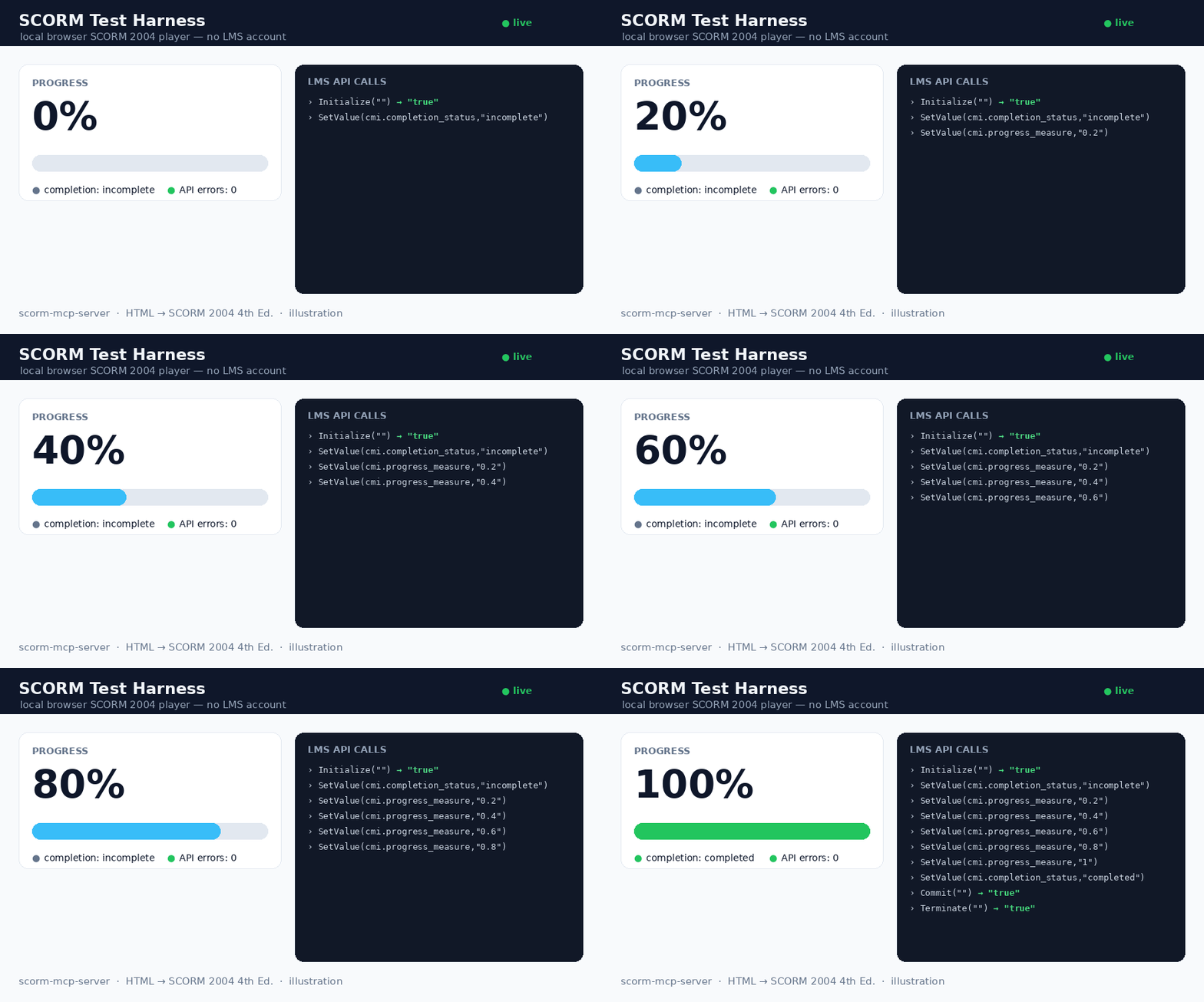
The bundled local harness (scorm-test-harness.html) playing a package: progress 0 → 100%, completion, and the live LMS API-call log (0 errors). Illustration.
An MCP server exposing three tools: scorm_package converts a finished HTML learning module into a .zip (PIF) any SCORM-compliant LMS can import, scorm_validate checks any existing SCORM zip (made by any tool) and explains exactly why an LMS would reject it, and scorm_selftest is a 1-second health check.
Principle: WRAP, don't rewrite. Your HTML is preserved; the tool only:
- Inlines every asset (CSS,
@import, fonts, JS, images,srcset, favicons) as data URIs → runs 100% offline. - Injects a small runtime that reports completion, progress (%) and time spent, with resume across sessions.
- Generates the manifest and bundles the 15 official ADL XSD schemas — the manifest is validated against them (real conformance, not just "well-formed").
✅ Status — validated on a real LMS
- 325/325 automated checks green: 23 converter · 15 runtime · 15 MCP · 1 schema conformance (
xmllint) · 6 security · 11 features · 13 auto-milestones · 21 V2 (bundle /.dc/ score) · 10 output-dir · 9 tracking-signal · 32 hardening · 29 SCORM 1.2 · 12 CLI/batch · 16 web UI · 44 mobile-learning migration · 35 package validation · 33 question-level interactions — plus 6 bonus strict-runtime checks (scorm-again). - SCORM Cloud (real LMS): imports cleanly (recognized as SCORM 2004 4th Ed., "manifest looks great"), and the dashboard reports completion = complete, success = passed, time tracked.
Input formats
Input (input_path or html) | Handling |
|---|---|
A single self-contained .html (e.g. Claude Design "standalone HTML" export) | assets inlined, runtime injected — v1 path |
A folder or .zip (multi-file module) | whole tree preserved; entry HTML inlined; manifest lists every file |
A Claude Design .dc bundle (*.dc.html + support.js + _ds/) | auto-detected; CDN libs (React/Babel…) vendored offline via window.__resources (no source patch); runtime injected before support.js |
A mobile-learning platform content export (Excel activity templates + media/) | auto-detected; an interactive HTML course is rebuilt from the templates — info / transition / flash cards, quiz questions, media codes ([media:…], [H1:…], [quote:…], !!), scored quizzes reporting cmi.score — then packaged. Course title derived from the template names; with --batch, a whole catalogue migrates in one run |
Pass a .dc bundle as its folder or .zip (not the lone .dc.html, which is inert without its siblings).
Scores & quizzes (optional)
Set mastery_score (0..1) to enable score-based success and add sequencing objectives to the manifest. Report the score from your content in one line — no SCORM knowledge required:
window.SCORM2004.score(8, 0, 10);                                   // raw, min, max
window.dispatchEvent(new CustomEvent("scorm:score",    { detail: { raw: 8, min: 0, max: 10 } }));
window.dispatchEvent(new CustomEvent("scorm:progress", { detail: 0.5 }));  // 0..1
window.dispatchEvent(new CustomEvent("scorm:complete"));
The runtime maps these to cmi.score.*, sets success_status = passed/failed against mastery_score, and reports completion/progress. (dc:* event names are accepted as aliases.)
Question-level tracking (v2.3) — report each answer as a cmi.interactions record, so the LMS gradebook shows which questions were missed, not just the total:
window.SCORM2004.interaction({
  id: "quiz1-q3", type: "choice",
  description: "Which colour is the brand?",
  learnerResponse: "Blue", correctResponse: "Red",
  result: false, latencyMs: 12000,
});
// or, without touching the API:
window.dispatchEvent(new CustomEvent("scorm:interaction", { detail: { id: "q3", result: true } }));
Dialect-aware (2004 learner_response/timestamp vs 1.2 student_response/time, incorrect vs wrong) and best-effort by design: an LMS that refuses interaction writes gets a logged warning and the session carries on. Quizzes generated by the mobile-learning migration report their interactions automatically — one record per question, with the question text, the learner's answer, the expected answer and the latency.
SCORM 1.2, batch mode, CLI (v2.1)
SCORM 1.2 — pass scorm_version: "1.2" and you get a 1.2 manifest (validated
against the bundled 1.2 XSDs, with adlcp:masteryscore when mastery_score is
set). The injected runtime is adaptive: it speaks to whichever API the hosting
LMS exposes (API_1484_11 or API), maps the data model (single
lesson_status, 0-100 score, HH:MM:SS session time, 4096-char suspend data)
and never downgrades a passed status.
Batch — batch: true treats input_path as a directory of courses (each
sub-directory, .zip or .html = one course). One package per course, one
consolidated batch-report.json, and a broken course never sinks the others.
CLI — no MCP client required:
npx -y scorm-mcp-server ui            # local drag & drop web UI
npx -y scorm-mcp-server pack course.html --title "My course"
npx -y scorm-mcp-server pack ./courses --batch --scorm-version 1.2
npx -y scorm-mcp-server validate pkg.zip   # conformance-check an existing package
npx -y scorm-mcp-server selftest      # 1-second health check
Web UI — ui opens a localhost page: drop an .html or .zip, pick the SCORM
edition and an optional pass mark, download the package. Runs entirely on your
machine; nothing is uploaded anywhere.
Library — buildPackage() is a public API for pipelines and SaaS backends:
import { buildPackage } from "scorm-mcp-server";
const r = await buildPackage({ html, title: "My course", scormVersion: "1.2", masteryScore: 0.6 });
// r.zip (Buffer) · r.fileName · r.warnings · r.milestoneIds …
Diagnostic — the scorm_selftest MCP tool packages a constant built-in HTML
and reports version, duration and output path: it separates "server broken"
from "input problem" in one second.
Validate any SCORM package (v2.3)
"Why does my LMS reject this zip?" — scorm_validate answers it for any SCORM package, not only those produced here, and the input is never modified:
npx -y scorm-mcp-server validate course.zip          # human-readable report
npx -y scorm-mcp-server validate course.zip --json   # machine-readable
Checks: zip readability, imsmanifest.xml at the ROOT (detects the classic "zipped the folder instead of its contents" mistake and says how to fix it), well-formed manifest, SCORM edition detection (2004/1.2), launchable organization/item/resource chain, launch file and every <file href> present in the archive (case-only mismatches flagged — they work on Windows and fail on Linux LMS servers), and full XSD validation against the official ADL schemas — using the package's own XSDs first and falling back to the embedded copies, so packages that ship without schemas validate too. Exit code 0/1 for CI pipelines; also exposed as the scorm_validate MCP tool and the validatePackage() library API.
Install
Option 0 — try it online, no install
https://scormpackager.vercel.app — drop a course, pick the SCORM edition, download the package. Files are processed in memory and never stored, but they do travel to a server; for real work use the local options below, where nothing leaves your machine (and there is no 4 MB limit).
Option A — one-click (recommended)
Download scorm-mcp-server-x.y.z.mcpb from the Releases, then in Claude Desktop → Settings → Extensions, drag-drop the .mcpb, pick an output folder, and enable it.
Option B — npm (any MCP client)
No install step: add this to your client's MCP config (~/Library/Application Support/Claude/claude_desktop_config.json for Claude Desktop):
{
  "mcpServers": {
    "scorm": {
      "command": "npx",
      "args": ["-y", "scorm-mcp-server"],
      "env": { "SCORM_OUTPUT_DIR": "/ABSOLUTE/PATH/scorm-packages" }
    }
  }
}
Registry name: io.github.giacomomaria81/scorm-mcp-server (MCP registry).
Option C — from source (developer)
git clone <this-repo> && cd scorm-mcp-server
npm install        # dist/ is prebuilt; npm run build is optional
Then point the config at node /ABSOLUTE/PATH/scorm-mcp-server/dist/index.js.
Restart Claude. The scorm_package tool is now available.
Usage
In a conversation: build your module with Claude Design, then say "package this module as SCORM." Claude calls scorm_package and returns the path to the .zip.
Progress & completion — it just works
You don't have to prepare anything: if your HTML declares no milestone, the packager auto-generates them from the document structure (sections → articles → headings, capped at 8, trigger view). Plain HTML gets meaningful progress out of the box. Disable with auto_milestones: false. Want success_status = passed on completion without touching the HTML? Pass success_on_completion: true.
Declarative milestones (recommended for fine control)
Mark the meaningful steps directly in your HTML — explicit milestones always take precedence over auto-generation. The runtime computes progress_measure = milestones_reached / total, and sets completion_status = "completed" once all are reached.
| Attribute | Effect |
|---|---|
data-jalon="unique-id" | declares a milestone |
data-trigger="view" | reached when scrolled into view (default) |
data-trigger="click" | reached on click |
data-trigger="ended" | reached when a video/audio ends |
<section data-jalon="intro"       data-trigger="view">…</section>
<button  data-jalon="read-pitch"  data-trigger="click">I read it</button>
<video   data-jalon="demo"        data-trigger="ended">…</video>
Recommended: 4–8 milestones per micro-module. Resume is automatic (cmi.suspend_data + cmi.location); progress never regresses.
Programmatic milestones — window.SCORM2004.reach("quiz-passed") works even if the id has no data-jalon element: unknown ids are declared on the fly and count in the total. To register one before it's reached (accurate denominator), use window.SCORM2004.declare("quiz-passed") early. Both survive resume.
Success status (opt-in) — add data-scorm-success="on-completion" on any element (e.g. <body>) and the runtime also sets cmi.success_status="passed" when the module completes. Without it, success_status is never written.
Language — the tool's language (BCP-47, default fr-FR) is applied as <html lang="…"> when the source HTML doesn't declare one.
Security — asset references are confined to the module folder: ../ or absolute paths outside it are never inlined (a warning is emitted instead).
Test it without an LMS account
Open scorm-test-harness.html via a tiny local server and drop a generated .zip into it:
python3 -m http.server 8000 # then open http://localhost:8000/scorm-test-harness.html
You'll see live progress %, completion, and the full log of LMS API calls (0 errors expected).
Build & test
npm install
npm run build     # tsc -> dist/
npm test          # 325 checks across 17 suites (xmllint required for the schema tests)

# bonus: validate against a strict independent SCORM 2004 runtime
npm i -D scorm-again && node test/scorm-again.test.mjs
Requirements: Node ≥ 20, and xmllint (libxml2-utils) for the schema test.
Project structure
src/        index.ts (MCP server + CLI) · converter.ts (inlining + manifest + zip) · runtime.ts (injected SCORM runtime) · validate.ts (package conformance checker) · tom.ts (mobile-learning migration) · ui.ts (local web UI)
dist/       compiled output (shipped)
schemas/    15 ADL XSD (SCORM 2004 4th Ed.) + schemas12/ (4 XSD SCORM 1.2), bundled into every package
test/       17 suites (converter / runtime / mcp / schema / validation / interactions / migration…) + fixtures
ARCHITECTURE.md           design decisions, data flow, testing strategy
scorm-test-harness.html   local browser SCORM player (fake LMS, no account)
manifest.json             MCPB manifest (for building the .mcpb desktop extension)
Privacy Policy
This extension runs entirely locally: no data collection, no telemetry, no third parties. The only network activity is downloading assets that your own HTML references, to embed them into the offline package. Full policy: PRIVACY.md.
License
Reviews
No reviews yet
Be the first to review this server!
More Developer Tools MCP Servers
Paperclip
Freeby Paperclipai · Developer Tools
Trending hip-hop artist momentum scores across four cultural dimensions.
Fetch
Freeby Modelcontextprotocol · Developer Tools
Web content fetching and conversion for efficient LLM usage
Git
Freeby Modelcontextprotocol · Developer Tools
Read, search, and manipulate Git repositories programmatically
Toleno
Freeby Toleno · Developer Tools
Toleno Network MCP Server — Manage your Toleno mining account with Claude AI using natural language.
MCP Marketplace
Freeby mcp-marketplace · Developer Tools
Search and install MCP servers from inside your AI client.
mcp-creator-python
Freeby mcp-marketplace · Developer Tools
Create, build, and publish Python MCP servers to PyPI — conversationally.