
Server data from the Official MCP Registry
Policy decision point for agent payments — allow, ask, or veto before signing
About
Policy decision point for agent payments — allow, ask, or veto before signing
Security Report
Valid MCP server (2 strong, 2 medium validity signals). No known CVEs in dependencies. Imported from the Official MCP Registry. 1 finding(s) downgraded by scanner intelligence.
6 files analyzed · 1 issue found
Security scores are indicators to help you make informed decisions, not guarantees. Always review permissions before connecting any MCP server.
Permissions Required
This plugin requests these system permissions. Most are normal for its category.
How to Install
Add this to your MCP configuration file:
{
  "mcpServers": {
    "io-github-gobeyondfj-cmd-boundra": {
      "args": [
        "boundra-mcp"
      ],
      "command": "uvx"
    }
  }
}Documentation
View on GitHubFrom the project's GitHub README.
Boundra · Payment approval gateway for AI agents
Boundra (boundra.io) — Boundaries for agent payments. The boundary layer for agent payments: before any money moves, answer "should this payment happen at all?"
Our thesis: the opportunity in agent payments is not "how to pay" (protocols solved that) but "whether to pay."
One natural-language rule → compiled into a policy → every payment the agent attempts is genuinely evaluated → allow / ask a human / veto, with a full audit trail.
Two run modes:
- Offline simulation (
demo.py): stdlib only, self-contained mock merchant and wallets, zero dependencies, zero network - Real protocol (
demo/demo_real.py): standard MCP server + real x402 SDK + Base Sepolia testnet
Data flow
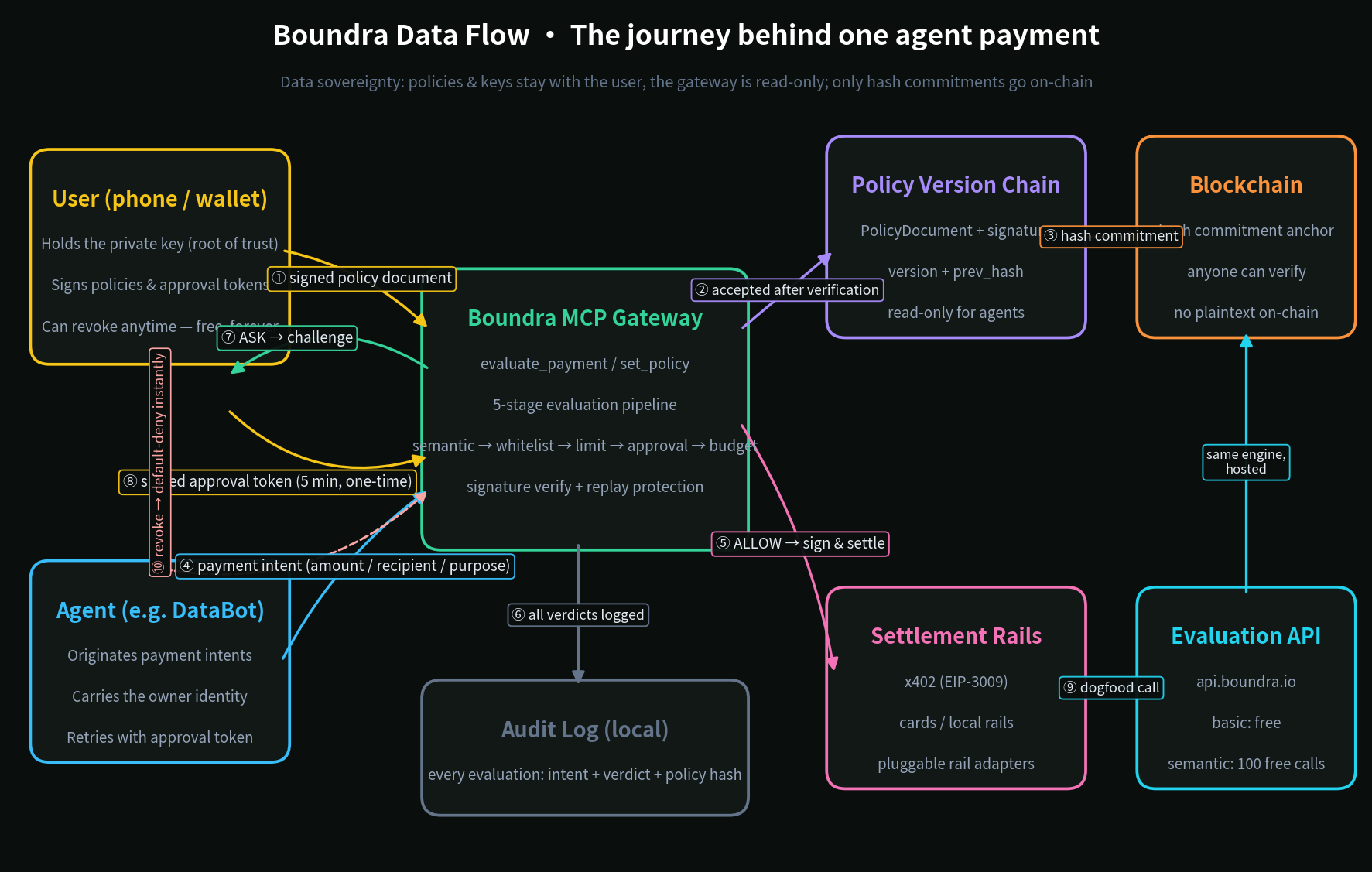
Policies and keys stay with the user; the gateway is read-only; only hash commitments go on-chain. Revocation is free — forever, no exceptions.
See it run in 60 seconds
# 1. Hit the hosted evaluation API — a real, public x402 merchant
curl -X POST https://api.boundra.io/evaluate/basic \
  -H 'Content-Type: application/json' \
  -d '{"intent":{"amount":0.01,"recipient":"api.weather.com","purpose":"weather data"}}'
# → {"decision":"ALLOW",...}  ·  semantic layer: 100 free calls per agent, then $0.003 via x402

# 2. Local end-to-end simulation — a data-procurement agent's day
.venv/bin/python demo/simulate_agent.py
# signed policy publish → ALLOW / DENY (limit) / ASK → user-signed approval token
# → prompt-injection blocked → audit trail, plus a dogfood call to api.boundra.io

# 3. One-line MCP install + 2-minute policy wizard
uvx --from git+https://github.com/gobeyondfj-cmd/boundra boundra-mcp     # stdio server
uvx --from git+https://github.com/gobeyondfj-cmd/boundra boundra-init    # wallet → template → sign → anchor
uvx --from git+https://github.com/gobeyondfj-cmd/boundra boundra-approve # sign an ASK challenge
The complete flow, step by step
Zero to a signed, enforced policy in ~10 minutes. No accounts, no dashboards — your wallet key is your identity.
0 · Try the hosted API (30 seconds, nothing to install)
curl -X POST https://api.boundra.io/evaluate/basic \
  -H 'Content-Type: application/json' \
  -d '{"intent":{"amount":0.01,"recipient":"api.weather.com","purpose":"weather data"}}'
1 · Bind your identity — the wallet is the account
uvx --from git+https://github.com/gobeyondfj-cmd/boundra boundra-init
Creates or imports a Base wallet. No signup, no email — the private key never leaves your device, and your address is your identity everywhere in the system.
2 · Set your policy
The wizard offers templates (personal assistant / travel / dev API / procurement) or lets you write your own rule in plain English, then compiles it and shows you exactly what will be enforced — before anything is signed.
3 · Sign & publish
You sign the policy document with your wallet key (EIP-191). It is published as a versioned document and a hash commitment is anchored on-chain. From this moment the gateway is read-only for every agent — changing the policy without your key is impossible.
4 · Mount the MCP server into your agent
{ "mcpServers": { "boundra": { "command": "uvx",
  "args": ["--from", "git+https://github.com/gobeyondfj-cmd/boundra", "boundra-mcp"] } } }
5 · Every payment gets a verdict before signing
Your agent calls evaluate_payment; the 5-stage pipeline answers
ALLOW (sign & settle) / DENY (aborted pre-signature, zero on-chain
trace) / ASK (a challenge bound to this exact payment).
6 · When the agent asks, you decide
uvx --from git+https://github.com/gobeyondfj-cmd/boundra boundra-approve
Paste the ASK challenge, sign it on your device — the agent retries with the signed approval token. Forged, rebound, or replayed tokens are rejected.
7 · Watch, update, revoke
get_spend_report / get_audit_trail / get_policy_versions keep you in
control day to day. Every policy change is a new signed version
(set_policy); revoke_policy is instant default-deny and free forever.
Quick start (from source)
cd boundra

# Mode 1: offline simulation (run this first — the full flow in 30 seconds)
python demo/demo.py

# Mode 2: real x402 + MCP
python -m venv .venv && .venv/bin/pip install \
    "x402[evm,httpx]" mcp eth-account fastapi uvicorn
.venv/bin/python tests/test_mcp_client.py    # MCP protocol-level tests
.venv/bin/python demo/setup_wallets.py       # generate Base Sepolia test wallets + faucet guide
.venv/bin/python demo/demo_real.py           # real protocol end-to-end (settles on-chain after funding)
Architecture: where the gateway stands
Agent framework (Claude / custom)
   │  MCP protocol (stdio)
   ▼
mcp_server.py  ──→  policy.py 5-stage evaluation pipeline
(policy decision     semantic → whitelist → limit → approval → budget
 point)
   ▲
   │ on_before_payment_creation hook (x402 SDK v2 native interception point)
x402_buyer.py ──sign (EIP-3009)──→ x402 server ──→ facilitator ──→ Base Sepolia
Key finding: x402 SDK v2 natively provides the on_before_payment_creation
hook plus register_policy / set_spend_controls — the policy layer is not a
bolt-on; it is the slot the official protocol stack reserves. This validates
the wedge.
File map
boundra/
├── policy.py                 intent compilation (NL→Policy, bilingual CN/EN) + 5-stage pipeline + platform red lines
├── signed_policy.py          ★ signed policy documents + version chain + revocation (keccak)
├── approval.py               ★ signed approval tokens (challenge → user signs → gateway verifies)
├── mandate.py                ★ task Mandates: single-use authorization, burned after use (pipeline layer 4)
├── templates.py              ★ policy template library (personal assistant / travel / dev API / procurement)
├── chain_anchor.py           ★ anchor backends: local simulation + real Base Sepolia (web3)
├── gateway.py                gateway core v3: 4-layer stacking + token verification + Mandate + revocation
├── rail_adapters.py          ★ rail adapter layer: evaluation core decoupled from settlement rails (x402 first)
├── mcp_server.py             ★ standard MCP server (11 tools, stdio)
├── boundra_cli.py            ★ boundra-init (policy wizard) + boundra-approve (challenge signer)
├── contracts/
│   └── PolicyAnchor.sol      ★ on-chain commitment contract (owner-write, anyone-read)
├── demo/
│   ├── simulate_agent.py     ★ end-to-end user journey simulation (MCP + hosted API dogfood)
│   ├── demo_policy.py        signed-policy demo (impersonation / unsigned / tampering attacks all blocked)
│   ├── demo_real.py          real-protocol end-to-end orchestration
│   ├── x402_resource_server.py  real x402 paywall server (FastAPI middleware)
│   ├── x402_buyer.py         real x402 buyer, evaluated by the MCP gateway before signing
│   ├── setup_wallets.py      Base Sepolia test wallet generation
│   └── demo.py / merchant.py / agent.py   offline simulation (zero dependencies)
├── tests/
│   ├── test_product.py       ★ product tests (22 assertions)
│   └── test_mcp_client.py    MCP protocol-level tests
├── docs/
│   ├── dataflow.png          data-flow diagram (English)
│   └── render_*.py           diagram renderers (architecture / flow / use-case / data flow)
└── state/audit.jsonl         audit trail (generated at runtime, gitignored)
Signed policies: the root of trust is the user's key, not the gateway's database (v2)
A policy is a document signed by the user's wallet, not a row in the gateway's configuration:
user private key signature ──→ PolicyDocument (NL rule + compiled artifact + prev_hash + version)
                      │  three checks: signer == owner, versions sequential, prev_hash unbroken
                      ▼
              PolicyStore (version chain) ──→ LocalAnchor (simulated commitment; production writes to contract)
                      │
                      ▼  check_integrity before every evaluation (signature + anchor)
              5-stage pipeline; audit records cite policy version + hash
- Read-only for agents: without the user's private key,
set_policyalways fails — impersonation, unsigned, and tampered submissions are all blocked (seven scenarios indemo/demo_policy.py) - Two stacked scopes: user-level (rules for all agents) × agent-level (per-agent rules); the strictest verdict wins
- Every version bump is a signature: v2 must reference v1's hash; tampering with any historical version → signature invalid + chain broken
- Privacy shape: only hash commitments go on-chain; policy plaintext never leaves the device unless the user chooses to disclose
Run: .venv/bin/python demo/demo_policy.py
MCP server tools
| Tool | Purpose | Caller |
|---|---|---|
evaluate_payment | Pre-payment evaluation. ALLOW proceeds / DENY aborts / ASK returns a challenge the user signs; retry with approval_token | Agent |
set_policy | Privileged: submit a new policy version; requires the owner's EIP-191 signature | User only |
revoke_policy | Privileged: revoke a policy chain (default-deny immediately, free forever) | User only |
get_policy_versions | Policy version history (chain + hashes, comparable with on-chain commitments) | Anyone |
get_policy | View the legacy fallback policy | Anyone |
get_spend_report | Today's spend / remaining budget | Agent |
get_audit_trail | Approval audit records | Agent |
request_policy_change | Agent asks the user for a policy change (queued, never self-applied) | Agent |
list_templates / render_template | Policy template helpers | Agent |
Mount into Claude Desktop
One line — uvx resolves dependencies and starts the server:
{
  "mcpServers": {
    "boundra": {
      "command": "uvx",
      "args": ["--from", "git+https://github.com/gobeyondfj-cmd/boundra", "boundra-mcp"]
    }
  }
}
On first run, use the boundra-init wizard (same package): create/import a
wallet → pick a policy template → sign → publish via MCP, about 2 minutes.
When your agent hits ASK, run boundra-approve and paste the challenge to
produce a signed approval token.
⚠️ Known trust-boundary simplifications (must fix for production)
human_approvedself-attested by the agentapprove(legacy-deprecated).- MCP-level interception is advisory — an agent framework can bypass the
gateway and talk to the wallet directly. Mitigation: pair with x402's
native hook (demonstrated in
demo/demo_real.py; the hook fires inside the SDK, before signing). Endgame: compile the deterministic parts of policy into a smart-contract wallet module, enforced at the settlement layer. - Semantic detection is regex-based — production should swap in LLM evaluation + intent anchoring.
- Anchoring defaults to a local log — the real contract
(
contracts/PolicyAnchor.sol) and web3 client (chain_anchor.BaseSepoliaAnchor) are ready; setchain_config.jsonto switch to the real chain (deploy via Remix with test ETH).
Economic model: the evaluation API is itself an x402 merchant
Tiered pricing:
| Operation | Price |
|---|---|
Deterministic evaluation (/evaluate/basic) | Free |
Semantic evaluation (/evaluate/semantic) | 100 free calls per agent; then $0.003 USDC/call (real x402 charge) |
| Policy anchoring / revocation | Free (revocation is free forever — a safety red line) |
Open core: the client, evaluation engine, and demos in this repo are
Apache-2.0. The hosted evaluation service (tiered pricing, free-quota
accounting, revenue ledger) runs from the private boundra-ops repo.
Verified / not yet verified
Verified (all of test_product.py 22 assertions + test_mcp_client.py pass):
4-layer policy stacking (platform red lines × user × agent × Mandate) with
strictest-wins; signed approval tokens (valid passes, forged rejected,
intent-rebinding rejected, replay rejected); Mandate single-use; revocation
defaults to deny and a signed v2 restores; template render+compile; all MCP
tools over the wire; gateway blocks an injection attack inside the real x402
402 round-trip before the SDK signs; the full tiered-pricing loop on Base
Sepolia (2026-10-16): free tier passes, paid tier settles $0.003 USDC for real
(buyer 20.000 → 19.997, platform address credited 0.003), dogfood hook
self-evaluates, semantic layer blocks the injection, /revenue ledger entry.
The settlement tx is publicly verifiable: 0x5ad8ef4b…c474bbe
(the hosted service code is closed by design — the chain is the receipt).
Not yet verified: real on-chain anchoring (contract ready, needs test ETH to deploy); real user demand; semantic layer false-positive rate under real LLM behavior distributions.
Reviews
No reviews yet
Be the first to review this server!
More Developer Tools MCP Servers
Rea
Freeby Morluto · Developer Tools
Reverse engineer anything from your terminal or agent with one CLI and MCP server.
Paperclip
Freeby Paperclipai · Developer Tools
Trending hip-hop artist momentum scores across four cultural dimensions.
Git
Freeby Modelcontextprotocol · Developer Tools
Read, search, and manipulate Git repositories programmatically
Fetch
Freeby Modelcontextprotocol · Developer Tools
Web content fetching and conversion for efficient LLM usage
Toleno
Freeby Toleno · Developer Tools
Toleno Network MCP Server — Manage your Toleno mining account with Claude AI using natural language.
MCP Marketplace
Freeby mcp-marketplace · Developer Tools
Search and install MCP servers from inside your AI client.