
Server data from the Official MCP Registry
Deterministic verification for AI-generated analysis: run a spec, inspect or diff a workbook
About
Deterministic verification for AI-generated analysis: run a spec, inspect or diff a workbook
Security Report
Valid MCP server (1 strong, 3 medium validity signals). 1 code issue detected. No known CVEs in dependencies. Package registry verified. Imported from the Official MCP Registry. 1 finding(s) downgraded by scanner intelligence.
7 files analyzed · 2 issues found
Security scores are indicators to help you make informed decisions, not guarantees. Always review permissions before connecting any MCP server.
Permissions Required
This plugin requests these system permissions. Most are normal for its category.
How to Install
Add this to your MCP configuration file:
{
  "mcpServers": {
    "io-github-gulmezeren2-byte-andon": {
      "args": [
        "andon-verify"
      ],
      "command": "uvx"
    }
  }
}Documentation
View on GitHubFrom the project's GitHub README.
andon
Stop the line when the numbers don't add up.


andon re-checks the numbers in finished analysis — the report your AI agent just drafted, the workbook a colleague "quickly updated" — against the data they came from and against themselves. It does this with arithmetic, not with another LLM: reconciliation, internal consistency, schema contracts and Excel workbook integrity, written down as a small YAML spec and enforced with exit codes.
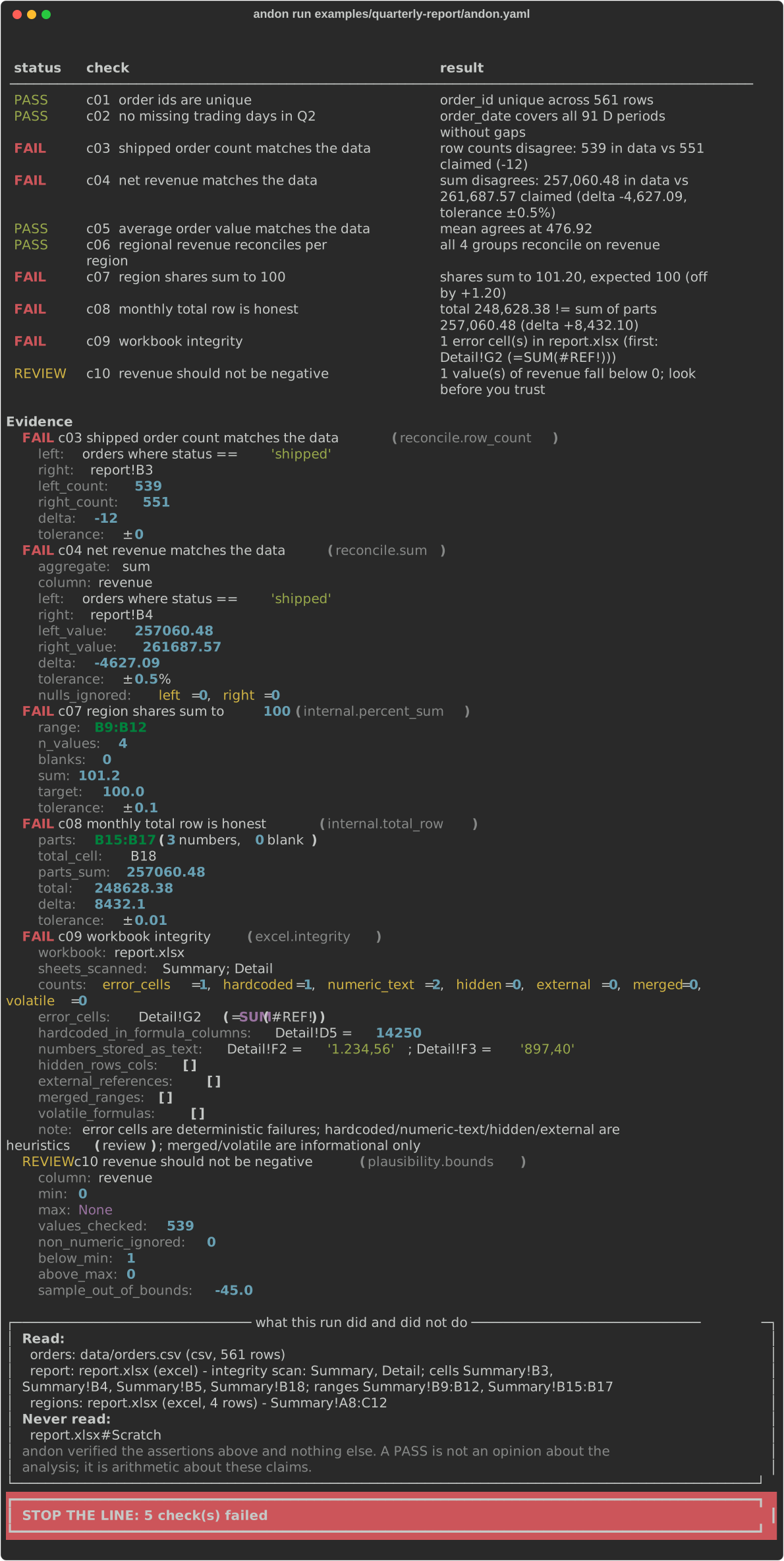
That screenshot is real output. The example it runs on is in
examples/quarterly-report/, staged by a script that
plants the defects I keep meeting in real reporting work: a count taken from a stale
snapshot, a revenue total typed over by hand, shares that sum to 101.2, a total row
nobody updated after a data refresh, a #REF!, and freight numbers stored as text.
Why this exists
I'm an industrial engineer. I build and run operations reporting — delivery KPIs, forecast accuracy, inventory analytics — and over the last two years an increasing share of the first drafts around me has been written by AI agents. They are fast, tireless, and confidently wrong in ways a tired human is not: the filter that silently dropped cancelled orders, the percentage column that almost sums to 100, the total row that survived three edits of its parts.
The common answer is to ask a second model to review the first one. I think that is the wrong tool. Whether 539 rows really sum to 257,060.48 is not a matter of opinion, and no amount of model capability makes an opinion the right instrument for it.
Manufacturing solved this problem decades ago. On a Toyota line, any worker who spots a defect pulls a cord — the andon — and the line stops until the problem is understood. The machine equivalent, jidoka, is a machine that stops itself when it detects an abnormal condition. This tool is that cord for spreadsheets and reports: a small, deterministic gate between "the analysis is written" and "the analysis is sent."
The iron rules
andon's behavior is easier to trust because it is constrained. These rules are enforced in code, not just promised here:
- Only arithmetic can fail the build. Heuristic checks (distribution shifts, plausibility bounds) can raise a REVIEW flag; the engine will not let them FAIL, even if a buggy check tries.
- No silent blessings. Every report ends with what was read, what was skipped, and which worksheets were never touched (the report calls this the honesty block). A PASS covers the listed assertions and nothing else.
- A check that can't run is a finding, not a pass. Missing file, unreadable range, text in a numeric column — the run continues, the check is recorded as ERROR, and the exit code is non-zero. "Not verified" must never be readable as "fine."
- Read-only by construction. There is no code path that writes to your data.
Install
pip install andon-verify
The PyPI distribution is named andon-verify (the bare andon name was already
taken); the command and the import stay andon — andon run ..., import andon.
From source: pip install git+https://github.com/gulmezeren2-byte/andon.
Quick start
Point andon at data and claims:
# andon.yaml
version: 1

sources:
  orders: data/orders.csv
  report: out/weekly.xlsx#Summary

checks:
  - name: no dropped orders
    reconcile.row_count:
      left:  { source: orders, where: "status != 'cancelled'" }
      right: { source: report, cell: B4 }

  - name: revenue adds up
    reconcile.sum:
      column: revenue
      left:  { source: orders, where: "status != 'cancelled'" }
      right: { source: report, cell: B6 }
      tolerance: 0.5%

  - name: totals row is honest
    internal.total_row:
      source: report
      parts: B10:B21
      total: B22
      tolerance: 0.01

  - name: workbook is mechanically sound
    excel.integrity:
      source: report
andon run andon.yaml            # human-readable verdict
andon run andon.yaml --json     # full machine-readable report
andon inspect out/weekly.xlsx   # integrity-scan a workbook, no spec needed
andon init                      # write a commented starter spec
Or try the sabotaged example in this repo:
git clone https://github.com/gulmezeren2-byte/andon
cd andon/examples/quarterly-report
andon run andon.yaml
What it checks
| Family | Checks | Question it answers | Can FAIL? |
|---|---|---|---|
reconcile | row_count, sum, aggregate, group_sum, keys | Does the report agree with the data it came from? | yes |
internal | total_row, percent_sum, recompute | Does the report agree with itself? | yes |
schema | columns, unique, not_null, allowed_values, date_continuity | Is the data shaped the way everyone assumes? | yes |
excel | integrity | Is the workbook mechanically sound? (#REF!, values typed over formulas, numbers stored as text — including the 1.234,56 flavor — hidden rows, external links) | on error cells |
plausibility | bounds, new_categories, mean_shift | Should a human look at this before anyone trusts it? | no — REVIEW at most |
Full parameter reference with examples: docs/checks.md.
Exit codes and CI
Exit codes are a contract:
| code | meaning |
|---|---|
| 0 | every check passed |
| 1 | at least one FAIL (with --strict: also on REVIEW/ERROR/nothing-ran) |
| 2 | no failures, but REVIEW flags were raised |
| 3 | nothing was verified — a check could not run, or every check was skipped |
| 4 | the spec itself is broken |
As a GitHub Action — one line, and the verdict lands in your job summary:
- uses: gulmezeren2-byte/andon@v1
  with:
    spec: reports/andon.yaml
    args: "--strict"
Or plainly, in any runner:
- run: pip install andon-verify
- run: andon run reports/andon.yaml --strict --md verdict.md   # --md → a PR-comment-ready verdict
As a pre-commit hook
Stop a commit before a broken report leaves your machine:
# .pre-commit-config.yaml
repos:
  - repo: https://github.com/gulmezeren2-byte/andon
    rev: v0.6.2
    hooks:
      - id: andon
        args: ["reports/andon.yaml", "--strict"]
Using andon with AI agents
andon is built to be driven by agents, not to contain one:
--jsonemits the full report with stable field names; the exit code alone is enough for a go/no-go decision.- Error messages name the sources, columns and sheets involved, so an agent can repair its own spec instead of guessing ("Column 'Revenue' not found. Columns are: region, share_pct, revenue").
skills/verify-with-andon/ships a skill for Claude Code and compatible harnesses that teaches an agent the discipline: after drafting any analysis, write the spec, run andon, and report the verdict — including the rule that loosening a tolerance to make a check pass must be declared, never silent.- MCP server.
pip install 'andon-verify[mcp]'and runandon-mcpto expose three tools to any MCP-speaking runtime:run(execute a spec),inspect(integrity-scan a workbook with no spec), anddiff(classify what changed between two versions). The agent gets the same structured verdict a human gets — not prose it has to parse back.
// e.g. Claude Desktop / Claude Code mcp config
{ "mcpServers": { "andon": { "command": "andon-mcp" } } }
No local Python? The Dockerfile builds the same server:
docker build -t andon . && docker run --rm -i -v "$PWD:/work:ro" -w /work andon.
My working rule: the agent that wrote the analysis also writes the spec, and neither is
finished until andon run exits 0 — or a human has signed off on every flag it raised.
What andon is not
- Not a data-quality platform. Great Expectations and pandera validate data inside pipelines, in code, usually against a warehouse. andon verifies claims in finished artifacts — the report against its source — and treats Excel as a first-class citizen, because that is where analysis actually lives in most companies.
- Not an LLM evaluator. It doesn't score model outputs; it re-derives numbers.
- Not a replacement for reading the report. It removes a class of mechanical error so human review can spend itself on judgment.
Limitations, honestly
- Formula cells need cached values. andon reads the value Excel last calculated. A workbook produced by a library and never opened in Excel/LibreOffice carries no cached values for its formulas; andon refuses to guess and reports exactly that.
wherefilters are pandasquery()expressions. They are expressive, which means a spec can encode the same mistakes as any query. Specs are code — review them like code.- Heuristic checks have false positives by design. That is why they cannot fail a build.
- Scale is untested beyond mid-size files. Everyday operational workbooks and CSVs (hundreds of thousands of rows) are fine; nobody has benchmarked it against 10 GB of parquet. If you do, tell me what broke.
- Parquet sources need
pip install 'andon-verify[parquet]'.
CSV encoding, delimiter, and how numbers are punctuated
A CSV source is read as utf-8 by default, and Excel's BOM is stripped so it can't poison
the first column name. When a file isn't utf-8 — Turkish exports out of Excel are often
;-separated, encoded cp1254, and write amounts as 1.234,56 — give the source as a
mapping instead of a bare path:
sources:
  sales:
    path: data/satis.csv
    encoding: cp1254      # default: utf-8-sig
    delimiter: ";"        # default: ","
    decimal: ","          # default: "."
    thousands: "."        # default: none
Get the encoding wrong and andon says so, naming the likely culprit — it does not silently mojibake your column names and then "verify" them.
The last two matter more than they look. Without them 1.234,56 is read as text, and
a column of text is a column a numeric check cannot examine. andon will tell you that
rather than pass — see below — but declaring the punctuation is what makes the column
checkable in the first place.
What a check does when it can't read the data
Every report ends with the same line: a PASS is not an opinion about the analysis; it is arithmetic about these claims. That obliges the checks to distinguish two things a careless implementation runs together:
- "I compared them and they were fine" — a PASS.
- "I had nothing to compare" — never a PASS.
So a plausibility check that finds no numeric values says so, instead of reporting that zero values fell outside the bounds:
REVIEW bounds no numeric values in tutar; nothing was compared against the bounds
And when only part of a column is readable, the verdict carries the denominator, because a statement about the half that parsed is not a statement about the data you handed over:
REVIEW bounds tutar stays within bounds, but only read 2 of 4 value(s) of tutar
Every such check reports values_checked, values_total and values_skipped in its
evidence, so the coverage is machine-readable too. Values that pandas turns into NaN at
read time — n/a, -, #N/A — are counted as skipped like anything else; they are
invisible to a naive coercion count, which is exactly how they used to go unnoticed.
Verify against a warehouse query (DuckDB)
A source can be a SQL query instead of a file — so you can reconcile a report against
the same data your BI tool reads, not just against a CSV. With
pip install 'andon-verify[duckdb]', prefix a source with duckdb: and DuckDB runs it
(it reads CSV, parquet, JSON and .duckdb files inside the query; relative paths resolve
against the spec):
sources:
  # the report's headline number
  report: out/q2.xlsx#Summary
  # the same number, straight from the raw data via SQL
  truth: "duckdb:SELECT SUM(revenue) AS rev FROM 'data/orders.parquet' WHERE status='shipped'"

checks:
  - name: revenue matches the warehouse
    reconcile.sum:
      column: rev
      left:  { source: truth }
      right: { source: report, cell: B6 }
      tolerance: 0.5%
Diff two workbook versions
"Someone edited the workbook — what actually changed?" git diff on an .xlsx is noise,
and the tools that compare spreadsheets show every changed cell flat. andon diff
classifies each change instead, so a new #REF! doesn't hide behind reformatted dates:
andon diff last-week.xlsx this-week.xlsx
andon diff v1.xlsx v2.xlsx --tolerance 0.5%   # hide numeric moves below 0.5%
andon diff v1.xlsx v2.xlsx --json             # machine-readable
cell        change      before → after
Summary!B9  new_error   43.8 → #REF!
Summary!B4  numeric     261,687.57 → 266,687.57  (+5000, +1.91%)
A new error cell is called out on its own; numeric moves come with a delta and a percent.
Exit codes: 0 = nothing meaningful changed, 1 = a new error appeared (or, with --strict,
any change), 2 = changes but no new error.
Roadmap
Shipped since 0.1: a GitHub Action and pre-commit hook, DuckDB
sources, andon diff, an MCP server, CSV encoding/delimiter
controls, and JSON/JSONL sources.
Near-term, in order:
- Row-level diff for data sheets, not just cell-by-cell
- A
--watchmode: re-run a spec when its sources change on disk
Not planned: dashboards, scheduled runners, LLM-powered anything inside the verifier. The verifier stays deterministic; that is the point.
How this project is built
I design the checks, decide the semantics and review every line; I use AI agents
(Claude Code) heavily for implementation speed, and the commit trailers say so. If that
bothers you, read tests/ first: the suite builds real CSV and XLSX fixtures, no
mocks, and it is the contract. Tests don't care who typed them.
Related
- opsaudit — the same instinct, one level up: operations analytics that audits its own numbers instead of trusting them.
andonchecks a finished report against its sources;opsauditcomputes the metrics with the honesty block built in.
More tools by Eren Gülmez.
License
MIT — Mehmet Eren Gülmez
Reviews
No reviews yet
Be the first to review this server!
More Developer Tools MCP Servers
Fetch
Freeby Modelcontextprotocol · Developer Tools
Web content fetching and conversion for efficient LLM usage
Git
Freeby Modelcontextprotocol · Developer Tools
Read, search, and manipulate Git repositories programmatically
Toleno
Freeby Toleno · Developer Tools
Toleno Network MCP Server — Manage your Toleno mining account with Claude AI using natural language.
MCP Marketplace
Freeby mcp-marketplace · Developer Tools
Search and install MCP servers from inside your AI client.
mcp-creator-python
Freeby mcp-marketplace · Developer Tools
Create, build, and publish Python MCP servers to PyPI — conversationally.
FinAgent
Freeby mcp-marketplace · Finance
Free stock data and market news for any MCP-compatible AI assistant.