
Server data from the Official MCP Registry
Lossless skim-then-expand reading of big files, repos, and command output with far fewer tokens
About
Lossless skim-then-expand reading of big files, repos, and command output with far fewer tokens
Security Report
skim-mcp is a well-designed, security-conscious MCP server for token-efficient file reading and command execution. The codebase is lean (~2000 lines), dependencies are minimal, and dangerous operations (shell execution, file writes) have explicit opt-out switches. No credentials are hardcoded, and authentication is not required (appropriate for a local utility). Minor concerns around input validation on file paths and broad shell command execution are inherent to the tool's purpose, not flaws. Supply chain analysis found 3 known vulnerabilities in dependencies (0 critical, 3 high severity). Package verification found 1 issue.
3 files analyzed · 10 issues found
Security scores are indicators to help you make informed decisions, not guarantees. Always review permissions before connecting any MCP server.
Permissions Required
This plugin requests these system permissions. Most are normal for its category.
How to Install
Add this to your MCP configuration file:
{
  "mcpServers": {
    "io-github-helloderekg-skim-mcp": {
      "args": [
        "skim-mcp"
      ],
      "command": "uvx"
    }
  }
}Documentation
View on GitHubFrom the project's GitHub README.
skim




Token-efficient skim-then-expand I/O for agentic models (Claude Code / desktop Claude).
Independent community project — not affiliated with, endorsed by, or sponsored by Anthropic. No telemetry; runs entirely on your machine. See Trademarks, privacy & license.
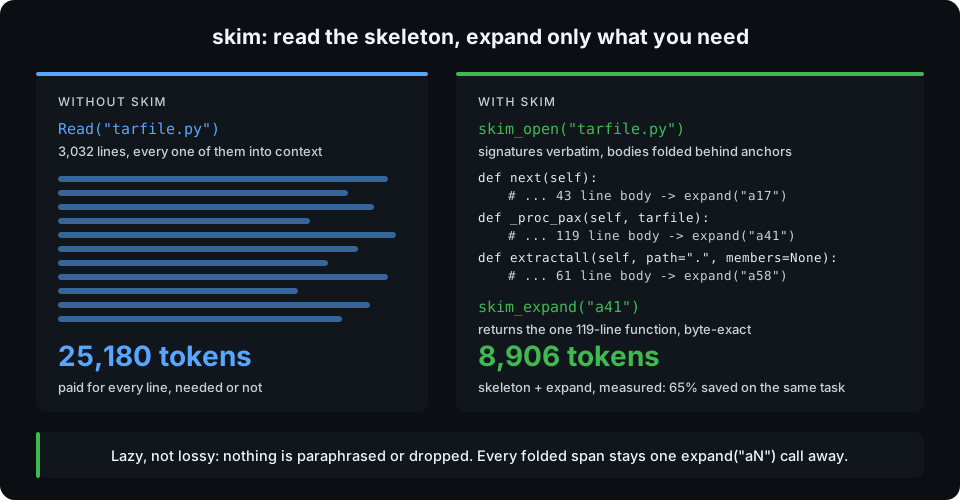
Instead of reading a whole large file into context, the model calls skim_open(path) and gets a
compact skeleton — structure, signatures, and (for logs/data) preserved critical values like ids,
numbers, dates, and error codes — plus anchor ids. It reads the skeleton cheaply, then calls
skim_expand(handle, anchors=[...]) to pull only the exact spans it needs, verbatim and lossless.
Compression is lazy, not lossy: nothing is paraphrased or destroyed, only deferred. Expansion is always one call away — which is what makes it safe for a closed model that can't ingest latent vectors.
What it does that other tools don't
The mainstream tools are lossy in context — repo-maps and --compress drop function bodies;
summarizers and compression models paraphrase. The closest neighbors either cover code only, or show
the model a transformed view and keep originals in a side cache. skim's line is stricter: whatever
lands in context is verbatim source, and everything not shown is one anchored expand away — an agent
can edit code from what it read without re-reading. That holds everywhere:
- Files — Python (
ast) + ~17 languages (tree-sitter); bodies folded, oneexpandaway. - Whole repos —
skim_repobuilds a ranked, token-budgeted map; expand exact code from any file. - Command output —
skim_runcompresses verbose test / build / log output, fully recoverable. - Data & logs — a generic path with a retention guarantee (ids, numbers, error codes, negations are promoted into the skeleton, never silently dropped) and dedup of repeated blocks.
See DESIGN.md for the architecture and verified prior-art positioning.
Falsifiable, not claimed
A reduction percentage is marketing until you can check it. skim ships the checker:
uv run skim-verify path/to/your/gnarliest_file.py # any file at all; exit code tells CI
Five invariants, verified on your files, locally: every non-blank line recoverable, expands
byte-exact, anchors in-bounds, reconstruction equal to the decoded file, deterministic output. The
test suite enforces the same contract with Hypothesis fuzzing on every path; a reproducible FAIL
on any readable file is a bug — please report it. Summarize-first tools cannot ship this command,
because for them the equivalent check fails by design.
The cost-vs-correctness question has its own open yardstick — eval/ACCURACY.md prices every eval question under a full read vs skim (including the rows where skim loses), and any other context tool can be scored under the same protocol.
Built to be audited
- Under 2,000 lines of stdlib Python for the whole package (the reading engine is ~1,200) — no
ML models to download, no framework, no telemetry, dependency surface of one (
mcp, plus optionaltiktoken/tree-sitter extras). An afternoon's security review covers all of it: SECURITY.md is the threat model. - A kill switch for every surface that isn't read-only:
SKIM_RUN_DISABLED=1removes the shell tool,SKIM_PATCH_DISABLED=1removes the file editor; the readers keep working. - Windows is a first-class platform, not a port: command output decoded as UTF-8 (no cp1252
mojibake), process trees actually killed on timeout (
taskkill /F /T), CRLF preserved byskim_patch, and CI runs the full suite onwindows-latestalongside Ubuntu.
Try the core (no install)
python demo.py path/to/file.py            # measured before/after token counts
python demo.py                            # demo on examples/sample.log (retention + dedup)
Results (hard data)
Every number below is generated live by uv run python benchmarks.py — full reproducible tables in
BENCHMARKS.md. Measured on the running interpreter's standard library (real code);
token counts via tiktoken cl100k_base (a proxy for Claude's tokenizer; ratios are tokenizer-robust).
Token savings on real code — 60 Python stdlib files: 387,911 → 122,660 tokens (68% fewer, 3.16×); per-file 1.5×–11×; 100% lossless, deterministic; ~linear runtime (~4 ms / 1k lines); pure CPU, no GPU, no network, no model calls.
Multi-language (tree-sitter, [lang] extra) — the same lossless engine on JS / TS / Go / Rust /
Java / C / C++ / Ruby / PHP / C# and more. Example: a 481-line JavaScript module → 6.6× / 85% saved, lossless.
1:1 before/after on a real task (distribution-level) — "read the largest function in this module"; the model opens the file, reads the skeleton, expands exactly the one function it needs. Same answer, full skim cost (skeleton + expand) counted, across 24 large modules:
| file | lines | function read | full read | skim (skeleton+expand) | saved |
|---|---|---|---|---|---|
tarfile.py | 3,032 | _proc_pax (119 lines) | 25,180 | 8,906 | 65% |
optparse.py | 1,682 | parse_args (37) | 12,830 | 5,610 | 56% |
pathlib.py | 1,436 | walk (43) | 11,242 | 5,421 | 52% |
bdb.py | 921 | effective (48) | 7,279 | 3,243 | 55% |
socketserver.py | 864 | serve_forever (27) | 5,824 | 3,615 | 38% |
| 24-file total | 176,897 | 71,877 | 59% |
Per-task savings: median 51%, mean 51%, range 30–91% across 24 tasks — the honest distribution, not a cherry-picked best case. The win shrinks when you need most of a file.
Head-to-head — same 30 files (compare.py + real Repomix via npx):
| approach | tokens | % of full | lossless? |
|---|---|---|---|
full read (Claude Read) | 184,277 | 100% | yes |
| skim | 64,043 | 34.8% | yes (lazy-expand) |
Repomix --compress | 105,963 | 57.5% | no (bodies dropped) |
| signatures-only (Aider/Basemind mechanism) | 20,276 | 11.0% | no |
skim is the only lossless option and uses 40% fewer tokens than Repomix --compress. The repo-map
approach is ~3× smaller but discards bodies/docstrings/comments irreversibly. (Basemind is pure Rust and
wasn't installed; its row reproduces the signatures-only mechanism — see COMPARISON.md.)
Correctness: 0 of 54,215 non-blank lines unrecoverable across 80 files; 202 tests / ~80% coverage with
Hypothesis property fuzzing of both paths; an ~18,000-case adversarial campaign (every bug found is fixed
and regression-locked). Reproduce: uv run python bench.py / pytest / benchmarks.py.
Run as an MCP server
The one-liner (installs from PyPI on first run, tree-sitter languages included):
claude mcp add skim -- uvx --from "skim-mcp[lang,tokens]" skim-mcp
Or from source:
git clone https://github.com/helloderekg/skim-mcp.git && cd skim-mcp
uv sync --extra lang                       # MCP SDK + multi-language (tree-sitter); drop --extra lang for Python-only
Register with Claude Code (use the repo's absolute path; forward slashes work on Windows):
claude mcp add skim -- uv run --directory /abs/path/to/skim-mcp skim-mcp
Or Claude Desktop — add to claude_desktop_config.json (%APPDATA%\Claude\ on Windows,
~/Library/Application Support/Claude/ on macOS), then restart:
{
  "mcpServers": {
    "skim": {
      "command": "uv",
      "args": ["run", "--directory", "/abs/path/to/skim-mcp", "skim-mcp"]
    }
  }
}
(If uv isn't found, use its full path from where uv / which uv.)
Tools
skim_open(path, query="")→ compact skeleton + anchor ids (read the skeleton; ids are in itsexpand("aN")markers). Passqueryto also getmatches(line + covering anchor) in the same call, no search round-trip.skim_expand(handle, anchors=[...])→ exact verbatim spans. Items are anchor ids ("a7") or literal line ranges ("L120-180") for when a grep already gave you line numbers.skim_search(handle, query)→ which anchors/lines contain a string, without reading them.skim_run(command)→ run a shell command, get a compact expandable view of its output (tests / builds / logs).skim_repo(path, query)→ a lossless, ranked, token-budgeted map of a whole repo; expand exact code from any file. Ranked by query match when you pass one, else by import-graph centrality (PageRank over which files import which), so the load-bearing modules surface first.skim_patch(handle, anchor, new_text)→ replace exactly one expanded span on disk, drift-safe: refused if the file changed sinceskim_open, LF/CRLF preserved, result re-verified from disk, fresh handle returned. Because expands are verbatim, an edit built from one applies safely — read 8% of the file, edit it anyway. (SKIM_PATCH_DISABLED=1turns it off.)- Spans are also MCP resources:
@skim:skim://doc/<handle>/span/<anchor>pulls a span by reference.
What it looks like in practice
Fix a bug in a big module you barely need. The task: "why does _proc_pax mishandle pax
headers?" in tarfile.py (3,032 lines, 25,180 tokens). Claude calls skim_open, reads a
skeleton with every signature, spots _proc_pax, expands that one anchor, and answers from the
exact 119-line body. Measured cost: 8,906 tokens including the skeleton and the expand. Same
answer, 65% fewer tokens (see the benchmark table — median across 24 such
tasks is 51%).
Get your bearings in an unfamiliar repo. skim_repo(".", query="rate limit") returns the
most relevant files' skeletons, ranked, inside one token budget, each with its own handle. Claude
reads the map, expands the two functions that matter from two different files, and starts editing
with the rest of the repo still unread but reachable.
A red CI run with 400 lines of noise. skim_run("pytest -q") returns the exit code plus a
compact view: repeated boilerplate collapses to "identical to a3" pointers, and the retention
layer promotes the load-bearing literals (error codes, file paths, counts) into view so the
failure is visible without expanding anything. When Claude needs the full traceback, it expands
that one block.
When not to skim (honesty). A 40-line config file, or a file you're about to rewrite wholesale: just read it. The skeleton wrapper costs more than it saves on tiny inputs, and the meter will show those rows as negative rather than hiding them. skim's win is the everyday case where you need 40 lines out of 2,000.
Getting Claude to use skim
Mounting skim makes the tools available — it does not make Claude use them. Claude picks a tool per
task, and its default for "read/review this file" is the built-in Read, not skim_open. Smaller
models (e.g. Haiku) are especially unlikely to reach for an MCP tool on their own. So skim saves tokens
only when it's actually invoked. Two ways to get there:
1. Ask for it, per task:
Use skim to review
src/big_module.pyMap this repo withskim_repobefore you start Run the tests throughskim_run
2. Make it automatic — add a rule to your CLAUDE.md (a project one, or global ~/.claude/CLAUDE.md)
so Claude reaches for skim without a reminder every turn:
When the skim MCP tools are available, prefer skim_open (files) and skim_repo (directories/repos) over
the built-in Read for anything larger than ~300 lines, and skim_run for verbose command output. Expand
only the spans you need — skim is lossless, so skimming first is never risky, only cheaper.
skim also ships a "prefer skim" instruction to the model, but models don't reliably act on server-level
instructions — the CLAUDE.md rule is what pulls hard enough, especially for smaller models. You can
confirm it's wired up any time: tell a session "use skim to open <a big file>" and watch the
meter tick.
Or let skim do both steps — registration and the rule — in one idempotent command:
uv run skim-mcp install                              # from a source checkout (project ./CLAUDE.md rule)
uvx --from "skim-mcp[lang,tokens]" skim-mcp install  # from PyPI
skim-mcp install --rule global                       # write the rule to ~/.claude/CLAUDE.md instead
skim-mcp install --print-only                        # show what it would do, change nothing
Re-running never duplicates the rule; if the claude CLI isn't on PATH it prints the exact manual
command and the Claude Desktop JSON instead.
See your savings live
Mount skim, then run the meter in a second terminal — a tiny localhost dashboard (pure stdlib, no
network, no deps) that reads the same skim_calls.jsonl the server writes and refreshes every second:
uv run skim-meter                        # -> http://127.0.0.1:17321
uv run skim-meter --once                 # one-shot text snapshot instead of the web view
uv run skim-meter --price-per-mtok 3     # optional: also show ~dollars saved at YOUR rate
It shows, in real time: tokens in (what reading those files / running those commands in full would
have cost), tokens out (what skim actually put into context — skeletons plus every expand/search),
and % saved = 1 - out/in, broken down by session. It's honest — expands eat into the number,
and a skim_run on a tiny output can even net negative.
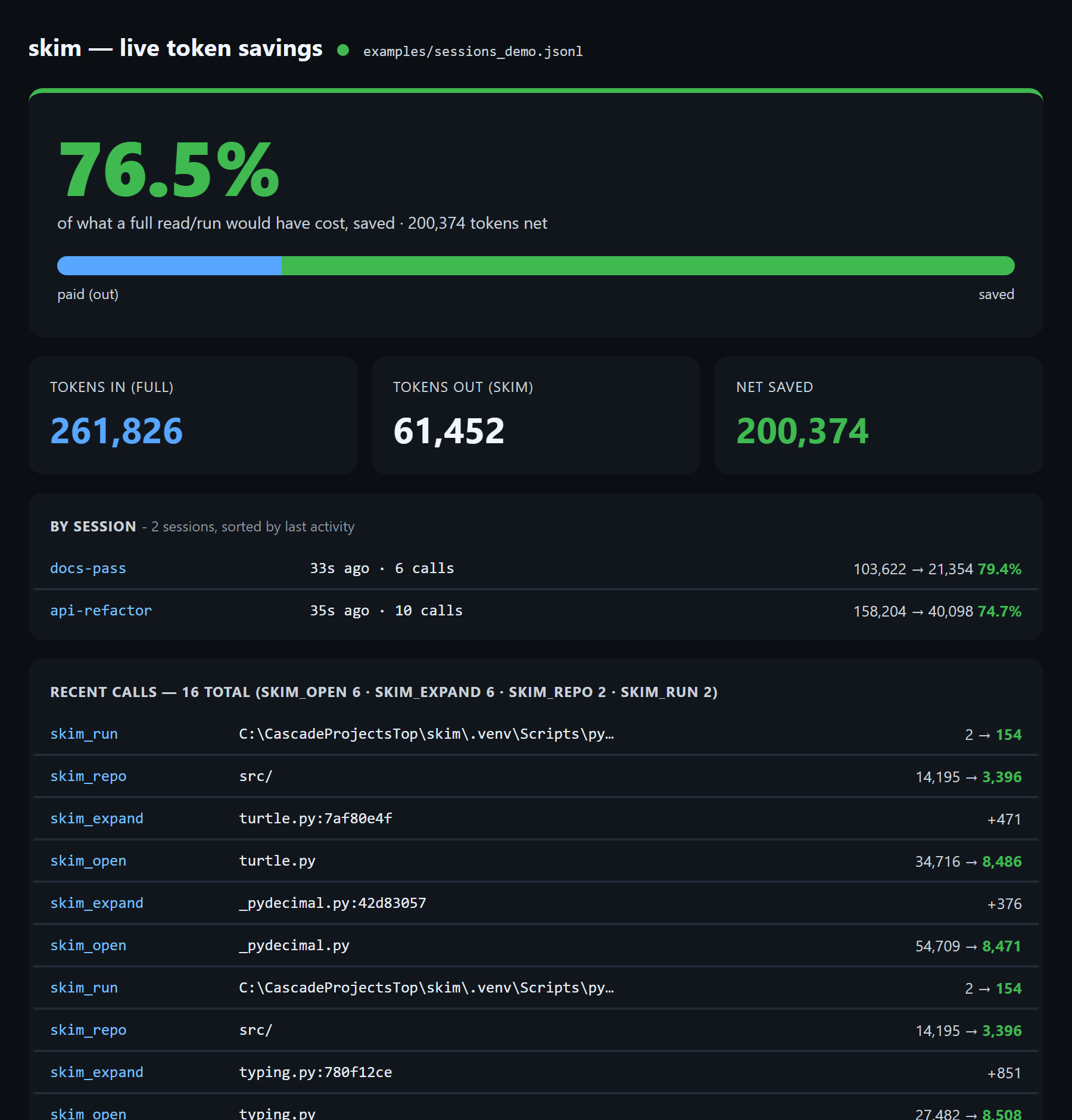
Per session: every skim server process stamps a session id on each call, and Claude Code spawns one
process per session — so the dashboard lists every session (even before it has used skim), sorted by
last activity. Each row is labeled by your SKIM_SESSION_LABEL if you set one, else by the first
file/repo that session touched (else idle), alongside its start time and short id so you can tell
them apart. A Clear button (or skim-meter --clear) archives the log to a timestamped ghost file and
resets the meter to zero — nothing is lost. (MCP doesn't tell the server which sub-agent issued a call,
so per-connection/session is the finest split available server-side.)
Tests
uv sync --extra dev
uv run pytest                  # unit + property-based fuzzing of the invariants (202 tests, ~80% coverage)
uv run python bench.py         # invariant sweep + compression over the standard library
uv run python check_invariant.py <file>   # check one file against the invariants
The suite enforces six invariants for any input — lossless, round-trip-exact, reconstruction-exact
(full_text equals the decoded file byte-for-byte), in-bounds, deterministic, never-crash — via
hand-written edge cases, the real standard library, and Hypothesis fuzzing of both the code and
generic paths.
Measure the expand-loop yourself: eval/QUESTIONS.md is a 7-question
under-fetch eval (every answer hidden behind an anchor, locked by a test);
uv run python eval/score_expand_loop.py scores a real session's log against it, and
eval/ACCURACY.md prices each question (full read vs skim, negatives included) —
the accuracy-vs-cost yardstick other context tools are invited to run against.
Limitations (honest)
- Code skeletons cover Python (
ast) + ~17 languages via tree-sitter — JS, TS, Go, Rust, Java, C, C++, Ruby, PHP, C#, Kotlin, Swift, Scala, Bash, Lua, R. Install the optional[lang]extra; other text falls back to the generic (lossless) block path. The long tail of ~300 tree-sitter grammars is incremental (each language's folding is verified against real parses before it ships). - Dense repetitive logs get Drain-style templates (
~412x GET /api/<*> took <*>ms) so the skeleton shows what repeats; structured JSON/CSV skeletons are still roadmap, so compression there is modest. - It depends on the model calling
expand. If the model answers from the skeleton when it needed a collapsed body, it can be wrong. A steering hint mitigates this;skim_calls.jsonllets you measure it. - Functions defined inside
if/tryblocks aren't shown as signatures (still lossless and expandable). skim_runruns shell commands on your machine (to capture and compress their output), with the privileges of the server process — the same capability class as an agent's Bash tool. Mount skim only where you'd let an agent run commands; a prompt-injected model could invoke a destructive command. SetSKIM_RUN_DISABLED=1to mount skim read-only (the shell tool refuses, the readers keep working). Full threat model in SECURITY.md.- Handles live in the server process's memory. They last the session (Claude Code runs one skim
process per session); after a restart an old handle returns a clean
unknown handleerror — re-open. Handles are content-hashed, so a re-opened changed file gets a new handle and stale anchor ids can never silently point at different lines. - Savings depend on usage: large on big files you read part of, a wash on small files or when you need most of a file. Token counts use tiktoken (a proxy for Claude's tokenizer); ratios are robust.
Status & roadmap
Shipped: Python ast + multi-language tree-sitter code skeletons (~17 languages, each verified
against real parses), a generic block path with retention + dedup + Drain-style templating for dense
logs, skim_run (lossless command/test-output compression with process-tree-safe timeouts),
skim_repo (whole-repo lossless map, ranked by query match or import-graph PageRank), spans as MCP
resources, an under-fetch eval harness, and skim-meter (a live token-savings dashboard) — all behind
an airtight test suite.
Roadmap: a structured-data skeleton for JSON/CSV (schema + value stats), the long tail of tree-sitter languages, a hybrid push mode (auto-expand the top relevance-ranked anchor) if the under-fetch eval shows models leaving answers on the table, and runner adapters so other context tools can be scored on the accuracy-vs-cost yardstick.
Contributing, security, changelog
CONTRIBUTING.md has the five invariants every change must keep (lossless, round-trip exact, in-bounds, deterministic, never-crash) and how to add a language. SECURITY.md is the threat model and how to report privately. CHANGELOG.md tracks releases; RELEASING.md is the release process.
Trademarks, privacy & license
Independent project. skim is a community open-source project, not affiliated with, endorsed by, or sponsored by Anthropic PBC, OpenAI, or any other company. "Claude", "Claude Code", and "Anthropic" are trademarks of Anthropic, PBC; "Model Context Protocol" / "MCP" are used descriptively to indicate protocol compatibility; "Aider", "Basemind", and "Repomix" are trademarks of their respective owners. All marks are used nominatively, for identification and comparison only, and imply no endorsement. No third-party logos are used.
Benchmarks. Figures in this repo are measurements under the documented conditions (tool versions, flags, corpus, token counter, date), reproducible via the published scripts — not guarantees under other conditions. Comparative figures for Aider, Basemind, and Repomix were produced with their then-current public releases; corrections welcome via an issue.
Privacy & telemetry. skim runs entirely on your machine. It makes no network requests and collects,
transmits, or sells no data. The only data written is a local skim_calls.jsonl log (skim tool calls —
file paths and span anchors — for your own debugging); it never leaves your computer. Delete it anytime, or
set SKIM_LOG_FILE to redirect it. It may contain paths/snippets from your own files; treat it like any local log.
License. MIT. Runtime deps mcp (MIT, © Anthropic PBC) and tiktoken (MIT, © OpenAI) — see
NOTICE. The dev-only test dep hypothesis is MPL-2.0, used unmodified and never bundled.
mcp-name: io.github.helloderekg/skim-mcp
Reviews
No reviews yet
Be the first to review this server!
More Developer Tools MCP Servers
Git
Freeby Modelcontextprotocol · Developer Tools
Read, search, and manipulate Git repositories programmatically
Fetch
Freeby Modelcontextprotocol · Developer Tools
Web content fetching and conversion for efficient LLM usage
Worldmonitor
Freeby Koala73 · Developer Tools
Live markets, conflicts, country risk, chokepoints, energy, and China decision signals. 86 tools.
Toleno
Freeby Toleno · Developer Tools
Toleno Network MCP Server — Manage your Toleno mining account with Claude AI using natural language.
mcp-creator-python
Freeby mcp-marketplace · Developer Tools
Create, build, and publish Python MCP servers to PyPI — conversationally.
MCP Marketplace
Freeby mcp-marketplace · Developer Tools
Search and install MCP servers from inside your AI client.