Back to Browse

Horizun Pbi MCP Server

Developer ToolsLow Risk9.5MCP RegistryLocal
Free

Server data from the Official MCP Registry

Open-source MCP server for Power BI Desktop, DAX, PBIP, TMDL and PBIR automation.

About

Open-source MCP server for Power BI Desktop, DAX, PBIP, TMDL and PBIR automation.

Security Report

9.5
Low Risk9.5Low Risk

Valid MCP server (2 strong, 2 medium validity signals). 1 known CVE in dependencies Imported from the Official MCP Registry.

7 files analyzed · 1 issue found

Security scores are indicators to help you make informed decisions, not guarantees. Always review permissions before connecting any MCP server.

Permissions Required

This plugin requests these system permissions. Most are normal for its category.

file_system

Check that this permission is expected for this type of plugin.

database

Check that this permission is expected for this type of plugin.

What You'll Need

Set these up before or after installing:

./libsOptional

Environment variable: HORIZUN_PBI_MCP_LIBS_DIR

netfxOptional

Environment variable: HORIZUN_PBI_MCP_DOTNET_RUNTIME

1000Optional

Environment variable: HORIZUN_PBI_MCP_MAX_ROWS

./outputsOptional

Environment variable: HORIZUN_PBI_MCP_OUTPUTS_DIR

./backupsOptional

Environment variable: HORIZUN_PBI_MCP_BACKUPS_DIR

INFOOptional

Environment variable: HORIZUN_PBI_MCP_LOG_LEVEL

HORIZUN_PBI_MCP_DEFAULT_PBIPOptional

Documentation

View on GitHub

From the project's GitHub README.

Horizun PBI MCP

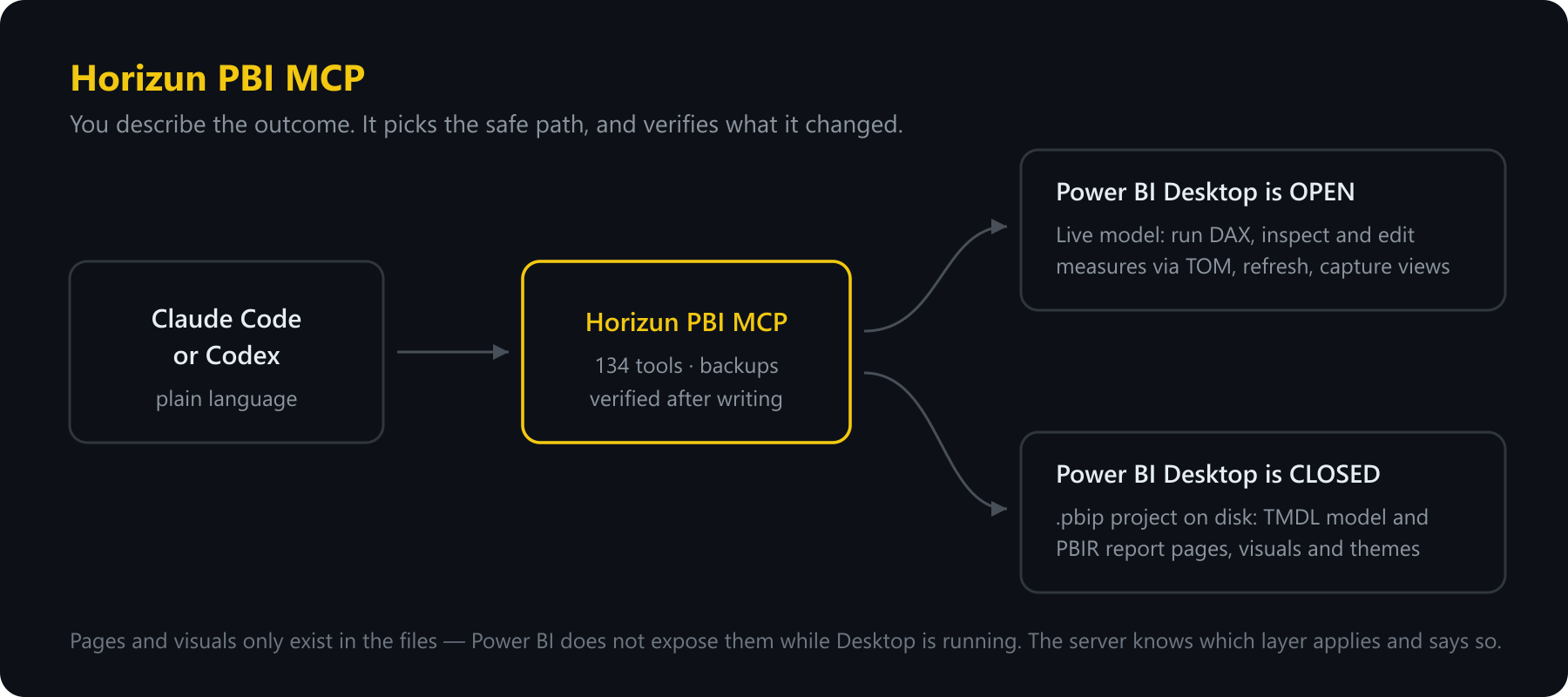
MCP (Model Context Protocol) server for working with local Power BI Desktop and .pbip projects from Claude Code.

v1.0.1 — 117 tools, 1547 tests passed (3 skipped, with their condition documented). Covers two complementary layers:

LayerFor whatHow
Live (Power BI Desktop open on localhost:<port>)Query data (DAX), document the model, create/edit measures, refreshADOMD.NET + TOM via pythonnet
On disk (.pbip project)Generate/arrange visuals, edit the model durablyTMDL (model) + PBIR (report), editing files

Key rule: the local endpoint only exposes the DATA layer (semantic model). Visuals/pages/layout are NOT in that endpoint or in any live API — they're edited via PBIR files. This MCP respects that separation: it doesn't try to move visuals "live".


Documentation

DocumentFor what
docs/INSTALL.mdInstall and register the server in Claude Code, Claude Desktop, Codex or a stdio client
docs/TOOL_INVENTORY.mdThe 34 baseline tools: domain, risk class, preconditions
docs/ARCHITECTURE.mdCurrent architecture, structural debt and invariants
docs/CAPABILITY_MATRIX.mdCoexistence with other Power BI MCPs, with verification levels
AGENTS.mdRules for modifying this repository without breaking the contract
docs/TOOL_CATALOG.mdThe 117 tools by block, with their risk class
docs/DUAL_MODE.mdWhy mode="both" is blocked (R15)
docs/VALIDATION.mdThe two PBIR validation layers and their limits
docs/RELEASE_CHECKLIST.mdWhat is checked before publishing
docs/BACKLOG.mdWhat remains open, with evidence and how to check it
docs/TUTORIAL.mdFrom installation to a dashboard, step by step
docs/SECURITY.mdThreat model, guarantees and what it does not promise
docs/RECOVERY.mdWhat to do when something is left half-done
docs/PHASE_1A_DESIGN.mdDesign of the security layer
CHANGELOG.mdVersion history
tests/fixtures/README.mdFixture strategy: versioned synthetic + ignored local copy

What it does

  • Live DAX: runs queries against the open model and returns columns/rows with timings.
  • Documentation: tables, columns, measures, relationships, hierarchies, roles (RLS) and quality analysis → Markdown.
  • Measures: create/edit/delete DAX measures in the open model (live), in the TMDL file (pbip) or in both (both).
  • Local refresh: refreshes the open model in Desktop (not the Service).
  • PBIP: open/validate projects, automatic backups.
  • .pbix.pbip conversion: report to PBIR (copied if the .pbix already carries it, translated if it keeps the legacy format) and model to TMDL, single file or batch folder.
  • PBIR visuals: list/document visuals, create visuals (cloning real templates from the report), move/resize and arrange by layouts.

What it does NOT do

  • It doesn't move or create visuals "live" on the open canvas (Power BI Desktop doesn't expose an API for that). Visuals are edited via PBIR files with the .pbip project.
  • It doesn't refresh or publish to the Power BI Service (local only).
  • It doesn't extract the model from a .pbix without Power BI Desktop: the DataModel stream is a backup compressed with XPress9 that only the Analysis Services engine knows how to read. When converting, the .pbix is opened in Desktop to serialize the model.
  • It doesn't translate legacy format bookmarks to PBIR: their state model is different and the conversion reports them as pending (dropped) instead of losing them silently. Creating new bookmarks is possible (pbi_create_bookmark).
  • It doesn't invent fields or nonexistent measures when generating pages.

Requirements

  • Windows (Power BI Desktop is Windows-only) with Power BI Desktop installed.
  • Python 3.10+ (tested on 3.14).
  • .NET Framework 4.x (comes with Windows) — used by pythonnet.
  • Python dependencies: mcp (includes FastMCP), pythonnet, psutil, python-dotenv.
  • ADOMD.NET + TOM DLLs (Analysis Services). Downloaded without admin rights via scripts/fetch_libs.py (no need to install in the GAC).
  • To edit/create visuals: the report saved as .pbip with PBIR enabled.
  • (Optional) Tabular Editor is not required — see Technical decisions.

Installation

Direct from Codex or Claude (recommended)

You don't need to download or register a .exe, create .mcp.json or manually locate this repository. The plugin sets up an isolated Python environment in the client's data folder and verifies every download.

Codex:

codex plugin marketplace add HorizunGroup/horizun-pbi-mcp
codex plugin add horizun-pbi-mcp@horizun

Claude Code:

claude plugin marketplace add HorizunGroup/horizun-pbi-mcp
claude plugin install horizun-pbi-mcp@horizun

When the first session opens, the plugin runs the full setup automatically in the background. Check pbi_install_status; once it finishes, restart the client and the 117 pbi_* tools will be available. There are no downloads or additional scripts the user needs to run manually.

Honest technical limit: there's no dedicated executable, but you do need Windows, Power BI Desktop and Python 3.10+. The server must run locally: a remote MCP cannot access Desktop's local engine or your .pbip files.

Manual installation for development

cd horizun-pbi-mcp

# 1) Python dependencies
python -m pip install -r requirements.txt
#   or:  python -m pip install -e .

# 2) Analysis Services DLLs (ADOMD.NET + TOM) -> libs/ folder
#    Pinned version (19.84.1) and SHA-256 verified before installing.
python scripts/fetch_libs.py

# 3) Official PBIR schemas (needed to WRITE)
#    Without them, every PBIR write fails with schema_unavailable.
python scripts/fetch_pbir_schemas.py

# 4) (optional, recommended) Microsoft's official PBIR validator
#    Requires Node >= 20. Adds semantic validation of the full report.
python scripts/fetch_report_validator.py

# 5) (optional) configuration
copy .env.example .env    # and edit it

Check the result at any time:

python scripts/doctor.py

Verify

With Power BI Desktop open on a report:

python src/server.py     # starts the MCP server (stdio); Ctrl+C to exit

For a quick test without MCP, in Python:

import sys; sys.path.insert(0, "src")
from config import get_session
from powerbi import desktop_discovery, dax_runner
s = get_session()
print(desktop_discovery.discover_instances())
desktop_discovery.select_model(s)
print(dax_runner.run_dax(s, 'EVALUATE ROW("ok", 1)'))

Registering with an MCP client

Full guide for Claude Code, Claude Desktop, Codex and generic stdio clients: docs/INSTALL.md.

Each client resolves environment variables, the working directory and the Python interpreter differently, so instead of a ${VAR} template that fails on half of them, there's a generator that resolves the absolute paths on your machine:

python scripts/make_mcp_config.py --client all

It only prints. To create this repository's local .mcp.json (which is in .gitignore):

python scripts/make_mcp_config.py --client claude-code --write

Before registering anything, check the installation:

python scripts/doctor.py

Exits with code 0 if everything mandatory is fine. It distinguishes missing dependency, missing DLL, server that won't start, unexpected MCP contract, Desktop closed, stale session and multiple instances. Power BI Desktop being closed does not fail the base diagnostic (use --require-desktop if you want to require it).

Environment variables (all optional)

VariableDefaultDescription
HORIZUN_PBI_MCP_LIBS_DIR./libsFolder with the ADOMD.NET/TOM DLLs
HORIZUN_PBI_MCP_DOTNET_RUNTIMEnetfxpythonnet runtime (netfx or coreclr)
HORIZUN_PBI_MCP_MAX_ROWS1000Default row limit in DAX
HORIZUN_PBI_MCP_OUTPUTS_DIR./outputsDocumentation and change_log.md
HORIZUN_PBI_MCP_BACKUPS_DIR./backups.pbip backups
HORIZUN_PBI_MCP_LOG_LEVELINFODEBUG/INFO/WARNING/ERROR
HORIZUN_PBI_MCP_DEFAULT_PBIP.pbip to open on startup

Available tools (117)

Full catalog by block: docs/TOOL_CATALOG.md. Baseline inventory with risk class and preconditions: docs/TOOL_INVENTORY.md. Names and signatures are frozen in tests/golden/tools_v1.json and verified by tests/test_tool_contract.py.

Connection / DAX

  • pbi_list_desktop_models — lists open models (port, connection string, catalog, number of tables).
  • pbi_select_model — sets the active model (by port if there are several).
  • pbi_run_dax — runs DAX (query, max_rows).
  • pbi_test_connection — validates the active connection.
  • pbi_validate_measures — validates measure DAX WITHOUT modifying the model (dry-run with DEFINE MEASURE); useful before creating them.
  • pbi_validate_desktop_render — opens a .pbix/.pbip, captures the exact window by PID without depending on focus and only closes Desktop if the tool itself opened it.

Documentation (Phase 3)

  • pbi_list_tables, pbi_list_measures, pbi_list_relationships — with source: live|pbip.
  • pbi_analyze_model_quality — typical model issues.
  • pbi_document_model — complete documentation in Markdown to outputs/.

Measures (Phase 4)mode: live|pbip|both, overwrite

  • pbi_create_measure, pbi_update_measure, pbi_delete_measure (destructive: confirm=true).

Refresh (Phase 5)

  • pbi_refresh_modeltype: full|calculate|clear_values, tables optional (local).

PBIP project (Phase 6)

  • pbi_open_pbip_project (path), pbi_validate_pbip_project, pbi_backup_pbip_project (mode: folder|zip, scope: report|model|both).

.pbix.pbip conversion

  • pbi_inspect_pbix — X-ray of the file without converting it or opening Desktop: report format, whether it carries its own model, pages and resources.
  • pbi_list_convertible_pbix — preview of a folder: what would be copied, what would need translating and which ones need Desktop.
  • pbi_convert_pbix_to_pbip — generates the project. Accepts a .pbix or a folder (recursive), and returns per file what was written, the warnings and what was left out (dropped).

The report is translated without Desktop, but the model requires opening each .pbix in Power BI Desktop (the session is reused if it's already open, and closed if the tool opened it). With include_model=false only the report half is generated, instantly. The original .pbix is never modified.

Power BI Desktop does not open a .pbip with paths of 260 characters or more: pick a short out_dir (C:\pbip). The tool checks this before writing and aborts with the detail instead of leaving a project that won't open.

Model editing

  • pbi_set_column_visibility / pbi_hide_columns — hide/show columns (e.g. IDs). mode: live|pbip|both.
  • pbi_set_relationship_direction — cross filter single|both of a relationship. mode: live|pbip|both.
  • pbi_disable_auto_date_time — enables/disables "Auto date/time" (pbip only).

PBIR Report (Phases 7–10)

  • pbi_list_report_pages, pbi_list_visuals (page), pbi_document_report_layout.
  • pbi_create_visualpage, visual_type, fields, position, title (clones an existing visual as a template).
  • pbi_update_visual_position, pbi_arrange_visuals (layout: grid|dashboard|executive_summary|custom).
  • pbi_generate_report_page — assisted page generation from the model.

HTML inside Power BI

  • pbi_add_custom_visual — registers an AppSource custom visual in the report (defaults to HTML Content, which renders HTML/SVG from a DAX measure).
  • pbi_create_html_visual — creates an HTML Content visual bound to a measure that returns HTML (html_measure).
  • pbi_create_measure with data_category: "ImageUrl" — measures that return an SVG data-URI and render as an image in native tables/matrices.

Natural-language sheet generation

  • pbi_page_building_blocks — content inventory (model + catalog of existing visuals + canvas) to design a sheet.
  • pbi_preview_spec_htmlHTML mockup of a proposed sheet (review before writing).
  • pbi_create_page_from_spec — materializes a full PBIR sheet from a spec (clones existing visuals by style).
  • pbi_export_page_html — exports an existing page to an HTML mockup.

Every tool returns {"ok": true/false, ...}; on error it includes error (code) and message (the engine's original message, never hidden).

Sheet generation flow: pbi_page_building_blocks → (Claude interprets your instruction and builds a spec) → pbi_preview_spec_html (you review the HTML) → pbi_create_page_from_spec (the PBIR gets written).


Usage examples (in natural language with Claude)

  • Run DAX: "List the open models, select the only one, and run EVALUATE TOPN(10, Sales)."
  • Document: "Document the active model and analyze its quality." → generates outputs/model_documentation_*.md.
  • Create measure: "Create the measure Margin % = DIVIDE([Profit],[Sales]) in the Sales table, format 0.0%, mode both."
  • List visuals: "Open the .pbip at C:/…/Report.pbip and list the visuals on the 'Summary' page."
  • Create visual: see examples/sample_visual_specs.json.
  • Arrange page: "Arrange the 'Summary' page with executive_summary layout."

More DAX in examples/sample_queries.md.

⚠️ PBIR editing and Desktop state: report edits (visuals/layout) are made to files; it's best to make them with Power BI Desktop closed and reopen it to see them (if Desktop is open and you save, it overwrites the changes on disk). Live model edits (live measures) require Desktop open and are persisted on save (Ctrl+S).


Troubleshooting

  • Doesn't detect the port / "No se detecto ningun modelo": open the report in Power BI Desktop; the port changes on every startup (the MCP discovers it on its own). If you use the Microsoft Store version, it's still detected by process.
  • adomd_not_installed / tom_not_installed: run python scripts/fetch_libs.py. Check that libs/Microsoft.AnalysisServices.AdomdClient.dll exists.
  • clr_not_available: .NET is missing; try PBI_MCP_DOTNET_RUNTIME=coreclr.
  • DAX error: the engine's message is returned as-is in message. Check the syntax (EVALUATE, quotes).
  • pbir_not_enabled: the report isn't in PBIR. Save as .pbip and enable Power BI Project (PBIR) format under Options → Preview Features (if applicable to your version) before saving.
  • Power BI doesn't reload visual changes: close it and reopen it; PBIR loads on open, not live.
  • Permissions/OneDrive: if the .pbip is in OneDrive, close Desktop before editing files and wait for OneDrive to finish syncing; backups are saved in backups/.

Technical decisions

  • TOM via pythonnet (not the Tabular Editor CLI). Evaluated: (1) Tabular Editor 2 CLI, (2) pythonnet loading TOM, (3) editing TMDL directly. Since pythonnet works on Python 3.14 and the ADOMD.NET/TOM DLLs can be vendored into libs/ without admin or GAC, loading them directly with pythonnet (runtime netfx) was chosen. It's more stable, has no external installation dependencies, and gives full control (create/edit measures and refresh, just like Tabular Editor). Durable editing is still available via TMDL in .pbip.
  • Visuals by cloning. pbi_create_visual clones an existing visual of the same type as a template (preserving the format/theme scaffolding) and only falls back to a minimal template if none exists, warning that it must be validated in Desktop.
  • Security (Phase 11): automatic backup before every .pbip write; atomic JSON (never leaves corrupted files); doesn't overwrite unreadable JSON; path validation; change_log.md in outputs/; destructive operations require confirm=true.

Limitations / open risks

None of these is a defect that can be fixed from here. They're documented because they affect what the server can promise.

Schemas Microsoft doesn't publish

Power BI Desktop writes visualContainer/2.10.0 and 2.11.0 in recent reports, and those URLs return 404 at the official source. The same happens with bookmarks/2.0.0. Microsoft's own official CLI can't validate them either: it emits PBIR_SCHEMA_UNREACHABLE and skips validation of those files.

For visualContainer, 2.10/2.11 are compared against 2.7 because that downgrade was measured against 275 real files and only differs in what a later version might add. bookmarks/2.0.0 is blocked with schema_unavailable because there's no earlier version of the same family to check it against.

Measured on a real 443-document report: 176 validate, 240 remain blocked for this reason.

G10 remains a documented release exception.

mode="both" blocked

live requires Power BI Desktop open; pbip requires it closed. There's no system state in which both destinations can be safely written in a single call. See docs/DUAL_MODE.md. R15 open.

filters and interactions in the page spec

They are rejected with unsupported_feature indicating the exact JSON path. They aren't silently dropped. Their serialization to PBIR is pending.

Others

  • PBIR must be enabled in the .pbip; pbi_validate_pbip_project checks this.
  • The friendly name of the open report isn't always readable from the engine (port + catalog are reported instead).
  • The on-disk TMDL parser is pragmatic (tables, columns, measures, relationships); for rich metadata, use the live path.
  • pbi_generate_report_page is a heuristic composition; it doesn't invent fields and warns about what it ignores.
  • The server starts without Node; what gets blocked are the writes that need the official validator.

Project structure

horizun-pbi-mcp/
├─ src/
│  ├─ server.py            # FastMCP + tool registration
│  ├─ config.py            # settings + session (active model/pbip)
│  ├─ logging_config.py
│  ├─ reporting.py         # Markdown documentation + quality
│  ├─ powerbi/             # live layer (ADOMD/TOM)
│  ├─ pbip/                # on-disk layer (TMDL/PBIR)
│  ├─ tools/               # MCP tools by area
│  └─ utils/               # JSON, files, validation, change_log
├─ scripts/fetch_libs.py   # downloads Analysis Services DLLs
├─ examples/  tests/  outputs/  libs/
├─ README.md  PLAN.md  pyproject.toml  requirements.txt  .env.example

Tests

python -m pytest -q

1262 tests, 3 skipped. The skip is environmental and says how to run it:

SkippedCondition
test_run_dax_liveRequires a Power BI Desktop instance serving a model. python -m pytest -m live
test_no_llega_a_cero_por_acumular_infosRequires the synthetic model to trigger only informational rules

Available markers:

python -m pytest -m "not packaging"     # fast: skips wheel and sdist
python -m pytest -m live                # against an open Power BI Desktop
python -m pytest -m live_validator      # against Microsoft's official CLI

Verify the MCP contract (the 117 tools are frozen):

python -m tests.contract_utils

Returns 0 if there are no breaks, 1 if there are, with a report stating what changed and whether it breaks compatibility.

Installation diagnostics:

python scripts/doctor.py

License

Open source under the Apache License 2.0. Also see NOTICE for third-party attributions and trademarks.

Reviews

No reviews yet

Be the first to review this server!