
Server data from the Official MCP Registry
Catches hallucinated and slopsquatted npm and PyPI packages before an agent installs them.
About
Catches hallucinated and slopsquatted npm and PyPI packages before an agent installs them.
Security Report
Valid MCP server (1 strong, 1 medium validity signals). No known CVEs in dependencies. Package registry verified. Imported from the Official MCP Registry.
7 files analyzed · 1 issue found
Security scores are indicators to help you make informed decisions, not guarantees. Always review permissions before connecting any MCP server.
Permissions Required
This plugin requests these system permissions. Most are normal for its category.
What You'll Need
Set these up before or after installing:
Environment variable: PKGTRUTH_REGISTRY
Environment variable: PKGTRUTH_DOWNLOADS_API
Environment variable: PKGTRUTH_CACHE_DIR
Environment variable: PKGTRUTH_TIMEOUT_MS
How to Install
Add this to your MCP configuration file:
{
  "mcpServers": {
    "io-github-hxckya-pkgtruth": {
      "env": {
        "PKGTRUTH_REGISTRY": "your-pkgtruth-registry-here",
        "PKGTRUTH_CACHE_DIR": "your-pkgtruth-cache-dir-here",
        "PKGTRUTH_TIMEOUT_MS": "your-pkgtruth-timeout-ms-here",
        "PKGTRUTH_DOWNLOADS_API": "your-pkgtruth-downloads-api-here"
      },
      "args": [
        "-y",
        "pkgtruth"
      ],
      "command": "npx"
    }
  }
}Documentation
View on GitHubFrom the project's GitHub README.
pkgtruth


Ground truth about npm and PyPI packages, for AI coding agents and CI.
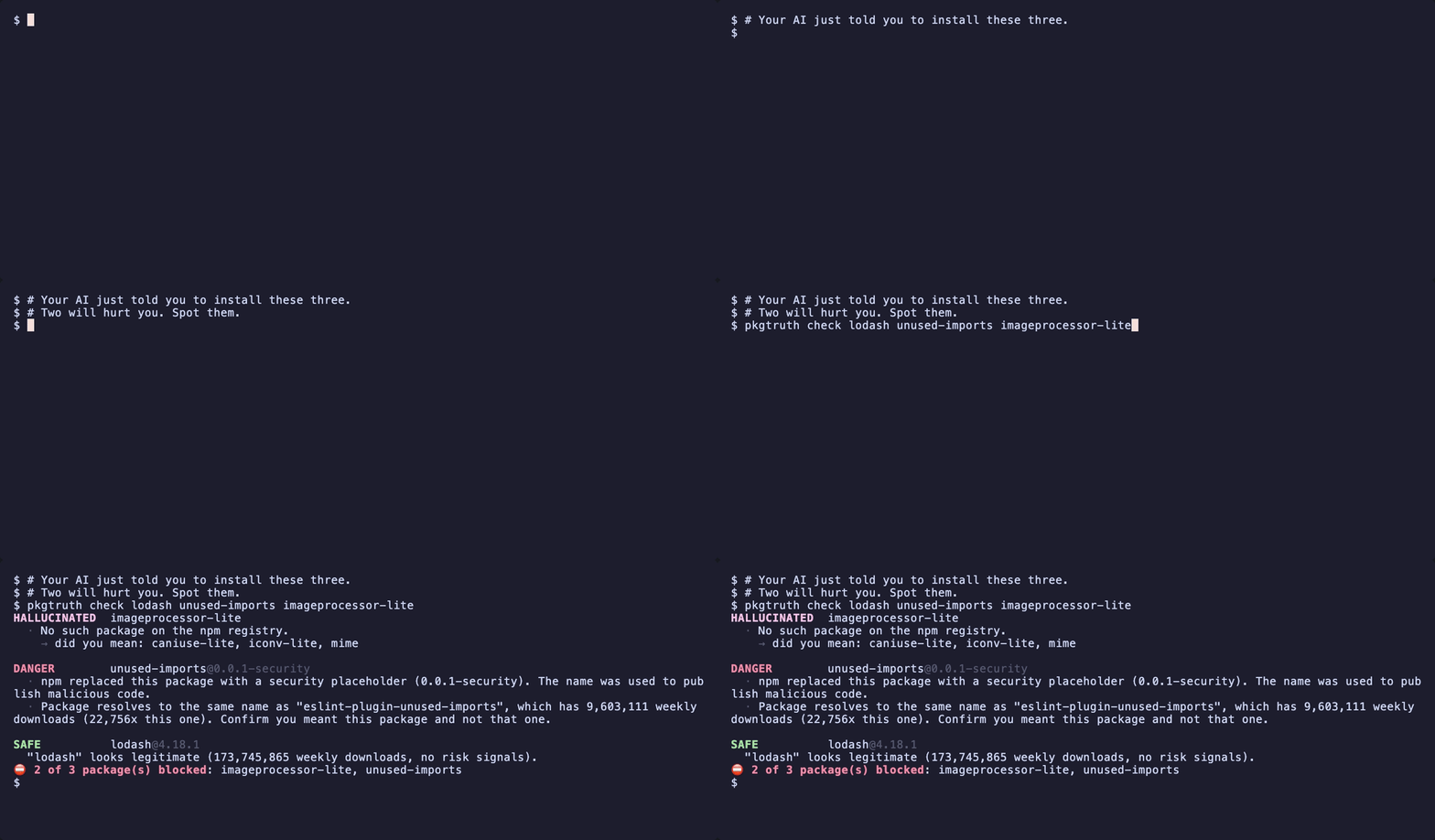
Your agent just wrote npm install unused-imports. That package is not the
linter plugin it meant. It is a name an attacker registered because models
kept inventing it — and npm has since replaced it with a security placeholder.
pkgtruth catches that before it reaches your lockfile — as an MCP server the
agent asks, a CLI for CI, a GitHub Action on pull requests, or a Claude Code
hook that denies the install command itself.
Why this exists
Large language models invent package names. Measured across models, 19.7% of generated package names were hallucinated, and when researchers re-ran the prompts, 43% of those names came back every single time.
That reproducibility is the whole attack. An attacker does not need to compromise a maintainer, poison a build server, or find a vulnerability. They watch what models invent, register the name, and wait. The technique is called slopsquatting, and it is already happening in the wild.
The standing security advice is that agents with package-management
capabilities should not install anything without a review gate. pkgtruth is
that gate, in a form an agent can call on its own.
Found in the wild
Two names a model plausibly produces, both live on npm today:
| Name | What it is | Weekly installs | The real one |
|---|---|---|---|
types-node | 0.0.1-security — npm's placeholder after purging malware | 10 | @types/node (429M) |
socket-io | Deprecated since 2022, "use the socket.io package instead" | 1,486 | socket.io (18M) |
types-node is what you get when a model drops the scope from @types/node.
npm removed it for malicious code in December 2024 and it is still installed
ten times a week.
socket-io is not malicious — it is an abandoned package with a confusable
name. That it takes 1,486 installs a week anyway is the point: a dot and a
hyphen are enough.
PyPI has the same shape without the placeholder:
| Name | What it is | Weekly installs | The real one |
|---|---|---|---|
sklearn | Deprecated shim — its own notice says "use scikit-learn instead" | 321,887 | scikit-learn (42.6M) |
pytorch | A decoy whose only content is "the package named for PyTorch is torch" | 41,026 | torch (14.4M) |
Neither is spelled anything like the package it stands in for, which is why pkgtruth also reads what a deprecation notice says: when it names a far more popular package, that name is the evidence.
npx pkgtruth check types-node socket-io
npx pkgtruth check -e pypi sklearn pytorch
Those two came from a hand check of twenty names. The systematic version — 242 well-known packages, every plausible garbling of each, regenerated every Monday — lives in SLOPSQUATS.md. Section A there is npm security placeholders alone: names npm purged for malware that are still being installed this week. Weeks in which names enter or leave the list are published as releases, so the releases feed is a way to follow the live list without watching the repository.
Install
As an MCP server (for coding agents)
{
  "mcpServers": {
    "pkgtruth": {
      "command": "npx",
      "args": ["-y", "pkgtruth"]
    }
  }
}
Three tools become available:
| Tool | Use it when |
|---|---|
check_package | About to add, import, or recommend one dependency (ecosystem: "npm" | "pypi", default npm) |
check_dependencies | About to write a package.json / requirements.txt |
check_install_command | About to run npm install …, npx …, pip install … — hand it the exact command |
As a Claude Code hook (the install command itself is stopped)
An MCP tool only helps when the agent remembers to call it. A PreToolUse
hook runs on every shell command instead, and denies npm install, npx,
pnpm add, yarn add, bun add, pip install, uv add, poetry add
and friends when a package they name is hallucinated or dangerous. Add this
to ~/.claude/settings.json (every project) or .claude/settings.json
(one repository, committable):
{
  "hooks": {
    "PreToolUse": [
      {
        "matcher": "Bash",
        "hooks": [{ "type": "command", "command": "npx -y pkgtruth hook" }]
      }
    ]
  }
}
Commands that install nothing by name — a bare npm install, git, tests,
npx <bin> of a tool already in node_modules — pass through with no network
call. A blocked command comes back to the agent
as a denial with the evidence, so it can pick the real package instead:
pkgtruth blocked this command: 1 of 2 package(s) must not be installed as-is.
  ✖ crossenv DANGER — npm replaced this package with a security placeholder (0.0.2-security).
    The name was used to publish malicious code. Package is 1 edit(s) from "cross-env",
    which has 22,155,059 weekly downloads (15,418x this one). Confirm you meant this
    package and not that one.
Add --fail-on caution to also stop packages that could not be verified.
npm install -g pkgtruth with "command": "pkgtruth hook" skips the npx
resolution on every call (measured: ~0.2 s per command via npx, ~0.03 s direct). The hook reads tool_input.command from Claude
Code's JSON, or a bare command string from any other agent that pipes one in,
and exits 2 with a permissionDecision: "deny" when it blocks — there is no
environment variable that turns it off, because the agent controls the
environment of the command it runs.
As a Claude Code plugin (server + hook in one install)
/plugin marketplace add hxckya/pkgtruth
/plugin install pkgtruth@pkgtruth
The plugin (plugin/) registers the MCP server and the hook above
together, pinned to the npm release it ships with.
As a CLI (for humans and CI)
npx pkgtruth check express unused-imports          # npm (default)
npx pkgtruth check -e pypi requests sklearn        # PyPI
npx pkgtruth scan .                                 # every manifest in the directory
scan reads package.json, requirements*.txt and pyproject.toml
(PEP 621 and Poetry), checks each against its own registry, and exits
non-zero when something is blocking, so it drops straight into CI.
As a pull-request gate (GitHub Action)
hxckya/pkgtruth-action (on the
GitHub Marketplace) runs the scan on every pull request, posts one sticky comment with the evidence, and
fails the check on HALLUCINATED or DANGER:
on:
  pull_request:
    paths: ['package.json', '**/package.json']
permissions:
  contents: read
  pull-requests: write
jobs:
  pkgtruth:
    runs-on: ubuntu-latest
    steps:
      - uses: actions/checkout@v5
      - uses: hxckya/pkgtruth-action@v1
This repository gates itself with it — see
.github/workflows/gate.yml, which also proves
the gate can fail by running it against a deliberately bad fixture.
What it checks
| Signal | Meaning |
|---|---|
| Not in registry | The name is fabricated. Nothing to install. |
| npm security placeholder | npm removed malicious code published under this name. |
| Impersonates a popular package | A near-identical name with a fraction of the adoption — or a deprecation notice that itself names the package you meant (sklearn → scikit-learn, pytorch → torch). |
| Yanked (PyPI) | Every file of the latest release was yanked by its maintainer. |
| Install-time scripts | preinstall/install/postinstall run code on npm install. |
| Deprecated | Upstream says stop using it. |
| Very new / almost no adoption | Days old with single-digit installs. |
| No repository | No source to audit. |
| Unmaintained | No release in years. |
Verdicts are SAFE, CAUTION, DANGER, HALLUCINATED, or UNKNOWN. Every
one arrives with the evidence behind it — an agent should never have to take
"DANGER" on faith, and neither should you.
Design notes
Network failures never open the gate. If the registry is unreachable, the
verdict is UNKNOWN, never SAFE. A degraded network must not silently turn
a security check into a no-op.
Popular packages are not flagged — measured, not asserted. The false-positive audit runs the detector over the direct dependency closure of 240 well-known packages: 1,523 real packages, 0 blocking verdicts, 0 UNKNOWN after the built-in second pass, and 40 CAUTION (deprecated or unmaintained — true statements, not blocked by default). A gate that cries wolf gets switched off; this one has a number attached.
No build step. Two direct dependencies — the MCP SDK and zod, both only
needed for the server. npx pkgtruth starts immediately.
Limitations
Read these before trusting it:
- npm and PyPI only. crates.io, Go modules, RubyGems are not covered yet.
- PyPI has no purge marker. npm leaves a
-securityplaceholder where it removed malware; PyPI deletes the project, so a purged PyPI name simply reads asHALLUCINATED. PyPI also has no search API — near-twins are found against a daily snapshot of the top 15,000 projects by downloads, so an impostor of an obscure package will not be caught. - Registry metadata only. It does not analyze package source code, so a legitimate-looking package with a malicious payload can still pass.
- Not a replacement for
npm auditor Snyk. Those find known CVEs in code you already trust.pkgtruthasks the earlier question: should this package be here at all? - New legitimate packages will get
CAUTION. That is deliberate. Newness genuinely is a risk signal; use--fail-on dangerso it does not block.
Options
--json              Machine-readable output
--fail-on <level>   danger (default) | caution
--fail-on caution also blocks packages that could not be verified at all,
since "we could not check" is not a pass.
Exit codes: 0 clean, 1 blocking packages found, 2 usage or runtime error.
Configuration
| Variable | Default | Purpose |
|---|---|---|
PKGTRUTH_TIMEOUT_MS | 8000 | Per-request timeout |
PKGTRUTH_RETRIES | 3 | Retries for 429/5xx/network errors |
PKGTRUTH_MAX_CONCURRENCY | per-host | Override request pacing |
PKGTRUTH_REGISTRY | npm | Alternate registry |
PKGTRUTH_DOWNLOADS_API | npm | Alternate downloads API |
PKGTRUTH_PYPI / PKGTRUTH_PYPISTATS | pypi.org / pypistats.org | Alternate PyPI endpoints |
PKGTRUTH_PYPI_TOP | hugovk top-pypi-packages | Alternate popularity snapshot for PyPI twins |
PKGTRUTH_CACHE_DIR | ~/.cache/pkgtruth | Where adoption figures are cached |
PKGTRUTH_DISK_TTL_MS | 6 hours | How long a cached figure stays usable |
PKGTRUTH_NO_DISK_CACHE | unset | Set to 1 to disable the cache |
On speed and rate limits
Adoption figures come from npm's downloads API, which throttles bursts and
cannot batch scoped names — a project with several @scope/pkg dependencies
would spend its whole budget on every scan.
Three things keep that in check: the bulk endpoint resolves all unscoped names in one request, requests to that host are paced serially, and figures are cached on disk for six hours. Weekly download counts move slowly, so a six-hour-old number is no less true.
A warm scan of ~18 dependencies takes about 1.4 seconds. Large scans that
draw 429s from the downloads API leave some packages UNKNOWN on the first
pass; every entry point then re-checks only those names, serially, after a
short pause. In the 1,523-package audit that second pass cleared all of them.
A throttled lookup never becomes SAFE.
Cached figures are keyed by the API they came from, so pointing
PKGTRUTH_DOWNLOADS_API at a private registry never reuses npm's numbers.
Contributing
Issues and pull requests are welcome at github.com/hxckya/pkgtruth.
Two things make a report especially useful: a legitimate package that gets flagged, and a malicious one that slips through. Both are regression tests waiting to be written.
npm test                 # offline
npm run test:online      # includes live registry checks
License
MIT © hxckya
Reviews
No reviews yet
Be the first to review this server!
More Developer Tools MCP Servers
Fetch
Freeby Modelcontextprotocol · Developer Tools
Web content fetching and conversion for efficient LLM usage
Git
Freeby Modelcontextprotocol · Developer Tools
Read, search, and manipulate Git repositories programmatically
Toleno
Freeby Toleno · Developer Tools
Toleno Network MCP Server — Manage your Toleno mining account with Claude AI using natural language.
MCP Marketplace
Freeby mcp-marketplace · Developer Tools
Search and install MCP servers from inside your AI client.
mcp-creator-python
Freeby mcp-marketplace · Developer Tools
Create, build, and publish Python MCP servers to PyPI — conversationally.
FinAgent
Freeby mcp-marketplace · Finance
Free stock data and market news for any MCP-compatible AI assistant.