
Server data from the Official MCP Registry
Parametric CAD as code: model 3D-printable parts on an exact B-rep kernel, measured.
About
Parametric CAD as code: model 3D-printable parts on an exact B-rep kernel, measured.
Security Report
Valid MCP server (3 strong, 2 medium validity signals). No known CVEs in dependencies. Imported from the Official MCP Registry. Trust signals: 3 highly-trusted packages.
14 files analyzed · No issues found
Security scores are indicators to help you make informed decisions, not guarantees. Always review permissions before connecting any MCP server.
Documentation
View on GitHubFrom the project's GitHub README.
ParCAD
Parametric CAD you write as code — for people, and for agents.
Status: 0.0.7, experimental. One author, and the DSL still moves. Every operation is checked against measured geometry (eval/cases/), but none of it has had the years of abuse that make a CAD kernel trustworthy. Measure a part before you machine it.
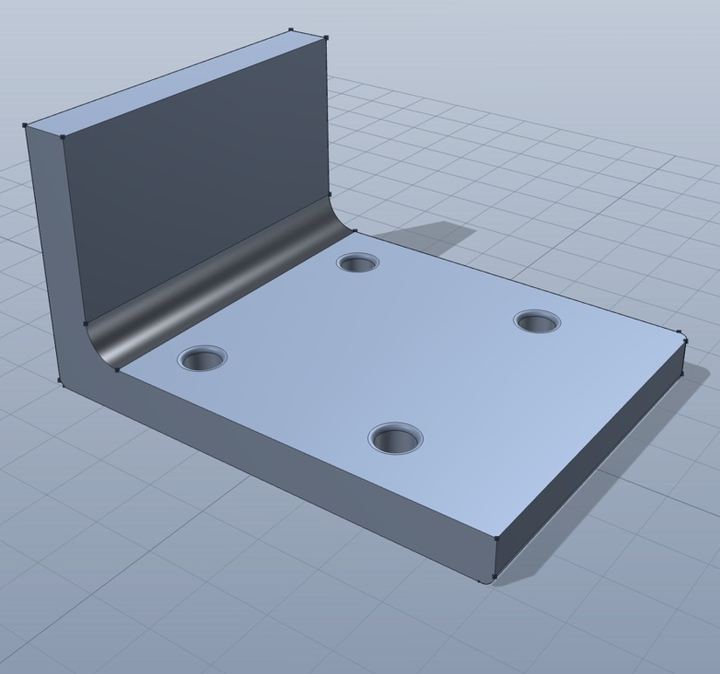
const plate = box(80, 60, 8).tag("plate");
const wall = box(8, 60, 40).at(-36, 0, 20).tag("wall");

const body = union(plate, wall, { blend: 6 });          // the blend is the fillet
const drilled = body.cut(...grid(2, 2, 36, 40).map(([x, y]) => cylinder(3, 32).at(x, y)));

return drilled
  .edges({ curve: "circle", role: "hole", adjacentTo: { faceNormal: "+z" } })
  .expect({ count: 4 })                                  // a build error, not a surprise
  .fillet(0.8);
You never name an edge by index. You describe it — the circular rims that open onto the top face — and the description still works after you move a hole.
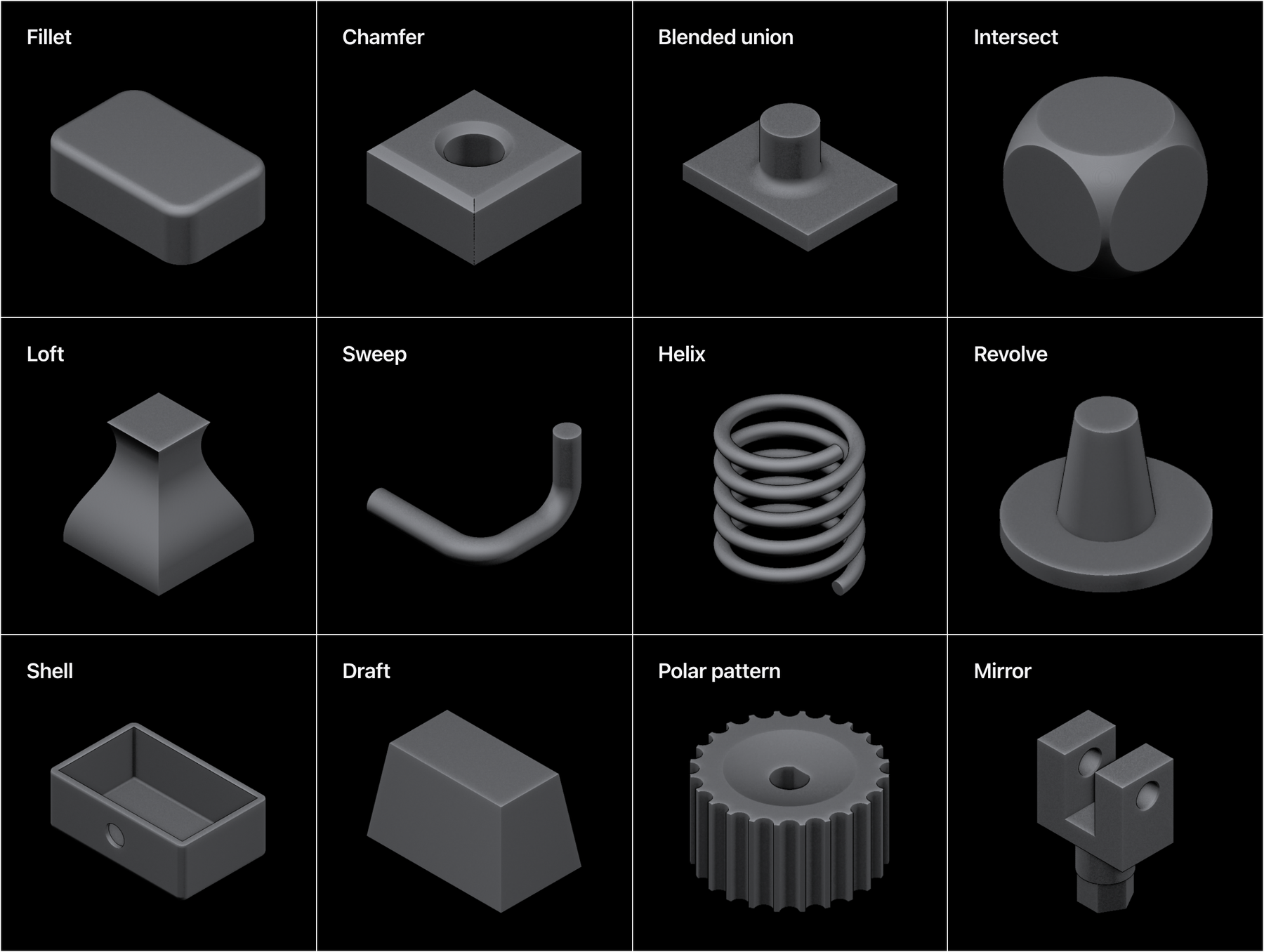
One graph, one exact kernel
Your script builds a small JSON graph, and an exact kernel reads it — OpenCASCADE: real faces and edges, STEP export, and a refusal rather than an approximation when it cannot do something faithfully. The graph is what keeps today's script working after tomorrow's kernel swap.
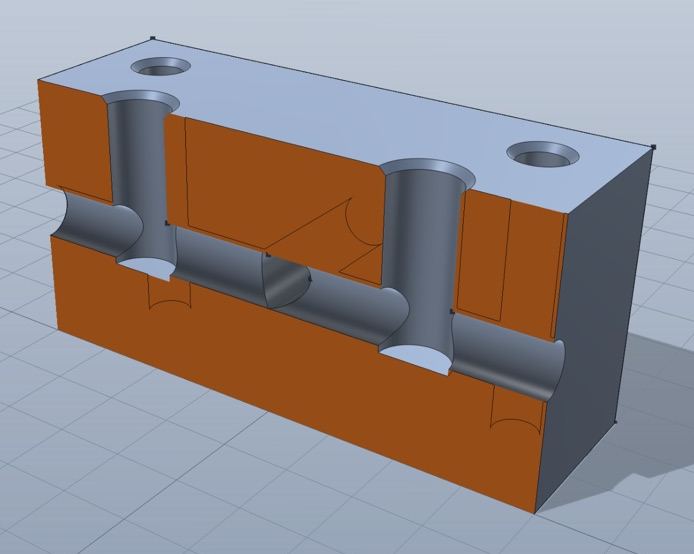
Parts get measured, not assumed — volume, wall thickness, whether two bores actually meet. An agent gets the same numbers over MCP, with no screen to look at.
And when it does look, it gets pictures made for reading: views that share one scale, sections through the inside, and every surface coloured by the tag that built it.
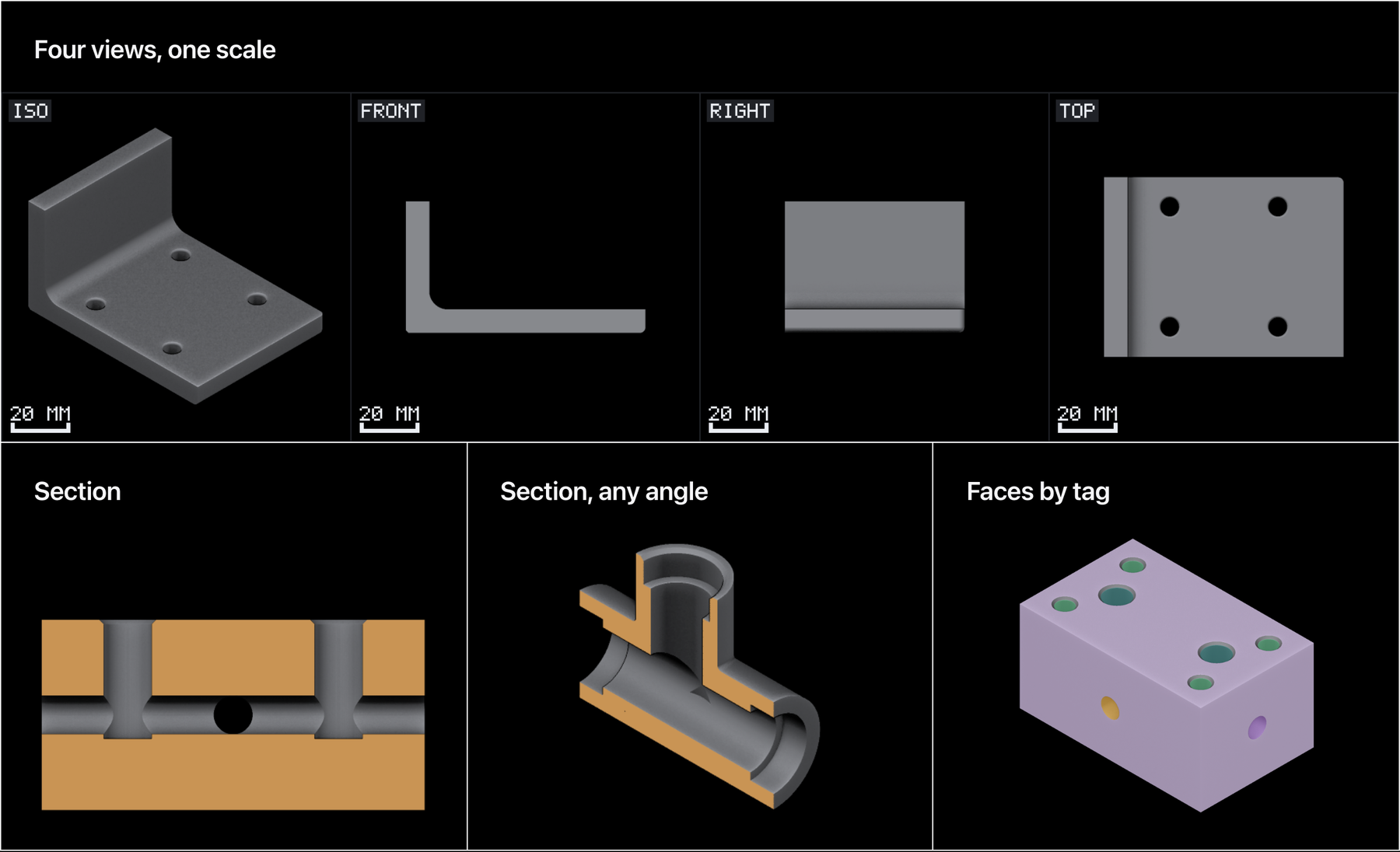
It is aimed at small mechanical parts — brackets, flanges, manifolds, heat sinks, the things you print or machine one of. examples/ is twenty-two.
Why not CadQuery, build123d or OpenSCAD
Those are good, and much older. Three differences. Selectors are descriptive and
checked — .expect({ count: 4 }) turns a selector that silently started
matching three edges into a build error, which is the failure mode that makes
code-CAD fragile. What you see, what you measure and what you export come off
one exact B-rep, so the preview and the STEP file are one model, not two
projects. And measurement is an output rather than something you eyeball,
which is what makes the MCP surface real instead of a wrapper.
Install it
With Homebrew, on macOS or Linux (Linux from 0.0.6), which installs the host and no window:
brew tap ierehon1905/parcad
brew trust ierehon1905/parcad
brew install parcad
Then add it to your agent, which starts parcad when it
needs it. To use the app yourself, run parcad serve and open
http://127.0.0.1:4242 — the whole app is there, in your browser.
On Windows, from 0.0.6, the desktop app through winget:
winget install ParCAD.ParCAD
Nothing on the Homebrew path is quarantined. The same parcad is the headless driver
(parcad part.js), and a client of the running host: parcad tools
lists what an agent can call over MCP and parcad call <tool> calls it from
a shell.
Or the desktop app, from Releases:
| platform | download |
|---|---|
| macOS, Apple silicon | ParCAD-aarch64-apple-darwin.zip — unzip, drag to Applications |
| Linux x86_64 | .deb or .AppImage |
| Windows x86_64 | .msi or -setup.exe |
Each platform's build measures the whole eval corpus with the worker it ships before it is uploaded. None of them is signed. macOS will refuse to open the app the first time, and again after each update. Clear the flag:
xattr -dr com.apple.quarantine /Applications/ParCAD.app
Windows SmartScreen warns the same way: More info, then Run anyway. Every
platform also has a parcad-cli-* archive — parcad, its worker beside it and
the seed parts — for running the host without a window. Keep the two binaries
together.
Build it
macOS, Linux and Windows. Day-to-day development is on macOS; the release workflow builds and measures on all three, and Linux on arm64 builds too.
You need Rust (the toolchain is pinned; rustup honours it),
Bun, CMake, a C++ compiler, patch(1) and Python 3.11+. A
clone is a 28 MB pack that expands to 144 MB, most of it a vendored OpenCASCADE
tree, and a full build wants around 20 GB free. On Linux the window also needs
WebKitGTK (libwebkit2gtk-4.1-dev), and libclang-dev for the script sandbox's
bindings. On Windows, use MSVC (Visual Studio Build Tools) and run the scripts
from Git Bash, which also provides patch.
cd app && bun install --frozen-lockfile && cd ..   # first: the Rust build shells out to bun
cargo build --locked --release
tools/build-worker.sh --release   # the exact kernel — ~5 min on 14 cores, once
cd app && bun run tauri dev
cargo build produces a dev app whatever the profile — Tauri's switch is the
custom-protocol feature, not --release — so launch the window through tauri dev or tauri build, never the bare binary. And a root cargo build
deliberately does not build OpenCASCADE; tools/build-worker.sh does.
tools/check.sh            # everything that gates a change (~5 min)
tools/check.sh --fast     # the kernel crates and the editor tests (~4 s)
Or headless:
bun tools/run.ts examples/bracket.js > /tmp/bracket.json
./target/release/parcad /tmp/bracket.json --out out --step out/part.step
The app serves its UI and an MCP endpoint on http://127.0.0.1:4242. Parts live
in ~/Library/Application Support/parcad as plain .js files you can edit anywhere.
Use it from an agent
With nothing installed: open ParCAD web, choose Connect your AI, and give your client the link it shows — Claude Code, the Claude app as a custom connector, Cursor, VS Code, or any client that connects to a URL. The tab is the server, with the same tools as the app, and it has to stay open; a relay passes the messages and keeps none (relay/README.md).
Every route below runs the same parcad on your machine: the one Homebrew
installs, which the desktop app carries too. Install either first.
As a plugin, which brings the MCP server and a skill that says how to use it:
/plugin marketplace add ierehon1905/parcad
/plugin install parcad@parcad
In Codex, which finds parcad on PATH, so the Homebrew install:
codex plugin marketplace add ierehon1905/parcad
codex plugin add parcad@parcad
In Cursor or VS Code, with parcad on PATH:


Or add the server by hand, in any client that launches stdio servers:
claude mcp add parcad -- parcad mcp
codex mcp add parcad -- parcad mcp
parcad mcp relays to the app or parcad serve when one is running, so the
agent shares the live session with your window. When none is running it hosts
one itself, for as long as the client stays connected. A client that connects
by URL can use http://127.0.0.1:4242/mcp directly, but only while a host is
up; brew services start parcad keeps one up from login.
The same tools are on the command line, with the same names and arguments —
parcad tools lists them, parcad call evaluate_part --set script=@part.js
calls one — and they work whether or not the app is open.
Start the agent on the read_docs tool, which hands over the whole language in
one call.
More
- examples/ — twenty-two parts, from a bracket to a hydraulic manifold
- CONTRIBUTING.md — the gate, and what a change has to satisfy
- docs/ARCHITECTURE.md — how the pieces fit, and why
- docs/GOTCHAS.md — traps that have already cost a day each
- docs/NEXT.md — what's missing, in order
Licensing
ParCAD is free software under the GNU AGPL-3.0 or later: use it,
change it and share it, but a modified ParCAD you distribute or run as a service
must publish its source too. The parts you make are yours — part scripts and
everything ParCAD exports from them can be licensed however you like, and the
seed parts in examples/ are MIT. Releases through v0.0.9 stay MIT or
Apache-2.0.
Built on components under other licences: OpenCASCADE
and its bindings under vendor/ are LGPL-2.1, and one file of our own,
crates/parcad-core/src/occlusion.rs, is MPL-2.0 because it was ported from
fidget. Building from source is
unencumbered; redistributing a binary carries obligations —
NOTICE.md spells them out, including how to swap in your own
OpenCASCADE.
This software makes use of facilities provided by the Open CASCADE Technology software.
Reviews
No reviews yet
Be the first to review this server!
More Developer Tools MCP Servers
Git
Freeby Modelcontextprotocol · Developer Tools
Read, search, and manipulate Git repositories programmatically
Fetch
Freeby Modelcontextprotocol · Developer Tools
Web content fetching and conversion for efficient LLM usage
Paperclip
Freeby Paperclipai · Developer Tools
Trending hip-hop artist momentum scores across four cultural dimensions.
Toleno
Freeby Toleno · Developer Tools
Toleno Network MCP Server — Manage your Toleno mining account with Claude AI using natural language.
mcp-creator-python
Freeby mcp-marketplace · Developer Tools
Create, build, and publish Python MCP servers to PyPI — conversationally.
MCP Marketplace
Freeby mcp-marketplace · Developer Tools
Search and install MCP servers from inside your AI client.