
Server data from the Official MCP Registry
Cheapest destinations from an airport, each with its fare and that route's typical price.
About
Cheapest destinations from an airport, each with its fare and that route's typical price.
Remote endpoints: streamable-http: https://mcp.apify.com/?tools=johnvc/google-flights-deals-api
Security Report
Valid MCP server (1 strong, 1 medium validity signals). 1 known CVE in dependencies Imported from the Official MCP Registry. Trust signals: trusted author (18/18 approved).
Endpoint verified · Requires authentication · 2 issues found
Security scores are indicators to help you make informed decisions, not guarantees. Always review permissions before connecting any MCP server.
Permissions Required
This plugin requests these system permissions. Most are normal for its category.
How to Connect
Remote Plugin
No local installation needed. Your AI client connects to the remote endpoint directly.
Add this to your MCP configuration to connect:
{
  "mcpServers": {
    "io-github-johnisanerd-google-flights-deals": {
      "url": "https://mcp.apify.com/?tools=johnvc/google-flights-deals-api"
    }
  }
}Documentation
View on GitHubFrom the project's GitHub README.
✈️ Google Flights Deals API: cheap destinations as clean JSON
Give it an airport and get back the thirty cheapest destinations you can fly to from there, as structured JSON. Each one comes with the price, the typical price for that route, exact dates, airline, stops, duration, a photo, and a booking link.
The part nobody else gives you: which of them are actually bargains. A cheap fare and a good deal are not the same thing.
Actor: Google Flights Deals API on Apify Store
Video Walkthrough
https://www.youtube.com/watch?v=jREWahDGhJM
Quick Start
git clone https://github.com/johnisanerd/Apify-Google-Flights-Deals-API.git
cd Apify-Google-Flights-Deals-API
cp .env.example .env          # paste your Apify token
uv sync
uv run google-flights-deals-api-example.py
Get a free Apify API key at apify.com.
Why Use This Google Flights Deals API?
- Bargain detection, not just cheap fares. Every row carries
average_price, what that route typically costs, plussavings,savings_percent, and anis_below_typicalflag. - One call, thirty bookable options. Each with real dates and a link that goes straight to the booking page.
- A real filter surface. Cabin class, max price, max stops, trip length, airline include or exclude.
- No arrival airport needed. This answers "where can I go cheaply from here", so the source ignores a destination by design.
An honest note on the data
Measured across three hubs, roughly 6 to 30% of the feed genuinely beats its typical price, depending on the airport. The rest are cheap in absolute terms without being discounts, usually short-haul routes. That is the nature of the source, and it is exactly why is_below_typical exists: it turns a list of cheap flights into a list you can filter for bargains.
One limit worth knowing: setting maxDurationMinutes makes the source stop returning the typical-price baseline, so that single filter turns off bargain detection. Every other filter keeps it, including one way.
Features
| Feature | Detail |
|---|---|
| Bargain flag | is_below_typical is true only when the fare beats its own route's typical price |
| Derived savings | savings and savings_percent, computed locally on every row |
| Multi-airport | departureIds watches several home airports in one run |
| Filters | cabin class, max price, max stops, trip length preset, airline include or exclude |
| Booking links | flight_link goes straight to the itinerary |
| Localization | currency, hl, and gl |
Usage Examples
Nonstop options under a budget:
run_input = {"departureId": "LAX", "maxStops": "nonstop", "maxPrice": 400}
Weekend trips from a set of home airports:
run_input = {"departureIds": ["JFK", "EWR", "LGA"], "travelDuration": "weekend"}
Business class bargains:
run_input = {"departureId": "LAX", "travelClass": "business"}
Input Parameters
| Parameter | Type | Description |
|---|---|---|
departureId | string | 3-letter IATA code, such as JFK. |
departureIds | array | More airports. Each is one lookup. |
tripType | select | Round trip (default) or one way. Both keep the savings baseline. |
outboundDate / returnDate | string | YYYY-MM-DD. Leave blank to let the feed pick cheap dates. |
travelDuration | select | any, one_week, weekend, two_weeks |
tripLength | string | Exact days, as 7 or a range like 5-10. |
travelClass | select | economy, premium_economy, business, first |
maxPrice | integer | Drop deals above this price. |
maxStops | select | any, nonstop, one_stop, two_stops |
maxDurationMinutes | integer | Drop longer deals. Turns off bargain detection, see above. |
includeAirlines / excludeAirlines | string | Comma-separated codes. Mutually exclusive. |
maxDealsPerAirport | integer | Default and maximum 30. |
currency, hl, gl | string | Currency, language, country. |
Output Format
One row per destination:
{
  "result_type": "deal",
  "position": 1,
  "departure_id": "JFK",
  "name": "Nantucket",
  "country": "United States",
  "price": 295,
  "average_price": 478,
  "savings": 183.0,
  "savings_percent": 38.3,
  "is_below_typical": true,
  "route": "JFK to ACK",
  "outbound_date": "2026-10-01",
  "return_date": "2026-10-08",
  "flight_duration": 282,
  "stops": 1,
  "airline": "JetBlue",
  "flight_link": "https://www.google.com/travel/flights?tfs=..."
}
Negative savings are preserved rather than hidden: knowing a "deal" sits above its typical price is useful information.
This Actor returns a snapshot. It does not track prices over time, keep history, or send alerts. It is the data layer you build a price-alert product on.
Install in Claude Cowork Desktop
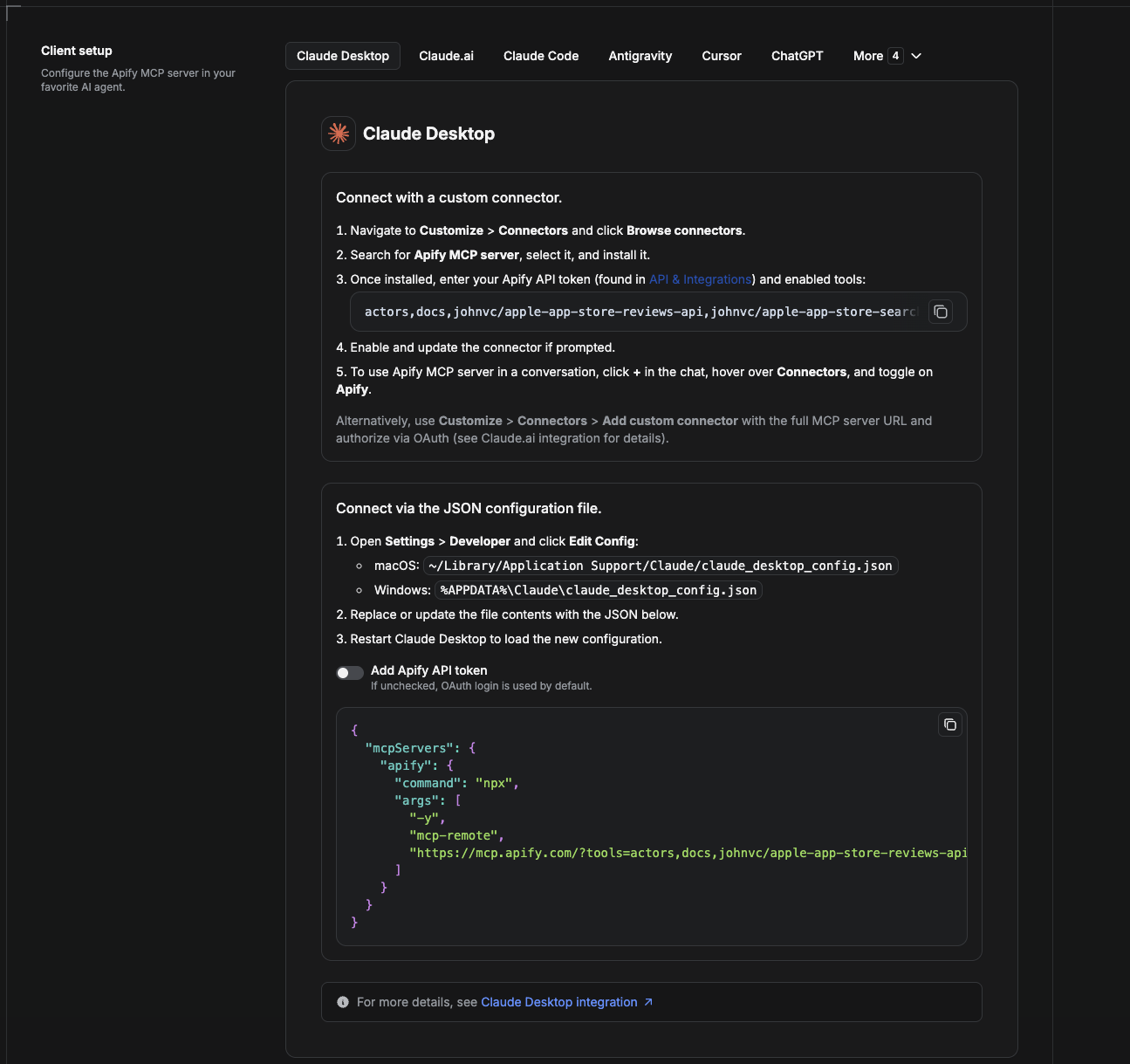
Cowork is the desktop app's automation mode. To give it the Google Flights Deals API as a tool, add the Apify MCP server as a connector.
- Open the Claude desktop app and go to Settings → Connectors (or Settings → Developer → Edit Config to edit
claude_desktop_config.jsondirectly).- macOS:
~/Library/Application Support/Claude/claude_desktop_config.json - Windows:
%APPDATA%\Claude\claude_desktop_config.json
- macOS:
- Add the Apify MCP server, preloaded with only this Actor:
{
  "mcpServers": {
    "apify": {
      "command": "npx",
      "args": [
        "-y",
        "mcp-remote",
        "https://mcp.apify.com/?tools=actors,docs,johnvc/google-flights-deals-api"
      ]
    }
  }
}
- Restart the app. When Cowork first calls the tool, complete the OAuth prompt in your browser, or add your Apify API token in the connector settings to skip OAuth.
- In a Cowork chat, confirm the tool is available and ask it to run the Google Flights Deals API.
Download the desktop app and start a free trial: https://claude.ai/referral/uIlpa7nPLg More help: https://docs.apify.com/platform/integrations/claude-desktop
Install in Claude Code
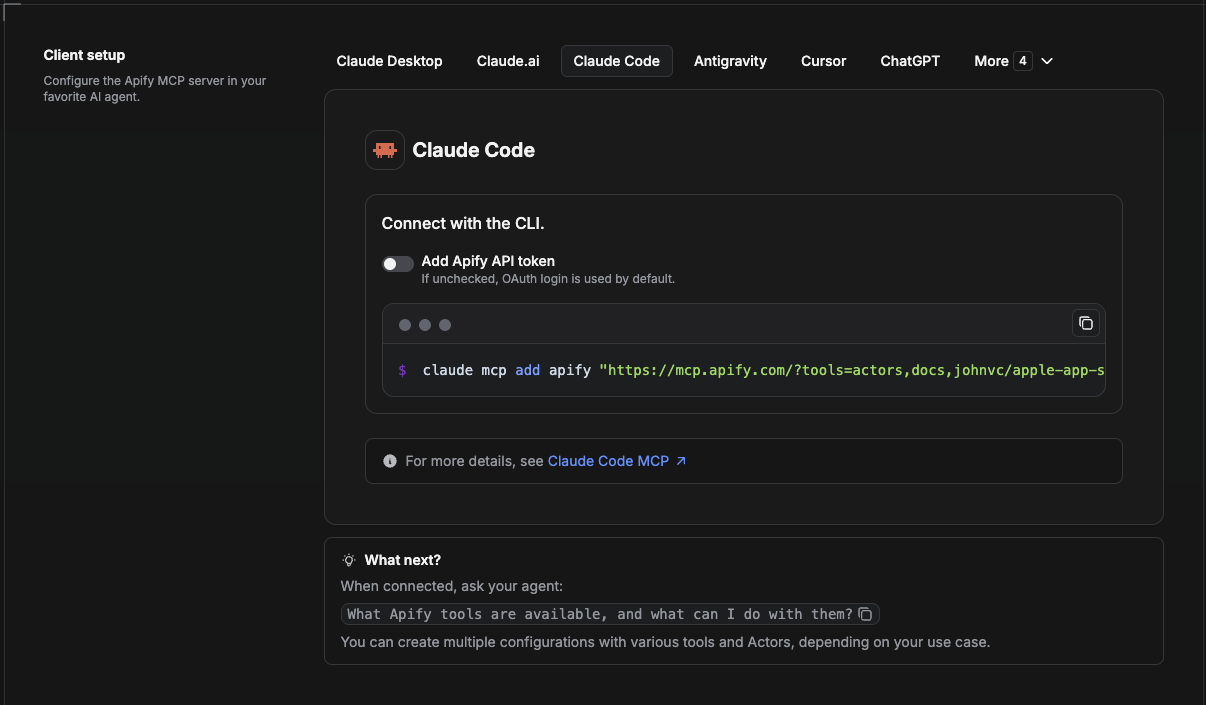
Claude Code is the command-line tool. Add the Actor's MCP server with one command:
claude mcp add --transport http apify \
  "https://mcp.apify.com/?tools=actors,docs,johnvc/google-flights-deals-api"
To use a token instead of browser OAuth:
claude mcp add --transport http apify \
  "https://mcp.apify.com/?tools=actors,docs,johnvc/google-flights-deals-api" \
  --header "Authorization: Bearer YOUR_APIFY_TOKEN"
Then verify with claude mcp list, or run /mcp inside a session. Ask Claude Code to call the Google Flights Deals API.
Try Claude Code free: https://claude.ai/referral/uIlpa7nPLg Claude Code MCP docs: https://code.claude.com/docs/en/mcp
Install in Claude (website)
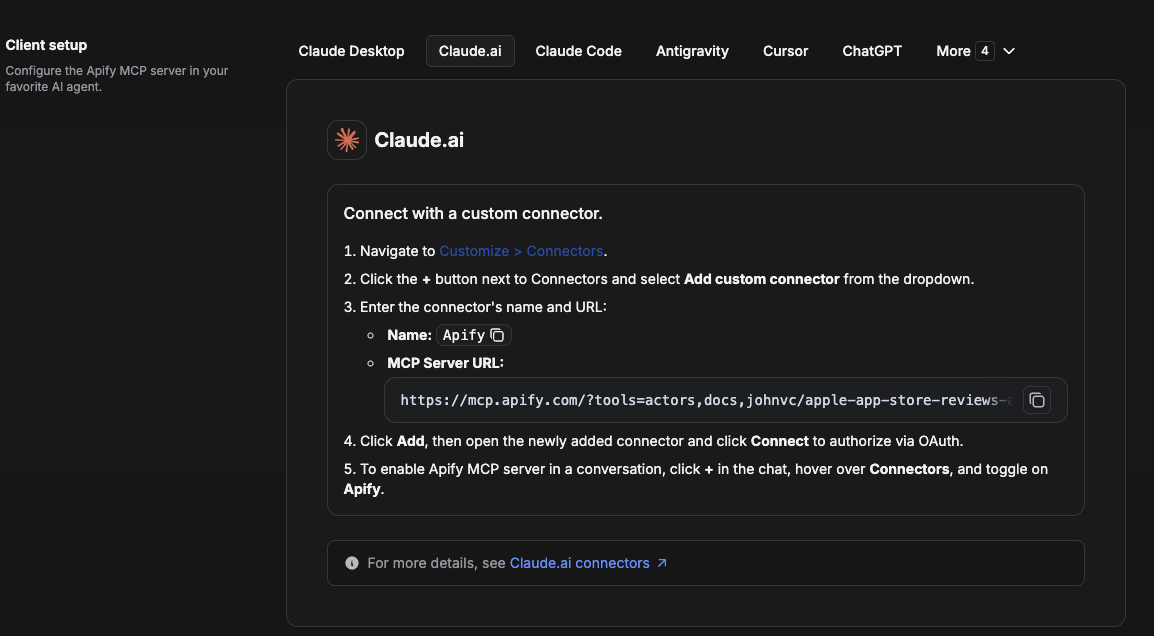
On claude.ai you add Apify as a connector, then enable just this Actor's tool.
- Go to Settings → Connectors → Browse connectors and search for Apify MCP server. Install it (enable or update if prompted).
- When connecting, authenticate with your Apify API token, and enable the tool
johnvc/google-flights-deals-api. - In any chat, open + → Connectors and turn on Apify.
- Alternatively, choose Add custom connector and paste the full MCP URL
https://mcp.apify.com/?tools=actors,docs,johnvc/google-flights-deals-api, using OAuth when prompted. - Ask Claude to run the Google Flights Deals API.
Open Claude on the web: https://claude.ai/referral/uIlpa7nPLg
Install in Cursor
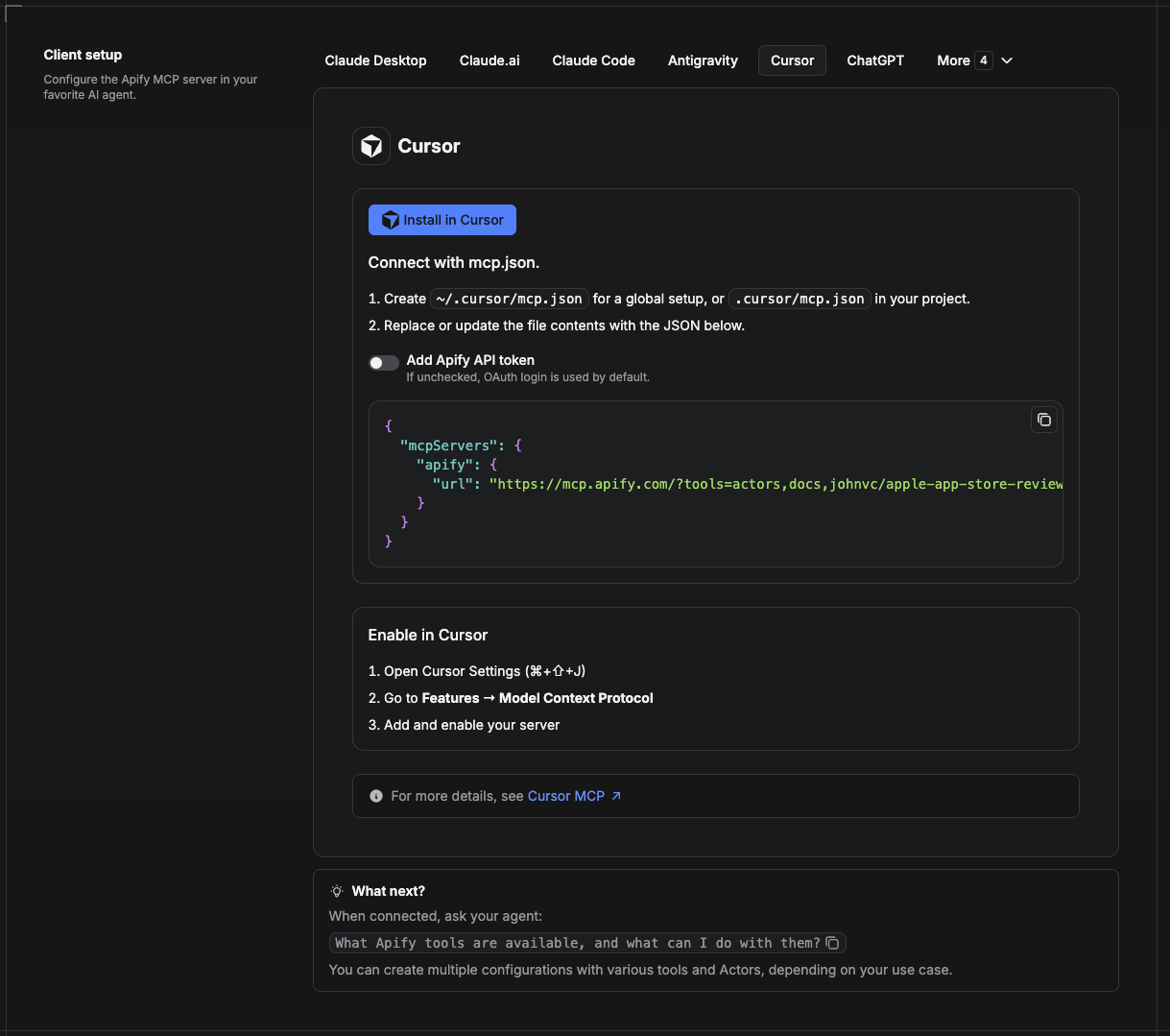
Cursor reads MCP servers from a project file at .cursor/mcp.json.
- In your project, create
.cursor/mcp.json:
{
  "mcpServers": {
    "apify": {
      "url": "https://mcp.apify.com/?tools=actors,docs,johnvc/google-flights-deals-api"
    }
  }
}
- If you prefer token auth over browser OAuth, add a header:
{
  "mcpServers": {
    "apify": {
      "url": "https://mcp.apify.com/?tools=actors,docs,johnvc/google-flights-deals-api",
      "headers": { "Authorization": "Bearer YOUR_APIFY_TOKEN" }
    }
  }
}
- Open Cursor → Settings → MCP and confirm the apify server is connected (green dot).
- In Composer or Chat, ask Cursor to call the Google Flights Deals API.
New to Cursor? Get it here: https://cursor.com/referral?code=XQP4VBLI3NNX
Install in ChatGPT
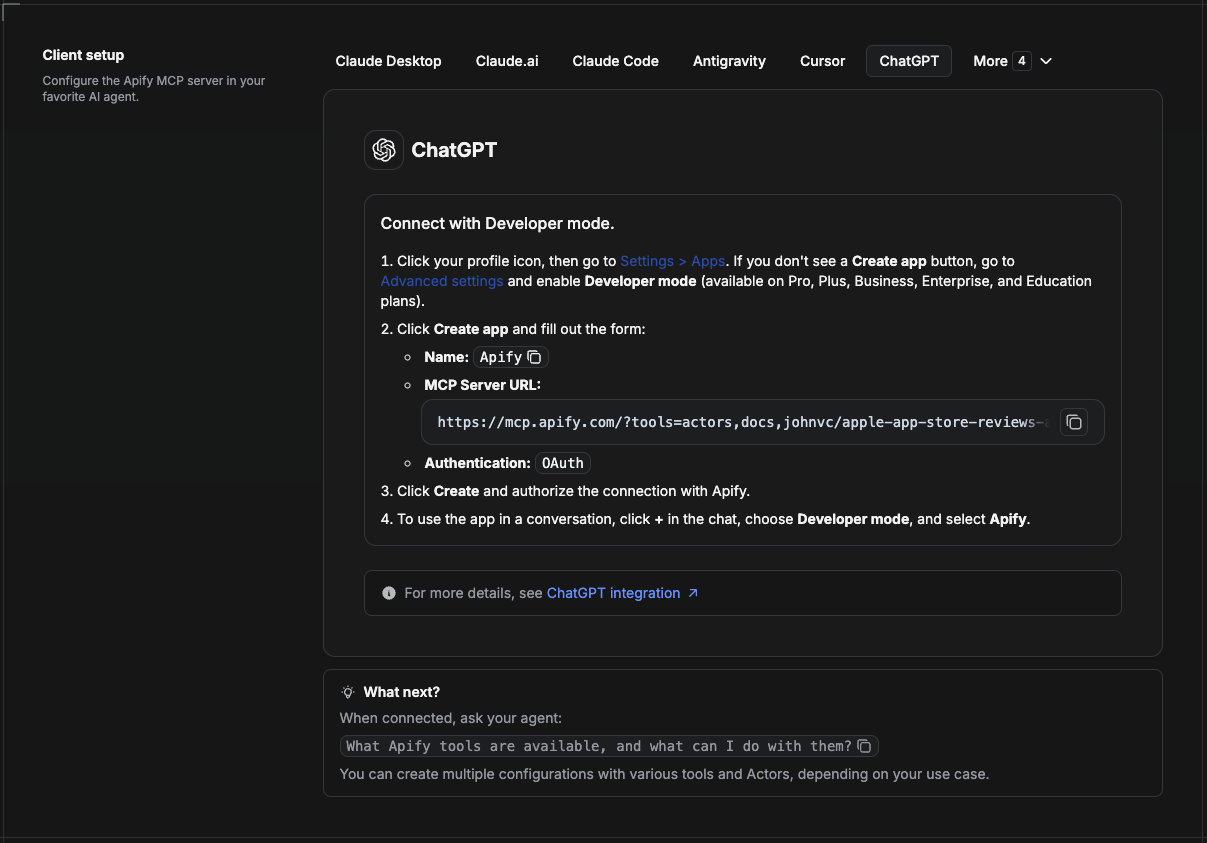
ChatGPT connects to the Apify MCP server through Developer mode (available on ChatGPT Pro, Plus, Business, Enterprise, and Education plans).
- Click your profile icon, then go to Settings > Apps. If you do not see a Create app button, open Advanced settings and enable Developer mode.
- Click Create app and fill out the form:
- Name: Apify
- MCP Server URL:
https://mcp.apify.com/?tools=actors,docs,johnvc/google-flights-deals-api - Authentication: OAuth
- Click Create and authorize the connection with Apify.
- To use the app in a conversation, click + in the chat, choose Developer mode, and select Apify.
More help: https://docs.apify.com/platform/integrations/mcp
Use the Google Flights Deals API to power local lead lists, market research, and place data for your product or AI agent.
Featured Tasks
Ready-to-run examples on the Apify Store, each targeting one local-data use case:
- Extract local business leads from Google Maps by API
- Extract phone numbers from Google Maps by zip code
- Find roofing contractor leads in Tampa with phone numbers
- Build a list of med spas in Miami with phone numbers
- Generate local leads in Claude via Google Maps MCP
- Export Google Maps Places to CSV
Last Updated: 2026.09.22
Reviews
No reviews yet
Be the first to review this server!
More Developer Tools MCP Servers
Fetch
Freeby Modelcontextprotocol · Developer Tools
Web content fetching and conversion for efficient LLM usage
Git
Freeby Modelcontextprotocol · Developer Tools
Read, search, and manipulate Git repositories programmatically
Paperclip
Freeby Paperclipai · Developer Tools
Trending hip-hop artist momentum scores across four cultural dimensions.
Toleno
Freeby Toleno · Developer Tools
Toleno Network MCP Server — Manage your Toleno mining account with Claude AI using natural language.
mcp-creator-python
Freeby mcp-marketplace · Developer Tools
Create, build, and publish Python MCP servers to PyPI — conversationally.
MCP Marketplace
Freeby mcp-marketplace · Developer Tools
Search and install MCP servers from inside your AI client.