
Server data from the Official MCP Registry
Operate a self-hosted Solana whale tracker and copy-trading deck: positions, rules, token checks.
About
Operate a self-hosted Solana whale tracker and copy-trading deck: positions, rules, token checks.
Security Report
Valid MCP server (2 strong, 3 medium validity signals). No known CVEs in dependencies. ⚠️ Package registry links to a different repository than scanned source. Imported from the Official MCP Registry. 1 finding(s) downgraded by scanner intelligence.
11 files analyzed · 1 issue found
Security scores are indicators to help you make informed decisions, not guarantees. Always review permissions before connecting any MCP server.
Permissions Required
This plugin requests these system permissions. Most are normal for its category.
What You'll Need
Set these up before or after installing:
Environment variable: MILLION_API
How to Install
Add this to your MCP configuration file:
{
  "mcpServers": {
    "io-github-kelows-million": {
      "env": {
        "MILLION_API": "your-million-api-here"
      },
      "args": [
        "-y",
        "million-mcp"
      ],
      "command": "npx"
    }
  }
}Documentation
View on GitHubFrom the project's GitHub README.
million
Your personal Solana memecoin intelligence dashboard.
An open-source, self-hosted whale tracker and copy-trading deck that you run by talking to your AI coding agent (Claude Code, Codex, Cursor, Gemini CLI…). It watches the wallets you follow, finds more wallets through the tokens they buy, filters out bots and rugs, shows where the smart money is flowing, and trades the signals that survive.
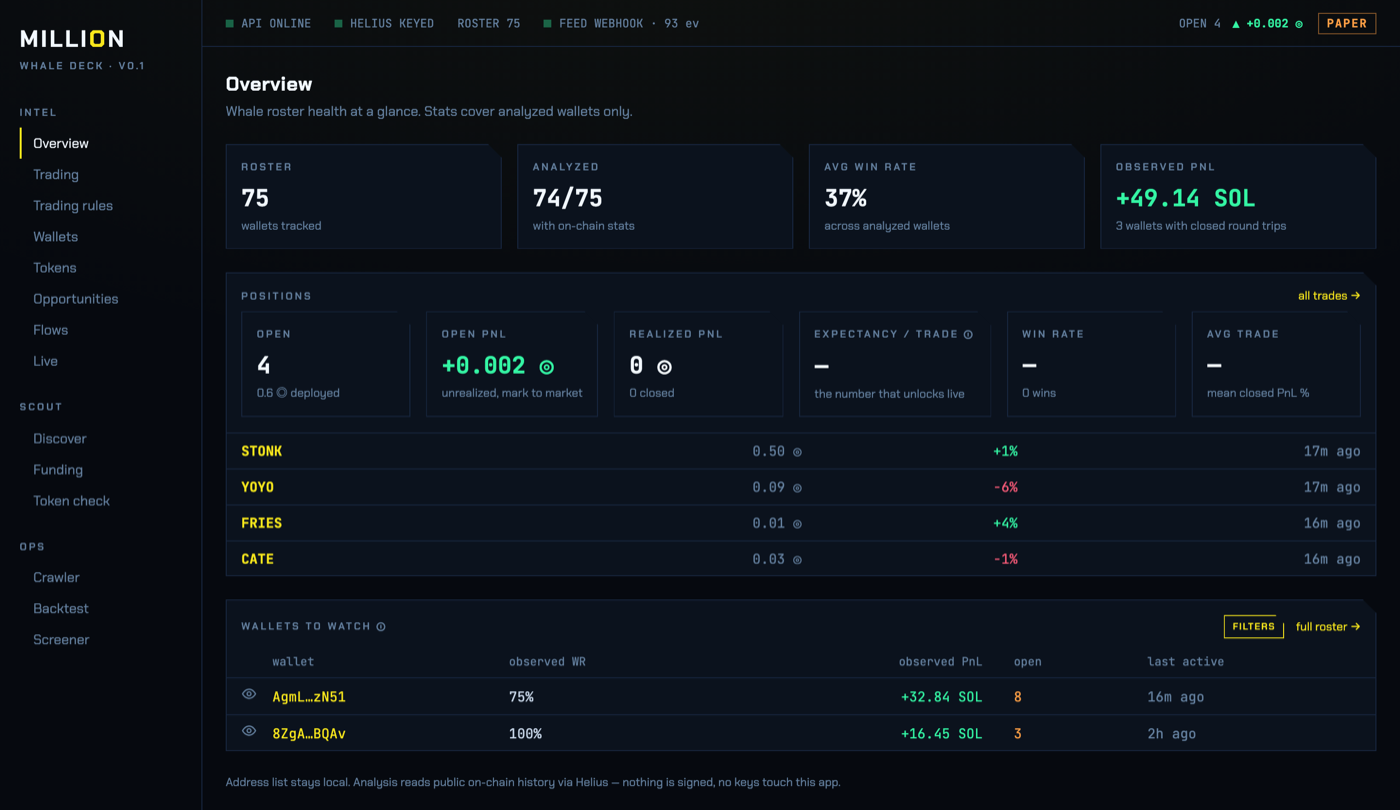
Start in two commands (Node 24 or nvm):
npx create-million       # clones, installs, checks your Helius key, starts the deck
cd million && claude     # or codex, gemini…, then type: set me up
Or clone it yourself and let the agent do everything:
git clone https://github.com/Kelows/million && cd million, open your agent and
type set me up.
| To start you need | You don't need |
|---|---|
| Node 24 | a webhook, tunnel, domain or Cloudflare account |
| a free Helius API key | a wallet or any SOL: it paper-trades until you switch live trading on |
| an account anywhere: it runs on your machine |
Without a webhook the live feed uses a websocket and follows up to 25 wallets; a webhook only lifts that cap.
Experimental. Provided as is, with no warranty. This is a research tool, not a money printer, and nothing in it is financial advice. Trading meme coins can lose you everything you put in. If you trade real money with it, that is your decision and your risk: the authors are not responsible for any loss.
Talk to it: million is the engine, your AI agent is the operator
You don't need to know what a webhook is. You don't need to read a single line of this repo. If you can type a sentence, you can run a whale deck.
Every whale you've watched buy a coin at 3am, while you were asleep, reading charts or doing it all by hand: that's the gap. million watches the wallets without blinking. Your coding agent sits on top of it and does the part that used to need a developer: installing it, wiring it up, explaining what it did, changing it when you ask.
you     set it up. I have 5 SOL and I want to follow patient whales
agent   installs the deck, checks your Helius key, asks three questions,
        applies the Swing Copy preset, sizes it to your 5 SOL, starts the feed

you     how's it going?
agent   Feed healthy, 2 positions open. STONK closed +7% on the
        trailing stop. CATE fired a ladder signal but was already bought an
        hour ago, so it waited.

you     why didn't it buy K7Pa…pump? everyone was talking about it
agent   Only one wallet you follow bought it, with 0.4 SOL: under your
        1.5 SOL minimum for a copy signal. Lowering it would also let in
        every small, noisy buy. Want to change it?

you     find me whales from this token: <address>
agent   pulls its biggest buyers, analyzes them, flags the four wallets
        that are really one operator, and adds the rest for you to pick

you     watch it and tell me when it buys
agent   OPENED FRIES · 0.2 SOL · copy signal from AgmL…zN51,
        a wallet you follow that bought 1.8 SOL of it a second ago
(An illustration of the conversation, not a record of trades.)
Start with the commands at the top of this page. The agent reads the project, follows the setup playbook, and asks you for what only you can decide: your Helius key, your size, your style, the wallets to start from. Everything it runs is in the open, in this repo.
What your agent can do with it, following the playbooks in .claude/skills
(in Claude Code they are also slash commands):
| You say | The agent runs |
|---|---|
| "set me up" | /setup-million: install, key, questions, presets, wallets, feed |
| "how's it going?" | /million-brief: health, positions, results, the most telling skip |
| "why didn't it buy X?" | /why-not-bought: the decision log for that token, in plain words |
| "make it safer" / "0.2 SOL per trade" | /tune-rules: shows the before → after, then saves |
| "watch it" | /watch-deck: live updates in the chat when it opens, closes or goes blind |
| "find me whales from this token" | /find-first-whales: a token's buyers, analyzed, clusters flagged |
Tested with Claude Code, which also gets the deck's state before you type
anything (a session hook) and can relay live updates while you work. Codex and
Cursor read the same instructions from AGENTS.md.
Prefer MCP? million-mcp exposes the deck as 14
tools to Claude Desktop, Cursor, VS Code or any MCP client: status, positions,
the decision log, rules, order flow, token checks and whale discovery.
claude mcp add million -- npx -y million-mcp # or add npx -y million-mcp to your client's MCP config
Some things stay yours no matter how you ask. The agent never turns on live
trading by itself: you have to type
I understand every signal will spend real SOL and I can lose all of it
yourself. It creates a trading wallet without ever showing its secret key, and
it never prints your API keys back.
No agent? Everything works by hand too: see the guide.
How it works
Counts from the first instance. Ribbon height is proportional to log(count): the narrowing is the filter.
Everything feeds everything.
- Wallets find tokens. Every swap a subscribed wallet makes arrives through Helius within seconds. A new buy puts that token on the table.
- Tokens find wallets. For any token, the crawler pulls its size buyers, analyzes them, and absorbs the ones that look like traders rather than bots, routers or distributors.
- Two filters sit in the middle. Wallets are flagged on behaviour (bot and infrastructure patterns, hold style, copyability). Tokens run a gauntlet: mint and freeze authority, liquidity, market cap, holder concentration, deployer history, a Jupiter sell simulation, RugCheck.
- Signals. When a subscribed wallet buys a token that passed, that's an opportunity: copy (one sized buy), consensus (several distinct owners in a window, with buyers outweighing sellers) or ladder (repeated small buys that add up). Wallets that keep entering the same tokens together are merged into one owner, so a cluster of addresses gets one vote.
- Trades. Opportunities open positions with a trailing stop, a hard stop and a breakeven ratchet, sized from your bankroll. Exits are checked every few seconds, and the moment a wallet you follow trades a token you hold.
- The loop back. Every round trip a wallet completes re-scores it, and wallets with styles that don't pay get churned out. Trades the filters skipped keep being priced as shadow positions, and cached candle paths feed the backtester, so the rules can be tested against what actually happened.
How it compares
Hosted Solana trading bots and terminals (Photon, GMGN, Axiom, Trojan and similar) are fast and polished. million makes different trade-offs:
| Hosted bots and terminals | million | |
|---|---|---|
| Where it runs | their servers | your machine |
| Trading keys | usually generated or held by the service | a keypair file on your disk, only if you go live |
| Fee | typically 0.5–1% per trade | 0.25% per live swap |
| Code | closed | open source, MIT |
| Why a trade did or didn't happen | usually not shown | every decision logged with its reason |
| Rules | the settings they expose | every threshold, in code that you can change |
What million isn't: a block-0 sniper (it follows wallets, so it buys after they do, even on fresh launches), a mobile app, or a hosted service. If a stop has to fire, the deck has to be running.
FAQ
Is there an open-source Solana copy-trading bot I can self-host? Yes, this one. Clone it, run it locally, read every line. MIT licensed.
Do I need a webhook, a tunnel or a domain? No. The live feed works over a websocket for up to 25 followed wallets. A webhook (Cloudflare Tunnel or ngrok) is only for following more.
Do I need a Helius API key?
Yes, a free one. It's how the deck reads wallet histories and live
transactions. It stays in apps/api/.env on your machine.
Does it hold my private key or my money?
No. Until you switch live trading on, it needs no wallet at all. Live trading
signs with a keypair file on your own disk, and only turns on when you set
EXECUTOR=local yourself.
Can it trade real SOL automatically? Only if you switch it on. Then every signal that passes your rules is bought with real SOL without asking, within the per-trade cap you set.
How do I set it up by hand, add a webhook or go live? The guide covers setup, the live feed (Cloudflare Tunnel or ngrok), live trading, the developer fee and security.
How does it find whales?
From tokens: pull a token's biggest buyers, analyze their trading history, and
flag bots, relays and clusters of wallets run by one person (see
/find-first-whales). From wallets: every token a followed wallet buys leads to
more wallets.
Why didn't it buy a token I expected? Ask your agent ("why didn't it buy ?") or open the token page: every decision is logged with the rule that stopped it.
Which AI agents does it work with?
Any coding agent that can run commands on your machine. Everything the deck
does is a plain local HTTP API, documented in AGENTS.md (read automatically
by Codex and Cursor), and the playbooks in .claude/skills are plain Markdown.
It's tested with Claude Code, which adds a session-start status and live
updates in the chat. Assistants that can't run commands can still use it through
the MCP server, million-mcp, as long as the deck runs on the same machine.
Is it profitable? Nobody can promise that, and this project's own measurements found past returns don't predict future ones. Treat it as a research tool.
License
MIT. Provided as is, without warranty: see the note at the top.
Reviews
No reviews yet
Be the first to review this server!
More Developer Tools MCP Servers
Git
Freeby Modelcontextprotocol · Developer Tools
Read, search, and manipulate Git repositories programmatically
Fetch
Freeby Modelcontextprotocol · Developer Tools
Web content fetching and conversion for efficient LLM usage
Paperclip
Freeby Paperclipai · Developer Tools
Trending hip-hop artist momentum scores across four cultural dimensions.
Toleno
Freeby Toleno · Developer Tools
Toleno Network MCP Server — Manage your Toleno mining account with Claude AI using natural language.
mcp-creator-python
Freeby mcp-marketplace · Developer Tools
Create, build, and publish Python MCP servers to PyPI — conversationally.
MCP Marketplace
Freeby mcp-marketplace · Developer Tools
Search and install MCP servers from inside your AI client.