
Server data from the Official MCP Registry
ERC-7303 token-controlled roles for AI agents: grant, check, and revoke permissions on-chain
About
ERC-7303 token-controlled roles for AI agents: grant, check, and revoke permissions on-chain
Security Report
tctc-mcp is a well-architected Ethereum-based access control MCP server with proper credential handling, appropriate permissions scoping, and clean code structure. The server enforces admin-mode private key isolation via environment variables only, implements IERC-7303 role introspection safely, and includes comprehensive testing. Minor findings around error handling and type safety are low-severity and do not affect the security posture. Supply chain analysis found 9 known vulnerabilities in dependencies (1 critical, 5 high severity). Package verification found 1 issue.
5 files analyzed · 14 issues found
Security scores are indicators to help you make informed decisions, not guarantees. Always review permissions before connecting any MCP server.
Permissions Required
This plugin requests these system permissions. Most are normal for its category.
What You'll Need
Set these up before or after installing:
Environment variable: TCTC_ADMIN_PRIVATE_KEY
How to Install
Add this to your MCP configuration file:
{
  "mcpServers": {
    "io-github-kofujimura-tctc-mcp": {
      "env": {
        "TCTC_ADMIN_PRIVATE_KEY": "your-tctc-admin-private-key-here"
      },
      "args": [
        "-y",
        "tctc-mcp"
      ],
      "command": "npx"
    }
  }
}Documentation
View on GitHubFrom the project's GitHub README.
tctc-mcp

An MCP server exposing ERC-7303 (Token-Controlled Token Circulation) roles to AI agents: agents check their own on-chain permissions, and human principals grant/revoke them by minting/burning control tokens — no permission server required.
Status: v0.3.4 — adds timed roles with gasless auto-expiry (below),
on top of v0.2's IERC7303 auto-discovery; published on npm
(tctc-mcp), unit-tested
and verified end-to-end against the Sepolia demo deployment (grant →
check → revoke → check, and grant-for-75s → auto-expiry, through a
real MCP client).
Demo (60 seconds)
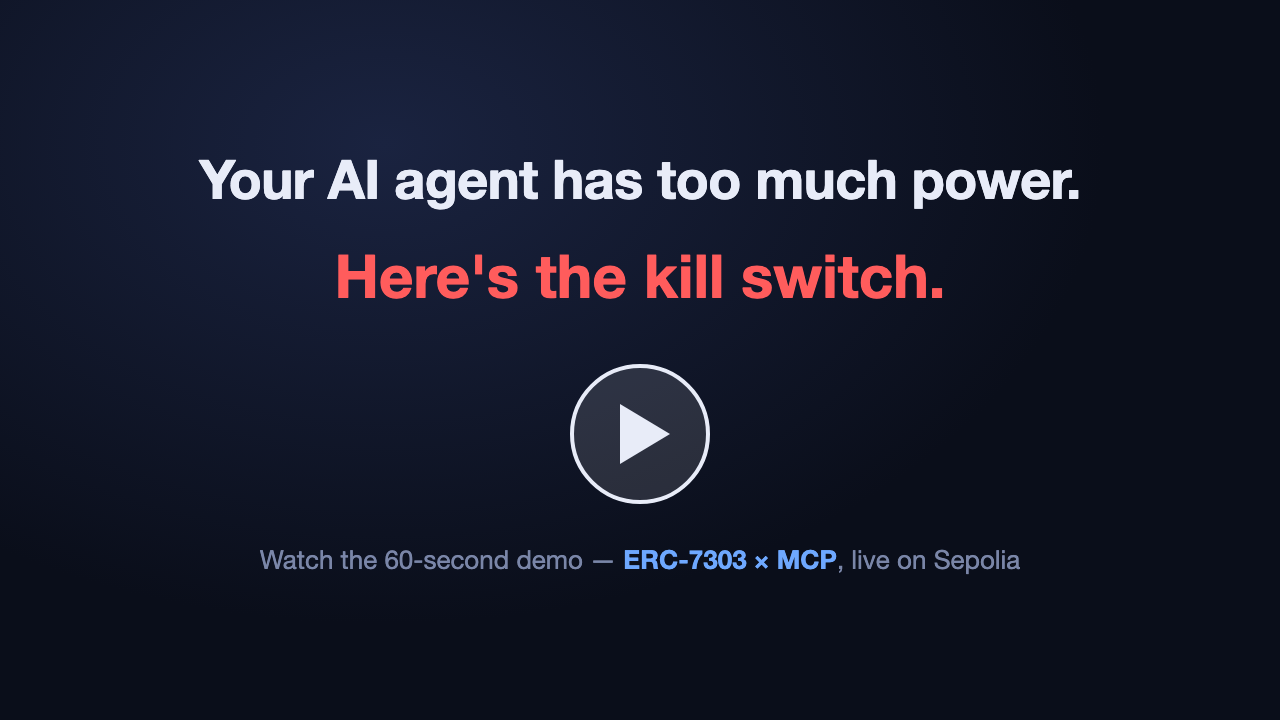
A human grants an AI agent a minting permission; the agent verifies it on-chain and mints an NFT. The human burns the role token — and the agent instantly loses the capability. Live on Sepolia, no permission server involved.
Quick start
The package is published on npm, so no clone or build is needed — npx
fetches and runs it directly:
# 1. Get a config. The secret-free Sepolia demo config needs no API keys:
curl -fsSLO https://raw.githubusercontent.com/kofujimura/tctc-mcp/main/examples/config.sepolia.agent.json

# 2. Register with your MCP client, e.g. Claude Code
#    (read-only mode: only query tools are registered)
claude mcp add tctc -- npx -y tctc-mcp --config "$PWD/config.sepolia.agent.json"

# Admin mode (principal side): grant_role / revoke_role also registered.
# Provide the issuer key ONLY via the environment:
claude mcp add tctc-admin --env TCTC_ADMIN_PRIVATE_KEY=0x... \
  -- npx -y tctc-mcp --config "$PWD/config.sepolia.json"
Or in a project-scoped .mcp.json:
{ "mcpServers": { "tctc": { "command": "npx",
    "args": ["-y", "tctc-mcp", "--config", "examples/config.sepolia.agent.json"] } } }
A fuller registration example is in
examples/claude.mcp.json. The admin private
key is only ever read from the TCTC_ADMIN_PRIVATE_KEY environment
variable; configs containing anything that looks like a private key are
rejected at startup.
Using tctc-mcp from your own app
The only supported entry point is the tctc-mcp bin — spawn it via
npx --no-install tctc-mcp (or node_modules/.bin/tctc-mcp). Never
reference the package's dist/ files directly: they are internal,
their layout is unversioned, and the package's exports field refuses
deep imports. A minimal MCP-SDK client example (the pattern for a web
backend) is in
examples/client-stdio.mjs; the release
pipeline verifies the packed bin end-to-end
(scripts/verify-pack.mjs).
Web application starter
Want to see tctc-mcp protecting a real API route?
tctc-openai-starter
is a standalone Next.js starter that verifies wallet ownership with
Sign-In with Ethereum, checks the configured role through tctc-mcp,
and calls OpenAI only when the on-chain gate grants access.
Use it as a GitHub template.
Token-gating any MCP server: tctc-gate
The reverse direction lives in this repo too:
tctc-gate (npm) is a
transparent stdio proxy that puts an ERC-7303 role check in front of any
existing MCP server, unmodified — deny comes back with a grant URL that
opens the dashboard pre-filled. tctc-mcp lets agents ask about roles;
tctc-gate enforces them at the boundary:
npx -y tctc-gate --config gate.json -- npx -y some-mcp-server …
Tools
| Tool | Mode | Purpose |
|---|---|---|
list_roles | both | Configured roles and their control tokens |
check_role | both | Does an account hold a role? (live balanceOf, with evidence) |
check_all_roles | both | Session-start self-assessment across all roles |
discover_roles | both | Introspect any contract via IERC7303 — no role config needed |
resolve_agent | both* | ERC-8004 agentId → owner / agentURI / agentWallet / ERC-6551 TBA |
grant_role | admin | Mint the control token to a subject |
revoke_role | admin | Burn the subject's control token — the kill switch |
* registered only when the config has an identity section.
Subjects can be given as a raw address, as an ERC-8004 agentId
(resolved to its ERC-6551 Token Bound Account, the recommended binding
target), or omitted to use the config's self.
IERC7303 auto-discovery (v0.2)
ERC-7303 now defines an introspection interface
(ethereum/ERCs#1872, merged
2026-07-11): compliant contracts expose hasRole, control-token getters,
configuration events, and ERC-165 detection (interfaceId 0x4ee69337).
tctc-mcp uses it two ways:
-
targetroles — a role config names only the target contract; the server reads which control tokens gate the role from the contract itself, and the verdict is the target's ownhasRole()answer:"roles": { "MINTER_ROLE": { "target": { "address": "0x4C0a78803D47154B9C6F42EC4AEbab2D1C94c97D" } } } -
discover_roles— introspect any address at run time, with no role configuration at all. Non-compliant contracts reportsupportsIERC7303: false; staticcontrolTokensconfigs remain the fallback for pre-IERC7303 deployments.
Working example: examples/config.sepolia.discovery.json
(secret-free, public RPC), verified live by scripts/e2e-discovery.mjs.
Timed roles: gasless auto-expiry (v0.3)
Delegation to an agent is usually short-term — "mint for one hour",
"act for the duration of this task". With an expiring control token
(ExpiringControlTokens),
balanceOf() returns 0 once the holder's expiry passes, so the role
revokes by itself, with no transaction — even if the principal
forgets, goes offline, or loses keys. The ERC-7303 target contract
needs no changes at all (the Sepolia expiry demo target is a
byte-for-byte copy of TCTCDemoToken).
-
Granting: a role whose grant template has
$expiresAtrequires an expiry —grant_rolewithexpiresInSeconds: 3600is "grant MINTER_ROLE for one hour":"admin": { "grant": { "function": "mint(address,uint256,uint64)", "args": ["$subject", "$typeId", "$expiresAt"] } } -
Checking:
check_roleevidence reportsexpiresAt(unix seconds) when the control token exposes it, so an agent can self-report "this permission expires in 5 minutes". -
Kill switch unchanged: expiry is a fail-safe, not a replacement —
revoke_role(issuer burn) still revokes immediately within the validity window.
Working example: the TIMED_MINTER_ROLE in
examples/config.sepolia.json, verified
live by scripts/e2e-expiry.mjs (grant for 75 s → watch it expire with
no further transaction).
Human dashboard
Live: https://tctc-mcp.vercel.app/ — while tctc-mcp exposes ERC-7303
roles to AI agents, the TCTC Dashboard exposes the same
on-chain state to the humans who manage them: inspect any IERC7303 target,
watch hasRole verdicts and per-control-token balanceOf evidence live,
grant/revoke as the issuer (with timed grants and countdowns for expiring
control tokens), and deploy new control-token collections straight from a
browser wallet. Two clients of one source of truth: the chain. See
dashboard/README.md for details and try-it links.
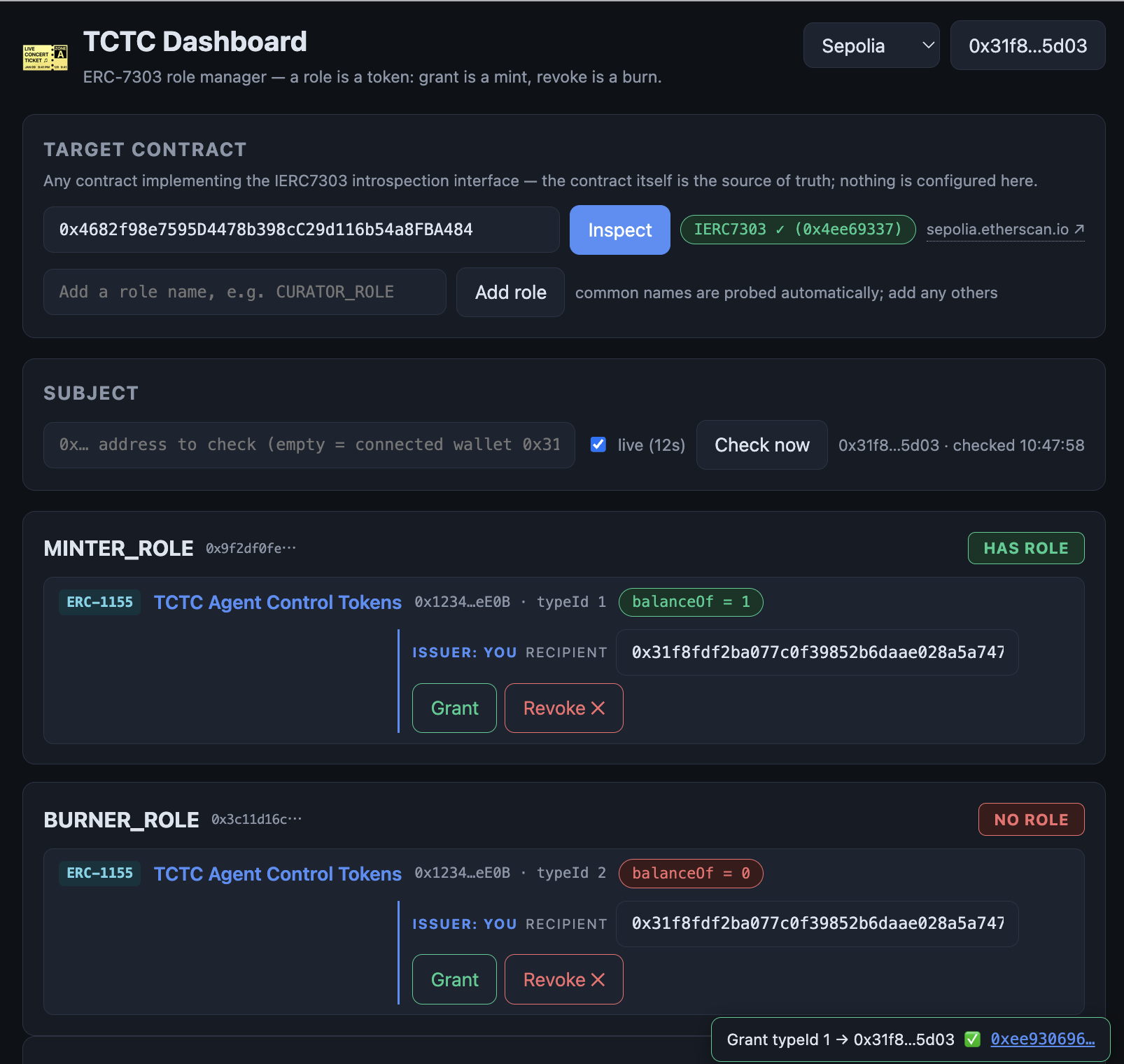
Not just for AI-agent delegation: any ERC-7303 contract works, so the dashboard doubles as a general-purpose on-chain permission manager — issue certificate collections, grant and revoke roles, and audit who holds what, all from a browser wallet.
Documents
- docs/CONCEPT.md — background and rationale: TCTC as the authorization layer for AI agents, its relationship to ERC-8004 (Trustless Agents) and ERC-6551 (Token Bound Accounts), recommended ERC-7303 spec updates, and the adoption strategy.
- docs/MCP_SERVER_SPEC.md — v1 design specification (architecture, config, tools, security, roadmap).
- docs/ERC_DRAFT_EXPIRABLE_1155.md —
working draft of a planned ERC, "Expirable ERC-1155 Tokens": the
standard behind the timed roles above (per-holder expiry, time-aware
balanceOf,expiresAt/ExpiryUpdated, interface ID0x300e616b). Not yet submitted to ethereum/ERCs; feedback welcome. - docs/TEST_REPORT.md — v1 test report: 24 unit tests and the live Sepolia E2E (on-chain kill-switch cycle through a real MCP client).
- examples/config.sepolia.json —
concrete config for the Sepolia demo deployment (primary roles,
static bindings) and the TCTC repo's
MyComplexTokensample (COMPLEX_*roles, resolved via IERC7303targetdiscovery). - examples/config.sepolia.agent.json — secret-free agent-side config for the same demo deployment (public RPC, no API keys); the one used in the Quick start above.
- examples/config.sepolia.discovery.json — IERC7303 auto-discovery variant: no control tokens configured, the target contract explains its own role structure.
- examples/contracts/ — sources of the demo
contracts deployed on Sepolia (
AgentControlTokens,TCTCDemoToken,ERC7303,IERC7303).
Demo deployment (Sepolia, Etherscan-verified)
AgentControlTokens(soulbound, issuer-burnable ERC-1155):0x12342A7F0190B3AF3F4b47546D34006EDA54eE0BTCTCDemoToken(ERC-721 + ERC-7303 target, implements theIERC7303introspection interface —hasRole, control-token getters, ERC-165 detectable via interfaceId0x4ee69337):0x4C0a78803D47154B9C6F42EC4AEbab2D1C94c97DExpiringControlTokens(soulbound, issuer-burnable ERC-1155 with per-holder expiry; time-awarebalanceOf— the basis of timed roles):0xb5abB6c060ed287e8B25aD121c8B46eE404fF09b- Expiry demo target (unmodified
TCTCDemoTokenbytecode bound to the expiring control tokens):0x3eAb11DE9655817A2e2977A486d9D33eBD10c9Ce
Development
git clone https://github.com/kofujimura/tctc-mcp.git && cd tctc-mcp
npm install && npm run build
node dist/index.js --config examples/config.sepolia.agent.json

npm test                  # unit tests (vitest)
node scripts/e2e-live.mjs # live E2E: spawns the server via MCP stdio client
                          # (needs ALCHEMY_API_KEY; admin phase additionally
                          #  TCTC_ADMIN_PRIVATE_KEY and E2E_SUBJECT)
Related
- Human dashboard (this repo,
dashboard/): https://tctc-mcp.vercel.app/ - npm package: https://www.npmjs.com/package/tctc-mcp
tctc-gate— token-gate any existing MCP server, no modification: https://www.npmjs.com/package/tctc-gatetctc-openai-starter— Next.js starter for token-gated OpenAI access.- Agent skill (teaches agents to use TCTC safely; install with
npx skills add kofujimura/tctc-skills): https://github.com/kofujimura/tctc-skills - TCTC reference implementation: https://github.com/kofujimura/TCTC
Reviews
No reviews yet
Be the first to review this server!
More Developer Tools MCP Servers
Git
Freeby Modelcontextprotocol · Developer Tools
Read, search, and manipulate Git repositories programmatically
Fetch
Freeby Modelcontextprotocol · Developer Tools
Web content fetching and conversion for efficient LLM usage
Worldmonitor
Freeby Koala73 · Developer Tools
Live markets, conflicts, country risk, chokepoints, energy, and China decision signals. 90 tools.
Paperclip
Freeby Paperclipai · Developer Tools
Trending hip-hop artist momentum scores across four cultural dimensions.
Toleno
Freeby Toleno · Developer Tools
Toleno Network MCP Server — Manage your Toleno mining account with Claude AI using natural language.
mcp-creator-python
Freeby mcp-marketplace · Developer Tools
Create, build, and publish Python MCP servers to PyPI — conversationally.