
Server data from the Official MCP Registry
LLM-operable Midjourney pipeline: 21 MCP tools to compose, generate, curate with vision, and log.
About
LLM-operable Midjourney pipeline: 21 MCP tools to compose, generate, curate with vision, and log.
Security Report
cascade-img is a well-structured MCP server for Midjourney image generation with generally sound architecture and reasonable permission scope for its purpose. However, there are moderate security concerns around Discord token handling, insufficient input validation on some endpoints, and potential data exposure through append-only logging without sanitization. The codebase shows good test coverage and resilience patterns, but credential security practices need strengthening. Supply chain analysis found 11 known vulnerabilities in dependencies (1 critical, 5 high severity). Package verification found 1 issue.
3 files analyzed · 20 issues found
Security scores are indicators to help you make informed decisions, not guarantees. Always review permissions before connecting any MCP server.
Permissions Required
This plugin requests these system permissions. Most are normal for its category.
What You'll Need
Set these up before or after installing:
Environment variable: DISCORD_USER_TOKEN
Environment variable: MJ_CHANNEL_ID
Environment variable: MJ_IMAGINE_VERSION
Environment variable: CASCADE_BRIDGE_URL
How to Install
Add this to your MCP configuration file:
{
  "mcpServers": {
    "io-github-laffeyp-cascade-img": {
      "env": {
        "MJ_CHANNEL_ID": "your-mj-channel-id-here",
        "CASCADE_BRIDGE_URL": "your-cascade-bridge-url-here",
        "DISCORD_USER_TOKEN": "your-discord-user-token-here",
        "MJ_IMAGINE_VERSION": "your-mj-imagine-version-here"
      },
      "args": [
        "cascade-img"
      ],
      "command": "uvx"
    }
  }
}Documentation
View on GitHubFrom the project's GitHub README.
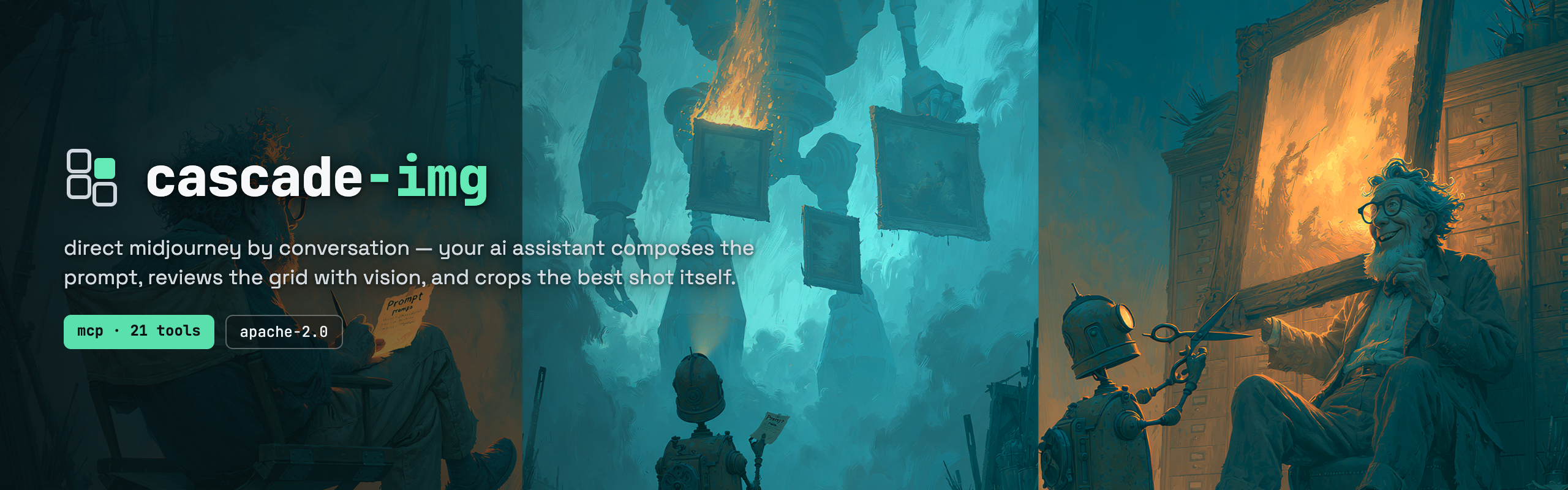





Generate Midjourney images by conversation instead of by hand. You describe what you want; your AI assistant composes the prompt, fires it, inspects the grid with vision, crops the best quadrant, cleans it up, and logs what worked.
You: "I need a flat-design mountain icon, centered, simple shapes, transparent background"

Agent: reads prompt log → composes prompt from parts → fires imagine →
       waits → inspects 2x2 grid with vision → picks best quadrant →
       crops it → removes background → saves → logs what worked
cascade-img is an MCP server with 23 tools that plugs into Claude, Cursor, Codex, or anything that speaks MCP. Midjourney is the first backend; Flux, DALL-E, and Imagen are on the roadmap. There's also a CLI.
Not a programmer? Open an AI assistant that can run commands (Claude Code, Cursor, or Cline), point it at this repo, and say: "Read RUNBOOK.md and set up cascade-img on this machine, then let me make images by describing them to you." It does the technical parts. You just need a Midjourney subscription and to copy a few values from Discord.
Quick Start
You need: a paid Midjourney subscription, a Discord account with the MJ bot in a channel, and Python 3.12 or newer.
pip install cascade-img
Or from source:
git clone https://github.com/laffeyp/cascade-img
cd cascade-img/packages/python
pip install -e .
This puts three commands for operating cascade-img on your PATH: cascade-mj-bridge (the daemon), cascade-mcp (the MCP server), and cascade-mj (the CLI). Installing also adds a fourth command, cascade-trace-check — a diagnostics validator (not part of the generation loop) that replays a recorded event log and checks it against the vocabulary's declared event ordering and timing rules.
Configure — you need four values from the Discord desktop app (channel ID, server ID, imagine version, and your user token). Takes about five minutes. RUNBOOK.md walks through each one step by step.
cp "$(python -c 'import cascade_img, pathlib; print(pathlib.Path(cascade_img.__path__[0]) / ".env.example")')" .env
# Fill in the four values per RUNBOOK.md, then validate:
cascade-mj-bridge --check-env --pretty
Start the daemon in one terminal, then connect from another:
cascade-mj-bridge # leave running — holds the Discord connection
Connect your AI assistant — add to your MCP config (Claude Desktop, Cursor, Cline):
{
  "mcpServers": {
    "cascade-img": {
      "command": "cascade-mcp"
    }
  }
}
Or point your assistant at this repo and ask it to read AGENTS.md — it'll wire everything up.
Or use the CLI:
echo '{
  "mountain-icon": {
    "subject": "a flat-design icon of a mountain, centered, simple shapes",
    "aspect_ratio": "1:1"
  }
}' > assets.json

cascade-mj mountain-icon --registry assets.json --upscale all --pretty
The 23 Tools
| Category | Tools | What they do |
|---|---|---|
| Onboarding | cascade_guide | Returns the full operating manual in one call — the loop, every tool, the failure→action table. Call it first; the generation and curation tools are gated until it's read. |
| Generation | imagine, generate_video, wait, status, bridge_health, mj_action | Compose and fire prompts, poll for results, check daemon health, trigger Midjourney actions (upscale, vary, pan) |
| Catch-up | channel_recent, adopt_message | See what the human did by hand in Discord and claim those results into the pipeline — adopted messages become normal jobs that curation and mj_action work on |
| Composition | compose_prompt, compose_video | Build prompts from structured parts — subject, moodboard, style refs, aspect ratio, negatives — not freeform text |
| Curation | crop_grid, alpha_key, auto_trim, palette_quantize, contact_sheet, sprite_sheet, score_grid, video_filmstrip, loop_seam_delta, promote | Extract quadrants from grids, remove backgrounds, trim whitespace, build sprite sheets, score results with vision, promote winners to final output |
| Working memory | log_append, read_prompt_log | Append-only prompt log the agent reads before every run — what was tried, what worked, what didn't. Persists across sessions. |
Every call returns {ok, result} or {ok: false, error: {code, remediation}}. Branch on the stable code, not the message. Full tool reference in AGENTS.md.
How This Differs
Other open-source Midjourney tools focus on the generation step — fire the prompt, hand back the image. cascade-img does the work around that:
- Vision-based self-curation — the agent inspects its own output and picks the best quadrant
- Structured prompt composition — prompts built from parts (subject, style, identity, constraints), not raw strings
- Working memory — append-only log persists across sessions; each run reads what came before
- Curation pipeline — crop grids, remove backgrounds, build sprite sheets, promote winners
- MCP-native — 23 tools that plug into Claude, Cursor, Codex, or anything that speaks MCP
- Pluggable backends — Midjourney now, Flux/DALL-E/Imagen on the roadmap
How It Works
One daemon, two stateless clients, all over local HTTP:
cascade-mj-bridge— the daemon. Only process that talks to Discord. Holds the live connection and tracks in-flight jobs. Must stay running.cascade-mcp— the MCP server. Stdio by default (Claude Desktop / Cursor / Cline);--http <port>for HTTP. Stateless — start and stop freely.cascade-mj— the CLI. Takes an asset ID and a registry, composes the prompt, fires, waits, writes to the log.
Prompts are composed from structured parts, not written as raw strings:
from cascade_img.prompt.composer import PromptComposer, Subject, StyleStack, IdentityStack

prompt = PromptComposer().compose(
    Subject(
        text="a flat-design icon of a mountain",
        constraints=["centered", "simple shapes", "transparent background"],
    ),
    # Both optional. moodboard is a Midjourney personalization code;
    # sref/oref are reference-image URLs you'd set up in MJ first.
    style=StyleStack(moodboard="abc123def", sref="https://cdn.example.com/style.png"),
    identity=IdentityStack(oref="https://cdn.example.com/ref.png", ow=1000),
    aspect_ratio="1:1",
    version="7",
)
All three entry points emit structured JSON and follow the same {ok, result | error: {code, remediation}} envelope. Every failure carries a stable error code (e.g. DISCORD_401, MJ_UUID_MISSING, UPSCALE_BUTTON_FAILED) with a machine-readable remediation — so a caller branches on the code, not the message. The full catalog of log events and error codes is in vocabulary/0.1.json, and a trace checker (cascade-trace-check) enforces event ordering over recorded runs.
prompt — the text + flags you send Midjourney. grid — the 2x2 set of four candidates returned per prompt. quadrant / U1-U4 — the four cells; "U2" means upscale the second. upscale — render one cell at full resolution. aspect ratio (--ar) — output shape. sref — an image whose style to borrow. oref — an image whose subject identity to keep across poses. moodboard (--p) — a saved personalization profile. stylize (--s) — how strongly MJ applies its own aesthetic.
Documentation
| Doc | What it covers |
|---|---|
| AGENTS.md | The LLM operator's guide. Read this when handing cascade-img to an agent. |
| RUNBOOK.md | Install, env capture, setup, reconnect lifecycle, every failure mode with error codes and fixes. |
| CAPABILITIES.md | Every Midjourney feature cascade-img drives — prompt parameters, mj_actions, the V8.1/V7 split. |
| ARCHITECTURE.md | Internal architecture and design decisions. |
| examples/ | Three walkthroughs: single image, batch, video. Read AGENTS.md first. |
| CHANGELOG.md | Release history. |
Roadmap
| Version | What's in it |
|---|---|
| v0.1 (current) | MJ backend (V8.1 + V7), prompt composer, curation tools, MCP server, CLI, prompt log |
| v0.2 | Channel catch-up + message adoption — landed on main: channel_recent and adopt_message let the agent see what the human did by hand in Discord and act on it (design); still to come: more MJ commands (/describe, /blend, Vary Region inpaint, /tune), retro-U-press on adopted grids, internal refactoring |
| v0.3 | TypeScript wrapper; first API backends — Flux via Fal + Flux Kontext, Ideogram |
| v0.4 | Google Imagen, Recraft (native vector/SVG) |
| v0.5 | OpenAI gpt-image, Stable Diffusion |
| v1.0 | API stable, three+ backends in production |
Every backend implements one interface, so a later release can chain them — generate on one provider, refine on a second (e.g. Flux Kontext), upscale on a third.
Repository Layout
cascade-img/
├── packages/python/        # the Python package (cascade_img)
│   ├── src/cascade_img/    #   prompt/, interfaces/, backends/, curation/, vocabulary/
│   ├── tests/              #   behavior tests
│   └── tools/              #   live smoke walk
├── examples/               # three walkthroughs of the operating loop
├── vocabulary/0.1.json     # event log-line catalog
└── *.md                    # README, ARCHITECTURE, RUNBOOK, AGENTS, CAPABILITIES, ...
Disclaimer
This tool automates Midjourney through a Discord user account. A paid Midjourney subscription is required. Both Discord and Midjourney's Terms of Service prohibit user-account automation. This is the same mechanism used by every open-source MJ tool (midjourney-proxy, midjourney-api, etc.) — there is no public Midjourney API. Use at your own risk.
The backend interface is pluggable — Flux, DALL-E, and Imagen are on the roadmap.
License
Apache-2.0. See LICENSE.
Reviews
No reviews yet
Be the first to review this server!
More Developer Tools MCP Servers
Git
Freeby Modelcontextprotocol · Developer Tools
Read, search, and manipulate Git repositories programmatically
Fetch
Freeby Modelcontextprotocol · Developer Tools
Web content fetching and conversion for efficient LLM usage
Worldmonitor
Freeby Koala73 · Developer Tools
Live markets, conflicts, country risk, chokepoints, energy, and China decision signals. 90 tools.
Paperclip
Freeby Paperclipai · Developer Tools
Trending hip-hop artist momentum scores across four cultural dimensions.
Toleno
Freeby Toleno · Developer Tools
Toleno Network MCP Server — Manage your Toleno mining account with Claude AI using natural language.
mcp-creator-python
Freeby mcp-marketplace · Developer Tools
Create, build, and publish Python MCP servers to PyPI — conversationally.