
Server data from the Official MCP Registry
Auditable multi-agent topology generator from Drosophila MaleCNS connectome motifs.
About
Auditable multi-agent topology generator from Drosophila MaleCNS connectome motifs.
Remote endpoints: streamable-http: https://lm203688.github.io/flybrain-connectome/
Security Report
Valid MCP server (1 strong, 0 medium validity signals). No known CVEs in dependencies. Imported from the Official MCP Registry. 1 finding(s) downgraded by scanner intelligence.
Endpoint verified · Open access · 1 issue found
Security scores are indicators to help you make informed decisions, not guarantees. Always review permissions before connecting any MCP server.
Permissions Found in Source Code
Found by scanning the linked source code. This listing connects to a hosted endpoint, so none of this runs on your machine: it describes what the server software does where it is hosted.
What You'll Need
Set these up before or after installing:
How to Connect
Remote Plugin
No local installation needed. Your AI client connects to the remote endpoint directly.
Add this to your MCP configuration to connect:
{
  "mcpServers": {
    "io-github-lm203688-flybrain-connectome": {
      "url": "https://lm203688.github.io/flybrain-connectome/"
    }
  }
}Documentation
View on GitHubFrom the project's GitHub README.
flybrain-connectome



v3.00.3 · 2026-10-25 · 116 functional units · 270 module profiles · 62 gates · EPE 全栈 + AIBOM 供应链披露 + 收据完整性门禁 + Gate 60/61/62/63/64 + fail-loud 纪律 + 版本单一真源 + Xu 2026 树突计算前沿对照 + Xu 2026 双层认知计算参考实现(tools/dendritic_rule_engine.py + examples/07_dendritic_rule_cache_demo.ipynb)+ E4 区室边界 + S1 外部验证 + S2 lesion cascade + S3 统计强化 + 纪律有效性量化(catch-rate 100%,W1–W7 全部关闭)+ Gate 63 research_claims 顶层统计完整性 + 作者署名规范化(P-3 / P-4 → Li Xing + ORCID)+ bioRxiv 投稿准备包 + flybrain demo 一条命令 + 5 分钟上手 + flybrain audit CLI + JOSS 投稿包 + MCP 生态提交包 + 9 篇论文 DOI 补齐
The 89% problem
Deloitte's 2026 agent-pilot survey found 89% of enterprise agent pilots never reach production. Teradata: 78% have pilots, only 14% scaled. The failure pattern repeats across industries in three words:
"跑不稳、管不住、查不清" — unstable, ungovernable, unauditable.
flybrain-connectomeaddresses the third word. Every agent edge in a generated topology traces back to a real neuron or synapse class in the Drosophila male brain connectome, serialized as W3C PROV-JSON — the same format EU AI Act auditors expect. Your agent swarm isn't a black box; it's a verifiable structure with biological provenance.5-minute quickstart — from zero to an interactive D3 topology graph in five minutes, no data download.
Auditable Agent Topology — 可审计的 Agent 拓扑生成与溯源, grounded in the real Drosophila male-brain connectome (MaleCNS v1.0 — 166,700 neurons / 124,177,617 synapses, CC-BY).
flybrain-connectome turns a real, published brain wiring diagram into
task-tailored multi-agent topologies you can instantiate as agent swarms —
and it can prove, for every edge, which real neuron / synapse class it came
from. The motif provenance is serialized as W3C PROV-JSON, the same
standard EU AI Act auditors expect.
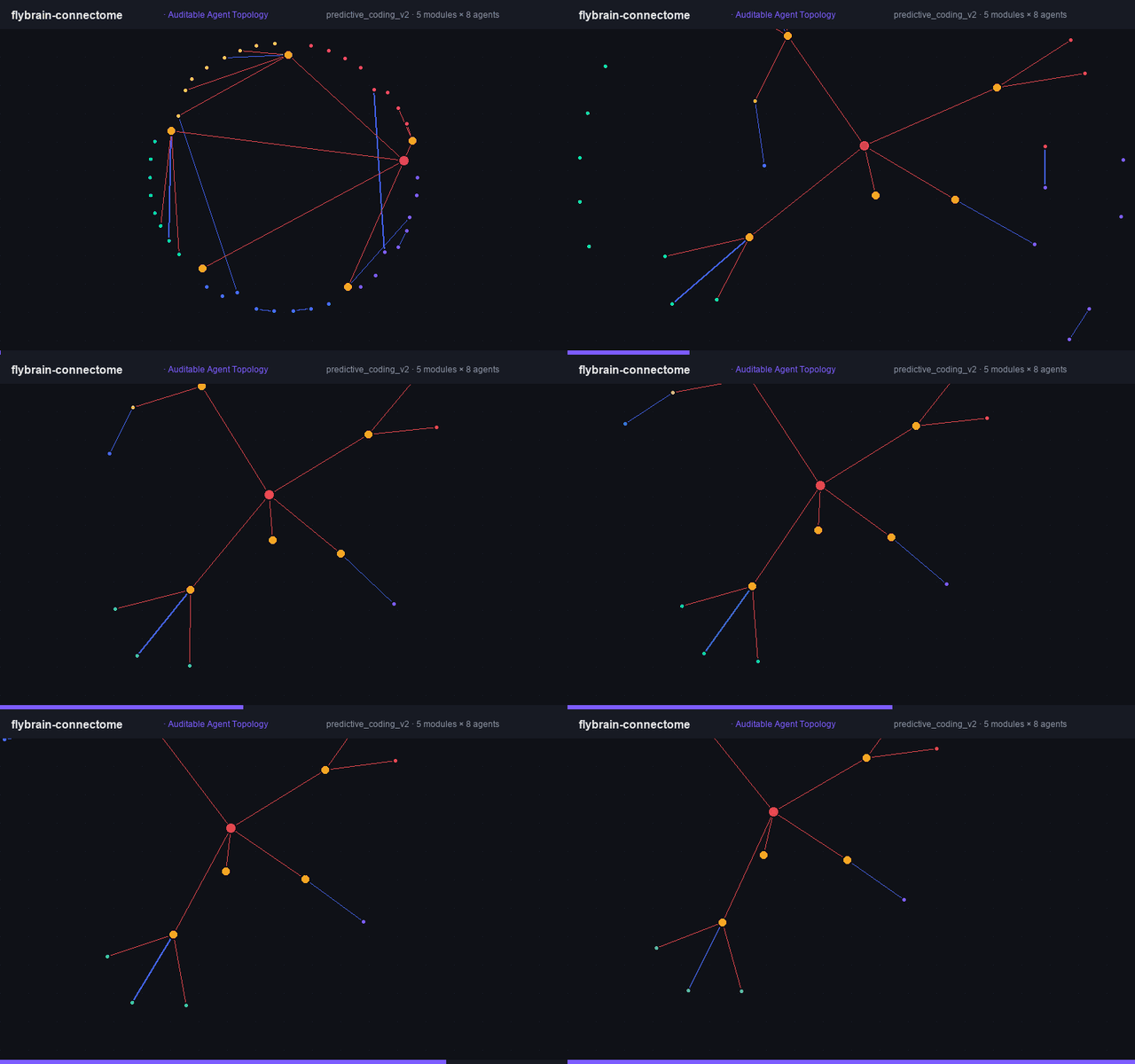
5-module × 8-agent topology (predictive_coding_v2 blueprint) — the same graph
you get from flybrain demo. Try it live →
It is a developer toolkit and research artifact, not a trained model and not a simulation of a fly. Read the honest boundaries before you quote it.
Repo status: PUBLIC since 2026-10-18. History was audited and cleaned before publicization (see CHANGELOG v1.3.0 for the original Tier-2 IP leak and docs/D3_REPOSITORY_PUBLICITY_DECISION_2026-10-18.md for the 16-step publicization runbook that was executed). The Tier-1 code is MIT-licensed and reachable at https://github.com/lm203688/flybrain-connectome. Tier-2 raw data (MaleCNS 5.63 GB, C. elegans Witvliet 2020, Drosophila larva edges.csv, Petkova 2025 zebrafish) is fetched via the documented data pipeline — see §"Requirements" and the S1 external-validation script.
What it is / what it is NOT
| ✅ This project | ❌ Not this project |
|---|---|
| A connectome query service (47 tools over HTTP + MCP) | A spiking-neuron simulator |
| A motif-extraction pipeline (real fly → derived motif doc) | A repository of the raw 5.63 GB data |
| A synthetic topology generator (bio-motifs → agent graphs) | A trained / fine-tuned model with weights |
| W3C PROV provenance on every generated artifact | A claim that the "virtual organism" is alive |
The killer offline feature: generate needs no data — it composes
topologies from a 7 KB derived motif snapshot. The connectome data is only
needed if you want to query the real brain.
Honest status of the unit library
The 116 functional units are split cleanly by how their evidence comes together. This is the number to remember when reading any downstream claim:
| Bucket | Count | Meaning |
|---|---|---|
| Anchored to real Drosophila male-brain cells | 37 / 116 (31.9 %) | embodiment.real_cells_anchored > 0 — each edge traces to actual MaleCNS v1.0 neurons |
| Cross-species declarations, unanchored | 79 / 116 (68.1 %) | provenance.unanchored_reason = identity_not_in_drosophila or taxon_no_malecns_data — the circuit exists in the literature for another species, not in the MaleCNS connectome |
The 68.1 % bucket is not a defect and not a hidden error. It is a comparative-neuroscience scaffold: bird song, mammalian cortical layers, fish Mauthner, cephalopod vertical lobe, Aplysia and leech CPGs, insect mushroom-body — all are wired into the library with named references and can be composed like the anchored ones, but they are not measured in a real connectome the way the 37 anchored units are. Reading the library correctly means reading those two numbers together, not the 116 by itself.
How to use this — tiered by what you can actually get today
Rather than a single "this is a X" pitch, the useful things this project does break down into three tiers. Which one you actually need depends on what you are building.
Tier 1 — usable today, offline, no data download.
Neuron-circuit search across 3 species × 4 axes (system / function /
species / provenance); compose a virtual-organism topology from any
subset of units; run the four canonical DEMOs (mammal, insect,
electrosensory, swim) end-to-end. This is the developer tool the
project actually is. flybrain search, flybrain compose, flybrain generate cover it.
Tier 2 — for people designing AI-agent scaffolds. The composed topologies trace back to real circuitry via W3C PROV-JSON, which means a downstream agent framework (LangGraph / CrewAI / AutoGen / SwarmLabs) can pick up a starting topology and audit where each wiring decision came from. This is not a general agent infra — it is a biology-prior layer you plug into one.
Tier 3 — what this project explicitly does not do.
It does not beat biology at anything (Phase 3 measured negative and
is not claimed). It does not replace any EM reconstruction pipeline.
It does not ship a trained model or a spiking simulator. If someone
reads a v1.x changelog entry that promises any of those, the honest
answer is "that was aspirational; the withdrawal is documented in
docs/PROJECT_REALITY_ASSESSMENT.md".
The four moats (measured, not marketed)
We ran the experiments. Two of the "obvious" advantages turned out to be false under controlled testing, and we say so.
| # | Moat | Evidence | Status |
|---|---|---|---|
| 1 | Traceability — every generated edge traces to a real neuron/synapse class, serialized as W3C PROV-JSON | _verify.py 70/70; prov_json top-level field (schema v1.2.1) | ✅ real |
| 2 | Structural parsimony — genetic search finds far leaner graphs than the biological prior | GA converges to 9–11 edges vs 57 locked → −84% wire cost | ✅ real |
| 3 | Structural stability — module-level fault isolation | 25 / 27 sampled topologies show modular H1 isolation (92.6%); spectral radius ρ held at 0.00–0.30% | ✅ real |
| 4 | Local decision-making — modules read out their own answers | multi-readout experiment 5 / 28 H1 (17.9%), only on simple/delay≤2 tasks | ⚠️ partial |
What we explicitly do not claim
| Dimension | Result | Why we dropped the claim |
|---|---|---|
| Raw compute advantage | 0 / 7 topologies beat random structure | Matched-control ESN calibration; motif advantage 0/7, differences within noise |
| Energy advantage | 0 / 24 runs beat random | SNN energy proxy; median ratio 1.006 (±5%), no systematic gain |
Honesty is a feature. The reproducible experiment scripts live in
integrations/swarmlabs/diagnostics/ and the reports in the repo root
(SNN_ENERGY_REPORT.md, MULTI_READOUT_REPORT.md, FAULT_ISOLATION_REPORT.md).
Install
The toolkit needs one runtime dependency (numpy, because the connectome
engine imports it at module level) plus optional extras for provenance and
columnar IO. No other third-party code is required. Pick either setup:
Repo status: PUBLIC since 2026-10-18. No authentication required — the clone commands below work directly. History was audited and cleaned before publicization (see CHANGELOG v1.3.0 for the original Tier-2 IP leak and docs/D3_REPOSITORY_PUBLICITY_DECISION_2026-10-18.md for the 16-step publicization runbook).
A. Clone and run (recommended, verified end-to-end)
git clone https://github.com/lm203688/flybrain-connectome.git
cd flybrain-connectome
python flybrain_cli.py --help
B. Editable install (puts flybrain on your PATH)
git clone https://github.com/lm203688/flybrain-connectome.git
cd flybrain-connectome
pip install -e .
flybrain info
pip install -e . is editable: the flybrain entry point maps back to the
checkout, which is precisely what lets it find the toolkit. A plain
pip install . ships only the launcher, so point it at a checkout explicitly:
pip install .
export FLYBRAIN_HOME=/path/to/flybrain-connectome
flybrain info
This path is verified in CI, not just documented. The
packagejob in.github/workflows/ci.ymlrunspip install ".[prov]", invokes the console script, resolves the toolkit viaFLYBRAIN_HOME, generates an organism, and asserts the artifact's invariants — so the install instructions cannot silently rot.
C. Optional: the standardized provenance bundle
Structural provenance (motif_provenance, with the snapshot sha256) is always
recorded. The standardized W3C PROV-JSON bundle (prov_json) is serialized
by the optional dataprov package:
pip install dataprov # or: pip install "flybrain-connectome[prov]" (once on PyPI)
Without it the toolkit still runs: prov_json becomes null and
get_provenance_bundle answers with prov_available: false plus the reason,
rather than crashing. Both arms are asserted by
scripts/check_degraded_mode.py — absent must degrade, present must actually
produce the bundle.
Always check what you got
flybrain info
reports the resolved toolkit root, the motif snapshot, the data dir, API-key status, and how many tools are exposed. Run it first whenever something looks wrong — it turns "ImportError" into a named, fixable problem.
To query the real connectome you also need the data
MaleCNS v1.0 is CC-BY, ~5.63 GB, and deliberately not in this repo:
export FLYBRAIN_DATA_DIR=/path/to/your/male_cns
generate and the bundled motif snapshot need no data at all.
Quickstart
Every
flybrain <cmd>below also works aspython flybrain_cli.py <cmd>(setup A), so you can try the project without installing anything.
0. Sanity-check the install
flybrain info
# -> toolkit root [ok] · motif snapshot [ok, 7363 bytes] · tools exposed: 36
1. Serve the connectome (optional — only for querying real data)
flybrain serve --port 8799
# or: python flybrain-connectome-mcp/run_api.py
2. Query the real brain
export FLYBRAIN_API_KEY=<your-key>   # set in config.json or env

flybrain query pair_synapses --args '{"pre":10540,"post":12569}'
# -> 711   (the real APL → DPM connection)

flybrain query connectome_overview
# -> {"total_synapses": 124177617, "annotated_neurons": 211577, ...}
3. Pull the derived motif document
flybrain motifs --out motifs.json      # live pull from the service
# offline snapshot (no server, no data): flybrain-connectome-mcp/motifs/swarm_agent_topology_motifs.json
4. Generate a synthetic bio-topology (offline, no data)
flybrain generate --blueprint predictive_coding_v2 --modules 5 --agents-per-module 8
# -> flybrain-connectome-mcp/generated_organisms/<name>.{json,html} + flybrain-connectome-mcp/swarmlabs/<name>.swarm.{json,yaml}
5. Read the C. elegans developmental axis
flybrain stages         # L1 x4 / L2 / L3 / adult x2, measured per animal
flybrain stages --caveat            # why the L1 columns are a floor
flybrain stages --unit cel_amphid_chemosensory_unit
6. Read the larva connectome cluster ledger
flybrain larva-clusters             # network totals + per-unit coverage
flybrain larva-clusters --top 20    # the 20 biggest clusters
flybrain larva-clusters --unannotated
flybrain larva-clusters --caveat    # what "covered" does and does not mean
7. Read the MaleCNS male-dimorphic ledger
flybrain composition               # can declared combinations actually form?
flybrain costs                      # latency/energy per connection type
flybrain function                   # coverage by FUNCTION, not by species
flybrain function --vision          # only what PROJECT_VISION requires
flybrain dimorphism                 # 2,368 cells nobody has looked at
flybrain dimorphism --provenance    # ... with the curator note behind each sex label
flybrain dimorphism --top 20 --internal
flybrain dimorphism --caveat        # what "male-specific" does not mean here
8. Verify everything still works
flybrain verify # needs FLYBRAIN_DATA_DIR set to your data
9. Profile a topology (offline, no data)
The topology-aware layer turns "what shape is this organism?" into a callable,
reproducible answer — density, degree spread, reciprocity, modularity Q,
transitivity, spectral radius (power iteration, no numpy), feedback-edge
fraction, a directed 3-node motif census, and a deterministic structural
signature. It is honest by construction: not_measured names what a
structural profile cannot speak to (dynamics, energy, task performance).
flybrain generate --blueprint predictive_coding_v2 --modules 5 --agents-per-module 6 --name demo
flybrain profile generated_organisms/demo.json
flybrain profile generated_organisms/demo.json --json          # full profile
flybrain profile generated_organisms/demo.json --compare generated_organisms/other.json
Self-validated by Gate 15 (scripts/check_topology_profile.py).
Repository layout
flybrain-connectome/
├── flybrain_cli.py                 ★ developer CLI (serve/query/motifs/generate/verify/info)
├── pyproject.toml                  zero deps, `flybrain` console script
├── LICENSE · CITATION.cff · CHANGELOG.md
├── flybrain-connectome-mcp/
│   ├── mcp_connectome/             query engine (core) + 47-tool MCP + HTTP API (:8799)
│   ├── motifs/                     drop-in client + derived motif snapshot
│   ├── synthetic_bio_topology.py   ★ C1 generator (motif → agent graph + config + PROV)
│   ├── _verify.py                  end-to-end smoke test (70/70)
│   └── flybrain-connectome-mcp/
│       ├── generated_organisms/     example artifacts (json/html + swarm configs)
│       └── swarmlabs/               swarm config exports
├── integrations/swarmlabs/         consistency checkers + diagnostics (reproducible experiments)
├── scripts/                        run_gates.py · check_no_secrets.py · check_docs_consistency.py
│                                   check_mcp_tools.py · check_degraded_mode.py
│                                   check_generated_artifact.py · gh_publish.py
├── .github/workflows/ci.yml        the same gates, on py3.10/3.12/3.13 + packaged-CLI job
└── docs/                           arxiv_paper.md · mcp_setup.md · module_factory.md
HTTP API reference
Service: flybrain-connectome-mcp/mcp_connectome/api_server.py.
| Endpoint | Auth | Purpose |
|---|---|---|
GET /health | none | liveness + version |
GET /tools | key | list the 47 tools + descriptions |
POST /query | key | {"tool": <name>, "args": {...}} → {"ok": true, "result": ...} |
Auth: Authorization: Bearer <key> or X-API-Key: <key>. Keys come from
config.json (api_keys) or env FLYBRAIN_API_KEY. If none is configured the
server generates a temporary per-boot key and warns loudly — it never falls
back to a key committed to source.
The 47 tools (real names, do not invent — verified against GET /tools
by scripts/check_docs_consistency.py):
Real-connectome queries — the 11 marked ⚠ need FLYBRAIN_DATA_DIR:
connectome_overview ⚠ · neuron_info ⚠ · pair_synapses ⚠ ·
neuron_outputs ⚠ · neuron_inputs ⚠ · degree ⚠ · search_neurons ⚠ ·
superclass_projection ⚠ · hub_targets ⚠ · list_superclasses ⚠ ·
pathway ⚠ · export_swarm_motifs
Generator surface — offline-capable, served from the motif snapshot:
list_blueprints · list_modules · list_bio_motifs ·
batch_generate_topologies · get_provenance_bundle ·
list_stacked_blueprints · get_stacked_feasibility ·
list_neuropils · get_neuropil_detail · get_module ·
check_module_compatibility · compose_virtual_organism · list_virtual_organisms ·
list_presets · get_preset · apply_preset ·
organism_to_swarmlabs · get_module_agent_roles ·
save_market_organism · load_market_organism · list_market_organisms ·
rate_market_organism · search_market_organisms · delete_market_organism ·
list_combination_rules · validate_combination · expand_organism · get_multiplier_metrics · profile_topology · profile_health
Functional-unit composition library — the composable layer above neuron types:
list_functional_units · get_functional_unit ·
list_connection_types · list_evidence_ledger · compose_from_units
Synthetic organism schema
synthetic_bio_topology.design_organism(spec) returns:
{
  "organism": {
    "nodes": [ {"id": "m0_rep", "role": "tissue_rep", "module": 0,
                "profile": "memory", "ref_superclass": "CB", ...} ],
    "edges": [ {"from": "m0_rep", "to": "m0_c0", "weight": -0.31,
                "kind": "inhibitory", "module": 0, "ref_body": 10540} ]
  },
  "metrics": {
    "n_nodes": 29, "n_edges": 18, "avg_degree": 1.24,
    "inhibition_ratio": 0.11, "n_modules": 4,
    "intra_module_edges": 14, "inter_module_edges": 4,
    "modularity_est": 0.778, "profile_breakdown": { ... }
  },
  "blueprint": "predictive_coding_v2",
  "motif_provenance": {            // 3-stage traceability
    "mode": "local_snapshot",
    "motif_synapse_stats": { ... },     // % of the 124M-synapse dataset
    "motif_query": "SELECT ...",        // runnable provenance query
    "blueprint_to_motif": { ... }
  },
  "prov_json": { ... }             // W3C PROV-JSON bundle (schema v1.2.1)
}
The W3C PROV-JSON (prov_json) bundle records entity / activity /
agent nodes with wasDerivedFrom / wasAssociatedWith / wasAttributedTo
edges, attributing every topology to FlyCellAtlas and the
flybrain:dataset_anchor (MaleCNS v1.0). It is consumable by yProv4ML,
MLflow2PROV, and MIT Sloan provenance tooling.
Blueprint & module library
25 blueprints across three categories, composed from 270 modules: 10 cognitive-function modules (sensory / memory / motor / integration / attention / working_memory / reward / punishment / habit / metacognition) + 190 cross-species neuron types spanning cortical pyramidal (L2/3 CX1/CX5, L4b/L4c, L5 basal tuft, L6 reticulo-thalamic, L7 temporal, Mayeret) + intermediate interneurons (Calbindin/LAMP/NPH/NPF/VLAC/SST-dendritic/ SST-somatic/KCN, plus PV/SST/VIP/chandelier/basket) + modulatory systems (dopaminergic A9/A11/VMC/VTA/SNC, serotonergic dorsal/ventral/median raphe, noradrenergic LC, cholinergic MT/horizontal, histaminergic TM, orexin) + retinal (bipolar cone/rod, amacrine ACL1/ACL2, midget/PV ganglion, horizontal) + spinal/cerebellar (α/γ motor, Icc/Ih/Ihp interneurons, glycinergic, nociceptive, Purkinje/granule/stellate, inferior olive) + thalamic/basal ganglia (LGN/MD/VA/VL/VPL/VPM/RTN, STN, red nucleus, striatal D1/D2 MSN) + limbic/edge (hippocampal CA1/CA2/CA3/CA4/granule/subiculum, amygdala BLA/LA, septum, entorhinal L2/L3, grid cell) + special senses (pineal, melanopsin, olfactory, vestibular, cochlear outer hair)
-
reactive astrocyte
-
four clades whose neurons have no vertebrate-cortex counterpart (35 further types, each carrying its own
biological_reference):
- insect (14) — Kenyon cell / mushroom-body output / PPL1-PAM dopaminergic / APL, antennal-lobe projection and local neurons, protocerebral bridge / ellipsoid body / fan-shaped body / noduli / ring neurons, s-LNv and lateral clock neurons, descending neuron
- bird (6) — HVC, RA, LMAN, Area X, DLM, NIf (the song system)
- fish (8) — Mauthner cell, reticulospinal neuron, lateral-line hair cell, ampullary and tuberous electroreceptors, ELL pyramidal cell, electrosensory inhibitory interneuron, electric-organ pacemaker neuron
- cephalopod (7) — vertical-lobe large / amacrine / small cells, superior frontal lobe cell, chromatophore motor neuron, arm motor neuron, arm sensory afferent
- a second non-cortical batch: rhythm, state and error (24 further types, v1.6.0):
- segmental / peripheral oscillators (9) — leech swim-CPG interneuron and body-wall motor neuron with its mechanosensory T cell, ascidian larval motor neuron and ocellus photoreceptor, Aplysia sensory / motor / serotonergic facilitating neurons, buccal ganglion CPG neuron
- infrared and amphibian (5) — trigeminal infrared afferent, infrared tectal map neuron, multimodal optic-tectum neuron, tectal T5-type prey detector, tongue motor neuron
- error teaching and state (6) — climbing fibre, cerebellar Golgi cell, vestibular nucleus neuron, pre-Bötzinger complex neuron, phrenic motor neuron, VLPO neuron
- navigation and active sensing (4) — head-direction cell, place cell, barrel cortex neuron, whisker motor neuron
Every blueprint traces to one of
40 topology motifs (3 original MaleCNS-extracted + 37 conceptual patterns spanning
anatomical / functional / plasticity / specialized categories) or is honestly marked
motif: none (synthetic orchestration, no bio-prior) — 16 bio-prior, 9 not:
- 5 basic — flat / hub / ring / layered / random reference topologies
- 16 biological — e.g.
predictive_coding_v2(recurrent_feedback+reward),metacognitive_control(inhibitory_hub),habit_consolidation(recurrent_feedback),hierarchical_deep(reservoir_smallworld) … - 4 synthetic —
rl_actor_critic,curiosity_driven,cognitive_control,multi_motif_blend(honestlymotif: none)
Nested composition a+(b+c) is parsed as isomorphic to a+b+c. Full list:
from flybrain_connectome_mcp.synthetic_bio_topology import BLUEPRINTS  # (in-repo path)
# or after pip install: import synthetic_bio_topology as c1; c1.BLUEPRINTS
Machine-readable equivalents (same data, over HTTP/MCP): list_blueprints,
list_modules, list_bio_motifs.
Functional-unit & connection-type library
The neuron list above is the vocabulary. It is not the unit of composition: a single neuron type does nothing on its own, and wiring two of them together means nothing. What composes is a function with a known interface. So the library is split into two tiers, and the upper tier is the one you actually build from:
- 116 functional units — each is ONE function (phototransduction, action
selection, theta pacing, gliotransmission, sparse mushroom-body coding, ring-attractor
heading, song timing, Mauthner escape, active electrolocation, camouflage, leech swim
rhythm, infrared thermal imaging, climbing-fibre error teaching, sleep/wake switching …)
delivered by a group of neuron populations (1–6 of them, taken from the 254-module
vocabulary) wired into an internal sub-circuit, and exposing typed ports (
lightin →high_resout;candidates+valuein →selected_actionout). Composition: 40 mammal-cortex-shaped + 16 cross-clade (insect / bird / fish / cephalopod, v1.4.1) + 16 rhythm/state/error and active-sensing (annelid, ascidian, mollusc, pit viper, frog, cerebellum, brainstem, hippocampus, barrel cortex, v1.6.0)- 10 Drosophila-shaped (optic lobe, giant-fiber escape, male courtship & song, lateral horn, v1.8.0 — every one of them fully anchored, see below).
- 5 Drosophila-shaped (thermal preference, feeding circuit, leg motor, multimodal LAL, sleep memory, v1.10.0 — first batch anchored, see below).
- 4 C. elegans connectome-derived (forward locomotion command, touch-avoidance reflex, amphid chemosensory, nociceptive avoidance — v2.27.0, see below; each also carries a L1 → L2 → L3 → adult axis, v2.30.0).
- 8 Drosophila larva connectome-derived (
larv_olfactory_associative_learning_unit,larv_somatosensory_escape_unit,larv_gustatory_feeding_program_unit,larv_descending_motor_command_unit,larv_mushroom_body_feedback_unit— v2.28.0, third connectome — pluslarv_thermosensory_relay_unit,larv_visual_relay_unit,larv_respiratory_relay_unit— v2.29.0, one unit per traced sensory channel, see below).
- 66 connection types — each is one connection FORM, constrained on the port types it may join, in six families: micro (axo-dendritic / axo-somatic / axo-axonic / dendro-dendritic … point-to-point contact sites) · circuit (feedforward / feedback / lateral / mutual / recurrent / disinhibition / winner-take-all / global inhibitory gain control / synfire chain / efference-copy cancellation / half-centre oscillation / grid phase precession …) · modulatory (diffuse / volume / retrograde / state gating) · electrical (gap junction / ephaptic / mixed electro-chemical / tripartite astrocyte / plateau-potential bistability) · plasticity (STDP / LTP-LTD / short-term / homeostatic scaling / modulator-gated / repeated-activation LTS / serotonergic presynaptic facilitation / short-term habituation / coincidence detection) · macro (topographic mapping / divergent fan-out / convergent fan-in / corollary discharge / global broadcast / sparse expansion / command-neuron recruitment / bistable state switch / thermal cross-modal convergence).
So the algebra is virtual organism = units (nodes) + connection types (typed edges), and every edge is mechanically checkable because both endpoints declare
port types:
unit A .out_port[type] --connection_type(from_port, to_port)--> unit B .in_port[type]
compose_from_units enforces port-type compatibility, required-port
satisfaction, external drivability/readability of the whole organism, and
reports feedback loops as warnings (an intentional feedback loop is a
first-class citizen here). An unsatisfied required input on the organism
boundary is the organism's external input, not a defect — pass
allow_boundary_inputs: false to validate an interior sub-chain instead.
Four canonical chains ship as fixtures and are re-validated by Gate 9 on every
run — --demo mammal (retina → thalamus → cortex → basal ganglia → motor
thalamus), --demo insect (antennal lobe → mushroom body sparse code → learned
valence → central complex heading/steering, clock-biased),
--demo electrosensory (EOD pacemaker → efference-copy cancellation →
electrolocation, plus a passive-electric cue into the Mauthner escape command)
and --demo swim (leech half-centre swim CPG → ascidian larval oscillator →
frog reticulospinal escape swim).
--demo with no argument runs all four.
Developmental axis (v2.30.0) — the same four circuits at L1 / L2 / L3 / adult
The Witvliet 2020 series is eight reconstructions, not two: four L1 animals,
one L2, one L3 and two adults. The library used to carry only the two adults.
All eight are now loaded and measured per animal. Each of the four C. elegans
units above carries the result in provenance.developmental_stages; run
flybrain stages to print it.
| stage | dataset | cell classes | unique edges | synapses |
|---|---|---|---|---|
| L1 | 1 | 108 | 566 | 1,400 |
| L1 | 2 | 114 | 693 | 2,028 |
| L1 | 3 | 119 | 700 | 2,237 |
| L1 | 4 | 122 | 795 | 3,020 |
| L2 | 5 | 128 | 1,107 | 4,535 |
| L3 | 6 | 132 | 1,072 | 4,723 |
| adult | 7 | 135 | 1,565 | 7,867 |
| adult | 8 | 134 | 1,530 | 8,400 |
The four circuits, measured at every stage (synapses per animal):
| unit | L1 | L2 | L3 | adult |
|---|---|---|---|---|
| forward locomotion command | 26 / 34 / 41 / 66 | 92 | 87 | 125 / 179 |
| touch-avoidance reflex | 30 / 38 / 43 / 72 | 111 | 107 | 159 / 210 |
| amphid chemosensory | 97 / 127 / 150 / 199 | 301 | 267 | 433 / 495 |
| nociceptive avoidance | 21 / 22 / 31 / 64 | 76 | 69 | 110 / 144 |
Those four rows do not add up (v2.34.0). The circuits are not disjoint
cell-class sets — AIA sits in all four, AIB/AIZ/AVB/PV in two or three
— so an edge like AIZ → AIB is internal wiring for two circuits at once and
gets counted by both. Adding the column overstates the wiring that is actually
internal to these circuits by ~1.27×. Both figures are now reported per stage:
| stage | sum of the four circuits | union (counted once) | inflation |
|---|---|---|---|
| L1 | 1,061 | 849 | 1.25× |
| L2 | 580 | 455 | 1.27× |
| L3 | 530 | 421 | 1.26× |
| adult | 1,855 | 1,456 | 1.27× |
Use union for "how much of this animal's wiring sits inside these circuits"; use the sum only when the circuits are counted individually. The extractor now asserts that the per-circuit rows reconstruct the sum, and refuses to write when they disagree.
One circuit is measured wider than the unit it attaches to (v2.35.0).
PROFILES declares 11 cell classes for the touch-avoidance circuit, PLM
among them, but extract_cel_profiles.py only emits a member profile for a
declared class that actually has an edge inside the module — and in the adult
reconstruction PLM has none, so the v2.27 unit ships 10 members and
cel.plm does not exist anywhere in this library. Merged across all eight
reconstructions PLM does have edges, so this series measures 11. Both
are correct; the unit name is identical, which is exactly why the gap had no
name and no guard. The artifact now records it as declared_vs_shipped and
the extractor refuses to write if a unit ever ships a class the series cannot
measure. Practical consequence: compare the touch-avoidance stage numbers
against the unit by that one class, not directly.
Across all 16 measurements the four circuits are present in every animal at every stage (6–37 edges at L1), so what development adds is synapse weight, not new topology.
The boundary that matters here. A side result — 271 edge pairs appear in L1
and not in the adults — is not reported as transient developing synapses. A
single L1 file carries 566–795 distinct edges against 1,107 for a single L2
file, so "seen at L1" is confounded with reconstruction depth. Only the claim
that survives that confound is published; the caveat field of
cel_development_stages.json states this in the artifact itself. As of
v2.34.0 that 271 is computed (stage_diffs.l1_only_keys, alongside
l1_union_keys 1,188, adult_union_keys 1,980, shared_keys 917,
adult_only_keys 1,063) rather than written into the caveat as a literal that
could not be re-derived if the source changed.
Larva cluster ledger (v2.31.0) — how much of the larva network the units cover
The eight larva units were built by aggregating nodes on
(cell_type, annotations). That left one question unanswered: how much of the
352,611-synapse larva network do they actually span? flybrain larva-clusters answers it by walking all 116,922 edges.
A synapse counts as covered only when both endpoints' (cell_type, modality bucket) resolve to a larv.* profile that at least one unit declares
as a member. A synapse is frontier when neither endpoint does.
| measure | synapses | share |
|---|---|---|
| both endpoints traceable | 271,956 | 77.13% |
| frontier (no unit declares either endpoint) | 12,415 | 3.52% |
Per unit, at both-endpoint resolution:
| unit | synapses | share | cells reached |
|---|---|---|---|
| olfactory associative learning | 80,161 | 22.73% | 548 |
| mushroom body feedback | 74,960 | 21.26% | 530 |
| somatosensory escape | 57,262 | 16.24% | 942 |
| descending motor command | 53,824 | 15.26% | 910 |
| thermosensory relay | 22,981 | 6.52% | 361 |
| visual relay | 20,712 | 5.87% | 358 |
| gustatory feeding program | 6,428 | 1.82% | 525 |
| respiratory relay | 2,736 | 0.78% | 275 |
Three cell classes sit entirely outside every unit: the unlabelled class
(346 cells), MB-FFN and pre-DN-SEZ.
_unannotated in a profile id does not mean "unannotated" (v2.36.0). 15 of
the 43 profile classes carry that suffix, and it is bucket()'s
modality-recognition fallback, not an annotation verdict: a cell whose
annotations string is literally KC contains no modality keyword, so it
lands in the fallback bucket while being fully named. 13 of those 15 classes
hold annotated cells — 1,686 of them, including larv.kc_unannotated (144
cells, all annotated KC), larv.mb_fbn_unannotated (100, all annotated like
CN-10; FAN-2) and larv.mb_ffn_unannotated (54, all FFN-23 and
siblings). The earlier line in this README that read the frontier list as an
annotation verdict was wrong on exactly this point: MB-FFN's 54 cells all
carry names.
The network-wide figure is unaffected — 1,560 cells (52.77%) genuinely have
no official annotation, because it reads the annotations column directly
and never touches the bucket. What was wrong was the reading of the names.
The ids are unchanged (40 profile keys, gate 9 and every published artifact
index them by name); the two notions are now measured apart in
annotation_identity and carried on each unit as member_id_caveat.
The per-unit rows are not additive either (v2.34.0). Nineteen larv.*
profiles are declared by more than one unit — larv.lhn_unannotated,
larv.lhn_mechano, larv.kc_unannotated and friends — so one synapse
legitimately counts toward each of them. The eight rows sum to 319,064
against a covered total of 271,956 (1.17×). Use the union figure for network
coverage and the per-unit rows only to compare units with one another; the
shared-profile list is in unit_attribution and flybrain larva-clusters --caveat prints it. The extractor asserts that the sum can only exceed the
covered total, that the coverage partition closes, and that per-cluster
internal + out reconstructs the network.
The headcount was the wrong measure. The larva network has 1,560 cells with no official annotation — 52.77% of its neurons, and the number that made the network look mostly uncharacterised. They touch 212,542 synapses, 60.28% of the total, because the units do declare the unannotated populations as filler roles. Coverage and characterisation are different things, and the ledger holds them apart on purpose: a unit can span three quarters of the larva synapses while its unannotated members still have no known function. Cluster 0 — the authors' unassigned bucket, 364 cells — is the single largest holder of synapses in the whole network (51,211) and is not given a function here.
Male dimorphic ledger (v2.32.0, audited v2.33.0) — 2,368 cells inside the male connectome
MaleCNS v1.0 is a male reconstruction, and its annotation table carries a
dimorphism column. Nobody in this library had ever read it: the 58 anchored
profiles were built from superclass / type, and type is not sex-aware.
flybrain dimorphism streams all 151,856,684 weight rows and asks, for every
edge, whether at least one endpoint is one of the 2,368 bodies the column
flags.
| quantity | value |
|---|---|
| bodies / cell types | 2,368 / 479 |
| edges touching the population | 5,875,648 pairs — 22.97% |
| synapses touching the population | 13,376,848 — 10.77% |
| edges with both endpoints dimorphic | 284,982 pairs — 1.11% |
| synapses with both endpoints dimorphic | 1,589,267 — 1.28% |
The gap between those last two rows is the finding. The male population is
not an island: it is a thin, widely-connected subset that mostly talks to
universal cells, and only about one in nine of the synapses it touches sits
between two of its own cells. A "male circuit" declared on these numbers
would have to be the 1.28% — which is smaller than the measurement noise of
the surrounding network. So no circuit is declared: FUNCTIONAL_UNITS stays at
115, and 29 units carry the population's distance in
provenance.male_dimorphic.
The heaviest type is TmY21 (372 bodies, 732,527 synapses, 0.590% of the
network). The heaviest both-ends pair is TmY21 → LoVP92 (442 edges / 2,721
synapses), then AN09B017b → mAL_m1, then pC1_2a → mAL_m8.
How big is "big" here (v2.33.0). v2.32.0 quoted those totals with nothing to
compare them against, which is how oviIN's two bodies / 196,360 synapses came
to look like an error — it is 10× the "1k–10k per neuron" folk rule. It is not
an error. The per-body distribution in this connectome is heavy-tailed:
| per-body synapses (annotated bodies) | median | p90 | p99 | p99.9 | max |
|---|---|---|---|---|---|
| 191,696 bodies with synapses | 1,164 | 4,636 | 19,816 | 48,496 | 271,220 |
So oviIN sits at the 99.98th percentile — the top of a long tail, not an
outlier — while TmY21, the heaviest type by total, sits at only the 72nd
percentile per body. Cell count and per-cell strength are different things and
the ledger now carries both.
Three things the type names will not tell you (v2.33.0). First, the
annotation table carries three independent type axes — type (MaleCNS,
11,751 classes), flywireType (8,199) and hemibrainType (4,495) — and
type disagrees with flywireType on 33.08% of bodies. TmY21 in this
ledger is the class FlyWire calls Tm36; the alias travels with every top
type. All 5,413 anchored type names were checked to sit on the type axis, and
the script refuses to write if that ever stops being true. Second, each type now
carries the curator's own matchingNotes sentence behind the sex label
(oviIN: "more extensive dendrites in male") plus its trace grade — 150 of
479 types have such a note and 327 are only Roughly traced. Third, the
per-type totals are now checked on every run: each pair is charged once per
dimorphic endpoint, so they must sum to touching + both-ends
(14,966,115), and the extractor refuses to write if they do not. They did not
in v2.32.0 — internal pairs were counted four times, which inflated every
per-type figure by 3× the internal total.
What this ledger cannot say. MaleCNS contains no female reconstruction, so
a dimorphism label is the curator's annotation, not a comparison made here.
Nothing in it supports "larger in males", and the artifact says so in its own
caveat field. Two counters are also kept separate on purpose: 194 dimorphic
types are listed in an anchored profile's own type list (someone looked at
them), while all 479 sit inside some anchored ^XXX family rule — family
membership is not tracing.
Documentation truncated — see the full README on GitHub.
Reviews
No reviews yet
Be the first to review this server!
More Developer Tools MCP Servers
Rea
Freeby Morluto · Developer Tools
Reverse engineer anything from your terminal or agent with one CLI and MCP server.
Paperclip
Freeby Paperclipai · Developer Tools
Trending hip-hop artist momentum scores across four cultural dimensions.
Git
Freeby Modelcontextprotocol · Developer Tools
Read, search, and manipulate Git repositories programmatically
Toleno
Freeby Toleno · Developer Tools
Toleno Network MCP Server — Manage your Toleno mining account with Claude AI using natural language.
MCP Marketplace
Freeby mcp-marketplace · Developer Tools
Search and install MCP servers from inside your AI client.
mcp-creator-python
Freeby mcp-marketplace · Developer Tools
Create, build, and publish Python MCP servers to PyPI — conversationally.