
Server data from the Official MCP Registry
Light Android emulators for AI agents: text screen outline, per-device network, battery, location.
About
Light Android emulators for AI agents: text screen outline, per-device network, battery, location.
Security Report
Valid MCP server (4 strong, 3 medium validity signals). No known CVEs in dependencies. Package registry verified. Imported from the Official MCP Registry.
7 files analyzed · 1 issue found
Security scores are indicators to help you make informed decisions, not guarantees. Always review permissions before connecting any MCP server.
Permissions Required
This plugin requests these system permissions. Most are normal for its category.
How to Install
Add this to your MCP configuration file:
{
  "mcpServers": {
    "crewdroid": {
      "command": "npx",
      "args": [
        "-y",
        "crewdroid@0.2.7"
      ]
    }
  }
}
Some servers take additional arguments. See the repository for details.
Documentation
View on GitHubFrom the project's GitHub README.
crewdroid




An Android emulator your AI agent drives on under half the RAM of Android Studio's, with the phone's conditions set per device: network, battery, location, screen, font, Android version.
crewdroid is for the build-and-check loop while you develop an app; a real phone is still where you test push notifications, Play services, Google sign-in and the camera app (Limits).
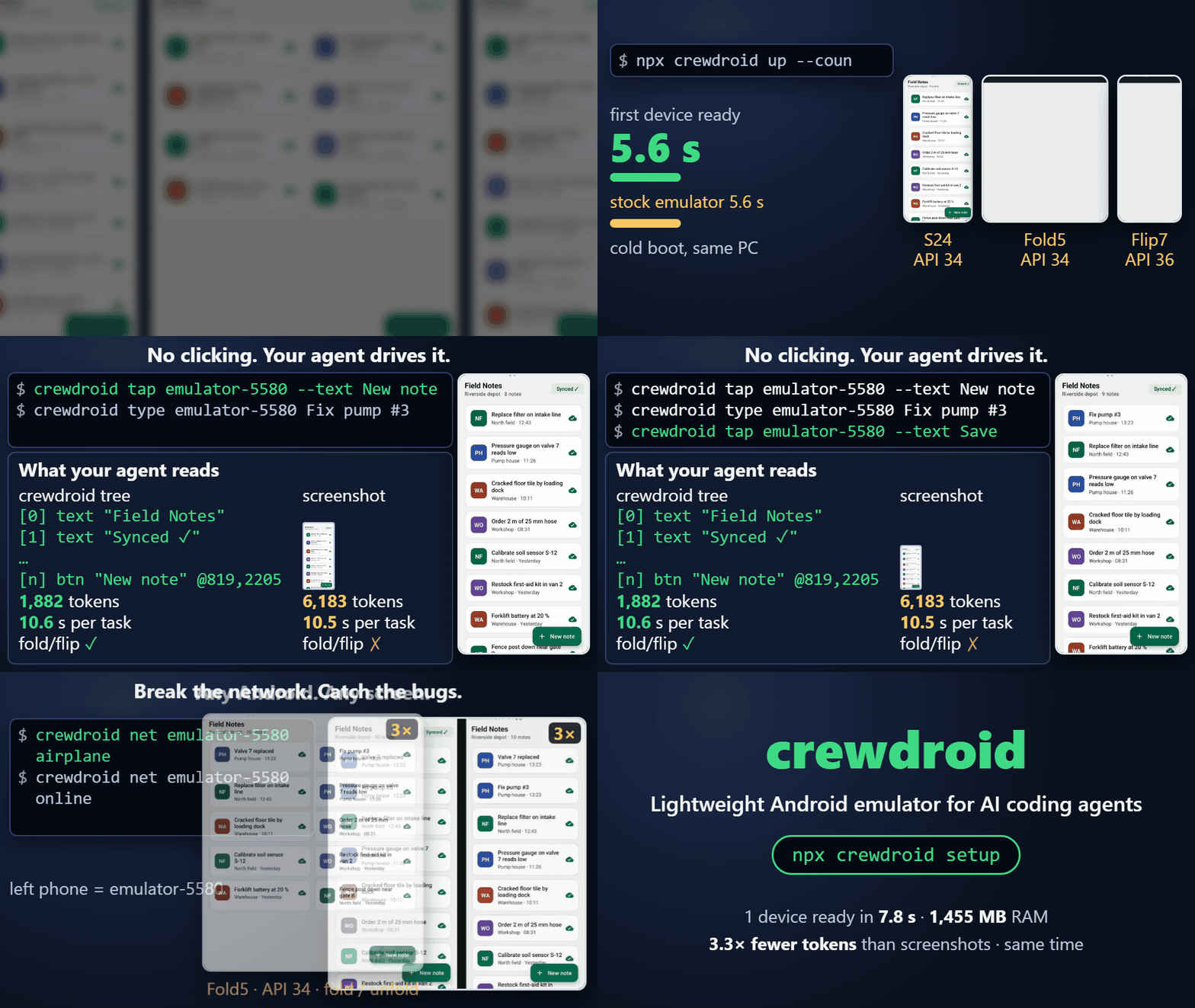
- Faster to a tested app. In one run per side, an AI agent built and 3-device tested the same app in 13 min 42 s on crewdroid and 40 min 30 s on Android Studio's default AVD, with the same result (details).
- Light. 1472 MB of host RAM and 2.09 GiB of disk per device, against 3388 MB and 7.29 GiB for Android Studio's default AVD; a screen read through the CLI takes 370.7 ms against 2074.1 ms (table).
- Made for an agent.
screenreturns a text outline ([3] btn "Send" #send @540,1210) in about a third of a screenshot's tokens (1882 vs 6183 per task),tap --text Sendtaps by name on any screen size, and every command is both a CLI with--jsonand an MCP tool. - Conditions on demand. Per device:
net airplane|nodata|slow|flaky,envbattery / location / dark mode / font size / locale / rotation, Galaxy S24 · Fold · Flip screens with fold / unfold, Android 12 / 14 / 16, a used-phoneload.
Also in the box: judging your server's data for duplicate, missing and silently overwritten records after a multi-device run, a layout sweep across screens and fonts, crash / ANR triage.
One app, built by an agent on both
We gave an AI agent the same empty project, spec and buggy server twice: build a designated-driver app, check every feature on screen, fix what breaks, then test 3 drivers against the server. Same model, no human. One run per side, 2026-11-02 (method and limits, files to repeat it).
| Android Studio default AVD + adb + mobile-mcp | crewdroid | |
|---|---|---|
| Empty project to finished 3-device test | 40 min 30 s | 13 min 42 s |
| Bringing up 3 devices | 759 s | 41 s |
| Server bugs found | 4 | 4 |
| Finished app, same scored run | passed | passed |
Same result, about a third of the time. Boot explains nearly half of the gap: without those 759 s the Studio side takes about 28 minutes, and an agent reusing a running emulator would not pay all of it. This is one run per side, not a benchmark.
The run command then took about 5 minutes for 3 devices x 5 rounds with network faults. It failed the buggy server 2 of 2 times and passed the fixed server 2 of 2 times.
One device, against Android Studio's default emulator
If you found crewdroid because an AI agent on the stock emulator is slow, start here. One device, medians of 3 runs, measured on the same PC (raw runs in docs/measurements/single-vs-studio.json):
| Android Studio default AVD | crewdroid up | |
|---|---|---|
| Disk (AVD + system image) | 7.29 GiB | 2.09 GiB |
| Host RAM after ready | 3388 MB | 1472 MB |
Screen read in the MCP server (Studio side: adb uiautomator dump) | 2074.1 ms | 175.2 ms |
| Screen read through the CLI | 2074.1 ms | 370.7 ms |
Screenshot in the MCP server (Studio side: adb screencap) | 723.7 ms | 286.3 ms |
| Screenshot through the CLI | 723.7 ms | 445.6 ms |
Cold boot to sys.boot_completed | 25.1 s | 24.6 s |
| Idle CPU, 60 s (100 % = 1 core) | 200.5 % (runs: 42.5 to 383.1) | 213.3 % |
Start from snapshot to sys.boot_completed | 5.3 s | 5.5 s |
Bold = crewdroid clearly ahead. Cold boot and snapshot boot are a tie, and idle CPU varies too much between runs to call. The CLI rows time the installed crewdroid command (node bin/crewdroid.mjs, a new node process per call; it starts in 79 ms, --version); the MCP rows time calls to one crewdroid mcp server kept running. npx crewdroid adds about 0.4 s to every call (cli-speed.json), so install it once (npm i -g crewdroid) or use the MCP server. Per-phase numbers in single-vs-studio.md.
An AI agent driving one device (Field Notes demo app, "add a note and confirm it", 5 runs per path, API 34, s24ultra; raw in docs/measurements/agent-bench.json): path A reads crewdroid's text outline and taps by text, path B reads a screenshot after every action and taps by x,y.
| Agent, per task | Screenshots + x,y taps | crewdroid screen + tap --text |
|---|---|---|
| Estimated model input tokens | 6183 | 1882 |
| Tool time (s) | 10.46 | 10.58 (a tie, not faster) |
| Same task on fold5-main and flip6-cover at font 1.3, no re-deriving | FAIL (s24ultra x,y outside the screen) | pass |
What crewdroid adds over mobile-mcp + the stock emulator: a lighter device (table above, single-vs-studio.json), per-device network faults (net), layout checks across screens and fonts (layout.md) and judging the server's data (run-app.json). What it does not add: tap / type speed, which is the same (agent-bench.json; mobile-mcp itself was not benchmarked, path B stands in for screenshot-driven agents).
Setup: Android 16 (API 36); the Studio side is a pixel_9 AVD from google_apis_playstore with default 2 GB RAM and 4 cores, window on, -gpu auto, quickboot; the crewdroid side is up with no flags (headless, 2 cores, google_atd image); Ryzen 7 5700X, 64 GB, Windows 11, emulator 37.1.11.0. The CLI rows include starting node.
What only crewdroid does
- Judges the server, not the screen. After a run,
crewdroid judgereads your API's data and checks rules:unique(no duplicates),count(nothing missing),noLostUpdate(no silent overwrite). A bug comes back asVIOLATIONlines and exit code 1, not as a screenshot to interpret. No export endpoint?crewdroid proxy start --target http://127.0.0.1:8080records every request the emulators send (through the Android system proxy, no app or server change), andcrewdroid judge --rules judge/proxy.rules.json --log proxy.jsonlchecksdupSuccess(one write applied twice),lostUpdate(two edits on the same version both accepted),lostWrite(a failed write never retried) andidlefrom that log. Plain HTTP only for now (ADR 0008). - Breaks one device at a time, mid-flow. Network
airplane/nodata/slow/flakyper device on its own schedule, fold / unfold during an upload, Doze, trim-memory, full storage, a low-end CPU / RAM spec. Every setter reads the state back. - Runs a mixed fleet from one command. Android 12 / 14 / 16 and S24 · Fold · Flip or any
WxH@dpi, headless, all clones of one base image: 3 devices in 3.93 GB of host RAM and 6.99 GiB of disk (allocated).
Also in the box: crash / ANR triage, cold start and jank, APK inspection. Every command has --json and an exit code, and every command is an MCP tool.
npx crewdroid setup --yes        # Android SDK + emulator images, if you have none
npx crewdroid up --count 3       # S24 Ultra / API 34, Fold5 / API 34, Flip7 / API 36
npx crewdroid run --apk app.apk --flow flows/add-item.yaml --server http://127.0.0.1:8080   # your app: your Maestro flow on every device + network faults + judge, exit 1 on a bug
New to it? Try the bundled sample first (sample app + sample server with a race condition): npx crewdroid run scenarios/photo-upload.json --seed 1. Your own app step by step: docs/guide-your-app.md.
Why not just the Android Emulator?
The stock emulator is one phone with a window, driven by hand. crewdroid is a fleet driven by a program.
| Android Emulator / AVD Manager | crewdroid | |
|---|---|---|
| Multi-user bugs | not a feature | run repeats a flow on every device at different timings, then judge checks the server: unique, count, noLostUpdate |
| Network | one toggle in Extended Controls | per-device airplane, nodata, slow, flaky on a randomised schedule, mid-upload |
| Devices | one AVD = one window, one disk image each | N read-only clones of one base image, mixed screens (S/Fold/Flip/any WxH@dpi) and API levels, one command |
| Interaction | click in a window | --json output + exit code on every command |
| Device state | GUI panels | env (GPS, battery, rotation, dark mode, font, locale, GSM, SMS, calls) and app (permissions, deep links, Doze, trim, full storage) — each setter reads its state back |
| Fold / Flip | needs a foldable AVD | fold / unfold on any clone: the app gets a real configuration change |
| For an AI agent | nothing to call | MCP server, AGENTS.md, 7 skills triggered by symptoms ("app crashed", "deep link does not open", "sync duplicated a row") |
Resources for 3 devices (3 API levels each; stock = avdmanager defaults, headless, fresh):
stock google_apis | stock google_atd | crewdroid | |
|---|---|---|---|
| Disk | 24.7 GiB (file length; not re-measured as allocated) | 11.8 GiB allocated (33.2 GiB file length) | 6.99 GiB allocated |
| Host RAM | 8.45 GB | 8.5-8.8 GB | 3.93 GB |
| Idle CPU (100 % = 1 core) | ~1000 % | ~248-352 % | ~600 % |
"Allocated" = bytes really on disk (sparse holes and NTFS compression excluded), the only disk number comparable to crewdroid's slimmed clones; the google_apis figure was taken as file length, so it overstates that column. Disk and RAM are lighter than both stock images, but idle CPU is not: crewdroid's ~600 % is higher than 3 stock google_atd AVDs (~248-352 % over 6 runs; one 60 s sample is noisy), so the CPU gap against google_apis comes from the image, not from crewdroid. Measured on one Windows 11 PC (Ryzen 7 5700X, 64 GB, WHPX), 3 devices. Raw JSON and method in docs/measurements/ (baseline.md, baseline-atd.md).
No barrier, by design. Real concurrency bugs come from retries, offline queues and late edits overlapping — not from pressing a button at the exact same millisecond. crewdroid gives each device its own delays and network schedule and lets the overlap happen, then reads the truth from the server (ADR 0002).
60-second tour
Boot a mixed fleet (headless, no emulator windows; on Windows a tray icon shows what runs):
$ crewdroid up --count 3 --json
[
  { "serial": "emulator-5580", "profile": "s24ultra",   "api": 34, "screen": "1080x2340@450", "bootSeconds": 6.4, "readySeconds": 42.1 },
  { "serial": "emulator-5582", "profile": "fold5-main", "api": 34, "screen": "1812x2176@420", "bootSeconds": 6.7, "readySeconds": 41.8 },
  { "serial": "emulator-5584", "profile": "flip7-main", "api": 36, "screen": "1080x2520@480", "bootSeconds": 3.1, "readySeconds": 39.9 }
]
Cut one device's data mid-upload, let another go flaky:
$ crewdroid net emulator-5580 nodata
$ crewdroid net emulator-5582 flaky
Run your own app (a release APK is fine): run --apk app.apk --flow flows/add-item.yaml --server http://127.0.0.1:8080 repeats your Maestro flow on every device under network faults, puts the recording proxy in front of your backend and judges the request log (docs/guide-your-app.md; a scenario file adds intents / adb actions per iteration). Worked example on an app that is not ours: DAVx5 (F-Droid) + a local Radicale CardDAV server, scenarios/davx5-contacts.json, 3 devices with airplane / nodata / slow / flaky, then again with 30 % of the answers cut: 0 violations, 12 of 12 contacts stored, none twice, so no bug found in DAVx5 (docs/measurements/run-app.json).
Or try the bundled sample: the multi-user scenario against a server with a race condition (BUGGY=1 in the bundled sample server), and read the verdict:
$ BUGGY=1 npx -y tsx sample/server/main.ts 5599     # in another terminal; run checks it is up before booting
$ crewdroid run scenarios/photo-upload.json --seed 1
...
VIOLATION uploads unique(key): duplicate key="u13-1" (2 rows)
VIOLATION uploads count(acks): missing 1 of 48 expected key values
VIOLATION writes noLostUpdate(id,baseVersion): lost update: 3 writes to id="r2" all based on baseVersion=4; all but one were overwritten
FAIL: 5 violations            # exit code 1
Same scenario, server fixed → OK: 3 rules, 0 violations, exit 0. The judge rules are a JSON file, so the same check runs against your own API's export.
Read the screen as text (what to tap, by name; one line per element, --json for the full tree):
$ crewdroid screen emulator-5580
dev.crewdroid.demo/dev.crewdroid.demo.MainActivity 1080x2340
[0] text "Field Notes" #app_title @391,141
[2] text "Synced ✓" #sync @908,169
[3] list #list @540,1306
  [5] text "Replace filter on intake line" #note_title @579,380
...
[35] btn "New note" #fab @819,2205
$ crewdroid tap emulator-5580 '[35]'      # or --text "New note"; prints the new screen once it settled
Agent interface
What an agent gets is a contract, not speed claims: JSON in, JSON out, an exit code, and the state read back after every change.
- Every command is machine-readable:
--json, non-zero exit on failure, read-back after every setter, clear error before any adb call on bad input. - MCP server:
crewdroid mcpexposesdevices,up,down,net,env,app,fold,triage,screen,perf,apk,judge,hammer,runover stdio — the same functions the CLI calls, no second implementation. - Skills in
.agents/skills/(read by Claude Code, Cursor, Gemini CLI, Copilot, Codex):crewdroid,android-triage,android-screen,android-permissions-intents,android-apk,android-perf,android-offline-concurrency. Each is a short recipe of exact commands whose output the agent can act on. AGENTS.mdwith the rules an agent must keep (adb only againstemulator-<port>, one run at a time, never a barrier) andCLAUDE.mdfor Claude Code.- Safe on a shared machine: a USB phone plugged into the same PC is never touched; clones are read-only;
downkills onlycrew-*.
{ "mcpServers": { "crewdroid": { "command": "npx", "args": ["-y", "crewdroid", "mcp"] } } }
claude plugin marketplace add namyunsu/crewdroid && claude plugin install crewdroid@crewdroid
Cursor: install the MCP server · Codex / Gemini CLI / Copilot: the skills and AGENTS.md are picked up from the repo.
What it finds
| Bug class | How crewdroid reproduces it | Rule that catches it |
|---|---|---|
| Duplicate upload after a retry (missing idempotency) | flaky network drops the response, the app's outbox retries with the same key | unique(key) |
| Dropped record (outbox lost on restart / airplane mode) | airplane during save, app restart offline, reconnect | count(acks) |
| Lost update (two users edit the same row, last write wins) | devices read the same version at different times and both PUT | noLostUpdate(id,baseVersion) |
| Fold during upload | fold / unfold while the outbox drains: the app must survive the configuration change with exactly one upload | unique + count |
| Crash / ANR only on one Android version or screen | mixed API 31/34/36 and S/Fold/Flip profiles in one run; triage reads the crash buffer, ANRs and exit reasons | — |
On your app: docs/guide-your-app.md (run --apk --flow --server, proxy log rules dupSuccess / lostUpdate / lostWrite). On DAVx5 with 30 % of the answers cut, each committed-but-unanswered PUT was resent with If-None-Match: *, got 412 and made no second copy: 0 violations, 12 of 12 contacts (docs/measurements/run-app.json).
The bundled sample app (Kotlin, offline outbox, probe-app/) and sample server (sample/server/, BUGGY=1 switch) make every row above reproducible on a laptop.
Limits: when to use a real phone
crewdroid runs Google's google_atd images (chosen for lightness). Measured on fresh devices, API 31 / 34 / 36 (docs/measurements/atd-limits.md, re-check: node scripts/check-atd-limits.mjs):
| Missing on the image | What breaks because of it | Instead |
|---|---|---|
A Google account and any screen to add one: 0 accounts, ADD_ACCOUNT_SETTINGS resolves to nothing; Play services itself is there (prebuilt GmsCore 22.50 / 23.18 / 25.08) (measured) | "Sign in with Google" and anything that needs a signed-in Google account; FCM push was not tested here | a real phone |
The Play Store: com.android.vending is only /product/app/LicenseChecker 1.8, market:// resolves to nothing (measured) | Play Billing, in-app updates, store links, installing from Play | a real phone |
Chrome: com.android.chrome not installed; VIEW https:// goes to a stub browser (fakesystemapp), on API 36 to a chooser with the WebView shell (measured) | Custom Tabs and browser links, browser-based OAuth redirects back into the app | the app's own WebView: the system WebView (91 / 113 / 133) rendered a local page on all three APIs (measured); else a real phone |
A camera app on API 31 and 34: IMAGE_CAPTURE resolves to nothing (API 36 has com.android.camera2) (measured) | camera-intent photo pickers ("take a photo" buttons) | adb push a picture, then the app's own picker; the system photo picker (PICK_IMAGES) resolves on API 34 and 36, not on 31 (measured). A real camera: a real phone |
A launcher: MAIN/HOME is an empty stub (fakesystemapp EmptyHomeActivity) on all three APIs (measured) | home-screen widgets, shortcuts, launcher badges | a real phone |
Requirements
- Android SDK with command-line tools and emulator >= 36.4 (
ANDROID_SDK_ROOTorANDROID_HOMEmust point at it, or~/.crewdroid/android-sdkmust exist). No SDK yet:npx crewdroid setup --yesinstalls JDK 17 (for sdkmanager only), command-line tools, platform-tools, emulator and thegoogle_atdimage (--images 34,31,36,--dry-runlists sizes first); crewdroid downloads thegoogle_atdimages it needs for the host CPU (x86_64, or arm64-v8a on Apple Silicon / ARM Linux; API 31/34/36, ~0.9 GB each) and shrinks them withslim - Node >= 22
- From a git checkout instead of npm: run
npm ci && npm run prepackonce. It builds the on-device helper APK (JDK 17) that the npm package already ships; without itscreen/tapfall back touiautomatorandtypetakes ASCII only - Windows 10/11 x64, macOS on Apple Silicon, or Linux x64/arm64
- Hardware acceleration: WHPX (Windows), Hypervisor.framework (macOS) or KVM (Linux,
/dev/kvm);setupreportsemulator -accel-check - Image limits (
google_atd, chosen for lightness): see Limits; also no Messages or Dialer (SMS and calls change telephony state only) and no GPU (frame numbers compare runs, not phones). Supported despite the image: any Unicode text input incl. Korean (on-device helper), and the API 31 black-screen-after-relaunch is detected and recovered (blackRelaunch) - macOS/Linux:
slimskips the NTFS sparse/compress steps (snapshot zero-fill and stale-overlay cleanup still run); RAM figures are process RSS (shared pages not split)
Commands
Every command takes --json and exits non-zero on failure.
| Command | What it does |
|---|---|
crewdroid up --count N [--profiles a,b] [--screen WxH[@dpi],...] [--profiles-file f.json] | boot N emulators with Galaxy profiles or your own screens (any size, e.g. --screen 3840x2160@320) |
crewdroid up [--cores 1|2|4|6|8] [--ram 896..8192] | pick the guest CPU count and RAM like a real device spec (also cores/ramMB in a profile, e.g. a16-lowend); default 2 cores / 896 MB; a new spec builds its own base snapshot on first use (docs/measurements/spec.md) |
crewdroid up [--count N] --wifi | each device can get its own Wi-Fi address; measured on Windows: 31 of 33 device boots got Wi-Fi from net wifi, the 2 misses were API 34 clones (wlan0 never associated), so net wifi asks for the access point again after 30 s (docs/adr/0009-wifi.md) (adds -feature -WiFiPacketStream to the clones, +9.4 % idle RAM; MCP up input wifi: true). Without it Wi-Fi gets an address on one device at a time. Each clone then sits on its own Wi-Fi network: clones cannot reach each other over Wi-Fi and wlan0 addresses can repeat. Untested on macOS and Linux (docs/adr/0009-wifi.md) |
crewdroid down | kill every crew-* emulator |
crewdroid net <serial> airplane|nodata|slow|flaky|online | set one device's network state |
crewdroid net <serial> wifi|cellular|both|none | which link is up: the emulator's "AndroidWifi" access point, mobile data, both, neither; slow and flaky then act on the chosen link. Every net call returns the transport apps see (default: wifi|cellular|none, metered). By default Wi-Fi gets an address on one device at a time; with up --wifi each device can (31 of 33 measured device boots), at +9.4 % idle RAM (docs/adr/0009-wifi.md) |
crewdroid net <serial> handover [--to wifi|cellular] [--during <ms>] | move the default network to the other link while the app keeps running; --during = ms with no link in between (default 0: new link first) |
crewdroid net <serial> metered on|off | mark the Wi-Fi network metered, so apps that sync only on unmetered networks hold back |
crewdroid fold <serial> / unfold <serial> | cover <-> main screen on a Fold/Flip profile |
crewdroid run --apk <app.apk> --flow <flow.yaml> --server <url> | run <scenario.json> [--seed N] | run a multi-device scenario on any APK (Maestro flow / intent / adb actions, network faults), then judge the proxy log or the server data (guide) |
crewdroid judge --rules <file> --source <url|file> | check unique / count / noLostUpdate rules |
crewdroid hammer --url <base> | server-side concurrency load without devices |
crewdroid slim / prepare / identity | shrink disk, build base AVDs, make devices distinct |
crewdroid measure --up N | measure disk, RAM, boot, idle CPU |
crewdroid triage / screen / perf / apk | Android diagnostics, see below |
crewdroid env <serial> <what> [args] | device environment: location, battery, rotation, dark, font, locale, mobile network, SMS, calls (see Environment) |
crewdroid app <serial> <pkg> <what> [args] | app control: permissions, deep links / App Links, data clear, backup / restore, resource pressure (see App control) |
crewdroid shot / tap / type / swipe / key | screenshot and input without mobile-mcp (see Screenshots and input) |
crewdroid mcp | stdio MCP server exposing the above to an agent |
Screenshots and input
| Command | What it does |
|---|---|
crewdroid shot <serial> [file.png] | exec-out screencap -p to file.png (default ./crewdroid-<serial>-<yyyymmdd-HHMMSS>.png); prints path, width x height and blackRelaunch (API 31 black screen recovered first, as in screen). The MCP tool returns the PNG as image content plus one text line. |
crewdroid tap <serial> <x> <y> | '[n]' | --text <T> | --id <resource-id> [--index N] | input tap at a point, at line [n] of the last screen outline (no new tree read while the same window has focus), or at the centre of the element whose text / content-desc or resource-id (full or the part after :id/) matches: exact first, then case-insensitive contains. No match, or several without --index (0-based), exits 1 with the candidates (text, id, bounds). |
crewdroid type <serial> <text> [--into <text|id>] | appends the text to the focused field through the on-device helper (any Unicode, e.g. Korean); --into taps the field first. Without the helper: input text, ASCII only, see below. |
crewdroid swipe <serial> up|down|left|right [--times N] | swipe <serial> x1 y1 x2 y2 [ms] | finger direction over the middle 50 % of the current screen (up scrolls the content down). |
crewdroid key <serial> back|home|enter|delete|tab|menu|KEYCODE_* | input keyevent; prints the focused window afterwards. |
tap, type, swipe and key then print the new screen outline (as screen), read once the tree is unchanged for 150 ms (1 s at most), so an agent needs no separate observe call; --no-screen (MCP screen:false) skips it, --json (MCP format:"json") returns the result object with the outline as screen.
screen, tap, type, swipe and key go through a small on-device helper that up starts on every device (instrumentation APK dev.crewdroid.agent, reached over adb forward on 127.0.0.1; docs/adr/0007-agent-helper.md): a tree read takes tens of milliseconds instead of a uiautomator dump. Each result says via: "helper" or via: "fallback" (helper not answering: the old uiautomator / input path, then the helper is restarted). Points outside the screen exit 1 before anything is sent. Without the helper, non-ASCII text (e.g. Korean) is not typed: type exits 1 with the reason. input text only types characters in the device key map, ATD has no shell command that sets the clipboard for a paste (cmd clipboard has no implementation), and crewdroid does not install a keyboard app; pass such text through your app (intent extra, test hook) or install an IME such as ADBKeyboard yourself. The probe app has a form for these: --es check form (field id name, button Send -> CrewProbe FORM <text>, a 3-screen scroll whose bottom END logs CrewProbe SCROLL END). node scripts/check-input.mjs runs all of it on an API 34 and an API 36 device.
Diagnostics
Read-only commands (nothing stays running on the device). Each takes --json; the same four are MCP tools.
| Command | Output |
|---|---|
crewdroid triage <serial> [--app <pkg>] [--heap out.hprof] | crashes (logcat crash buffer: pkg, exception, top frame in the app, time), anrs (ActivityManager log + dumpsys activity exit-info), anrTraces (/data/anr headers, or "unreadable" without root), exits (exit reasons), recentLog (the app's last 200 lines), summary. --heap runs am dumpheap and pulls the hprof. |
crewdroid screen <serial> [--png file] [--bounds] | focused window (dumpsys window) and screen size, then one line per visible element of the accessibility tree from the on-device helper (uiautomator as fallback): [n] role "text" #id @x,y flags (role btn / edit / text / img / list / check; a clickable card is one line with its texts; R8-obfuscated ids left out; @x,y = centre, --bounds adds [l,t,r,b]; flags focused / checked / disabled; … N more below (swipe up) for off-screen nodes). --json (MCP format:"json") = the full tree [{cls, text, desc, id, bounds, clickable, depth, editable?, scrollable?, checked?, focused?, disabled?}]. Compose testTag shows as id only under testTagsAsResourceId = true. On API 31 a fully black screen left by an app relaunch (Android 12 emulator bug, any tool's am start -S) is recovered first (HOME + resume) and reported as blackRelaunch, so it is never mistaken for an app bug. |
crewdroid perf <serial> <pkg> [--activity .Main] [-- <am start extras>] | cold start (am force-stop, 2 s, am start -W; TotalTime ms), frames / jank % / p50-p90-p99 from dumpsys gfxinfo, PSS total / Java / native KB from dumpsys meminfo. ATD images have no GPU: compare frame numbers between runs, not with a phone. |
crewdroid apk <file.apk> | host only (aapt2 from the newest build-tools): package, version, min/target SDK, permissions, exported activities, deep-link filters. |
The probe app has targets for these: adb -s emulator-5580 shell am start -n dev.crewdroid.probe/.ProbeActivity --es check crash|anr|jank (anr: tap the button, then tap again within 10 s). node scripts/check-triage.mjs runs all four on one API 34 device.
Environment
crewdroid env <serial> <what> [args] [--json]. Every setter reads the state back and exits 1 with a message when it differs; bad values (battery 150, rotate 9, a serial that is not emulator-<port>) exit 1 before any adb call. Also an MCP tool (env).
| What | Meaning |
|---|---|
geo <lon> <lat> [alt] | GPS fix (longitude first) and location switched on. Android only receives a fix while an app requests location, so the setter cannot fail on a mismatch: it only checks that location is on and reports the last fix Android saw (androidLastFix, delivered). The fix is confirmed only by the probe's ENV loc= line (check=env) |
| `battery <0-100> [ac | unplugged]` |
rotate <0-3> | auto-rotate off, fixed rotation |
sensor acceleration x:y:z | accelerometer value |
| `dark on | off/font ` |
locale <pkg> <tags> | per-app locale, e.g. locale dev.crewdroid.probe ko-KR,en; API 33+ only (no shell command for the device-wide locale) |
| `gsm data home | roaming |
gsm signal <0-31> [--hold <sec>] | signal strength; the console keeps it 15 s, --hold re-sends every 10 s. No read-back exists (console ack only) |
sms <from> <text> / `call [accept | cancel]` |
show | every state above, read back from the device |
rotate also runs wm fixed-to-user-rotation enabled: without it, on the API 36 image WindowManager restored the previous rotation (revertOverride) at the next app launch. rotate and show read the lock back from settings and WindowManager. gsm signal is confirmed only by the console's OK (no read-back exists). Negative numbers work (env emulator-5580 geo -122.084 37.422). ATD has no Messages or Dialer app: SMS and calls change telephony state and broadcasts only. The probe app logs what it sees: am start -n dev.crewdroid.probe/.ProbeActivity --es check env -> CrewProbe ENV dark=<bool> font=<scale> rot=<n> battery=<pct> loc=<lat>,<lon>|none (loc needs the location permission: pm grant). node scripts/check-env.mjs runs all of it on 2 devices.
App control
crewdroid app <serial> <pkg> <what> [args] [--json]. Setters read the state back and exit 1 with a message when it differs; bad names, buckets or sizes exit 1 before any adb call. Also an MCP tool (app).
| What | Meaning |
|---|---|
| `perm grant | revoke <perm…>/perm show [perm…]` |
open <uri> [--pkg] | am start -a VIEW -c BROWSABLE -d <uri> (--pkg: only this package). Nothing can handle it -> exit 1 No Activity found (ATD has no Chrome). A running app only gets its task brought to the front and never sees the uri: the result says delivered: false; force-stop it first |
links show / links force <domain> / links reset | App Links (API 31+): pm get-app-links; set-app-links --package <pkg> 2 <domain> (approved without internet); ... 0 all |
clear | pm clear; read back with run-as (debuggable apps), else only pm's Success |
backup / restore | bmgr with com.android.localtransport/.LocalTransport (present on the API 34 and 36 images; absent -> exit 1 with that reason). backup of an app with no data is rejected by the transport. restore uses the newest set |
pressure doze / `standby <active | working_set |
pressure trim <level> | am send-trim-memory (HIDDEN ... COMPLETE). No read-back on the device: only am's ack. A background level to a foreground process, or a process that is not running, is an error. The probe logs CrewProbe TRIM <level> |
pressure reset | undoes doze, battery unplug, standby bucket (-> active), bg-restrict, battery-saver |
fill-storage <GB> / fill-storage free | fallocate a file in /data/local/tmp, read back with df -k /data; free removes it. The image has about 5.8 GB free |
The probe app has the deep links crewdroid://probe/* and https://probe.crewdroid.example/* (autoVerify) and logs CrewProbe LINK <uri>. node scripts/check-app.mjs runs all of it on 2 devices.
Used-phone load
crewdroid load <serial> off|low|mid|high [--keep-apps] [--json], or crewdroid up --load <level> (applied after boot). Also an MCP tool (load, and a load input on up). Off by default: a plain up installs nothing of this.
A real user's phone has many apps installed, several alive in the background, little free RAM and some CPU work going on. Each level is a fixed recipe: installed filler apps (30 / 80 / 150 tiny APKs, generated once by scripts/gen-filler-apks.mjs; every 3rd wakes up and schedules a periodic job), background processes of the load app dev.crewdroid.load (5 / 15 / 30), memory ballast until MemAvailable is at 50 / 30 / 15 % of its value with load off, CPU workers at 10 / 25 / 50 % of every guest core, and AlarmManager / JobScheduler wakeups. off force-stops the load app (processes, ballast, alarms, jobs) and uninstalls the fillers and the load app unless --keep-apps. The result is the measured guest state: MemAvailable (MB, %), swap, load average, CPU busy %, running processes, installed packages.
The default 896 MB guest has only ~130 MB free at idle, so lmkd kills apps from low on; use --ram 2048 or more to tell the levels apart. What each level costs (cold start, jank, low-memory kills of the app under test, host CPU/RAM) on API 34 and 36: docs/measurements/load.md (node scripts/check-load.mjs).
Add a device profile
A profile is a screen (width x height, density) applied with wm size / wm density after boot, not a separate AVD. Add an entry to profiles/galaxy.json:
{ "name": "s25", "model": "Galaxy S25", "width": 1080, "height": 2340, "density": 420, "minAndroid": "15", "minApi": 35 }
Then crewdroid up --count 1 --profiles s25. minApi picks which Android image the device lands on.
Any size without editing that file: crewdroid up --count 2 --screen 1920x720@160,3840x2160@320 (density optional, derived for a ~360dp short side), or --profiles-file my.json (same schema; see profiles/custom.example.json). Sizes beyond the host monitor work — up to 7680x2160 tested; see docs/measurements/size.md.
Safety rules
- Every adb call goes through a guard that only accepts
emulator-<port>serials, so a USB phone on the same machine is never touched. - Emulators run as read-only clones of one base AVD: nothing is saved back, and
downremoves onlycrew-*instances. - One crewdroid run at a time per machine (
up/downtake a lock). - The SDK path comes only from
ANDROID_SDK_ROOT/ANDROID_HOME; nothing is hard-coded.
How it stays light
Clones of one base AVD (-read-only), system images rewritten sparse + NTFS-compressed, quickboot RAM image zero-filled before the snapshot, -lowram with 896 MB guest RAM, host Vulkan off, no audio, no window. Every knob was measured one at a time: docs/measurements/slim.md (disk), ram.md (RAM), features.md (each runtime feature's idle cost).
Hidden emulators leave nothing in the taskbar, so on Windows up adds one tray icon: a badge with the device count, green when ready. Click it for each device and the last command (command and serial only, never typed text). It holds 51 MB and 0.17 % of one core while devices run, and exits on down or when the emulators die, so nothing stays behind. CREWDROID_NO_TRAY=1 turns it off.
Devices an agent forgot are stopped for you: up leaves a small watcher (70 MB, 0.02 % of one core) that runs down after 60 minutes without a crewdroid command, or as soon as the MCP server that ran up exits. A long command such as run or layout counts as use while it runs. up --idle-minutes 120 changes the time (MCP idleMinutes, env CREWDROID_IDLE_MINUTES); 0 keeps the devices until down.
Korean docs: README.ko.md · License: MIT
Keywords: android emulator, headless, multi-device testing, concurrency testing, race condition, idempotency, lost update, offline-first sync, flaky network, Galaxy Fold Flip profiles, MCP server, AI agent, Claude Code plugin, agent skills, mobile QA automation.
Reviews
No reviews yet
Be the first to review this server!
More Developer Tools MCP Servers
Rea
Freeby Morluto · Developer Tools
Reverse engineer anything from your terminal or agent with one CLI and MCP server.
Paperclip
Freeby Paperclipai · Developer Tools
Trending hip-hop artist momentum scores across four cultural dimensions.
Scrapling
Freeby D4Vinci · Developer Tools
Web scraping with stealth HTTP, real browsers, and Cloudflare bypass. CSS selectors supported.
Git
Freeby Modelcontextprotocol · Developer Tools
Read, search, and manipulate Git repositories programmatically
Toleno
Freeby Toleno · Developer Tools
Toleno Network MCP Server — Manage your Toleno mining account with Claude AI using natural language.
MCP Marketplace
Freeby mcp-marketplace · Developer Tools
Search and install MCP servers from inside your AI client.