
Server data from the Official MCP Registry
Locale vocabulary audit (calques, inventeds, foreign slips). Local CLI via stdio — no hosted API.
About
Locale vocabulary audit (calques, inventeds, foreign slips). Local CLI via stdio — no hosted API.
Security Report
Valid MCP server (1 strong, 3 medium validity signals). No known CVEs in dependencies. Package registry verified. Imported from the Official MCP Registry.
7 files analyzed · 1 issue found
Security scores are indicators to help you make informed decisions, not guarantees. Always review permissions before connecting any MCP server.
Permissions Required
This plugin requests these system permissions. Most are normal for its category.
How to Install
Add this to your MCP configuration file:
{
  "mcpServers": {
    "io-github-nareyko-lexaudit": {
      "args": [
        "lexaudit"
      ],
      "command": "uvx"
    }
  }
}Documentation
View on GitHubFrom the project's GitHub README.
lexaudit
Finds odd, wrong or copied-from-another-language words in your texts, and tells you which pages to fix first.
In plain words
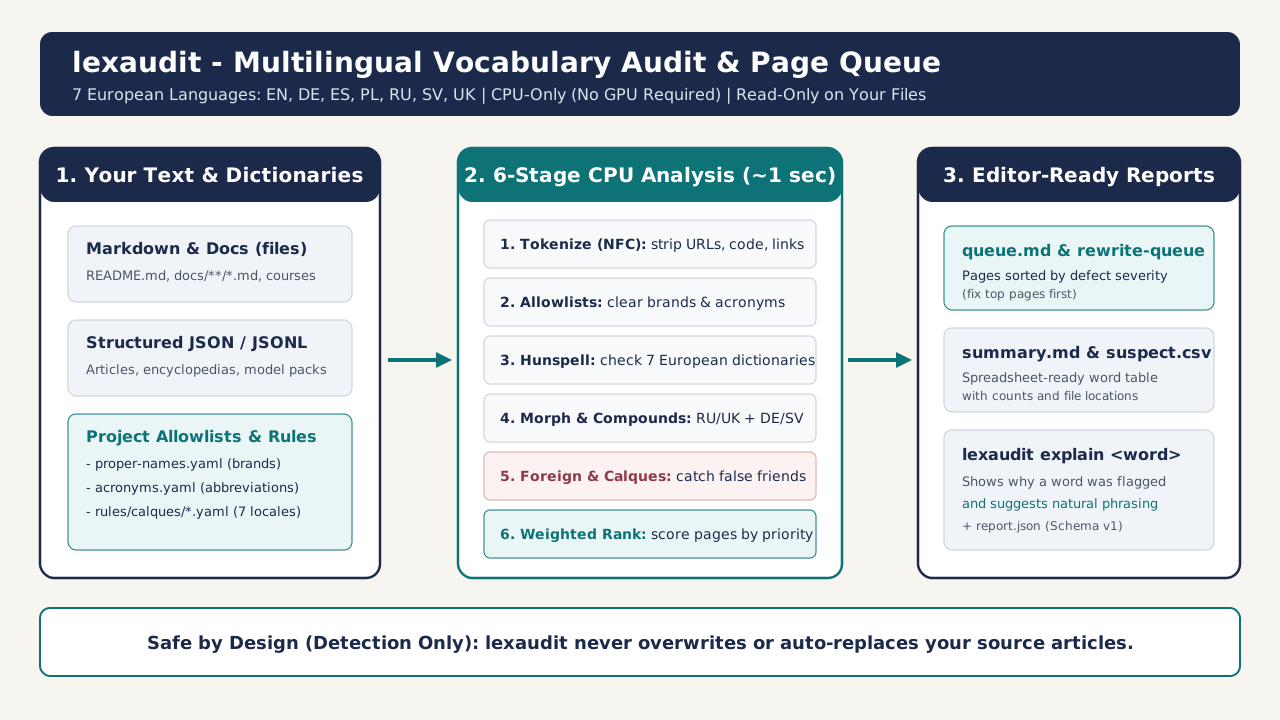
You write or translate articles, courses or documentation. A normal spellchecker shouts about every brand name, abbreviation and long German word, and still misses the words that really hurt: a word copied from another language ("calque"), a real word used with the wrong meaning ("false friend"), or a word someone invented.
lexaudit reads your files, ignores the harmless things, and gives you a short ranked list: "look at this page first." It runs on an ordinary laptop in about a second. No graphics card, no internet, no account.
It only reports. It never changes your texts.
Unknown terms? See the glossary.
0.3.0 prep and publish path: docs/p1-INDEX.md.
- Languages: English (
en), German (de), Spanish (es), Polish (pl), Russian (ru), Swedish (sv), Ukrainian (uk) - Hardware: CPU only
- Author: Vadim Nareyko (github.com/nareyko, Founder at Arviser Sp. z o.o.)
- License: dual MIT package and AGPL-3.0-or-later hosted SaaS (details)
Try it in 30 seconds
pipx run lexaudit audit --path . --locale en --check
# or: uvx lexaudit audit --path . --locale en --check
Missing spelling dictionaries download automatically into your user cache. No GPU. No config file required. Exit code 1 means confirmed calques or invented words remain.
Optional helpers: lexaudit doctor, lexaudit fetch-dicts, lexaudit init.
Check a file or a whole project
# One file or folder, no settings file needed
uv run lexaudit audit --path ./README.md --locale en

# Or create starter settings first, then check everything
uv run lexaudit init
uv run lexaudit audit --locale en
Open the report
The reports are in the output folder, one subfolder per language. Start with queue.md:
| score | unique_suspects | path | top_words |
|---|---|---|---|
| 12.0 | 2 | docs/en/en-04-defect-known-calques.md | orientir surveyness |
| 6.0 | 1 | docs/en/en-05-defect-false-friend.md | denseness |
| 1.6 | 2 | docs/en/en-03-clean-unseen-jargon.md | vinylester haulout |
A higher score means "look here first". top_words shows the words behind the score.
Ask why a word was flagged
uv run lexaudit explain orientir --locale en
word: orientir (normalized: orientir, locale: en)
status: calque (tier: confirmed)
reason: loan-calque-orientir | detectors: calque, hunspell
editorial hint: working rule / ballpark / figures - not orientir
Reproduce our test results
uv run lexaudit audit --config examples/synthetic-demo/lexaudit.config.yaml
Then open tmp/synthetic-demo-out/<language>/queue.md.
How good is it? An honest answer
We built a 42-page test set in all 7 languages: 21 clean technical pages and 21 pages with planted problems. Some problems are known to the rules, some are brand new words the rules have never seen. Details: docs/synthetic-benchmark.md.
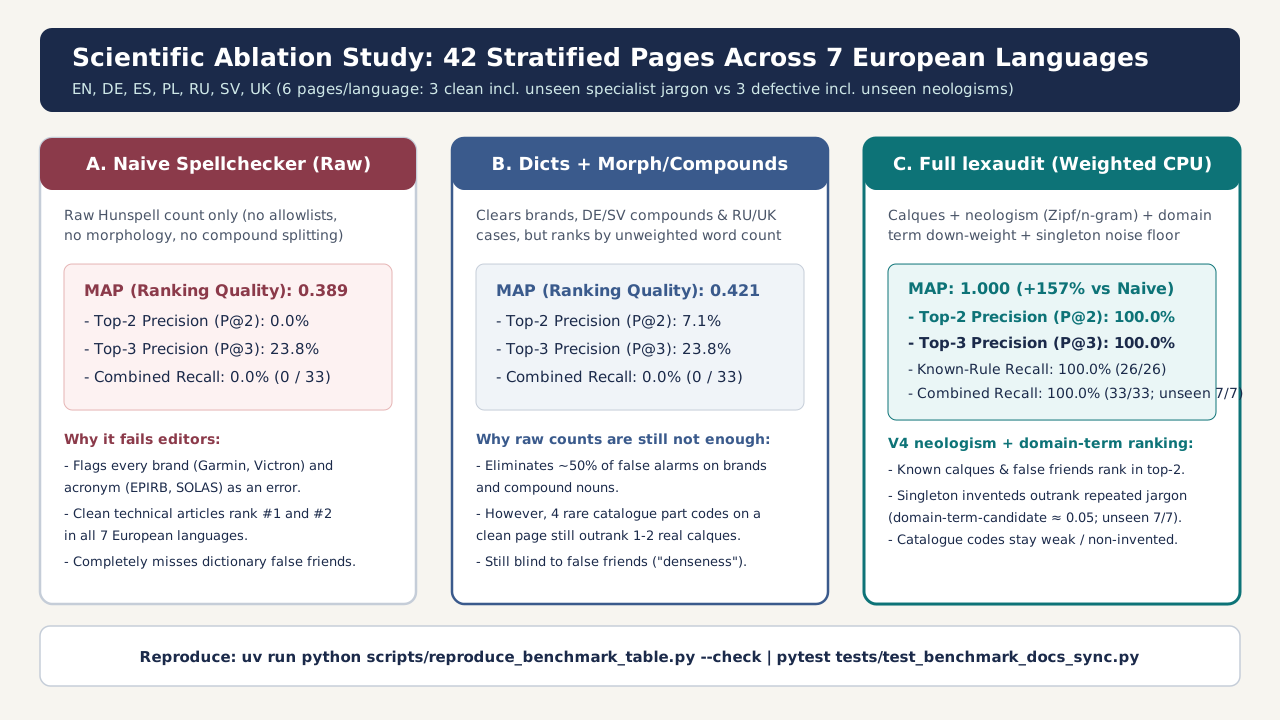
| Setup | Bad page in top 2 | Bad page in top 3 | Recall@2 | Recall@3 | MAP (0 to 1, higher is better) | Known problems found | Brand-new neologisms found | Combined planted problems | Clean-page FP / 1k tokens | Time |
|---|---|---|---|---|---|---|---|---|---|---|
| A. Plain spellchecker | 0.0% | 23.8% | 0.0% | 23.8% | 0.389 | 0.0% (0/26) | 0.0% (0/7) | 0.0% (0/33) | 81.2 | 0.48 s |
| B. Plus your word lists | 7.1% | 23.8% | 4.8% | 23.8% | 0.421 | 0.0% (0/26) | 0.0% (0/7) | 0.0% (0/33) | 47.1 | 0.56 s |
| C. Full lexaudit | 100.0% | 100.0% | 66.7% | 100.0% | 1.000 | 100.0% (26/26) | 100.0% (7/7) | 100.0% (33/33) | 47.1 | 2.97 s |
What this means:
- Pages with known problems come first in every language. The plain spellchecker puts clean pages first.
- Known-rule problems: 100.0% (26/26). Unseen single-occurrence neologisms (Zipf + char n-gram / affix-glue): 100.0% (7/7). Combined planted problems (honest fraction): 100.0% (33/33).
- With exactly 3 defective pages per locale,
Recall@2is 66.7% when the top-2 slots are both bad (Precision@2= 100.0%).Precision@3/Recall@3are 100.0% (singleton inventeds outrank repeated domain jargon). - Clean-page false positives: 47.1 unique flagged words per 1000 tokens (36 unique FP / 764 tokens).
- Domain terms that recur on a page (or sit in H1/title) are tagged
domain-term-candidate, nearly zero-weighted in ranking, and listed under Suggested glossary additions.
Documentation
Start with docs/README.md.
| Guide | What you learn |
|---|---|
| Glossary | Every term in plain words |
| Benchmark | The 42-page test, step by step |
| Architecture | What goes in, what comes out |
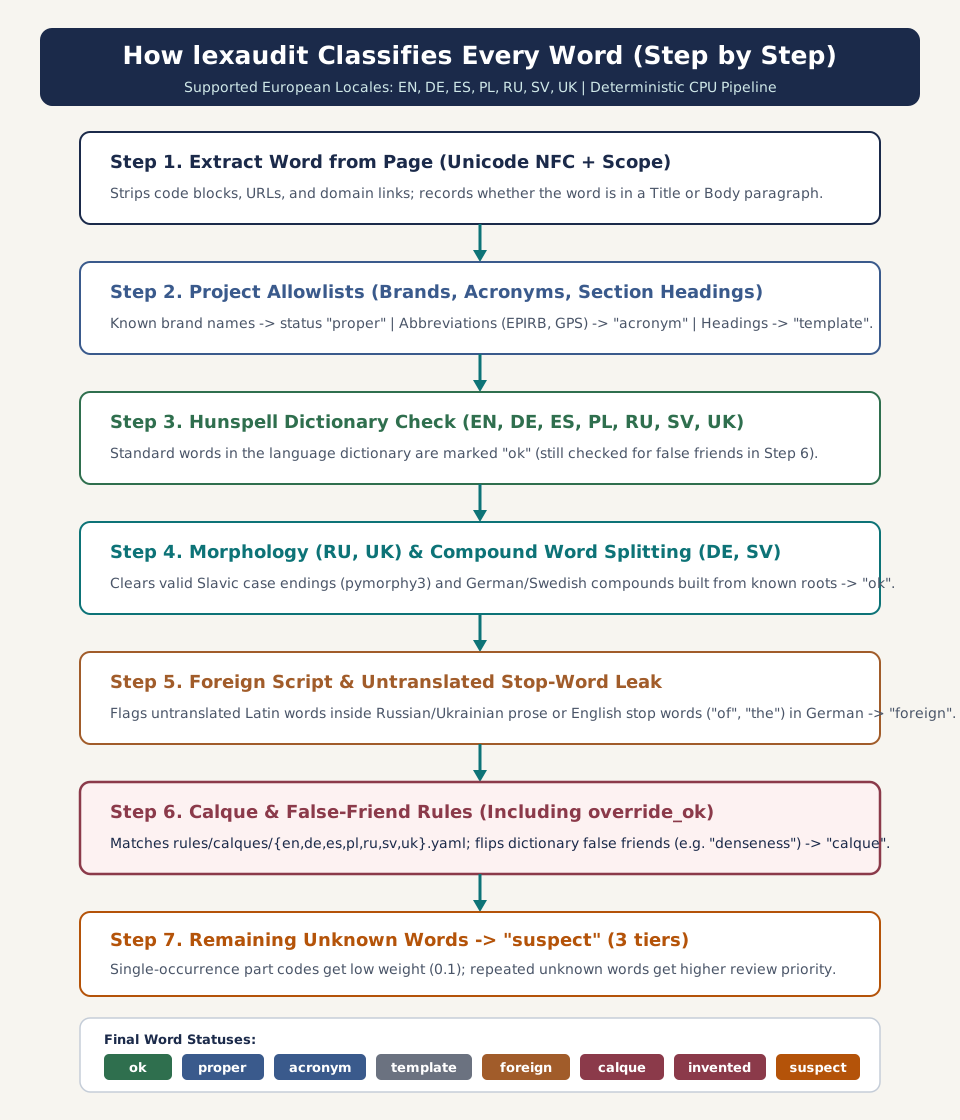
| Pipeline | The gates every word passes |
| CLI reference | All commands |
| Agent workflow | From report to fixed page |
| Scores and metrics | How pages are scored |
More commands
# Re-rank pages, filter by source (docs, academy, model_pack)
uv run lexaudit rank --locale ru --mode weighted --sources=docs

# Add every page that contains a known bad word to your to-do list
uv run lexaudit expand-needle --needle orientir --locale all \
  --write-queue /abs/path/to/rewrite-queue.md

# Optional: ask a language model for a second opinion (your own endpoint)
uv run lexaudit label --locale ru --top-pages 20 --top-words 50 --tiers likely,weak --profile cpu

# Compare two runs
uv run lexaudit diff --baseline .../report.json --current .../report.json --out /tmp/diff.json
For contributors
Setup and checks:
uv sync --extra dev
uv run ruff check . && uv run ruff format --check .
uv run mypy --strict src/
uv run pytest
uv run python scripts/crap_report.py
uv run mutmut run && uv run python scripts/check_mutation_score.py --min-percent 80
uv build
Test layers: unit and integration tests (branch coverage 80% or more), the 7-language benchmark, property-based fuzzing (Hypothesis), golden regression with a read-only check of your files, JSON Schema contract, complexity gate (CRAP), mutation testing (kill rate 80% or more).
Pictures in docs/images are generated from code: run python scripts/render_diagrams.py (needs Inkscape and Pillow). Never edit the JPG files by hand.
License
| What | License |
|---|---|
| PyPI / this repo’s code (CLI, library, YAML rules, packs) | MIT — use in products and private SaaS is fine under MIT |
| Intended future hosted multi-tenant network service (not shipped here) | Policy text: AGPL-3.0-or-later — not a second license on the MIT wheel |
| Benchmark corpora & fetched spelling dictionaries | LICENSE-THIRD-PARTY.md + upstream *.license.txt |
Full wording: docs/licensing.md. Adding rules: docs/contributing-rules.md.
Origin and author
Created and maintained by Vadim Nareyko (github.com/nareyko). It grew out of auditing multilingual courses and encyclopedias at FairHelm.
Reviews
No reviews yet
Be the first to review this server!
More Developer Tools MCP Servers
Rea
Freeby Morluto · Developer Tools
Reverse engineer anything from your terminal or agent with one CLI and MCP server.
Paperclip
Freeby Paperclipai · Developer Tools
Trending hip-hop artist momentum scores across four cultural dimensions.
Fetch
Freeby Modelcontextprotocol · Developer Tools
Web content fetching and conversion for efficient LLM usage
Git
Freeby Modelcontextprotocol · Developer Tools
Read, search, and manipulate Git repositories programmatically
Toleno
Freeby Toleno · Developer Tools
Toleno Network MCP Server — Manage your Toleno mining account with Claude AI using natural language.
MCP Marketplace
Freeby mcp-marketplace · Developer Tools
Search and install MCP servers from inside your AI client.