
Server data from the Official MCP Registry
Local-first evidence tracking, formal logic checks and prerequisite planning for AI agents.
About
Local-first evidence tracking, formal logic checks and prerequisite planning for AI agents.
Security Report
Valid MCP server (2 strong, 3 medium validity signals). 3 code issues detected. No known CVEs in dependencies. Package registry verified. Imported from the Official MCP Registry. 3 finding(s) downgraded by scanner intelligence.
18 files analyzed · 4 issues found
Security scores are indicators to help you make informed decisions, not guarantees. Always review permissions before connecting any MCP server.
Permissions Required
This plugin requests these system permissions. Most are normal for its category.
How to Install
Add this to your MCP configuration file:
{
  "mcpServers": {
    "io-github-noetra2-noetra": {
      "args": [
        "-y",
        "noetra"
      ],
      "command": "npx"
    }
  }
}Documentation
View on GitHubFrom the project's GitHub README.
NOETRA — Universal Cognitive Engine
Give AI agents a checkable trail: evidence, formal logic and prerequisite plans.
Local-first, open-source MCP server · CLI · TypeScript SDK. The core runs on an ordinary CPU with Node.js; no GPU, AI subscription or model API key needed. It stores attributed evidence, checks supplied integer constraints through Z3, and plans from explicit dependencies. It does not replace your host AI.
Open the recorded preview · Try the engine locally · npm · Connect your agent · Tool API · Launch status
Developer alpha 0.1.0-alpha.4. Check release availability
for current npm, MCP Registry and hosted-demo status. Source and local tarball
installation are available independently of those services.
Image-to-3D is an optional, unfinished advanced workflow; no validated 90% fidelity
claim exists.
Try it in one minute
With Node.js 24.11+ in 24.x, or Node.js 26+, run the published exact version:
npx --yes noetra@0.1.0-alpha.4 demo
Open http://127.0.0.1:7860. Check a claim, toggle a missing prerequisite or inspect an evidence record. These controls execute the actual engine, not canned results. Every run has a separate in-memory database, discarded afterward. No model downloads or optional 3D tools are installed. Stop with Ctrl+C.
No installation yet? The free online preview lets you inspect real recorded examples and the walkthrough. It displays stored results; it does not run the engine remotely. The command above runs the actual engine locally. The npm artifact was checked against the reviewed upload and a fresh anonymous registry installation passed the MCP/SQLite/Z3 self-test.
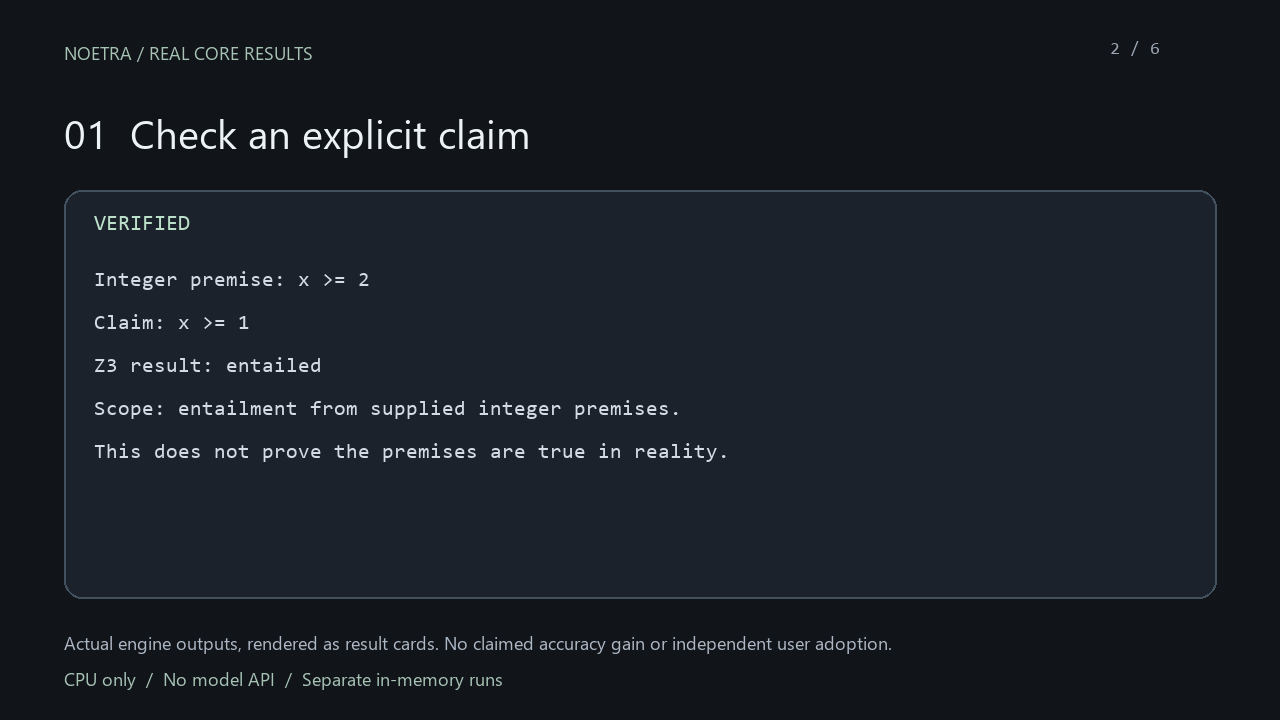
Watch the 60-second result walkthrough · How to reproduce the examples
The walkthrough presents actual engine outputs as labelled cards; it is not a browser recording. Capture provenance.
A result you can inspect
| Example | What NOETRA does | Scope |
|---|---|---|
Integer premise x ≥ 2, claim x ≥ 1 | Z3 checks entailment | Valid only for the supplied integer premises |
Same premise, stronger claim x ≥ 5 | Returns a counterexample | A formal counterexample, not a real-world measurement |
| Build → review → release, tests missing | Reports blocked actions | Actions/effects are supplied; nothing is published |
| One observed test result | Stores origin, digest and limitations | Remains an untrusted observation, not proof |
Maintained by NOETRA2. Core code is MIT licensed. Optional providers have their own licences and are not bundled or installed automatically. NOETRA is independent of Nexa apps and is not endorsed by Tencent, OpenAI, REA, Blender or other upstream projects.
What is implemented
- Evidence records, assumptions, unknowns and revision history in project-local SQLite memory; explicit local export/removal.
- Structured world graphs, rule deduction and contradiction detection.
- Z3/WASM checks for supplied integer-linear constraints, entailment and counterexamples. A formal result is scoped to its premises, not empirical truth.
- Dependency/precondition planning and ranking host-authored candidates.
- Eleven default MCP operations; 23 optional reconstruction operations when deliberately configured, plus one optional Ghidra route.
- Optional REA integration for permission-scoped software investigation.
- Reference preservation, source hashes, calibrated-silhouette experiments, bounded part correction and local mesh export/render validation.
- Automatic observed-colour families, connected image regions, boundaries and texture directions. Colour regions are not verified anatomical parts.
- Real xatlas UV generation and Blender PBR-map baking; a measured-palette preview uses an existing attributed layout and preserves original geometry.
Install from this repository
Prerequisite: Node.js 24.11+ in the 24.x line, or Node.js 26+ and npm. No GPU is needed for the core reasoning/MCP tools.
git clone https://github.com/NOETRA2/NOETRA.git
cd NOETRA
npm ci --ignore-scripts
npm run build
node dist/apps/cli/src/index.js help
node dist/apps/cli/src/index.js doctor
node dist/apps/cli/src/index.js test
GitHub's Code → Download ZIP also provides the source; extract it and run the npm commands from that folder. Once the exact release appears under the verified owner harshavardhan2 on npm, it can be run without a source build:
npx --yes noetra@0.1.0-alpha.4 test
npx --yes noetra@0.1.0-alpha.4 demo
Use a project-local installation for durable AI-host registration, rather than relying on an npm temporary cache path. Availability and publish verification are tracked in the release-status document; these commands are not a claim that an unverified package or hosted endpoint is live.
To build a local distributable:
npm pack
Connect an AI host
node dist/apps/cli/src/index.js setup --client codex --scope project
node dist/apps/cli/src/index.js setup --client cursor --scope project
node dist/apps/cli/src/index.js setup --client claude --scope project
Setup previews configuration first. Cursor/Claude JSON setup requires a reviewed
--apply --yes; Codex registration prints a TOML snippet for manual review.
Reconnect the host afterward. No existing AI-client or REA settings are silently
replaced. See installation.
Models and tools used
| Component | Role | What it does not establish |
|---|---|---|
| Codex host agent | Interpreted the brief, authored scripts/candidates and reviewed output | Exact host model identifier was not recorded in the original experiment |
| Built-in image-generation tool | Created reference/concept artwork | Those images are not renders of a mesh; exact image-model/version was not recorded |
| Tencent Hunyuan3D-2mini Turbo | Actual learned lion geometry | Hidden surfaces, accurate anatomy, physical scale and materials remain unverified |
| TripoSR + U2Net/rembg | Optional local shape backend / foreground estimation | Not automatically fused detailed multi-view reconstruction |
| Blender 5.2.2 LTS | Mesh assembly, PBR baking, export and actual renders | A successful render is not an accuracy score |
| xatlas 0.0.11; OpenCV; NumPy/SciPy | UV charts, measured appearance, image/geometry calculations | Colour clusters do not identify anatomy or recover depth |
| Z3 | Checks explicit formal constraints | Does not judge artistic quality or physical truth |
| REA 6.7.0 / optional Ghidra | Authorized software investigation | They are analysis tools, not image-to-3D generators |
The lion model revision is f90a0f7df7d5e6f71109cf333f6a95a0ae3194a6;
the upstream source commit is f8db63096c8282cb27354314d896feba5ba6ff8a.
The pinned manifest includes full checkpoint/source hashes. Model weights,
third-party applications, private accounts and local model caches are excluded.
Hunyuan is a separately licensed optional provider, not MIT-licensed model weights. Review its licence, notice and model/source provenance before provisioning it. Its licence contains territory and use restrictions. Powered by Tencent Hunyuan when that provider is enabled; Tencent does not sponsor, endorse or operate this independent project.
Real mesh demonstrations
The images below are Blender renders of actual meshes, not generated concept pictures presented as 3D output. Details, settings and limitations are in comparisons.
Lion: standalone Blender mesh beside the NOETRA workflow
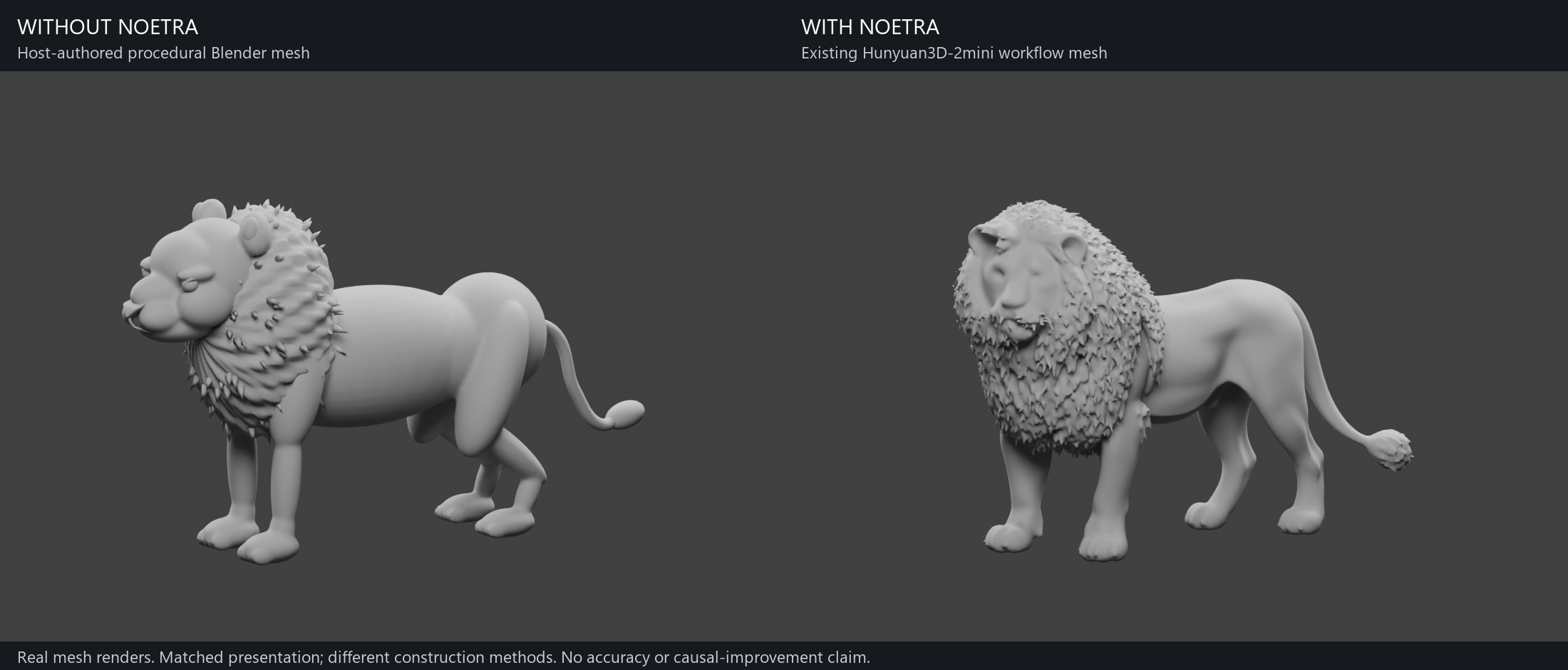
Left: without NOETRA, a new host-authored procedural lion built directly in Blender from primitives, remeshing and solid geometry. No NOETRA code or learned shape model generated that mesh. Right: with NOETRA, the existing lion created through its Hunyuan3D-2mini Turbo workflow. Both pictures render real meshes using the same clay material, lighting, view directions and normalized height. The procedural lion is stylized; these different methods are not a controlled test of NOETRA's quality or accuracy. The downloadable mesh, script and second angle are in comparisons.
We also ran a separate direct Hunyuan inference with NOETRA bypassed and otherwise matching inputs/settings. That result is identical to the workflow's raw mesh; the report preserves this evidence. No numerical accuracy gain is claimed.
Validation and limitations
The local core TypeScript/build checks, 71 Node tests and CLI protocol self-test passed. The reconstruction Python suite and focused cache/region tests passed (156 tests across the recorded runs). The example meshes were actually exported, reimported and rendered. GitHub Actions results, once available, are separate from these local checks.
The lion mesh and painting remain partial. Accurate facial anatomy, semantic part-to-mesh correspondence, calibrated detailed multi-view fusion, intrinsic albedo/PBR recovery and reliable unseen geometry are unfinished. The automatic appearance-readiness gate remains false; an explicitly requested unverified paint preview does not override it or replace the accepted model.
Accuracy is not measured by triangle count, watertightness, successful export or a visually pleasing screenshot. We need a defined metric, independent ground-truth 3D data, held-out inputs and reproducible evaluation before making a numerical fidelity claim such as 90%.
Documentation
Architecture · Tool API · Security · REA · Reconstruction · Appearance analysis · Surface painting · Third-party notices
Development
npm ci --ignore-scripts
npm run check
Python reconstruction tests require separately provisioned local dependencies; model inference is optional and is not run merely by installing the core package. Report reproducible problems through GitHub Issues, with sanitized inputs and logs. Do not upload credentials, private images, AI-client settings or model weights.
Reviews
No reviews yet
Be the first to review this server!
More Developer Tools MCP Servers
Rea
Freeby Morluto · Developer Tools
Reverse engineer anything from your terminal or agent with one CLI and MCP server.
Paperclip
Freeby Paperclipai · Developer Tools
Trending hip-hop artist momentum scores across four cultural dimensions.
Git
Freeby Modelcontextprotocol · Developer Tools
Read, search, and manipulate Git repositories programmatically
Toleno
Freeby Toleno · Developer Tools
Toleno Network MCP Server — Manage your Toleno mining account with Claude AI using natural language.
MCP Marketplace
Freeby mcp-marketplace · Developer Tools
Search and install MCP servers from inside your AI client.
mcp-creator-python
Freeby mcp-marketplace · Developer Tools
Create, build, and publish Python MCP servers to PyPI — conversationally.