
Server data from the Official MCP Registry
Persistent file-based memory for AI agents: inspectable, versionable, fully local.
About
Persistent file-based memory for AI agents: inspectable, versionable, fully local.
Security Report
Valid MCP server (2 strong, 3 medium validity signals). No known CVEs in dependencies. Package registry verified. Imported from the Official MCP Registry.
4 files analyzed · 1 issue found
Security scores are indicators to help you make informed decisions, not guarantees. Always review permissions before connecting any MCP server.
Permissions Required
This plugin requests these system permissions. Most are normal for its category.
How to Install
Add this to your MCP configuration file:
{
  "mcpServers": {
    "io-github-octonove-crbro-memory": {
      "args": [
        "-y",
        "crbro-memory"
      ],
      "command": "npx"
    }
  }
}Documentation
View on GitHubFrom the project's GitHub README.
🧠 CRBRO — Persistent Neural Memory for AI



CRBRO is a local MCP (Model Context Protocol) server that gives your AI assistant persistent long-term memory across sessions. It uses a biological neural architecture — cortex, synapses, hippocampus — to store, connect, and retrieve knowledge automatically.
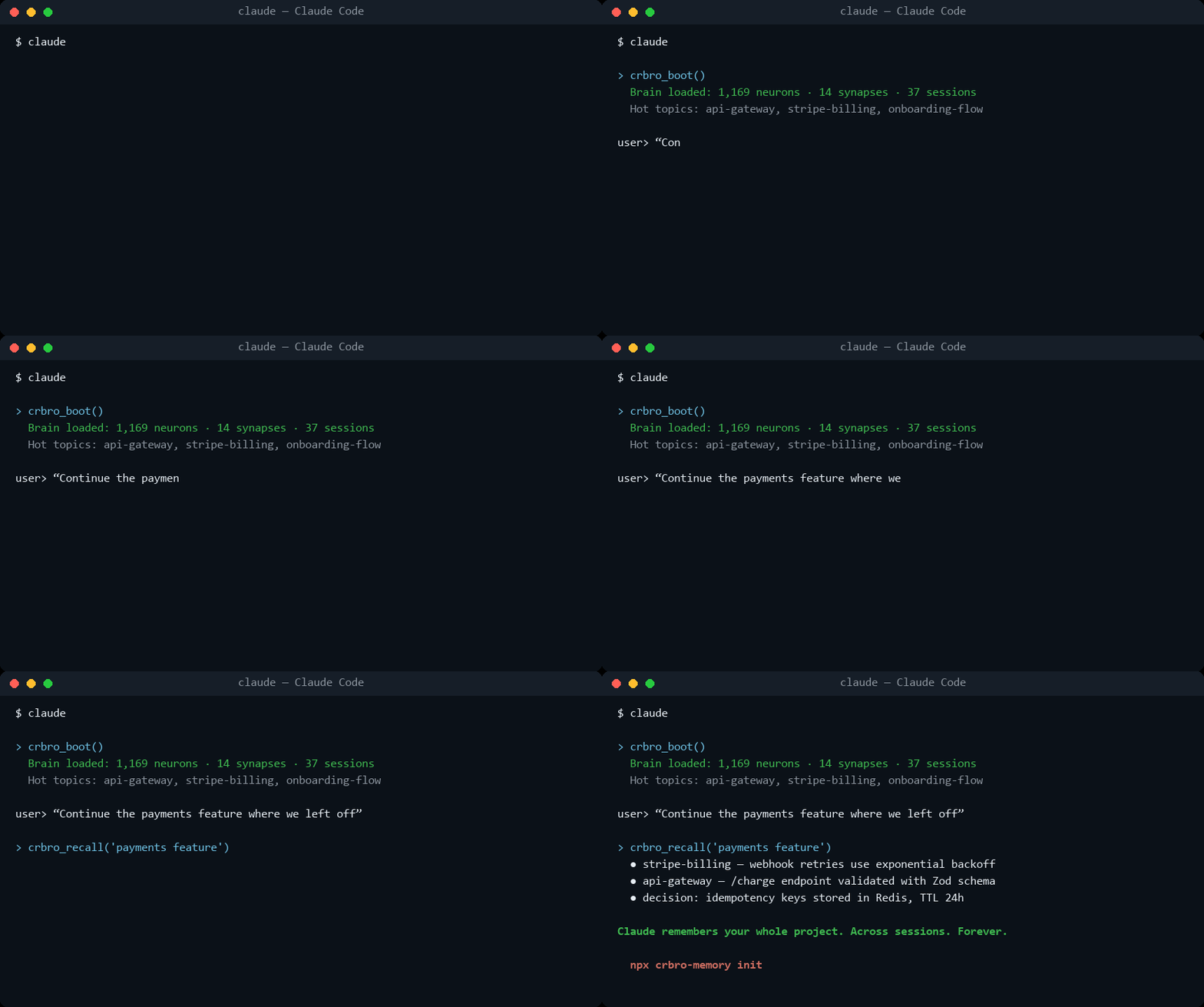
Free and open source (MIT). All 16 tools included — no license, no account, no tiers.
⭐ If CRBRO gives your AI a memory worth keeping, a star on GitHub is the best way to support it.
Features
- 🧬 Biological Architecture — Knowledge organized as neurons (cortex), connections (synapses), and session memory (hippocampus)
- 🔍 Fact-Level Search — Powered by Orama. Every fact is indexed on its own, so a topic with hundreds of facts stays as findable as one with three, and each result comes back with the exact fact that matched and the date it was recorded
- 🔥 Heat Scores — Automatic relevance tracking based on frequency, recency, and connectivity
- ✏️ Correctable — Knowledge can be superseded or retracted, not just piled up. A memory that only appends keeps serving yesterday's answer with today's confidence
- 🗺️ Global Map — Cluster detection and cross-domain bridge identification
- ⛏️ Knowledge Miner — Optionally scans your local
.md/.txtnotes and feeds them into the brain - 🔒 Fully Local — Runs on Node.js alone: no Python, no Docker, no databases, no external services. Your memory never leaves your machine
- 💾 File-Based — All data stored as readable JSON files in
~/.crbro/— inspectable, diffable, and versionable with git - 🔌 MCP Native — Works with Claude Desktop, Claude Code, Cursor, Windsurf, and any MCP-compatible client
Quick Start
1. Initialize
npx crbro-memory init
2. Add to your MCP config
Register CRBRO at the user level, not per-project. Your brain lives in
~/.crbro/and is shared across every folder — but if you register the server inside a single project, other folders won't have the tools and it will look like the memory is gone. User-level registration makes it available everywhere, which is the whole point.
Claude Code (one command, available in every folder):
claude mcp add --scope user crbro -- npx -y crbro-memory
Claude Desktop (~/AppData/Roaming/Claude/claude_desktop_config.json):
{
  "mcpServers": {
    "crbro": {
      "command": "npx",
      "args": ["-y", "crbro-memory"]
    }
  }
}
Cursor (~/.cursor/mcp.json — the one in your home folder, not a project's .cursor/):
{
  "mcpServers": {
    "crbro": {
      "command": "npx",
      "args": ["-y", "crbro-memory"]
    }
  }
}
3. Start using it
Your AI will now have access to 16 memory tools. Start any session with crbro_boot.
Tools
| Tool | Description |
|---|---|
crbro_boot | Boot the brain at session start — loads hot topics and context |
crbro_status | Brain status — neurons, synapses, sessions count |
crbro_learn | Store a fact, decision, pattern, or preference |
crbro_neuron | Read a specific neuron (topic) with all its knowledge |
crbro_neurons | List neurons with optional filters (domain, type, heat) |
crbro_recall | Search every stored fact, not just topic names — returns the fact that matched |
crbro_connect | Create or strengthen a connection between neurons |
crbro_connections | Get all connections for a neuron |
crbro_session_log | Log a session summary |
crbro_sessions | List recent sessions |
crbro_context | Read/update active working context |
crbro_hot_topics | Get the most active topics by heat score |
crbro_global_map | View the neural network — clusters and cross-domain bridges |
crbro_revise | Mark facts as superseded or retracted when they stop being true |
crbro_maintenance | Brain maintenance — heat, pruning, integrity, index rebuild |
crbro_consolidate | End-of-session consolidation |
Architecture
~/.crbro/
├── manifest.json           ← Brain metadata
├── cortex/                 ← One JSON per neuron (topic)
│   ├── project_octochat.json
│   └── tech_firebase.json
├── synapses/               ← One JSON per connection
│   └── syn_octochat__firebase.json
├── hippocampus/            ← One JSON per session
│   └── session_2026-05-06.json
├── prefrontal/             ← Working memory
│   ├── active_context.json
│   ├── hot_topics.json
│   └── global_map.json
├── archives/               ← Cold neurons (opt-in; nothing is archived unless you ask)
└── .search/                ← Orama search index
    └── chunks.index.json   ← one document per fact
Heat Score Algorithm
Each neuron has a heat score (0.0 - 1.0) calculated from:
- Frequency (35%) — How often the neuron is accessed
- Recency (40%) — When it was last accessed (today = 1.0, >3 months = 0.05)
- Connectivity (25%) — How many synapses connect to it
Knowledge Miner
The miner is an optional, fully local helper that scans a directory for .md and .txt files (notes, docs, journals) and extracts knowledge into the brain — so CRBRO can learn from what you already wrote, not just from conversations. It never touches the network and never leaves your machine.
npx crbro-memory mine [dir]       # One-shot scan of a directory
npx crbro-memory setup-miner      # Install a scheduled auto-scan (OS task scheduler)
npx crbro-memory miner-status     # Check the auto-miner status
npx crbro-memory remove-miner     # Remove the scheduled task
Naming note: "miner" here means knowledge mining — extracting facts from your own text files. Nothing to do with cryptocurrency.
CLI Commands
npx crbro-memory          # Start MCP server (stdio)
npx crbro-memory init     # Initialize brain + detect IDEs
npx crbro-memory status   # Show brain status
npx crbro-memory reindex  # Rebuild the search index
npx crbro-memory eval     # Measure retrieval quality against your own query set
npx crbro-memory --help   # Help
Measuring retrieval
eval is there so you can tell a fix from a feeling. Write
~/.crbro/.eval/queries.json as a list of questions you would actually ask,
each naming the neuron that should answer it:
[
  { "query": "how we deploy the api",
    "expect_neuron": "project_octochat",
    "expect_contains": "Cloud Run" }
]
Then npx crbro-memory eval reports how often the right neuron comes back
first, how often it makes the top three, and MRR — plus every miss, so you can
see what it got wrong instead of guessing.
License
Reviews
No reviews yet
Be the first to review this server!
More Developer Tools MCP Servers
Fetch
Freeby Modelcontextprotocol · Developer Tools
Web content fetching and conversion for efficient LLM usage
Git
Freeby Modelcontextprotocol · Developer Tools
Read, search, and manipulate Git repositories programmatically
Toleno
Freeby Toleno · Developer Tools
Toleno Network MCP Server — Manage your Toleno mining account with Claude AI using natural language.
mcp-creator-python
Freeby mcp-marketplace · Developer Tools
Create, build, and publish Python MCP servers to PyPI — conversationally.
MarkItDown
Freeby Microsoft · Content & Media
Convert files (PDF, Word, Excel, images, audio) to Markdown for LLM consumption
MCP Marketplace
Freeby mcp-marketplace · Developer Tools
Search and install MCP servers from inside your AI client.