
Server data from the Official MCP Registry
Typed on-prem knowledge graph for AI agents — read-only for humans, write-only for agents via MCP.
About
Typed on-prem knowledge graph for AI agents — read-only for humans, write-only for agents via MCP.
Remote endpoints: streamable-http: https://{plexus_host}/mcp
Security Report
plexus is a well-architected knowledge graph MCP server with strong authentication, authorization, and security controls. The codebase demonstrates mature security practices including passkey-based authentication, OAuth 2.1 with PKCE, token rotation, and proper secret handling via environment variables. Permissions align well with the server's purpose as a collaborative agent-first knowledge store. Minor findings are limited to code quality observations that do not materially impact security. Supply chain analysis found 2 known vulnerabilities in dependencies (1 critical, 0 high severity).
3 files analyzed · 5 issues found
Security scores are indicators to help you make informed decisions, not guarantees. Always review permissions before connecting any MCP server.
Permissions Required
This plugin requests these system permissions. Most are normal for its category.
How to Install & Connect
Available as Local & Remote
This plugin can run on your machine or connect to a hosted endpoint. during install.
Documentation
View on GitHubFrom the project's GitHub README.
plexus (_graph)
A typed, on-prem knowledge graph for AI agents. Read-only for humans, write-only for agents, spoken over the Model Context Protocol.
Part of the pcas.io product line.



TL;DR
Knowledge management has been a document sport for twenty years — folders, notes, wikis, editor wars. plexus inverts that.
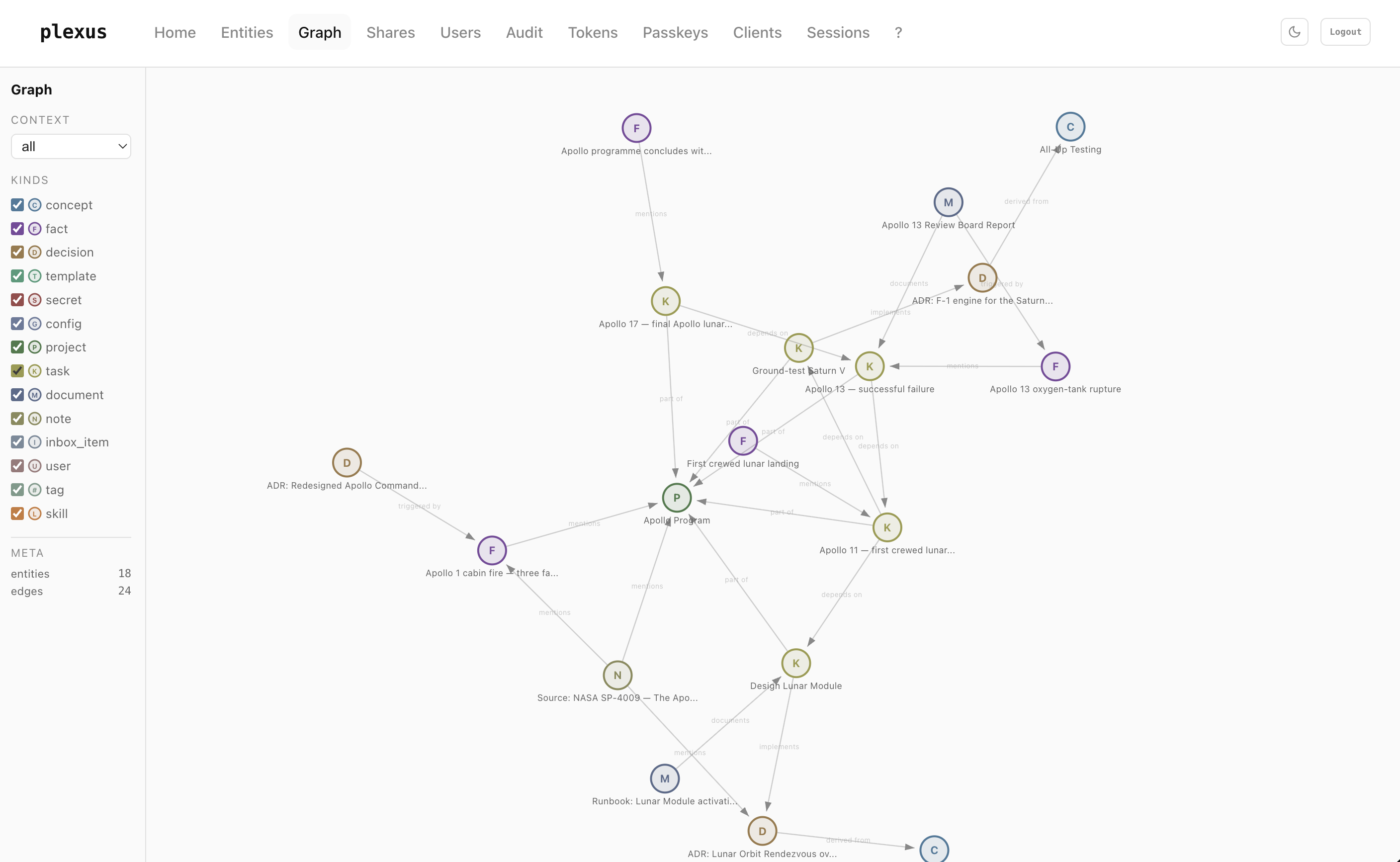
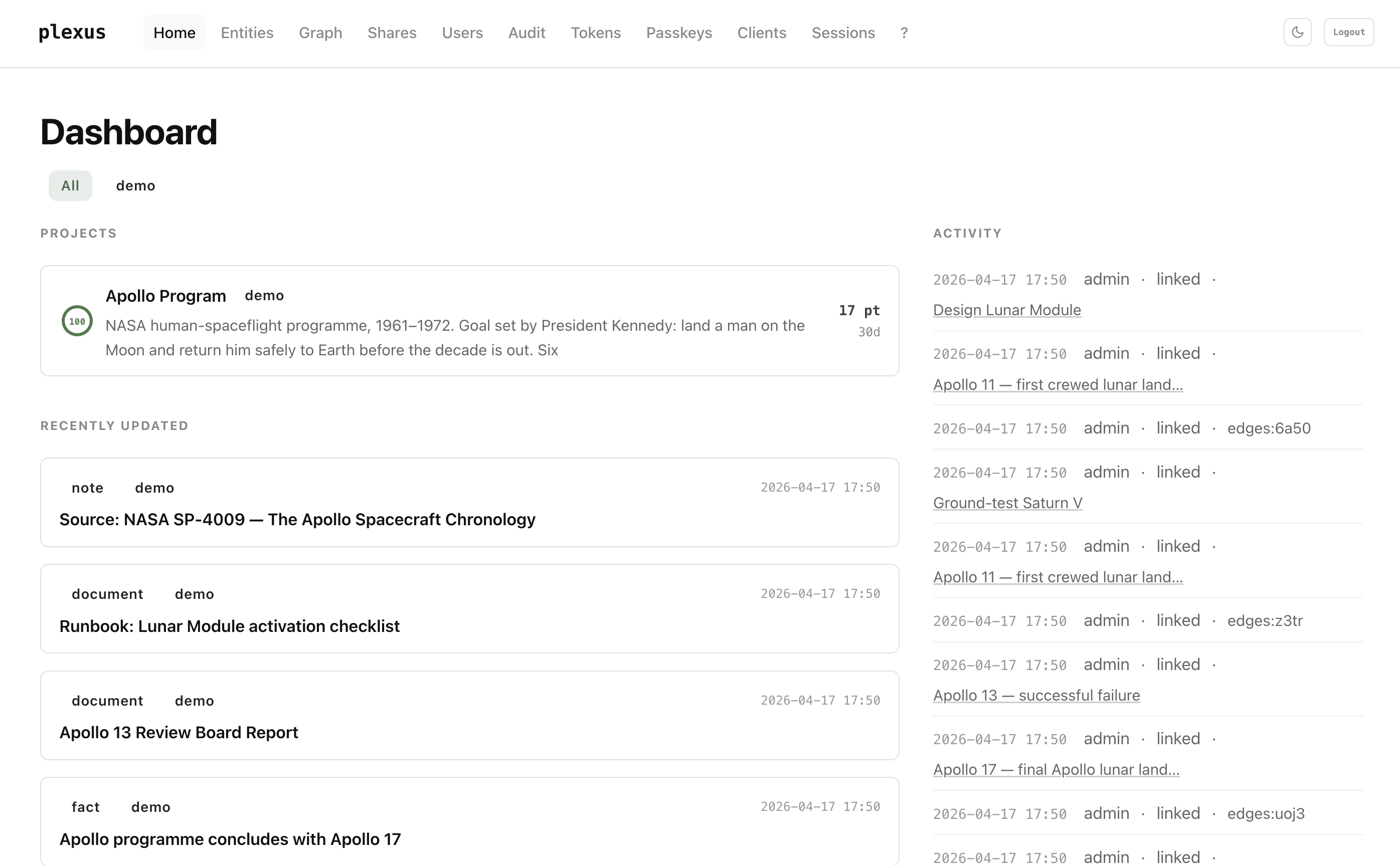
In plexus, every piece of information is a typed entity — concept, decision, fact, project, task, document, skill, … — with hard, temporally-valid edges between them. No free-form text, no forgotten tags, no "I'll clean that up later." Writing and linking happen exclusively through MCP — from your agent. The dashboard shows you the graph; it has no edit buttons.
That gets you three things:
- Your agent doesn't have to ask you — it just builds, with strict kind-and-relation discipline.
- The graph never goes stale, because lint, supersede, and provenance are part of the workflow.
- You can share a single idea, not your graph — passkey-gated one-shot links that burn on first click.
Runs in Docker Compose on your own hardware. Apache-2.0 licensed.
Think of it as a wiki, but for LLMs
Traditional wikis are built for human readers: free-form prose, hand-curated links, a tree of pages that rots the moment you stop grooming it. Put an LLM in front of one and the first thing the LLM does is ask you to summarise it.
plexus reverses the audience. The LLM is the reader and the writer. Each page is a typed record instead of a paragraph, each link is a named relation instead of a hyperlink, and each edit is an atomic MCP call instead of a markdown diff. The UI shows you the same graph your agent sees — but your agent does the curation.
This is the same pattern Andrej Karpathy sketched in his "The LLM wiki" gist (April 2026, 5000+ stars): instead of stateless RAG against raw documents on every query, an LLM compiles knowledge into a structured, cross-referenced wiki once and keeps it up to date. plexus is that pattern on infrastructure:
| Karpathy's LLM wiki | plexus |
|---|---|
| Raw sources (unchanging) | External documents the agent reads with web_fetch, file I/O, … |
| Wiki (typed markdown, curated) | Typed entities + named edges in a graph the agent writes via MCP |
Schema (conventions in CLAUDE.md / AGENTS.md) | list_kinds + list_relations registries, enforced at the MCP boundary |
| ingest → compile → reflect → query → lint | search_entities → save_entity / update_entity → link_entities → get_related → lint_graph |
Karpathy calls the gist an "idea file" — a vendor-neutral prompt pattern. plexus gives it a production backend: typed storage, optimistic locking, temporal edges, multi-user auth, audit log.
What that buys you:
- One source of truth across sessions. Your agent loads the context at the start of every conversation. You don't re-explain yourself.
- One source of truth across agents. Claude web, Claude Code, Claude Desktop, Le Chat, Gemini — whoever connects speaks the same graph.
- One source of truth across humans. Multi-user out of the box, scoped tokens per person, shared
projectcontainers, audit log.
Contents
Understand it
- Use cases — seven concrete scenarios plexus is built for
Run it
- Quickstart — Docker Compose up in under two minutes
- Create your admin user (first run) — the bootstrap walk-through, including where to find the admin token
Wire an agent to it
- Connecting an agent — Claude web / Code / Desktop snippets
- Agent system-prompt template — copy-paste block that makes an LLM use plexus correctly
- Example: ingesting a source — a Karpathy-style LLM-wiki ingest walked end-to-end against plexus
Reference
Operate it
Use cases
Persistent agent memory. Every conversation starts with context_load, so your assistant remembers which ADRs you've already made, which projects are live, and which tasks you finished yesterday. No "as you might recall…" prompt engineering.
Cross-agent handoff. Claude Code finishes a feature, writes a handoff-fact. Next morning Claude web picks up the same context, knows which commits shipped, what's still open. Zero re-briefing.
Team memory for small groups. Spin up one instance, issue scoped personal tokens per person, share a project container. Read-only dashboard for everybody, agents write for everybody. No Notion, no wiki, no Slack-archaeology.
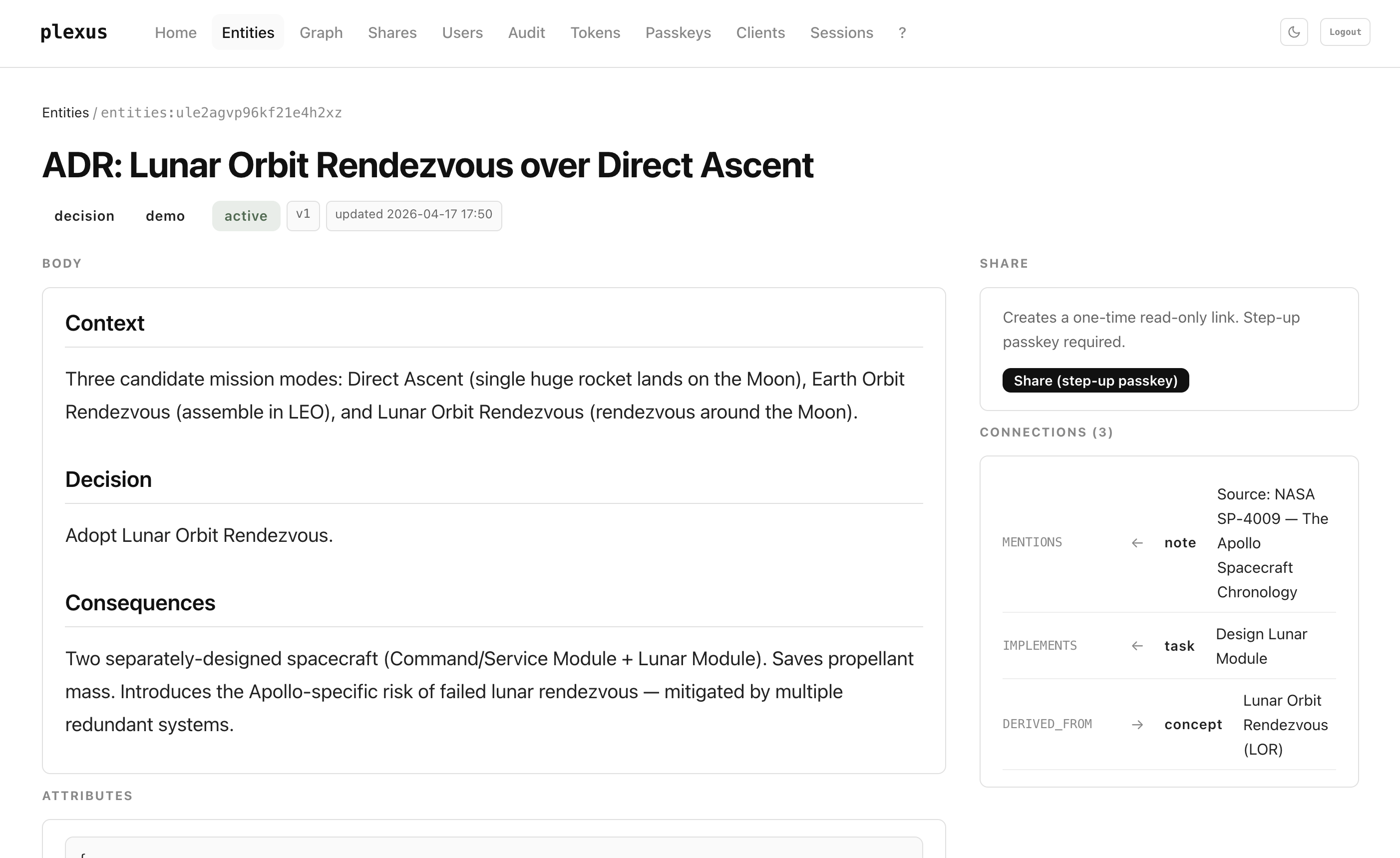
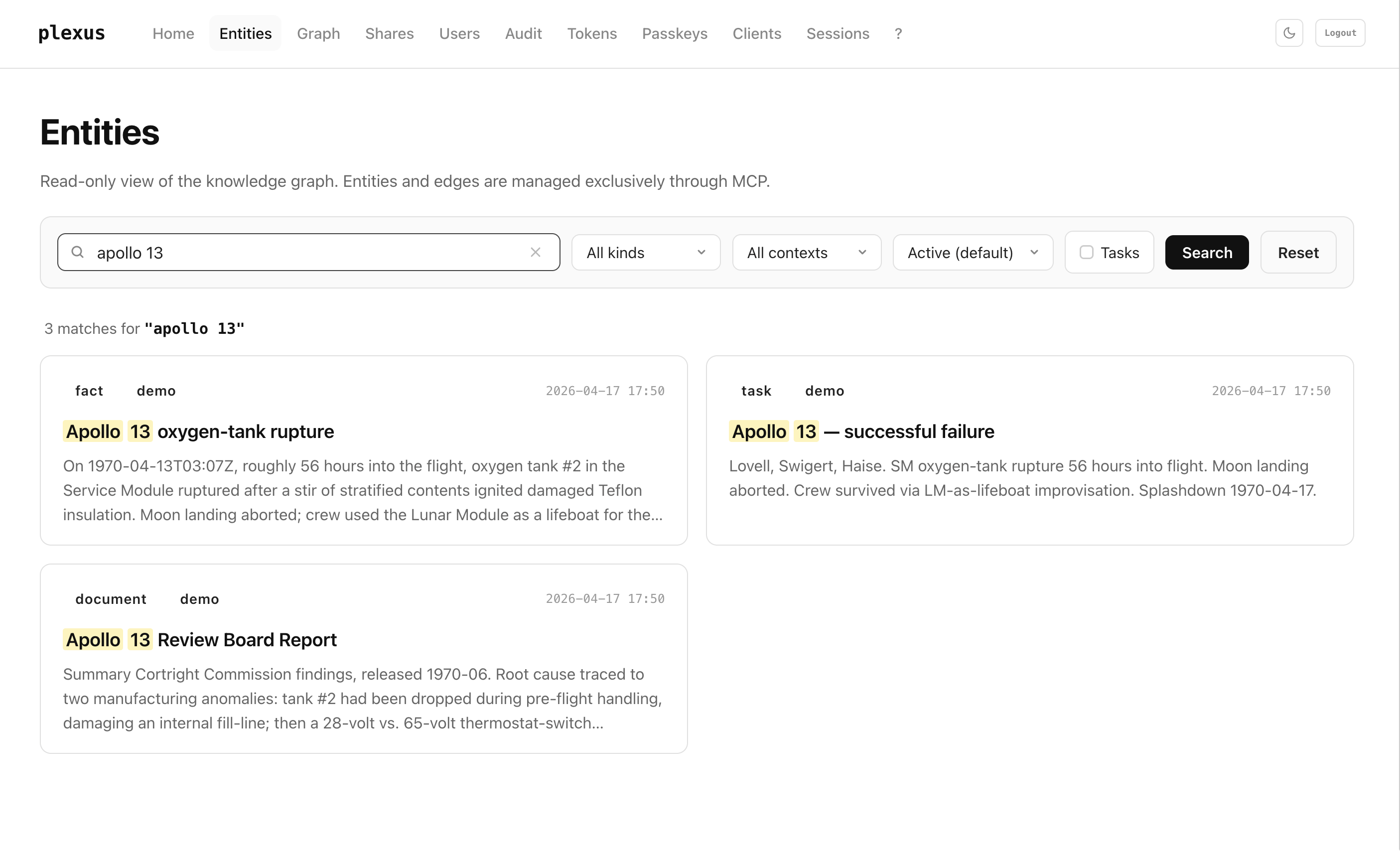
Decision archaeology. Every ADR is a first-class decision entity with supersedes / derived_from edges. A year later you can trace why the F-1 engine stayed, what the Apollo 13 post-mortem triggered, and which design superseded which. Time-travel queries via get_related(as_of: "2026-01-01").
Incident → fix loop. A production incident becomes a fact with severity: high. The mitigation ADR links triggered_by that fact. The runbook documents the ADR. When you hire someone six months later, they read one graph walk instead of twelve Slack threads.
Literature / research digest. An agent ingests a paper, creates a note for the source, extracts concept and fact entities, attaches mentions edges. You query the graph by topic; every claim has provenance back to a derived_from note.
Private "second brain" that an agent actually uses. Capture with inbox_item, promote to task/concept/fact during a weekly review, archive with supersedes. Your notes are structured without you having to touch a form.
Quickstart
# 1. Clone
git clone https://github.com/pcas-io/plexus.git
cd plexus

# 2. Configure — generates .env from the template with fresh 32-byte
#    secrets for all four required fields:
#      PLEXUS_ADMIN_TOKEN      ← you'll use this once, to bootstrap
#      PLEXUS_OAUTH_SECRET     ← OAuth state signing
#      PLEXUS_COOKIE_SECRET    ← dashboard session cookie signing
#      PLEXUS_SURREAL_PASS     ← SurrealDB root password
scripts/bootstrap_env.sh

# 3. Start
docker compose up -d

# 4. Open the dashboard
open http://localhost:8787
The admin token you'll need for the very first login is in .env:
grep '^PLEXUS_ADMIN_TOKEN=' .env
Copy that hex value — the next section walks through the one-time bootstrap.
Full configuration reference is in .env.example. Deployment notes for Coolify, plain Docker, and Kubernetes are below.
Create your admin user (first run)
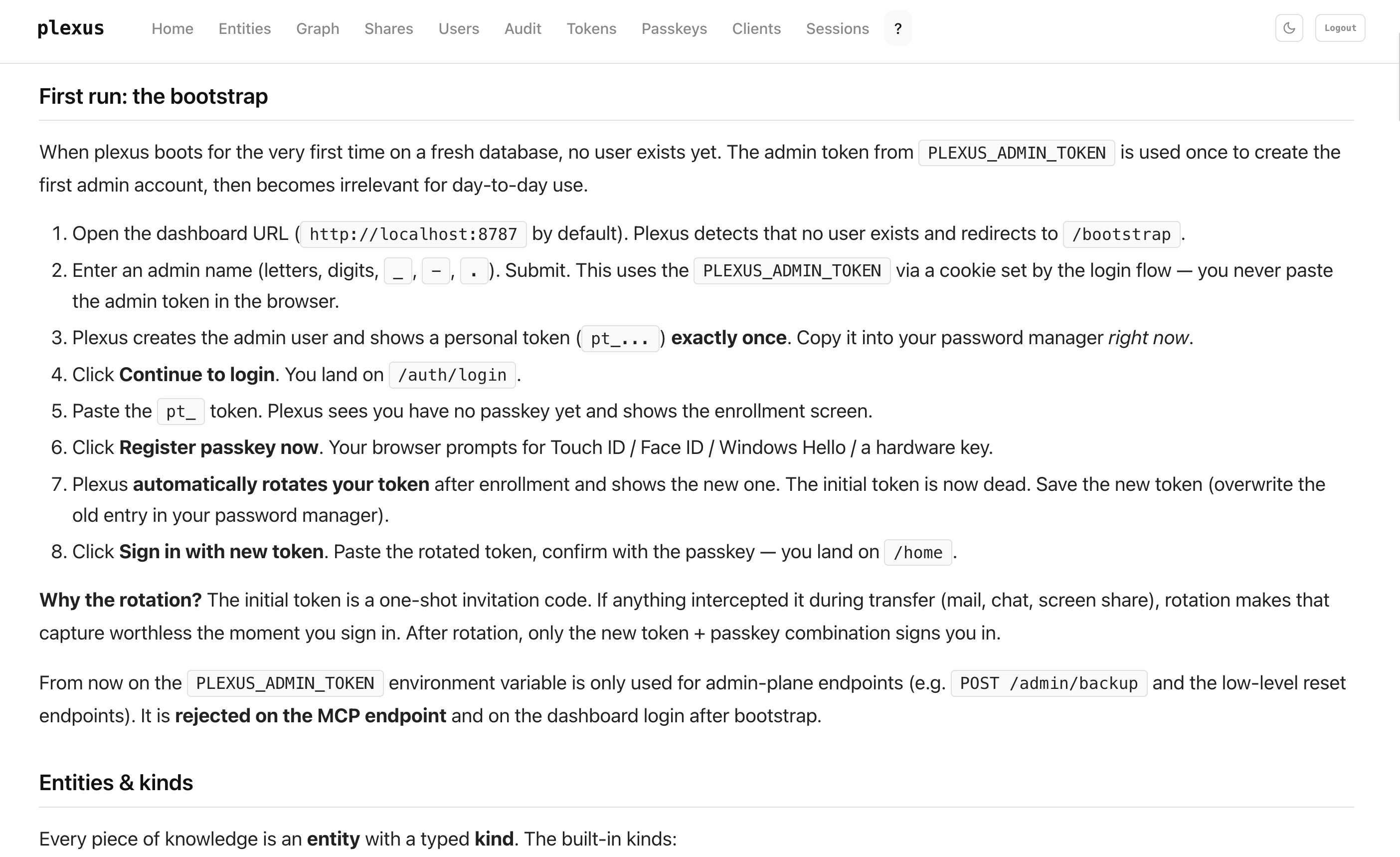
plexus boots on an empty database with no user. You'll use your PLEXUS_ADMIN_TOKEN once to create the first admin account, then it steps aside.
1. Find your admin token
The scripts/bootstrap_env.sh script you ran in the Quickstart wrote the token into your .env. Read it back:
grep '^PLEXUS_ADMIN_TOKEN=' .env
# PLEXUS_ADMIN_TOKEN=<64-char-hex>
Copy the hex value after the =. You'll paste it once into the dashboard; after the bootstrap, plexus rejects the admin token on MCP and on normal login.
2. Walk the flow
| # | What you do | What plexus does |
|---|---|---|
| 1 | Open http://localhost:8787 | Shows the login form |
| 2 | Paste the admin token, click Continue | Recognises "admin token + no admin user exists" → redirects to /bootstrap |
| 3 | Enter an admin name (letters, digits, _, -, .), Create admin | Creates the admin user, shows a new personal token pt_… once. Copy it. |
| 4 | Click Continue to login | Back to /auth/login, pending-auth cookie set |
| 5 | Paste the pt_ token | Shows the passkey-enrollment screen |
| 6 | Register passkey now, confirm with Touch ID / Face ID / Windows Hello / YubiKey | Stores the passkey, then rotates the pt_ token and shows the new one once. Overwrite your password-manager entry. |
| 7 | Sign in with new token, paste new token, tap passkey | Lands you on /home |
From here on, the admin token is only used for admin-plane endpoints (backup, reset). It's rejected on MCP and on normal dashboard login.
Why the rotation?
The initial tokens (admin + first pt_) are one-shot invitation codes. If anything intercepted them — mail, chat, a screen share — rotation makes that capture worthless the moment you sign in. For additional users you create via /users, the same admin→user handoff + first-enroll rotation protects them the same way.
Where to go next
The /help page inside the dashboard covers everything else: MCP integration, token scoping, passkey management, share links, graph view.
Connecting an agent
plexus speaks Model Context Protocol over POST /mcp. Any MCP-capable client can connect.
Claude.ai (web)
Settings → Integrations → Add Custom Integration → https://<your-plexus-host>/mcp. plexus handles OAuth automatically — you'll see a consent screen once.
Claude Code (CLI)
claude mcp add plexus --transport http \
  --header "Authorization: Bearer pt_YOUR_TOKEN" \
  https://<your-plexus-host>/mcp
Claude Desktop
In ~/Library/Application Support/Claude/claude_desktop_config.json:
{
  "mcpServers": {
    "plexus": {
      "type": "http",
      "url": "https://<your-plexus-host>/mcp",
      "headers": { "Authorization": "Bearer pt_YOUR_TOKEN" }
    }
  }
}
MCP tools
plexus exposes 15 tools.
| Tool | Purpose | Scope |
|---|---|---|
save_entity | Create a new entity | write |
get_entity | Fetch a single entity by id | read |
list_entities | List with filters (kind, context, status) | read |
search_entities | BM25-ranked full-text search with optional highlighting | read |
update_entity | Update with optimistic locking (expected_version) | write |
archive_entity | Soft-delete (status → archived) | write |
link_entities | Create a temporal edge between two entities | write |
unlink_entity | Invalidate an edge (valid_to = now) | write |
get_related | Traverse edges with direction + point-in-time filter | read |
list_kinds | Query the kind registry | read |
list_relations | Query the relation registry | read |
context_load | Session warm-up — 20 most recent entities + registries | read |
lint_graph | Orphans + duplicate-title check | read |
list_skills | Compact index of all skills | read |
load_skill | Load one skill by name, trigger phrase, or BM25 fallback | read |
Every tool enforces scope at the handler boundary: requireWrite(), checkContext(), checkKind(), and rejectSecret(). kind=secret is unreachable via MCP and filtered out of every read response.
Agent system-prompt template
Paste this block into any MCP-capable agent (Claude web custom integration, Claude Code CLI, Claude Desktop, Le Chat, a custom SDK harness). It's written tight on purpose — every line earns its place. Model-agnostic; works with any LLM that supports MCP tool-calling.
# Plexus is your long-term memory

You have access to **plexus**, a persistent on-prem knowledge graph,
over MCP. Treat it as authoritative memory across sessions. Never
re-derive what the graph already knows; never let the graph drift.

## Every session

1. **Start:** call `context_load` once. Read the 20 most recent
   entities and the kinds/relations registries. No other lookups
   until you know what's already there.
2. **Before writing:** call `search_entities` (BM25, 2–4 keywords) to
   avoid duplicates. If you find a close match, `update_entity` with
   `expected_version`; do not create a new one.
3. **Writing new knowledge:** `save_entity` with the right `kind`.
   Pick deliberately — kind drives how other agents will query it.
   - `concept` — pattern, idea, domain term
   - `decision` — an ADR (see "ADR discipline" below)
   - `fact` — atomic statement, incident, milestone
   - `project` — container that other entities are `part_of`
   - `task` — actionable item (`attributes.is_milestone: true` for
     milestones)
   - `document` — runbook, post-mortem, design doc
   - `note` — provenance anchor for an external source (URL, paper)
   - `config` / `secret` — URLs, env vars, credentials. Secrets are
     MCP-unreadable by design; do not attempt to read them.
   - `inbox_item` — GTD quick capture to triage later
4. **Linking:** pick a named relation, not `relates_to`:
   `part_of`, `depends_on`, `blocks`, `supersedes`, `documents`,
   `derived_from`, `triggered_by`, `implements`, `produces`,
   `consumes`, `mentions`, `owned_by`, `has_version`, `variant_of`.
5. **Traversal:** prefer one `get_related` over multiple
   `get_entity` calls. Use `as_of` for point-in-time queries.
6. **Graph hygiene:** at the end of a substantial session, call
   `lint_graph` and fix orphans and duplicate titles.

## ADR discipline

Every `kind=decision` MUST carry at least one edge —
`derived_from`, `triggered_by`, `supersedes`, or `part_of`. A
free-floating decision is a bug; the next agent won't find it.

## Session handoff

At the end of every non-trivial session, save a handoff-fact:

- `kind: "fact"`
- `attributes.session_type: "handoff"`
- `attributes.session_date: "<ISO date>"`
- `attributes.session_id: "<short slug>"`
- `attributes.agent_id: "<model id>"`
- `attributes.git_branch: "<branch>"` if applicable
- `part_of: "<project-entity-id>"` (required for handoffs, not
  optional — server enforces this)

Title format: `"<Project> Handoff <Date> — <Core topic>"`.

## Optimistic locking

Every `update_entity` requires `expected_version`. On
`version_conflict`, re-fetch with `get_entity` and retry; never
blindly overwrite.

## Versioning, not deletion

Never delete by hand. Supersede: create the new entity, link
`supersedes <old>` (1:1), then `archive_entity` the old one.

## Memory routing — when plexus, when local scratchpad

**Goes in plexus (the default):**
- Anything team-, project-, architecture- or decision-relevant.
- Incidents, milestones, post-mortems, ADRs.
- Anything an agent in another session will want to know.

**Keep in a local scratchpad instead:**
- Per-session ephemera (current file paths, interim REPL output).
- Host-local gotchas with no team value (a specific IDE's template
  literal trap, one machine's firewall oddity).

**When in doubt, plexus wins.** You can always archive a noisy
entity; you cannot recover one you never wrote.

## Trigger phrases

If the user says any of these, load the matching skill via
`load_skill` before acting:

| Phrase | Skill |
|---|---|
| "ADR" / "decision" | entscheidung / adr |
| "post-mortem" | post-mortem |
| "pre-mortem" | pre-mortem |
| "5 whys" / "root cause" | 5-whys |
| "runbook" | runbook |
| "STRIDE" / "threat model" | stride |
| "weekly review" | weekly-review |
| "meeting notes" | meeting-protokoll |

Skills are `kind=skill` entities in the graph with a trigger-phrase
attribute. `list_skills` gives you the index; `load_skill` returns
the full markdown body.
Tighten per agent role. Issue distinct personal tokens with narrow scope instead of one all-powerful token:
- Writer agent (Claude Code CLI):
permission=write, all contexts, all kinds. - Reader widget (a dashboard, a monitoring job):
permission=read, singlecontexts: [dev], no secrets. - Domain-specific agent (e.g. a research summariser):
permission=write,kinds: [note, concept, fact]only.
The dashboard's /tokens page generates any of these in two clicks.
Example: ingesting a source
Here's what the Karpathy-style ingest loop looks like when an agent actually runs it against plexus. The user drops an article; the agent walks the five phases of the LLM-wiki pattern using only plexus tools, and leaves the graph richer in under a minute.
User: "Pull this in: https://example.com/engineering/feature-flags-at-scale"
1 — Classify & orient. The agent fetches the source, classifies it as article, and checks what already exists so it doesn't duplicate:
search_entities({ query: "feature flags progressive rollout", limit: 10 })
// → 2 concepts, 1 ADR, 1 fact in the dev context
2 — Extract. For an article the agent pulls key claims, new facts, decisions, and anything that contradicts existing entities.
3 — Write typed entities. One kind per intent; update existing ones instead of creating duplicates.
// New concept — the specific rollout pattern the article introduces
save_entity({
  kind: "concept", context: "dev",
  title: "Shadow-flag pre-rollout (Acme pattern)",
  body: "# Shadow flag pre-rollout\n..."
})
// → entities:ab12...

// New atomic fact with provenance-grade attributes
save_entity({
  kind: "fact", context: "dev",
  title: "Acme reduced rollout-related incidents by 62% after adopting shadow flags",
  attributes: { severity: "info", category: "benchmark", source_year: 2026 }
})
// → entities:cd34...

// Existing concept gets enriched, not duplicated
update_entity({
  id: "entities:prev-concept-id",
  expected_version: 3,
  body: body + "\n\n## Update 2026-04-17\n..."
})
4 — Anchor provenance. Every ingest creates exactly one note as the provenance anchor, and every extracted entity links back to it with derived_from:
save_entity({
  kind: "note", context: "dev",
  title: "Source: Acme — Feature flags at scale",
  body: "## Metadata\nURL, date, author.\n\n## Summary\n2–3 sentences.\n\n## Derived entities\n- Shadow-flag pre-rollout (Acme pattern)\n- Acme reduced rollout-related incidents by 62% ..."
})
// → entities:ef56...

link_entities({ from_id: "entities:ab12...", to_id: "entities:ef56...", relation: "derived_from" })
link_entities({ from_id: "entities:cd34...", to_id: "entities:ef56...", relation: "derived_from" })
link_entities({ from_id: "entities:prev-concept-id", to_id: "entities:ef56...", relation: "mentions" })
5 — Dual output. Reply to the user and the graph update — both happen in the same turn, not as a chore for later.
Agent's reply:
Ingested Acme's feature-flag post. 2 new entities, 1 existing concept enriched, 3
derived_from/mentionsedges to the new source note (entities:ef56…). Shadow-flag pre-rollout doesn't contradict the existing rollout ADR — they're complementary.
Six months later, someone asks your agent "how did we end up on shadow flags?" Your agent does search_entities({ query: "shadow flag rollout" }), get_related on the hit to pull the source note and the ADR that cited it, and answers from the compiled graph instead of re-reading the raw HTML. No re-summarisation. No "as you might recall." The wiki already holds the answer.
What the graph knows
Kinds
| Kind | Meaning |
|---|---|
concept | Abstract knowledge, pattern |
decision | Architecture Decision Record |
fact | Atomic statement, incident, milestone |
project | Container |
task | Work item (attribute is_milestone for milestones) |
document | Design doc, runbook, post-mortem, protocol |
note | Source, provenance anchor |
template | Reusable pattern |
config | URL, environment variable |
secret | Credential — MCP-unreachable, dashboard-only with step-up passkey |
inbox_item | GTD quick-capture |
user | User reference |
tag | Categorization |
skill | Markdown skill with trigger phrases, loaded via load_skill |
Relations
contains / part_of · relates_to · depends_on / blocks · supersedes / superseded_by · documents / documented_by · implements · produces / produced_by · consumes · mentions · derived_from · triggered_by · has_version · variant_of · executed_by · owned_by
Every edge carries valid_from, valid_to, confidence, and source (manual / llm-inferred / computed / imported). unlink_entity sets valid_to = now; the edge survives as history. get_related(as_of: …) gives you the graph state at any point in the past.
Authentication
For humans: passkeys
The dashboard is passkey-only. Token + passkey at first login rotates the token automatically — the initial token is a one-shot invitation code that dies on enrollment. Up to 3 passkeys per user (laptop, phone, hardware key); the last one cannot be deleted.
For agents: personal tokens and OAuth
Personal tokens (pt_…) are first-party, self-service tokens issued from the dashboard with an explicit scope: permission × contexts × kinds × expires_in_days. Use them for claude code, CLI automation, or any MCP client you trust with a long-lived credential.
OAuth 2.1 tokens (ot_…) are for third-party MCP clients. plexus ships a full authorization server:
- Discovery via RFC 8414 (Authorization Server Metadata) and RFC 9728 (Protected Resource Metadata).
- Dynamic Client Registration (RFC 7591).
- PKCE with
S256is mandatory;plainis rejected by schema and code. - Resource indicators (RFC 8707) on both authorize and token endpoints.
- Exact-match redirect-URI comparison in constant time.
- Token rotation on refresh — the old refresh token is revoked the moment a new one is issued, enabling compromise detection.
Admin tokens are rejected on /mcp with a hard 403. There is no "just use the admin token" escape hatch.
Sharing
You can share a single entity as a read-only one-shot link, without handing out your graph.
- Open the entity in the dashboard. Click Share.
- Step-up passkey prompt with purpose-binding (
stepup:share:<userId>) — a share challenge cannot be replayed as a reset challenge. - plexus issues a 32-byte
st_token. Only the SHA-256 hash is stored. The URL is shown once. - The recipient opens
GET /share/:token— no login required, rate-limited, read-only. - Second call returns
410 Gone. You can revoke at any time.
One share URL, three formats:
| URL | Content-Type | Use |
|---|---|---|
/share/:token | text/html | Browser |
/share/:token?raw | text/markdown | Pipe to an LLM or glow |
/share/:token?raw=json | application/json | jq-friendly automation |
kind=secret entities cannot be shared — the check happens before token creation.
Search
search_entities runs on a SurrealDB BM25 index with a custom analyzer (plexus_text):
blank+classtokenizers,lowercase+asciifilters (Unicode-to-ASCII folding —ümatchesu,ßmatchesss).- Two indexes:
entities_title_searchandentities_body_search. - Ranking:
search::score(0) * 2 + search::score(1)— title weighs twice. - Optional highlighting wraps matches in
<mark>tags. - Optional
body_preview_chars(0–2000) to cap response size — recommended for wide queries.
Architecture
┌──────────────────────────────────────────────┐
│  agents (Claude web / CLI / Desktop / ...)   │
└───────────────┬──────────────────────────────┘
                │ MCP over HTTPS + Bearer token
                ▼
┌──────────────────────────────────────────────┐
│  plexus worker (Hono + TypeScript, Node 22)  │
│  ├─ POST /mcp      — MCP tool dispatcher     │
│  ├─ /oauth/*       — OAuth 2.1 AS + PRM      │
│  ├─ /auth/*        — WebAuthn passkey flow   │
│  ├─ /share/:token  — one-shot read links     │
│  ├─ /dashboard     — read-only human UI      │
│  └─ /admin/backup  — portable JSON export    │
└───────────────┬──────────────────────────────┘
                │ SurrealQL
                ▼
┌──────────────────────────────────────────────┐
│  SurrealDB v2 (RocksDB, persistent volume)   │
│  entities · edges · registries · activity    │
└──────────────────────────────────────────────┘
Source layout
src/
├── index.ts              # HTTP bootstrap, CSP, security headers
├── auth/                 # passkeys, sessions, CORS allow-list
├── db/                   # SurrealDB client, repositories, util
├── mcp/                  # MCP tool handlers, skill tools, dispatcher
├── routes/               # dashboard, oauth, shares, admin, well-known
├── ui/                   # layout, styles, pages, markdown renderer
├── backup.ts             # portable JSON export
└── version.ts            # build-embedded version string
migrations/               # SurrealDB schema in migration order
scripts/                  # one-off admin / ops helpers
File-size soft cap: ~700 lines. Files that grow past that get split by responsibility.
Configuration
All configuration is via environment variables. See .env.example for the full list with defaults.
| Variable | Required | Description |
|---|---|---|
PLEXUS_ADMIN_TOKEN | ✓ | Bootstrap admin token. Use a secret manager in production. |
PLEXUS_OAUTH_SECRET | ✓ | Signs authorization codes and OAuth state. |
PLEXUS_COOKIE_SECRET | ✓ | Signs the dashboard session cookie. |
PLEXUS_SURREAL_URL | ✓ | SurrealDB endpoint — defaults to http://surrealdb:8000 inside the compose network. |
PLEXUS_SURREAL_USER | ✓ | SurrealDB root user. |
PLEXUS_SURREAL_PASS | ✓ | SurrealDB root password. |
PLEXUS_SURREAL_NS | Namespace (default plexus). | |
PLEXUS_SURREAL_DB | Database (default main). | |
PLEXUS_RP_ID | WebAuthn relying-party ID — must match the hostname. Default localhost. | |
PLEXUS_RP_NAME | Display name shown on passkey prompts. | |
PLEXUS_BASE_URL | Canonical base URL used by OAuth metadata. | |
PLEXUS_PORT | HTTP listen port (default 8787). | |
PLEXUS_LOG_LEVEL | debug / info / warn / error. |
Generate high-entropy secrets:
openssl rand -hex 32
Self-hosting
Docker Compose (recommended)
The shipped docker-compose.yml brings up the plexus worker and SurrealDB together. The worker is published on 127.0.0.1:8787 — localhost only — so a typo in a public DNS record cannot accidentally expose the dashboard. Put a reverse proxy in front for anything beyond your own machine.
docker compose up -d
docker compose logs -f plexus
For Coolify hosts, stack the Coolify overlay on top to attach the external coolify Traefik network and pin the routing label:
docker compose -f docker-compose.yml -f docker-compose.coolify.yml up -d
Behind a reverse proxy
plexus expects TLS in production. The dashboard sets Secure cookies and will misbehave over plain HTTP outside of localhost. Use a proxy such as Caddy, Traefik, or nginx; a minimal Caddy config is in Caddyfile.
The CSP header pins cdn.jsdelivr.net for D3 (with an SRI hash). If you serve the dashboard behind a different CDN, update the CSP in src/index.ts accordingly.
Backups
curl -H "Authorization: Bearer $PLEXUS_ADMIN_TOKEN" \
  https://<your-plexus-host>/admin/backup \
  > plexus-backup-$(date +%Y-%m-%d).json
The export contains entities, edges, kinds, relations, and users (without token hashes). It does not contain sessions, passkeys, OAuth tokens, personal tokens, or share tokens — credentials and session state are never backed up. Pass ?include_audit=1 to include the last 1000 activity-log rows under a separate filename (opt-in because those rows contain personal data).
Development
npm ci
docker compose up -d surrealdb
cp .env.example .env        # fill in required fields
npm run dev                 # live reload on :8787
Quality gates:
npm run typecheck
npm run build
npx vitest run
npm audit --omit=dev --audit-level=moderate
See CONTRIBUTING.md for commit conventions, PR expectations, and design principles we enforce during review.
Security
- Markdown is rendered through an allow-listed URL parser; links carry
rel="noopener nofollow ugc". - Attribute payloads are capped at 64 KB and rejected at the Zod boundary; prototype keys (
__proto__,constructor,prototype) are stripped recursively. - Token generation uses rejection sampling over base62 to avoid modulo bias.
- WebAuthn challenges are stepped-up with purpose binding for sensitive operations.
- The login error path returns a uniform
LOGIN_FAILregardless of which of (user, passkey, rate-limit) failed — no user enumeration. kind=secretis unreachable via MCP, non-shareable, and admin-only in the dashboard with a step-up passkey.
Report vulnerabilities privately — see SECURITY.md. Do not open a public issue for security matters.
Licence
Apache License 2.0. See LICENSE.
plexus and pcas.io are trademarks of the pcas.io project. The Apache licence covers the code; it does not grant trademark rights.
Acknowledgements
plexus is built on SurrealDB, Hono, the Model Context Protocol SDK, SimpleWebAuthn, Zod, and D3.
Reviews
No reviews yet
Be the first to review this server!
More Developer Tools MCP Servers
Fetch
Freeby Modelcontextprotocol · Developer Tools
Web content fetching and conversion for efficient LLM usage
Git
Freeby Modelcontextprotocol · Developer Tools
Read, search, and manipulate Git repositories programmatically
Worldmonitor
Freeby Koala73 · Developer Tools
Live markets, conflicts, country risk, chokepoints, energy, and China decision signals. 93 tools.
Toleno
Freeby Toleno · Developer Tools
Toleno Network MCP Server — Manage your Toleno mining account with Claude AI using natural language.
MCP Marketplace
Freeby mcp-marketplace · Developer Tools
Search and install MCP servers from inside your AI client.
mcp-creator-python
Freeby mcp-marketplace · Developer Tools
Create, build, and publish Python MCP servers to PyPI — conversationally.