
Server data from the Official MCP Registry
Local Git-history memory for coding agents: reverts, suppressions, hotspots, and annotations.
About
Local Git-history memory for coding agents: reverts, suppressions, hotspots, and annotations.
Security Report
Valid MCP server (7 strong, 3 medium validity signals). No known CVEs in dependencies. ⚠️ Package registry links to a different repository than scanned source. Imported from the Official MCP Registry. 1 finding(s) downgraded by scanner intelligence.
12 files analyzed · 1 issue found
Security scores are indicators to help you make informed decisions, not guarantees. Always review permissions before connecting any MCP server.
Permissions Required
This plugin requests these system permissions. Most are normal for its category.
How to Install
Add this to your MCP configuration file:
{
  "mcpServers": {
    "io-github-promptwheel-ai-logbook": {
      "args": [
        "-y",
        "@promptwheel/logbook-mcp"
      ],
      "command": "npx"
    }
  }
}Documentation
View on GitHubFrom the project's GitHub README.
logbook


Coding agents often skip git history. It is large, and an arbitrary slice can give the wrong picture.
Every feature gets added by someone who can read the code but not the decisions behind it: the module that was rewritten three times, the approach that was tried and reverted, the "fix" last quarter that was actually a skipped test. Fresh agent sessions often start without those decisions. Code maps (Graphify and friends) tell them where things are, not what happened. The logbook mines the existing git history — up to the newest 20,000 commits — and writes a compact recall layer that your agent is instructed to consult.
npx -y @promptwheel/logbook init
One line: it reads the history, writes the brief, and adds a history workflow to your agent config (AGENTS.md, CLAUDE.md, or .cursorrules).
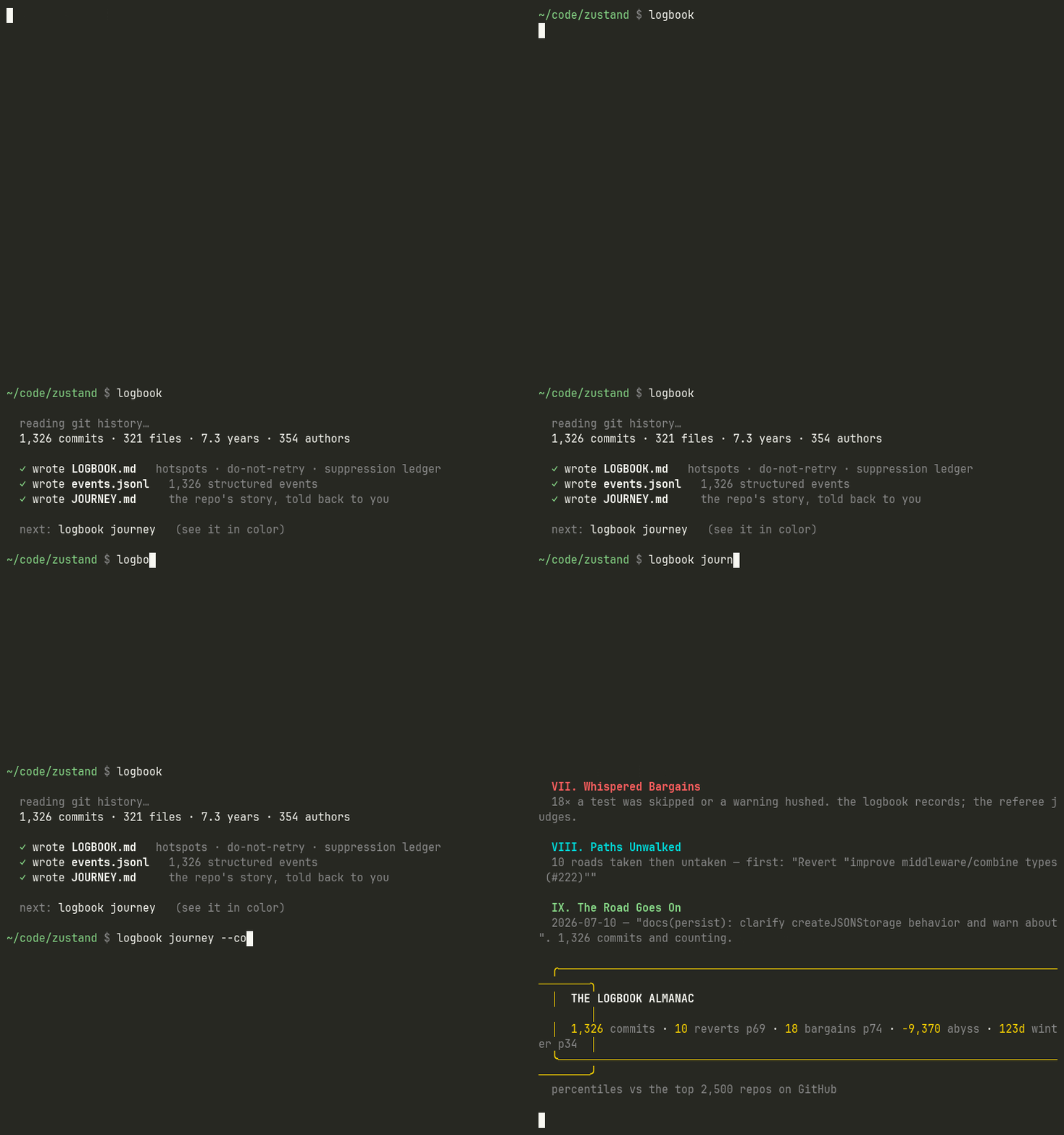
  1,326 commits · 322 files · 7.3 years · 354 authors

  ✓ wrote LOGBOOK.md     hotspots · do-not-retry · suppression ledger
  ✓ wrote events.jsonl   1,326 structured events
  ✓ wrote JOURNEY.md     the repo's story, told back to you
Single file. Zero npm dependencies. It never touches your source code or
git history, and no repository data leaves your machine — it writes only
its own brief files (and init adds a block to your agent config).
Why "logbook"
Because you need a compact index of the decisions its detectors can recover without pulling every book out of the library. In a random 400-repo sample of the top 2,500 GitHub repositories, 34% of full logs exceeded a 150k-token context estimate. Logbook turns that record into a bounded brief and verifiable leads; it does not claim complete decision recall.
The three artifacts
| File | What it is | Who it's for |
|---|---|---|
LOGBOOK.md | The brief a fresh session needs: hotspots, do-not-retry (reverted approaches), the suppression ledger (the times a test was skipped or a warning hushed), assertion-weakening events, fragile areas | Your agent. Drop it in context — CLAUDE.md can point at it |
events.jsonl | One structured event per analyzed commit: shape (src/test/config/docs), adds/dels, suppressions found in the diff, assertion deltas | Your tools. The data layer |
JOURNEY.md | Your repo's history as a hero's journey: The Call, The Threshold, The Abyss, The Long Winter, the Whispered Bargains | You. Run logbook journey to see it in color |
Usage
npx @promptwheel/logbook              # analyze the current repo
npx @promptwheel/logbook path/to/repo # or any repo
npx @promptwheel/logbook journey      # the story, in color (writes nothing)
npx @promptwheel/logbook journey --compare  # rank your almanac vs the top 2,500 GitHub repos
npx @promptwheel/logbook audit        # what is STILL suppressed in HEAD, and since when
npx @promptwheel/logbook doctor       # read-only artifact/wiring/skill/query health check
npx @promptwheel/logbook context --file path/to/file --revert  # bounded, paged query view
npx @promptwheel/logbook context --file src/a.ts --file src/b.ts # multi-path OR query
npx @promptwheel/logbook annotate SHA "why it happened" --by WHO   # persist WHY a commit happened
npx @promptwheel/logbook --json       # events to stdout (writes nothing)

# era-scoped archaeology
npx @promptwheel/logbook --since 2024-01-01 --until 2025-01-01
Options: -n/--max N (commit cap, default 20000) · --compare · --out DIR · -q/--quiet
context preserves the filtered query order but serializes it into pages of
at most 20 events and 8 KiB, with an opaque NEXT cursor and explicit
END complete. It is a delivery format, not relevance ranking; use query
when you need the raw JSONL interface. A cursor is bound to the repository
HEAD, filters, analysis window, and ordered event set; if any changes, restart
from the first page. Repeat --file to match commits touching any supplied
path; remaining filters still combine with that union. Repeat the same filters
with every NEXT cursor. On a default-window cold run, the CLI creates or refreshes
events.jsonl after page one so NEXT pages reuse the scan; it never changes
source or Git history. Non-default -n or --since/--until windows remain
uncached, so each CLI page rescans that explicit window. Across 7,123 measured
events, the 0.8 representation used 72.7% fewer bytes than the raw rows
(method and scope).
The ledger is batched
The expensive part (scanning 20k commits of diffs) runs once, in bounded
windows, and every consumer reuses it: if events.jsonl is present and
matches HEAD it is loaded instantly; if new commits landed, only they are
scanned and merged. Measured on a 20k-commit repo: 43s cold, 0.4s with a
prior run on disk, 4ms on repeat calls in an MCP session. Escape hatches:
LOGBOOK_NO_CACHE=1 forces a full rebuild; LOGBOOK_WINDOW=N tunes the
scan window.
--compare uses a percentile table baked into the CLI from a 2,500-repo fleet
run — still zero dependencies and zero network calls.
Trust and diagnostics
Git subjects, paths, authors, and annotations are repository-controlled input.
Logbook stores the event record unchanged, but sanitizes those values when it
renders Markdown or agent-facing audit output and labels the result as untrusted
evidence. Generated files are replaced atomically one at a time; the two
Markdown artifacts carry matching HEAD, event-count, scope, and ledger-hash
records that bind events.jsonl. A multi-file refresh is not transactional, so
an interrupted bundle is detected on the next check.
Run the read-only doctor when a report looks stale or when filing a bug:
npx -y @promptwheel/logbook@latest doctor
It checks generated-record freshness and ledger integrity, current agent wiring
(including a shadowing AGENTS.override.md), an installed Logbook skill, and a
real path query. It does not separately hash user edits to the Markdown prose.
It writes nothing, returns nonzero on a failed check, and prints a compact report
suitable for pasting into an issue or launch-thread reply.
Wire it into your agent
logbook init does this for you. Manually, it's one block in your
CLAUDE.md (or AGENTS.md / .cursorrules) so every fresh session is instructed
to read the history first:
## Repo memory
Before planning or editing:
1. Read LOGBOOK.md at the repo root completely before any history query.
2. If Historical signal is LOW, use it only as a hotspot map. Otherwise,
   inspect task-relevant do-not-retry entries and fragile areas.
3. For complete do-not-retry coverage, inspect all relevant paths:
   npx -y @promptwheel/logbook context --file path/to/file --revert
   Repeat --file for each other relevant path. If output says NEXT, repeat the
   identical filters with --cursor TOKEN until END complete before concluding.
4. Treat findings as leads, not verdicts. Verify claims with git show SHA and
   confirm that the constraint still applies to the current tree.
Refresh the record: npx -y @promptwheel/logbook
Check what is still silenced: npx -y @promptwheel/logbook audit
When you investigate WHY a listed commit happened and verify it in the
diffs, persist it (replace SHA, the sentence, and MODEL with your own
model name; never annotate guesses):
npx -y @promptwheel/logbook annotate SHA "one specific sentence" --by MODEL
Wiring installs the history workflow instead of relying on the agent to invent it. It is still an instruction, not a guarantee; observed consultation remains imperfect, so confirm it for high-risk work.
Lazy enrichment: the record says WHAT, your agent persists WHY
The ledger can tell you a refactor was reverted; it can't tell you it was
reverted because webpack4 broke. Your agent figures that out anyway the
first time a task collides with the revert — annotate keeps the finding
instead of discarding it at session end:
logbook annotate c08adc2 "WeakMap cache added to dodge a React-Compiler lint warning; reverted to direct ref mutation" --by claude
LOGBOOK.md is updated immediately (a later session that finds fresh artifacts on disk may never re-run the CLI), and the do-not-retry entry carries the why:
- 2024-09-15 c08adc2 revert useShallow refactor in #2701 (#2703)
  - why (inferred by claude, 2026-07-11): WeakMap cache added to dodge a React-Compiler lint warning; reverted to direct ref mutation
Annotations live in annotations.jsonl — sha-keyed (immutable, so they
never go stale as facts), attributed, dated, last write per commit wins.
They are judgments layered on the record, never mixed into it: the
deterministic ledger stays untouched, the whys render with provenance and
a disclaimer. Measured on the A/B benchmark: an agent whose logbook carried
the whys stated real failure causes as design constraints at plan time
(+2% read tokens), where the un-enriched agent planned an investigation —
and, on zustand, guessed the cause wrong. One caution: annotations age as
constraints even though they never invalidate as facts — a "broke webpack4"
reason stops binding once webpack4 is dead, so the date is always shown.
Commit the file for a shared team memory, or gitignore it for a private one.
The audit: archaeology becomes a to-do list
logbook audit joins the ledger's dates with what is still true in HEAD:
  describe.skip  test/express.static.js:137  since 2019-05-02 (7.2y)

  1 live suppression · oldest 7.2 years
That is express, today: its static-file test suite has been skipped for
seven years. The ledger tells you when it happened; the audit tells you it
is still happening. And when a suppression has been removed and RE-added,
the audit shows the fight log: re-silenced ×3 (+-++--+) — a test someone
keeps trying to fix, and keeps losing to.
Context economics
In a random 400-repo sample of the top 2,500, the median LOGBOOK.md was
~1,000 estimated tokens. The sample's median full git log was 82× that,
and 34% exceeded a 150k-token estimate. This is potential context avoided only
when a session would otherwise ingest raw history:
docs/context-economics.md.
Does it actually change agent behavior?
On selected history-dense planning tasks, yes—with an important boundary. In a
later screen of ten new, less history-selected tasks, the packaged Logbook arm
did not beat strong raw-Git instructions (2/10 safe plans versus 3/10). Every
known receipt was indexed, but none reached the agents through Logbook queries,
identifying retrieval and consumption as the bottleneck. See the evidence-status
note in docs/wrong-work-benchmark.md. In the
original A/B test, an agent asked to plan a useShallow
refactor in zustand walked straight into re-attempting a refactor that was
merged and reverted in 2024. The same agent with LOGBOOK.md in context
started from the revert, inferred the repo's characteristic failure class
from the do-not-retry list, and planned to pin the old failure with a test
first. Full transcripts: docs/does-it-change-agent-behavior.md.
In a six-task internal experiment across deliberately history-dense planning tasks, agents without supplied history proposed already-reverted or completed work in 4 of 6 tasks; agents supplied the full generated LOGBOOK.md did so in 0 of 6, for about +4.7k tokens of context. This was planning-only, internally graded, and selected for historical landmines. Method and scope: docs/wrong-work-benchmark.md.
Honest scope
- Findings are leads, not verdicts. A suppression commit means "a human should look here," not misconduct. Large assertion removals are usually feature deletions — they're tagged as such.
- Detection is regex over commit subjects and diffs (lineage: a calibrated classifier from a 1,800-PR study of agent-authored code). It will miss clever evasions and flag some innocents. That's the right trade for a zero-dependency tool that runs in seconds — and it's a deliberate division of labor: the logbook is the cheap, deterministic recall layer; the agent reading it is the precision layer that triages leads against the task.
- It reads what survived. Squash and rebase erase in-branch attempts (a
tried-then-reverted change nets to zero in the squashed diff), and
uncommitted experiments were never visible at all. The logbook
complements an agent journaling during the work —
annotateis the bridge for exactly that — it does not replace it. - Shallow clones starve the analysis — the logbook will tell you to
git fetch --unshallow.
The logbook records; the referee judges
This tool is one half of a pair. The logbook tells you a test was skipped in March. promptwheel — the referee — proves whether today's "win" came from the code or from editing the tests. Past tense and present tense of the same question: did this actually improve?
MIT.
Reviews
No reviews yet
Be the first to review this server!
More Developer Tools MCP Servers
Git
Freeby Modelcontextprotocol · Developer Tools
Read, search, and manipulate Git repositories programmatically
Fetch
Freeby Modelcontextprotocol · Developer Tools
Web content fetching and conversion for efficient LLM usage
Worldmonitor
Freeby Koala73 · Developer Tools
Live markets, conflicts, country risk, chokepoints, energy, and China decision signals. 90 tools.
Paperclip
Freeby Paperclipai · Developer Tools
Trending hip-hop artist momentum scores across four cultural dimensions.
Toleno
Freeby Toleno · Developer Tools
Toleno Network MCP Server — Manage your Toleno mining account with Claude AI using natural language.
mcp-creator-python
Freeby mcp-marketplace · Developer Tools
Create, build, and publish Python MCP servers to PyPI — conversationally.