
Server data from the Official MCP Registry
Drive a PC over MCP: shell, files, processes, system stats, screenshots, mouse and keyboard.
About
Drive a PC over MCP: shell, files, processes, system stats, screenshots, mouse and keyboard.
Security Report
This MCP server exposes powerful remote control capabilities (shell execution, file I/O, UI control, screenshots) over HTTP with bearer-token authentication. While the authentication mechanism is sound and the code quality is generally good, the inherent design grants root-equivalent access to any caller with a valid token. Several security concerns warrant flagging: insufficient input validation on shell commands, potential sensitive data exposure in error messages despite sanitization attempts, overly broad file operations (no path restrictions), and unprotected screenshot functionality. The threat model relies entirely on token secrecy and network isolation; a compromised token or network exposure creates severe risk. For a developer tool intended for trusted LAN/Tailscale use, this is acceptable with proper warnings, but the implementation has gaps. Supply chain analysis found 14 known vulnerabilities in dependencies (0 critical, 11 high severity). Package verification found 1 issue.
7 files analyzed · 27 issues found
Security scores are indicators to help you make informed decisions, not guarantees. Always review permissions before connecting any MCP server.
Permissions Required
This plugin requests these system permissions. Most are normal for its category.
What You'll Need
Set these up before or after installing:
Environment variable: REMOTE_PC_MCP_TOKEN
Environment variable: REMOTE_PC_MCP_HOST
Environment variable: REMOTE_PC_MCP_PORT
How to Install
Add this to your MCP configuration file:
{
  "mcpServers": {
    "io-github-raghibrm-remote-pc-mcp": {
      "env": {
        "REMOTE_PC_MCP_HOST": "your-remote-pc-mcp-host-here",
        "REMOTE_PC_MCP_PORT": "your-remote-pc-mcp-port-here",
        "REMOTE_PC_MCP_TOKEN": "your-remote-pc-mcp-token-here"
      },
      "args": [
        "remote-pc-mcp"
      ],
      "command": "uvx"
    }
  }
}Documentation
View on GitHubFrom the project's GitHub README.
remote-pc-mcp
Expose any PC's capabilities — shell, filesystem, background processes, system stats, screenshots, UI control, and file transfer — to any MCP client (Claude Desktop, Claude Code, Cursor, Cline, Continue, Windsurf, custom agents — anything that speaks the Model Context Protocol) over streamable HTTP.
Drop it on any machine you want to drive remotely: a home server, a desktop, a build/CI box, a media server, a workstation, a Raspberry Pi. From a separate machine, your AI agent of choice can run commands on it, manage files, launch and monitor background jobs, take screenshots, and drive the desktop UI.
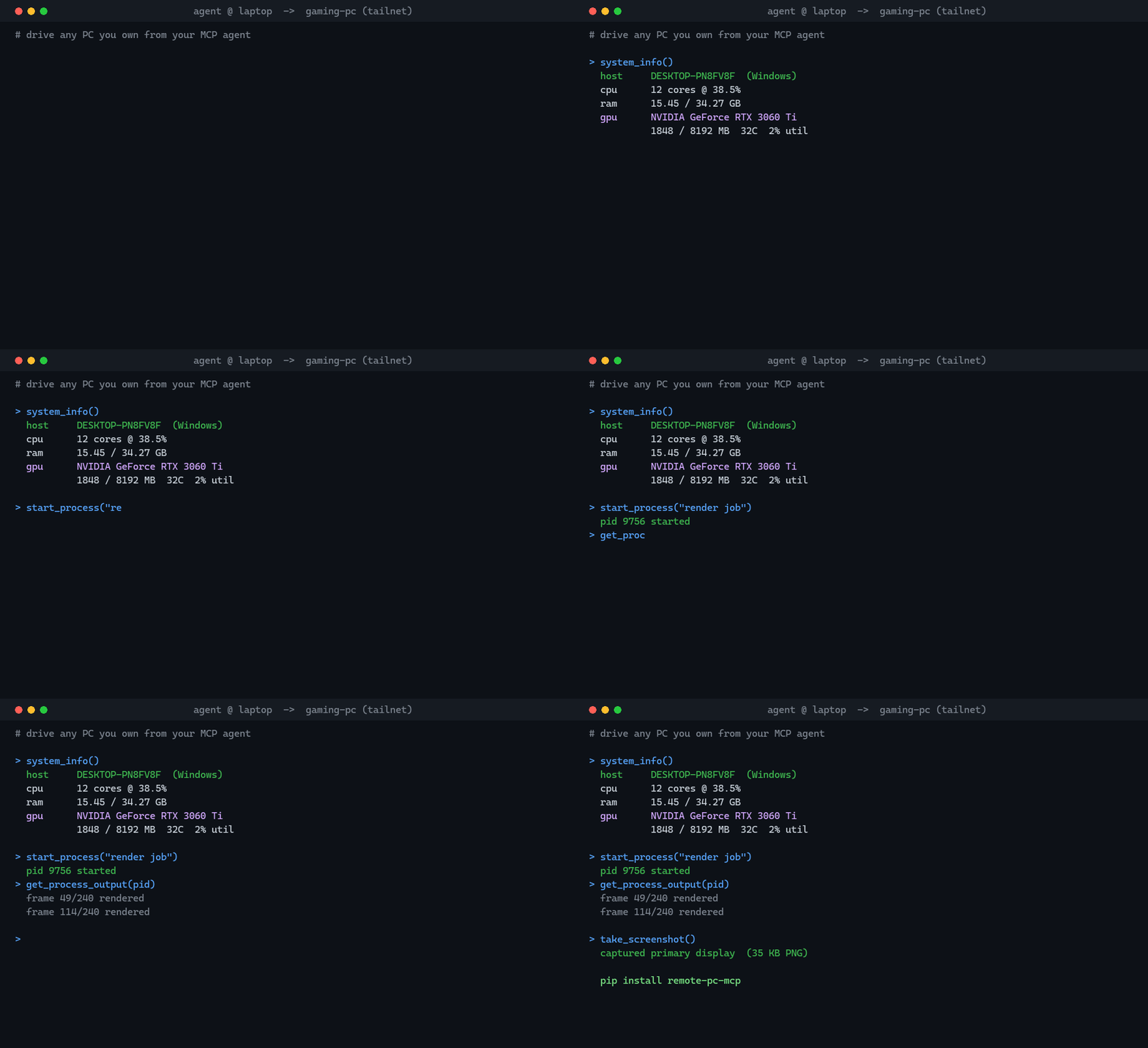
The transport is the mcp SDK's streamable HTTP (stateless_http=True), so a server restart does not break already-connected clients. Each request is self-contained — there is no in-memory session to go stale.
⚠️
shell_execruns arbitrary commands on the host as the user that started the server. The bearer token is a root-equivalent credential. See Security before exposing the server.
Tools
| Tool | Description |
|---|---|
shell_exec | Run any shell command — returns stdout, stderr, exit code |
read_file | Read a file as text or base64 (binary fallback) |
write_file | Write text or binary content to a file |
list_directory | List files and directories, optionally recursive |
system_info | OS, CPU, RAM, and GPU stats (NVIDIA GPUs via nvidia-smi; absent on non-GPU hosts) |
start_process | Start a long-running command in the background — returns a PID |
get_process_output | Poll stdout/stderr of a background process by PID |
kill_process | Terminate a process by PID |
download_file | Download a URL directly to this machine |
take_screenshot | Capture the primary display — returns base64-encoded PNG |
click | Click at screen coordinates (x, y) — left / right / middle, single or multi-click |
move_mouse | Move cursor to (x, y), optionally animated |
type_text | Type a string into the focused window |
press_key | Press a single key or hotkey combo (e.g. enter, f11, ctrl+c, win+d) |
scroll | Scroll the mouse wheel up or down, optionally at a specific point |
Requirements
- Python 3.10+
- Windows 10/11, or Linux with systemd (for autostart)
Install
On the machine you want to control:
git clone https://github.com/raghibrm/remote-pc-mcp
cd remote-pc-mcp
cp .env.example .env
Set a strong token in .env:
REMOTE_PC_MCP_TOKEN=your-long-random-token-here
Generate one:
# Windows
python -c "import secrets; print(secrets.token_hex(32))"

# Linux / macOS
openssl rand -hex 32
Then run the installer:
# Windows
install.bat

# Linux
chmod +x install.sh
./install.sh
That's it — one command. The installer:
- installs Python dependencies
- registers the server to launch hidden on every login (Startup-folder shortcut on Windows, systemd user unit on Linux)
- starts it now
- supervises it with exponential backoff on crash (5→10→20→40→60 seconds, resets after 5 minutes of uptime)
- survives reboots — set once, runs forever
Verify it's up
curl http://localhost:8765/health
# {"status":"ok","server":"remote-pc-mcp","version":"0.5.0"}
When to rerun the installer
install.bat / install.sh are idempotent and self-healing. Rerun any time after:
- You move the repo to a different folder
- You reinstall or upgrade Python to a different path
- You rebuild the machine and want to restore autostart
For day-to-day operation you never need to think about it.
After a reboot
Autostart fires when you sign in to Windows. A reboot that sits at the lock screen will NOT start the daemon until somebody logs in. This is intentional — enabling Windows auto-logon to make reboots fully hands-off would let anyone with physical access to the machine get a logged-in desktop, which is the wrong trade-off for a remote-control tool.
If you need to bring the daemon back up after a reboot without walking to the PC, sign in remotely via Remote Desktop or Tailscale SSH. Once you're logged in, the Startup shortcut fires and the daemon starts.
Linux is different: install.sh --linger runs sudo loginctl enable-linger $USER so the systemd user unit runs across reboots without any logon. systemd's user services don't share the auto-logon security problem because they don't grant interactive desktop access — they just keep your user-scoped daemons alive.
Uninstall
# Windows
install.bat --uninstall

# Linux
./install.sh --uninstall
Removes the autostart entry and stops the running server + supervisor.
Foreground run (development)
For a one-off run with visible console output and no autostart:
python server.py
That's it — no special script. Use install.bat / install.sh for the normal supervised setup.
Or install from PyPI
pip install remote-pc-mcp
remote-pc-mcp          # run the server in the foreground
remote-pc-mcp-daemon   # supervised: restarts the server on crash
A pip install gives you the server and supervisor commands but does not register autostart. For autostart on sign-in, use the clone and install-script path above. .env, logs, and .state/ live in REMOTE_PC_MCP_HOME (default: the working directory).
Adding to your MCP client
Most MCP clients use the same JSON schema; the file just lives in different places. Example:
{
  "mcpServers": {
    "remote-pc": {
      "type": "http",
      "url": "http://YOUR_PC_IP_OR_HOSTNAME:8765/mcp",
      "headers": {
        "Authorization": "Bearer your-long-random-token-here"
      }
    }
  }
}
Where to put it:
| Client | Config file |
|---|---|
| Claude Code | .mcp.json in the project root (or ~/.claude.json for user-wide) |
| Claude Desktop | claude_desktop_config.json (Settings → Developer → Edit Config) |
| Cursor | .cursor/mcp.json |
| Cline / Continue / Windsurf | each has its own MCP servers panel — paste the JSON there |
| Custom agents | wherever your agent reads MCP server definitions |
For Tailscale users, the magic-DNS hostname works in the URL:
"url": "http://your-pc.tail12345.ts.net:8765/mcp"
Restart (or reload) your client. The tools appear automatically. The "remote-pc" key is just a label — pick whatever name you want.
Security
shell_exec runs any command on the host as the user that started the server. That is intentional — it is what makes the server useful for remote-driving a PC. It also means:
- The bearer token is a root-equivalent credential. Generate a 32-byte hex token, store it only in
.env(which is git-ignored), and treat it like a password. - Never expose the server to the public internet without TLS and a reverse proxy (nginx, Caddy, Cloudflare Tunnel).
- Use Tailscale (strongly recommended): bind to your Tailscale IP (set
REMOTE_PC_MCP_HOST=100.x.x.xin.env) so the listener is only reachable from devices in your tailnet. - LAN-only deployments with
REMOTE_PC_MCP_HOST=0.0.0.0are reasonable if you trust every device on the LAN and have a strong token. Don't do this on an untrusted network.
The token is compared with secrets.compare_digest (constant-time). All error messages pass through a sanitiser that strips absolute paths, the home directory, and the token before being returned to clients.
Configuration
All env vars are optional except REMOTE_PC_MCP_TOKEN.
| Var | Default | Description |
|---|---|---|
REMOTE_PC_MCP_TOKEN | (required) | Bearer token clients must present |
REMOTE_PC_MCP_HOST | 0.0.0.0 | Bind address. Set to a Tailscale IP to restrict reach |
REMOTE_PC_MCP_PORT | 8765 | Listen port |
REMOTE_PC_MCP_ALLOWED_HOSTS | (empty) | Comma-separated allowlist for DNS-rebinding protection. Empty disables it (default — wrong threat model on a tailnet) |
REMOTE_PC_MCP_MAX_SHELL_TIMEOUT | 600 (s) | Cap on per-call shell_exec timeout |
REMOTE_PC_MCP_MAX_READ_BYTES | 50 MB | read_file upper limit |
REMOTE_PC_MCP_MAX_WRITE_BYTES | 50 MB | write_file upper limit |
REMOTE_PC_MCP_MAX_DOWNLOAD_BYTES | 2 GB | download_file upper limit |
After changing .env, restart the server so the new value takes effect:
# Windows: easiest path is just re-run the installer (idempotent)
install.bat --uninstall && install.bat

# Linux
systemctl --user restart remote-pc-mcp
Logs and troubleshooting
Two log files in the repo root, both rotated automatically:
| File | What's in it | Rotation |
|---|---|---|
server.log | App events + uvicorn startup/access logs | 10 MB × 5 |
daemon.log | Supervisor events (crashes, restarts, backoff) | 2 MB × 3 |
Server isn't responding?
# Is the listener up locally?
curl http://localhost:8765/health

# What's the supervisor seeing?
tail -f daemon.log

# Linux: full journal
journalctl --user -u remote-pc-mcp -f

# Windows: is the autostart registered?
explorer shell:startup    # look for remote-pc-mcp.lnk
MCP client says tools are missing after a server restart?
The streamable HTTP transport is designed so a restart does not brick clients, but the client still has to issue a request to notice the new server. First fix: invoke any tool from this server (e.g. ask your agent to run system_info) — the client will retry the connection. If that fails, reconnect the MCP server in your client (Claude Code: /mcp ; Cursor: refresh in MCP panel) or restart the client.
Stuck process / port already in use?
# Windows
install.bat --uninstall && install.bat

# Linux
./install.sh --uninstall && ./install.sh
UI-driving tools
take_screenshot, click, move_mouse, type_text, press_key, and scroll require an interactive desktop session:
- Windows: a user must be logged in and the screen unlocked. A service running under Session 0 cannot reach the desktop. The Startup-folder install gives you exactly this — the daemon runs in your user session.
- Linux: needs an X11 or Wayland session. For screenshots specifically, install
scrot,gnome-screenshot, or ImageMagick'simport—sudo apt install scrotis the easiest.
Development
Project layout:
| File | Purpose |
|---|---|
server.py | The MCP server — tools, auth, transport |
daemon.py | Supervisor — spawns server, restarts on crash with backoff |
_logging.py | Shared logging config — one handler for app + uvicorn loggers |
install.{bat,sh} | Single entry point: default installs, --uninstall removes |
Tests
A self-contained test suite under tests/ launches its own isolated server on a high port with an ephemeral token, exercises every tool, and verifies that a mid-run server restart does not lock the client out. It does not touch the production server you have running.
pip install -r requirements-dev.txt
python -m pytest tests/ -v
License
MIT
Reviews
No reviews yet
Be the first to review this server!
More Developer Tools MCP Servers
Git
Freeby Modelcontextprotocol · Developer Tools
Read, search, and manipulate Git repositories programmatically
Fetch
Freeby Modelcontextprotocol · Developer Tools
Web content fetching and conversion for efficient LLM usage
Worldmonitor
Freeby Koala73 · Developer Tools
Live markets, conflicts, country risk, chokepoints, energy, and China decision signals. 90 tools.
Paperclip
Freeby Paperclipai · Developer Tools
Trending hip-hop artist momentum scores across four cultural dimensions.
Toleno
Freeby Toleno · Developer Tools
Toleno Network MCP Server — Manage your Toleno mining account with Claude AI using natural language.
mcp-creator-python
Freeby mcp-marketplace · Developer Tools
Create, build, and publish Python MCP servers to PyPI — conversationally.