
Server data from the Official MCP Registry
Google Trends for any number of keywords on one scale: interest over time, regions, rising queries.
About
Google Trends for any number of keywords on one scale: interest over time, regions, rising queries.
Remote endpoints: streamable-http: https://mcp.apify.com/?tools=ralfij/google-trends-scraper
Security Report
Valid MCP server (1 strong, 1 medium validity signals). No known CVEs in dependencies. Imported from the Official MCP Registry.
Endpoint verified · Requires authentication · 1 issue found
Security scores are indicators to help you make informed decisions, not guarantees. Always review permissions before connecting any MCP server.
Permissions Found in Source Code
Found by scanning the linked source code. This listing connects to a hosted endpoint, so none of this runs on your machine: it describes what the server software does where it is hosted.
What You'll Need
Set these up before or after installing:
How to Connect
Remote Plugin
No local installation needed. Your AI client connects to the remote endpoint directly.
Add this to your MCP configuration to connect:
{
  "mcpServers": {
    "io-github-ralfij-google-trends": {
      "url": "https://mcp.apify.com/?tools=ralfij/google-trends-scraper"
    }
  }
}Documentation
View on GitHubFrom the project's GitHub README.
Google Trends API for Python (a pytrends alternative)
Get Google Trends data into Python: interest over time, interest by region, top and rising related searches, and simple trend metrics. You can also compare 10, 50 or 100+ keywords on one scale. The Google Trends website stops at 8 (5 in classic Explore).
pytrends was archived in April 2025 and often fails with 429 Too Many Requests. Google announced an official Trends API in July 2025, but it is an alpha with limited, application-based access. These examples use a hosted scraper instead, the Google Trends Scraper on Apify, which deals with Google's session cookies and rate limits for you.
Tutorial: Google Trends in Python without pytrends, and how to compare more keywords than Google allows. It covers the two endpoints behind the website, the trick for linking comparisons, and what the data looks like.
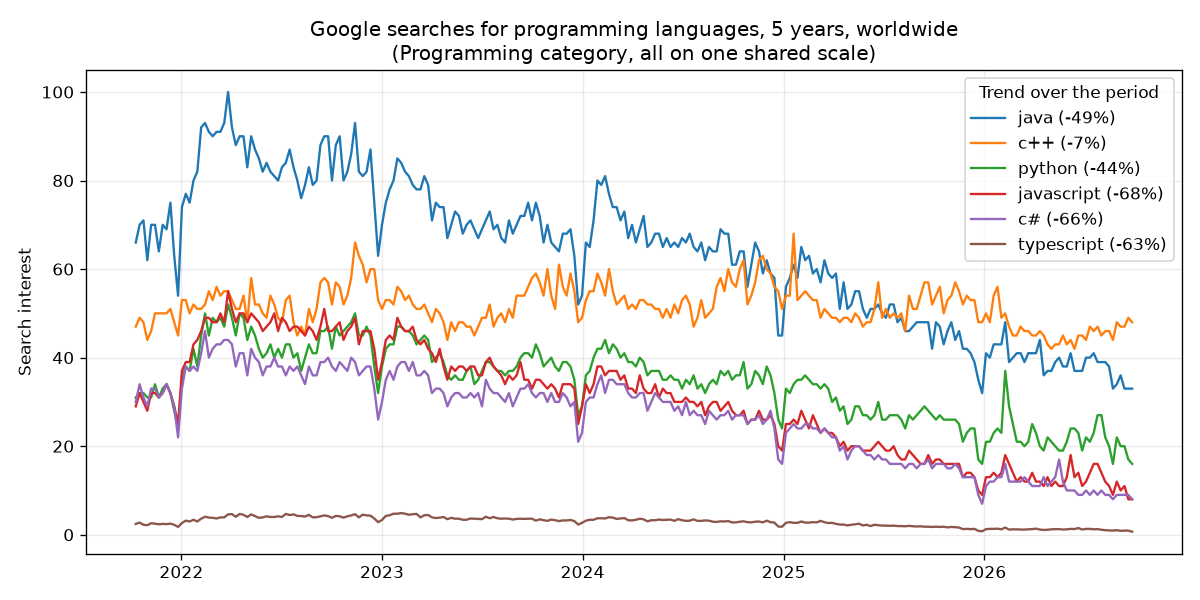
Example output: search interest in the Programming category fell 40-68% for most languages between 2021 and 2026. Made with examples/compare_keywords.py and matplotlib.
Quick start
- Create a free Apify account. The free plan includes $5 of credit every month, which covers about 2,500 keywords. No credit card needed.
- Copy your API token from Settings > API & Integrations in Apify Console.
- Run an example:
pip install -r requirements.txt
export APIFY_TOKEN=your-token        # Windows: set APIFY_TOKEN=your-token
python examples/compare_keywords.py
keyword       share %  average  trend
java             29.4     63.7  falling (-48.8%)
c++              23.8     51.6  stable (-7.1%)
python           15.8     34.3  falling (-43.7%)
...
Examples
| File | What it does |
|---|---|
examples/compare_keywords.py | Compares 10 keywords on one shared scale, prints share of search and trend, and saves a CSV |
examples/keyword_report.py | Trend, peak, busiest month, top regions and rising searches per keyword |
examples/plot_trends.py | Plots interest over time for several keywords with matplotlib |
examples/raw_endpoints.py | The two JSON endpoints behind trends.google.com, with no library at all. Good for a few keywords. |
sample-output/programming-languages-5y.csv shows the CSV from compare_keywords.py.
What you get per keyword
interestOverTime: the full time series (0-100), with the unfinished last week or day markedpartialinterestByRegion: countries, states or regions where the keyword is most popularrelatedQueriesTopandrelatedQueriesRising, including breakoutsaverageInterest,latestInterest,peakInterest,peakDatetrend(rising, falling or stable) andtrendChangePercent: the last quarter of the period against the first quarterbusiestMonthfor periods of about a year or longershareOfSearchwhen you compare keywords on one shared scale
How comparing many keywords works
Google's Trends API compares at most 5 keywords per request (the website shows up to 8) and scales each request so its highest point is 100. To compare more, the scraper:
- requests the keywords in groups of 5;
- compares the most searched keyword of each group (the group "leader") with the other leaders, 5 at a time with one leader of overlap, so any number of groups can be chained;
- rescales every group through its leader, then rescales everything so the highest point overall is 100.
Google rounds to whole numbers, so a tiny keyword next to a huge one can still show as 0. Compare keywords of a similar size for the best precision.
Use it from AI assistants (MCP)
To let Claude, Cursor, VS Code or another MCP client look up Google Trends for you, add this MCP server URL: https://mcp.apify.com/?tools=ralfij/google-trends-scraper. Sign in to Apify when the client asks, or send your Apify API token as Authorization: Bearer <token>. Runs are billed to your own Apify account.
Notes
- I built the Google Trends Scraper used in these examples, so keep that in mind.
raw_endpoints.pyshows how to do it yourself. - Pricing is per keyword with no subscription; see the actor page. More ready-made searches are on its example tasks.
- Not affiliated with, endorsed by or sponsored by Google. Google Trends is a trademark of Google LLC.
License
MIT
Reviews
No reviews yet
Be the first to review this server!
More Developer Tools MCP Servers
Fetch
Freeby Modelcontextprotocol · Developer Tools
Web content fetching and conversion for efficient LLM usage
Git
Freeby Modelcontextprotocol · Developer Tools
Read, search, and manipulate Git repositories programmatically
Worldmonitor
Freeby Koala73 · Developer Tools
Live markets, conflicts, country risk, chokepoints, energy, and China decision signals. 93 tools.
Toleno
Freeby Toleno · Developer Tools
Toleno Network MCP Server — Manage your Toleno mining account with Claude AI using natural language.
MCP Marketplace
Freeby mcp-marketplace · Developer Tools
Search and install MCP servers from inside your AI client.
mcp-creator-python
Freeby mcp-marketplace · Developer Tools
Create, build, and publish Python MCP servers to PyPI — conversationally.