
Server data from the Official MCP Registry
Computer-use for Kasm Workspaces: lets AI agents see and drive your Kasm desktops over KasmVNC.
About
Computer-use for Kasm Workspaces: lets AI agents see and drive your Kasm desktops over KasmVNC.
Security Report
kasm-use is a well-architected MCP server for controlling Kasm Workspaces desktops. The codebase demonstrates strong security discipline with proper credential handling, scoped permissions, and clear architectural boundaries. Minor code quality issues (exception handling, input validation) and the inherent risks of desktop automation do not significantly impact the score, as the security model is sound and permissions align with the server's purpose. Supply chain analysis found 5 known vulnerabilities in dependencies (0 critical, 5 high severity). Package verification found 1 issue.
5 files analyzed · 13 issues found
Security scores are indicators to help you make informed decisions, not guarantees. Always review permissions before connecting any MCP server.
Permissions Required
This plugin requests these system permissions. Most are normal for its category.
What You'll Need
Set these up before or after installing:
Environment variable: KASM_API_URL
Environment variable: KASM_API_KEY
Environment variable: KASM_API_KEY_SECRET
Environment variable: KASM_USER_ID
Environment variable: KASM_VERIFY_TLS
How to Install
Add this to your MCP configuration file:
{
  "mcpServers": {
    "io-github-rchurro-kasm-use": {
      "env": {
        "KASM_API_KEY": "your-kasm-api-key-here",
        "KASM_API_URL": "your-kasm-api-url-here",
        "KASM_USER_ID": "your-kasm-user-id-here",
        "KASM_VERIFY_TLS": "your-kasm-verify-tls-here",
        "KASM_API_KEY_SECRET": "your-kasm-api-key-secret-here"
      },
      "args": [
        "kasm-use"
      ],
      "command": "uvx"
    }
  }
}Documentation
View on GitHubFrom the project's GitHub README.
kasm-use
Let an AI agent use a Kasm Workspaces desktop: start a session, look at the screen, click, type, press keys, scroll, and stop it — in plain language, from any MCP client (Claude Code, Claude Desktop, OpenCode, Cursor, …) or as a native Hermes Agent plugin.
Other Kasm MCP servers manage sessions (start, list, stop). kasm-use actually uses them: the agent sees the desktop and operates it, like computer-use or browser-use, inside your Kasm.
- Works with stock Kasm images. Nothing is baked into the workspace; it drives the desktop through Kasm's API and the session's own KasmVNC connection.
- You can watch and take over. Sessions are created as your Kasm user, so they show up in your Kasm dashboard. Open one to watch the agent work, or to handle a login or CAPTCHA yourself.
- Your Kasm, your key. You run the server next to your own Kasm. Nothing goes through a third party.
What's Kasm?
Kasm Workspaces streams disposable desktops and apps to your web browser, each running in its own container on a server you control. Click "Chrome" and you get a fresh Chrome in a browser tab; close it and it's wiped. kasm-use lets an AI agent sit down at those desktops and use them the way a person would.
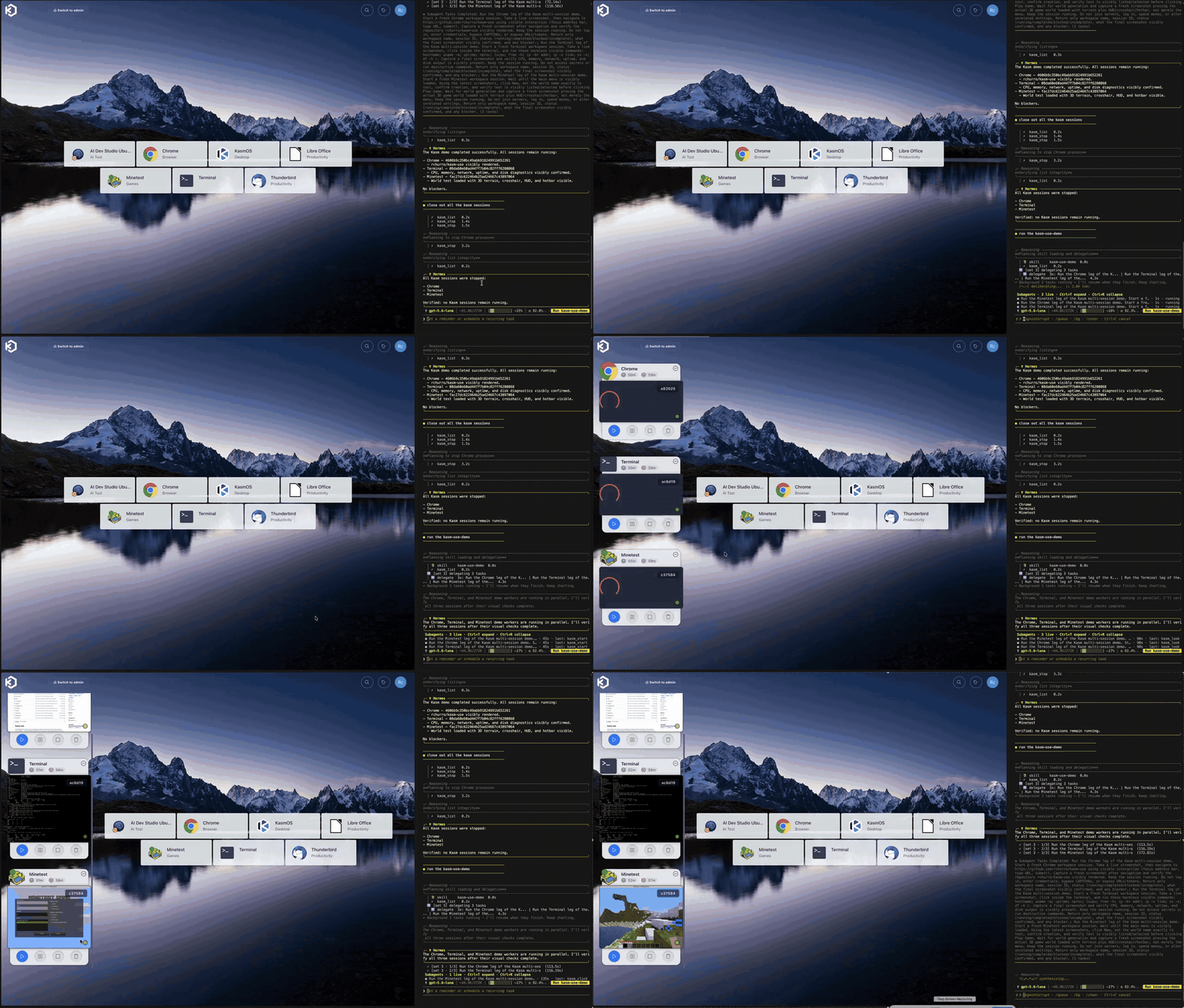
Demo (3x speed): Hermes Agent runs a three-session demo with kasm-use. Chrome, Terminal and Minetest are started and driven in parallel while the Kasm dashboard shows each one live.
How the pieces connect:
flowchart LR
    agent["AI agent<br/>(any MCP client or Hermes)"] -->|"tool calls:<br/>look, click, type"| ku["kasm-use"]
    ku -->|"start / list / stop<br/>(API key)"| api["Kasm API"]
    api -->|"starts container"| desk
    ku -->|"screenshots + input<br/>(VNC over websocket)"| proxy["Kasm proxy"]
    you["You, in the<br/>Kasm dashboard"] -->|"watch or take over"| proxy
    proxy --> desk["Session desktop<br/>(KasmVNC in a container)"]
Status: early — testers wanted
kasm-use works well on the setup it was built on (Kasm 1.19.0 in linuxserver's Docker image; Chrome, Terminal and Minetest workspaces; Claude Code and Hermes Agent as clients). It talks to parts of Kasm that aren't documented, so other versions and install types are the big unknown. If you try it, please open an issue, whether it worked or not: your Kasm version, how Kasm is installed, the workspace image and your MCP client are the most useful details.
Tools
| Tool | What it does |
|---|---|
kasm_list | Workspaces you can start, and your running sessions |
kasm_start | Start a workspace (e.g. Chrome); returns once the session is running |
kasm_look | Live screenshot of the session, returned as an image (~1 s) |
kasm_click | Click at x,y in the latest screenshot's coordinates |
kasm_type | Type text into the focused field |
kasm_key | Keys/shortcuts, e.g. ctrl+l, Return, Tab |
kasm_scroll | Scroll, optionally at a point |
kasm_stop | Destroy the session |
Requirements
-
Kasm Workspaces 1.19 or newer (tested on 1.19.0).
-
A Kasm API key: Admin → Settings → Developers → API Keys → Add, then edit its permissions. kasm-use 0.3 needs exactly these five (tested end to end with a key that has only these):
- Images View, User, Users Auth Session — starting sessions (without them
kasm_startfails withUnauthorized). - Sessions View — session status and
kasm_list. - Sessions Delete —
kasm_stop.
It no longer calls Kasm's exec API (Sessions Modify) or screenshot API (Session Recordings View), so you can remove those if you granted them for 0.2 or earlier. A missing permission shows up as
Unauthorizedfrom the tool that needs it. Read Security model first: these permissions are server-wide. - Images View, User, Users Auth Session — starting sessions (without them
-
Your Kasm user ID, so sessions belong to you: Admin → Access Management → Users → open your user; the ID is in the page URL.
-
Any workspace image. Nothing is installed in the session for sessions kasm-use starts.
Configuration
| Variable | Required | Meaning |
|---|---|---|
KASM_API_URL | yes | e.g. https://kasm.example.com |
KASM_API_KEY / KASM_API_KEY_SECRET | yes | the API key pair |
KASM_USER_ID | yes | the Kasm user sessions are created for |
KASM_VERIFY_TLS | no | false to accept a self-signed Kasm certificate (default true) |
KASM_USE_TOKEN | HTTP only | bearer token clients must send |
Run it
Locally (stdio) — the usual way
Your MCP client starts the server itself. With uv installed:
{
  "mcpServers": {
    "kasm": {
      "command": "uvx",
      "args": ["kasm-use"],
      "env": {
        "KASM_API_URL": "https://kasm.example.com",
        "KASM_API_KEY": "…",
        "KASM_API_KEY_SECRET": "…",
        "KASM_USER_ID": "…"
      }
    }
  }
}
Claude Code:
claude mcp add kasm -e KASM_API_URL=https://kasm.example.com -e KASM_API_KEY=… -e KASM_API_KEY_SECRET=… -e KASM_USER_ID=… -- uvx kasm-use
As a service (streamable HTTP)
docker run -d -p 8000:8000 \
  -e KASM_API_URL=https://kasm.example.com -e KASM_API_KEY=… -e KASM_API_KEY_SECRET=… \
  -e KASM_USER_ID=… -e KASM_USE_TOKEN="$(openssl rand -hex 32)" \
  ghcr.io/rchurro/kasm-use:latest
Clients connect to http://host:8000/mcp with the header Authorization: Bearer <KASM_USE_TOKEN>.
Health check: GET /healthz. Run one replica per Kasm user: the server remembers each
session's last screenshot size in memory to map click coordinates.
Keep it on a private network (LAN, VPN, Tailscale). Anyone with the token can drive your desktops.
Hermes Agent
pip install kasm-use                      # into Hermes's Python environment
cp -r hermes-plugin/kasm ~/.hermes/plugins/kasm
Enable kasm under plugins.enabled, set the environment variables above, and start a new
Hermes session (/new) so the tools load.
Safety
An agent with these tools drives a real desktop on your network, so treat it like handing someone your mouse and keyboard.
- Use throwaway workspaces. Don't let the agent work in a session that's logged into your real accounts, and don't save passwords in workspace images it uses.
- Web pages can talk to the agent. Text on a page it visits can try to steer it (prompt injection). Keep a human watching for anything that matters.
- Traffic comes from your network. Whatever the agent browses comes from your Kasm host's IP address. Kasm's per-workspace VPN/egress settings can route it elsewhere.
- The tool descriptions tell the agent never to type passwords, MFA codes or payment details and to hand CAPTCHAs to you, but that is guidance to the model, not enforcement.
Security model
Two Kasm facts shape what kasm-use can and can't promise:
- A Kasm API key is server-wide, not per user. Kasm has no way to limit a key to one user. With the permissions above it can see and stop any user's sessions, and Users Auth Session ("login on behalf of another user") lets it get a login for any user.
- The token
request_kasmreturns is a login forKASM_USER_ID, not for one session. It opens every session that user has (verified on Kasm 1.19.0: a token from one session opened another session of the same user over VNC).
So the boundary is kasm-use itself:
- Every tool only acts on sessions this kasm-use process started. Any other
session_id(yours, another user's, one from before a restart) is refused, including forkasm_lookandkasm_stop.kasm_listonly shows kasm-use's own sessions. - The model never sees the API key or any token, only the eight tools.
- No exec, no screenshot API. kasm-use doesn't use Kasm's exec API (which can run commands in a session as root) or its screenshot API, so it doesn't need those permissions.
What that means for you:
- Treat the API key like an admin credential, and run kasm-use only on a machine you trust. Anyone who gets the key gets your Kasm, whatever kasm-use's code does.
- Give the agent its own Kasm user and set
KASM_USER_IDto it. That keeps the agent's sessions and tokens away from your own sessions if something goes wrong in kasm-use. (It is a seatbelt, not a wall: the key itself can still reach every user.) - Kasm's disposability helps, but only so much. Sessions are thrown away when they end (unless you enable persistent profiles), so nothing an agent does survives the session. The exposure is in sessions that are still running: one that's logged into an account, or that you're working in.
- There's no per-action policy yet (rate limits, blocked keys, "ask the human first"). Input goes straight to VNC once the scope check passes. VNC only sees pixels and keystrokes, so rules like "never type into this window" can't be enforced at this layer.
Limitations
- Only sessions kasm-use started, and only until it restarts. The session tokens live in memory. After a restart, earlier sessions keep running in Kasm but kasm-use won't touch them; stop them from the Kasm dashboard.
- Input reports "sent", not "succeeded". The next screenshot is the confirmation.
- CAPTCHAs, passwords, MFA and payments are handed to you. The tool descriptions tell the agent never to type them; open the session in Kasm and take over.
- It's slow compared to a local browser tool: every step is a screenshot round trip.
How it works
kasm-use talks to each session's KasmVNC server directly, through Kasm's own proxy
(wss://<kasm>/desktop/<id>/vnc/websockify), with the login token request_kasm returns.
The VNC client is built in and uses only the Python standard library.
- Eyes: a full framebuffer read over VNC (ZRLE, decoded with
zlib), returned as PNG. Kasm's screenshot API isn't used for these sessions: it only refreshes while a viewer is connected, so with nobody watching it returns stale frames. - Hands: VNC pointer and key events. KasmVNC's pointer message is 11 bytes (16-bit button mask plus scroll deltas), not standard RFB's 6.
- Clicks are given in screenshot pixels and scaled to the desktop's current size, which VNC reports on connect — it changes when someone opens the session and Kasm resizes it to their window.
- Each tool call opens a short VNC connection and does a round trip before closing, so no input is lost on disconnect. The owner can stay connected at the same time.
What this relies on. None of this is an official Kasm API; it's how Kasm's own web viewer connects, observed on Kasm 1.19.0:
- Kasm's proxy accepts the
username+session_tokencookies thatrequest_kasmreturns, and requires anOriginheader matching the Kasm host. - Behind the proxy, KasmVNC offers VNC authentication and accepts an empty password (the proxy has already authenticated you).
- KasmVNC's pointer message is 11 bytes (visible in its open-source web client).
A Kasm update or a different install type could change any of these. If kasm-use stops connecting, that's the likely cause, and an issue with your Kasm version and install type helps.
License
MIT
Reviews
No reviews yet
Be the first to review this server!
More Developer Tools MCP Servers
Git
Freeby Modelcontextprotocol · Developer Tools
Read, search, and manipulate Git repositories programmatically
Fetch
Freeby Modelcontextprotocol · Developer Tools
Web content fetching and conversion for efficient LLM usage
Worldmonitor
Freeby Koala73 · Developer Tools
Live markets, conflicts, country risk, chokepoints, energy, and China decision signals. 86 tools.
Toleno
Freeby Toleno · Developer Tools
Toleno Network MCP Server — Manage your Toleno mining account with Claude AI using natural language.
mcp-creator-python
Freeby mcp-marketplace · Developer Tools
Create, build, and publish Python MCP servers to PyPI — conversationally.
MCP Marketplace
Freeby mcp-marketplace · Developer Tools
Search and install MCP servers from inside your AI client.