
Server data from the Official MCP Registry
Find printer profiles, check bed fit, slice to .gcode.3mf and extract the G-code.
About
Find printer profiles, check bed fit, slice to .gcode.3mf and extract the G-code.
Security Report
The cadloop MCP server provides parametric CAD workflow automation with reasonable security controls. A workspace directory guard prevents basic path traversal, and operations are appropriately scoped to file I/O and subprocess execution of trusted external tools. However, several moderate concerns reduce the score: the OpenSCAD server executes arbitrary .scad files (inherent design risk), unsafe string formatting in subprocess arguments could enable injection attacks, limited input validation on some parameters, and the workspace guard only protects tool arguments—not the scripts themselves. These are partially mitigated by the intended use case (controlled model writing), but users should be aware of the limitations. Supply chain analysis found 5 known vulnerabilities in dependencies (0 critical, 5 high severity). Package verification found 1 issue.
5 files analyzed · 14 issues found
Security scores are indicators to help you make informed decisions, not guarantees. Always review permissions before connecting any MCP server.
Permissions Required
This plugin requests these system permissions. Most are normal for its category.
What You'll Need
Set these up before or after installing:
Environment variable: SLICER_WORKSPACE
Environment variable: SLICER_BIN
Environment variable: SLICER_PROFILE_DIRS
Environment variable: SLICER_TIMEOUT
How to Install
Add this to your MCP configuration file:
{
  "mcpServers": {
    "io-github-richardofortune-cadloop-slicer": {
      "env": {
        "SLICER_BIN": "your-slicer-bin-here",
        "SLICER_TIMEOUT": "your-slicer-timeout-here",
        "SLICER_WORKSPACE": "your-slicer-workspace-here",
        "SLICER_PROFILE_DIRS": "your-slicer-profile-dirs-here"
      },
      "args": [
        "cadloop"
      ],
      "command": "uvx"
    }
  }
}Documentation
View on GitHubFrom the project's GitHub README.
cadloop
A closed loop from parametric source to G-code, with the verification step in the middle that neither the CAD tool nor the slicer can do.
Two MCP servers. A model writes OpenSCAD, compiles it, reads computed values back out, looks at a render, checks it fits the bed, slices it and pulls out the G-code, with every plate proven against the printable area. No GUI at any point.
The verify step in the middle is yours to write. cadloop makes everything around it cheap enough that you get to run it often; it cannot tell you whether the part works.
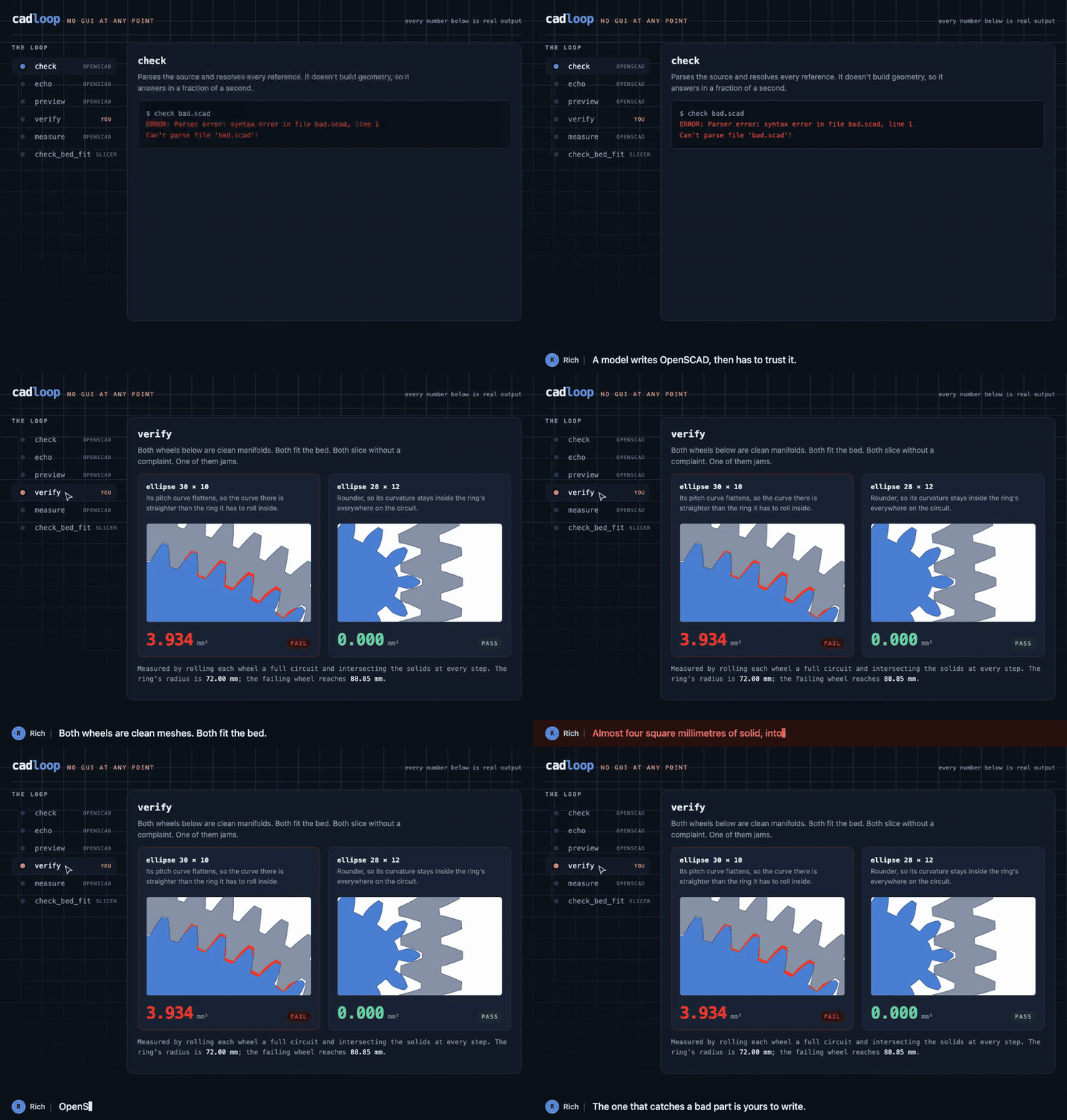
Every number in that walkthrough is real output. The failing wheel is a real measurement, not an illustration. How it's built and where each number comes from is in docs/walkthrough.
 setup_printer   once, no arguments: which printer is this for
      |
  write .scad
      |
   check          syntax and references, about a second
      |
   echo           read computed values without rendering
      |
   preview        look at it
      |
   verify         does it actually work  <- yours; nothing here does it for you
      |
   measure        bounding box and volume
      |
 check_bed_fit    against the printer you set up
      |
  slice_model     -> .gcode.3mf
      |
 extract_gcode    -> .gcode
The ordering is the point. check and echo skip geometry evaluation
entirely, so they cost a second against models where a full render takes
minutes. Pay for the expensive steps only once the cheap ones pass.
Everything from the bed check down is also one call, make_printable, which
renders, packs, slices and proves the result on the bed and reports what it
did in a screen of text. See the worked example.
Install
pip install cadloop
The only dependency is mcp. Or from a checkout, which is what you want if you
intend to run the worked example or the tests — the verify extra is shapely,
needed by the example's own checker rather than by cadloop:
git clone https://github.com/richardofortune/cadloop
cd cadloop
pip install -e ".[verify]"
Needs OpenSCAD on PATH or at OPENSCAD_BIN, and for slicing, OrcaSlicer,
Bambu Studio, ElegooSlicer or Creality Print. They share a CLI, so any of them
works, and all four are auto-detected along with the profiles they ship.
No slicer is preferred over another here. setup_printer probes each one it
finds and then proves the winner by slicing a 20mm cube with your profiles, so
which one you get is decided by which one works on your machine rather than by
the order of a list in this repository. Creality Print's CLI is broken headless
on macOS today, and that is something this discovers rather than something it
asserts, so it corrects itself when upstream ships a fix; see testing status
below. SLICER_BIN overrides the choice.
Configure
Copy mcp.json into your client's config and fix the paths. Both servers
should point at the same workspace directory, which is the only place either
one reads or writes.
| Variable | Default | Meaning |
|---|---|---|
OPENSCAD_BIN, SLICER_BIN | auto-detected | binary paths |
OPENSCAD_WORKSPACE, SLICER_WORKSPACE | ~/cad | the sandbox |
SLICER_PROFILE_DIRS | auto-detected | extra profile roots |
CADLOOP_MACHINE | $XDG_CONFIG_HOME/cadloop/machine.json | where the machine record lives |
OPENSCAD_TIMEOUT, SLICER_TIMEOUT | 300, 600 | seconds before a kill |
The servers
openscad exposes check, echo, render, measure, preview and
workspace file access. preview returns the PNG as an MCP image, so the model
can look at what it built rather than inferring from numbers. render returns
OpenSCAD's manifold report alongside a bounding box and volume, where
simple: yes with a sensible volume count is the signal the mesh is printable.
The two split on what happens to the picture. preview hands it back and keeps
nothing; render writes it to the workspace when the output ends in .png,
taking the same camera, imgsize, projection and full_render options. Use
render when the image is the artefact rather than the answer. Since render
also takes source as text rather than a path, the before half of a comparison
is git show <rev>:model.scad piped straight in — no checkout, no temp file.
slicer exposes setup_printer, machine_info, make_printable,
slicer_info, list_profiles, check_bed_fit, slice_model,
slice_summary and extract_gcode.
make_printable is the whole chain in one call. Give it a .scad and the
parts you want out of it, and it renders each one, measures it, packs what
fits onto as few plates as it can, slices them, and then reads the finished
G-code back to prove every extruding move lands on the bed. It never edits
the model: a part that cannot print as designed is reported, not quietly
shrunk or split. The one thing it changes is which plate a part lands on, and
turning a part ninety degrees when it will not fit square, which it names in
the report. It answers with every fact it established and, in summary, the
one screen of text those facts add up to, ending in what to do next.
Call setup_printer() once, with no arguments. It reads what your slicer is
already configured with, resolves that to a machine, process and filament
profile from one install, proves the combination by slicing a 20mm cube, and
remembers it. It reports the printer, the quality and the filament it settled
on, and stores nothing at all if the test slice fails. Pass printer,
filament or process only to override one of those fields; the rest still
come from your slicer's own settings. A profile you name is either used or
refused by name, never quietly swapped for a different one.
After that, check_bed_fit and slice_model need no profile arguments, which
is the point: a caller cannot supply three profiles that disagree if it
supplies none. Explicit arguments still win where you pass them.
machine_info says which printer this workspace is set up for and whether it
is still current. The record is a cache, not a source of truth. If the slicer
moves, a profile is edited, or the slicer's version changes, every tool that
would have used it refuses with the reason instead - ok: null, nothing
written - until you run setup_printer again. A setup that no longer matches
reality is never used to produce G-code.
Call slicer_info before doing anything unusual: the Orca-family CLI is
undocumented, changes between releases, and Creality's fork diverges, so the
flag list it reads off your install is more trustworthy than anything assumed.
slice_model has an extra_args escape hatch and a dry_run mode.
check_bed_fit is where the two meet. The slicer will emit out-of-bounds
G-code without complaining, so this measures the STL, reads printable_area
out of the machine profile, and compares. It checks the 45 degree diagonal too,
since a part that misses square-on often fits rotated.
Reading printable_area back out is fiddlier than it looks. Stock profiles
write it both as a list of "XxY" strings and as one comma-separated string,
and most Bambu machines carry no bed of their own at all, inheriting it through
inherits from a common base. So the lookup parses both forms and walks the
inheritance chain. Of the 473 concrete machine profiles shipped with Creality
Print 7.1.1, 469 resolve; the remaining four define no bed anywhere in their
chain, and those report ok: null with a reason rather than guessing.
The verification step
This is the part cadloop does not do for you, and the reason it is a worked
example rather than a feature. models/verify_spirograph.py ships beside the
model, not inside the package: every project's version of "does it actually
work" is different, and none of them generalise. Yours will look nothing like
this one.
It runs two checks. For the spirograph the first lays each wheel's pitch curve onto the ring's pitch circle, walks a full circuit, and measures overlap between the two solids at every position. Zero overlap across the whole circuit at some meshing phase is the pass condition. The second checks the parts are not laid on top of each other on the sheet.
$ python models/verify_spirograph.py
part     teeth  overlap mm2  result
24T         24     0.000000  pass
...
trefoil     23     0.000000  pass

14/14 parts mesh cleanly

group        volume mm3
ring            23939.8
outer_ring      25652.8
wheels         197113.5
shapes          10078.7
sum            256784.8
sheet          256784.8

no parts overlap on the sheet
The second check is the same idea one level up. A sheet that lays two parts
on top of each other still renders as a clean manifold, still fits the bed,
and still slices without a word; it just prints as one fused object. So it
renders the sheet and each of its groups and compares the union against the
sum, which is the only place the collision shows up. It needs OpenSCAD and
skips without one; --skip-layout and --skip-mesh run one half alone.
What the tooth counts decide
A pen in a wheel of r teeth rolling in a ring of R traces a figure with
R / gcd(R, r) lobes, closing after r / gcd(R, r) circuits. The pattern is
settled by the tooth counts before any geometry exists, so the checker's
--patterns mode reads it straight off the set:
$ python models/verify_spirograph.py --patterns

main ring, 96 teeth
      part  teeth  lobes  circuits
       32T     32      3         1  plain
       24T     24      4         1  plain
       72T     72      4         3  plain
...
   trefoil     23     96        23
96 is 2^5 x 3, so it shares factors with most of an even wheel set and a good half of these wheels draw eight lobes or fewer. There is no 48 in the set for this reason: 48 is exactly half of 96, the degenerate ratio whose pen traces an ellipse and nothing else, so it earned no slot. The outer ring, 105 = 3 x 5 x 7, behaves far better, and the trefoil at 23 teeth is coprime to both rings, which is what makes it the richest wheel in the set.
This is worth running before choosing tooth counts rather than after printing them.
This is model-specific by nature, which is the honest lesson. A manifold mesh that fits the bed and slices cleanly can still be a part that does not work. Whatever your equivalent of "does it actually roll" is, it belongs in the loop between preview and measure, and you have to write it yourself.
The worked example
models/spirograph.scad is the model the loop was built around. A 96 tooth
internal ring in a flanged body, an outer ring, eleven circular wheels and
three non-circular ones (ellipse, egg, trefoil), all involute geared at module
1.5 with pen holes on a golden-angle spiral.
The non-circular wheels are why the verifier exists. A first attempt used capsule and teardrop outlines built from tangent lines; those looked right, rendered as clean manifolds, and would have sliced without complaint, but the rolling check showed them ploughing 30 to 80 mm² into the ring teeth. A flat section of pitch curve touches the ring at one point and stands proud of it everywhere else. Nothing downstream of CAD would have caught that. The shapes that shipped are smooth convex curves whose radius of curvature stays inside the ring's everywhere.
Taking the whole set from source to plates is two calls, and the first one is only needed once:
setup_printer()
make_printable("spirograph.scad",
               ["ring", "outer_ring", 24, 30, 32, 36, 40, 45, 52, 56, 63, 72,
                80, "ellipse", "egg", "trefoil"])
On an Ender-3 V3 SE with OrcaSlicer 2.4.2 and generic PLA, that is sixteen renders, five plates, five slices and five G-code files read back and checked against the bed, in about half a minute:
ok      16 parts on 5 plates, every plate proven on the bed

  machine ...... Creality Ender-3 V3 SE 0.4 nozzle, 220 x 220 mm bed, PLA
  parts ........ 16 of 16 fit this bed
  plates ....... 16 parts packed onto 5
  sliced ....... 5 of 5, every extruding move on the bed
  ready ........ ~/cad/plates/spirograph, 13h09m, 63.17 m PLA

  worth a look:
    plate_2 sits 2.2 mm from the bed edge, consider a brim

  next: print the plates in ~/cad/plates/spirograph. Nothing above stops the
        print — the notes are advisories — so read them and go.
Every number there is from that run. The brim note is an advisory and not a
defect: plate 2 is on the bed with 2.2 mm to spare, which is close enough to
the edge that a warped first layer would show. Anything the run could not
prove says so in its own words — ok for what came out, FAILED for
something attempted that did not, UNKNOWN for anything it could not tell —
and the last line is always the call to make next.
make verify              # rolling interference and layout, all 14 parts
make render PART=ring    # one part to an .stl, no printer set up needed
make smoke               # both servers, end to end
make render is the one step of the old walkthrough worth keeping by hand:
it wants nothing but OpenSCAD, so it is the quickest way to look at a single
part while you are still changing the model. Everything after it is
make_printable.
Testing status
make smoke drives both servers over real MCP stdio sessions and asserts on
forty-five behaviours: tool surface, defines reaching the script, a
deliberate syntax error being caught, measured geometry matching known
dimensions, an image coming back from preview, profile classification,
argument ordering, archive parsing, G-code extraction, bed fit passing and
failing, both printable_area spellings and an inherited bed, and the
workspace guard rejecting traversal.
It also drives the zero-argument path end to end against a slicer install
built for that run alone: setup_printer() with no arguments has to name the
printer, quality and filament it chose and store a triple from one install,
and check_bed_fit and slice_model then have to work with no profile
arguments at all. Editing a profile afterwards has to make both of them refuse
and write nothing.
make_printable is driven the same way, over the same session: a two-part
.scad has to come back as at least one plate, with every plate proven on the
bed by reading its G-code rather than by assumption, and a report of thirty
lines or fewer that names the next step. That is the only automated end-to-end
check of the one-call path.
The OpenSCAD half runs against a real OpenSCAD and skips if none is installed.
The slicer half runs against a mock binary that emits an Orca-shaped help text
and a representative .gcode.3mf, so everything except the real slicer's own
behaviour is covered.
Against a real install, the OpenSCAD half and check_bed_fit are confirmed end
to end: a 24 tooth wheel rendered out of spirograph.scad measures 38.99 mm and
passes the K1's 220 mm bed. Every flag slice_model builds is present in
Creality Print 7.1.1's --help.
The loop is confirmed end to end against OrcaSlicer 2.4.2 on macOS: the 96 tooth ring slices to 113,808 lines of G-code over 35 layers, a 51 minute print using 7.27 m of PLA, with every coordinate inside the bed.
Creality Print's CLI does not work headless on macOS. On 7.1.1.4472 under
macOS 26, every operation except --help segfaults, including --info with no
profiles loaded at all. It dies in Slic3r::GUI::PartPlate::set_shape called
from Slic3r::CLI::run, a null dereference in GUI bed setup that the headless
path never initialises, and no combination of --datadir, --outputdir or
profile arguments avoids it. Point SLICER_BIN at OrcaSlicer, Bambu Studio or
ElegooSlicer instead, or run Creality Print's CLI on Linux. If you do pass
--datadir, it must be writable: an unwritable one aborts in set_data_dir
rather than segfaulting, which is a different failure with the same outcome.
The workspace guard covers tool arguments, not the scripts themselves.
OpenSCAD's include, use and import can reach any file the process can
read, so running an untrusted .scad is running untrusted code.
License
MIT. See LICENSE.
Not affiliated with Creality, Bambu Lab, Elegoo, the OrcaSlicer project or the OpenSCAD project. Those names appear here only to describe what this drives.
Reviews
No reviews yet
Be the first to review this server!
More Developer Tools MCP Servers
Fetch
Freeby Modelcontextprotocol · Developer Tools
Web content fetching and conversion for efficient LLM usage
Toleno
Freeby Toleno · Developer Tools
Toleno Network MCP Server — Manage your Toleno mining account with Claude AI using natural language.
mcp-creator-python
Freeby mcp-marketplace · Developer Tools
Create, build, and publish Python MCP servers to PyPI — conversationally.
MCP Marketplace
Freeby mcp-marketplace · Developer Tools
Search and install MCP servers from inside your AI client.
MarkItDown
Freeby Microsoft · Content & Media
Convert files (PDF, Word, Excel, images, audio) to Markdown for LLM consumption
FinAgent
Freeby mcp-marketplace · Finance
Free stock data and market news for any MCP-compatible AI assistant.