
Server data from the Official MCP Registry
Scan, enumerate, and risk-score every MCP server configured on your machine.
About
Scan, enumerate, and risk-score every MCP server configured on your machine.
Security Report
Valid MCP server (1 strong, 1 medium validity signals). 1 known CVE in dependencies Package registry verified. Imported from the Official MCP Registry. Trust signals: trusted author (6/6 approved).
6 files analyzed · 2 issues found
Security scores are indicators to help you make informed decisions, not guarantees. Always review permissions before connecting any MCP server.
Permissions Required
This plugin requests these system permissions. Most are normal for its category.
How to Install
Add this to your MCP configuration file:
{
  "mcpServers": {
    "io-github-saagpatel-mcp-audit": {
      "args": [
        "mcp-audits"
      ],
      "command": "uvx"
    }
  }
}Documentation
View on GitHubFrom the project's GitHub README.
mcp-audit





Audit what your AI agents can actually touch.
Every MCP server wired into your editor is a process that can read your files, reach the network, or run shell commands on your behalf — frequently launched from a remote npx/uvx package that can change underneath you. mcp-audit reads the MCP configs already on your machine and tells you what each server can do, how risky it is, whether its tool descriptions hide adversarial instructions, and whether anything changed since you last looked.
Read-only by default: it never edits a config and reports env-var key names only (never values). Use --skip-connect for a zero-touch config-only pass that does not spawn MCP servers or contact remote endpoints; connected scans, package verification, downloads, and LLM analysis make their extra reach explicit in the command.
For pre-run behavioral evidence, MCPAudit also includes Proof Before Action: a local-only CLI that runs a synthetic command in a disposable no-network container, compares observed effects with a declaration, joins repository MCP dependencies to local mcp-trust evidence, and exports verifiable JSON plus offline HTML.
For MCP 2026-07-28 cache behavior, the experimental
Cache Contract Auditor runs a bounded
logical-clock simulator over program-owned JSON traces. It checks required
ttlMs/cacheScope, private authorization partitions, exact request keys,
expiry/refresh and validated change-event behavior, linked page scope, and
deterministic tools ordering without running a client, server, or proxy.
For the experimental MCP Tasks extension, the MCP Task Time Machine runs seed-free synthetic lifecycles on a virtual clock. It explains creation, polling, input, retry, cooperative cancellation races, expiry, success, failure, duplicates, stale observations, and forbidden terminal transitions without discovering or contacting an MCP server or reading credentials.
🌐 Try it in your browser, no install: paste any MCP client config at mcp-audit.saagarpatel.dev for an instant config-only trust report. It runs this exact engine, never launches configured servers, never contacts configured endpoints, and stores nothing. The CLI below adds the connected deep checks (prompt-injection, SSRF, the lethal trifecta, schema drift, SARIF).
⚡ 60-second start
No install required — uv runs it in a throwaway environment. This reads the MCP configs already on your machine, connects to each configured server to read its real tool schemas, and flags SSRF-shaped tools:
uvx --from mcp-audits mcp-audit scan --ssrf-check
It stays read-only the whole time — it never edits a config and reports env-var key names only, never values. Sample output:
╭───────────────────── mcp-audit scan ─────────────────────╮
│ Scanned 5 servers across 2 clients. 1 high-risk.         │
│ 0 failed to connect. (2.4s)                              │
╰──────────────────────────────────────────────────────────╯
┏━━━━━━━━━━━━┳━━━━━━━━━━━━━━━━┳━━━━━━━┳━━━━━━━━━┳━━━━━━━━━━━┳━━━━━━┳━━━━━━━━━━┳━━━━━━━━━━━━━━━━━━━━━━━━━━━━┳━━━━━━━━━━━┓
┃ Server     ┃ Client         ┃ Tools ┃ Prompts ┃ Resources ┃ Risk ┃ Non-Tool ┃ Top Permissions            ┃ Status    ┃
┡━━━━━━━━━━━━╇━━━━━━━━━━━━━━━━╇━━━━━━━╇━━━━━━━━━╇━━━━━━━━━━━╇━━━━━━╇━━━━━━━━━━╇━━━━━━━━━━━━━━━━━━━━━━━━━━━━╇━━━━━━━━━━━┩
│ github     │ claude_desktop │    26 │       0 │         0 │  9.4 │ n/a      │ file_write, network, exfil │ connected │
│ filesystem │ claude_desktop │    12 │       0 │         0 │  6.8 │ n/a      │ file_write, file_read      │ connected │
│ memory     │ cursor         │     9 │       0 │         0 │  5.3 │ n/a      │ file_write                 │ connected │
│ fetch      │ cursor         │     1 │       0 │         0 │  3.5 │ n/a      │ network                    │ connected │
│ time       │ claude_desktop │     2 │       0 │         0 │  1.5 │ n/a      │ none                       │ connected │
└────────────┴────────────────┴───────┴─────────┴───────────┴──────┴──────────┴────────────────────────────┴───────────┘

──────────────────────────────── SSRF Warnings ────────────────────────────────
┏━━━━━━━━┳━━━━━━┳━━━━━━━━━┳━━━━━━━━━━┳━━━━━━━━━━━━━━━━━┳━━━━━━━━━━━━━━━━━━━┳━━━━━━━━━━━━━━━━━━━━━━┓
┃ Server ┃ Type ┃ Target  ┃ Severity ┃ Pattern         ┃ Evidence          ┃ Suggested Action     ┃
┡━━━━━━━━╇━━━━━━╇━━━━━━━━━╇━━━━━━━━━━╇━━━━━━━━━━━━━━━━━╇━━━━━━━━━━━━━━━━━━━╇━━━━━━━━━━━━━━━━━━━━━━┩
│ fetch  │ tool │ fetch   │ medium   │ url param +     │ url: string       │ Restrict to a host   │
│        │      │         │          │ fetch verb      │ (caller-supplied) │ allowlist; never     │
│        │      │         │          │ (MCP011)        │                   │ proxy caller URLs    │
└────────┴──────┴─────────┴──────────┴─────────────────┴───────────────────┴──────────────────────┘
Sample output with illustrative public server names. Higher risk = a broader surface to sandbox, not "malicious." Want a zero-touch pass first? Add
--skip-connectto reason purely from your config — no servers spawned, no network calls. Stack--trifecta-checkor--shadow-checkalongside--ssrf-checkto hunt more attack surfaces, and--json/--sarif/--htmlto pipe results into CI or a dashboard.
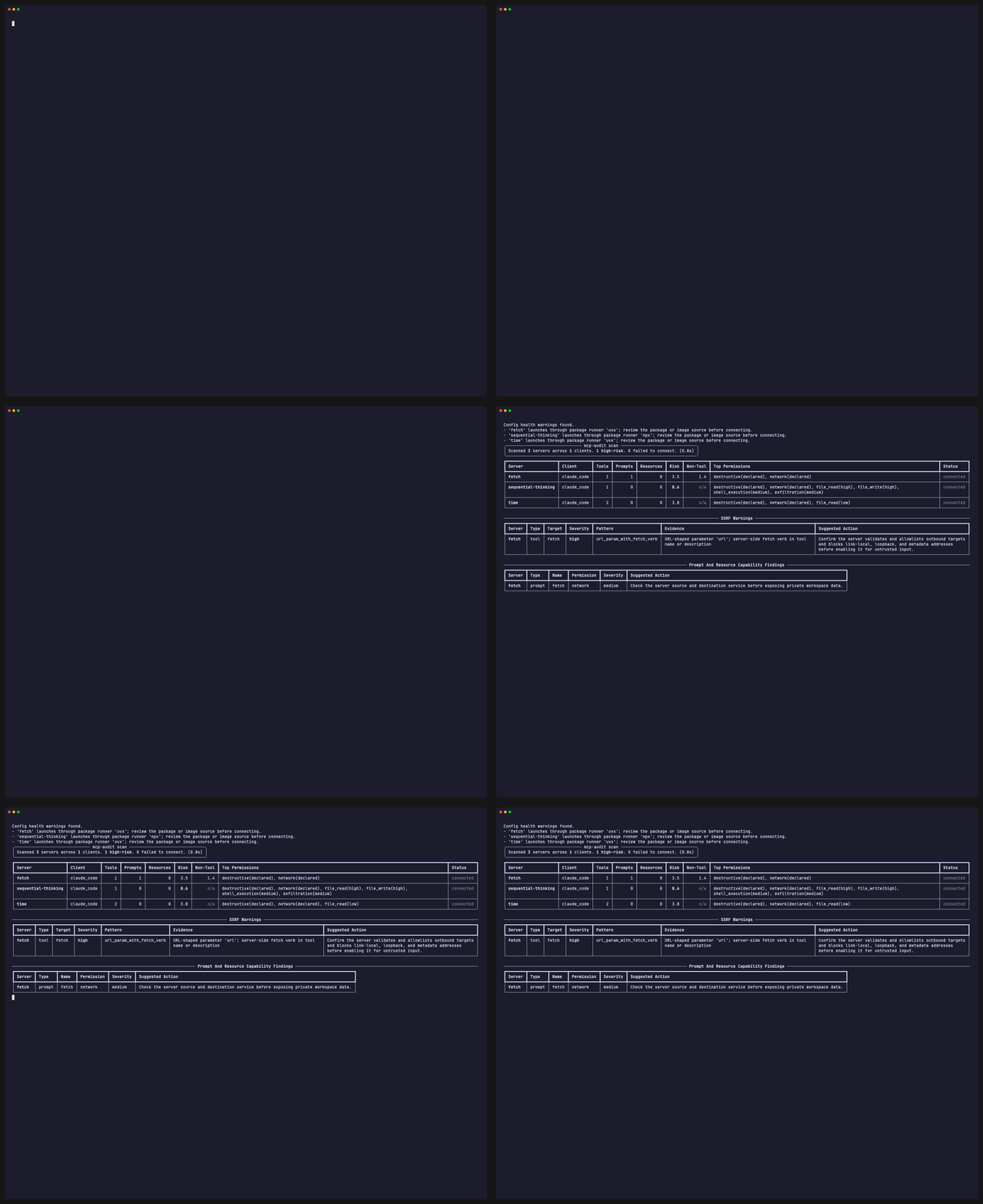
Connected public-fixture demo (fetch, sequential-thinking, time; no auth tokens or workstation configs):
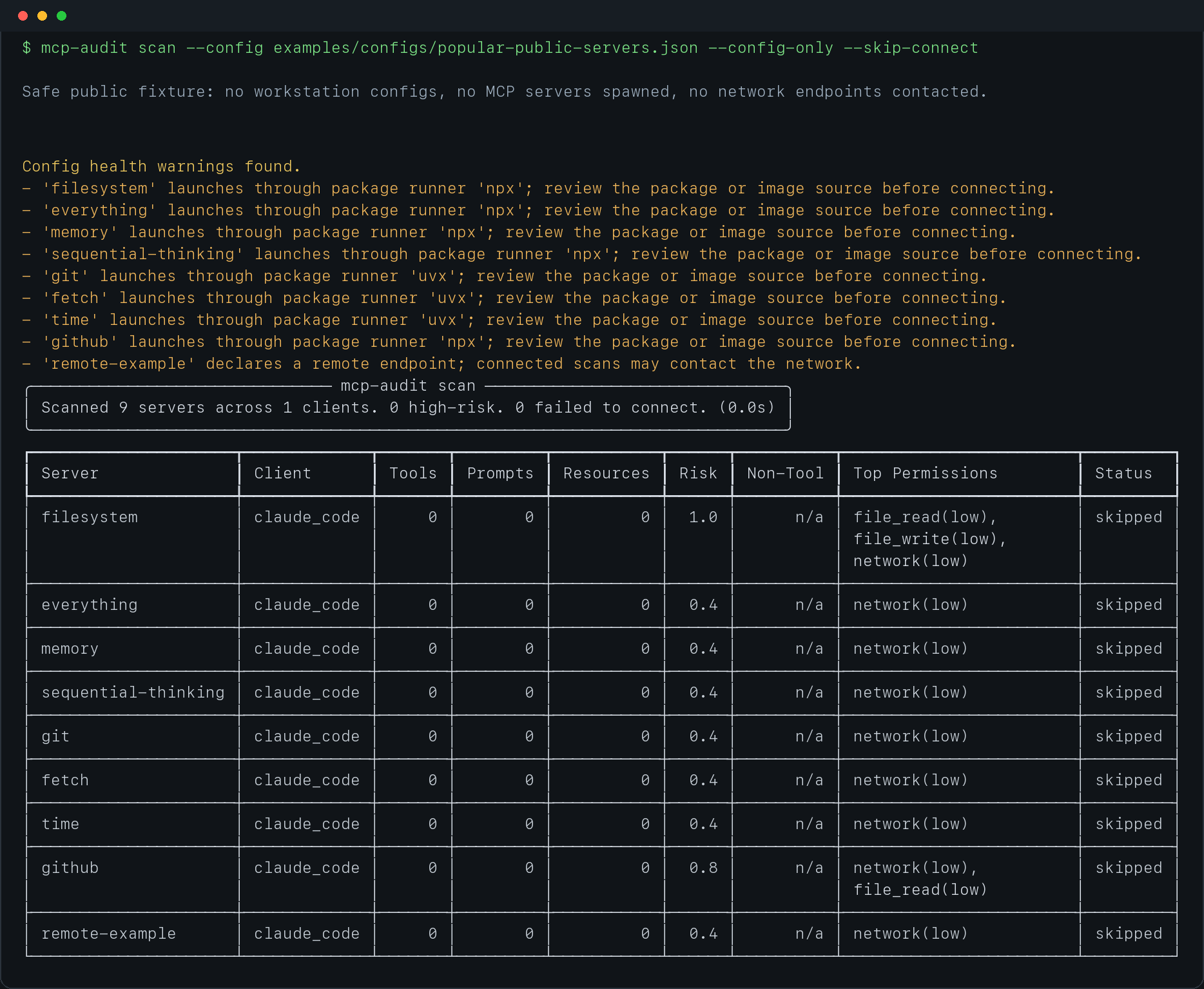
Zero-touch preview against the bundled public fixture:
Install it permanently once you're hooked:
uv tool install mcp-audits                # adds the `mcp-audit` command to your PATH
mcp-audit scan                            # connected scan of every configured client
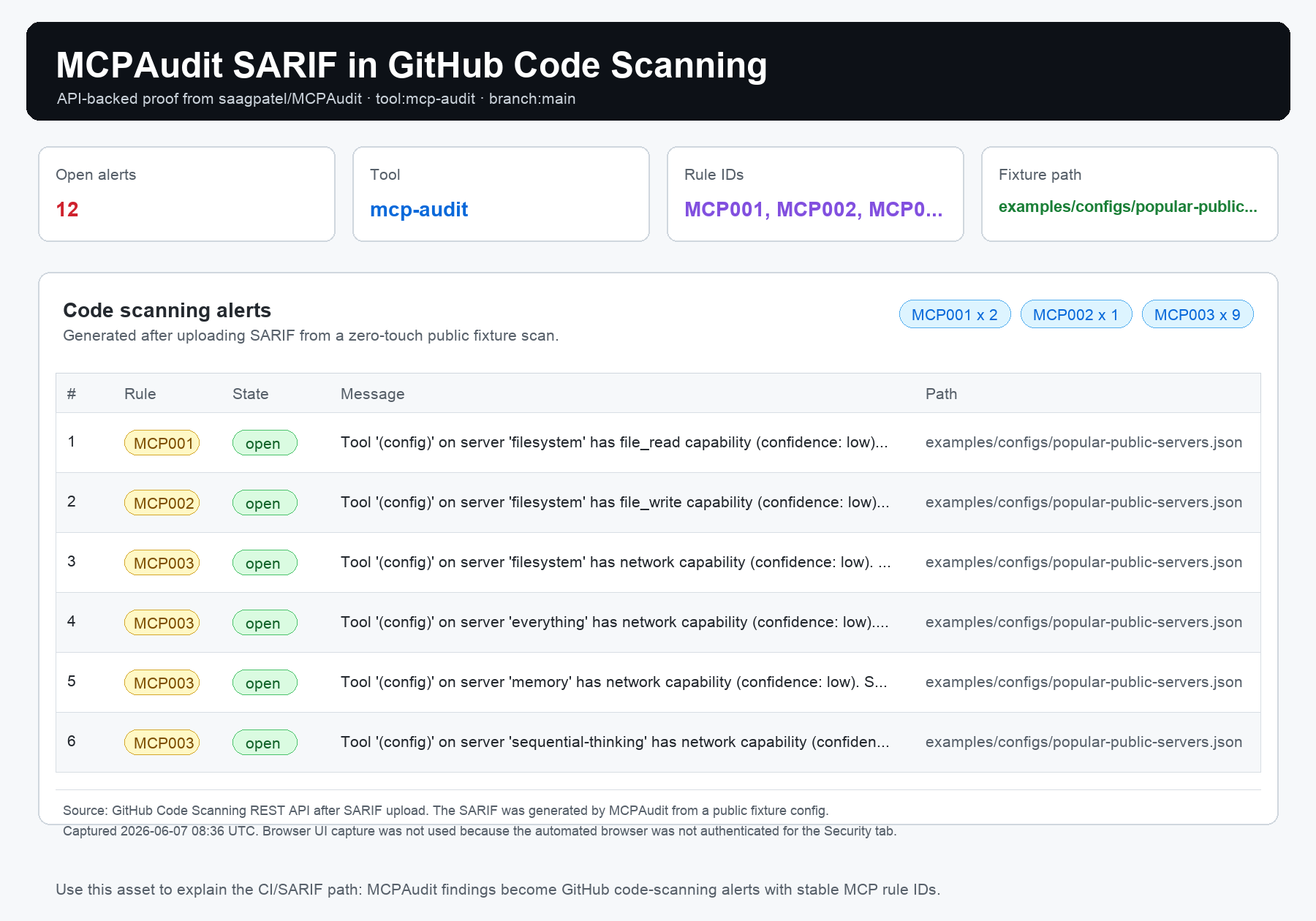
Drop it into CI in one step — the composite GitHub Action runs the scan and writes SARIF straight to GitHub code scanning:
- uses: saagpatel/MCPAudit@v2.7.0 # config-only by default; optional policy gate exits 2
SARIF proof from the public fixture scan:
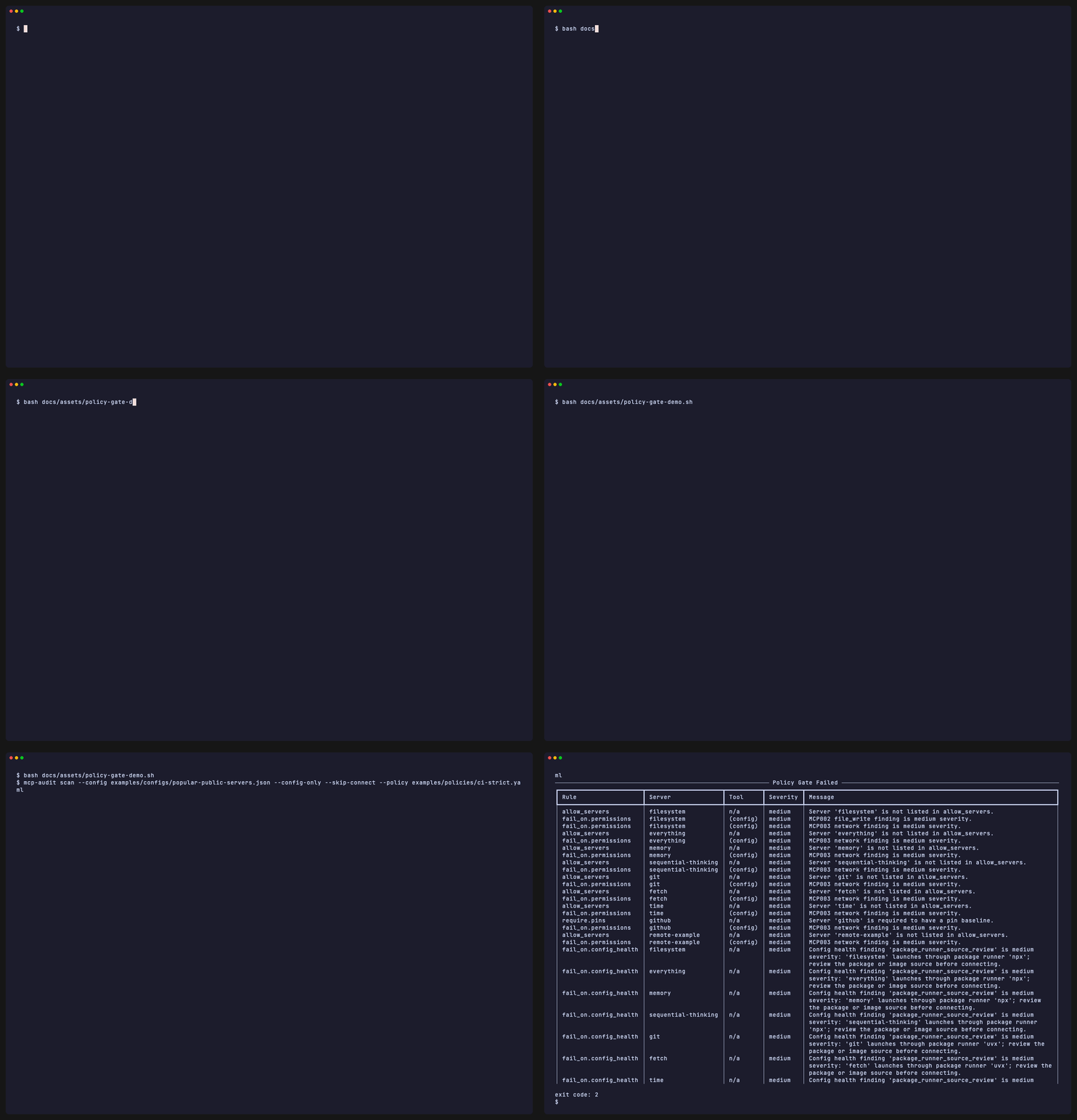
Policy gate demo from the same zero-touch public fixture:
Self-contained HTML report preview from a redacted config-only scan:
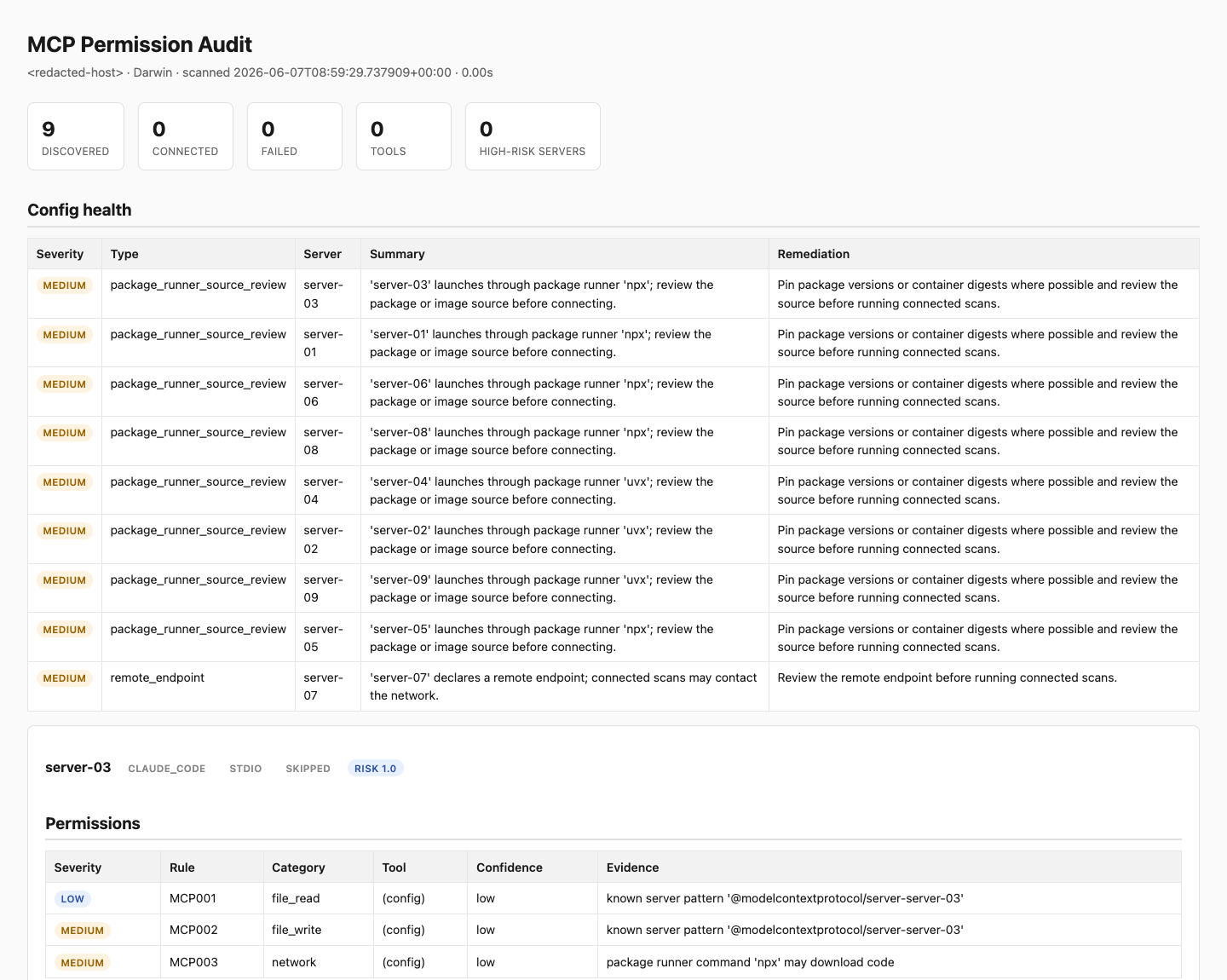
Teach the risk safely: examples/sandbox/ is a
public-safe MCP prompt-injection sandbox with synthetic configs, benign twins,
malicious-lookalike tool descriptions, a static config-only MCPAudit report, and
a connected-tool manifest that demonstrates what config-only mode can and cannot
prove.
PyPI package: mcp-audits · installed command: mcp-audit · full flag and detector reference below.
Use as an MCP server
mcp-audit is also an MCP server. Point any MCP client (Claude Code, Claude Desktop, Cursor) at it and your agent can audit its own MCP attack surface on demand: enumerate every configured server, risk-score them, and pull injection, SSRF, lethal-trifecta, shadowing, and drift findings without leaving the conversation.
uvx --from mcp-audits mcp-audit serve
Add it to a client config (Claude Code shown):
{
  "mcpServers": {
    "mcp-audit": {
      "command": "uvx",
      "args": ["--from", "mcp-audits", "mcp-audit", "serve"]
    }
  }
}
stdio only, by design. This server reads the MCP configs already on your machine, so it runs locally over stdio and is never offered as a hosted remote. It stays read-only (it never edits a config) and reports env-var key names only, never values.
All tools are read-only and take no URL or filesystem path; server discovery is automatic from the standard client config locations.
| Tool | Purpose | Args |
|---|---|---|
scan_mcp_servers | Full audit of every discovered MCP server; returns the JSON report | skip_connect: bool = false |
check_server | Audit a single server by name | name: str |
get_high_risk_servers | Servers with a composite risk score of 7.0 or higher | none |
list_discovered_servers | Names and clients of all discovered servers (config-only, no spawning) | none |
get_injection_findings | Prompt-injection findings across all servers | none |
get_ssrf_findings | SSRF-shaped tools and resources across all servers | none |
get_trifecta_findings | Lethal-trifecta findings (per-server and fleet-level) | none |
get_shadowing_findings | Cross-server tool-name shadowing collisions | none |
get_escalation_findings | Capability-escalation ("rug pull") deltas vs the pin baseline | none |
get_provenance_findings | Launch-config and provenance drift vs the pin baseline | none |
get_integrity_findings | Launch-artifact on-disk hash drift vs the pin baseline | none |
get_package_verify_findings | Registry package-hash verification vs the pin baseline | none |
get_artifact_verify_findings | Byte-level artifact verification vs the pin baseline | none |
The five drift tools (get_escalation_findings, get_provenance_findings, get_integrity_findings, get_package_verify_findings, get_artifact_verify_findings) compare against a saved baseline, so run mcp-audit pin first.
Every get_*_findings tool returns a JSON object with findings and warnings lists. warnings names any requested check that was skipped or degraded (for example, a drift tool called with no pin baseline) — so an empty findings list with empty warnings genuinely means "checked, clean".
Features
- Capability inventory — catalogs server tools, prompts, and resources; tool, prompt, and resource capabilities are classified across six permission categories:
file_read,file_write,network,shell_execution,destructive,exfiltration - Config-only inference —
scan --skip-connectinfers conservative risks from declared commands, transports, credential key names, package runners, and remote URLs - Config health diagnostics —
discoverandscanflag duplicate server names, conflicting command or URL definitions, missing stdio commands, missing local command paths, project/global scope conflicts, package-runner launches, deprecated SSE transports, shell-wrapper launches, remote endpoints, and credential-heavy configs before users pin or connect; JSON reports include additiveconfig_health_findings - Risk scoring — composite 0–10 per server as a weighted sum of tool permission categories, with a five-dimension breakdown (file access, network, shell, destructive, exfiltration); prompt/resource findings also produce an additive
non_tool_risksignal without changingrisk_score.composite - Stable finding metadata — permission and prompt-injection findings include stable rule IDs, severity, evidence, and suggested remediation so reports are easier to triage
- Fixture-first MCP cache contract audit —
mcp-audit cache-contract scan TRACEdeterministically evaluates synthetic MCP2026-07-28list/read cache traces under stableMCPCACHE000–MCPCACHE009rules; malformed, unsupported, clock-ambiguous, or truncated evidence isUNKNOWN, while real caches, transports, credentials, and logs remain out of scope. Seedocs/CACHE-CONTRACT-AUDITOR.md - Offline MCP Tasks state-machine lab —
mcp-audit task-time-machine run --builtin happy-pathexecutes strict versioned scenarios in(at_ms, sequence)order, emits human or canonical JSON explanations under stableMCPTASK000–MCPTASK008rules, and preserves experimental or underspecified semantics asUNKNOWN. Seedocs/MCP-TASK-TIME-MACHINE.md - Offline MCP result parcel lab —
mcp-audit result-parcel analyzecompares inline, provider/local chunk or progress extensions, core resource links, and the negotiated Tasks extension against size, expiry, authorization, redaction, integrity, and retrieval faults. Explanations bind to named inputs; no payload, MCP server, network, credential, or object store is read. Seedocs/RESULT-PARCEL-LAB.md - Local policy gates —
scan --policy policy.yamlevaluates reports against local YAML rules and exits nonzero for CI enforcement - Report redaction — terminal, JSON, SARIF, and HTML report paths share a redaction layer for likely credential values;
scan --redactadds an opt-in field-report pass that also scrubs the machine hostname and home-path usernames (/Users/<name>,/home/<name>,C:\Users\<name>) from--json/--sarif/--htmloutput, and replaces server names with stable aliases (server-01, …) everywhere they appear — structured fields, free-text summaries, and command basenames — so a config-only report is safe to share (the field-report checklist stays the backstop for any residual free-text specifics) - Prompt injection detection —
scan --inject-checkscans tool, prompt, and resource text for instruction-override patterns, hidden directives, fake role turns, and adversarial phrasing; pattern-based, no LLM required - SSRF detection —
scan --ssrf-checkflags tools and resources whose interface lets a caller steer a server-side request target (including URL/host params nested in object, array-item, or composition schemas, plus caller-templated remote resource hosts); static and schema-derived, never issues a request or reads a credential value - Egress detection —
scan --egress-checkaudits where a server may send data: destinations outside--egress-allowlist(MCP040, MED), unbounded caller-controlled targets (MCP041, HIGH), and the trusted-destination residual for allowlisted-but-multi-tenant or credential-bearing hosts (MCP042, LOW/MED — the Cowork lesson). Static and schema/URI-derived; gated viafail_on.egress. Seedocs/EGRESS-DETECTION.md - Lethal trifecta detection —
scan --trifecta-checkdetects the canonical agent-exfiltration attack surface: per-server (HIGH,MCP013) when a single server covers all three legs (file_read + untrusted-content ingestion + exfiltration), and fleet-level advisory (MEDIUM,MCP014) when the trifecta assembles only across servers; re-uses inferred permissions, never issues requests or reads credentials - Tool-name shadowing detection —
scan --shadow-checkflags cross-server tool-name collisions that could trick an AI agent into routing a call to the wrong server: exact matches (HIGH,MCP015), case/separator-normalised collisions (MEDIUM,MCP016), and homoglyph spoofing via non-ASCII confusable codepoints (HIGH,MCP017); offline, deterministic, no new dependencies - Schema drift tracking —
mcp-audit pinconnects to servers and snapshots current tool schemas; subsequentscan --pin-checkflags added, removed, and changed tools with plain-language summaries, changed-field hints, suggested actions, and a dry-run refresh workflow for reviewed upgrades.pin --refresh <server>additionally surfaces capability-escalation (MCP018/MCP019) and launch-config/provenance (MCP020–MCP023) deltas in the same preview — unconditionally, so a rug-pull or launch swap can't slip through a baseline refresh - Capability-escalation ("rug pull") detection —
scan --escalation-checkcompares each tool against its pin baseline and flags security-significant escalations over time: a tool that gained a dangerous capability (MCP018— HIGH for exfiltration/shell/destructive, MEDIUM for file_write/network) or whose description gained prompt-injection patterns (MCP019, HIGH); pure delta vs the approved baseline, so findings stay scoped to reviewed baseline deltas. Seedocs/ESCALATION-DETECTION.md - Provenance / launch-config drift detection —
scan --provenance-checkcompares a server's launch configuration against its pin baseline to catch supply-chain changes the schema check can't see: command/transport swap (MCP020, HIGH), argument/version drift with dangerous-flag escalation (MCP021, MED/HIGH), HTTP endpoint change (MCP022, HIGH), and credential key-name set changes (MCP023, MEDIUM — key names only, never values). Seedocs/PROVENANCE-DETECTION.md - Launch-artifact integrity detection —
scan --integrity-checkhashes the on-disk artifact a server launches (the resolved command binary + local script args) and flags drift vs the pin baseline (MCP024— HIGH when the SHA-256 changed, MEDIUM when the file is gone). The command string can stay byte-identical while the file it runs is swapped underneath you; this catches that. Offline and deterministic — only local bytes are hashed, nothing is fetched. Package-runner (npx/uvx) launches hash the runner, not the remote package (see registry verification below). Seedocs/INTEGRITY-DETECTION.md - Registry package verification —
scan --verify-artifacts(opt-in, network) covers the package-runner case the on-disk check can't: it compares the registry-published hash (npmdist.integrity, PyPI sha256) for the exact pinnedpackage@versionagainst the hash captured at pin time (MCP025— HIGH on a changed published hash, a republish/tampering signal; MEDIUM when unverifiable). Network is contacted only under--verify-artifacts, on bothpin(to capture) andscan(to compare). Covers npm + PyPI. Seedocs/PACKAGE-VERIFICATION.md - Byte-level artifact verification —
scan --download-artifacts(opt-in, network) goes one level deeper than the published-hash compare: it downloads the actual bytes the registry serves, hashes them, and checks them against both the registry's own published hash and a byte-hash captured at pin time (MCP026). It catches a CDN/mirror/MITM serving bytes inconsistent with the registry's integrity metadata (PUBLISHED_MISMATCH, HIGH) and a pinned file whose bytes changed or vanished (BASELINE_MISMATCH, HIGH); a newly-added file on a frozen version is an advisory MEDIUM, not a false alarm. Downloads stream through bounded hashers, never to disk, only to an allowlist of registry/CDN hosts (re-validated on every redirect hop). Network is contacted only under--download-artifacts, on bothpinandscan. - Multi-client support — reads configs from Claude Desktop, Claude Code, Cursor, VSCode, and Windsurf — plus custom paths via
--config; use--config-onlyfor isolated scans of one config file - Structured output — Rich terminal report plus JSON and SARIF 2.1.0 export for ingestion by GitHub Advanced Security and SARIF-aware SAST pipelines, and a self-contained shareable HTML report via
scan --html report.html(inline CSS, no JavaScript, redacted and fully HTML-escaped) - Drop-in CI distribution — a composite GitHub Action (
uses: saagpatel/MCPAudit@v2.7.0) runs the scan, writes SARIF, and uploads it to code scanning in one step (config-only by default; optional policy gate exits2); apre-commithook (id: mcp-audit) audits repo-local.mcp.json/.vscode/mcp.jsonon commit. Seedocs/ADOPTION-GUIDE.md - Documented output contract — JSON, SARIF rule IDs, and policy exit codes are documented in
docs/OUTPUT-CONTRACT.md - Experimental fixture enforcement — a narrow, repository-owned gateway converts one synthetic connected report into explicitly approved fixture-only policy and proves readback, negative controls, idempotency, and rollback; it never changes normal MCP client configuration (guide)
- MCP session/resume fault lab —
mcp-audit session-resumereplays strict synthetic Streamable HTTP session, disconnect, replay, migration, and cancellation scenarios against a deterministic virtual transport. It supports legacy session-bearing protocol profiles and fails visibly when legacy resume behavior is applied to the stateless2026-07-28transport; no network, credential, server, scheduler, or live MCP dependency is used. See the lab guide - Watch mode —
mcp-audit watchre-scans on config file changes viawatchfiles(optional extra: install withmcp-audits[watch])
Quick Start
Prerequisites
- Python 3.11+
uv(recommended) orpip
Installation
uvx --from mcp-audits mcp-audit discover
# or install permanently:
uv tool install mcp-audits
# with watch mode support:
uv tool install 'mcp-audits[watch]'
# pip fallback:
pip install mcp-audits
Usage
mcp-audit --version

# Discover configured MCP servers without connecting to them
mcp-audit discover

# Scan all configured MCP servers
mcp-audit scan

# Config-only scan that does not spawn or connect to servers
mcp-audit scan --skip-connect

# Filter to specific clients (comma-separated)
mcp-audit scan --clients claude_desktop,cursor

# Scan only one explicit MCP config file
mcp-audit scan --config ./mcp.json --config-only

# Check tools, prompts, and resources for prompt-injection patterns
mcp-audit scan --inject-check

# Flag SSRF-prone tools/resources (caller-controlled server-side fetch targets)
mcp-audit scan --ssrf-check

# Suppress SSRF findings whose fixed target host is trusted (caller-controlled targets are never suppressed)
mcp-audit scan --ssrf-check --ssrf-allowlist api.github.com,internal.svc

# Audit outbound destinations; hosts outside the allowlist are flagged, trusted multi-tenant hosts raise a residual
mcp-audit scan --egress-check --egress-allowlist api.anthropic.com,internal.corp.example

# Detect lethal-trifecta / toxic-flow attack surface (per-server and fleet-level)
mcp-audit scan --trifecta-check

# Detect cross-server tool-name shadowing (exact, normalised, homoglyph collisions)
mcp-audit scan --shadow-check

# Pin current tool schemas, then detect drift on later scans.
# Pinning connects to servers so it can capture real tool schemas.
mcp-audit pin
mcp-audit pin --status
mcp-audit pin --status --json
mcp-audit pin --stale
mcp-audit pin --stale --json
mcp-audit scan --pin-check

# Review expected drift for one server before refreshing its baseline.
mcp-audit pin --refresh github
mcp-audit pin --refresh github --json
mcp-audit pin --refresh github --apply

# Detect capability escalation ("rug pull") vs the pin baseline (implies a pin comparison).
# A tool that gained a dangerous capability, or a description that gained injection patterns.
mcp-audit scan --escalation-check

# Detect launch-config / provenance drift vs the pin baseline (command, args, URL, credential keys).
mcp-audit scan --provenance-check

# Detect on-disk launch-artifact (binary/script) hash drift vs the pin baseline.
mcp-audit scan --integrity-check

# Verify npm/PyPI package@version registry hashes vs the pin baseline (opt-in, network).
mcp-audit pin --verify-artifacts        # capture registry hashes into the baseline
mcp-audit scan --verify-artifacts       # compare on later scans

# Download the artifact bytes and verify their hash vs published + baseline (opt-in, network).
mcp-audit pin --download-artifacts      # capture byte-hashes into the baseline
mcp-audit scan --download-artifacts     # download + verify on later scans

# Export JSON or SARIF 2.1.0, or a single-file shareable HTML report
mcp-audit scan --json audit.json --sarif audit.sarif
mcp-audit scan --html audit.html

# Field-report mode: scrub hostname + home-path usernames from file output (opt-in)
mcp-audit scan --skip-connect --json field-report.json --redact

# Fail CI on local policy violations
mcp-audit scan --policy policy.yaml

# Optional LLM-assisted classification (requires ANTHROPIC_API_KEY)
mcp-audit scan --llm-analysis

# Watch mode — re-scan on config change; use --skip-connect for config-only watching
mcp-audit watch

# Replay one built-in transport-session fault, or the complete offline corpus
mcp-audit session-resume list
mcp-audit session-resume run disconnect-after-acceptance-before-response
mcp-audit session-resume run --all --format json
LLM mode treats all server-provided metadata as untrusted JSON data, keeps
classification instructions in a separate system message, and reports an
explicit UNKNOWN status without admitting model findings when injection,
refusal, omission, provider failure, or malformed output prevents a complete
classification. Deterministic analysis remains authoritative.
Help improve mcp-audit (2 minutes)
Redacted field reports from real MCP configs help calibrate the scanner.
If you run MCP servers, contributing one stays config-only: the scan does not
spawn configured MCP servers or contact their configured remote endpoints.
uvx may contact the configured Python package index and may reuse uv's tool
cache:
uvx --from mcp-audits mcp-audit scan --skip-connect --json mcp-audit-field-report.json --redact
uvx --from mcp-audits mcp-audit --version
--redact auto-scrubs the machine hostname, home-path usernames, and server
names for you. Then open a redacted field report
— the template walks you through the safe fields. Please still redact credential
values and any proprietary prompt/tool/schema text; docs/EXTERNAL-FIELD-REPORT-REQUEST.md
has the full checklist, and
docs/FIELD-REPORTS.md#minimal-public-example
shows a safe example shape. For a reference of what the scanner reports on real
software, see the solo field scan in
docs/FIELD-SCAN-POPULAR-SERVERS.md.
For an end-to-end generator-to-auditor demo packet, see
docs/MCP-TRUST-PACKET.md.
Tech Stack
| Layer | Technology |
|---|---|
| Language | Python 3.11+ |
| CLI | Click 8 |
| Output | Rich |
| MCP protocol | mcp SDK 2.x |
| Validation | Pydantic v2 |
| Config parsing | PyYAML + json5 |
| Watch mode | watchfiles (optional extra) |
| Optional LLM | Anthropic SDK |
Architecture
The scanner enumerates MCP client config files, connects to each configured server, and calls tools/list, prompts/list, and resources/list over the MCP protocol when those capabilities are available. Stdio servers are started as subprocesses via anyio; HTTP/SSE servers are contacted at their configured URL. Returned tool schemas, prompt arguments, and resource URIs flow into the permission classifier (schema walker + regex ruleset over six permission categories) and the optional injection detector (pattern ruleset for instruction-override, role-switch, and hidden-directive phrasing). The risk scorer composes a per-category weighted sum clamped to 0–10 from tool findings, then separately reports additive non_tool_risk for prompt and resource capability or injection findings. non_tool_risk is for triage and output consumers; it does not change risk_score.composite. Reports render via Rich; JSON and SARIF 2.1.0 export are first-class. The pin store serializes SHA256 schema hashes plus reviewable tool snapshots to ~/.mcp-audit-pins.yaml for actionable drift detection on subsequent --pin-check scans. Use mcp-audit pin --refresh <server> to preview expected drift for one reviewed server — including capability-escalation and launch-config/provenance deltas vs the baseline — then rerun with --apply to replace that server's pins. Use mcp-audit pin --stale to review pinned servers that are no longer present in discovered MCP configs before clearing them explicitly with mcp-audit pin --clear <server>.
The experimental mcp-audit agent-ui group statically scans program-owned MCP
Apps/OpenAI UI metadata fixtures and A2UI v0.9 JSONL fixtures. It emits
deterministic JSON plus inert offline HTML and never loads widget code, connects
to an MCP server, authenticates, or processes real user data. Unsupported
protocols, catalogs, host behavior, bindings, malformed component shapes, and
unbound approval versions remain UNKNOWN. Approval provenance inherits only
from the nearest declared JSON Pointer, dual standard/OpenAI metadata must
reconcile, malformed HTTPS authorities cannot pass by string equality, fixture
reads are descriptor-bound and size-capped, and no-force report writes use
atomic no-clobber commit. Supported contradictions cannot be erased by a later
A2UI replacement or deletion. See
docs/AGENT-UI-CONTRACT-AUDITOR.md for the
exact input profiles, six stable rules, fixtures, and claim ceiling.
The experimental mcp-audit oauth-transcript group audits explicitly
synthetic, redacted MCP OAuth transcripts without opening a network, browser,
OAuth, MCP, keychain, account, or credential-store path. Stable
MCPOAUTH000–MCPOAUTH007 findings cover the 401 discovery chain, RFC 8707
resource and audience binding, authorization-response issuer mix-up,
issuer-bound client credentials, registration method and application_type,
protected-resource scopes, and redirect URI binding through code redemption.
Missing or malformed evidence is UNKNOWN;
valid deprecated DCR fallback is advisory rather than forbidden. JSON is
authoritative and optional SARIF uses the existing compatibility shape. See
docs/OAUTH-TRANSCRIPT-AUDITOR.md for the
specification pins, strict schema, fixture corpus, and claim ceiling.
The experimental mcp-audit authorization-posture group consumes one saved
McpAuthorizationPostureV1 public-metadata artifact entirely offline. It
validates the producer's exact version, Registry binding, capability boundary,
claim ceiling, and cross-field metadata state, then emits only
policy-review-only or blocked. It does not authenticate producer provenance
or current freshness, repeat network fetches, contact the MCP endpoint, handle
credentials, run OAuth, authorize a scan, or change a trust grade. See
docs/AUTHORIZATION-POSTURE-ADOPTION.md
for the authority flow, strict schemas, exit contract, and claim ceiling.
The experimental mcp-audit result-parcel group evaluates versioned,
synthetic result-delivery scenarios entirely offline. It distinguishes current
MCP core result and resource semantics from separately negotiated Tasks and
provider/local chunk or progress patterns, and reports suitability, exposure,
durability, retry/idempotency risk, cleanup burden, and UNKNOWNs without an
opaque score. See
docs/RESULT-PARCEL-LAB.md for the current
primary-source map, comparison table, threat boundaries, fixtures, and
five-minute demo.
Local Policy Gates
Policies are local YAML files evaluated after a scan. A failing policy exits with code 2 after terminal, JSON, or SARIF output is written.
fail_on:
  severity: high
  injection: medium
  capabilities: medium
  config_health: medium
  drift: true
require:
  pins:
    servers:
      - github
deny:
  permissions:
    - shell_execution
max_risk: 7
allow_servers:
  - github
servers:
  github:
    max_risk: 5
    deny:
      permissions:
        - shell_execution
See docs/ADOPTION-GUIDE.md for local review, team CI, and GitHub code
scanning setup paths, non_tool_risk parsing examples, and policy selection
notes, and examples/consumers/ for runnable JSON consumer examples. See examples/policies/ for starter policies. See
docs/GOLDEN-ROLLOUT.md for the recommended config-only to policy-gated
rollout path. See docs/STABLE-READINESS.md for the stable-release bar. See
docs/PIN-MAINTENANCE.md for reviewed pin refresh and stale server cleanup
workflows. See docs/PROMPT-RESOURCE-SCORING.md and
docs/SCORING-MIGRATION.md for the current prompt/resource scoring boundary
and migration path. See docs/COMPOSITE-SCORING-PROPOSAL.md for the future
combined-score proposal. See examples/ci/pin-stale-review.yml and
examples/maintenance/stale-pin-review.sh for routine stale pin review flows.
See docs/MAINTAINER-WORKFLOWS.md for Codex-assisted maintainer workflows and
the boundaries used for security-sensitive triage and release preparation.
See docs/FEEDBACK-TO-FIXTURES.md for turning false positives, missing
detections, output issues, and pin lifecycle feedback into safe regression
fixtures. See docs/FIELD-REPORTS.md for the redacted field-report evidence
path, minimal public example shape, public field-report issue template, and
consumer-contract coverage. See
docs/MCP-TRUST-PACKET.md for the public MCP ecosystem demo path that pairs
mcpforge scaffolding with MCPAudit review output. See
docs/SOLO-EVIDENCE.md for solo multi-environment evidence that can reduce
release risk without replacing external reports. See
docs/ROADMAP-NEXT.md for the post-2.2.0 roadmap and
docs/1.5-EVIDENCE-INTAKE.md for the earlier adoption-hardening evidence
intake. See docs/BETA-READINESS-EVIDENCE.md for the beta-readiness evidence
and release decision. External field-report evidence is tracked in
https://github.com/saagpatel/MCPAudit/milestone/4. See
docs/EXTERNAL-FIELD-REPORT-REQUEST.md for the copy-paste contributor request,
and docs/EXTERNAL-OUTREACH-MESSAGES.md for direct outreach messages.
License
MIT
Reviews
No reviews yet
Be the first to review this server!
More Developer Tools MCP Servers
Git
Freeby Modelcontextprotocol · Developer Tools
Read, search, and manipulate Git repositories programmatically
Fetch
Freeby Modelcontextprotocol · Developer Tools
Web content fetching and conversion for efficient LLM usage
Paperclip
Freeby Paperclipai · Developer Tools
Trending hip-hop artist momentum scores across four cultural dimensions.
Toleno
Freeby Toleno · Developer Tools
Toleno Network MCP Server — Manage your Toleno mining account with Claude AI using natural language.
mcp-creator-python
Freeby mcp-marketplace · Developer Tools
Create, build, and publish Python MCP servers to PyPI — conversationally.
MCP Marketplace
Freeby mcp-marketplace · Developer Tools
Search and install MCP servers from inside your AI client.