
Server data from the Official MCP Registry
Fail-closed merge gate an agent calls before saying done: MERGE, BLOCK or INCONCLUSIVE.
About
Fail-closed merge gate an agent calls before saying done: MERGE, BLOCK or INCONCLUSIVE.
Security Report
23 tools verified · Open access · No issues found
Security scores are indicators to help you make informed decisions, not guarantees. Always review permissions before connecting any MCP server.
Remote servers are capped at 8.0 because source code is not available for review. The score reflects endpoint verification only.
What You'll Need
Set these up before or after installing:
Environment variable: ADVERSARY_GATE_BASE_REF
Environment variable: ADVERSARY_GATE_PYTHON
Environment variable: ADVERSARY_GATE_POLICY
How to Install
Add this to your MCP configuration file:
{
  "mcpServers": {
    "io-github-sanflow10-adversary-gate": {
      "env": {
        "ADVERSARY_GATE_POLICY": "your-adversary-gate-policy-here",
        "ADVERSARY_GATE_PYTHON": "your-adversary-gate-python-here",
        "ADVERSARY_GATE_BASE_REF": "your-adversary-gate-base-ref-here"
      },
      "args": [
        "adversary-gate-mcp"
      ],
      "command": "uvx"
    }
  }
}Documentation
View on GitHubFrom the project's GitHub README.
AdversaryGate (v2.11.0)
High AI usage ≠ high confidence. The cost of an agentic coding pipeline is not the model's intelligence — it is the pipeline's self-deception.
Uso alto de IA ≠ confiança alta. O custo de um pipeline com agentes de código não está na inteligência do modelo, está no autoengano do pipeline.
An evidence-based fail-closed verification gate for AI coding agents where uncertainty is a first-class result (INCONCLUSIVE) instead of a silent approval.
Measures Python/pytest repositories today. On other stacks it runs your suite via --test-command but answers INCONCLUSIVE, never MERGE — see Language support.
pip install adversary-gate
| Document | What it is |
|---|---|
| 📄 CHANGELOG | what changed — and which versions actually have a tag |
| 🛡️ SECURITY | report a fail-open. A bug in this repo is a security bug, because a wrong MERGE is the whole failure mode |
| 📋 Findings AG-001…AG-032 | every finding, reproduced by real exit code before being fixed — and what is still open |
🎬 Watch it decide (60 seconds)
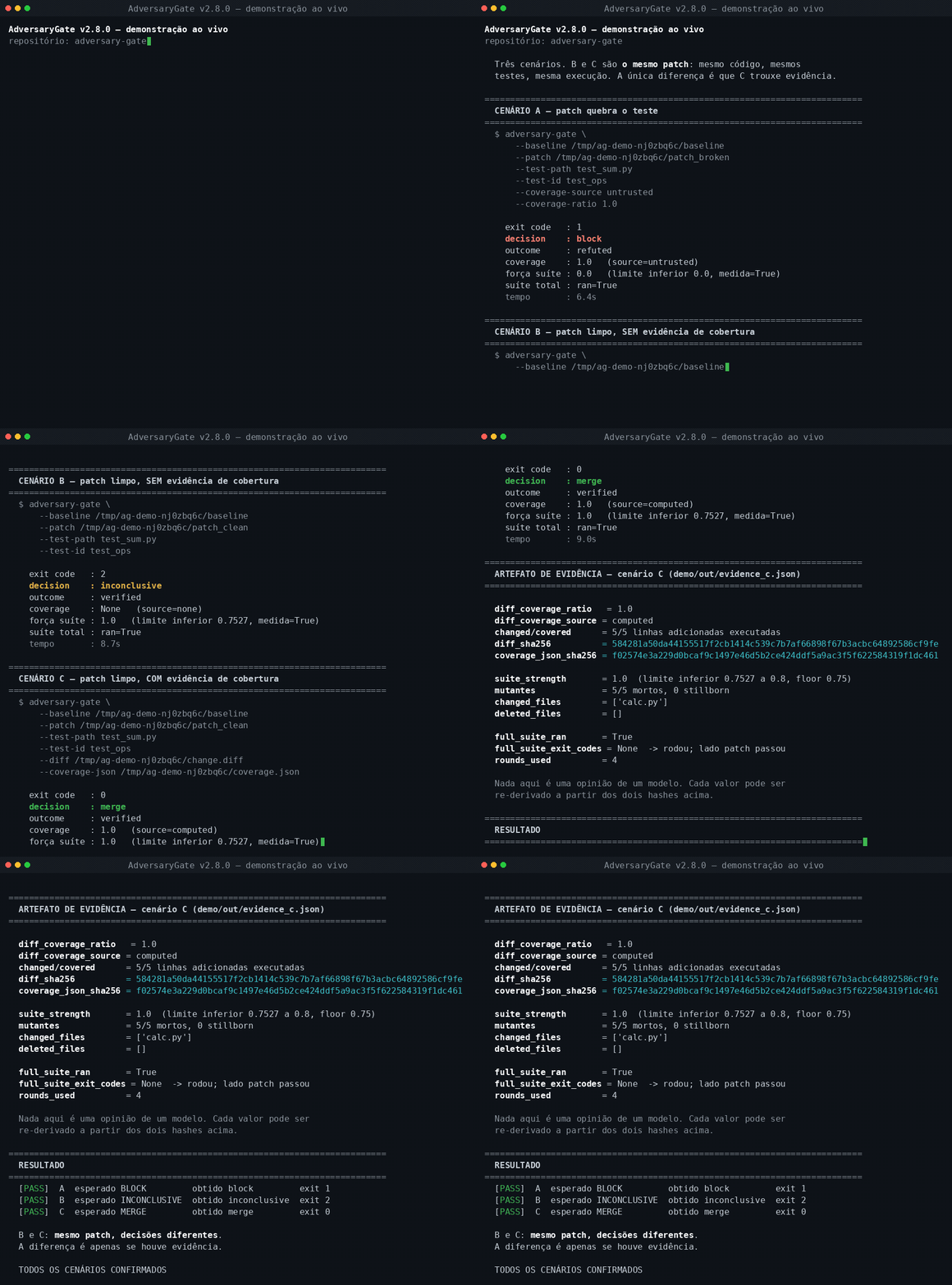
B and C are the same patch. Same code, same tests, same execution. The only difference is that C brought evidence (--diff + --coverage-json); B brought none.
| Patch | Coverage evidence | Decision | Exit | |
|---|---|---|---|---|
| A | breaks the test | declared untrusted | BLOCK | 1 |
| B | clean | none — never measured | INCONCLUSIVE | 2 |
| C | clean | measured, both artefacts SHA-256'd | MERGE | 0 |
That middle row is the whole product. An unproduced measurement is not a measurement, so it cannot clear a floor — and a number nobody can re-derive is an opinion with a false precision label.
python3 demo/demo.py          # runs the three scenarios; exits non-zero if one regresses
python3 demo/render_gif.py    # rebuilds demo/demo.gif from the captured frames
demo/demo.py is an acceptance test, not a screenshot: it builds the fixtures, runs the real CLI as a subprocess, reads the real exit codes, and fails if any of the three decisions changes. Its evidence artefacts are checked in under demo/out/.
INCONCLUSIVEis not an error. It is the gate saying "I did not measure that", and it is exit 2 so CI treats it as "do not merge yet", not as "pass". See Howdiff_coveragegets its value for the one-step path fromINCONCLUSIVEtoMERGE.
🎯 The Thesis
- High AI usage ≠ high confidence. The more a team leans on agents in its real engineering flow, the more the cost of "looks right" shows. Agents write fluent, plausible code, and naive pipelines that collapse infrastructure errors into "pass" approve patches whose tests are broken or never ran.
- Switching models is a symptom. Teams move between models looking for PRs they can trust. What is missing is deterministic verification, not a better model. AdversaryGate runs the same test harness with no LLM in the verifier, which is what makes patches from different models comparable at all.
- The loss is concrete. Merged regressions, tasks reported done that are not, rollbacks, and reviewer hours spent re-reading the same PR.
- Less pipeline self-deception. The product does not sell a smarter AI. It sells a pipeline that says "I did not measure that" instead of a green check. How to count that honestly is in Provenance & metrics — and the counter this README used to point at is zero by construction on the gate's own logs (AG-029), so it is no longer the pitch.
🔒 The Fail-Closed Model & Double-Filter Rigor
A single invariant governs the entire system:
The gate only reports what a healthy test harness actually executed. Unproduced proof is never proof of clean code.
| State | Outcome | Meaning |
|---|---|---|
Executed & Passed | Outcome.VERIFIED | Test ran to completion and evidence confirms clean execution. |
Executed & Failed | Outcome.REFUTED | Test ran to completion and evidence condemns the patch. |
Harness / Error | Outcome.UNVERIFIED | Collection error, syntax error, missing file, timeout or flaky signal. Never mergeable. |
Patch Decision Matrix
Decision.MERGE: Requires every verdict to beVERIFIED, a measureddiff_coverage >= 80%, a suite strength whose 80 % lower confidence bound is>= 0.75when strength was measurable (suite_strength_lower), and the full repository test suite to pass on the patch side.Decision.BLOCK: Triggered if any claim isREFUTED, or if the patch fails the full test suite that the baseline passed (collateral regression). Checked before the coverage floor: direct evidence of breakage outranks missing evidence.Decision.INCONCLUSIVE: Triggered onUNVERIFIEDoutcomes, open circuit breakers, coverage that was never measured, a weak test suite (suite_strength < 0.75), a strength that could not be measured even though source changed, or a full suite that was already red before the patch. Never merges.
Precedence is BLOCK > INCONCLUSIVE > MERGE, and direct evidence always outranks missing evidence: a patch whose claim could not be executed but whose collateral run broke the suite is BLOCK, not a shrug.
A passing claim says how it passed (AG-030). VERIFIED comes with one of three classifications: fixed — the test failed on the baseline and passes on the patch, the strongest evidence there is that the patch fixes what the test checks (SWE-bench's FAIL_TO_PASS); no_regression — it passed on both sides, which only says nothing it checks broke; discarded — a test the patch added, with no "before". The output carries claims_fixed and fix_proven, so "this patch fixes what it says it fixes" is a field, not an inference — and MERGE with fix_proven: false is a patch that broke nothing and proved nothing about the bug it was for.
The patch does not get to write its own answer — the baseline does. If the claim's test file already existed on the baseline and its bytes differ on the patch, the patch's copy is never run for the verdict. The gate copies the patch tree, puts the baseline's test file back, and runs the claim there: the patch's code answers to the test that existed before it (the baseline oracle; the artefact records "oracle": "baseline"). So a bug hidden behind a rewritten assertion is REFUTED → BLOCK, and an honest refactor of the test file is VERIFIED instead of stuck. A test the patch added to an existing file has no baseline copy: it is judged like any added test, but only after every test the baseline shipped in that file has passed on the patch's code ("oracle": "baseline-file") — so the new test cannot be the cover for an old one the patch bent. The oracle covers three more places a test's answer can hide:
- Helpers. Every baseline file that is a test file is put back, not only the claim's —
test_*,*_test.py,conftest.py, anything undertests/or__tests__/, and*.test.*,*.spec.*,*_test.go,*Test.java,*_spec.rb. A helper whose path says nothing (testing_utils.pyat the root) cannot be told apart from code under test —numpy.testingis public API — so it is declared:--test-support testing_utils.py(repeatable, a glob; Action inputtest-support). Declared paths are test files everywhere: out of diff coverage and mutation, and restored from the baseline. Any change to a baseline test file engages the oracle, even with the claim's own file untouched. - The collateral suite. When the patch changed tests the baseline had, the full-suite run also executes the baseline's tests against the patch's code (
full_suite_oraclein the artefact). A test that is no claim's, bent to agree with a bug, is a collateral regression →BLOCK. --test-commandclaims. Thetest-idof a command suite is a label, so the transplant always applies: the command runs from the baseline's copy of the files.
When the baseline's copy of a Python test cannot be parsed, the old rule stands: a passing rewritten test is UNVERIFIED. A test file the patch adds is judged as before. A legitimate behaviour change that rewrites its tests therefore lands on BLOCK — the old tests fail on the new code — which is the gate saying "the contract changed; a person signs that". Nor does it get to configure the runner that judges it (AG-032): every test-harness file in the tree — the five config names pytest 9 reads (pytest.ini, .pytest.ini, pytest.toml, .pytest.toml, tox.ini), plus pyproject.toml, setup.cfg, any conftest.py, sitecustomize.py, usercustomize.py and *.pth, at any depth — must be byte-for-byte the baseline's, or the claim is UNVERIFIED. The trees are compared directly, so a harness change the --diff leaves out is still caught. The paths named by --diff are also checked against the protected-path policy (conftest.py, pytest.ini, pyproject.toml, …), not only the ones passed with --changed-path.
How diff_coverage gets its value
Coverage is an evidence question, not a parameter. There are exactly three ways it can be supplied, and the artefact records which one was used (diff_coverage_source):
--coverage-source | Inputs | Meaning |
|---|---|---|
computed (via auto) | --diff + --coverage-json | The gate parses the unified diff and the coverage.py JSON report itself, and records the SHA-256 of both. This is the only measured option. |
untrusted | --coverage-ratio | A number the caller asserts. Accepted only when you say so out loud; the artefact marks it untrusted. |
none (via auto) | neither | No evidence. diff_coverage_ratio is null and the floor is not cleared → INCONCLUSIVE. |
Test files are not part of the ratio: diff_coverage is covered added lines over added lines of source files. A test executes by construction, so counting its lines let ten unexecuted source lines plus forty test lines read as 0.8. The artefact records test_lines_excluded and test_files_excluded next to changed_lines.
A bare --coverage-ratio with no --coverage-source is exit 3 (usage error). Before v2.1.0 the flag defaulted to 1.0, the gate never read a diff or a coverage report, and the GitHub Action passed neither — so diff_coverage >= 80% was satisfied by a default value on every run.
--coverage-floor 0 disables the requirement explicitly; it is not a way to satisfy it.
How suite_strength is measured
It is a mutation score — mutants killed / mutants executable — produced by breaking the lines the patch changed and re-running the claim's tests against them. It is not derived from coverage or from parsing pytest output.
- Mutants are limited to lines the patch actually wrote; mutating untouched lines would let tests covering unrelated code inflate the score.
- Added, modified and deleted source files all count as changes. A deleted file has nothing left to mutate, so it is reported separately as
mutation.deleted_filesand cannot contribute a score: wheneverdeleted_filesis non-empty the patch lands onINCONCLUSIVE, neverMERGE. That includes a mixed patch where the surviving file measured1.0— that score covered only what was left after the deletion, sosuite_strength_unverifiedgoestruerather than let one file's number authorise the change as a whole. - A mutant that no longer runs at all (syntax/collection error) is stillborn and excluded from both sides of the ratio rather than counted as a kill.
suite_strength: nullmeans not measured — there was no source change to judge. It is never reported as1.0, and it does not block.- If source did change and no score could be produced, that is unknown, not strong: the decision is
INCONCLUSIVE. - The floor reads a confidence bound, not the ratio (AG-023). A ratio from one mutant is
1.0and evidence of almost nothing. The gate computes a two-sided Wilson interval aroundkilled / countedand applies--suite-strength-floorto its lower bound (--strength-confidence, default0.80;0restores the raw ratio). At the default, 5 of 5 killed mutants clear 0.75 (lower bound 0.753) and 4 of 4 do not (0.709). The artefact recordssuite_strength(the ratio),suite_strength_lower,mutation.intervalandmutation.confidence. Consequence, said plainly: a patch whose changed lines hold fewer than five mutable operators cannot reachMERGEat the default — it isINCONCLUSIVE, because the gate cannot tell a strong suite from a lucky one on that sample. - Sites are spread across the change. One mutant per changed line before any line gets a second, files and lines in order (deterministic). Sites used to be taken in file order until the budget ran out, so a first line with six operators was the whole sample. The budget (
--mutation-max) defaults to 12.
--mutation-max N bounds the cost (0 disables the measurement entirely, which is recorded as such in the evidence artefact). It is the strength floor's escape hatch, the way --coverage-floor 0 is the coverage floor's: the requirement is disabled, not satisfied. What it does not switch off is the check for source this engine cannot judge — that is a property of the patch, not of your budget, and it still forces INCONCLUSIVE with the budget at zero (AG-014).
🌐 Language support — read this if your repo is not Python
Today the gate measures Python. Three layers are Python-specific, and each one is a different kind of "no":
| Layer | What it does | Non-Python |
|---|---|---|
| Test execution | python -m pytest <path::id> | never runs; pytest reports no tests collected (exit 5) |
| Coverage | parses coverage json (files → executed_lines) | no report in that shape to parse |
| Mutation | tokenizes Python and swaps operators | cannot break a .cpp or a .rs |
Everything above those layers — decision precedence, the evidence questions, the SHA-256'd artefact, exit codes — is language-agnostic. The brain is portable; the senses are not.
What you get today on a non-Python patch
INCONCLUSIVE, never MERGE — and that is deliberate, not a limitation
that happens to work out.
Until AG-012 it was worse than useless, it was wrong. The mutation scanner only
walked *.py, so a patch whose entire effect was in calculator.cpp reported
changed_files: [] and the reason "no non-test source file changed between baseline and patch" — a statement that was simply false. With a passing
Python test and a coverage artefact, that patch reached MERGE while the
only thing that had executed anywhere was assert True:
$ adversary-gate --baseline b --patch p --test-path test_ok.py --test-id test_ok \
      --diff change.diff --coverage-json cov.json
decision: merge        # changed calculator.cpp from `a - b` to `a * b`
suite_strength: null   # reason: "no non-test source file changed"
It now records what it actually observed and refuses to judge what it cannot:
decision: inconclusive                                        exit 2
suite_strength: null | suite_strength_unverified: true
mutation.foreign_changed_files: ["calculator.cpp"]
mutation.reason: "1 non-Python source file(s) changed that suite strength
                   cannot judge: calculator.cpp"
INCONCLUSIVE here is the product working: the patch changed code we did not
execute, so we are not saying it is clean. The alternative — a green checkmark
over a test suite that never looked at the change — is the exact failure this
project exists to prevent.
The mixed patch, which is the one that hides
The pure-C++ case is easy to spot; the dangerous one is Python + C++ in the same patch, because there the Python half does measure:
$ adversary-gate ... --diff change.diff --coverage-json cov.json
decision: merge                                                 # before
coverage: 0.80   suite_strength: 1.0   suite_strength_unverified: false
mutation.foreign_changed_files: ["vec.cpp"]      # recorded, never acted on
A 1.0 next to an untouched bug reads as a clean patch. Coverage often masks
this by accident — an unexecuted .cpp line drags the ratio down — but that is
a coincidence of arithmetic, not a guarantee, so the case is now pinned
directly: any non-Python source in the patch makes
suite_strength_unverified fire, and the artefact says what the score is a
score for:
decision: inconclusive                                         exit 2
suite_strength: 1.0 | suite_strength_unverified: true
mutation.reason: "score covers the 1 Python file(s) mutated only; 1 non-Python
                  source file(s) in this patch were never judged"
Which files count as "source we cannot judge"
NON_SOURCE_SUFFIXES in src/adversary_gate/verifiers/strength.py — a denylist, not an
allowlist. Anything that is not Python, not a test, and not on the list of
things that are plainly not code (.md, .yml, .json, images, archives,
compiled artefacts) counts as source we cannot judge. That direction is
deliberate: the previous shape was an allowlist of languages somebody had
remembered to type, and every suffix outside it was invisible.
That is not a hypothetical. Until AG-013, a patch whose entire effect was in
schema.sql reported:
decision: merge                                   # changed schema.sql
suite_strength: null
mutation.reason: "no source file changed between baseline and patch"
— the exact false statement AG-012 was opened to remove, still reachable
through a suffix nobody had listed. .proto, .pyi, .vue, .sol, .tf
and .r were all in the same hole, and the mixed patch (a measured
calc.py plus an unmeasured schema.sql) merged with suite_strength: 1.0
and suite_strength_unverified: false.
A list of remembered languages has an end; a list of what is not code does not. Unrecognised now fails closed.
Two sources are unioned, so either alone being wrong cannot open a hole:
| Source | Catches |
|---|---|
| directory scan (denylist) | changes a hand-written or partial diff left out |
--diff paths (authoritative) | anything the scan cannot see — generated files, paths absent from both trees |
A documentation-only patch is still unaffected, because .md is on the list.
What shipped, and what still requires
1. Execution on any stack — --test-command (shipped).
adversary-gate --baseline before --patch after \
      --test-path run_tests.sh --test-command "./run_tests.sh"
Replaces pytest with a command you supply, on the baseline side and the patch side. The convention is the table below with the pytest names stripped out:
| Exit | Meaning | ExecState |
|---|---|---|
0 | passed | PASS |
1 | failed | FAIL — the only code that counts as evidence |
2/3/4 | the harness itself broke | UNRUNNABLE → UNVERIFIED |
| timeout | gave up | TIMED_OUT → UNVERIFIED |
--test-id is no longer required when --test-command is given: a suite that
is one command has no node IDs to name, so the claim is labelled
(test-command). The collateral full-suite run uses the same command unless
--full-suite-command says otherwise — declaring a non-pytest suite does not
silently cost you the collateral-regression check.
2. A coverage adapter — not yet. llvm-cov export, grcov,
cargo-llvm-cov and cargo tarpaulin all emit different shapes; normalise
them to {files: {path: {executed_lines: [...]}}} and covered_diff_ratio
needs no change at all.
3. A mutation adapter — not yet, and this one is the hard one.
cargo-mutants is mature for Rust; for C++ the options (mull, LLVM
pass-based) are much thinner. Without it suite_strength stays null and
every non-Python patch is INCONCLUSIVE, so this is a requirement for
MERGE, not an optimisation.
The distinction between (1) and (3) matters. --test-command turns "the
gate cannot run my suite" into "the gate ran it", which converts
UNVERIFIED into a genuine PASS or FAIL — a real BLOCK becomes
possible. Only a mutation adapter converts INCONCLUSIVE into MERGE.
Until it exists the honest answer for a non-Python repo stays
INCONCLUSIVE, and that is the product working rather than failing.
📊 Measured Pytest Exit Code Taxonomy
| Exit Code | Pytest Meaning | ExecState | Gate Behavior |
|---|---|---|---|
0 | Tests passed | PASS | Evaluated against baseline comparison |
1 | Tests failed | FAIL | The ONLY exit code counted as evidence |
2 | Collection error (import crash) | UNRUNNABLE | UNVERIFIED $\rightarrow$ INCONCLUSIVE |
3 | Internal error (harness crash) | UNRUNNABLE | UNVERIFIED $\rightarrow$ INCONCLUSIVE |
4 | Usage error (bad path / node ID) | UNRUNNABLE | UNVERIFIED $\rightarrow$ INCONCLUSIVE |
5 | No tests collected | UNRUNNABLE | UNVERIFIED $\rightarrow$ INCONCLUSIVE |
-1 | Sandbox timeout | TIMED_OUT | UNVERIFIED $\rightarrow$ INCONCLUSIVE |
📦 Installation
pip install adversary-gate
Check what PyPI is serving before you trust it — pip index versions adversary-gate. Anything below 2.2.0 is missing the fixes for AG-018,
AG-021 and AG-022, two of which are fail-opens (a patch reaching MERGE it
should not). PyPI gets a release through Actions → Publish to PyPI → Run workflow
(Trusted Publishing, AG-008 closed) — 2.2.0 and 2.3.0 were never uploaded,
so PyPI jumps from 2.1.0 to 2.4.0. The GitHub Release below always gets it. Every other route works too, and none of
them needs PyPI:
# straight from the repository
pip install git+https://github.com/Sanflow10/adversary-gate.git
# or clone it
git clone https://github.com/Sanflow10/adversary-gate.git
cd adversary-gate && pip install .
# or don't install it at all
PYTHONPATH=src python3 -m adversary_gate --help
| Route | Follows | Needs |
|---|---|---|
pip install git+https://…adversary-gate.git | main | network |
git clone + pip install . | main | git |
PYTHONPATH=src python3 -m adversary_gate --help | main | nothing |
uses: Sanflow10/adversary-gate@main | main | GitHub Actions |
| GitHub Release wheel (below) | 2.11.0 — every fix | nothing but pip |
pip install adversary-gate (PyPI) | whatever PyPI has — check it first | network |
Install a released wheel
git+… always follows main. For a fixed, versioned build there are two, and
they do not carry the same code:
# PyPI -- 2.11.0 is there; 2.1.0 and older still have AG-018, AG-021, AG-022 and AG-032
pip install adversary-gate==2.11.0
# GitHub Release -- 2.11.0: every fix in this document.
# The tag carries the "v", the filename does not.
pip install https://github.com/Sanflow10/adversary-gate/releases/download/v2.11.0/adversary_gate-2.11.0-py3-none-any.whl
The second is a plain public URL — no PyPI, no GitHub login, no git — and it
needs a GitHub Release for that tag to exist: if it answers 404, the
Release for v2.11.0 has not been published yet. (There is no v2.1.1: that
version was written up and never released; its fixes are in 2.2.0.) Releases
are published from
Actions → Release → Run workflow. That workflow:
- runs the full test suite and refuses to publish if it fails — a release only ever leaves a build whose tests passed;
- builds the wheel and sdist and installs the wheel into a clean interpreter;
- reads the version from
pyproject.tomlrather than taking it as an input, so a tag disagreeing with the package metadata (the inconsistency AG-008 recorded) is unreachable, not merely unlikely; - refuses if that tag already exists, then creates the tag and attaches the artefacts in one step.
- moves the floating major tag (
v2) to the new release — only forward, so re-releasing an old version does not drag it back — and uploads to PyPI when aPYPI_API_TOKENsecret exists. Without that secret it says, as a warning in the run, that PyPI was not updated.
To send a release that already exists to PyPI, use Actions → Publish to PyPI
→ Run workflow and give it the tag (v2.11.0). It builds from that tag's
tree, refuses a tag whose pyproject.toml names another version, and
authenticates with PYPI_API_TOKEN when the secret exists, or with Trusted
Publishing when it does not.
It is triggered by hand rather than by a v* tag on purpose: the tag is made
by the workflow's own token, and events that token produces do not start other
workflows — so releasing does not fire the PyPI publisher and leave a red
run behind every time. Pushing a v* tag yourself still will.
PyPI
2.0.1 is the version the audit was run against, and it predates every fix in
this document — which is why PyPI serving it was a problem at all:
$ pip install adversary-gate==2.0.1
$ adversary-gate --baseline b --patch p --diff changes.diff
error: unrecognized arguments: --diff changes.diff
--diff and --coverage-json did not exist yet (AG-002), and on that version
the gate returns decision: merge with diff_coverage_ratio: null — coverage
simply was not a question. Running it against a patch that changed only
calculator.cpp (rewriting a - b to a * b) merges on the strength of a
Python test whose only assertion is assert True.
AG-008 is closed (2026-10-04). The Trusted Publisher is registered in the PyPI
project settings (Sanflow10 / adversary-gate / pypi-publish.yml, no
environment), and 2.4.0 went up through it — OIDC, no token — with PyPI
provenance attestations attached to the wheel and the sdist. Until then the
upload step had failed on every tag with invalid-publisher: valid token, but no corresponding publisher, and 2.2.0/2.3.0 never reached PyPI at all.
🚀 Quick Start (CLI & GitHub Action)
Command-Line Usage
adversary-gate \
  --baseline /path/to/before \
  --patch /path/to/after \
  --test-path tests/test_auth.py \
  --test-id test_token_expiry \
  --diff changes.diff \
  --coverage-json coverage.json \
  --model "${AGENT_MODEL_NAME}" \
  --evidence-log evidence.jsonl \
  --report
Produce the two artefacts in your own pipeline, for example:
git diff --no-ext-diff baseline...patch > changes.diff
coverage json -o coverage.json          # after: coverage run -m pytest
Which tests? Name several, or let coverage say
One run verifies any number of claims, and the decision is over all of them
(one REFUTED blocks; one UNVERIFIED makes it INCONCLUSIVE):
adversary-gate ... --test-path tests/test_auth.py --test-id test_expiry --test-id test_refresh
adversary-gate ... --claim tests/test_auth.py::test_expiry --claim tests/test_api.py::TestLogin::test_ok
Or name none, and let the gate verify the tests that executed a changed source line — read from coverage.py's per-test contexts, not guessed:
printf '[run]\ndynamic_context = test_function\n' > contexts.coveragerc
coverage run --rcfile=contexts.coveragerc -m pytest
coverage json --show-contexts -o coverage.json
adversary-gate --baseline before --patch after \
      --diff changes.diff --coverage-json coverage.json --discover-claims
A test file the patch rewrote is still picked, and judged with the
baseline's copy of it (the baseline oracle, above); it is named under
discovery (rewritten_test_files_judged_by_baseline), next to anything that
could not be resolved to a node id, and the cap
(--max-claims, default 10) with how many it cut. A report recorded without
contexts is a usage error (exit 3), not "no tests".
Your project's interpreter, its limits, its environment
adversary-gate ... --python .venv/bin/python \
      --timeout 120 --cpu-seconds 60 --memory 2G \
      --pass-env PATH --env PYTEST_DISABLE_PLUGIN_AUTOLOAD=1
| Flag | Default | |
|---|---|---|
--python | the gate's own | the interpreter pytest runs on — the one your dependencies are in |
--timeout | 30 | wall-clock seconds per claim or mutant run; none removes it |
--cpu-seconds | 10 | CPU seconds per claim or mutant run; none removes it |
--full-suite-timeout | 900 | wall-clock seconds for the collateral full-suite run |
--full-suite-cpu-seconds | none | CPU seconds for the collateral full-suite run |
--full-suite-memory | 4G | address space for the collateral full-suite run |
--memory | 512M | address space per run (K/M/G); none — the JVM and Node cannot start under one |
--pass-env NAME | — | copy a variable into the runs (they start from a minimal environment) |
--env NAME=VALUE | — | set one |
The same choices apply to every run — claims, mutants and the collateral suite —
except time and memory: the whole suite gets its own limits, because ones sized
for a single test killed every suite of real size on both sides (out of time, or
pytest dying with MemoryError under 512M of address space): never a MERGE (two failing
sides are unverifiable), but the regression the suite would have caught came
back INCONCLUSIVE instead of BLOCK (AG-033). The output records them under execution, with the names of the
variables and never their values. A run the memory limit killed (MemoryError,
Fatal process out of memory, Could not reserve enough space…) is reported as
the harness dying, not as a failing test: it says nothing about the patch.
Not a pytest suite, or running a patch you have not seen?
# 1. run your own command instead of pytest (any language, any runner)
adversary-gate --baseline before --patch after \
      --test-path run_tests.sh --test-command "./run_tests.sh"

# 2. wrap every run in bubblewrap: no network, private PID//tmp,
#    read-only system, only the repo writable
adversary-gate ... --sandbox bwrap

# 3. both together -- the usual shape for a patch from someone else
adversary-gate ... --test-command "make check" --sandbox bwrap \
      --require-network-isolation
--test-command needs no --test-id (there are no node IDs to name), and it
feeds the collateral full-suite run too unless you pass --full-suite-command.
--sandbox bwrap needs bubblewrap
installed and refuses to start without it — see
Execution boundary
for exactly what it does and does not contain.
Exit Codes for CI Integration:
0—MERGE: Every claim executed cleanly and cleared coverage & suite strength floors.1—BLOCK: Regressions or collateral suite failures detected.2—INCONCLUSIVE: Infrastructure error, missing test, missing coverage evidence, or weak suite (blocks merge).3—USAGE_ERROR: Bad arguments, malformed JSON, or a coverage claim that was not declared as untrusted.
GitHub Action Integration (action.yml)
One ref in. base-sha derives the baseline, the diff and the coverage
report itself, so the first thing you install is not a INCONCLUSIVE:
name: Verification Gate

on: [pull_request]

jobs:
  verify-agent-patch:
    runs-on: ubuntu-latest
    steps:
      # base-sha is a commit in history: this is not optional.
      - uses: actions/checkout@v4
        with:
          fetch-depth: 0

      # Your Python, your dependencies -- the tests run here.
      - uses: actions/setup-python@v5
        with:
          python-version: '3.11'
      - run: pip install -r requirements.txt pytest coverage

      - name: Run AdversaryGate
        uses: Sanflow10/adversary-gate@v2
        with:
          base-sha: ${{ github.event.pull_request.base.sha }}
          evidence-log: 'evidence.jsonl'
No test is named: the Action records coverage per test and verifies the tests
that executed the lines the pull request changed. Name them yourself with
claims (one path::test per line) or test-path + test-id (one id per
line); either one turns discovery off unless discover-claims: 'true'.
It runs your tests on your Python. The gate itself lives in a private venv
on its own 3.12, and your job's python is the same before and after the step.
The tests run on the first python/python3 on PATH that can import pytest —
the one your setup-python step put there — or on the interpreter you name with
python:. When there is none, they run on the gate's own and the run says so.
timeout, cpu-seconds, memory, pass-env and env are the CLI flags
above.
Which ref?
v2.11.0carries every fix, and the Release workflow that publishes it also moves the floatingv2tag, which follows every 2.x release.v2.1.0lacks AG-018, AG-021 and AG-022;v2.0.0andv2.0.1point at the audited version with the bugs.@mainfollowsmainand picks up whatever lands next. For anything that matters, pin the full commit SHA instead (uses: Sanflow10/adversary-gate@<full-sha>), which cannot be moved under you.
What that does, and where each piece comes from:
| Artefact | Derived from |
|---|---|
baseline | git archive <base-sha> — the committed tree, no worktree leftovers |
diff | git diff --no-ext-diff <base-sha>...HEAD |
coverage-json | coverage-command, run in the checkout |
patch | the checkout itself |
If the ref is not in your local history the Action stops with exit 4 and
tells you fetch-depth: 0 rather than measuring against a baseline it
invented. coverage-command defaults to coverage run -m pytest + coverage json
(with per-test contexts when claims are discovered), and coverage in it is
coverage.py on your interpreter — installed beside it, not into it, when it
is missing. Override it to point at your own suite, or pass coverage-json to
supply the artefact yourself.
Everything it derived is one git diff you could have run by hand. When
you would rather assemble it yourself — a monorepo, a generated diff, coverage
from a non-coverage.py tool — pass the paths explicitly instead:
      - name: Collect coverage evidence
        run: |
          git diff --no-ext-diff ${{ github.event.pull_request.base.sha }}...HEAD > changes.diff
          python -m pip install pytest coverage
          coverage run -m pytest
          coverage json -o coverage.json

      - name: Run AdversaryGate
        uses: Sanflow10/adversary-gate@main
        with:
          baseline: './baseline'
          patch: './patch'
          test-path: 'tests/test_token_expiry.py'
          test-id: 'test_token_expiry'
          diff: 'changes.diff'
          coverage-json: 'coverage.json'
          coverage-floor: '0.80'
          suite-strength-floor: '0.75'
          model: '${{ matrix.model }}'
          evidence-log: 'evidence.jsonl'
Without diff + coverage-json (and without base-sha to derive them) the Action reports INCONCLUSIVE, because there is no coverage evidence to clear the floor with. If you deliberately want to assert the number instead, set coverage-ratio and coverage-source: 'untrusted'.
🤖 Coding agents: Hermes (MCP) and Jev (triage)
Two integrations, one rule: nothing an integration says can make the gate more lenient.
An agent that cannot grade itself — MCP server (Hermes, Claude Code, any MCP client)
pip install "adversary-gate[mcp]"          # in an environment the agent cannot write to
# or, without installing anything:  uvx adversary-gate-mcp  (the same server, as its own PyPI package)
adversary-gate-mcp                         # stdio MCP server
adversary-gate-mcp --print-hermes-skill    # SKILL.md for ~/.hermes/skills/adversary-gate/
adversary-gate-mcp --print-hermes-config   # the mcp_servers block for ~/.hermes/config.yaml
Tools: verify_repo(repo, claims?, pytest_args?, base_ref?) and gate_policy(). verify_repo judges the repository's working tree — committed or not, untracked files included — against a baseline: it materialises the baseline with git archive, writes the diff, runs coverage.py with per-test contexts (data file in a scratch directory, nothing written into the repo), discovers the claims when none are named, and runs the gate. The answer carries decision, mergeable, fix_proven, every claim's oracle, and the full artefact.
The agent says what to judge; the operator says how strictly, and against what. The tool arguments name evidence only. Everything that decides the answer comes from the server's environment, set in the agent's MCP config by whoever runs it:
| Variable | Why the agent may not set it |
|---|---|
ADVERSARY_GATE_POLICY | gate flags (--sandbox bwrap, --triage jev, floors). An agent that can pass --coverage-floor 0 grades itself. Evidence flags here are refused. |
ADVERSARY_GATE_BASE_REF | the baseline is the oracle: an agent could commit a rewritten test and name that commit as the base. Unpinned, the answer says "baseline_chosen_by": "agent". |
ADVERSARY_GATE_PYTHON | the interpreter's site-packages are harness too — a plugin installed there runs inside pytest. Use one the agent cannot write to. |
pytest_args accepts test paths only; an option (-p evil) is refused. The shipped Hermes skill tells the agent to call the gate before saying "done", to fix code rather than tests on block, to never report inconclusive as success, and to promote a self-written skill only on merge.
Risk triage with Jev (TypeSafe AI) — advice that can only tighten
export TYPESAFE_API_KEY=sk-...
adversary-gate ... --diff change.diff --triage jev     # --triage-threshold 0.70 by default
Jev is a calibrated decision model: text and a schema in, a typed answer with a probability out, in ~100 ms. The gate asks it one choice (low / medium / high risk) and one yes/no (does this change a contract callers rely on?). A confident high raises this run's floors — strength confidence to 0.95, coverage floor to 0.90 — so a 5-of-5 mutant score that merges an ordinary change is INCONCLUSIVE for a risky one. A low, a medium, an unconfident high, an error or a timeout change nothing; there is no path from Jev's answer to a more lenient decision, which is what makes it safe to feed it text the patch's author wrote. The answer is recorded in execution.triage either way.
- The diff leaves the machine (truncated to 64 KiB,
httpsonly). That is why it is opt-in. - Jev is early-access (launched 2026-09-15). The client follows TypeSafe's published request/response shape and is tested against a local server speaking it — not against the live API from this repository.
🛡️ Execution boundary (read this before trusting it with untrusted code)
src/adversary_gate/sandbox/runner.py applies POSIX resource limits on every run: RLIMIT_CPU, RLIMIT_AS, RLIMIT_FSIZE, RLIMIT_NOFILE, RLIMIT_NPROC, plus a timeout that kills the process group. By itself that is a resource-limited runner, not a security sandbox — it bounds how much a test can do, not what.
--sandbox bwrap — opt-in, and what it honestly buys
adversary-gate ... --sandbox bwrap
Wraps every claim run and the collateral suite in bubblewrap:
Documentation truncated — see the full README on GitHub.
Reviews
No reviews yet
Be the first to review this server!
More Developer Tools MCP Servers
Git
Freeby Modelcontextprotocol · Developer Tools
Read, search, and manipulate Git repositories programmatically
Fetch
Freeby Modelcontextprotocol · Developer Tools
Web content fetching and conversion for efficient LLM usage
Worldmonitor
Freeby Koala73 · Developer Tools
Live markets, conflicts, country risk, chokepoints, energy, and China decision signals. 89 tools.
Paperclip
Freeby Paperclipai · Developer Tools
Trending hip-hop artist momentum scores across four cultural dimensions.
Toleno
Freeby Toleno · Developer Tools
Toleno Network MCP Server — Manage your Toleno mining account with Claude AI using natural language.
mcp-creator-python
Freeby mcp-marketplace · Developer Tools
Create, build, and publish Python MCP servers to PyPI — conversationally.