
Server data from the Official MCP Registry
Watch your coding agent work as a film: opens and replays the Agent Theatre stage for a repo.
About
Watch your coding agent work as a film: opens and replays the Agent Theatre stage for a repo.
Security Report
Valid MCP server (2 strong, 2 medium validity signals). 1 known CVE in dependencies ⚠️ Package registry links to a different repository than scanned source. Imported from the Official MCP Registry. 1 finding(s) downgraded by scanner intelligence.
11 files analyzed · 2 issues found
Security scores are indicators to help you make informed decisions, not guarantees. Always review permissions before connecting any MCP server.
Permissions Required
This plugin requests these system permissions. Most are normal for its category.
How to Install
Add this to your MCP configuration file:
{
  "mcpServers": {
    "agent-theatre": {
      "command": "npx",
      "args": [
        "-y",
        "agent-theatre"
      ]
    }
  }
}
Some servers take additional arguments. See the repository for details.
Documentation
View on GitHubFrom the project's GitHub README.
Agent Theatre
Watch your coding agent work — as a film, not a log.
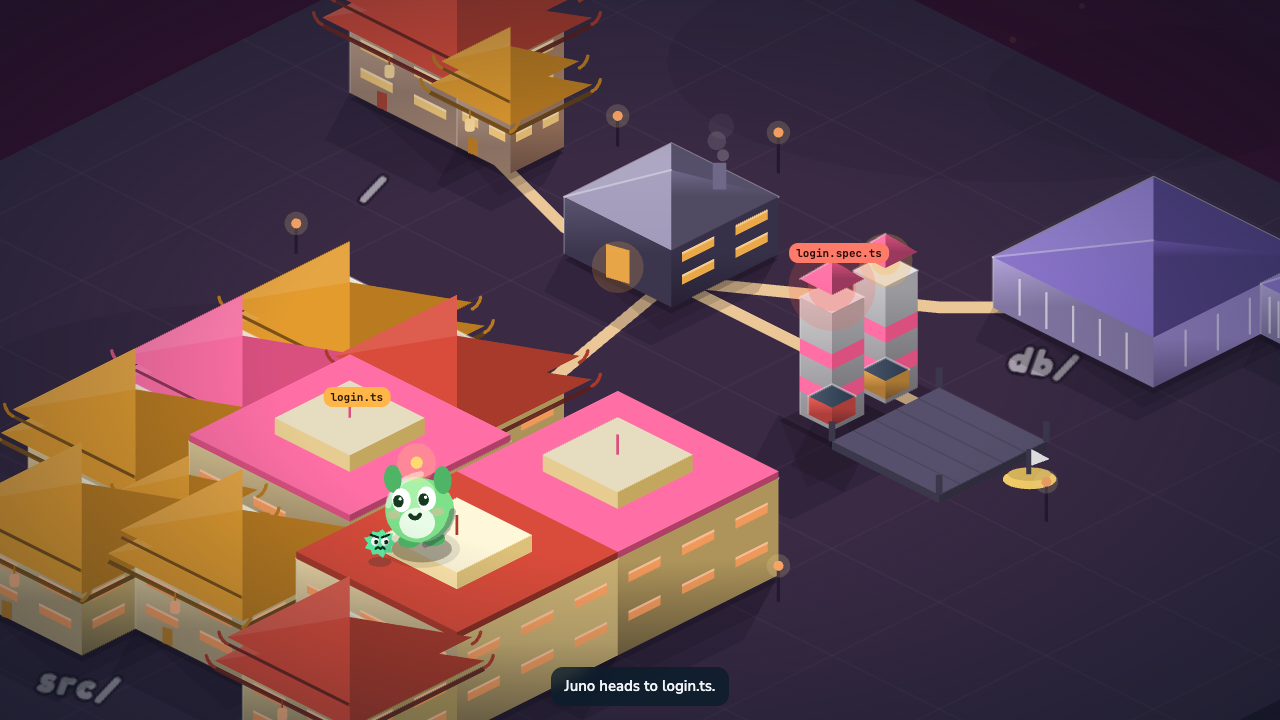
Agent Theatre turns a Claude Code session into an animated scene. Your repo becomes a stage: folders are districts, files are buildings, test files are beacons. The agent is a character — one of a cast of twelve — who walks to the files it reads, builds on the files it edits, runs tests at the beacons, and chases bug gremlins when they fail. Subagents arrive at the dock as other members of the cast. Live, or replayed from any past session.
Twenty-one stages. Agent Theatre reads what your repo is — a web app, a backend, a CLI, data work, a game, infrastructure — and suggests the stages that suit it: Island, Orbit, Metropolis, Harbour, Observatory, Greenhouse, Workshop, Arcade, Kingdom, Outpost, Snowfield, Canopy, Lagoon, Volcano, Cloudtop, Reef, Bazaar, Monastery, Moonbase, Lanterns — and, in the weeks around Halloween, Halloween: jack-o'-lanterns, bats, a ghost-white gremlin and the odd jump scare (switch them off with Scares in the toolbar). Or hit Surprise me.
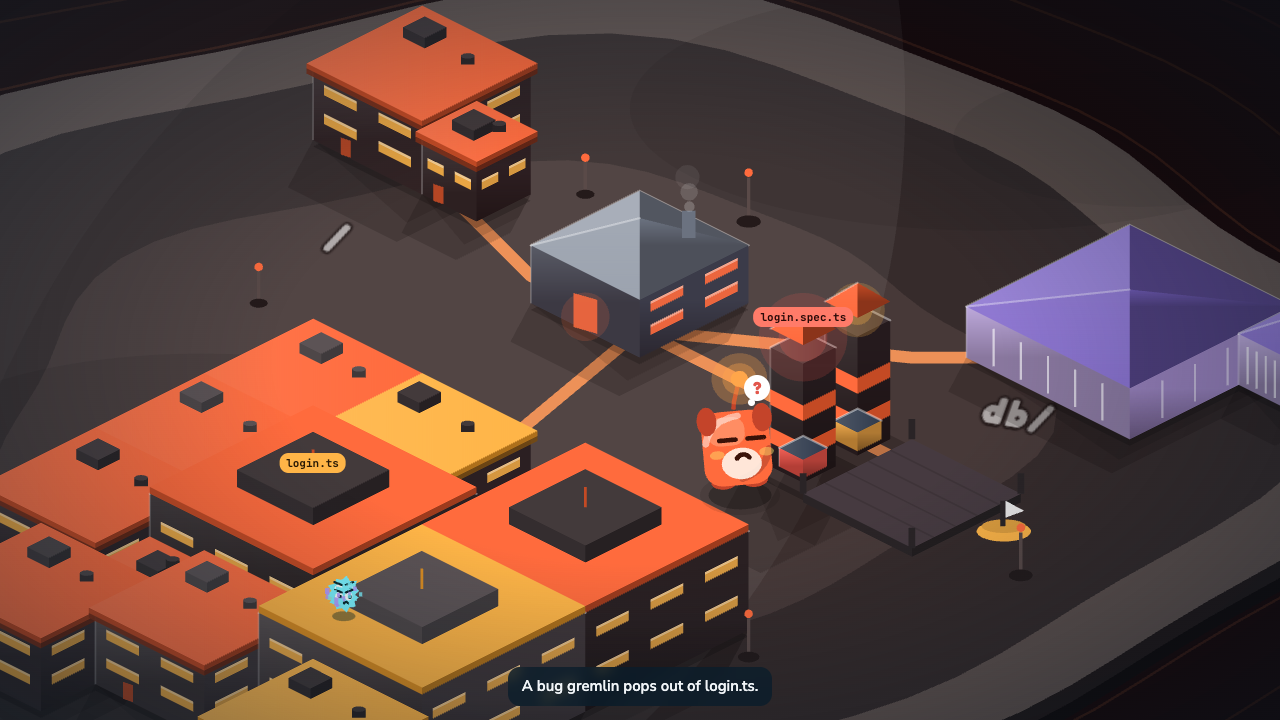
And one honest detail: if the agent says the job is done but no test has passed since the last edit, a gremlin hides behind it.
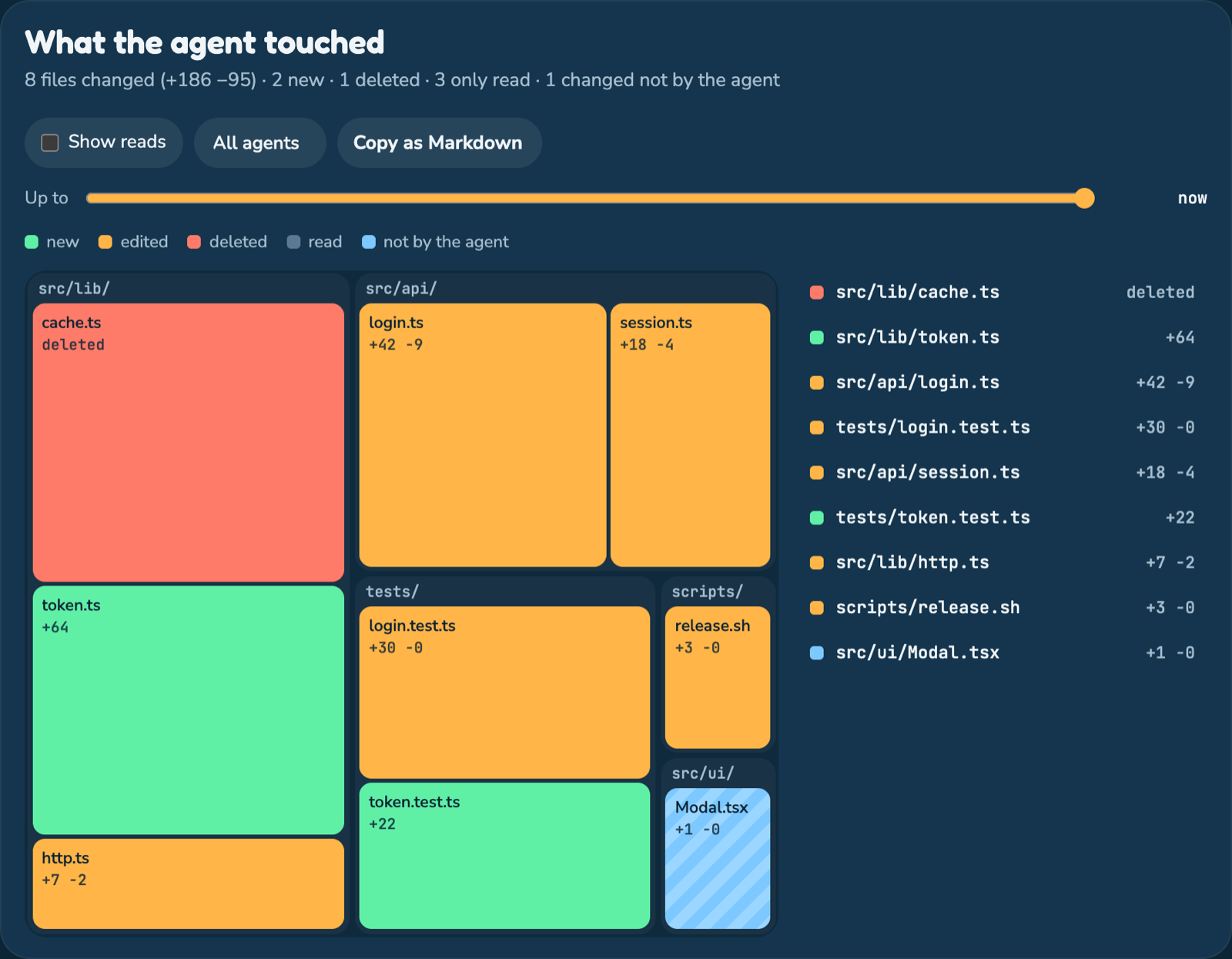
What did the agent change?
The Changes view turns the same session into a map of every file the agent touched: folders as blocks, files sized by lines changed and coloured by what happened (new, edited, deleted, read), plus anything changed during the session that the agent did not do (you, a formatter, another tool). Drag the time slider to see the map at any moment, filter to one helper, click a file for its diff, or copy the whole thing as Markdown for a pull request.
- At the end of every turn, Claude Code shows a one-line summary under the reply, e.g.
this turn: 3 files changed (+50 −2) · 1 new · 1 deletedwith a link to the map. Turn it off withAGENT_THEATRE_SUMMARY=0. - In the terminal:
npx agent-theatre changes(--mdfor Markdown,--json,--reads). - On the pull request:
npx agent-theatre changes --prposts (or updates) one comment with the map, using your ownghlogin, after asking you. - In VS Code: an Agent changes list in the Explorer, a dot on every file the agent touched, and the editor's own diff on click.
Built from the agent's own events and checked against git, so shell edits (sed -i, heredocs, rm) are confirmed on disk
before they appear, and changes committed mid-session still count. Paths and line counts only; a diff is read from your
disk only when you open it.
 |  |  |
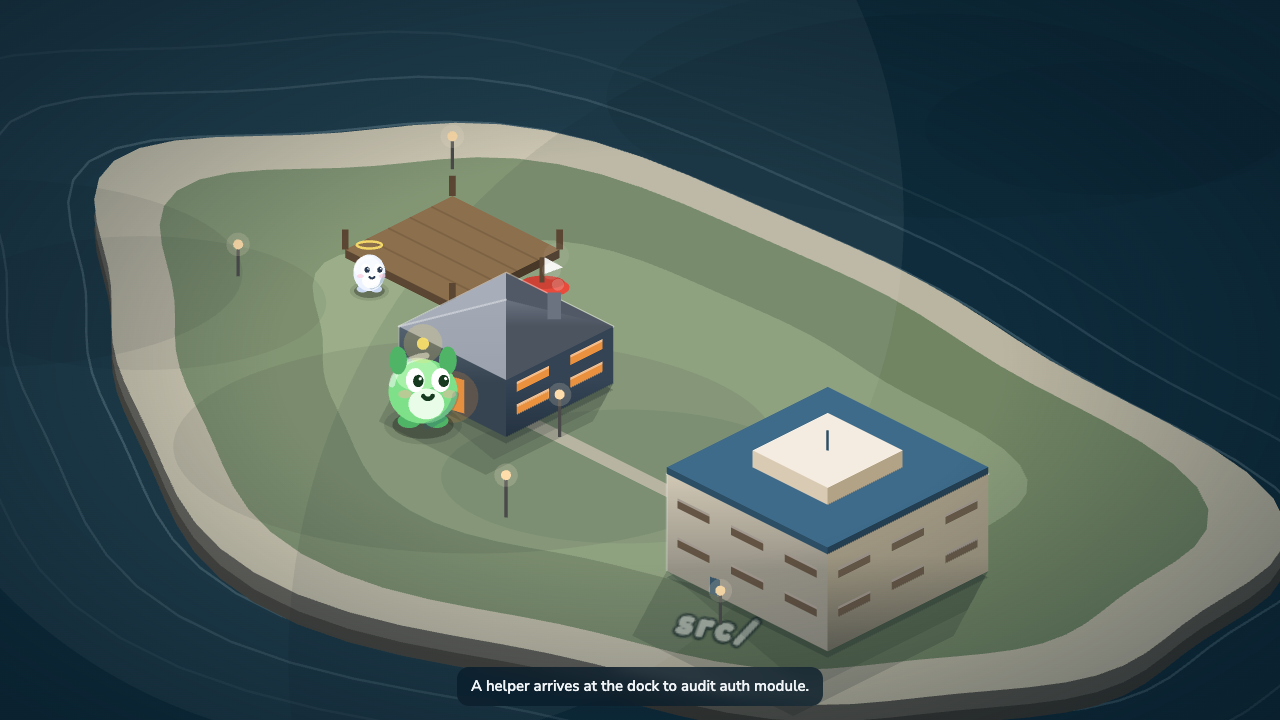 | 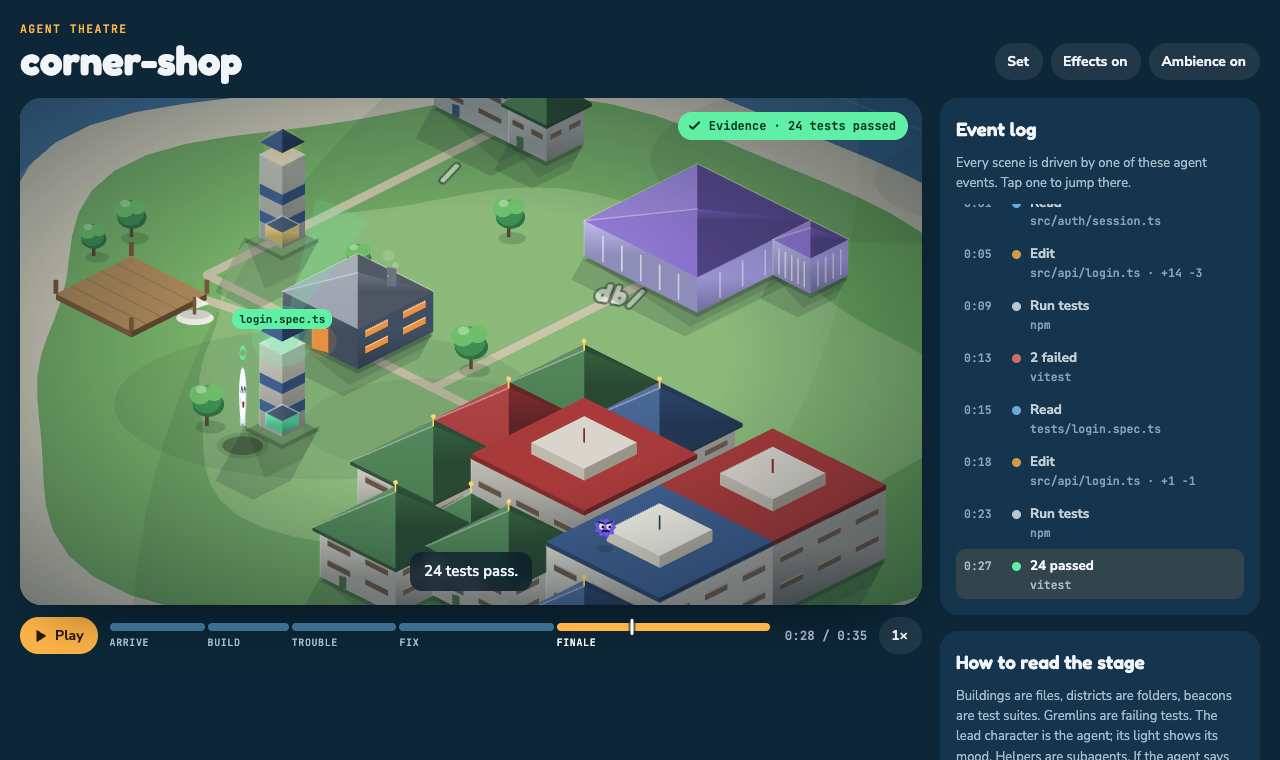 | 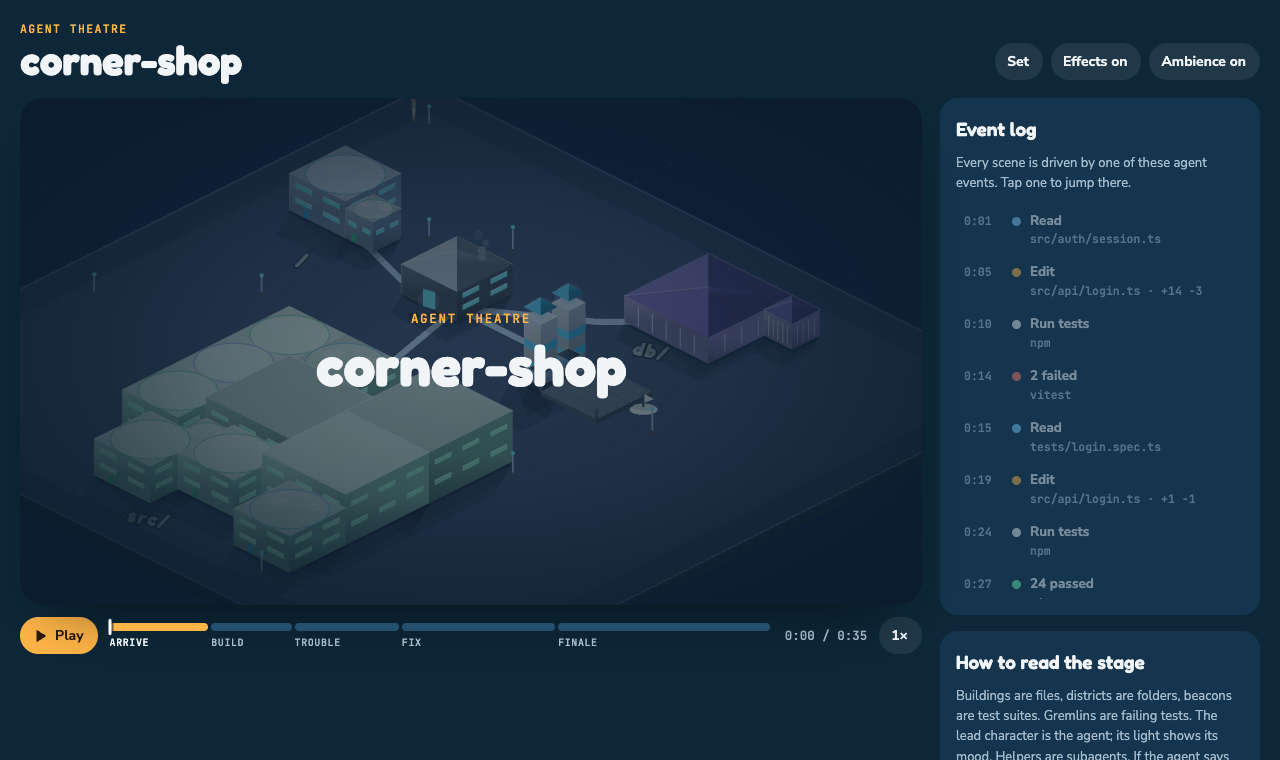 |
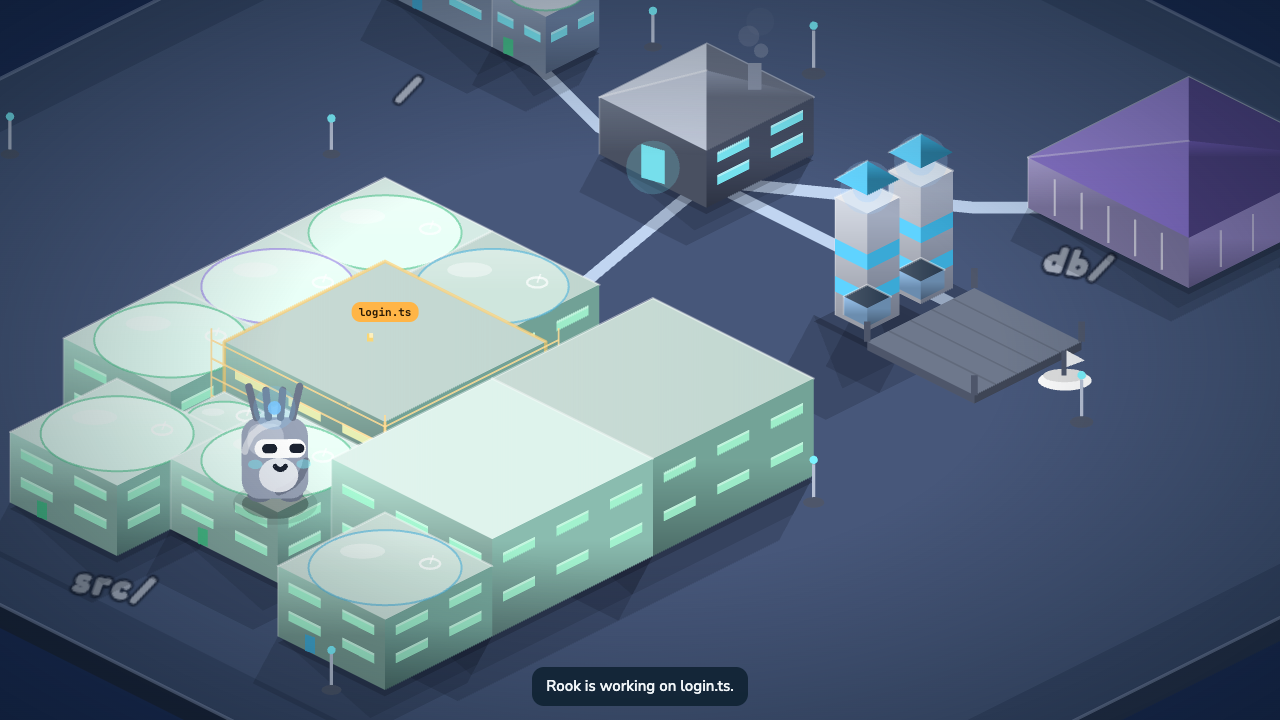
Same session, different stages, different leads. The picker reads your repo and suggests three.
Six bundled episodes, each a different kind of work in a different repo — all synthetic, hand-written, never a captured session:
| Episode | Kind | What happens |
|---|---|---|
| The login timeout | bug fix | two failing tests, one grace window, a green run — and the evidence chip |
| The research brief | research | field notes, a data file, two web searches, one written brief; no tests claimed |
| The export endpoint | new feature | two new buildings rise, a route is wired, the suite is green first time |
| The rename | refactor | six files touched, one test catches a slip, fifty-eight pass |
| Ship 1.4.0 | deploy | all shell work at the forge: build, plan, a timeout, a retry, a rollout, a tag |
| The audit | helpers | two helpers arrive at the dock and fan out while the lead keeps working |
Watch them at agenttheatre.dev or locally with ?demo=research, ?demo=feature, ?demo=refactor, ?demo=deploy, ?demo=subagents.
Status
v1.6.0 — the Changes map; on npm as agent-theatre, VS Code extension on every
release, six playable episodes at
agenttheatre.dev. Live via hooks and replay of real sessions both verified
end-to-end on real repos. Design notes in docs/design.md.
Install
Pick whichever fits how you work. All of them run the same local stage on your machine. It talks only to 127.0.0.1, except when you post a change map to GitHub yourself (changes --pr).
| Where | How | Notes |
|---|---|---|
| npm (CLI) | npx agent-theatre | Node 22+. npx agent-theatre replay for past sessions |
| Claude Code plugin | /plugin install agent-theatre --marketplace shreyassaw5394/agent-theatre | one step on Claude Code 2.1.275+; brings the hooks, a /theatre command and a skill |
| Homebrew | brew install shreyassaw5394/tap/agent-theatre | tap: shreyassaw5394/homebrew-tap |
| VS Code | search Agent Theatre in Extensions, or Marketplace | commands: Open the stage (live), Replay a session…, Switch folder. .vsix also on every release |
| Cursor / Windsurf / VSCodium | agent-theatre.vsix from the latest release → Extensions → ⋯ → Install from VSIX… | same extension; Open VSX listing coming |
| MCP server (Cursor, Windsurf, Claude Desktop, Codex, Gemini CLI, VS Code Copilot) | npx agent-theatre init | registers agent-theatre serve with every agent on your machine; --repo writes .mcp.json / .cursor/mcp.json / .vscode/mcp.json for the team. One-click:   |
| Just watch | agenttheatre.dev | six synthetic episodes, no install |
First run (CLI):
cd your-repo
npx agent-theatre hooks install   # once — skip if you installed the Claude Code plugin, it brings the hooks
npx agent-theatre                 # opens the stage for this repo; run Claude Code in another terminal
npx agent-theatre replay          # pick any past Claude Code session of this repo and watch it
npx agent-theatre changes         # what the agent touched: files, lines, new, deleted (--md, --pr)
npx agent-theatre hooks uninstall # reverses the install byte-for-byte
Flags: --port <n>, --no-open, --set <stage-id>; replay --latest skips the picker. Global install if you prefer: npm i -g agent-theatre.
In the stage: hover anything for what it is and what happened to it this session. Live stages show Live at the edge and a Go live button whenever you have scrubbed back. Whole repo pulls back to every building (wheel to zoom). Full screen (or F) keeps just the stage and the transport bar. Export clip records what you see and hear to mp4/webm with a share sheet (download, system share, X, LinkedIn). When the agent needs you, the stage says so and points you back to Claude Code (in VS Code it focuses the Claude Code input); you answer there, never on the stage. When the agent goes quiet the stage says so: after ~20 s "thinking…", after 90 s the house lights dim, the lead sits down, ambience thins and a banner counts the silence; the moment an event arrives it all comes back. When the session ends, the banner says so. A stage watches the folder it was started in; several stages at once (browser, VS Code, another repo) all receive events.
MCP tools
agent-theatre serve is an MCP server (stdio). Any MCP client can:
| Tool | Does |
|---|---|
open_stage | start (or reuse) the live stage for a folder → URL |
list_sessions | past Claude Code sessions of a folder: ids, titles, times |
replay_session | open a replay of one session (newest by default) → URL |
stage_status | event/beat counts and the last few event kinds; never contents |
what_changed | the change map: files read, edited, created, deleted, with line counts; Markdown for a PR on request |
install_hooks | install the Claude Code hooks (not needed with the plugin) |
Listed on the MCP Registry as io.github.shreyassaw5394/agent-theatre.
How it works
Claude Code ──hooks──▶ agent-theatre (local) ──WebSocket──▶ browser / VS Code webview
     │                        │
     └─ JSONL transcript ─────┘  (replay)
- Events. Hook payloads (live) or transcript rows (replay) are normalised into a small,
product-agnostic
AgentEventschema:read_file,edit_file (+n −m),run_command (intent),test_result,subagent_start/stop,waiting_for_user,turn_end, … - Stage. The repo's file tree becomes a deterministic arrangement — one of six layout archetypes (ring, grid, strip, scatter, terrace, spine) chosen from the repo and the stage, so the same project is a ring island in one set and a terraced spine in another, and always the same in the same set. Capped to ~60 buildings by relevance; every file in the folder that the session touches is always placed. Work outside the folder (another repo, your home folder) raises nothing: the character doing it wears an "elsewhere: " badge instead.
- Director. Events become scene beats —
walk_to,build,run_tests,spawn_gremlin,chase,celebrate,unverified_claim— with a mood: curious, focused, lost, happy. - Renderer. PixiJS, isometric, soft lighting, easing everywhere — no linear tween exists
in the codebase, a test makes sure. The camera frames the action; the whole stage appears
only to open, celebrate and close, so it never gets cluttered. One key light: long soft
cast shadows, gradient faces with ambient occlusion and rim light, aerial haze on far rows,
bloom only on lamps and lit windows, cloud shadows drifting over the ground.
prefers-reduced-motionrespected. Twenty-one stages, each with its own silhouette — gabled harbour houses, pagoda tiers, onion domes, moonbase capsules, bazaar tents — on the same geometry; a cast of twelve characters from one procedural routine. - Sound. Every beat has a sound, all synthesized at runtime with the Web Audio API — no audio files, no licences to worry about. Every stage has its own voice (waveform, pitch, decay, the surface underfoot) and its own ambience — washes, pads and occasional details like gulls, bells, bubbles, wind or market murmur on a jittered timer, so nothing loops. Effects and background ambience toggle separately. The "needs your permission" chime is the one you'll notice.
Privacy
Everything runs on your machine; nothing is sent anywhere unless you post a change map to GitHub
yourself. The event stream never contains code, prompts, command text or search queries — only
repo-relative paths, counts, a command's first word and a classified intent. This is a tested
invariant (packages/core/tests/privacy.test.ts plants secrets in a fixture session and asserts
none reach the stream). The hook strips each Claude Code event down to those paths, counts and
flags before it sends anything, and sends only to a stage that answers with the id it registered
(packages/cli/tests/script.test.ts plants secrets in every hook field and asserts none are sent).
| Read | Rendered | Leaves the machine | |
|---|---|---|---|
| File paths | yes | repo-relative | never |
| File contents | counted only (±lines) | only a file's diff, when you open it in the Changes view (read from your disk) | never |
| Your prompts | tail never read; never stored | no | never |
| The agent's closing message | last paragraph, truncated to 240 chars (turn_end.note) | yes — shown with "your turn" so you know what it asked | never |
| Command text | first word + classified intent + redirect / delete targets | no | never |
| End-of-turn summary | file paths and line counts of the turn | shown by Claude Code under the reply | never |
PR comment (changes --pr) | paths and line counts | posted only when you confirm, with your own gh login | to GitHub, by you |
| Test output | summary counts only | pass/fail | never |
| Telemetry | — | — | none, ever |
| Audio | — | synthesized, no files | never |
The server binds to 127.0.0.1 only. Hooks always exit 0, never block your agent, and give up within about half a second.
Repo layout
packages/core (schema, adapters, island, director — no DOM, no fs) ·
packages/cli · packages/web · packages/vscode · fixtures/ (synthetic sessions).
Community
Questions, stages worth showing off, ideas for v2: Ship at Midnight Discord, one server for every tool, with a channel for Agent Theatre.
Site
agenttheatre.dev — the story, a playable Episode 1, all twenty-one stages, the cast,
the privacy sheet and install notes. agenttheatre.com redirects there. The site is site/ in this
repo, deployed on Vercel from main; the playable demo is the real web bundle at /theatre/.
License
MIT © 2026 Shreyas Sawant and Agent Theatre contributors.
Independent project, not affiliated with or endorsed by Anthropic, Microsoft, Anysphere (Cursor), Codeium (Windsurf), OpenAI or Google. Claude and Claude Code are trademarks of Anthropic; other names belong to their owners.
Agent Theatre is a free, non-commercial passion project. MIT licensed; bundled third-party code is listed in THIRD_PARTY_LICENSES.txt. It runs locally and sends no telemetry (privacy).
Reviews
No reviews yet
Be the first to review this server!
More Developer Tools MCP Servers
Rea
Freeby Morluto · Developer Tools
Reverse engineer anything from your terminal or agent with one CLI and MCP server.
Paperclip
Freeby Paperclipai · Developer Tools
Trending hip-hop artist momentum scores across four cultural dimensions.
Scrapling
Freeby D4Vinci · Developer Tools
Web scraping with stealth HTTP, real browsers, and Cloudflare bypass. CSS selectors supported.
Git
Freeby Modelcontextprotocol · Developer Tools
Read, search, and manipulate Git repositories programmatically
Toleno
Freeby Toleno · Developer Tools
Toleno Network MCP Server — Manage your Toleno mining account with Claude AI using natural language.
MCP Marketplace
Freeby mcp-marketplace · Developer Tools
Search and install MCP servers from inside your AI client.