
Server data from the Official MCP Registry
Local fixed-sheet nesting for laser and CNC cutting: SVG/DXF import, nest, validate, export.
About
Local fixed-sheet nesting for laser and CNC cutting: SVG/DXF import, nest, validate, export.
Security Report
Nestbolt is a Rust nesting engine with an MCP stdio server that reads and writes only within its workspace, and the README states no uploads occur in the browser app. The reviewed code (geometry import, SVG/DXF parsing, validation) shows no exfiltration, shell execution, or hardcoded secrets, and its permissions (file I/O for import/export) match its stated purpose. Only minor observations remain, such as the truncated file content limiting full verification of the MCP server and file path handling. Supply chain analysis found 6 known vulnerabilities in dependencies (0 critical, 4 high severity).
6 files analyzed · 9 issues found
Security scores are indicators to help you make informed decisions, not guarantees. Always review permissions before connecting any MCP server.
Permissions Required
This plugin requests these system permissions. Most are normal for its category.
How to Install
Add this to your MCP configuration file:
{
  "mcpServers": {
    "io-github-skulitom-nestbolt": {
      "args": [
        "-y",
        "nestbolt-web"
      ],
      "command": "npx"
    }
  }
}Documentation
View on GitHubFrom the project's GitHub README.
Nestbolt
8.5% less material at the median than the best of Deepnest, SVGnest and Sparrow at equal 60-second budgets, and 9.6% at 300 seconds, in the final benchmark run (fresh seeds, ten held-out jobs). Sparrow still wins 8 of the 56 jobs at 60 seconds (details, every number).
Free, open-source nesting for people who cut fixed sheets: laser cutters, CNC routers, plasma, waterjet, fabric and leather. Nestbolt arranges parts so they use the least material. It runs in your browser (nothing is uploaded), on the command line, and as an MCP server that AI agents can call.
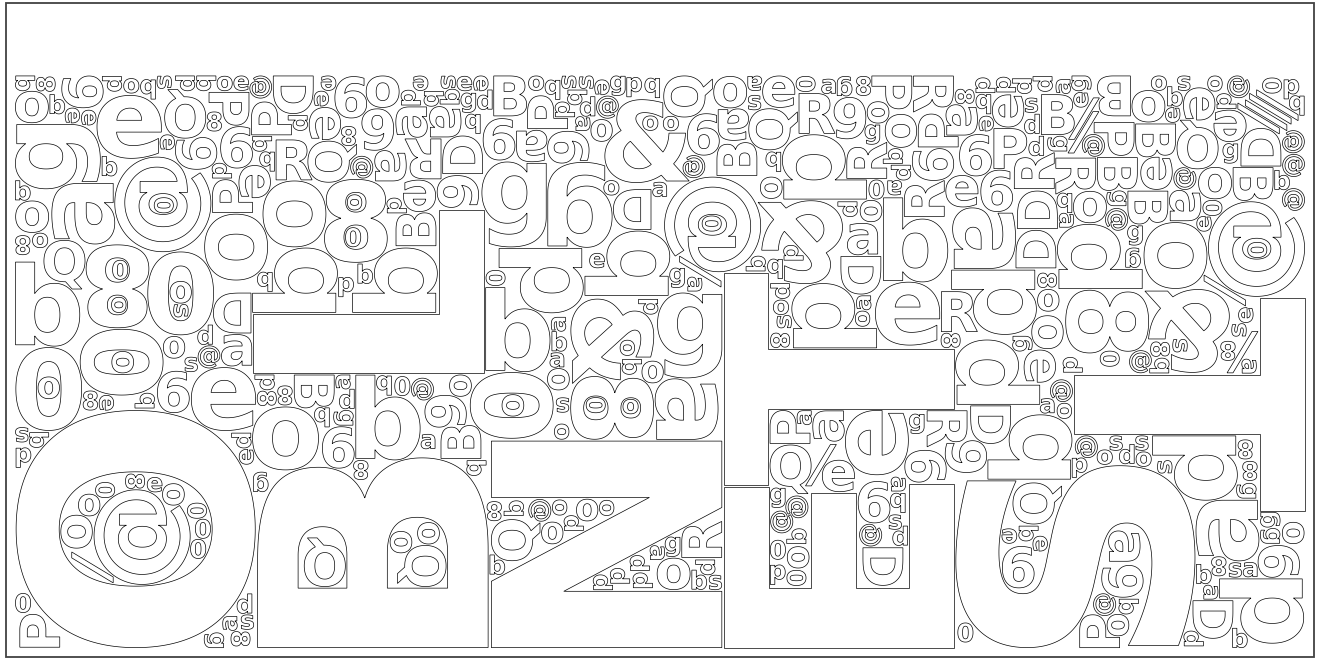
451 parts on one 850 × 425 mm sheet in 120 seconds on one CPU core: DejaVu Sans
Bold glyphs in four sizes with their exact Bézier outlines, 90° rotations and
1 mm spacing. 29 letters sit inside the holes of others, and the unused material
stays as one clean offcut along the top. The layout passed the independent
validator. Rebuild it with python scripts/make_showcase.py --nest 120.
How it compares
Final acceptance run (2026-10-13): 75 frozen sheet jobs (35 academic, 40 maker, ten of them held out from all tuning), equal time budgets, one CPU core per tool, five fresh seeds each, every layout checked by an independent validator. The comparison is against the best of Deepnest, SVGnest and Sparrow on each job, each with the better of its two settings.
| Budget | Valid Nestbolt layouts | Less material than the best competitor (median) | Wins or ties |
|---|---|---|---|
| 60 s | 375/375 | 8.5% | 48 of 56 |
| 300 s (long subset) | 60/60 | 9.6% | 11 of 11 |
At 60 s Nestbolt uses less material than Deepnest on all 55 jobs where Deepnest produced a layout (median 9.9%) and than SVGnest on all 36 (14.4%). Sparrow, which Nestbolt builds on, wins 8 jobs. Seven are one-sheet jobs that Nestbolt hands to Sparrow itself after its own first layout, so Sparrow runs with slightly less time there; it is 0.03-2.4% better on them. The eighth (two sheets) is 0.34% better. That misses the project's own 60-second bar (wins or ties on 90% of jobs and never more than 1% worse); the 300-second, strip-parity and speed bars are met (status).
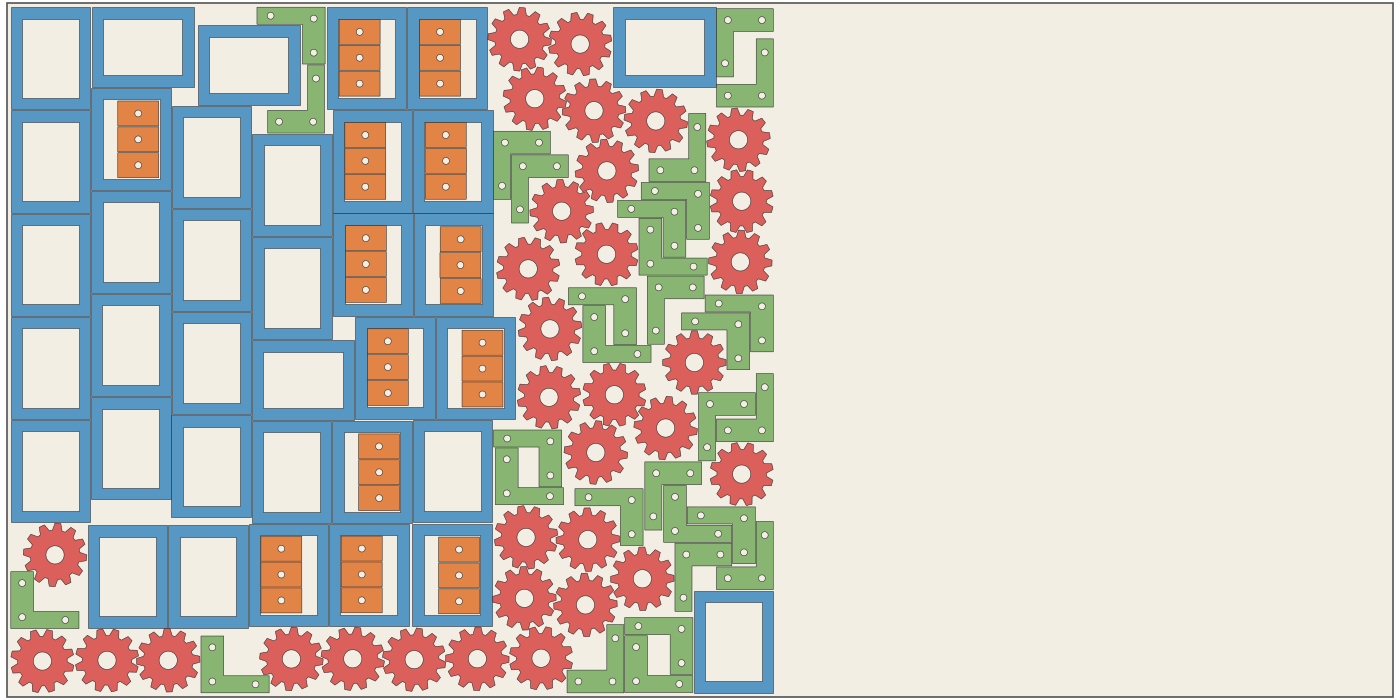
One benchmark job exactly as nested in a 60-second development run (m-mechanical-frame-inserts,
seed 0, sheet turned to landscape): 138 parts, all 39 inserts placed inside frame
windows, everything packed into 56% of a 2440 × 1220 mm sheet so the rest stays one
offcut. The best competitor used 62% of the sheet on this job.
In 30 s Nestbolt matches the competitors' 300 s result on 10 of 11 jobs. The first
final run (build 484ce8b) stopped with an error on one job; the fix is in 75cbb32
and both runs are published. Every run, including failures, is in
BENCHMARKS.md; status lists the evidence per
gate. The results page shows every
per-job number, tool revision, seed and the hardware; python scripts/reproduce.py --phase final --final-acceptance rebuilds the datasets, reruns what is missing and regenerates it.
What works today
- Import SVG and DXF: lines, arcs, ellipses, Béziers, B-splines, blocks, transforms and units, converted to millimetres. Each closed outline is a part; outlines inside it are its holes. Real maker files work: all 192 boxes.py example drawings import and nest, including their relief loops at slot corners.
- Nest on fixed sheets: margins, part and edge spacing, several sheets, several stock sizes with limits, defects, remnant outlines, rotations (free, stepped or a list such as 0/180 for fabric grain) and mirroring. Small parts can sit inside the holes of larger parts. The last sheet is compressed towards one end so the offcut stays usable.
- Export one SVG and one DXF per sheet from the original curves, transformed rather than re-polygonised: on 196 real drawings every exported contour is within 0.0005 mm of its source. LightBurn, Inkscape and LibreCAD open them at the exact size.
- Check every result with an independent Clipper2 validator (overlap, spacing, containment, rotations, quantities). Invalid layouts are never returned.
- Browser app (
web/): the same engine compiled to WebAssembly in Web Workers, several seeds in parallel, a live view of the best layout, projects saved in the browser or as a ZIP, and five one-click examples. Files never leave the computer. On the 65 development jobs, one browser worker matches the native build within 0.1% at the median (Chrome and Firefox, 60 s). - MCP server with
import_parts,nest,validate_layout,export_layoutandestimate_sheets, tested with Claude Code. Its budgets are repeatable: same inputs, budget and seed, same layout. See the agent interface.
The engine builds on jagua-rs and sparrow by Jeroen Gardeyn and collaborators (arXiv 2509.13329). Fixed-sheet search lays the last sheets end to end as one walled strip and shrinks the last sheet with a port of Sparrow's separator; parts move between sheets and an emptied sheet disappears. Near-rectangular parts such as box panels also get a bounding- rectangle packing start. One sheet of hole-free parts without defects is exactly Sparrow's own strip-packing problem, where it is the state of the art, so there Nestbolt runs unmodified Sparrow for the rest of the budget.
Quick start
Install Rust through rustup (the repository selects Rust 1.98.1) and build:
cargo build --release -p nestbolt-cli -p nestbolt-mcp
Import parts, nest them for 30 seconds, and get per-sheet SVG/DXF files
(examples/box-99x63x45.svg is the browser app's example box):
target/release/nestbolt import examples/parts.svg --output library.json
target/release/nestbolt nest --library library.json --request examples/nest-request.json --out-dir run --seconds 30
For drawings with larger gaps, import --close-gaps 0.05 explicitly repairs up
to 0.05 mm and reports every repair's position and size. It is off by default;
the silent join limit remains 0.005 mm. The UI and MCP expose the same option.
See import options and reports.
A request names library parts with quantities and the sheets in millimetres:
{
  "parts": [{"id": "parts-1", "quantity": 4}, {"id": "parts-2", "quantity": 12, "rotations": {"kind": "free"}}],
  "sheets": [{"width_mm": 600, "height_mm": 400, "margins_mm": {"left": 5, "right": 5, "bottom": 5, "top": 5}}],
  "spacing_mm": 1.0,
  "edge_spacing_mm": 1.0
}
run/ then holds layout.json, report.json and sheet-0.svg/sheet-0.dxf and
so on. Existing files are never overwritten. nestbolt export re-exports a
layout; nestbolt validate checks a polygon job and layout. Add --repeatable
to nestbolt nest or nestbolt sheets for a deterministic work budget instead of
wall-clock time: the same inputs, budget and seed then give the same layout. On a
machine much slower than the reference PC, --time-limit <seconds> allows more real
time for the same work (the default is --seconds).
File formats are described by the JSON Schemas.
Browser app
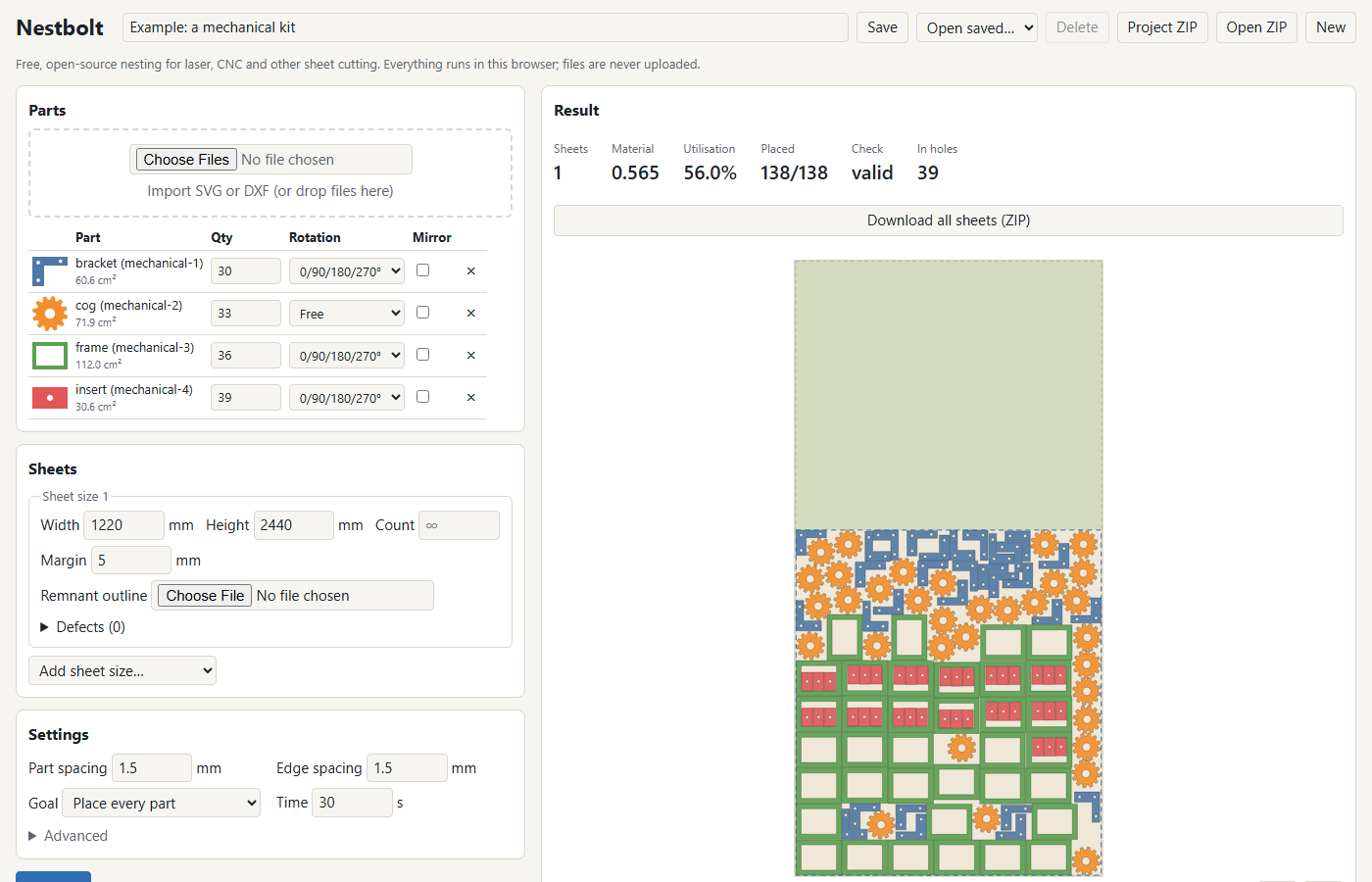
Open it and pick an example (finger-jointed boxes, letters inside letters, a 138-part mechanical kit, a FreeSewing T-shirt pattern on a fabric roll, interlocking gears), or drop your own SVG and DXF files. The best layout so far is drawn while the search runs, and each sheet shows the box around its parts and the clear offcut left above them.
To build it locally you need the wasm32-unknown-unknown target, wasm-bindgen-cli
0.2.129 and Node.js 24; then open the printed address:
cd web && npm ci && cd ..
python scripts/build_web.py
npm --prefix web run preview
python scripts/build_web.py --test also runs the Playwright tests in Chromium
and Firefox.
Use from agents
Register the MCP server with an absolute path, for example in Claude Code:
claude mcp add --transport stdio --scope local nestbolt -- /path/to/target/release/nestbolt-mcp
The server reads and writes only inside its working directory (or
NESTBOLT_WORKSPACE). docs/AGENT_INTERFACE.md covers
Claude Code, Codex and Claude Desktop, the request format and the rules.
Development
python scripts/check.py
python scripts/sheets_batch.py --cpu 0 --cpu 2 --seconds 60
The first runs format, lint, all Rust and Python tests, WebAssembly builds,
notice and dataset checks; add --web for the browser build and tests. The second runs the development benchmark (held-out
jobs excluded) and writes an audited report under benchmarks/results/.
| Path | Purpose |
|---|---|
crates/core | Geometry import/export, sheet search, separator, part-in-part |
crates/cli | Command-line interface |
crates/mcp | Native stdio MCP server |
crates/validator | Independent Clipper2 checker and material scoring |
crates/wasm | WebAssembly boundary for the browser app |
web | Browser app (Preact, Vite) and its Playwright tests |
benchmarks | Frozen datasets, competitor runners and all results |
docs/PLAN.md | The full plan and its acceptance gates |
docs/STATUS.md | Milestone evidence and next steps |
Every benchmark run, including failures, is logged in BENCHMARKS.md.
Progress and licence
Progress counts finished milestones only; see docs/STATUS.md.
Nestbolt is MIT. jagua-rs is an unmodified MPL-2.0 dependency; the
separator in crates/core/src/separate.rs is adapted from Sparrow (MIT).
THIRD_PARTY_NOTICES records every dependency and licence.
Reviews
No reviews yet
Be the first to review this server!
More Developer Tools MCP Servers
Fetch
Freeby Modelcontextprotocol · Developer Tools
Web content fetching and conversion for efficient LLM usage
Git
Freeby Modelcontextprotocol · Developer Tools
Read, search, and manipulate Git repositories programmatically
Worldmonitor
Freeby Koala73 · Developer Tools
Live markets, conflicts, country risk, chokepoints, energy, and China decision signals. 93 tools.
Toleno
Freeby Toleno · Developer Tools
Toleno Network MCP Server — Manage your Toleno mining account with Claude AI using natural language.
MCP Marketplace
Freeby mcp-marketplace · Developer Tools
Search and install MCP servers from inside your AI client.
mcp-creator-python
Freeby mcp-marketplace · Developer Tools
Create, build, and publish Python MCP servers to PyPI — conversationally.