
Server data from the Official MCP Registry
C/C++ crash, hang and dump debugging for Claude Code, Codex and Qwen via GDB, LLDB and MCP
About
C/C++ crash, hang and dump debugging for Claude Code, Codex and Qwen via GDB, LLDB and MCP
Security Report
Valid MCP server (1 strong, 2 medium validity signals). 5 known CVEs in dependencies (0 critical, 4 high severity) Package registry verified. Imported from the Official MCP Registry.
9 files analyzed · 6 issues found
Security scores are indicators to help you make informed decisions, not guarantees. Always review permissions before connecting any MCP server.
Permissions Required
This plugin requests these system permissions. Most are normal for its category.
How to Install
Add this to your MCP configuration file:
{
  "mcpServers": {
    "io-github-spk-c-qwen-dap-mcp": {
      "args": [
        "-y",
        "@slp-dev1/qwen-dap-mcp"
      ],
      "command": "npx"
    }
  }
}Documentation
View on GitHubFrom the project's GitHub README.
Qwen DAP MCP — Native Debugger MCP for Claude Code, Codex, Qwen and AI Coding Agents
Debug native C/C++ crashes, hangs, deadlocks, Windows minidumps and core dumps with Claude Code, OpenAI Codex CLI, Qwen Code, Gemini CLI and other local MCP-compatible coding agents. Connect a real GDB, LLDB or CodeLLDB debugger through the Debug Adapter Protocol (DAP) and Model Context Protocol (MCP).
qwen-dap-mcp is a local Debug Adapter Protocol (DAP) → Model Context Protocol (MCP) bridge for native crash debugging, hang/deadlock triage, crash dumps, differential runtime analysis, remote targets, and bounded fix/verify workflows.
Originally designed for Qwen Code, but usable from other local stdio MCP clients including Claude Code and Codex CLI. The AI model may run in the cloud; the debugger bridge and target binary still run where the MCP process is started.


Quick start · Capabilities · Debugger support · Safety · Docs · Contributing
Maintained Apache-2.0 fork of the original project by SLP-DEV1. The maintained source is spk-c/Qwen-dap-mcp; npm distributes
@slp-dev1/qwen-dap-mcp. GitHub'smainmay be ahead of the latest published npm version. See fork notes and TypeScript migration status.
See it in action: C++ crash → evidence → verification
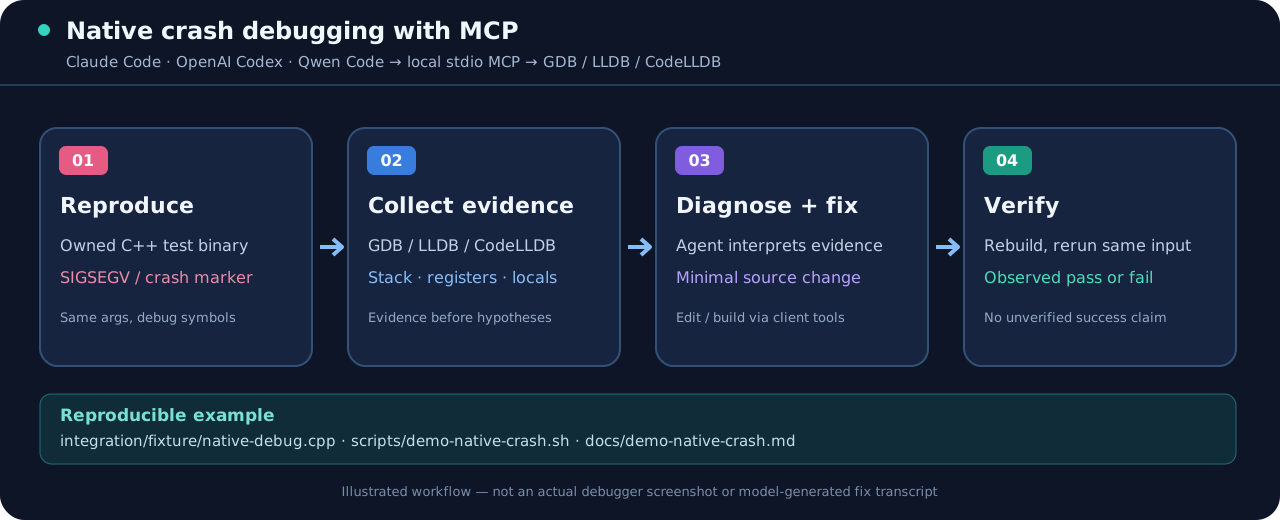
Illustrated architecture/workflow, not a captured AI session or fabricated debugger transcript. Reproduce an actual intentional crash in the project's own C++ fixture, collect a GDB backtrace, apply an illustrative change only in a temporary copy, and rerun the same command:
bash scripts/demo-native-crash.sh
Requires Linux, g++ and gdb. CI also executes the demo with a real debugger. View step-by-step verified demo and Claude/Codex MCP setup.
Why this exists
Coding agents can read source and propose patches, but native failures often cannot be diagnosed reliably from source alone. The useful evidence lives at runtime: thread stacks, registers, locals, disassembly, exception state, modules, memory, wait states, symbols, and crash dumps.
qwen-dap-mcp makes that evidence available through MCP and adds agent-oriented workflows on top of raw debugger primitives:
- Evidence first — inspect the actual failing process instead of guessing from source.
- High-level workflows — crash, hang, differential, causal tracing, progress probing, runtime-report, dump, and verification tools are designed for agents rather than humans driving a debugger console.
- Bounded automation — autonomous fix/verify state is explicit, serializable, iteration-limited, and re-checks the original reproduction.
- Small default surface — 18 core agent tools stay visible by default; forensic workflows and raw DAP controls are separate opt-in tiers.
- Local by default — the MCP server communicates over stdio and debugger adapters run locally unless you explicitly configure a validated remote target.
Quick start
Qwen Code
Install the current published npm version:
qwen extensions install @slp-dev1/qwen-dap-mcp
Or install the newest code directly from the maintained GitHub repository (this can be ahead of npm):
qwen extensions install spk-c/Qwen-dap-mcp
In Qwen Code, run /mcp and /skills to check that the qwen-dap-mcp server and the native-runtime-debug skill were discovered.
Prerequisites: Node.js 20+, and a supported native DAP debugger installed separately (CodeLLDB, LLVM lldb-dap, or GNU GDB DAP). This package is a bridge, not a bundled debugger. See platform setup.
Claude Code
Use a local Claude Code CLI with Node.js 20+ and an installed native DAP debugger:
claude mcp add --transport stdio --scope user qwen-dap-mcp -- npx -y @slp-dev1/qwen-dap-mcp
claude mcp list
See Claude Code native debugging guide for a setup check, test prompt, Windows notes and safety boundaries.
OpenAI Codex CLI
codex mcp add qwen-dap-mcp -- npx -y @slp-dev1/qwen-dap-mcp
codex mcp list
See Codex CLI + IDE debugging guide and versioned Codex TOML configuration.
Gemini CLI, Cursor, VS Code Copilot and other clients
Use a local stdio MCP entry pointing to npx -y @slp-dev1/qwen-dap-mcp. These clients have different configuration schemas: Gemini CLI and Cursor use mcpServers, while VS Code's .vscode/mcp.json uses servers. See multi-client setup and compatibility matrix and the tested configuration examples.
Cloud execution boundary: Claude Code or Codex CLI may call a cloud AI model while the CLI and debugger remain on your desktop. A browser-only Claude.ai/ChatGPT session or a remote Codex task cannot automatically access your PC's local stdio MCP server or Windows processes. Remote debugging requires separately authorized local execution or a protected connection; never expose a raw debugger port to the public internet.
Other stdio MCP clients
Run the published package with npx:
npx -y @slp-dev1/qwen-dap-mcp --help
npx -y @slp-dev1/qwen-dap-mcp --version
Configure a trusted local MCP client with:
{
  "mcpServers": {
    "qwen-dap-mcp": {
      "command": "npx",
      "args": ["-y", "@slp-dev1/qwen-dap-mcp"]
    }
  }
}
When started without --help or --version, the CLI operates as a local stdio MCP server. Client configuration syntax may vary.
Update an existing installation
Update the npm-backed Qwen extension using the extension manager in your installed Qwen Code version, or reinstall the package with the command above. For npx, restart the MCP client to use newly resolved versions. npm releases are immutable: README changes appear on npmjs.com only after publishing a new package version, not when GitHub's README changes.
MCP client compatibility
| Client | Local MCP setup | Verification |
|---|---|---|
| Qwen Code | Qwen extension | /mcp and /skills |
| Claude Code | Local stdio claude mcp add | claude mcp list and /mcp |
| OpenAI Codex CLI | Local stdio codex mcp add | codex mcp list and /mcp |
| Gemini CLI | settings.json mcpServers | gemini mcp list |
| Cursor | Desktop MCP settings | Connected tools in Cursor |
| GitHub Copilot in VS Code | .vscode/mcp.json servers | MCP tools in Agent mode |
| Browser-only / cloud task | Not direct local stdio | Requires independent secure execution path |
The project includes automatic protocol-level stdio initialize + tools/list smoke tests with Claude Code, Codex CLI and Gemini client identities. These prove the shared MCP server protocol and example configuration consistency, not full end-to-end verification inside proprietary client applications. Native debugger E2E checks run separately. Run npm run test:clients from a built checkout.
30-second example
You: Debug why app.exe crashes with --repro

Coding agent
  ↓
qwen-dap-mcp starts a DAP debugger
  ↓
captures the native failure + project-controlled frame
  ↓
correlates stack + registers + locals + disassembly
  ↓
backtracks runtime evidence toward the likely producer
  ↓
agent applies a minimal source fix
  ↓
builds and repeats the original reproduction
  ↓
verifies whether the original crash fingerprint is gone
The MCP server supplies debugger evidence and bounded workflow state. Source editing, builds, tests, and source-control operations stay with the coding agent's normal authorized tools.
What it does
| Problem | Agent-oriented capability |
|---|---|
| Native crash | Diagnose a stopped process, identify project frames, collect runtime evidence, and drive bounded fix/verify loops |
| Hang or deadlock | Observe, pause when needed, capture all-thread stacks, classify waits, and surface conservative deadlock candidates |
| Good run vs bad run | Compare stopped sessions semantically while suppressing raw ASLR/address noise |
| Suspicious value | Trace real writers with data breakpoints/watchpoints and bounded temporal tracing |
| Runtime causality | Build a bounded suspicious-value consumer → writer/producer chain with debug_causal_trace |
| Suspected busy loop | Resume/pause sample a live target with debug_progress_probe to distinguish repeated state from observed execution movement |
| Record/replay target | Move backward with capability-gated debug_reverse_execution using DAP stepBack / reverseContinue |
| Crash fleet triage | Build debug_runtime_report fingerprints, cluster them with debug_cluster_crashes, and classify regression reproductions with debug_regression_oracle |
| Child/fork signal | Inspect fail-closed adapter startDebugging requests with debug_child_requests without auto-spawning child sessions |
| Crash dump | Inspect Windows minidumps and supported LLDB/GDB postmortem targets without launching the failed program |
| Remote native target | Attach through validated gdbserver / lldb-server gdbserver endpoints with loopback-first policy |
| Multiple targets | Keep isolated DAP sessions and route requests by sessionId |
| Agent safety | Keep the default surface high-level and optionally gate executable/mutating DAP actions with HOL Guard |
| Object lifetime / UAF | Correlate pointer writers, sanitizer evidence, reverse stepping, and allocation/free hints |
| Symbol mismatch | Compare adapter symbol state with bounded local binary/PDB identity evidence |
| Crash fleets | Batch postmortem analysis plus exact/semantic/family grouping |
| Offline handoff | Export structured evidence and SARIF without keeping the target alive |
Tool surfaces
The default agent toolset intentionally exposes 18 core tools so coding models spend less context and selection effort on rarely needed forensic workflows.
| Core tool | Purpose |
|---|---|
debug_this_crash | High-level native crash diagnosis and bounded autonomous verification |
debug_this_hang | High-level hang/deadlock triage |
debug_compare_runs | Semantic comparison of baseline and failing stopped sessions |
debug_trace_value | Bounded temporal tracing of a suspicious value |
debug_causal_trace | Consumer-to-writer producer evidence for suspicious runtime state |
debug_progress_probe | Resume/pause sampling for no-progress and busy-loop triage |
debug_runtime_report | Fingerprints, symbols, sanitizer evidence, memory hazards, ABI/API analysis, hypotheses, and breakpoint planning |
debug_trace_lifetime | Object/pointer lifetime and writer provenance |
debug_adaptive_evidence | Cheap → medium → full bounded evidence collection |
debug_diagnose_stop | Diagnose the current debugger stop |
debug_source_disassembly | Correlate source with nearby native instructions |
debug_find_writer | Stop at the code that writes a watched value |
debug_run_to_stop | Continue/launch toward a bounded meaningful stop |
debug_open_dump | Open supported postmortem dump/core targets |
debug_snapshot | Capture structured runtime evidence |
debug_status | Inspect debugger/session state |
debug_disconnect | Cleanly end a debugger session |
debug_sessions | Create, inspect, and remove isolated sessions |
Set QWEN_DAP_MCP_TOOLSET=forensics when deeper investigation is needed. It keeps the raw manual DAP surface hidden while adding:
| Forensics-only tool | Purpose |
|---|---|
debug_reverse_execution | Capability-gated reverseContinue / stepBack |
debug_cluster_crashes | Cluster normalized crash reports |
debug_regression_oracle | Classify original/changed/inconclusive reproductions |
debug_child_requests | Inspect fail-closed child/fork reverse requests |
debug_adopt_child | Explicitly adopt one reviewed startDebugging child into an isolated session when QWEN_DAP_MCP_CHILD_DEBUG=1 |
debug_time_travel | Bounded rr recording/replay planning and reverse workflows |
debug_thread_timeline | Multi-thread progress and explicit-owner lock graph |
debug_symbol_doctor | Binary identity, local symbols, and PDB/DWARF mismatch diagnosis |
debug_dump_batch | Bounded crash-dump fleet analysis |
debug_crash_families | Exact/semantic/family crash comparison |
debug_cpp_object | Read-only C++ object/vtable inspection |
debug_evidence_bundle | JSON/Markdown/SARIF evidence handoff |
debug_adapter_doctor | Adapter capability, rr, and security-profile audit |
Set QWEN_DAP_MCP_TOOLSET=full only when raw stacks/scopes/variables, manual breakpoints/watchpoints, evaluate, memory reads, stepping, or adapter-specific controls are intentionally required. See docs/toolsets.md.
Debugger support
| Adapter / target | Supported use |
|---|---|
| CodeLLDB | Local native launch/attach and Windows minidump workflows |
LLVM lldb-dap | Native launch/attach, core-file inspection, and lldb-server gdbserver remote attach |
| GNU GDB 14+ DAP | Native launch/attach, core-file workflows, and hardened gdbserver remote attach |
Adapter discovery, prerequisites, and platform-specific setup are documented in docs/README.md.
More than raw DAP
Raw DAP is intentionally low level. qwen-dap-mcp keeps raw debugger access available in the full toolset, but its default surface focuses on workflows an agent can reason about directly.
| Source only | Raw DAP | qwen-dap-mcp agent tools | |
|---|---|---|---|
| Runtime debugger evidence | — | ✓ | ✓ |
| High-level crash diagnosis | — | — | ✓ |
| All-thread hang triage | — | manual | ✓ |
| Good-vs-bad semantic diff | — | manual | ✓ |
| Explicit bounded fix/verify state | — | — | ✓ |
| Verification fingerprinting | — | — | ✓ |
| Causal writer chain | — | manual | ✓ |
| Progress sampling / busy-loop triage | — | manual | ✓ |
| Sanitizer + symbols + ABI report correlation | — | manual | ✓ |
Safety by design
A debugger can execute and mutate target state, so the bridge treats that power explicitly.
- No arbitrary shell tool is exposed by the MCP server.
- No source-writing primitive is exposed by the MCP server.
- No general memory-write primitive is part of the default agent surface.
- Remote endpoints are validated and non-loopback access requires explicit allowlisting.
- Autonomous workflow state is explicit rather than hidden inside a background loop.
- Optional HOL Guard 2.2+ integration can fail closed before protected adapter startup or executable/mutating DAP actions cross the debugger boundary.
Read the full policy and threat model in docs/hol-guard.md and SECURITY.md.
Development and reproducible verification
The repository includes native crash, hang, postmortem, Windows minidump, and remote-debugger fixtures. On a development checkout:
npm ci
npm run check
npm run check:pack
The checks include source/build integrity, MCP tests, document consistency, and inspection of the actual npm tarball. Native adapter end-to-end tests run in dedicated CI jobs and require their debugger/toolchain prerequisites. See the integration tests and the benchmark harness; no performance claims are made without recorded, reproducible results.
Practical debugging tutorials
These focused tutorials describe setup, expected debugger evidence and limitations with real native targets; the MCP bridge does not bundle a debugger.
- C/C++ crash debugging with Qwen Code — reproduce a native crash, capture stack/register/local evidence and verify a fix.
- Windows minidump debugging with CodeLLDB — inspect a crash dump with matching executable and symbols, without rerunning the crashing process.
- GDB/LLDB MCP setup and troubleshooting — install a DAP-capable adapter, discover MCP tools and resolve common adapter issues.
- Reproducible native crash and fix-verification demo — build a real owned C++ test fixture, collect a GDB SIGSEGV backtrace, apply a temporary guard, and rerun the same argument.
MCP Registry discovery
The maintained package publishes its MCP metadata under io.github.spk-c/qwen-dap-mcp when a matching npm version and official registry publication succeed. This is separate from any historical registry listing for the original author. See publishing and registry verification; a listing is not proof of a particular feature until its exact package version is verified.
Discover the maintained fork: Official MCP Registry · npm · Source and checksums · Directory-ready listing and attribution.
Documentation
Start with the documentation index.
| Topic | Guide |
|---|---|
| macOS experimental support | docs/macos.md |
| CodeLLDB on Windows | docs/CODELLDB_WINDOWS.md |
LLVM lldb-dap | docs/lldb-dap.md |
| GNU GDB DAP | docs/gdb-dap.md |
| Remote debugging | docs/remote-debugging.md |
| Hang/deadlock analysis | docs/hang-debugging.md |
| Differential debugging | docs/differential-debugging.md |
| Runtime debugging v2 | docs/runtime-debugging-v2.md |
| Agent vs full toolsets | docs/toolsets.md |
| HOL Guard integration | docs/hol-guard.md |
| Publishing / releases | docs/publishing.md |
Contributing and source build
Requirements: Node.js 20+.
git clone https://github.com/spk-c/Qwen-dap-mcp.git
cd qwen-dap-mcp
npm ci
npm run check
src/**/*.ts is the source of truth for 51 runtime modules; generated JavaScript mirrors and declarations are checked by CI. The full TypeScript strict: true migration is complete (issue #24, PRs #52–#56). CI enforces zero strict compiler diagnostics; native debugger support remains limited to the adapters and scenarios tested in CI.
See CONTRIBUTING.md before opening a pull request.
Distribution and release status
- npm:
@slp-dev1/qwen-dap-mcp— installable published versions; verify the npm version before assuming a GitHub change is included. - Maintained source and Qwen extension:
spk-c/Qwen-dap-mcp—qwen extensions install spk-c/Qwen-dap-mcp. - Release archives and changelog: GitHub Releases and CHANGELOG.md.
- Publishing: Releases are triggered by an intentional
vX.Y.Ztag on a verifiedmaincommit or by manual workflow dispatch; npm Trusted Publishing uses GitHub Actions OIDC without a long-lived npm publication token.
The npm listing is updated from the README inside the published tarball. The GitHub README and npm README can temporarily differ until the next release.
Contributing
Bug reports, reproducible native failure cases, adapter compatibility findings, documentation fixes, and focused feature proposals are welcome. Please keep additions evidence-driven and prefer high-level agent workflows over expanding the default surface with raw debugger commands.
If this project saves you a debugging session, consider starring the repository — it helps other MCP and coding-agent users discover it.
License
Reviews
No reviews yet
Be the first to review this server!
More Developer Tools MCP Servers
Rea
Freeby Morluto · Developer Tools
Reverse engineer anything from your terminal or agent with one CLI and MCP server.
Paperclip
Freeby Paperclipai · Developer Tools
Trending hip-hop artist momentum scores across four cultural dimensions.
Fetch
Freeby Modelcontextprotocol · Developer Tools
Web content fetching and conversion for efficient LLM usage
Git
Freeby Modelcontextprotocol · Developer Tools
Read, search, and manipulate Git repositories programmatically
Toleno
Freeby Toleno · Developer Tools
Toleno Network MCP Server — Manage your Toleno mining account with Claude AI using natural language.
MCP Marketplace
Freeby mcp-marketplace · Developer Tools
Search and install MCP servers from inside your AI client.