
Deterministic, read-only TRIZ: matrix, principles, effects, routing, type-checked function models.
About
Deterministic, read-only TRIZ: matrix, principles, effects, routing, type-checked function models.
Security Report
Valid MCP server (4 strong, 3 medium validity signals). 6 known CVEs in dependencies (0 critical, 4 high severity) Package registry verified. Imported from the Official MCP Registry.
5 files analyzed · 7 issues found
Security scores are indicators to help you make informed decisions, not guarantees. Always review permissions before connecting any MCP server.
Permissions Required
This plugin requests these system permissions. Most are normal for its category.
What You'll Need
Set these up before or after installing:
Environment variable: TRIZ_DATA_DIR
Environment variable: TRIZ_GRAPH
Environment variable: TRIZ_REGISTRY
How to Install
Add this to your MCP configuration file:
{
  "mcpServers": {
    "io-github-sv-triz": {
      "env": {
        "TRIZ_GRAPH": "your-triz-graph-here",
        "TRIZ_DATA_DIR": "your-triz-data-dir-here",
        "TRIZ_REGISTRY": "your-triz-registry-here"
      },
      "args": [
        "-y",
        "triz-mcp"
      ],
      "command": "npx"
    }
  }
}Documentation
View on GitHubFrom the project's GitHub README.
triz-skill
An agent skill that applies TRIZ to real problems — products, services, processes, organizations, markets, and technical systems — plus a deterministic MCP server so the agent can only cite principles and matrix cells it has looked up, never ones it recalled.
Two parts, usable separately:
| Part | Path | What it is |
|---|---|---|
triz-innovation skill | skills/triz-innovation/ | SKILL.md, references, and the canonical JSON knowledge base |
triz MCP server | src/ | Read-only stdio MCP server over the same JSON |
Why
An LLM asked for "the TRIZ principles for this contradiction" will produce plausible principle
numbers from memory. The matrix is a lookup table, not a reasoning step, so recall is the wrong
mechanism for it — and a wrong cell silently poisons everything downstream. This repo makes the
lookup deterministic and fail-closed: a blank or diagonal cell returns covered: false with a
pointer to the canonical reference, never a guess.
The skill itself is method, not vocabulary: frame → diagnose → model → synthesize → substantiate, with the matrix used only where both sides of a contradiction credibly map to engineering parameters.
Install the skill
Copy or symlink skills/triz-innovation/ into wherever your agent loads skills from — e.g.
.claude/skills/, .agents/skills/, .codex/skills/, or a $SKILLS_DIR your harness reads:
git clone https://github.com/sv/triz-skill.git
ln -s "$PWD/triz-skill/skills/triz-innovation" ~/.claude/skills/triz-innovation
Once the repo is listed on skills.sh the shorthand becomes
npx skills add sv/triz-skill.
The skill works standalone. The MCP server is what removes recall from the loop.
Run the MCP server
Published package (preferred once released):
npx -y triz-mcp # stdio server, no checkout needed
From a checkout:
pnpm install
pnpm start          # stdio server
pnpm test           # deterministic lookup regressions
pnpm typecheck
Register it (.mcp.json in this repo is a working example):
{
  "mcpServers": {
    "triz": {
      "type": "stdio",
      "command": "npx",
      "args": ["tsx", "/path/to/triz-skill/src/server.ts"],
      "env": { "TRIZ_DATA_DIR": "/path/to/triz-skill/skills/triz-innovation/data" }
    }
  }
}
TRIZ_DATA_DIR is only needed when the server runs outside this repo's layout; otherwise the data
dir is resolved relative to the repo root and the server fails closed with a clear message if it is
missing.
Hosted endpoint
src/worker.ts serves the same tools, except the optional triz_graph and triz_purpose and
triz_export format svg, as a Cloudflare Worker over stateless streamable HTTP (deploy with npx wrangler deploy; endpoints
/mcp and /health). It has no authentication and allows any origin (Access-Control-Allow-Origin: *) on purpose: it
is a stateless, read-only public utility with no storage bindings and no secrets, so any client
or web page may drive it. An operator who wants it private can check a token in fetch before
the MCP handler, list allowed origins instead of *, or put it behind Cloudflare Access or a
rate limit. Calling a hosted endpoint sends your model to whoever runs it; keep private models on
the local stdio server.
Tool map
One line per workflow stage; the table below has one row per tool. What each model tool's verdict means, and how to chain the tools, is in categorical-model.md; the theory behind them, and exactly what is and is not claimed, is in docs/theory-map.md.
| Stage | Tools | What they do |
|---|---|---|
| Lookup | triz_parameter, triz_principle, triz_matrix, triz_matrix_multi, triz_resolve, triz_effects, triz_route, triz_tool_catalog, triz_evals | Read the canonical data: parameters, principles, matrix cells, effects, the method router, and the eval suites |
| Model | triz_build_model, triz_expand_hierarchy, triz_subsystem_contract, triz_function_model, triz_nine_windows, triz_abstraction, triz_export, triz_isomorphism, triz_behavior_refinement, triz_subsystem_summary | Write the system as a typed function model, view it per level and time, relate coarse and detailed models, draw it |
| Check | triz_function_model, triz_trim, triz_separate, triz_flow, triz_global_separation, triz_queue, triz_conservation | Type errors, harm loops, ideality; trim candidates; whether a contradiction separates; flow bottlenecks |
| Transform | triz_transform, triz_rule_apply, triz_trim_rewrite, triz_rewrite_pair, triz_rule_set | Apply one typed move or a rewrite rule; the result type-checks or the call fails closed |
| Decide | triz_behavior, triz_weakness, triz_dynamics, triz_feasibility, triz_adequacy, triz_implementations, triz_absorber_assignments, triz_synthesize | From declared rows: is behaviour preserved, which concept is weakest, does it escalate, does it fit the budget |
| Relax & rank | triz_feasibility relaxation, triz_pareto | When the budget says no, the minimal raises that say yes; candidate designs compared jointly, with trade-offs instead of a hidden scalarization |
| Local | triz_import_source, triz_review_import | Draft models from local sources, then record explicit analyst confirmation |
| Optional | triz_graph, triz_purpose | A project's own network of problems (stdio server only; see below) |
Tools
| Tool | Purpose |
|---|---|
triz_parameter | Get one of the 39 engineering parameters with alternate labels and interpretation guidance; omit id to list all |
triz_knowledge | List universal and domain knowledge packs, provenance, review status and explicit quantity parameters; all packs by default |
triz_principle | Get one of the 40 inventive principles; omit id to list all |
triz_matrix | Retrieve a canonical contradiction-matrix cell; blank cells fail closed |
triz_matrix_multi | Every (improving × worsening) cell for multi-parameter conflicts, aggregated by recommendation frequency |
triz_resolve | Retrieve a cell and expand its parameters and principles |
triz_tool_catalog | List the routed TRIZ tool catalog, optionally by stage; entries name the MCP tools (mcp_tools) that carry out their method |
triz_effects | Search all installed effects packs by function, category or typed quantity; optional domain/pack filters |
triz_effect_setup | Build a typed model from registered effect ids and explicit finite/resource declarations |
triz_route | Select candidate tools by stage and observed problem signals |
triz_evals | Return the neutral lookup and reasoning evaluation suites |
triz_build_model | Build a typed model from explicitly rated component interactions, with stable ids, lints, and a bounded completeness report |
triz_expand_hierarchy | Expand an inner model with explicit checked flow routes, media mappings, and opt-in budget, weight and contradiction policies |
triz_subsystem_contract | Distinguish a declared interface summary from one checked against complete inner behavior and a supported resource mode |
triz_import_source | Local only (stdio server and triz CLI): draft BOM, OpenAPI, Quint, Lean or Julia inputs with embedded source locations and pending review |
triz_review_import | Local only (stdio server and triz CLI): confirm every pending rating and assumption while retaining source provenance |
triz_function_model | Type-check a TRIZ function model (typed wiring diagram); harm loops, ideality per dimension, separation, baseline comparison with an isomorphism check; mpv_weights for a comparison over the main parameters of value |
triz_trim | Screen trimming by MATRIZ rules A/B/C; carrier-typed absorbers, trimming problems, and level problems for excessive or insufficient functions |
triz_separate | Decide whether a physical contradiction separates over space, time, condition, direction, or system level; optionally index it by one axis (Principle 15 along time); each separated pair gets suggested operations that could build the separation (hints, not verdicts) |
triz_transform | Apply one typed move — a construction for one of 13 principles, an applied trim, or a rewrite; fails closed |
triz_rule_apply | Double-pushout rewriting with rules as data: list a rule's matches, apply one; built-in evolution-line rules (mono → bi, self-adjusting feedback, changing the working field) and the uneven-development detector (the lagging subsystem) |
triz_nine_windows | System-operator views: subsystem restriction, system, supersystem collapse, per time; transitions between times as checked triz_transform sequences; with declared rows, behaviour, weakness, and feasibility verdict changes between times, and flow candidates when flows are declared; returns the models transitions derive |
triz_export | Export a model that type-checks as Graphviz DOT, a Mermaid flowchart, a self-contained SVG picture, or an open hypergraph |
triz_behavior | Compose declared box behaviour into the input→deliverable relation (steady states, relational trace); with compare_to (and box_map), decide whether a concept such as a transform result preserves it; trim is shorthand; joint_boxes computes a coupled multi-box residual with projection-safety checks; one-hole weakest_spec can price missing producible rows using explicit row_costs |
triz_weakness | Rank modelled concepts by the situations they admit, by inclusion, with incomparable pairs; counts second; acceptable values listed or derived from a threshold through the carrier's levels |
triz_pareto | Rank candidate designs jointly over declared metric vectors (feasibility resources, lifecycle figures, component counts, costs): the nondominated frontier, dominance witnesses, and trade-offs between incomparable candidates; weights order the listing only |
triz_dynamics | Bounded runs of boxes with declared state (nondeterministic Mealy machines): escalation into an unsafe set with a shortest trace, invariance of a safe set, separation in time along one run; loops classified as bistable, trapped (inside the unsafe set), recurrent (meets it but can recover), or oscillating |
triz_feasibility | Monotone co-design (Censi 2015): minimal resource vectors from declared box feasibility, by Kleene's ascent to the least fixpoint; an infeasible verdict also returns relaxation, the nondominated minimal budget raises (each with its row-selection witness) or the smallest per-port capability raises; with trim, decide whether the remaining boxes provide what the trim leaves them within budget, and the absorber's added resources; with carrier levels, the rows that disagree with declared behaviour |
triz_abstraction | Check that a coarse model is an abstraction of a detailed one under a map of boxes, ports, and carriers: total, typed, every coarse function and harm loop the image of a detailed one; forgotten and hidden harms listed |
triz_flow | Flow analysis over declared flow paths (boxes in series): per flow, bottleneck, accumulation, and leak candidates, and loops |
triz_graph | Optional: analyse a project's OTSM Network of Problems (see below) |
triz_adequacy | Require nonblocking and acceptable outputs at every required operating input |
triz_isomorphism | Verify or search an annotation-preserving value/state/wiring bijection |
triz_behavior_refinement | Check exact complete whole-model relation inclusion under an explicit interface/value map |
triz_subsystem_summary | Compose an exact stateless boundary summary and report hidden harms |
triz_implementations | Require one named implementation to meet behavior, resources and declared-harm constraints together |
triz_absorber_assignments | Evaluate complete absorber assignments over every compatible output endpoint |
triz_synthesize | Search fixed-wiring finite libraries jointly; optional checked symbolic serial maps reduce union trace enumeration |
triz_component_search | Find components, chains or multi-input assemblies by searching catalogue instances and wiring against typed ports and optional finite property/resource contracts |
triz_component_catalogue | Get general relations or registered multiport/stateful effect models; configure explicit types and implementation rows |
triz_effect_chains | Search bounded typed effect chains from explicit resources; hypotheses require substantiation |
triz_lifecycle | Solve declared maintenance policies and holding costs; ambiguous optimal-policy occupancy remains undecided |
triz_bond_graph | Check structural effort/flow causality, forced derivative storage and equation dependencies |
triz_effect_insert | Insert a discovered effect chain into an existing model with explicit bindings and a replayable rewrite |
triz_global_separation | Find one assignment satisfying every allowed overlapping local relation |
triz_queue | Compile and check an explicitly scheduled finite queue for overflow |
triz_conservation | Check declared extensive consumption or shared intensive minimum levels |
triz_rule_set | Check a sufficient termination measure for a validated named rule subset |
triz_rewrite_pair | Check whether two named rewrites commute in their two orders |
triz_trim_rewrite | Return explicit absorber-aware trim data with checked structural replay |
triz_purpose | Optional: inspect the invariant, purpose gate, and separation check of one graph node |
triz_synthesize preserves exhaustive reference mode and the optimized residual search.
Use strategy: "symbolic" for checked joint finite-map compilation of stateless serial regions before
union traces are enumerated. Typed port permutations, grouped primitives and bounded residual
reuse compound boundary sharing; concrete resource choices remain separate. See
scope, proofs and trust boundary and
measured benchmarks.
For local source import, including exports from instantiated ModelingToolkit and Agents.jl models, see Importing models. Imported models remain drafts through the builder and are refused by analysis until explicitly reviewed.
triz_behavior can specify several unknown boxes jointly: use weakest_spec with joint_boxes
and a target. The result keeps coupling explicit and checks whether its per-box projections are
safe. See Joint weakest specification.
Command line
The package also installs triz, which runs the same tools without an MCP client, for scripts
and agents with a shell. It validates arguments exactly as the server does and prints only JSON
on stdout:
triz list                                       # one line per tool; --json for a JSON array
triz schema triz_behavior                       # the description and input JSON Schema, as JSON
echo '{"improving": 9, "worsening": 14}' | triz call triz_matrix    # or: triz call <tool> args.json
triz call exits 0 with a result, 1 when the result has ok: false (its issues and hints are
still on stdout), and 2 on a usage error or arguments that fail the tool's schema (the issues as
JSON on stderr); --pretty indents the output. Without a global install, run
npx -y -p triz-mcp triz …; from a checkout, node --import tsx src/cli.ts …, or
node dist/cli.js … after pnpm build. triz_graph and triz_purpose read TRIZ_GRAPH and
TRIZ_REGISTRY, as on the server.
Function models as typed data
The eight-workstream assurance extension adds whole-model behavior, operational adequacy, semantic isomorphism/refinement, joint implementation and finite synthesis contracts, global overlapping-constraint checks, finite queue/conservation adapters, and restricted rewrite analysis. See implemented scope and tools. Acceptance criteria and literature references are kept separately. The documentation index maps guides, guarantees and planned work.
triz_function_model, triz_trim, and triz_separate run deterministic checks over a function
model written as an open wiring diagram, defined by
function-model.schema.json:
- boxes are components with typed ports;
- wires are functions rated useful, insufficient, excessive, or harmful;
- carriers name what flows and in what unit;
- flows, optionally, list the boxes a carrier passes through in series, in order.
Any dangling, mis-directed, or mistyped wire fails closed. The checks cover:
- harm loops;
- trimming by rules A/B/C;
- ideality compared per dimension and never summed;
- physical-contradiction separation as a gluing problem.
Every ok: false result keeps its errors and adds issues: per error a stable kebab-case
code, a JSON path into the call's arguments (such as $.model.wires[2].carrier), and a
hint with a concrete fix, so an agent can correct its input from the output alone. Common
slips get a pointed hint, such as a whole triz_rule_apply listing entry passed as match.
triz_function_model, triz_trim, and triz_behavior also return warnings: lints such as an
excessive rating on a loss like a pressure drop, which never change a verdict. That lint guesses
a loss from words unless the carrier declares loss, so a renaming can move it.
error-codes.md tabulates every code.
Every loop and absorber they return is a hypothesis to substantiate. triz_transform applies
typed moves. Each returns a model that type-checks, or fails closed:
- constructions for the 13 principles whose looked-up text describes a structural move, such as Segmentation, Merging, Inversion, Feedback, and Intermediary; the theory map classifies all 40 and says why the others are parametric or analogies;
- an applied trim;
- a raw rewrite.
triz_rule_apply takes a rule as data, a span L ← K → R of patterns
(rule.schema.json). It lists the rule's
matches in a model, then applies one by double pushout after checking the no-identification and
no-dangling conditions. Three built-in rules encode evolution lines whose text describes a
structural move: mono → bi, self-adjusting feedback, and changing the working field (the same
function on another carrier, with the change recorded). The uneven-development line is a
detector instead: it names the lagging subsystem, a box of the largest harm-loop region that is on
a binding feasibility dimension or limits a deliverable.
Functions record who acts on whom, not which boxes sit in series along a flow: two valves in a
line both act on the water, not on each other. A model can declare flows, each an ordered path
of boxes with a carrier. triz_flow reports per flow its bottleneck candidates (resistance-like
functions acting on the flow), accumulation candidates (flows converging, or ending inside the
system), leaks, and loops. Principle 5's merge treats boxes consecutive on a flow as adjacent,
and every construction carries the flows along.
When boxes declare behaviour (finite carrier values and relation rows), triz_behavior
decides a concept against a baseline instead of only screening it: preserved, changed with
a counterexample input, or undecided (boxes that need behaviour, or no steady state in either
model). The concept can be a trim or any triz_transform result; a segment's boxMap maps its
parts back. Segmentation gives each part its projection of the box's relation when that relation
is the product of the projections, and suggests the finest partition of the box's ports for
which it is; Intermediary's mediator can declare an identity relation.
The semantics is steady state; it says nothing about dynamics. With weakest_spec, it gives the
weakest specification for the one box without behaviour, such as an absorber: every row that
keeps the relation inside the target. The verdict is spec when that specification also covers
the target, and impossible when no behaviour of the box can. When the box declares the rows it
can physically produce (producible), the specification is cut down to them, and a target only
unproducible rows reach is impossible with reason infeasible, naming those rows. With two
boxes without behaviour, such as an absorber and a new mediator, it gives the maximal pairs of
relations for them that cover the target; several such pairs are incomparable, so there may be
no weakest one. triz_weakness ranks modelled
concepts by the situations they admit (references/weakness.md).
When boxes declare feasibility (minimal rows of levels provided against levels required and
operating cost), triz_feasibility finds the minimal resource vectors by Kleene's ascent to the
least fixpoint, loops included, and judges them against the budget: feasible, infeasible
(over budget with the binding dimension, or a level no row provides), or undecided. With
trim, it decides whether the remaining boxes provide what the trim leaves them within budget,
and reports each absorber's added resources. No polynomial bound is claimed; past its caps the
call fails closed.
When boxes declare state (state, initial, and transition rows), triz_dynamics explores
every run up to a horizon. It decides whether a harm loop escalates into an unsafe set, with a
shortest trace, and whether a safe set is invariant. It also decides whether one run meets
time-separated demands within their windows. It classifies the loops' long-run behaviour as
bistable, trapped (a closed component inside the unsafe set), recurrent (one that meets it and
can recover), or oscillating. Only finite, discrete dynamics are covered.
The models link to each other. A carrier may declare levels, thresholds that read numeric
feasibility amounts as behaviour values (from 2500 N, supported); triz_feasibility then
reports each feasibility row whose amounts disagree with the box's behaviour rows, and
triz_weakness takes its acceptable set from a threshold (at_least, below) instead of a
hand-written list. triz_abstraction checks that a coarse model (few boxes, behaviour) is an
abstraction of a detailed one (many boxes, costs) under a map of boxes, ports, and carriers:
total, typed, every coarse function the image of a detailed one of its polarity class, and
every coarse harm loop the image of a detailed loop. triz_function_model takes mpv_weights
to compare a concept with its baseline over the main parameters of value only, with explicit
weights. When the 9-windows snapshots declare rows, each time carries its behaviour and
feasibility verdicts, and each change between times says how they move.
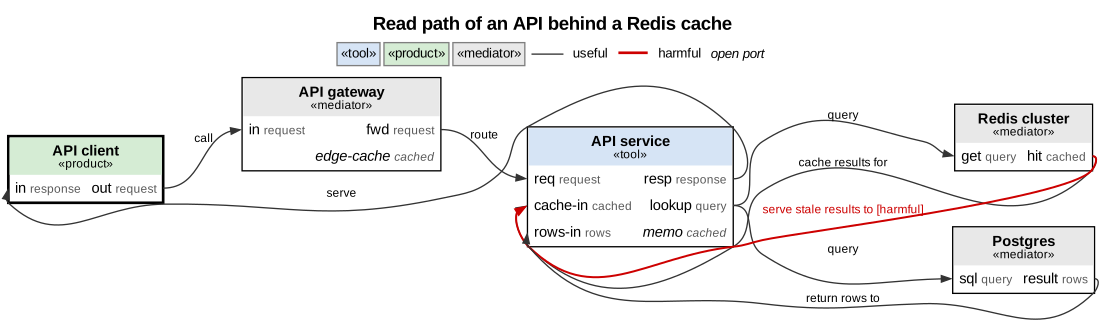
triz_nine_windows builds system-operator views, and triz_export draws a model or encodes it
as an open hypergraph. Format dot draws each box with its «role» and its typed ports, inputs
left and outputs right, rates each function by line style and colour, and adds a legend; render
it with dot -Tsvg. Format mermaid renders as is in GitHub and GitLab markdown and in many
chat clients; Mermaid has no ports, so each edge names its ports and carrier instead.
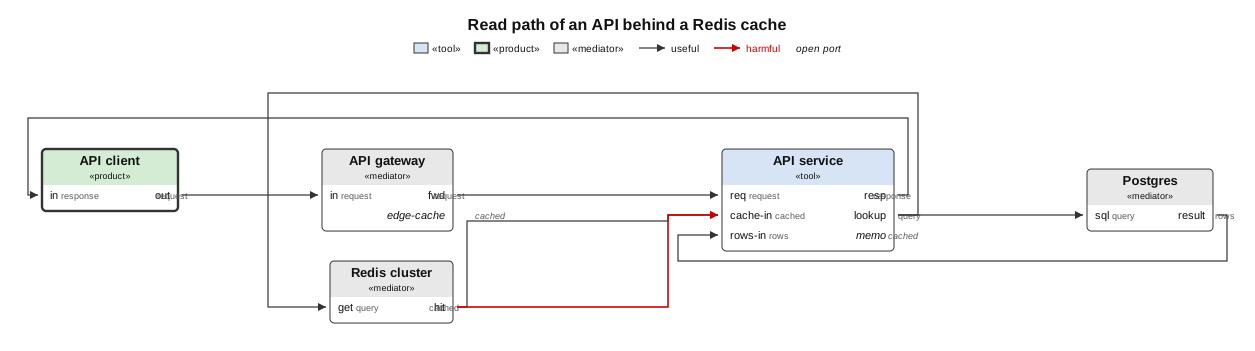
Format svg returns the picture itself, with no Graphviz needed. The server lays the model out
with elkjs: boxes left to right, ports fixed on the box sides,
and orthogonal edges. It then writes a self-contained SVG with the same conventions as dot.
Hover a box or edge to see its id. Text widths are estimated from Helvetica and Arial metrics,
so a much wider font may run past a box. elkjs (about 1.6 MB) is an optional dependency: it is
installed with triz-mcp unless optional dependencies are omitted (--omit=optional), and
without it the format answers ok: false with format-unavailable. The hosted Worker does not
offer the format. elkjs would more than double the script, it does not start on workerd as
published, and a first layout costs more CPU than a Free-plan request allows (see
src/worker.ts).
 Given
compare_to, triz_function_model also reports whether the two
models share a wiring shape. Each verdict names in basis the theorem in theory/ it relies
on; a test checks that every cited name is a theorem there. Nothing is extracted from Lean:
the theorems prove the abstract facts the algorithms rest on, tests check the TypeScript
against them, and the pairing is enforced in CI (lake build --wfail, so no sorry ships).
The theorems also act as design machinery, not just citations: when triz_feasibility says
infeasible, budget_feasible_iff (a budget admits a configuration iff it lies above one of
the minimal resource vectors) is what the returned relaxation block computes — the
nondominated minimal budget raises, each with the row selection that then fits; when candidates
must be compared across resources, lifecycle figures and component counts at once,
triz_pareto returns the joint nondominated frontier with dominance witnesses, and reports
incomparable candidates as trade-offs instead of resolving them (pareto_not_total: the
componentwise order is not total, so a single ranking needs weights the caller chooses).
The structured verdicts of the
checks are label-blind: renaming ids or
changing the domain does not change them. Property tests check this, with the exclusions listed
in the theory map. That shows the kernel reads only the wiring shape, not that solutions
transfer between domains.
docs/theory-map.md states exactly
what is and is not claimed. examples/function-models/ holds a physical, a business, and two
software models. One software model has the physical model's wiring shape. Three copies of
the physical model declare box behaviour, box feasibility, and a shaft temperature, so their
trims can be decided and their heat loop's escalation classified.
Behavior contracts prune incompatible multi-port correlations before enumeration, and resource support witnesses expose their activation order. The mathematical integration map explains the checked foundations for general component synthesis and the remaining adapters. The mixed-system guide includes a runnable hardware, software and service-provider example and explains multidimensional constraints and optimization scope.
theory/ is a Lean 4 / Mathlib package that states and proves the facts the checks rely on,
with no sorry:
- gluing iff every cell is satisfiable;
- an edge in a strongly connected region lies on a cycle;
- the componentwise order is not total;
- typing survives relabelling, deletion under the no-dangling condition, gluing, and re-attachment to a same-carrier port;
- restriction composes, and makes typed diagrams a presheaf on the poset of box sets;
- restriction commutes with every rewrite step restricted to the subsystem, so the subsystem and system rows of the 9 windows, with two steps, form a functor from time × (box sets)ᵒᵖ to sets;
- series composition of relations (Mathlib's
Relation.Comp) is monotone, and the relational trace is monotone and yanks a swap to the identity; - declared behaviour has a compositional steady-state semantics (
theory/Semantics.lean): gluing open diagrams in series, with the interface fully exposed, composes their external relations; a disjoint union gives the product; feedback gives the relational trace; widening a box widens the relation. Diagrams up to their relations form a category with a faithful functor toRelCat.externalBehavioris checked against a brute-force transcription of this semantics on seeded random models and the examples, not extracted from it; - a relation is the product of its projections iff it is a product at all, for two parts and for any family of parts, and for two parts iff it is a rectangle: rows (a, b) and (c, d) give the row (a, d);
- series composition and the trace preserve unions, so for one unknown box the rows that keep a composite inside a target form the weakest specification (a Galois connection), and the target is reachable iff that specification's composite covers it; within the rows the box can produce, iff the specification cut down to them covers it, and a relation that reaches the target holds, for each target pair, a row of the specification that delivers it; for two unknown boxes the maximal safe pairs of relations are the formal concepts of the safe row pairs, and the target is reachable iff one of them covers it;
- concepts are ordered by inclusion of the situations they admit, and a strict inclusion gives a strictly larger count;
- reachability within n steps is an existential over traces, a counterexample trace is sound, a layer that adds nothing completes the reachable set, reachability is monotone in the transition rows, a closed set holds every run that enters it, from a closed set inside the unsafe set every reachable state is unsafe, and without a fixed point every return takes two steps or more;
- series, parallel, and feedback composition keep feasibility monotone, Kleene's ascent reaches the least fixpoint of a finite lattice, and the co-design fixpoint is the upward closure of the feasible configurations.
Verdicts cite only the statements they use exactly; the theory map marks the others as never cited, and why.
theory/Witnesses.lean checks that none of the typing, restriction, rewrite,
behaviour-monotonicity, residual, weakness, co-design, or dynamics lemmas is vacuous. For each, a
concrete diagram, relation, or step relation meets all its hypotheses, and a counterexample shows
each hypothesis is needed. theory/SemanticsWitnesses.lean does the same for the compositional
semantics, except for the part of a diagram (sub): there only the extension hypothesis has a
counterexample, and the interface and locality hypotheses (hI, hO, hloc) have none.
Trimming is decided only for models that declare behaviour, by triz_behavior's finite
relational check, and its verdict depends on the absorber chosen. theory/ does not state
trimming as a Kan extension; the theory map says why.
pnpm schema                       # regenerate the JSON Schema from src/act.ts
pnpm lean:setup                   # theory/.lake/packages: cloned from another checkout, or fetched
(cd theory && lake build --wfail) # the same check Lean CI runs: no `sorry` ships
pnpm lean:setup (scripts/lean-setup.mjs) sets up theory/.lake/packages: Mathlib and the
packages it requires, with the prebuilt oleans of the Mathlib modules the theory imports. When the
directory is missing, it looks for another worktree or the main checkout of this repository
(git worktree list) whose theory/lake-manifest.json and theory/lean-toolchain are
byte-identical, and clones its packages copy-on-write (cp -cpR on macOS APFS, cp -pR --reflink=auto on Linux), so a new worktree downloads nothing and shares the blocks on disk.
Without one, or when an imported module still has no olean, it runs lake exe cache get with the
theory's Mathlib imports, the same list as Lean CI (node scripts/lean-setup.mjs --print-imports). That command is its only network access. It prints what it did; then build.
The TypeScript test suite never runs Lean: it checks the kernel against the theorems by name
(basis) and by property tests, and Lean CI builds theory/ separately with lake build --wfail.
Optional: your own network of problems
triz_graph and triz_purpose reason over a project contradiction graph — they ship with no
data. The graph is an OTSM Network of Problems with a DIKWP purpose layer:
- nodes are open contradictions; edges are
couples,blocks, ordissolves; - the core conflict is the node with the most outgoing
dissolvesedges — resolving it removes the most others (the Theory-of-Constraints step); - a node may carry a
contradictionin the function-model schema's PhysicalContradiction form.triz_graphchecks it and reportsirreducible,separable,no-contradiction, orinvalid; an invalid one fails closed for that node only, with its errors.- Ties on
dissolvesgo first to irreducible nodes, then to unmodelled or invalid nodes, then to separable nodes, and last to nodes that are not contradictions. dissolvesstays the primary key. A node that already separates keeps its place but is flagged, because separation already gives it a resolution route;
- Ties on
- each node's
purposenames the invariant it serves, and counts as secured only when averified_byrecord exists on the node or on a linked registry entry. No verifier, no gate — it fails closed.
examples/problem-graph.json and examples/triz-registry.json show the expected shape:
TRIZ_GRAPH=examples/problem-graph.json \
TRIZ_REGISTRY=examples/triz-registry.json \
npx tsx scripts/graph-report.mjs report.md
Point TRIZ_GRAPH / TRIZ_REGISTRY at your own files, or place them at data/problem-graph.json
and data/triz-registry.json.
Evaluations
skills/triz-innovation/data/ carries three suites:
evals.json— hard lookup assertions (run bypnpm test) plus synthetic reasoning cases;published-case-evals.json— six problems reconstructed from CC BY MATRIZ publications. Solver prompts contain only pre-solution facts; reported diagnoses and outcomes stay in judge-only fields and are never returned bytriz_evals.
Scoring does not require reproducing the published solution — a causally stronger, testable alternative earns full credit.
Running the suites (bring your own key)
The suites ship as data; nothing calls an LLM by default. scripts/run-evals.mjs runs them
against any OpenAI-compatible endpoint and is fail-closed on a key — without
TRIZ_EVAL_API_KEY (or OPENAI_API_KEY) it exits before any network call. CI exercises it in
--dry-run mode only, which is offline and keyless. Results land in evals/results/ (gitignored)
as JSON plus a markdown report:
pnpm evals -- --suite no-recall --limit 40        # matrix-recall citation benchmark
pnpm evals -- --suite reasoning                   # synthetic cross-domain cases, LLM judge
pnpm evals -- --suite published --variant solver  # blinded MATRIZ cases, structured variant
pnpm evals -- --dry-run --suite published         # plan a run: no key, no network
TRIZ_EVAL_BASE_URL and TRIZ_EVAL_MODEL select the endpoint and model (any
OpenAI-compatible API). no-recall is the benchmark that justifies the server: a model asked
for matrix cells from memory is scored against the canonical table, and fabricated citations are
counted. With the server in the loop, the same citations are lookups — fabrication is zero by
construction.
Data provenance and licensing
-
The 39 parameters, 40 principles, and the core tool catalog are classical TRIZ vocabulary; the effects starter database (78 entries, all with conditional typings) contains repository-authored summaries of physics, chemistry and geometry. See the catalogue audit for corrections, additions, references and evidence gaps.
-
Knowledge packs separate universal measurement vocabulary from domain quantities and effects. All installed packs are used by default. Expert contributions add versioned JSON packs with attributed review status;
pnpm knowledgevalidates their union and updates hosted imports. Canonical matrix parameters remain the original 39. -
Eight shared interface families factor 22 named cases into 14 signatures, with 52 direct definitions giving 66 independently declared interfaces while retaining all 78 searchable entries and their case-specific evidence. Four named configurations derive their boundaries from registered multiport models; two explicit forward observations forget qualified current/force types without unit conversion. Serial recipes expand into checked constituent models through
triz_effect_setup; they need no new opaque generator. Raw pack consumers should usecompileKnowledgeto resolve contracts. -
triz_knowledgereports field groups separately from the 69 response and nine mechanism entries; these are modeling roles, not counts of independent physical laws.pnpm example:effects-productschecks selected contracts against a real voice-coil stage and two patent disclosures, preserving discovery and rejecting unsupported decompositions. See the validation scope.pnpm example:effects-recent-patentschecks nine 2025–2026 publications, four added response clauses, further interface sharing, and explicit state/probability limitations. -
Compound/clause assessments identify 15 named functions to retain as compounds, six entries needing separate clause models, and 13 coupled responses to retain. Query them with
triz_effects.assessment; missing facets remain advisory and do not change the 78-entry executable catalogue. -
The classical parameter audit retains every matrix id, clarifies nearby categories and normalizes Force at id 10 with the former wording retained as an alias. Runtime and schema checks protect the closed 1–39 vocabulary.
-
matrix.jsonwas imported from a machine-readable workbook. The underlying table is Altshuller's and widely republished. To regenerate the file from a source of your own choosing:npx tsx scripts/import-matrix.mjs <url|file.csv|file.json> [--format csv|json] -
Published case benchmarks are concise attributed paraphrases of CC BY publications; sources, authors, and pages are recorded per case in
published-case-evals.json. -
The code in this repository is MIT licensed (
LICENSE). That license covers the code and the original prose, not third-party data noted above.
Roadmap
The engine roadmap owns priorities and workstream status. Assurance requirements owns acceptance cases; the joint engineering synthesis design develops architecture, sizing and maintenance optimization. See the documentation index for current tool guides and research notes.
Publishing and distribution
The full runbook — npm release flow, the MCP Registry PR, Smithery/Glama/PulseMCP, skill registries (skills.sh, anthropics/skills, OpenAI), and promotion — lives in docs/PUBLISHING.md.
Registries
MCP Registry. server.json holds the prepared entry (name
io.github.sv/triz) for the official registry at
registry.modelcontextprotocol.io. Listing goes
through the official mcp-publisher CLI — not a PR: publish the npm package first (the registry
verifies the mcpName field inside the published package.json), then
mcp-publisher login github (device flow) and mcp-publisher publish. Full steps in
docs/PUBLISHING.md.
Documentation truncated — see the full README on GitHub.
Reviews
No reviews yet
Be the first to review this server!
More Developer Tools MCP Servers
Rea
Freeby Morluto · Developer Tools
Reverse engineer anything from your terminal or agent with one CLI and MCP server.
Paperclip
Freeby Paperclipai · Developer Tools
Trending hip-hop artist momentum scores across four cultural dimensions.
Toleno
Freeby Toleno · Developer Tools
Toleno Network MCP Server — Manage your Toleno mining account with Claude AI using natural language.
MCP Marketplace
Freeby mcp-marketplace · Developer Tools
Search and install MCP servers from inside your AI client.
mcp-creator-python
Freeby mcp-marketplace · Developer Tools
Create, build, and publish Python MCP servers to PyPI — conversationally.
by Lharries · Communication
Read, search, and send WhatsApp messages through your AI assistant